Home Blog Page 6603

The iconic book on Makati: Fifty Years and Forward

“The rapid, well-ordered growth of Makati didn’t happen by chance. One thing has to be made clear: The process that caused this change was long and complicated. It had to be planned… It was created.”

— Colonel Joseph R. McMicking

“It has been interesting to follow through the unique role that the leaders of Ayala played in the evolution of the Makati Central Business District, from concept, to planning, and ultimately, to execution,” revealed Fernando Zóbel de Ayala, chairman of Ayala Land, president and CEO of Ayala Corp., in the newly launched book on the development of Makati, Fifty Years and Forward.

This stunningly beautiful book will take the reader on an extraordinary journey that Col. McMicking once called “The Makati Adventure.” It is the first book on the making of the Makati Central Business District (CBD), that golden quadrant through which Ayala Avenue runs. It has defined the entire city.

“Col. Joseph McMicking played a very distinctive role in the visioning of Makati with the close support and help of Alfonso Zobel de Ayala and Col. Jaime C. Velasquez. Much of the execution of this plan followed under the leadership of Enrique Zóbel and subsequently, Jaime Zóbel de Ayala, laying down the strong foundations of the Makati that we see today.

“Along the way, while the key principles of the original masterplan were maintained, certain elements were adjusted, all in the hope of ensuring that the development was as relevant and responsive to the needs of the times,” he explained.

“Today, as this responsibility moved to our generation of managers, we once again had to evolve Makati to keep it as dynamic and meaningful to present and future Filipinos; Throughout this process, MACEA (Makati Central Estate Association) continues to be a key partner as the association that represents the diverse community within this district. We work hand in hand though MACEA and with all our stakeholders to achieve these goals and preserve Makati’s status as the country’s premier city.”

He described Col. McMicking as “A true visionary… a bold and pioneering spirit.”

Architect William V. Coscolluela, chairman and president of MACEA, wrote in the preface of the book: “MACEA’s primary purposes were two-fold: ‘To promote the general welfare, prosperity, service, and reputation of the Ayala Avenue-Paseo de Roxas Administrative Office Area. To promote the best interest and well-being as well as safeguard the welfare of the owners, lessees and occupants of property’ in the area.”

The original incorporators of MACEA were Col. Jaime C. Velasquez, Salvador J. Lorayes, Silvio M. Barcelon, Ramon T. Garcia, and Jose Ma. Enriquez. In 1953, the Association had 39 landowner-members. In 2021, there are more than 390 members.

MACEA has quietly but effectively shepherded the area’s trajectory as the nation’s business — and political — nerve-center to the high-rise residences that set the pace for the country’s condos, to the 21st century “city within cities” combining creative communities and transport hubs and information highways.

In the book’s epilogue, Jaime Zóbel de Ayala, chairman emeritus of Ayala Corp., wrote: “Anticipation of the future is based of the past — and on the present. The elements of yesterday serve as the foundation of today and influence the direction of tomorrow.”

The book’s author, Lisa Guerrero Nakpil, navigated the research and production. She described the process, “The terrific thing is that the ‘Master Plan’ that created Makati also provided for the establishment of an archive, a repository of information. At the same time those fabulous buildings on Ayala Avenue were going up in the 1960s, Col. McMicking and his wife Mercedes Zóbel set up the Filipinas Foundation which would eventually become Ayala Foundation, which in turn created Ayala Museum and the Filipinas Heritage Library which are all wonderful sources of data.

“Among all the things that were envisioned by the planners — Col. McMicking, Don Alfonso Zóbel de Ayala, Col. Jaime C. Velasquez — the importance given to culture was never taken for granted. That attitude informs the business and investment of the CBD.

“MACEA chairman and president William Coscolluela gave the book an architect’s perspective and one can see this in the text and visuals. Fernando Zóbel de Ayala provided the context for the direction of the book. He parsed the essence of the Makati CBD and its different moving parts.

“It was important to Arch. Coscolluela to chart the develop as a connected, walkable, weather-proof city — think of the underpasses and elevated walkways — but also a secure district that is safe 24/7 in tune with today’s work and lifestyles.

“The MACEA board was also active in sharing its inputs and that was a big help. And in keeping with MACEA tradition, the book is intended for a worthy cause: To help Makati’s poorest with coping with the pandemic.”

The Ayala archives had two exceptional and precious vintage photographs by Nap Jamir. They were traced back to his son who is an excellent photographer in his own right.

“Nap Jr. was putting together an archive of his father’s work and was rehabilitating the negatives. It took several months — almost as long as the book production itself to get them back into shape.”

Well-known photographers were reeled in by Ms. Nakpil. Wig Tysmans, an architecture graduate, found it a different challenge. “The cover of the book, for example, involved lying on his back between the structures of the new Tower two (in the Ayala Triangle Gardens) to get just the right angle.

“I was a little merciless with him because this was at the height of the Delta virus, and he had to shoot without his usual retinue. If the photographs have the feel of Vanilla Sky (the surreal movie that featured empty streets), it’s because it was a surreal time. Mr. Tysmans had a talented fellow, Paul Quiambao, who operated the drones. We crashed a couple of those in the process because there’s apparently a lot of jammers in the CBD. We also recruited Patrick Diokno who is the creative director of L’Officiel [for the] atmospheric shots,” Ms. Nakpil recalled.

The timeline of Makati from1834 through the decades until 2021 makes one feel nostalgic. The vintage photos of the Master Plan; The Nielsen Tower and airfield (1937) on Makati Ave.; the early Makati buildings like the Rizal Theater (1960), Hotel Inter-Continental (1969), the Asian Institute of Management, and the first skyscraper, The Insular Life Building (1962), that still stands at the iconic crossroads of Ayala Ave. and Paseo de Roxas.

The book’s impressive visuals include photos of geometric patterns — close and long shots of the shimmering steel and glass skyscrapers — the magnificent Ayala Triangle Gardens Tower Two, the multi-awarded Zuellig Building with its unique bamboo design on the glass windows. There are the murals on the ceilings and walls of a driveway and the underpasses; aerial shots of the towers and rooftops with floral designs including that of the Makati Medical Center (1969).

The verdant lungs of the city are the Jaime C. Velasquez Park in Salcedo Village and the Zen-inspired Washington Sycip Park in Legazpi Village.

A chapter “The Capital of Art” is dedicated to the precious collections located everywhere in the area. These include the excavated pieces of the exquisite pre-Spanish gold collection and the abstract paintings, including the legendary black and white Icaro (1958) by the internationally acclaimed artist Fernando Zóbel, at the gleaming new Ayala Museum. This painting was exhibited at the Venice Biennale 2017.

The Exchange Plaza has the Philippine marble sculpture by Impy Pilapil and the epic black and white artworks by National Artist Arturo Luz. A dramatic brass sculpture by Eduardo Castrillo is at the MetroBank plaza. A painting of National Artist Juan Luna is at the RCBC Plaza’s Yuchengco Museum. The Mauro “Malang” Santos Barrio Fiesta mural is at the Makati Building.

The fabulous annual Art Fair (2017) held at the Link carpark has featured the intriguing installation Settlement by Mark Justiniani and the landmark contemporary mural collaboration Tagadagat by Elmer Borlongan and Manny Garibay.

Ms. Nakpil’s flowing historical essays complement the marvelous visuals of the book. It is “must-have” for the collections of businessmen, lovers of art, architecture, culture and history, and schools and institutions.

Warm congratulations to Ayala Corp., Ayala Land, and publisher MACEA for the launch of Fifty Years and Forward

(The book is available by e-mailing fiftyyearsandforward@gmail.com)


Maria Victoria Rufino is an artist, writer and businesswoman. She is president and executive producer of Maverick Productions.

mavrufino@gmail.com

What is a woman?

PIKISUPERSTAR-FREEPIK

“Woman, I can hardly express…,” so sang John Lennon.

Unfortunately, nowadays, not many people apparently can even express what a “woman” is. Not even US Supreme Court nominees. And if USA Today is to be believed, not even members of the medical profession. Which is disconcerting because the latter were also the same ones telling us to be completely terrified of COVID and inject ourselves continually with vaccines. But that’s another matter.

If indeed there is no way, as liberal progressives insist, to coherently define what a woman is, then:

• chivalry is not a thing;

• the women and children first rule should be set aside;

• separate sports divisions and separate toilets have no rationale;

• sex based criminal laws protecting women should be repealed;

• women’s rights legislation should be repealed;

• treaties involving women’s rights should be terminated;

• gender equality studies should be shut down; and,

• Women’s Month is non-sensical.

But until this year, everybody knew what a woman is. Cambridge Dictionary defines “woman” as “an adult female human being” or “a wife or female sexual partner.” The Collins Dictionary says that a “woman” is “an adult female human being.” Wiki: “A woman is an adult female human.” And what is a “female”? That “sex that can give birth to young or produce eggs” (Cambridge Dictionary), “produce babies from its body” (Collins Dictionary), or “the sex of an organism that produces the large non-motile ova (egg cells), the type of gamete (sex cell) that fuses with the male gamete during sexual reproduction” (Wiki).

Liberal progressives however try to confuse the issue by making a false distinction between “sex” and “gender,” the former (they say) are physical characteristics including genitalia and chromosomes while the latter is how a person identifies.

The problem with that subjective approach is ultimately it doesn’t make sense; taken to its logical conclusion, the words “man” and “woman” would have no meaning whatsoever. And if indeed being a woman is just a “construct,” then it still begs the question of what that person identifying as a “woman” actually means, that identification (by the way) being also obviously a construct.

Sex and gender clearly cannot be separated from each other. Glenn Stanton, Focus on the Family director of family formation studies, writes (“Why Sex and Gender Are Not Two Different Things,” The Federalist, Oct. 15, 2019): “From the 14th century, gender has referred to the essence of what male and female are, issuing from the Proto-Indo-European root gen- or gene-. It fundamentally references the creation, birth, and begetting of new human beings, as in, to generate or engender.”

Furthermore, “gender’s grammatical root — gene/gen — is also associated with such words as genesis, generation (both in terms of being generated as well as the historical time-frame one was generated) and yes, of course, genitals, those two unavoidably binary parts of the human anatomy that help our gonads and associated cooperative parts do what gonads do: generate.”

Thus, “gender” is actually “the furthest thing from being a mere social construct,” the words “‘sex’ and ‘gender’ are indeed two objective sides of the same coin. Anyone who says differently is just making stuff up.”

Indeed, what makes a woman a woman (and a man a man) run to the very core of our DNA, the fundamental molecule containing genetic instructions of our physical being. A chain of DNA is called a “chromosome.” Women have two similar X chromosomes. Men, on the other hand, have one X and one Y chromosome.

And what makes a woman a woman continue to the very wiring of women’s brains — “Women excel in several measures of verbal ability — pretty much all of them, except for verbal analogies. Women’s reading comprehension and writing ability consistently exceed that of men, on average. They outperform men in tests of fine-motor coordination and perceptual speed. They’re more adept at retrieving information from long-term memory.

“Men, on average, can more easily juggle items in working memory. They have superior visuospatial skills: They’re better at visualizing what happens when a complicated two- or three-dimensional shape is rotated in space, at correctly determining angles from the horizontal, at tracking moving objects and at aiming projectiles.” (“Two minds: The cognitive differences between men and women,” Stanford Medicine, 2017).

The characteristics that make up a woman are so profound that some scientists even claim that men are more closely related to male chimpanzees than to women! (https://bit.ly/36AmNPv and here https://bit.ly/3Lrgpsr.)

Wisely, our own Supreme Court so far has refused to buckle down to progressive nonsense. In Silverio vs. Republic (G.R. No. 174689), it ruled — quite correctly — that “the sex of a person is determined at birth” and is “immutable.” Thus, “sex is defined as ‘the sum of peculiarities of structure and function that distinguish a male from a female’ or ‘the distinction between male and female.’ Female is ‘the sex that produces ova or bears young’ and male is ‘the sex that has organs to produce spermatozoa for fertilizing ova.’”

Besides, it would be a quite disturbing world if John Lennon (“Woman”), Billy Joel (“She’s Always A Woman”), Urge Overkill (“Girl, You’ll Be a Woman Soon”), and Roy Orbison (“Pretty Woman”) all don’t know what they’re singing about.


Jemy Gatdula is a senior fellow of the Philippine Council for Foreign Relations and a Philippine Judicial Academy law lecturer for constitutional philosophy and jurisprudence

https://www.facebook.com/jigatdula/

Twitter@jemygatdula

US weighs largest ever draw from emergency oil reserve

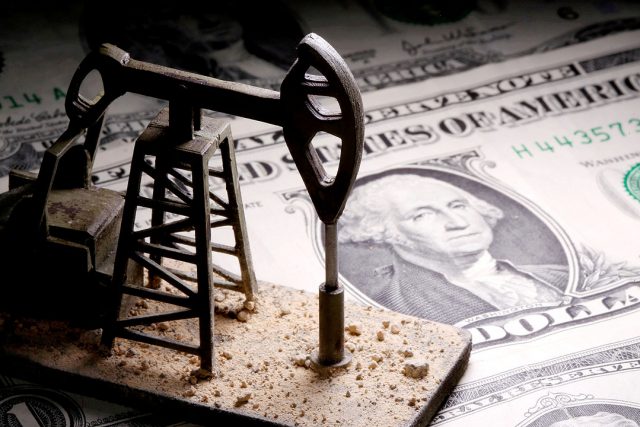
A 3D printed oil pump jack is placed on dollar banknotes in this illustration picture, April 14, 2020. — REUTERS/DADO RUVIC/ILLUSTRATION/FILE PHOTO

WASHINGTON — The Biden administration is considering releasing up to 180 million barrels of oil over several months from the Strategic Petroleum Reserve (SPR), four US sources said on Wednesday, as the White House tries to lower fuel prices.

The International Energy Agency (IEA) member countries are set to meet on Friday at 1200 GMT to decide on a collective oil release, a spokesperson for New Zealand energy minister said in an email on Thursday.

“The amount of the potential collective release has not been decided,” the spokesperson for minister Megan Woods added. “That meeting will set a total volume, and per country allocations will follow,” she said.

It is unclear if the US SPR draw would be part of a wider global coordinated release.

The IEA did not respond to a request for comment outside office hours. President Joseph R. Biden will deliver remarks on Thursday on his administration’s actions, the White House said.

The latest amount of U.S. oil release being considered, which is equivalent to about two days of global demand, would mark the third time the United States has tapped its strategic reserves in the past six months, and would be the largest release in the near 50-year history of the SPR.

Global oil prices plunged more than $5 a barrel on the news.

Oil prices have surged since Russia invaded Ukraine in late February and the United States and allies responded with hefty sanctions on Russia, the second-largest exporter of crude.

Brent crude, the world benchmark, soared to about $139 earlier this month, highest since 2008, but slipped under $108 a barrel in Asian trading on Thursday.

Russia is one of the top producers of oil, contributing about 10% to the global market. But sanctions and buyer reluctance to purchase Russian oil could remove about 3 million barrels per day (bpd) of Russian oil from the market starting in April, the IEA has said. Russia exports 4 to 5 million bpd.

The news comes just before the Organization of the Petroleum Exporting Countries and its allies, an oil producer group known as OPEC+ that includes Saudi Arabia and Russia, meets to discuss reducing supply curbs. The United States, Britain and others have previously urged OPEC+ to quickly boost output.

However, OPEC+ is not expected to veer from its plan to keep boosting output gradually when it meets Thursday.

The US SPR currently holds 568.3 million barrels, its lowest since May 2002, according to the US Energy Department.

The United States is considered a net petroleum exporter by the IEA. But that status could change to net importer this year and then return to exporter again as output has been slow to recover from the COVID-19 pandemic.

It was not immediately clear whether a 180 million barrel draw would consist of exchanges from the reserve that would have to be replaced by oil companies at a later date, outright sales, or a combination of the two.

The White House did not comment on the plan to release oil.

“The immediate need is to fill the gap in the real economy, and releasing barrels from the SPR will alleviate that problem although it is effectively transferring the shortage from one pocket to the other,” said Howie Lee, an economist at Singapore’s OCBC bank.

POLITICAL LIABILITY FOR BIDEN
The White House said Mr. Biden will deliver remarks at 1:30 p.m. ET (1730 GMT) on “his administration’s actions to reduce the impact of Putin’s price hike on energy prices and lower gas prices at the pump for American families.”

It did not give additional details.

High gasoline prices are a political liability for Biden and his Democratic Party as they seek to retain control of Congress in November elections.

Given that the United States is taking a “muscular stance toward Moscow, promising more sanctions if Russia continues to wage war in Ukraine, we believe the SPR release is being used as a tool to blunt the impact of these foreign policy decisions for US consumers,” RBC Capital said in a note to clients.

U.S. Energy Secretary Jennifer Granholm said last week that the United States and its allies in the IEA were discussing a further coordinated release from storage.

IEA member states agreed earlier in March to release over 60 million barrels of oil reserves, with 30 million barrels coming from the US SPR.

The Biden administration is also considering temporarily removing curbs on summer sales of higher-ethanol gasoline blends as a way to lower fuel costs for US consumers, three sources familiar with the matter told Reuters.

Adding more ethanol to gasoline blends could potentially reduce prices at US gas pumps because ethanol, which is made from corn, is currently cheaper than straight gasoline. — Reuters

Russia sanctions threaten to chip away at dollar dominance — IMF official

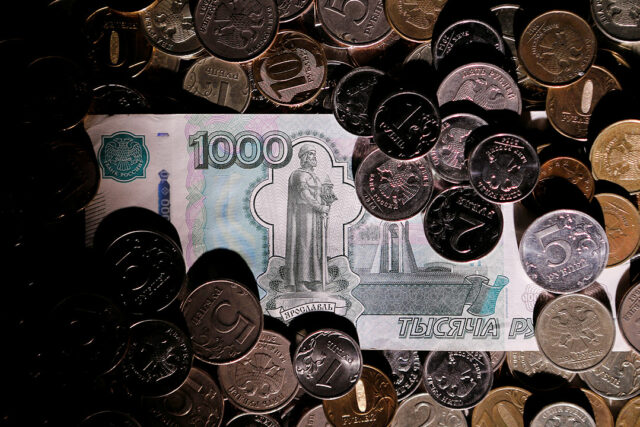
RUSSIAN rouble coins and a 1,000-rouble banknote are seen in this picture illustration taken June 7, 2016. — REUTERS

FINANCIAL SANCTIONS imposed on Russia threaten to gradually dilute the dominance of the US dollar and could result in a more fragmented international monetary system, Gita Gopinath, IMF’s First Deputy Managing Director, told The Financial Times.

Russia has been hit with a plethora of sanctions from the United States and its allies for its late-February invasion of Ukraine. Russia has called the invasion a ‘special operation’ to disarm its neighbor.

“The dollar would remain the major global currency even in that landscape but fragmentation at a smaller level is certainly quite possible,” Ms. Gopinath told the newspaper in an interview, adding that some countries are already renegotiating the currency in which they get paid for trade.

She said that the war will also spur the adoption of digital finance, from cryptocurrencies to stable coins and central bank digital currencies.

The IMF did not immediately respond to a Reuters request for comment.

Ms. Gopinath told the FT that the greater use of other currencies in global trade would lead to further diversification of the reserve assets held by national central banks.

She had earlier said the sanctions against Russia do not foreshadow the demise of the dollar as the reserve currency and that the war in Ukraine will slow global economic growth but will not cause a global recession. — Reuters

Fuel hikes anger food delivery drivers and truckers across Asia

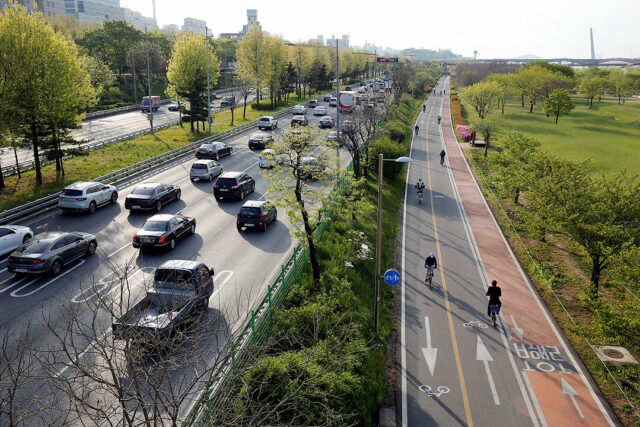
VEHICLES are seen on the road in Seoul, South Korea on April 27, 2020. — REUTERS

SKY-HIGH fuel prices are sparking waves of anger and frustration throughout the ranks of truckers and food delivery drivers in Asia, causing concerns over potential disruptions that could add to supply-chain risks.

South Korea’s average diesel price last week jumped 44% from a year earlier to the highest since 2008, while gasoline surged more than 30%, according to data from Korea National Oil Corp. The fuel costs are rising at a time when freight rates and delivery fees have remained unchanged, directly impacting workers’ wages, union groups that represent the drivers said.

“The spike in petrol prices is a huge burden on us,” Gu Gyo-hyeon, a director at Rider Union, which represents 1,000 food delivery drivers in South Korea, said by phone. “Unlike other industries, we get zero subsidies from the government, which makes it even harder for us to maintain our jobs.”

Surging energy costs have been adding inflationary pressure across the globe, affecting everything from Uber rides to children’s toys as oil underpins essential aspects of the economy like shipping and manufacturing. Japan has maximized the subsidy provided to oil refiners, and Pakistan is risking its $6 billion bailout program with the International Monetary Fund by cutting fuel prices and pledging not to increase them until at least June.

In response to the growing pressure, ride-hailing companies and other transportation providers are taking action. In the US, Lyft, Inc. and rival Uber Technology Inc. added surcharges this month to rides to help drivers, while Grab Holdings, Inc. was among several companies in Singapore making similar moves to ease drivers’ gas bills. In Tokyo, taxi drivers are seeking their first fare hike in 15 years.

Pump prices for diesel in New Delhi have increased 6.5% after a freeze of more than four months ended on March 22, sparking a protest from opposition lawmakers in India’s parliament. The spike is destroying the road transport sector, as diesel accounts for about 70% of operating costs, according to Kultaran Singh Atwal, president of the All India Motor Transport Congress, which represents about 10 million truck and bus operators.

Operators of cargo trucks in South Korea that weigh 25 tons had to pay about 2.5 million won ($2,070) more on average for diesel in March compared with a year earlier, according to the Cargo Truckers Solidarity, which is affiliated with the Korean Public Service and Transportation Workers’ Union. Food delivery drivers are paying about 50,000 won more to fill up their gas tanks each month, Gu said.   

South Korea has extended a reduction in fuel taxes for another three months through July to rein in inflation. Still, workers from the food delivery and trucking sectors, services that became even more crucial during the Covid-19 pandemic, are seeking additional government support to offset the soaring fuel prices, the union groups said.

“The skyrocketing diesel prices are leading us to suffer from greater losses if we continue to stay on the road,” Lee Bong-ju, president of the Cargo Truckers Solidarity, said at a briefing last week. “But we have to bite the bullet and continue working over fears that we may lose our work contracts.” — Bloomberg

S. Koreans flock overseas for ‘revenge travel’ as COVID rules ease

STOCK IMAGE VIA KOREANAIR.COM

SEOUL — After spending two years being socially distanced in his home country of South Korea, Kim Hoe-jun booked a last-minute flight to Hawaii, where he had enjoyed his honeymoon six years ago, giving in to his craving for overseas travel. 

“I bought the ticket just a week ago, but it was rather a no-brainer. It felt like I was making up for those two years not being able to go abroad often as I used to before COVID,” he said, before boarding the plane from Incheon International Airport on Friday. 

Vaccinated and boosted, Mr. Kim and his wife are among South Koreans joining in a rush for “revenge travel” — a term that has been trending on social media as people scramble to book overseas trips that were delayed by coronavirus restrictions. 

The boom started after March 21 when South Korea lifted a seven-day mandatory quarantine for fully vaccinated travelers arriving from most countries. The restriction had been eased last year but was reimposed in December as the highly infectious Omicron variant spread. 

The country has largely scrapped its once-aggressive tracing and containment efforts despite a record coronavirus disease 2019 (COVID-19) wave, joining a growing list of Asian countries which have eased quarantine rules, including Singapore, Japan, Australia and New Zealand. 

Koreans now appear more ready to travel. Polls showed people are less worried about the implications of catching the virus, and increasingly see its prevention as out of their hands. 

Sales of overseas flight tickets on 11st, an e-commerce unit of SK Telecom Co Ltd, South Korea’s top mobile carrier, rose more than eight-fold compared with a year before between March 11, when the lifting of quarantine was announced, and March 27, the company said. 

Kim Na-yeon, 27, was excited to return to Hawaii where she used to live. 

“I couldn’t dare to travel even in Korea because of COVID,” she said. “But now I feel a bit freer with the exemption, so I’ve decided to go meet old friends and do some sightseeing.” 

EXPLODING DEMAND
Airlines and travel agencies have reported exploding demand for routes to Hawaii, Saipan, and Guam, as well as some destinations in Europe and Southeast Asia where tourists submitting a vaccination certificate or negative test result are exempted from quarantine. 

Saipan and Guam, both of which have travel bubble pacts with South Korea, also offer free COVID testing and pay for quarantine expenses if a traveler tests positive. Each South Korean national visiting Saipan even receives $100 in “travel bucks” incentives to spend at businesses there. 

The tour arm of online retail giant Interpark Corp. reported a 324% growth in flight bookings for Oceania between March 11–22 from the same period of 2021, a 268% increase for Southeast Asia and 262% more bookings for Europe. 

On Sunday, the company sold a record 5,200 Hawaii tour packages within just 70 minutes. CJ Corp.’s home shopping unit said it received some 2,800 orders for a Spain and Italy trip in one hour on Sunday, totaling 15 billion won ($12.41 million), days after garnering 9 billion won from its sales of a Hawaii package. 

“The surge reflects growing customer sentiment that an end of COVID travel curbs might be in the offing after the mandatory quarantine was lifted,” said Lee Jeong-pil, general manager of CJ’s home shopping unit. 

Lee Tae-woo, a 36-year-old frequent traveler to Japan, said he has changed some money into yen, taking advantage of the currency’s sharp decline and hoping to jump on the revenge travel bandwagon soon. 

Though Japan has yet to allow tourists back in, it has reduced the quarantine period for arrivals for business and other purposes to three days from seven this month, and signaled further easing of travel curbs. 

“It’s been a long wait, and I’m ready to go back as soon as they finally open up again, and visit my favorite coffee roastery and enjoy the night view from Shibuya station,” Mr. Lee said, referring to Tokyo’s bustling central district. — Hyonhee Shin and Yeni Seo /Reuters

Australian businesses commit to $38B new UK investment, Britain says

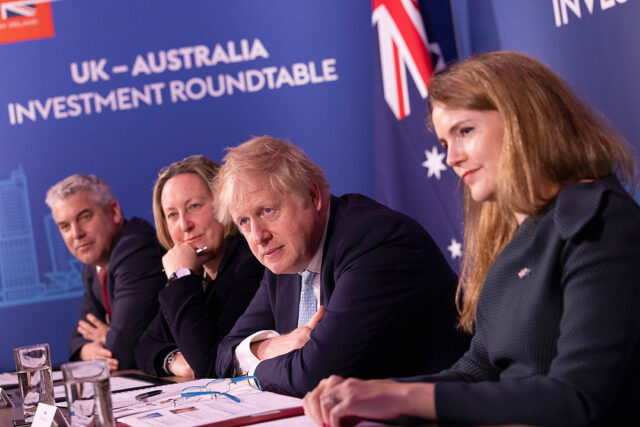
UK Prime Minister Boris Johnson (third from left) hosts an Australia Investment Announcement Roundtable in 10 Downing Street. Picture by Simon Dawson/No. 10 Downing Street/Flickr

LONDON — Australian businesses have committed to investing 28.5 billion pounds ($37.5 billion) in sectors such as infrastructure and clean energy in Britain, the British government said following a UK-Australia investment roundtable. 

British Prime Minister Boris Johnson and International Trade Secretary Anne-Marie Trevelyan met with 10 Australian chief executives and senior executives on Wednesday evening to discuss the investments and opportunities for further collaboration. 

The investments include a pledge by financial services firm Macquarie Group to support 12 billion pounds of investment by 2030 in infrastructure projects including offshore wind, gigabit broadband and hydrogen hubs, the government said. 

It said this would include Macquarie’s Green Investment Group founding a new UK-headquartered global offshore wind development business Corio, and developing two new British offshore wind sites over the next decade. 

Other investments include 5.5 billion pounds from real estate and investment group Lendlease and its partners over the next five years to deliver new low carbon homes as part of major regeneration projects in London and Birmingham. 

IFM Investors plan to deliver 3 billion in investment over five years to maintain existing assets such as Stansted and East Midlands airports, and create a new net zero fund to support large-scale infrastructure energy transition projects. 

The government also said pension fund AustralianSuper forecasted a further 8 billion pounds in investments across the UK over the next five years. 

Last month AustralianSuper’s head of international investments told the Financial Times newspaper the fund expected to more than double its UK assets from 7 billion to more than 15 billion by 2026. 

Britain and Australia signed a free trade deal in December projected to eventually boost bilateral trade by over 10 billion pounds. 

Total goods and services trade between Britain and Australia was worth 14.5 billion pounds in the year to June 2021, with Australia ranked Britain’s 21st-largest trade partner and accounting for 1.2% of total British trade. — Reuters

Sanctioned or not, Russians abroad find their money is ‘toxic’

PAUKRUS/CC BY-SA 2.0/Wikimedia Commons

LONDON/ZURICH/NEW YORK — Yevgeny Chichvarkin, a telecoms tycoon who fled Russia in 2008 and became a high-profile London restaurateur, has long been a vocal supporter of Ukraine. 

Together with partner Tatiana Fokina, the multimillionaire says he has sent four truckloads of medical and protective equipment to Poland to help Ukrainians since the Russian invasion on Feb. 24. 

Mr. Chichvarkin, a burly man with a waxed mustache, said he drove the first load himself. 

But the 48-year-old entrepreneur, a long-time critic of Russian President Vladimir Putin, said he has just unexpectedly had one of his Swiss bank accounts frozen. He declined to say by which bank. 

Mr. Chichvarkin is one of a growing number of Russians living abroad who are finding issues accessing their money, even when they are not the direct targets of Western sanctions. 

Reuters interviews with nine Russians living overseas — as well as their wealth managers, lawyers, tax advisers, real estate and art brokers — suggest that Western sanctions meant to punish Putin’s inner circle are also broadly ensnaring Russian passport holders. 

Four Russians living overseas with dual citizenship described banks freezing their accounts or payments in London, Zurich and Paris. One wealthy émigré in London said he had switched to cash to make purchases and was keeping a low profile. 

Two wealth advisors and a lawyer described applications for bank accounts by Russian clients being rejected. Banks said they were taking extra precautions with Russian money. And three brokers said some real estate and art deals had stalled. 

A Canadian-American lawyer said his Russian clients were afraid to take international trips for fear of being stopped at customs as Western banks cast a wide blanket of suspicion on Russian money — even donations to charities. Dual passports no longer provide escape routes as they once did. 

“I am dealing with Russians who can’t get out of hotels, students who have no money because credit cards are valueless,” said Bob Amsterdam, a founding partner of Washington- and London-based law firm Amsterdam & Partners. 

“Banks … are refusing Russians bank accounts: they are closing their doors to Russians on nationality,” said Mr. Amsterdam, who is based in London. “Leading law firms in the City have closed their doors to Russians in terms of nationality.” 

‘YOU NEED TO BE VERY QUIET’
Several lawyers representing wealthy Russians in Europe spoke about a pervasive climate of distrust. One tax and wealth planning expert, who asked not to be named due to a climate that she said penalized association with Russia, said that Russians were being scrutinized regardless of their place of residence or wealth. 

“Currently, everything that is Russian is toxic, which means that everyone is trying to be extremely, extremely careful in terms of what to do with Russian clients,” said the lawyer, a dual Russian and British citizen, who runs a law firm in Zurich. 

Journalist Elena Servettaz, a dual citizen who has lived in France since 2005, said French bank Crédit Mutuel rejected a transfer of less than 1,000 euros to her account — money sent to her from London to support Ukrainian refugee aid efforts. 

When Ms. Servettaz called the bank, she was told the transaction had been flagged due to her Russian nationality. Ms. Servettaz received the money more than a week later. 

“It’s so unfair when you are part of the Russian opposition, you’re helping Ukrainian refugees, and they’re saying you’re Russian so you can’t have your money,” Ms. Servettaz said. 

Crédit Mutuel said that European banks were obliged to apply “the greatest prudence” in scrutinizing transactions that could be affected by E.U. sanctions, and that additional checks required to ensure compliance could lead to delays, though it was doing its best to limit the effects on customers. 

A Crédit Mutuel spokesperson said in an emailed statement that the situation relating to Ms. Servettaz “was quickly resolved once the customer sent us the requested information.” 

Reuters reported this month that European Union regulators have told some banks to scrutinize transactions by all Russian and Belarusian clients, including EU residents. 

Some wealth managers in Europe have sought to distance themselves from economic and political fallout. Switzerland’s Julius Baer this month began blocking new business with Russian clients, two sources familiar with the operations said. UBS CEO Ralph Hamers said all Russian passport holders have effectively become semi-sanctioned. 

Julius Baer said it was not accepting new Russian clients with a Russian domicile but continued to serve existing Russian clients “in compliance with all applicable laws, regulations or sanctions.” 

Russian writer Grigory Chkhartishvili, who lives in London and whose last name is Georgian, successfully transferred a sum of money through British bank Barclays to support his Ukrainian refugee assistance charity, True Russia. 

But his wife, whose last name is Russian, was blocked by Barclays when attempting to send money to the same charity, he said. The bank requested a face-to-face interview with her. 

“My sum was ten times bigger, but it was no problem,” Mr. Chkhartishvili said. “It shows the atmosphere.” 

Mr. Chkhartishvili said his wife, who declined to be interviewed by Reuters and asked for her name not to be made public, had told him she was able to transfer the money the next day after she called the bank and explained that she was helping Ukrainian refugees. 

Barclays did not respond to a request for comment. 

A wealthy Russian oil and banking magnate, who asked not to be identified so he could speak freely about his financial situation, said he felt he had become “collateral damage” from Russia’s invasion — which Moscow calls a “special operation.” 

Based in London for three decades, he said he still had businesses in Russia and was anxious about greater financial restrictions, despite not being on a sanctions list. 

“I have some savings,” he said, adding he was considering selling European assets. “You need to live out of cash … You need to be very quiet.” 

‘RUSSOPHOBIA’
In the basement of one of his newest ventures, The White Horse pub in London’s upmarket Mayfair district, Mr. Chichvarkin says he is confident his lawyers will be able to unfreeze his Swiss bank account. 

It is the only account of his that has been frozen, he said. He believes that is because it is the only one he opened with a Russian passport. 

At the same time, Mr. Chichvarkin believes his and his partner’s opposition to Mr. Putin and the war, as well as their vocal support for Ukraine, has helped protect their businesses from anti-Russian hostility by customers and the public, stirred by what Ms. Fokina calls “Putin’s war”. 

Still, their Michelin-starred restaurant Hide — which they own alongside wine boutique Hedonism Wines, where a bottle can cost 124,000 pounds ($163,500) — received a one-star Google review about two weeks into the war, Ms. Fokina’s assistant said. 

The rare poor review, among 1,767 others that give the restaurant an average 4.5-star rating, said simply: “Russian owned.” It has since been removed. 

“You read about people canceling Tchaikovsky concerts, people vandalizing Russian food shops,” said Ms. Fokina. “This is London 2022. How did we get here so quickly?” — Kirstin Ridley, Brenna Hughes Neghaiwi and Danielle Kaye/Reuters

Intel CEO earned 1,711 times more than average company worker in 2021

Intel Corp. Chief Executive Officer (CEO) Pat Gelsinger. — IMAGE VIA INTEL CORP.

Intel Corp. Chief Executive Officer (CEO) Pat Gelsinger earned 1,711 times as much as the average worker at the US chipmaker in just 11 months since he joined in February last year, a regulatory filing showed on Wednesday.

Compared to Mr. Gelsinger, former CEO Bob Swan had earned 217 times more than the average Intel employee in 2020.

Mr. Gelsinger earned $178.6 million in 2021 with stock awards making up nearly 79% of his total compensation, which was about 698% higher than Mr. Swan’s 2020 pay.

Executive pay has been rising in the United States. Apple Inc. CEO Tim Cook earned 1,447 times the average employee’s salary at the tech giant in 2021. Shareholders of Apple approved the pay package despite proxy advisory firm Institutional Shareholder Services pushing against it.

Intel has asked shareholders to vote in favor of its executives’ compensation at the annual stockholder’s meeting on May 12. It did not immediately respond to a Reuters request for comment.

After Mr. Gelsinger took the reins at Intel, once a world leader in chip-making technology, he unveiled a turnaround strategy for the company to regain its dominance in the semiconductor industry, currently led by Taiwan’s Taiwan Semiconductor Manufacturing Co.

Intel’s shares rose 6.8% last year after declining about 17% the year before as the company faced a manufacturing crisis and struggled with competition. The shares were up 0.3% at $52.41 on Wednesday.

Earlier this month, Intel laid out the first details of a $88 billion investment plan spanning across six European Union countries including a massive investment in Germany.

Mr. Gelsinger was CEO of VMWare Inc before he returned to Intel as its top boss. He had spent 30 years at Intel before leaving.

His compensation included one-time new-hire equity awards with a target value of about $110 million, according to the filing. — Reuters

Cracks widen in euro zone economy as war in Ukraine rages on

REUTERS

FRANKFURT — Europe’s economy is increasingly strained by Russia’s war in Ukraine as growth stalls, confidence plummets and inflation soars, data and warnings from policymakers made clear on Wednesday. 

Sanctions on Russia following its invasion last month have pushed energy prices to record highs across the continent, sapping confidence and raising the risk of another recession, even before some states have recovered from a downturn fueled by coronavirus disease 2019 (COVID-19)

Germany, the bloc’s biggest economy and one of the most reliant on Russian energy, will be among the hardest hit and the government’s council of economic advisers on Wednesday more than halved their growth forecast for this year, to 1.8%. 

“The risk of a recession is substantial,” Volker Wieland, one of the panel’s members said, adding the economy would now take until the third quarter to return to its pre-pandemic size. 

The advisers, whose forecasts guide the government in setting fiscal policy, also predicted that German inflation would double to over 6%. 

As the government triggered an emergency plan for possible gas rationing should supplies from Russia be disrupted or stopped, Wieland said Germany should work to end its dependence on Russian energy, possibly through a longer-than-anticipated nuclear energy program. 

This would push up inflation for now but improve the long-term security of the country and the economy’s stability, he said. 

European Central Bank (ECB) President Christine Lagarde also warned that, as the conflict drags on, Europe’s economy could suffer more than feared just a few weeks ago. 

“The longer the war lasts, the higher the economic costs will be and the greater the likelihood we end up in more adverse scenarios,” she said in a speech. 

In Vienna, Austria’s central bank cut its growth forecast and sharply raised its inflation outlook for this year, saying its new predictions would worsen further if the war dragged on. 

STAGFLATION DILEMMA 

Ms. Lagarde said households were already becoming more pessimistic and businesses could soon be postponing investment. 

Her warning was underlined by a sentiment indicator that showed the war had sent consumer confidence in the euro zone plummeting and inflation expectations to record highs. 

The European Commission’s economic sentiment index dropped to 108.5 in March from a downwardly revised 113.9 in February, while consumer confidence plunged to -18.7 from -8.8. 

The biggest hit to confidence came from inflation, which is sapping consumer spending power, even as governments quickly roll out subsidies to ease some of the pain. 

In Spain, one of the bloc’s biggest economies, inflation accelerated to 9.8% in March, the fastest pace since May 1985, from 7.6% in February. 

German price growth meanwhile soared past expectations to hit 7.6%, a level not seen since the early 1980s, suggesting that the euro zone reading on Friday is almost certain to exceed economists’ 6.6% forecast. 

“Those inflation numbers were absolute whoppers, big big upside surprise to the numbers,” Chris Scicluna, head of research at Daiwa Capital Markets, said. 

Stagnating growth coupled with high inflation — stagflation in economic jargon — leaves Ms. Lagarde’s ECB in a dilemma. 

While the central bank would normally tighten policy to fight inflation, such a move could exacerbate a recession, hurting consumers even more. 

To mitigate the risk, Ms. Lagarde promised to move only by small increments, without making longer-term commitments. 

“Gradualism means that we will move carefully and adjust our policy as we receive feedback on our actions,” she said. 

This policy dilemma could in turn divide the ECB’s rate setting Governing Council even more, as conservatives are already calling for a hike to combat high inflation. 

“Unless … the war …becomes a global conflict, then I think that the first rise (of rates) could come towards the end of this year,” ECB policymaker Peter Kazimir said. — Balazs Koranyi/Reuters

Axie Infinity owner ‘fully committed’ to reimbursing players after hack

REUTERS

The company behind the popular Axie Infinity crypto game said it will reimburse online participants who lost funds after hackers stole about $600 million from a blockchain system underpinning the game.

“We are fully committed to reimbursing our players as soon as possible,” Aleksander Leonard Larsen, chief operating officer of the gaming studio Sky Mavis, said via text message. “We’re still working on a solution, that is an ongoing discussion.”

Hackers exploited a security weakness in a so-called bridge — software that lets people convert tokens into ones that can be used on another network — to drain it of 173,600 Ether and 25.5 million USDC tokens in two transactions. The breach happened on March 23, but was only discovered Tuesday, according to Ronin, the blockchain that supports Axie Infinity.

The funds swiped include the “deposits of players and speculators and the Axie Infinity Treasury revenue,” Larsen said. Of the Ether stolen, 56,000 belonged to the Axie Infinity treasury, he said. The company doesn’t suspect insider involvement in the heist, according to Larsen.

Axie Infinity is among the biggest of the so-called play-to-earn games, which allow participants to accumulate tradeable crypto coins. Daily active users swelled last year in developing countries hit hard by Covid, including the Philippines, Brazil and Venezuela. It continued to be played Wednesday.

The attack is the latest to show that bridges are often rife with problems. The computer code of many isn’t audited, allowing for hackers to exploit vulnerabilities. It’s often unclear who runs them and exactly how. Identities of validators, who are supposed to order transactions on bridges, are often shrouded in mystery. And yet there are thousands of bridges out there, and they move hundreds of million of dollars worth of crypto.

POSSIBLE SOLUTIONS

Among possible ways to raise funds, Sky Mavis could sell some of its Axie-related tokens in bulk at discount to major players, or sell the company’s equity to raise cash, said Sam Peurifoy, head of interactive at Hivemind Capital who also leads the play-to-earn guild Kapital DAO in Axie Infinity.

Alternatively, the Axie community could host a vote to approve liquidating enough funding from its “community treasury” — which currently has a total net worth of $1.6 billion — for reimbursements of the hack, Peurifoy said.

AXS, a token used in Axie Infinity, fell as much as 11% after the hack was announced before recouping some losses. It was down about 9% on Wednesday, according to CoinMarketCap data. Ron, a token used on the Ronin blockchain, was down about 20%.

“From our experience, the chances of recovery are low,” said Rishav Rai, lead investigator for Merkle Science, a blockchain data analysis company. “When we look at the biggest crypto hacks and heists out there, it’s very rare that the funds get returned.

Sky Mavis has said it keeps all its revenue from Axie Infinity — including fees for joining the game, breeding its nonfungible token creatures, and other in-game payments — in its treasury, and only uses outside investor money to maintain its real-world team’s operations. It generated $1.3 billion in revenue in the 12 months through February.

“The easiest way to look at this is like the bridge is the bank for the Ronin Network,” Larsen said. “The heist that happened took out all the ETH and USDC. So the ETH/USDC on Ronin Network is not currently backed by anything. But we are looking at other options.” — Bloomberg

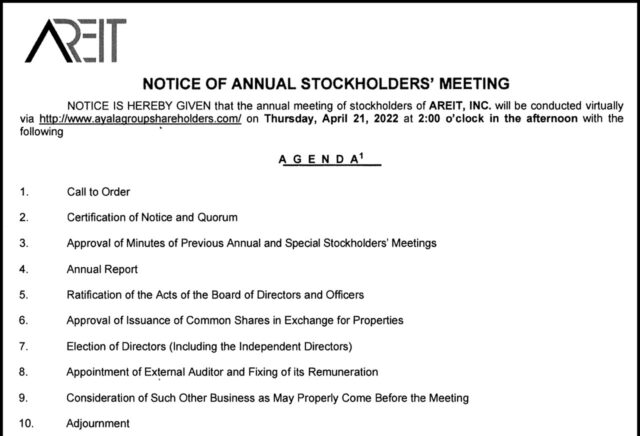
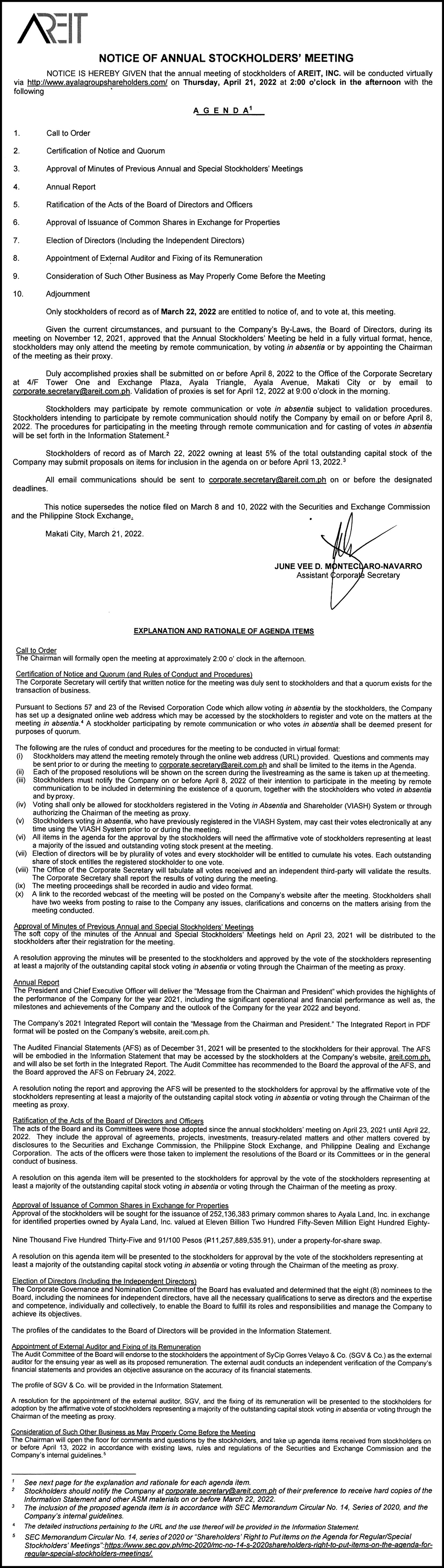
AREIT, Inc. announces schedule of annual stockholders’ meeting on April 21

Click to enlarge.
ADVERTISEMENT
ADVERTISEMENT