Home Blog Page 6467

What To See This Week (04/29/22)

The Bad Guys

The Bad Guys 

ADAPTED from a graphic novel series by Australian author Aaron Blabey, The Bad Guys follows a gang of animal outlaws — Mr. Wolf, Mr. Snake, Mr. Piranha, Mr. Shark and Ms. Tarantula — who are finally caught after years of successful heists. To avoid a prison sentence, the animal outlaws must pull off becoming model citizens. Directed by Pierre Perifel, the animated film features the voices of Sam Rockwell, Marc Maron, Anthony Ramos, Craig Robinson, Awkwafina, Lilly Singh, Richard Ayoade, Zazie Beetz, and Alex Borstein. Collider’s Ross Bonaime writes, “First-time director Pierre Perifel, who has worked in animation on such projects as 2006’s Curious George, Monsters vs. Aliens, The Illusionist, and the Kung Fu Panda series, directs The Bad Guys more like an action film than an animated film. Every frame of The Bad Guys is full of life and excitement, a beautiful film that wears its cinematic loves on its sleeve.” Review aggregate site Rotten Tomatoes’ Tomatometer gives it a score of 87% and the audience score is 93%.

MTRCB Rating: PG

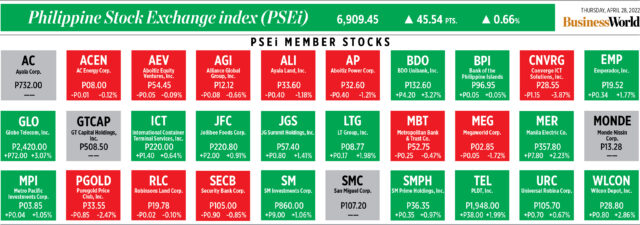
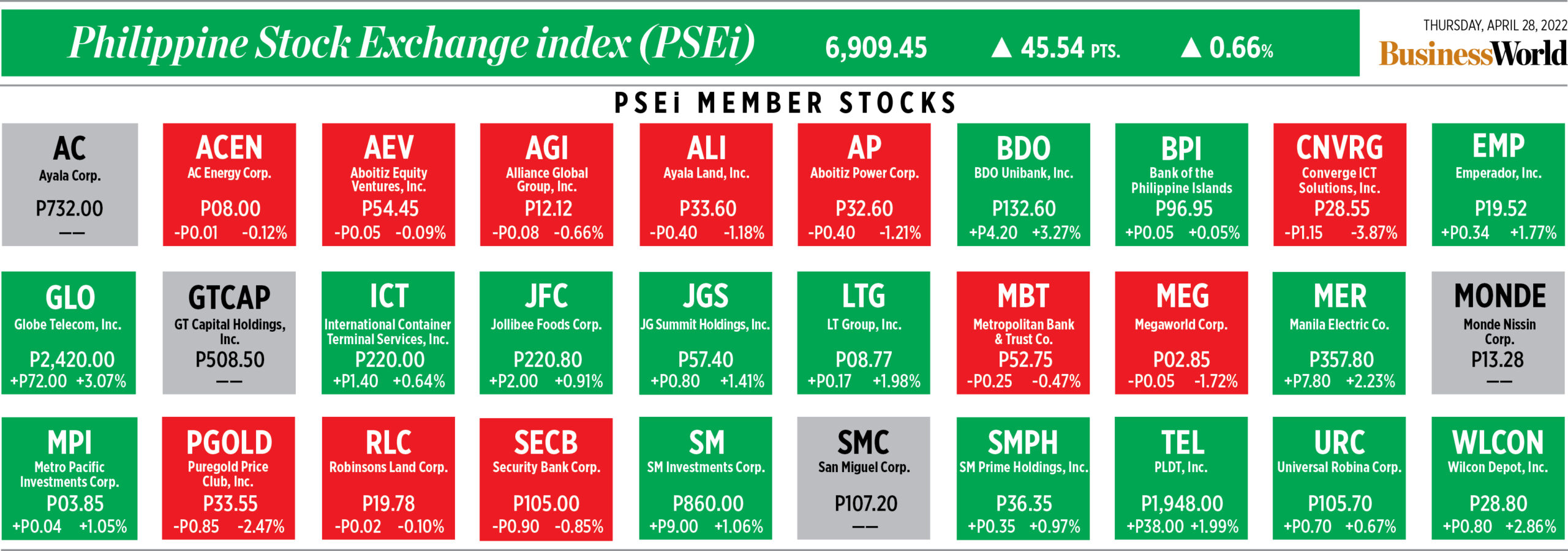
How PSEi member stocks performed — April 28, 2022

Here’s a quick glance at how PSEi stocks fared on Thursday, April 28, 2022.


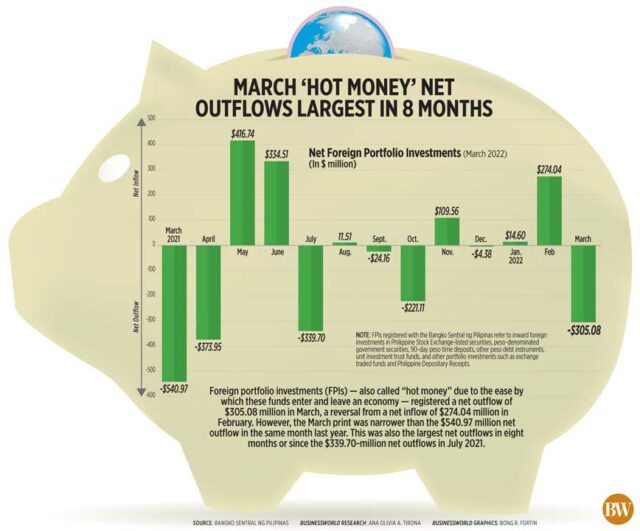
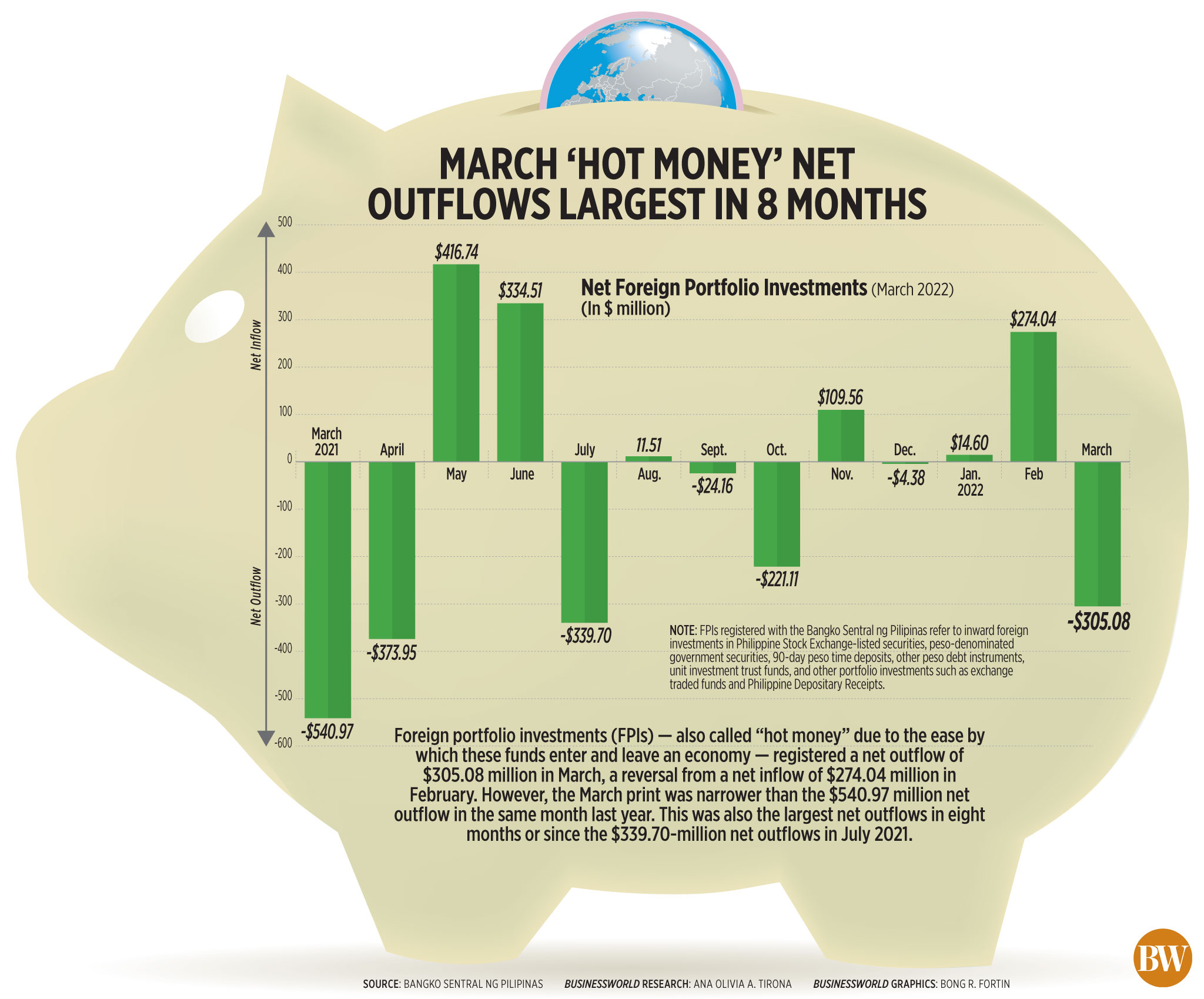
March ‘hot money’ net outflows largest in 8 months

MORE SHORT-TERM foreign investments left the Philippines than what entered in March, reflecting heightened uncertainty from the Russia-Ukraine war and monetary policy tightening in the United States. Read the full story.

March ‘hot money’ net outflows largest in 8 months

Regional share in gross domestic product

THE NATIONAL Capital Region’s (NCR) economy bounced back last year from a double-digit contraction in 2020, but remained below the national growth rate due to strict lockdowns meant to contain the coronavirus. Read the full story.

Regional share in gross domestic product

PSEi rebounds on bargain hunting, income results

STOCKS rebounded on Thursday on bargain hunting and the release of more local and US corporate financial reports.

The bellwether Philippine Stock Exchange index (PSEi) gained by 45.54 points or 0.66% to close at 6,909.45 on Thursday, while the broader all shares index went up by 17.15 points or 0.46% to 3,677.48.

“The market ended in green territory amid investors hunting for bargains following the bourse’s weak performance yesterday. Market participants may also be assessing the corporate earnings reports that have continued to be released over the past few days,” Timson Securities, Inc. Trader Darren Blaine T. Pangan said in a Viber message.

“Bargain hunting emerged anew and that’s due to corporate earnings resilience in some sectors,” First Metro Investment Corp. Head of Research Cristina S. Ulang said in a Viber message.

“Philippine shares rose to recover some previous losses, as concerns over inflation and global economic growth stirred up further volatility across risk assets… Investors digested a slew of mixed corporate earnings from the likes of Microsoft and Alphabet,” Regina Capital Development Corp. Head of Sales Luis A. Limlingan said in a Viber message.

Mr. Limlingan said investors are waiting for other technology firms’ earnings, namely from Apple, Amazon, and Twitter, among others.

A mixed bag of earnings from some of Wall Street’s biggest companies may muddy the outlook for investors hoping to “buy the dip” amid a vicious stock market sell-off, Reuters reported.

With a massive week of corporate results under way, Google parent Alphabet, Inc. reported first-quarter revenue below expectations on Tuesday, while software giant Microsoft Corp. forecast double-digit revenue growth for its next fiscal year.

At home, listed companies have begun announcing their results for full-year 2021 and the first quarter of 2022.

All sectoral indices ended in the green on Thursday. Mining and oil surged by 145.83 points or 1.26% to 11,636.26; financials rose by 16.88 points or 1.03% to 1,644; holding firms climbed by 45.14 points or 0.70% to 6,453.45; services went up by 13.18 points or 0.68% to 1,929.70; industrials added 52.48 points or 0.56% to end at 9,395.95; and property increased by 1.49 points or 0.04% to 3,172.35.

The MidCap index advanced by 6.79 points or 0.60% to 1,130.57 and the Dividend Yield index gained 15.06 points or 0.93% to 1,631.49.

Advancers outnumbered decliners, 92 versus 83, while 58 names ended unchanged.

Value turnover decreased to P5.73 billion with 8.5 billion shares changing hands on Thursday from the P8.78 billion with 816.50 million issues seen the previous day.

Foreigners turned sellers anew with P772.5 million in net sales on Thursday versus the P1.67 billion in net purchases recorded on Wednesday.

For Friday, the last trading day of the week, Timson Securities’ Mr. Pangan placed immediate support at the 6,800 area and resistance at 7,510. — L.M.J.C. Jocson with Reuters


Peso falls on virus fears, March ‘hot money’ net outflow

BW FILE PHOTO

THE PESO weakened versus the greenback on Thursday following news of the detection of a case of the new sub-variant of the coronavirus disease 2019 in the country and data showing a net “hot money” outflow last month.

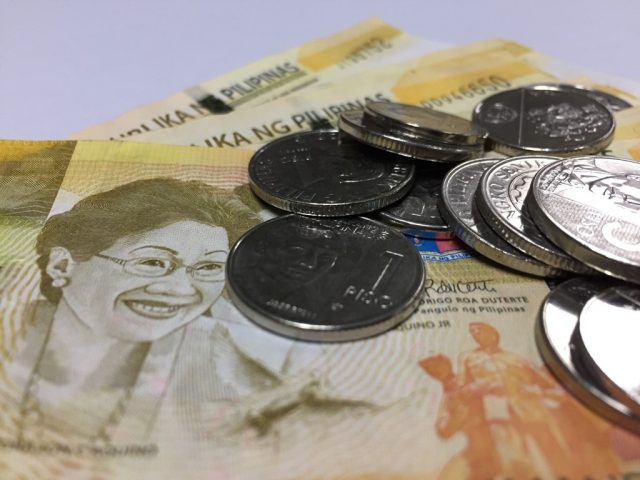
The local unit closed at P52.27 per dollar on Thursday, weaker by 15 centavos from its P52.12 finish on Wednesday, based on data from the Bankers Association of the Philippines.

The peso opened Thursday’s session at P52.15 against the dollar. Its weakest showing was at P52.36, while its intraday best was at P51.96 versus the greenback.

Dollars exchanged declined to $1.597 billion on Thursday from $1.654 billion on Wednesday.

The peso depreciated on news of the detection of the first case of the Omicron sub-variant (BA.2.12) in the country, Rizal Commercial Banking Corp. Chief Economist Michael L. Ricafort said in a Viber message.

The virus was detected in a female who arrived from Finland earlier this month, the Department of Health said late Wednesday. The patient, who is fully vaccinated and was asymptomatic, went to Baguio City to conduct seminars.

The US Center for Disease Control earlier attributed rising infections in the world’s largest economy to the sub-variant.

The net hot money outflow recorded last month also caused risk-off sentiment, Mr. Ricafort added.

Foreign portfolio investments posted a net outflow of $305.08 million in March, the central bank reported on Thursday. This is smaller by 43.6% than the $540.97-million net outflow a year earlier but a reversal of the $274.04-million net inflow seen in February.

Last month’s net outflow is also the biggest in eight months or since the $339.7 million seen in July 2021. Analysts attributed the net outflow to worries amid the war in Russia as well as uncertainties ahead of the national elections on May 9.

Meanwhile, a trader in a Viber message said the peso “depreciated from bargain hunting after the currency briefly reached below the P52 level intraday.”

For Friday, both Mr. Ricafort and the trader gave a forecast range of P52.15 to P52.35 per dollar. — Luz Wendy T. Noble

NLEX Corp. to build P5.5-billion Candaba swamp third viaduct

NLEX

By Arjay L. Balinbin, Senior Reporter

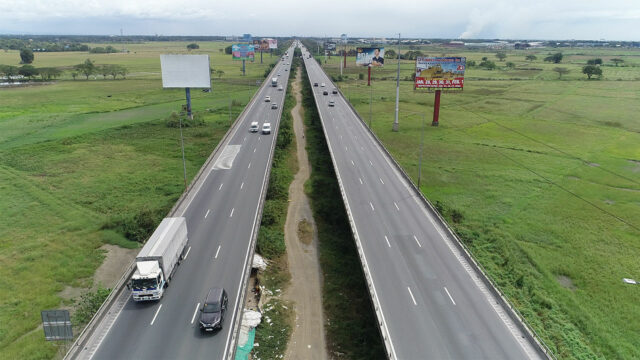
NLEX Corp., a unit of Metro Pacific Tollways Corp. (MPTC), hopes to start the construction of a P5.5-billion third Candaba Viaduct later this year, its President and General Manager said.

The Candaba Viaduct is a causeway allowing motorists to traverse the section of the swamp between Pulilan, Bulacan and Apalit, Pampanga.

“What we are busy with today, apart from the NLEX Connector project, is we are bidding out the Candaba Viaduct, (which) we call the third viaduct,” NLEX Corp.’s J. Luigi L. Bautista told BusinessWorld in a chance interview.

“Today, you have the northbound viaduct and the southbound viaduct, right? What we will do is we will construct a third viaduct in the middle,” he added.

He said two contractors were vying for the project. “We are in the process of selecting the contractor.” 

Construction is expected to take two years, “if not in the last part of the third quarter, maybe early fourth quarter of this year,” Mr. Bautista noted.

The viaduct is a bottleneck for vehicles traveling north and south along NLEX, where the available lanes narrow from the normal width on dry land.

The company is also planning to start this year the construction of a two-kilometer expressway section between the Mindanao Avenue toll plaza and Quirino Highway in Novaliches, Quezon City.

It is currently awaiting approval from the Toll Regulatory Board for the implementation of the first section of the proposed P92-billion NLEX-CAVITEX Port Expressway Link project.

The 15-kilometer (km) NLEX-CAVITEX Port Expressway Link project was originally a joint unsolicited proposal with the Manila-Cavite Expressway (CAVITEX) submitted to the Department of Public Works and Highways in 2019 to extend the North Luzon Expressway (NLEX).

MPTC’s capital expenditure budget for the year has been set at P32 billion. It recently opened the Cebu-Cordova Link Expressway project in Cebu.

MPTC expects the completion of NLEX Connector Phase 1, Cavite-Laguna Expressway – Cavite Segment, NLEX Segment 8.2 Section 1A, NLEX Connector Phase 2, and CAVITEX C5 Link projects this year.

MPTC is the tollway unit of Metro Pacific Investments Corp., one of three key Philippine units of Hong Kong-based First Pacific Co. Ltd., the others being Philex Mining Corp. and PLDT, Inc.

Hastings Holdings, Inc., a unit of PLDT Beneficial Trust Fund subsidiary MediaQuest Holdings, Inc., has a majority stake in BusinessWorld through the Philippine Star Group, which it controls.

Grab seeks more ride-share slots as mobility rules ease

GRAB Philippines, the dominant ride-sharing company, said it is asking the government to allow it to hire more drivers amid increasing demand due to reduced mobility restrictions.

“We anticipated this situation, and are working with the LTFRB (Land Transportation Franchising and Regulatory Board) to onboard more TNVS (technology- and app-based transport network vehicle service) drivers on the platform,” Grab Philippines said in a statement.

“Last April 12, we received the welcome news that the LTFRB will open a batch of almost 8,000 TNVS slots on April 18 through the TNVS online portal,” it added.

The company expects additional TNVS drivers to be on the road in two to three months. But the additional TNVS slots “are not enough to meet the increasing demand for GrabCar,” it noted.

“Grab continues to work with the LTFRB to add more TNVS slots to better serve the needs of the riding public.”

Grab Philippines has said that as of February 2020, it had around 33,000 active drivers daily.

The number significantly decreased during the pandemic, it said.

“We understand that life is going back to normal, and more Filipinos are going out and taking GrabCar for their everyday commute. Despite Grab Philippines’ efforts to support driver-partners on the platform, the prolonged suspension of ride-hailing during the height of the lockdowns forced thousands of GrabCar driver-partners to give up their cars, or look for alternative income opportunities elsewhere,” it also said.

“This situation has created a serious imbalance in GrabCar’s supply and demand conditions, resulting in fewer GrabCar driver-partners on the road having to serve an ever-increasing number of passengers.”

In March, drivers of ride-hailing services, including Grab, urged the LTFRB to act on their petition to increase base fares by P15 as pump prices continued to rise.

Rates vary depending on the vehicle type. The flag down rate is as much as P40 for sedans and as much as P50 for premium Asian and sport utility vehicles. For hatchback or sub-compact cars, the flag down rate is as much as P30. — Arjay L. Balinbin

EV zero-tariff policy readied before end of term

REUTERS

A ZERO-TARIFF policy for electric vehicle (EV) imports is targeted for approval before the current government leaves office, according to the Department of Trade and Industry (DTI).

Trade Secretary Ramon M. Lopez said during the launch of SM Supermalls’ free EV charging stations at the SM Aura Premier on Thursday that the DTI’s proposal to lower the tariff on EV imports to 0% from 30% was approved by President Rodrigo R. Duterte, with the proposal now being heard by the Tariff Commission (TC).

“We’re just undergoing the process now of the usual hearings in the TC so that we can formalize the reduction from 30% to 0%. And then it will pass through the Committee on Tariff and Trade Related Matters,” Mr. Lopez said.

He is hoping for approval before June 30, the day the President’s term ends.

The DTI, in March, announced the zero-tariff policy for EVs, pitching it as a counter to rising fuel prices and promote the vehicles’ widespread adoption.

“The EV industry will be happy with this. Distributors (will) lower the price of EVs and encourage the use of these. Hopefully, the streets of the Philippines (will) have more EVs,” Mr. Lopez said.

Mr. Lopez said broader adoption will result in the construction of more charging stations, making local manufacturing of EVs more feasible.  

He estimated a charging station to cost between P1 and P2 million.

Mr. Lopez said the effort to build an EV market will gain traction due to the recent passage of Republic Act No. 11697, or the Electric Vehicle Industry Development Act.

The new law requires companies, public transport operators, and government units maintain vehicle fleets that include at least 5% EVs.

Mr. Lopez said that the DTI is also considering the allocation of part of the fiscal support for the P27-billion Comprehensive Automotive Resurgence Strategy (CARS) program to local EV manufacturing.

“Remember, the CARS program has 2 participants. There are supposed to be three participants. The remaining budget for that, hopefully, we can channel it into the development for the manufacturing of EVs as well,” Mr. Lopez said.

“That’s about P9 billion per company (worth) of support. The third one we can allocate to the third participant in the CARS program. It’s still a draft executive order I’d like to present to the President. Hopefully it can be passed by the President (before he steps down),” he added.

The two manufacturers participating in the CARS program are Toyota Motor Philippines Corp. (TMP) and Mitsubishi Motors Philippines Corp. (MMPC).

The program provides fiscal support for the domestic production of at least 200,000 units within six years.

Under the program, TMP produces the Vios compact car while MMPC manufactures the competing Mirage. The deadline for MMPC to meet the Mirage quota is 2023 while TMP has until 2024 to produce the required volume of Vios cars. — Revin Mikhael D. Ochave

AFP, PNP supplier wary of PHL policy shifts as government turns over

PHILSTAR

AN Indian maker of body armor and military electro-optic devices said on Thursday that its main challenge in deciding to manufacture in the Philippines is the policy uncertainty accompanying the imminent change of government.

“The challenge in building a facility here in the Philippines is continuity. An administration only has six years. A President may come and go shortly,” according to Anton Chan, Jr., local representative of MKU Ltd., an Indian defense contractor, speaking at a briefing.

“Any investor would require continuity and return on investment,” he said, citing previous incidents like the cancellation of a UK armored vehicle contract.

“Aside from continuity, developing the supply chain is also an issue here,” according to Manish Khandelwal, a director at MKU. “These are the two issues that prevent us from putting up a manufacturing site here.”

“Supply chain challenges may involve small components, including the delivery of materials and products.”

The company remains interested in exploring opportunities in the Philippines, he said.

“We want to invest in the Philippine defense (industry) to boost its capability,” Mr. Khandelwal said, noting that the company is willing to respond to the Armed Forces of the Philippines’ needs and help the defense establishment achieve its long-term goals “That’s one of our commitments to the market.”

In 2017, the company supplied the Philippines with helmets that were used in operations in the southern Philippines.

MKU has exported body armor and night vision devices to the Philippine Army and the Philippine National Police (PNP) via the government’s international procurement arm, the Philippine International Trading Corp.

Mr. Chan said that the company would only set up a manufacturing site in the Philippines under a joint venture agreement with the government.

“The Philippines in the near future might not be interested in investing in or pursuing joint venture agreements because the world will be flooded with equipment,” said security and defense consultant Jose Antonio Custodio, citing the increased demand and production resulting from the war between Russia and Ukraine.

“We are likely to buy surplus defense equipment because production across the world has increased due to recent events.”

He said Philippine defense spending has historically been “driven by fiscal policy, not political priorities.”

“The government cannot increase its defense spending when it doesn’t have the budget to do so,” he said in a Messenger call.

Mr. Custodio said the government needs to smooth out inefficiencies in procurement to attract investment.

He said the government needs to host an industry summit to lay out its defense procurement plans.

“In that sense, the government can create a roadmap which would allow continuity of defense programs.” — Kyle Aristophere T. Atienza

FIRB stands firm on ecozone onsite work

ANFLOINDUSTRIALESTATE.COM

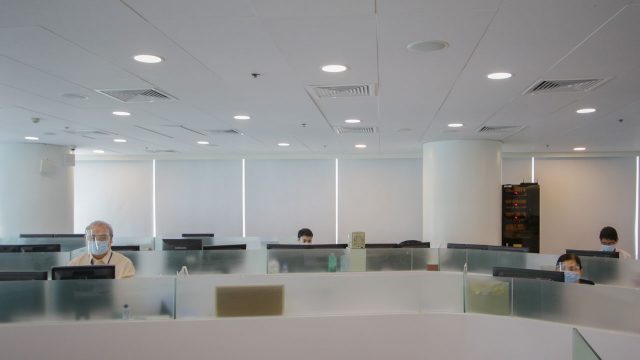
THE Fiscal Incentives Review Board (FIRB) said it will continue to require registered business enterprises (RBEs), including information technology–business process management (IT-BPM) firms, to make their employees work onsite.

Finance Assistant Secretary Juvy C. Danofrata, who also heads the FIRB Secretariat, said in a statement on Thursday that the work-from-home (WFH) arrangement previously enjoyed by RBEs was a time-bound measure that expired when quarantine conditions eased.  

“Given the increasing vaccination rate of Filipinos nationwide, we can now undertake safety measures for the physical reporting of employees. In fact, the President has ordered all government agencies and instrumentalities to adhere to the 100% on-site workforce rule allowed by Alert Level 1,” Ms. Danofrata said.

“The government has exercised significant caution in balancing the economy’s needs and the health requirements to address concerns the pandemic caused. However, we believe that the current situation allows us to direct our policies towards fully reopening the economy,” she added.

Under FIRB Resolution 19-21, registered IT-BPM companies can implement WFH arrangements for up to 90% of their workforce while still enjoying tax incentives. However, the resolution expired on April 1, with employees having since been directed to return to onsite work.

According to Ms. Danofrata, the FIRB was taking in requests for the continued adoption of flexible or off-site work arrangements for the IT-BPM sector while still enjoying their tax breaks. She said tax breaks are a privilege of RBEs operating in special economic zones or freeports.

She said registered projects or activities should be done within the geographical boundaries of the economic zone (ecozones) or freeports to be entitled to fiscal incentives, as provided under the National Internal Revenue Code as amended by Republic Act No. 11534 or the Corporate Recovery and Tax Incentives for Enterprises (CREATE) Act.

Ms. Danofrata said tax incentives are given to priority projects or activities located within ecozones and freeports, which were established to promote export activity and allow the free flow of goods and services, including IT-BPM services, within the zones.

“Under the law, allowing companies to have their activities be conducted from their homes or anywhere outside the zone territory while enjoying their tax incentives is in utter disregard and violation of the aforementioned provision of law,” Ms. Danofrata said.

Recently, the Philippine Economic Zone Authority announced that it is allowing registered firms to conduct a 70% on-site and 30% WFH arrangements in the face of the government’s return to office order.

Asked to comment, Alliance of Call Center Workers Co-Convenor Emman D. David said via chat that the government should revert to full WFH arrangements amid the detection of the coronavirus disease 2019 (COVID-19) Omicron sub-variant BA.2.12 in the country.

“With the emergence of the COVID-19 BA.2.12 Omicron sub-variant, we implore the government to restore the full work-from-home setup as it existed before the expiration of FIRB Resolution 19-21. This would mitigate the spread of the virus and protect citizens from illness and possible death,” Mr. David said. — Revin Mikhael D. Ochave

Liberalization bills seen producing spate of SEC foreign ownership rulings

THE Securities and Exchange Commission (SEC) is expected to expedite rulings involving companies with foreign ownership cases, following the passage of three laws liberalizing foreign participation in various industries.

“With the signing of the amendments of the Foreign Investments Act (FIA), the Public Service Act (PSA), and the Retail Trade Liberalization Act (RTLA), the regulatory body may now quickly resolve pending cases, a move that will help the Philippines hasten its recovery from the pandemic,” former SEC Secretary Gerard M. Lukban said in a statement.

“Instituting these game-changing reforms is a step in the right direction. Now more than ever, it is imperative to further liberalize the Philippine economy and open its doors to foreign investment to spur economic growth amid the lingering impact of the COVID-19 pandemic,” he added.

President Rodrigo R. Duterte recently signed into law the three measures designed to further open up the economy to foreign investors.

Republic Act (RA) No. 11647, which amended the Foreign Investments Act of 1991, eases foreign ownership rules for most retail companies except for micro and small market enterprises with paid-in capital of up to $200,000.

RA No. 11595, which amended the Retail Trade Liberalization Act of 2000, lowers the minimum paid-up capital for foreign retailers to P25 million and the minimum investment requirement to P10 million per store.

In March, Mr. Duterte signed Republic Act (RA) No. 11659, which amended the Public Service Act to allow 100% foreign ownership in many industries, the main exceptions being entities engaged in the transmission and distribution of electricity, water pipeline and sewerage companies, seaports, petroleum pipelines, and public utility vehicles.

The Bangko Sentral ng Pilipinas (BSP) estimates that the Philippines took in a record foreign direct investment (FDI) of $10.3 billion in 2021.

With the amendment, Mr. Lukban said he expects FDI to surge, aiding the Philippines in its recovery from the pandemic.

He also said that the favorable resolution of pending cases complements the amended laws and will further bolster the Philippines’ image as a new investment destination.

“Foreign investors were previously cautious (about entering) the Philippines because of the old and antiquated laws, which made it hard for us to attract larger investments. Resolving pending cases swiftly will allow us to show investors that the Philippines is now a haven for foreign investments,” Mr. Lukban said.

“Allowing more players to jump-start their business in our country, as evidenced by the record-high improvement in investor sentiment, can help drive our economic recovery. The implementation of easier restrictions on foreign entrants will lead to the creation of more jobs and unlock more opportunities, ultimately leading to higher income and spending power of households,” he added. — Luisa Maria Jacinta C. Jocson