Home Blog Page 6461

Post Clearance Audits, visitorial, and police authority of the Customs Bureau

BW FILE PHOTO

The Bureau of Customs (BoC) has enhanced its collection efforts in recent years. In the first quarter of 2022, the BoC collected approximately P534.29 million through its Post Clearance Audit (PCA) and Prior Disclosure Program (PDP). The BoC has met 35% and 44.5% of its 2021 and 2020 collections, respectively, in a mere quarter. Importers can expect its steadfast collection efforts to continue this year.

The BoC is mandated to prevent and curtail fraud and illegality in importations. Last January, the BoC, together with the National Bureau of Investigation (NBI) and the Philippine Coast Guard, seized fake COVID-19 test kits and counterfeit face masks, among others, in a warehouse in San Miguel, Manila. In the same month, it seized various smuggled goods in a warehouse in Pandi, Bulacan.

With the BoC’s enhanced collection efforts, corresponding rules have been issued to protect the rights of each importer and stakeholder, so that each is protected and aware of the nature, basis, and extent of each investigation.

POST CLEARANCE AUDIT
Customs Administrative Order (CAO) 01-2019 authorizes the Post Clearance Audit Group-Compliance Assessment Office (PCAG-CAO), to conduct an audit examination, verification, and investigation of records pertaining to any goods declaration for the purpose of ascertaining its correctness and determining the liability of the importer for duties, taxes, and other charges, including any fine or penalty within three years from the date of final payment of duties and taxes or customs clearance.

Similar to a Letter of Authority issued by the Commissioner of Internal Revenue, the PCAG-CAO PCA may only be performed if the Commissioner of Customs issues an Audit Notification Letter (ANL). When served with an ANL, an importer may safeguard its rights by observing the possible issues that could arise during its implementation:

a. Issuance of ANLs past the prescribed period to audit, which should only be within the three-year period;

b. Conduct of audit by personnel not explicitly listed in the ANL;

c. Performance of audit procedures not expressly approved by the Commissioner of the BoC.

EXERCISE OF POLICE AUTHORITY
As mentioned earlier, unlike the revenue generating purpose of a PCA, the BoC is duty-bound to prevent and suppress smuggling and other customs fraud. Thus, CAO 03-2019 was enacted to implement the fortification of the BoC’s police authority and the Commissioner’s visitorial power emphasized by the CMTA. In fact, this CAO was supplemented by OCOM Memorandum No. 162-2021 (OCOM Memo) which was issued in late November last year.

These two issuances taken in tandem highlight that although the CMTA explicitly authorizes [Section 214, CMTA] certain persons to conduct searches, seizures, and arrests, such actions must be performed pursuant to various documentary requirements, particularly a valid Disposition Form (DF), Letter of Authority (BoC LOA), Mission Order (MO), and Deputization Order, all signed by the Commissioner.

The above documents are different from an ANL discussed in the previous section. The BoC LOA is issued based on derogatory information that imported goods, which are probably smuggled, regulated, prohibited, or restricted, are being openly offered for sale or kept in a particular store, stalls, exhibition places, warehouses, and/or enclosures. [Section 2.2, OCOM Memo. No. 162-202]

Notwithstanding the dissimilarities in basis, BoC’s exercise of police authority must also be implemented with due regard to the following due process considerations:

a. The search and seizures cannot be conducted in the absence of a valid BoC LOA;

b. Entering the premises without the presence of the lawful occupant or the other persons listed under Section 2.9 of the OCOM Memo;

c. Irregularities in the contents of the BoC LOA: i. Location of place to be searched; ii. Implementing team’s lack of proper authorization; and,

d. Confiscation of prohibited goods in violation of the Plain View Doctrine.

Despite the seemingly convoluted guidelines surrounding PCAs and the exercise of police authority, it all boils down to acknowledging that these rules are in place to protect both the BoC, importers, and all stakeholders. On one hand, the government seeks lawful collection of revenue under the lifeblood doctrine. On the other, importers and/or stakeholders expect the corresponding fruits of its due contributions while upholding their rights to substantive and procedural due process.

Thus, balancing of their particular interests through their respective compliance with the prescribed rules is fundamental to this symbiotic relationship.

The views and opinions expressed in this article are those of the author. This article is for general information and educational purposes, and is not offered as, and does not constitute, legal advice or legal opinion.


Rex Wilbert L. Rivera is an Associate of the Tax Department of the Angara Abello Concepcion Regala Cruz Law Offices.

rlrivera@accralaw.com

02-8830-8000

Missiles pound Odesa after Russia marks WW2 victory

A RUSSIAN FLAG flies with the Spasskaya Tower of the Kremlin in the background in Moscow, Russia, Feb. 27, 2019. — REUTERS

KYIV/KHARKIV, Ukraine — Buildings in Odesa lay in ruins on Tuesday, a day after Kremlin forces pounded the southern Ukrainian port with missiles and Russian President Vladimir Putin led defiant celebrations marking the Soviet’s victory over Nazi Germany in World War II.

While Mr. Putin was silent about plans for any escalation in Ukraine, there was no letup in fighting with a renewed push by Russian forces on Monday to defeat the last Ukrainian troops holding out in a steelworks in ruined Mariupol.

“You are fighting for the Motherland, for its future, so that no one forgets the lessons of World War II. So that there is no place in the world for executioners, castigators and Nazis,” Mr. Putin said.

Ukraine’s President Volodymyr Zelensky, in his own speech on Monday, promised Ukrainians would triumph.

“On the Day of Victory over Nazism, we are fighting for a new victory. The road to it is difficult, but we have no doubt that we will win,” said Zelensky.

In Odesa, the major Black Sea port for exporting agricultural products, one person was killed and five people were injured when seven missiles hit a shopping center and a depot, Ukraine’s armed forces said on Facebook.

Video footage from the scene showed fire and rescue workers combing through piles of rubble dousing still smoking wreckage.

Ukraine — a major maize and wheat producer — and its allies have intensified efforts on how to unblock ports or provide alternate routes for exporting grain, wheat and corn.

European Council President Charles Michel visited Odesa on Monday, urging afterwards a global response to aid Ukraine.

A meeting between Mr. Michel and Ukrainian Prime Minister Denys Shmyhal in Odesa was interrupted by the missile attack, forcing the men into a bomb shelter, according to Mr. Shmyhal’s official Twitter account.

In the town of Bogodukhov, northwest of Kharkiv, four people were killed and several homes were destroyed in Russian attacks, local media quoted Kharkiv officials as saying.

In some eastern regions of Ukraine, Luhansk, Kharkiv and Dnipro, air raid sirens could be heard early on Tuesday.

Ukraine’s defense ministry said Russian forces backed by tanks and artillery were conducting “storming operations” at Mariupol’s Azovstal plant, where hundreds of Ukrainian defenders have held out through months of siege.

Mariupol lies between the Crimean Peninsula, seized by Moscow in 2014, and parts of eastern Ukraine under the control of Russia-backed separatists. Capturing the city would allow Moscow to link the two areas.

More than 5.5 million Ukrainians have fled their country since Russia’s invasion on Feb. 24, according to the United Nations, which has called it Europe’s fastest-growing refugee crisis since World War II.

Moscow’s gains from the invasion, however, have been slow at best and it has little to show for it beyond a strip of territory in the south and marginal gains in the east.

US President Joseph R. Biden said he was worried that Mr. Putin “doesn’t have a way out right now, and I’m trying to figure out what we do about that.”

Sources say US Democratic lawmakers have agreed on a $40-billion aid proposal for Ukraine, including a massive new weapons package.

The White House had earlier described Mr. Putin’s remarks during his Victory Day speech as “revisionist history that took the form of disinformation.”

The Soviet victory in World War II has acquired almost religious status in Russia under Mr. Putin, who has invoked the memory of the “Great Patriotic War” throughout what he calls a “special military operation” in Ukraine. — Reuters

TV binges, heated toilets targeted in Tokyo’s energy saving push

REUTERS

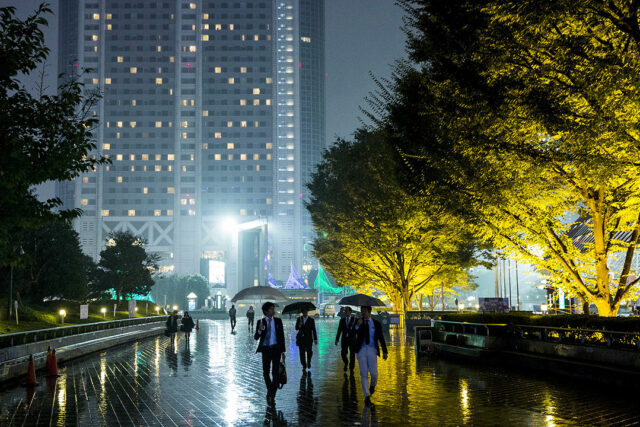
THE DRIVE to conserve energy is coming for Tokyo residents’ living rooms, bathrooms and kitchens.

With governments globally grappling with surging electricity prices as the war in Ukraine strains fossil fuel supply chains, authorities are examining almost every possibility to reduce power demand. In Tokyo, officials are urging residents to watch an hour less TV a day, switch off the keep-warm mode on rice cookers, and refrain from using heater functions on toilet seats until winter.

The suggested measures also ask households to keep their air-conditioning temperature at around 28 °C (82.4 °F).

Tokyo’s appeal comes after a power crunch in March that nearly brought blackouts to Japan’s capital and with tight electricity supplies expected through the summer and next winter. The effort underscores a new urgency from governments as they target energy-sucking luxuries inside peoples’ homes as extreme weather from Texas to New Delhi strains power grids.

“We need to share this sense of crisis,” Tokyo Governor Yuriko Koike said during a May 6 press conference. “We need the support of Tokyo residents and business owners.”

Japan’s efforts to ensure electricity supply also include more conventional methods. Residents and businesses are being encouraged to install more rooftop solar, while Tokyo’s government is pressing the city’s main electricity provider for the restart of retired and idled power plants.

Prime Minister Fumio Kishida has also urged the country to consider using more nuclear power to help limit the nation’s reliance on fuel imports. — Reuters

‘Our mountains are gone’: Grief as sacred New Mexico forests burn

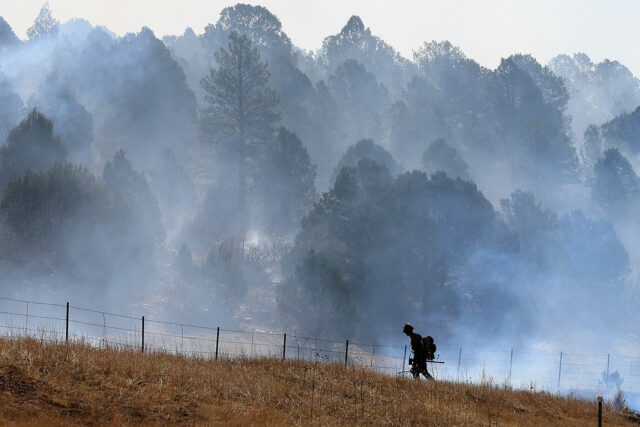
A firefighter works to combat the Hermits Peak and Calf Canyon wildfire, near Las Vegas, New Mexico, US, May 4. — REUTERS

ANGOSTURA, N.M. — Forests in Ella Arellano’s family for nine generations burned in a day on Monday as fierce winds drove the United States’ largest wildfire through a New Mexico valley towards a third county.

Ms. Arellano sat in an evacuation center in Peñasco on Monday and grieved the loss of timbered mountainsides around her home in Holman after the fire leaped across the Mora valley about 40 miles (64 km) northeast of the state capital Santa Fe.

“I’m of the land,” said Ms. Arellano, a mayordoma in charge of irrigation channels known as acequias, as she wiped away tears. “Our mountains are gone and it’s still burning.”

The so-called Hermits Peak Calf Canyon fire, larger than the city of Chicago, has been contained to the east but is racing north through land that has deep religious significance to Indo-Hispano villages established two centuries ago.

Around 35 miles in length, the blaze has destroyed hundreds of homes and other structures and triggered evacuation orders for 12,000 homes in San Miguel and Mora counties.

After more than a month of wildfires, residents of Taos County on Monday for the first time were told to prepare to evacuate as the fire advanced towards the villages of Angostura and Tres Ritos as well as the Sipapu ski area around 15 miles south of the town of Taos.

Winds gusting up to 66 mph blew a rancher off his feet as he hosed down his Angostura home in preparation for embers flying over a mile from the fire.

He was in shock as a blaze that started 20 miles distant when a US Forest Service controlled burn got out of hand on April 6 burned less than 5 miles away.

A few miles down the road in Tres Ritos, ski area employees emptied belongings from a storage unit in preparation for a fire they believed was coming.

“They’ve been fighting it for a month in wilderness, they can’t stop it,” said Greg Payne, facilities maintenance manager at Sipapu ski area two miles down the valley.

The fire has burned 76,890 hectares and is 43% contained. — Reuters

Yoon faces early North Korea, inflation tests

SEOUL — South Korea’s new president, Yoon Suk-yeol, will face two major problems as soon as he takes over on Tuesday, a belligerent North Korea testing new weapons and inflation threatening to undermine an economic recovery from two years of coronavirus disease 2019 (COVID-19) gloom.

Mr. Yoon, 61, won a tight election in March as the standard bearer of the main conservative People Power Party, less than a year after entering politics after a 26-year career as a prosecutor.

He will be sworn in early on Tuesday at a ceremony in front of parliament in Seoul.

Yoon won the election on a platform of fighting corruption and creating a more level economic playing field, amid deepening public frustration with inequality and housing prices, as well as simmering gender and generational rivalry.

South Korea’s inflation hit a more than 13-year high last month as Russia’s invasion of Ukraine sent commodity prices soaring, boosting expectations of more central bank interest rate rises, which could threaten growth prospects.

Mr. Yoon could find himself at the center of international uproar over North Korea within days if it carries out its first nuclear test in five years, as US and South Korean officials suspect it might.

North Korea put its weapons tests back on top of the agenda when it broke a 2017 moratorium on long-range missile testing in March.

Mr. Yoon has vowed to strengthen the deterrent capability of the staunch US ally as it confronts the North’s evolving threats, while seeking a reset of relations with China. Both issues will likely dominate his first summit with US President Joseph R. Biden this month.

Mr. Yoon formally assumed his duties at midnight on Monday with a bell-tolling ceremony at Bosingak Pavilion in downtown Seoul.

The inauguration will be held on the front lawn of parliament, attended by some 40,000 people.

Three hundred foreign guests will include Chinese Vice-President Wang Qishan, Japanese Foreign Minister Yoshimasa Hayashi, and Douglas Emhoff, the husband of US Vice-President Kamala Harris.

The inauguration has been given the slogan “Again, Republic of Korea! A new country of the people” which reflects Mr. Yoon’s commitment to the people and to resolving regional, class and generational divisions and fostering unity, his team said.

After the inauguration, Mr. Yoon will begin work at a new office at a former defense ministry building inside a sprawling compound.

He has moved the presidential office and residence from the traditional Blue House under a plan, that is estimated will end up costing $40 million, criticized by outgoing President Moon Jae-in as rushed and a national security risk. — Reuters

S.Korea’s Yoon suggests ‘audacious’ economic plan if N.Korea abandons nukes

South Korean President Yoon Suk-yeol. — REUTERS

South Korea’s new president, Yoon Suk-yeol, said on Tuesday that North Korea’s weapons programs pose a threat but that he is ready to provide an “audacious” economic plan if the North is committed to denuclearization.

Mr. Yoon gave the remarks in his inauguration speech after being sworn in at a ceremony in Seoul. He won a tight election in March as the standard bearer of the main conservative People Power Party, less than a year after entering politics following a 26-year career as a prosecutor. Read full story

Mr. Yoon, 61, will face two major problems as he takes office: a belligerent North Korea testing new weapons and inflation threatening to undermine an economic recovery from two years of COVID-19 gloom.

He has signaled a tougher line on North Korea, warning of a preemptive strike if there is a sign of an imminent attack and vowing to strengthen the South’s deterrent capability. But his speech was seen as focused more on his willingness to reopen stalled denuclearization talks with Pyongyang. Read full story

“While North Korea’s nuclear weapon programs are a threat not only to our security and that of Northeast Asia, the door to dialogue will remain open so that we can peacefully resolve this threat,” Mr. Yoon said.

“If North Korea genuinely embarks on a process to complete denuclearization, we are prepared to work with the international community to present an audacious plan that will vastly strengthen North Korea’s economy and improve the quality of life for its people,” he added.

Mr. Yoon did not elaborate on his re-engagement or economic plan for the North. But his national security adviser, Kim Sung-han, told Reuters in February that his team would devise a roadmap in early days in which Pyongyang could quickly earn sanctions relief or economic aid in exchange for denuclearization measures. Read full story

Mr. Yoon could face a security crisis if North Korea carries out its first nuclear test in five years, as U.S. and South Korean officials warned, after it broke a 2017 moratorium on long-range missile testing in March. Read full story


NO MORE BLUE HOUSE

Mr. Yoon won the election on a platform of fighting corruption and creating a more level economic playing field amid deepening public frustration with inequality and housing prices, as well as simmering gender and generational rivalry.

South Korea’s inflation hit a more than 13-year high last month as Russia’s invasion of Ukraine sent commodity prices soaring, which could dampen growth prospects. Read full story

Mr. Yoon did not mention inflation, but cited low growth, rising unemployment and wage gaps as key economic challenges, pledging to address those by focusing on developing science, technology and innovation.

Some 40,000 people attended the ceremony on the front lawn of parliament, including about 300 foreign guests, including Chinese Vice President Wang Qishan, Japanese Foreign Minister Yoshimasa Hayashi, and Douglas Emhoff, the husband of U.S. Vice President Kamala Harris.

Mr. Wang, at a meeting with Mr. Yoon, relayed Chinese President Xi Jinping’s letter and invitation to China, and expressed Beijing’s hopes for stronger cooperation on North Korea, bilateral and global issues.

Mr. Yoon separately met Mr. Hayashi and thanked him for conveying a letter from Prime Minister Fumio Kishida, saying he hoped to meet him soon and work together to improve relations.

Mr. Yoon promised stronger support for the U.S. alliance to Emhoff, who also delivered a letter from President Joe Biden and said Biden was looking forward to their first summit, scheduled for this month, and was hoping for closer cooperation.

After the inauguration, Yoon moved to a new office at a former defence ministry building, holding his first meeting with aides and appointing seven cabinet nominees who had passed their confirmation hearings, including finance and defence ministers.

He has moved the presidential office and residence from the traditional Blue House under a $40 million plan, though his predecessor Moon Jae-in criticised it as rushed and a national security risk. Read full story

A separate event was held at the Blue House, where 74 citizens selected by lottery entered the long enclosed complex, which was opened to the public for the first time in 74 years.

Mr. Yoon had called the office a “symbol of absolute power,” and said it would be used as a public park and cultural space. – Reuters

AI platform to solve the pain of recruitment manual work launched

Recruiting and hiring talent is one of the most important HR functions. Currently, employer demand for workers remains high in the Philippines and is fueling the trend known as the Great Resignation in our side of the world. This means recruiters are making ends meet to ensure quality talent are properly identified and promptly hired before the competition.

But this is easier said than done given an average recruiter spends at least 3-5 hours every working day for CV or resume screening as well as initially interviewing applicants. This is the most manually intensive portion of the process. The time utilized at this phase by recruiters could have been applied to other priorities.

This insight inspired MetroCity AI to develop a recruitment platform that solves the pain of long hours spent on CV screening and initial virtual interviews. Companies can make use of the asynchronous video interview (AVI) functionality in the platform to invite applicants to record themselves on camera as they answer questions related to culture-fit, behavior, and skills provided by the company.



The submitted applicant videos are then processed by the platform. The applicants with answers that align with the company continues on to the next steps. Since it uses AI, the platform further refines the answers and profiles that would pass the screening process resulting to a more robust screening system unique to a company as it processes more applicants.

The platform also has a CV screening function that can match unprocessed CVs to the job opportunities in the company. Once matched, it will send an invite to the pre-screened applicants to take the asynchronous video interview at their own time.

Just this April 2022, MetroCity AI released a Freemium package for companies to take advantage on. This means, companies can utilize the platform absolutely free.

MetroCity AI is part of the Batch 10 startups of UP Diliman’s UPSCALE Incubation Program. They are one of the recipients of the Accenture startup grant via UP Engineering Research and Development Foundation, Inc. (UPERDFI) and UPSCALE Innovation Hub.

For more information and to sign-up for a freemium account, you can visit www.metrocity.ai. You can also email the founders at hello@metrocity.ai.


Spotlight is BusinessWorld’s sponsored section that allows advertisers to amplify their brand and connect with BusinessWorld’s audience by enabling them to publish their stories directly on the BusinessWorld Web site. For more information, send an email to online@bworldonline.com.

Join us on Viber to get more updates from BusinessWorld: https://bit.ly/3hv6bLA.

Japan to decide Russia oil embargo timing while weighing impact on economy

STOCK PHOTO | Image by Schmucki from Pixabay

Japan will decide the timing and method of a Russian oil embargo while considering the possible economic impact, its industry minister said on Tuesday, after Tokyo agreed on a ban with other Group of Seven nations over Moscow’s invasion of Ukraine.

“We would like to consider a method of phasing out over time in a way that minimizes adverse effects on people’s lives and business activities,” Japanese industry minister Koichi Hagiuda told a news conference.

“We will think about specific methods and timing for reducing or suspending oil imports, taking into account the actual situation,” he said.

Prime Minister Fumio Kishida said on Monday that Japan will phase out Russian oil imports. Read full story

Hagiuda said Japan cannot immediately stop importing oil from Russia but will gradually move away from dependence on Russian energy while ensuring access to alternative supplies.

Asked about a possible acceleration of the restart of nuclear power plants, he said: “Given that it is a decarbonised base-load power source at the practical stage, it is necessary to utilize it as an important power source.”

But there is no change in the ministry’s policy to proceed with any nuclear restarts only after winning the support of local communities, he said.

Globally, the United States will be indispensable for securing a stable energy supply, Hagiuda said.

“As an oil and gas producing country, the United States has a major role to play and should firmly establish its own system to increase production,” he said.

There are plans to expand existing liquefied natural gas projects in the United States that can increase output in a relatively short period of time, and Japan is willing to contribute to those through public finance, he said. – Reuters

Ukraine calls for moves to unblock ports and prevent global food crisis

President of Ukraine Volodymyr Zelenskyy/Flickr

Ukraine‘s president said on Monday that trade at the country’s ports was at a standstill and urged the international community to take immediate steps to end a Russian blockade to allow wheat shipments and prevent a global food crisis.

Volodymyr Zelenskiy made the comments after speaking to European Council President Charles Michel, who was visiting Odesa – the major Black Sea port for exporting agricultural products where missiles struck tourist sites and destroyed buildings on Monday. Read full story

“For the first time in decades and decades, in Odesa there is no regular movement of the merchant fleet, there is no routine port work. This has probably never happened in Odesa since World War Two,” Zelenskiy said in a video address.

And this is a blow not only to Ukraine. Without our agricultural exports, dozens of countries in different parts of the world are already on the brink of food shortages. And over time, the situation can become, frankly, frightening.”

Ukraine was the world’s fourth-largest exporter of maize (corn) in the 2020/21 season and the No.6 wheat exporter, according to International Grains Council data. But nearly 25 million tonnes of grains are now stuck in Ukraine, a U.N. food agency official said on Friday. Read full story

“Immediate measures must be taken to unblock Ukrainian ports for wheat exports,” Zelenskiy said earlier on his Telegram messaging channel.

He did not specify what measures he was seeking. NATO countries including the United States have ruled out armed intervention for fear of triggering a wider war. Read full story

Canadian Prime Minister Justin Trudeau, who visited Kyiv on Sunday, said his country would help Ukraine work out options on how to export stored grain. Read full story


SILOS OF BLOCKED GRAIN

Michel, who chairs summits of the European Union’s national leaders, wrote on Twitter that he had seen silos full of grain, wheat and corn in Odesa that was ready for export but blocked.

“This badly needed food is stranded because of the Russian war and blockade of Black Sea ports. Causing dramatic consequences for vulnerable countries. We need a global response,” he wrote.

Russia’s blockade of Ukrainian ports since the invasion on Feb. 24 has added to volatility in international financial markets, sending commodity prices higher.

U.N. Secretary-General Antonio Guterres said last week the problem of food security cannot be solved without restoring Ukrainian production to the world market. Read full story

Ukrainian agriculture officials say the exportable surplus is around 12 million tonnes, and agriculture analysts have said Ukraine‘s stocks are so high that there will not be enough room to store the new harvest when it comes.

Ukraine has sown about 7 million hectares of spring crops this year, or 25-30% less than a year earlier, Agriculture Minister Mykola Solskyi said on Monday.

He said Ukraine had exported 1.090 million tonnes of grain in April, but that the sowing was not of the same quality as last year and the sowing area for corn was smaller.

Moscow says its “special operation” in Ukraine is designed to disarm and denazify its smaller neighbo r. Ukraine and the West say this is a false pretext for an unprovoked war of aggression by Russia. – Reuters

Japan expects launch of U.S. Indo-Pacific economic plan during Biden visit

President Joe Biden‘s visit to Japan this month is expected to coincide with the formal launch of a new U.S. economic strategy for the IndoPacific, even as China seeks “very aggressively” to fill a void since Washington quit a regional trade pact, Tokyo’s ambassador to the United States said on Monday.

Ambassador Koji Tomita told an event hosted by Washington’s Center for Strategic and International Studies that Japan and the United States had been working on the details of the IndoPacific Economic Framework (IPEF), which, he said, needed to strike a balance between inclusivity and high standards.

Asian countries are keen to boost ties with the United States, but have been frustrated by its delay in detailing plans for economic engagement with the region since former President Donald Trump quit a regional trade pact in 2017. Read full story

Mr. Biden, who is to visit South Korea and Japan from May 20 to May 24, announced the plan for IPEF last year. In announcing its strategy for the IndoPacific region in February, the administration said the plan was to launch IPEF in early 2022.

Mr. Tomita said Mr. Biden‘s visit would send a powerful signal that Washington remains focused on the IndoPacific in spite of the war in Ukraine.

“But this is not just a message. I think the visit will establish in very strong terms that Japan and the United States jointly are ready to play a leadership role in the economic and social development of the broader IndoPacific region,” he said.

Mr. Tomita noted that Mr. Biden‘s visit would include a summit meeting of the Quad grouping of the United States, Japan, Australia and India, an important vehicle for that purpose.

“Also, I’m expecting the visit will also coincide with the formal launch of the IndoPacific Economic Framework initiative by the United States. And we are now trying to flesh out the ideas to be contained in this initiative,” he said.

Mr. Biden is due to host Southeast Asian leaders at a special summit in Washington on Thursday and Friday, but an Asian diplomat said IPEF was not on the formal agenda as most ASEAN economies would not be among the initial signatories. Read full story

The diplomat said at least six countries were likely to sign up initially with the United States to negotiate agreements on a range of common standards. These were Australia, Japan, New Zealand, South Korea and ASEAN members the Philippines and Singapore.

Analysts say Washington was particularly keen to get Vietnam and Indonesia aboard too, but they have had issues about agreeing to U.S. standards on cross-border data flows.

Mr. Tomita said the U.S. withdrawal from what is now known as the Comprehensive and Progressive Agreement for Trans-Pacific Partnership was a setback and China was “very aggressively seeking to fill this void.”

“Whenever you do any form of regional economic forum there is a trade-off between inclusiveness and high standards,” he said, referring to IPEF. “Of course, we need both, but we have to strike the right balance between these two requirements.”

The Biden administration has ignored calls for a return to CPTPP because of concerns about the effect this could have on U.S. jobs and has frustrated smaller Asian countries by its unwillingness to offer greater market access they seek via IPEF.

The U.S. ambassador to Japan, Rahm Emanuel, told the same forum IPEF needed to be inclusive, but also have high enough standards that it would not be “a race to the bottom economically.” – Reuters

Philippine stocks fall as traders weigh Marcos win, global rout

REUTERS

The benchmark Philippine stock index slid amid a global selloff, as investors awaited Ferdinand Marcos Jr.’s economic policies following his landslide win in the presidential election.

The Philippine Stock Exchange Index declined as much as 3.1% before paring declines. Most of the 30 components of the benchmark fell with Aboitiz Power Corp., AC Energy Corp. and LT Group Inc. leading the losses.

Equities are unlikely to rebound until Marcos lays out a plan to spur growth, tame inflation and address the nation’s ballooning debt, according to analysts. The drop in the benchmark gauge also reflects losses in regional shares as rising U.S. interest rates and slowing Chinese growth hurt sentiment.

“Many investors are likely to be in a wait-and-see mode,” Robert Ramos, who helps manage P140 billion ($2.7 billion) as head of the trust and investments group at Rizal Commercial Banking Corp., said before the start of trading. “They will wait for the new government to discuss its plan for the economy and how we get out from the impact of the pandemic.”

The Philippine Stock Exchange Index has declined about 8% this year, outperforming an 18% drop for the MSCI AC Asia Pacific Index. — Bloomberg

Philippines election win returns Marcos to power, and polarization

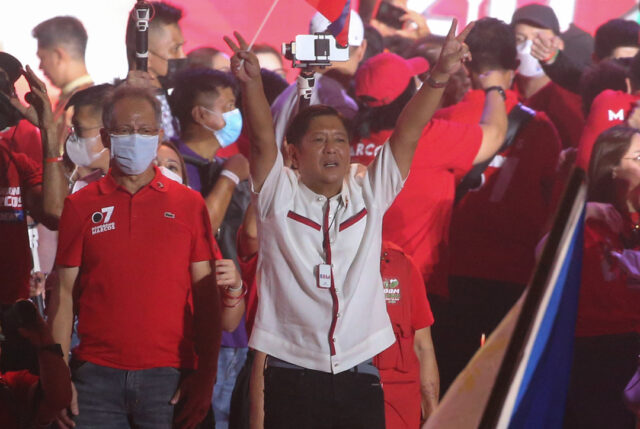
Presidential candidate Ferdinand "Bongbong" Marcos Jr. is seen at the miting de avance in Paranaque City, May 7. — PHILIPPINE STAR/KRIZ JOHN ROSALES

MANILA – The Philippines woke to a new but familiar political dawn on Tuesday, after an election triumph by Ferdinand Marcos Jr paved the way for a once unimaginable return to the country’s highest office for its most notorious political dynasty.

Marcos, better known as “Bongbong”, trounced bitter rival Leni Robredo to become the first candidate in recent history to win a Philippines presidential election majority, marking a stunning comeback by the son and namesake of an ousted dictator that has been decades in the making.

Marcos fled into exile in Hawaii with his family during a 1986 “people power” uprising that ended his father’s autocratic 20-year rule, and has served in congress and the senate since his return to the Philippines in 1991.

Marcos’s runaway victory in Monday’s election looked certain when early results of an unofficial vote poured in and with 95% of the eligible ballots counted, he had more than 30 million votes, double that of Robredo.

An official result is expected around the end of the month.

Marcos refused to celebrate, offering instead what he called a statement of gratitude.

“There are thousands of you out there, volunteers, parallel groups, political leaders that have cast their lot with us because of our belief in our message of unity,” he said, standing beside a national flag, in remarks streamed on Facebook.

“Any endeavour as large as this does not involve one person, it involves very, very many people working in very, very many different ways.”

Though Marcos, 64, campaigned on a platform of unity, political analysts say his presidency is unlikely to foster that, despite the huge margin of victory.

Many among the millions of Robredo voters are angered by what they see as a brazen attempt by the disgraced former first family to use its mastery of social media to reinvent historical narratives of its time in power.

Thousands of opponents of Marcos senior suffered persecution during a brutal 1972-1981 era of martial law, and the family name became synonymous with plunder, cronyism and extravagant living, with billions of dollars of state wealth disappearing.

The Marcos family has denied wrongdoing and many of its supporters, bloggers and social media influencers say historical accounts are distorted.

‘DETESTABLE IMAGE’

Human rights group Karapatan called on Filipinos to reject the new Marcos presidency, which it said was built on lies and disinformation “to deodorize the Marcoses’ detestable image”.

“Marcos Jr has not publicly acknowledged the crimes of his father and his family’s role, as direct beneficiaries,” it said in a statement.

“Marcos Jr continues to spit on the graves and sufferings endured by all the Marcos martial law victims by feigning ignorance on the numerous documented atrocities.”

Marcos, who shied away from debates and interviews during the campaign, recently praised his father as a genius and a statesman but has also been irked by questions about the martial law era.

As the vote count showed the extent of the Marcos win, Robredo told her supporters to continue their fight for truth until the next election.

“It took time to build the structures of lies. We have time and opportunity to fight and dismantle these,” she said.

Marcos gave few clues on the campaign trail of what his policy agenda would look like, but is widely expected to closely follow outgoing President Rodrigo Duterte, who targeted big infrastructure works, close ties with China and strong growth. Duterte’s tough leadership style won him big support.

Aries Arugay, a political science professor, said Marcos has much to do to prove he is sincere about unity.

“This polarization will happen regardless,” he said.

“Under a Marcos presidency, perhaps it will become more pernicious because I don’t think the unity slogan will be implemented, meaning reaching out to the other side.”

“It will be a tough sell because it is not credible.” — Reuters