Home Blog Page 6348

Independence Day weekend at Las Casas Quezon City  

Independence Day, for all Filipinos, should be a day to celebrate! And we know that the offers and festivities in store this June 12 at Las Casas, Quezon City are sure to instill Filipino sense of pride.

Back by popular demand, Las Casas QC’s Independence Day Fiesta Street Party will showcase the finest of Filipino cuisine, talents, and more. Celebrate with a Pinoy street food feast or delight in a Filipino-themed buffet dinner. Enjoy entertainment by local artists and performers as you dine amidst the awe-inspiring architecture and artistry that surrounds the plaza.

Celebrate with local craft cocktails made from local liquors, local craft beers, delicacies and so much more. They have also recently relaunched a new menu showcasing classic and modern Filipino dishes and a brand-new Spanish tapas menu that is sure to delight.

For dining reservations and more information about Las Casas Quezon City, call +63917 136 6796 or +63933 822 4522 or visit www.lascasasqc.com.


Spotlight is BusinessWorld’s sponsored section that allows advertisers to amplify their brand and connect with BusinessWorld’s audience by enabling them to publish their stories directly on the BusinessWorld Web site. For more information, send an email to online@bworldonline.com.

Join us on Viber to get more updates from BusinessWorld: https://bit.ly/3hv6bLA.

Phoenix Adarna takes flight with Cebu Pacific

A mobile game–themed flight from budget carrier Cebu Pacific and Tencent Games, a China-based game publisher, features Phoenix Adarna, a PUBG Mobile character inspired by the mythical bird of the same name from Philippine literature.   

Flight 5J 573, a Manila-to-Cebu flight that departs on June 15, will be assisted and crewed by personnel wearing costumes inspired by Phoenix Adarna and other PUBG Mobile characters. 

“Tencent Games and PUBG Mobile have always wanted to partner with an airline company especially since aircrafts are recurring elements within our game,” said Noel Bernard N. Dalmacio, senior business development manager of Tencent Games Philippines, in an e-mail to BusinessWorld.

“We hope that, through this partnership, our game can be a platform to promote Filipino culture and tourism to our young audience,” he said. “We definitely foresee more collaborations with Cebu Pacific in the future — perhaps even taking the partnership higher in terms of offerings and unique experiences we’ll provide to both our markets.” 

The themed flight — a first in Philippine aviation, according to Mr. Dalmacio — includes trivia games and limited-edition PUBG Mobile x Cebu Pacific merchandise.  

PUBG Mobile is a freemium game that has over 5 million registered users, with around 500,000 daily active users in the Philippines. It has more than 500 million downloads worldwide.  

The details of the mobile game-themed flight are subject to change without prior notice. — Patricia B. Mirasol

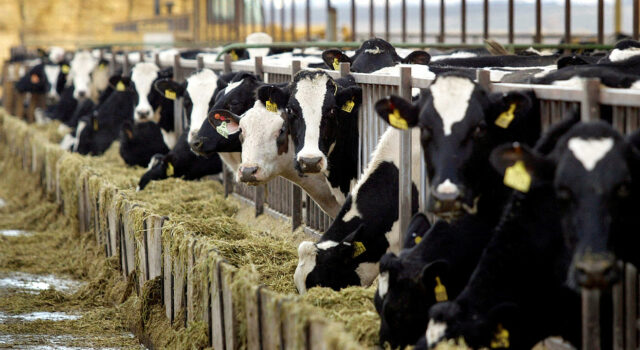
Global investors write to UN to urge global plan on farming emissions

REUTERS

LONDON — Investors managing $14 trillion have urged the United Nations to create a global plan to make the agriculture sector sustainable and curb one of the biggest sources of climate-damaging emissions, a letter seen by Reuters showed. 

Food production accounts for around a third of global greenhouse gas emissions and is the main threat to 86% of the world’s species at risk of extinction, the group said, while cattle ranching is responsible for three quarters of Amazon rainforest loss. 

Climate scientists warned in April that the world’s goal of limiting global warming to 1.5 degrees Celsius (2.7°F) above the pre-industrial average by mid-century could not be met without marked changes in land use. 

Despite this, a FAIRR Initiative study last year showed the emission reduction plans of most of the Group of 20 (G20) nations had no target to reduce agricultural emissions. 

Writing to the director general of the UN’s Food and Agriculture Organization (FAO), Qu Dongyu, the letter, coordinated by the investor network FAIRR, said the agency was best-placed to take the lead on creating a road-map to ensure better planning. 

“To keep the 1.5C goal within reach, the global food system urgently requires a gold-standard roadmap that reduces emissions whilst protecting the health and livelihoods of people across the globe,” said Guenther Thallinger, chair of the UN-convened Net-Zero Asset Owner Alliance (NZAOA), one of the signatories of the letter. 

“We urge the FAO to act on the science and work towards delivering this landmark roadmap.” 

As well as the NZAOA, whose members include insurers Allianz and Swiss Re, 33 other investors signed, including US asset manager Capital Group and Britain’s Aviva Investors. 

The call for action was also backed by Christiana Figueres, former executive secretary of the UN Framework Convention on Climate Change and one of the architects of the 2015 Paris Agreement on climate. 

FOCUS ON ‘GREEN REVOLUTION’
The launch of a similar report for the energy sector last year by the International Energy Agency had shown how successful such a roadmap could be, the investors said, and would prove a crucial tool to help investors and other stakeholders change their practices more quickly. 

Although the investors considered the FAO best-placed of the UN agencies to lead such work, Olivier De Schutter, co-chair of the International Panel of Experts on Sustainable Food Systems, said it had historically delivered a “mixed message about the impacts of agriculture … on climate change.” 

Despite typically promoting approaches relying on heavy machinery, large-scale irrigation, chemical fertilizers and pesticides to feed the world, all of which substantially increase greenhouse gas emissions, it had also pushed for low-input solutions that reduce dependency on fossil fuels. 

“The FAO has been far from consistent in this regard and there remains a huge gap between its pledge to support agroecology and the reality of the advice and project support it gives to countries,” he said. “My hope is that the initiative of these investors can force the FAO to rethink its policies.” 

The FAO did not respond to a request for comment. 

As well as setting clear guidance for companies and other stakeholders as to the volume of emissions that must be mitigated to limit warming to 1.5°C, the letter drew special attention to the need for a pathway to cut methane emissions. 

Livestock account for nearly a third of the global methane emissions linked to human activity, released in the form of cattle burps, manure and the cultivation of feed crops. 

Methane stays in the atmosphere for two decades compared with the centuries it takes for carbon dioxide to wash out, but a single methane molecule traps far more heat. — Reuters

US asks if China, Russia favor their ties over world security with North Korea vetoes

REUTERS/MIKE SEGAR/FILE PHOTO

UNITED NATIONS — The United States on Wednesday questioned whether China and Russia had elevated their “no limits” strategic partnership above global security by vetoing more UN sanctions on North Korea over its renewed ballistic missile launches. 

“We hope these vetoes are not a reflection of that partnership,” senior US diplomat Jeffrey DeLaurentis told a meeting of the 193-member UN General Assembly in response to the vetoes in the Security Council two weeks ago. 

“Their explanations for exercising the veto were insufficient, not credible and not convincing. The vetoes were not deployed to serve our collective safety and security,” said Mr. DeLaurentis, addressing the assembly after China and Russia. 

China and Russia declared a “no limits” partnership in February, nearly three weeks before Russia began its invasion of Ukraine. Their vetoes on North Korea publicly split the UN Security Council for the first time since it started punishing Pyongyang with sanctions in 2006. 

During a right of reply in the General Assembly later on Wednesday, Chinese diplomat Wu Jianjian said China categorically rejected “presumptuous comments and accusations against China’s voting position.” 

“China’s vote against the US-tabled draft resolution was entirely reasonable and justified,” Mr. Wu said. “Continuing to increase the sanctions against DPRK (North Korea) would only make the likelihood of political solution even more remote.” 

The Russian UN mission did not immediately respond to request for comment on the US remarks. 

North Korea has carried out dozens of ballistic missile launches this year, including intercontinental rockets commonly known as ICBMs, after breaking a moratorium on tests that it self-imposed in 2018 after leader Kim Jong Un first met then-US President Donald Trump. 

The United States has warned that North Korea is preparing to conduct a seventh nuclear test, and says it will again push for UN sanctions if it takes place. 

Earlier on Wednesday in his speech to the General Assembly, China’s UN Ambassador Zhang Jun blamed a “flip-flop of US policies” for a renewed escalation of tensions, pushing Washington to take action. 

“There are many things that the US can do, such as easing sanctions on the DPRK (North Korea) in certain areas, and ending joint military exercises (with South Korea). The key is to take actions, not just talk about its readiness for dialogue with no preconditions,” said Mr. Zhang. 

Mr. DeLaurentis said Washington was “more than prepared to discuss easing sanctions to achieve the complete denuclearization of the Korean Peninsula.” He said the United States has repeatedly tried to restart talks, sending public and private messages, but had not received a response. 

North Korea defended its development of ballistic missiles and nuclear weapons as protection against “direct threats” from the United States. Mr. DeLaurentis said Pyongyang’s missile launches and nuclear tests were unprovoked. 

“The measures that the DPRK is taking for bolstering national defense capabilities are an inevitable choice to cope with the hostile threats of the US within the scope of self-defense rights,” North Korea’s UN Ambassador Kim Song told the General Assembly. — Reuters

ECB to chart course out of stimulus, setting stage for rate hikes

FRANKFURT — The European Central Bank (ECB) will pull the plug on years of stimulus on Thursday and signal a string of rate hikes to fight surging inflation, leaving markets only to guess the size and speed of policy tightening. 

With inflation at a record-high 8.1% and broadening quickly, the ECB has already flagged a series of moves, hoping to stop rapid price growth from developing into a hard-to-break wage-price spiral. 

Details remain elusive, however, as predicting inflation has proven impossible, suggesting the ECB will only signal its initial steps on Thursday and maintain plenty of discretion further down the line. 

What appears certain is that the ECB will end its long-running Asset Purchase Programme at the end of this month, promise a rate hike on July 21 and signal that the deposit rate will be out of negative territory in the third quarter. 

Everything else, including the size of the initial rate increase from minus 0.5%, is likely to be left open, with ECB chief Christine Lagarde emphasizing flexibility and optionality. 

While the bank has signaled a preference for 25-basis-point hikes, the energy-driven surge in prices could change that in just weeks. A handful of policymakers have already said that a bigger increase needs to remain in play. 

Supporting their case, new economic projections from the ECB are likely to indicate that inflation across the 19 countries that use the euro will hold above its 2% target through 2024, pointing to four straight years of overshooting. 

“The likelihood of a 50-basis-point hike is rising by the day,” Moody’s Analytics senior economist Kamil Kovar said. 

“We currently view a 50-basis-point hike in July as possible but unlikely. In contrast, a 50-basis-point hike in September is as likely as it is unlikely at this point.” 

“It is even possible that the bank will resort to multiple 50-basis-point hikes,” he said. 

Markets are pricing in 135 basis points of rate hikes by the end of this year, or an increase at every meeting from July, with some of the moves in excess of 25 basis points. 

That leaves the ECB in a tricky position, just months after Ms. Lagarde said that a rate hike this year was highly unlikely. 

If she ignores markets, even more aggressive tightening might be priced in, unnecessarily pushing up borrowing costs. But if she pushes back strongly, the ECB president might signal a commitment that could become obsolete within weeks, much like the no rate increase pledge. 

The ECB’s first rate hike in over a decade would still leave it trailing most of its global peers, including the US Federal Reserve and the Bank of England, which have been raising aggressively and promising even more action. 

“The hawkish pivot begins,” Bank of America said in a note. “We expect the ECB to leave the door open to 50 basis points in July and September by signaling that negative rates will end during the third quarter.” 

WHERE DOES IT END? 

While the start of policy tightening is now set, the end point remains uncertain. 

Ms. Lagarde has said that rates should move towards the neutral point at which the ECB is neither simulating nor holding back growth. But this level is undefined and unobservable, leaving investors guessing just how far the ECB wants to go. 

“In our view, the ‘neutral’ rate … is around 2%,” Berenberg economist Holger Schmieding said. 

“We expect the ECB’s main refinancing rate — currently 0.0% — to reach this level in mid-2024 after three rate hikes of 25 basis points in the second half of 2022, three such moves in 2023 and two further increases in the first half of 2024.” 

The main refinancing rate is formally the ECB’s benchmark but it has used the rate on its overnight deposit facilities for banks as its main policy rate for much of the past decade given that banks have piled up hundreds of billions of euros worth of excess liquidity. 

Another question is how the ECB will handle the divergence in borrowing costs of various member states. 

Nations with bigger debt piles, such as Italy, Spain and Greece, have already seen a sharper increase in borrowing costs — a headache for the ECB’s one-size-fits-all monetary policy. 

While the ECB promised to fight “unwarranted fragmentation” it has yet to define unwarranted and has not said what action it would take to tackle it. 

Ms. Lagarde could clarify these points but she is unlikely to announce a specific tool on Thursday, emphasizing instead the ECB’s flexibility and commitment to act quickly in case of market turmoil. — Reuters

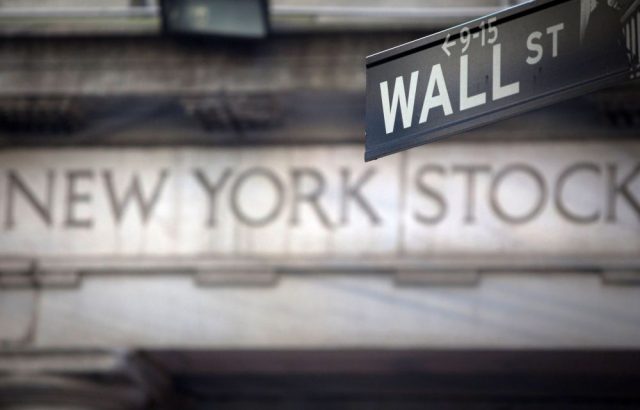
US SEC chief unveils plan to overhaul Wall Street stock trading

REUTERS

WASHINGTON/NEW YORK — The top US securities regulator on Wednesday unveiled a planned overhaul of Wall Street retail stock trading rules, aiming to boost competition for handling orders by commission-free brokerages to ensure mom-and-pop investors get the best price for trades. 

US Securities and Exchange Commission (SEC) chair Gary Gensler told an industry audience he wants to require trading firms to directly compete to execute trades from retail investors. 

The Wall Street watchdog plans to scrutinize growth in recent years of the payment for order flow (PFOF) practice, which is banned in Canada, the UK, and Australia. 

Some brokers, such as TD Ameritrade, Robinhood Markets, and E*Trade, accept these payments from wholesale market makers for orders. In December 2020, Robinhood actually paid a fine related to the practice, which the SEC said raised costs for investors using the online brokerage. 

A ban on the PFOF practice is not off the table, Mr. Gensler has said. On Wednesday, he said the practice has “inherent conflicts,” while noting some zero-commission brokerages operate without PFOF. 

“I asked staff to take a holistic, crossmarket view of how we could update our rules and drive greater efficiencies in our equity markets, particularly for retail investors,” Mr. Gensler said. 

Investor advocates praised the SEC’s plan, which would be the biggest shake-up of US equity market rules in over a decade. But financial industry executives quickly blasted the plans, saying they could hinder commission-free brokerages from serving more investors. 

“Too many in the financial industry today get rich from anti-competitive and predatory practices in highly fragmented markets that result in retail investors being mistreated if not ripped off,” said Dennis Kelleher, the chief executive of Washington-based advocacy group Better Markets, who supports the SEC’s plans. 

Joseph Mecane, head of execution services at Citadel Securities warned against broad plans to revamp the market. 

“We talk about how our markets are the envy of the world,” said Mr. Mecane. “We need to be very careful about … unintentionally taking us back to a period that looks worse that how it looks today.” 

“Let’s keep our eye on the retail investor who has never had it better as far as liquidity and low cost trading,” said Kirsten Wegner, who leads the Modern Markets Initiative, a Washington-based group that represents high-speed trading platforms. 

Mr. Gensler said if PFOF is still allowed, the SEC wants rules to mandate market makers disclose more data around fees these firms earn and the timing of trades. 

Mr. Gensler’s announcement would generate any formal proposals in the fall. The public could then weigh before the SEC votes on whether to adopt them. 

Dan Gallagher, Robinhood’s chief legal, compliance and corporate affairs officer, said his firm “looks forward to reviewing the Commission’s eventual rule proposal and engaging with the SEC during a meaningful notice and comment rulemaking process.” 

The intended changes would fundamentally alter the business model of wholesalers. They could also affect brokers’ ability to offer commission-free trading to retail investors. Reuters first flagged the reforms in March. 

PFOF came under regulatory scrutiny last year when an army of retail investors went on a buying spree of “meme stocks” like GameStop and AMC, squeezing hedge funds that had shorted the shares. Many investors purchased shares using commission-free brokers such as Robinhood. 

To enhance order-by-order competition, the new rules would call for “open and transparent” auctions aimed at providing investors better prices. They would also require dealers executing trades to ensure the best price for investors and to improve transparency around the procedural standards brokers must meet when handling and executing orders. 

They would also require broker dealers and market centers to disclose more data including a monthly summary of price improvement and other statistics, Mr. Gensler said. 

The rules would seek to shrink the minimum pricing increment or so-called tick size to ensure all trading occurs in the minimum increment. 

WHOLESALE OVERHAUL 

Currently, retail brokerages can send customer orders directly to a wholesale broker to be executed, as long as the broker is matching or bettering the best price available on US exchanges. Large market-makers typically improve on the best price by a fraction of a cent. Gensler has criticized this model as limiting competition for retail orders. 

“It’s great to see the SEC taking a holistic approach to this problem — there’s not a single answer, we need changes to different parts of the market,” said Dave Lauer, chief executive officer of financial platform Urvin Finance. — Reuters

After lockdown, Shanghai tries to mend fences with foreign firms

A VIEW of the city skyline in Shanghai, China, Feb. 24, 2022. — REUTERS

SHANGHAI — Shanghai officials are seeking to revive confidence among multinational companies bruised and frustrated by the city’s coronavirus disease 2019 (COVID-19) lockdown by holding multiple meetings with foreign firms and easing a key border requirement for overseas workers. 

The image of China’s most cosmopolitan city and its biggest business hub was badly damaged by the two-month lockdown, with countless expatriates relocating and foreign businesses warning that they are reconsidering investment plans. 

The Shanghai government plans to hold 20 meetings this month with foreign firms engaged in key industries such as automobiles, trade, semiconductors and biomedicine, a report by the Jiefang Daily, a Shanghai government-backed newspaper, said on Sunday. The report was reposted on the Shanghai city website. 

The firms would be picked from major investment countries and regions, including the United States, Europe, Japan, and South Korea. 

Four online meetings have been held so far since June 1, when the city eased its lockdown, according to Shanghai government statements. 

The first was attended by executives from US blue chips such as Procter & Gamble and Johnson & Johnson, and the second included automakers Tesla, General Motors, and Ford. The companies did not respond immediately to requests for comment on Wednesday. 

In addition, the European Chamber of Commerce said on Tuesday it had been informed during a meeting with the city’s vice mayor that Shanghai will no longer require official invitation letters, so-called PU letters, for foreigners returning for work and their dependents, addressing what had become a bugbear for the expat community. 

China began in early 2020 to require foreigners to obtain PU letters as part of their visa application as it dramatically tightened border controls when the coronavirus pandemic hit. 

Many firms had complained about the difficulties and long waits in obtaining the document, which impeded the hiring of foreign staff. 

‘INITIATIVE TO ENCOURAGE WORK’ 

The removal of this requirement was “an initiative from central government to encourage work and production resumption in Shanghai,” the European Chamber said. 

Asked for comment on Wednesday, the Shanghai government referred to remarks city official Gu Jun made at a press conference in late May, in which he acknowledged that the epidemic had impacted foreign trade and investment in the city. 

He said the city would take measures to boost confidence among businesses and support multinationals in setting up regional headquarters and research centers in Shanghai. It did not provide further comment. 

Tom Simpson, managing director of the China-Britain Business Council, said it was expecting to meet with the Shanghai government in the coming weeks. 

Shanghai had provided its members “more practical” business resumption support including issuing logistics permits and reopening warehouses, he said. 

During the lockdown, Shanghai tried to keep factories open under “closed loop” operations but businesses said the arrangements posed numerous difficulties. 

The lack of flights into China — the vast majority have been canceled for more than two years – also remains a key hindrance. 

China has resolutely stuck to a “zero-COVID” policy that aims to eradicate the spread of the virus, an approach that is increasingly out of step with the rest of the world where economies have reopened after vaccination campaigns. 

Joerg Wuttke, president of the EU Chamber, said the zero-COVID policy was not just denting Shanghai’s attractiveness, but China as a whole, especially as other rival markets open and try to lure companies away from China. 

“The world is not going to wait for China to clean this mess,” he said. — Reuters

Manufacturing growth eases to 13-month low in April

Factory output eased to its lowest in 13 months in April, the Philippine Statistics Authority (PSA) reported this morning.

Preliminary results from the PSA’s Monthly Integrated Survey of Selected Industries (MISSI) showed manufacturing output, as measured by the volume of production index (VoPI), went up 3.4% year on year in April.

This was slower than the revised 352.3% growth in March and the 157.8% in April last year.

It marked the slowest pickup in 13 months or since the 73.1% contraction in March last year.

Manufacturing growth averaged 54.8% in the first four months to April.

Fourteen out of 22 industry divisions recorded expansions in April, led by textiles with 45.6% which grew almost twice from the previous month’s record of 24%. This was followed by manufacture of machinery and equipment except electrical with 39.2% (from March’s 48.4%).

On the other hand, declines were recorded for eight industry divisions.

In comparison, S&P Global’s Philippines Manufacturing Purchasing Managers’ Index rose to 54.3 in April from 53.2 in March. It was the highest reading in more than four years since the 54.8 print in November 2017

The 50-mark separates manufacturing expansion from contraction.

The capacity utilization — the extent to which industry resources are used in producing goods — averaged 69.2% in April, slower from the revised 70.9% in the previous month. Of the 22 sectors, 18 industries reached an average capacity utilization rate of at least 60%. — AMPY


April trade deficit narrows as import growth eases to 13-month low

The country’s trade-in-goods deficit narrowed in April as merchandise import growth eased to 13-month low, the Philippine Statistics Authority (PSA) reported earlier this morning.

Preliminary PSA data showed the value of merchandise exports grew by 6% year on year to $6.129 billion in April.

This was lower than the 74.1% increase in the same month in 2021 but higher than the 5.9% growth in March.

It was the highest export growth in two months since the 15.8% recorded in February.

Meanwhile, the country’s merchandise imports rose by 22.8% to $10.902 billion in April. This was slower than the 153.2% growth in the same month last year and the 27.7% import growth the previous month.

This was the lowest import growth in 13 months or since the 22.1% growth in March 2021.

This brought the trade-in-goods deficit to $4.773 billion in April, wider than the $3.098-billion shortfall recorded a year ago, but narrower than the $5.007-billion gap in March.

Exports rose by 8.9% year on year to $25.55 billion in the four months to April, above the revised 7% growth projected by the Development Budget and Coordination Committee for 2022.

Imports climbed by 26.7% to $44.22 billion in the January to April period. This pace was above the government’s also revised 15% assumption.

Year to date, the trade balance ballooned to a $18.668-billion deficit, from a $11.442-billion trade gap in the comparable four months last year. — LOP

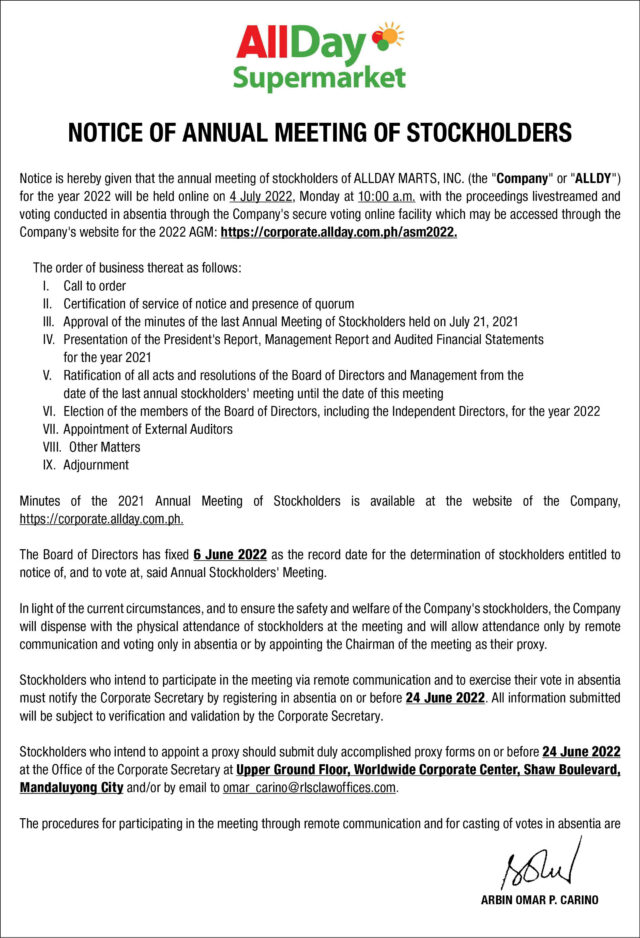
AllDay Marts, Inc. announces annual meeting of stockholders to be held online on July 4


Spotlight is BusinessWorld’s sponsored section that allows advertisers to amplify their brand and connect with BusinessWorld’s audience by enabling them to publish their stories directly on the BusinessWorld Web site. For more information, send an email to online@bworldonline.com.

Join us on Viber to get more updates from BusinessWorld: https://bit.ly/3hv6bLA.

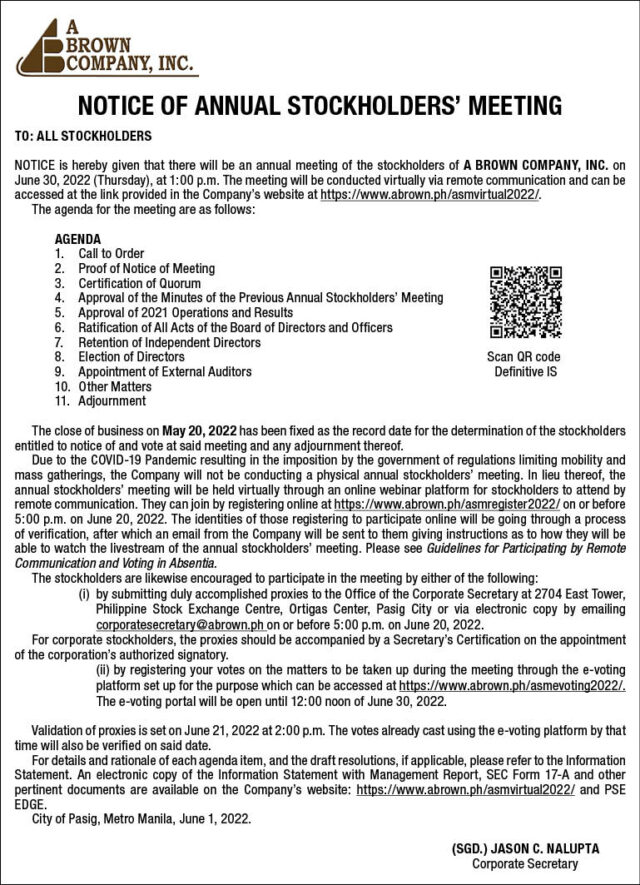
A Brown Company, Inc. to hold annual stockholders’ meeting via remote communication on June 30


Spotlight is BusinessWorld’s sponsored section that allows advertisers to amplify their brand and connect with BusinessWorld’s audience by enabling them to publish their stories directly on the BusinessWorld Web site. For more information, send an email to online@bworldonline.com.

Join us on Viber to get more updates from BusinessWorld: https://bit.ly/3hv6bLA.

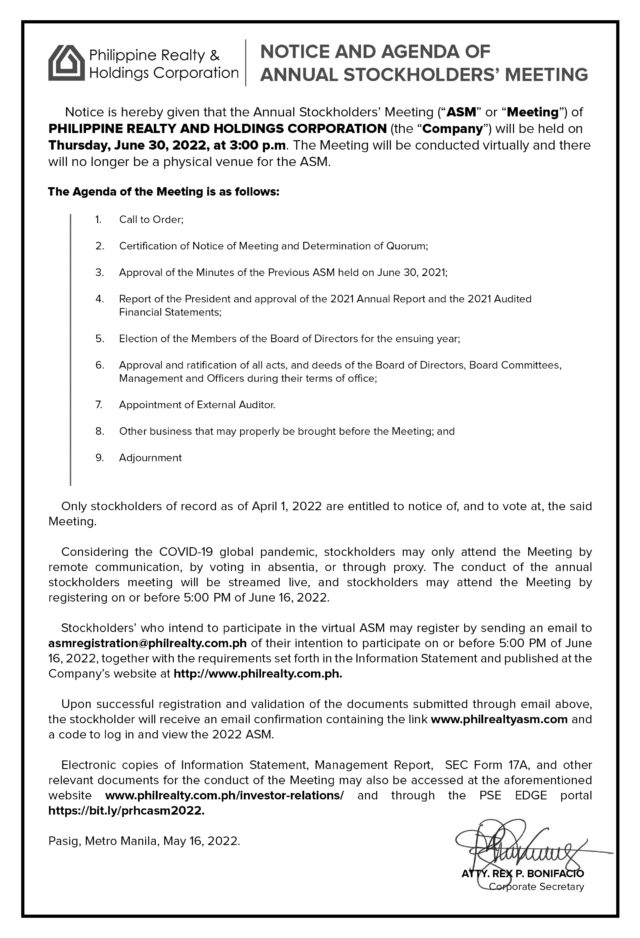
Philippine Realty and Holdings Corp. to conduct annual stockholders’ meeting on June 30


Spotlight is BusinessWorld’s sponsored section that allows advertisers to amplify their brand and connect with BusinessWorld’s audience by enabling them to publish their stories directly on the BusinessWorld Web site. For more information, send an email to online@bworldonline.com.

Join us on Viber to get more updates from BusinessWorld: https://bit.ly/3hv6bLA.

ADVERTISEMENT
ADVERTISEMENT