Home Blog Page 6294

Philippines remains on FATF ‘gray list’
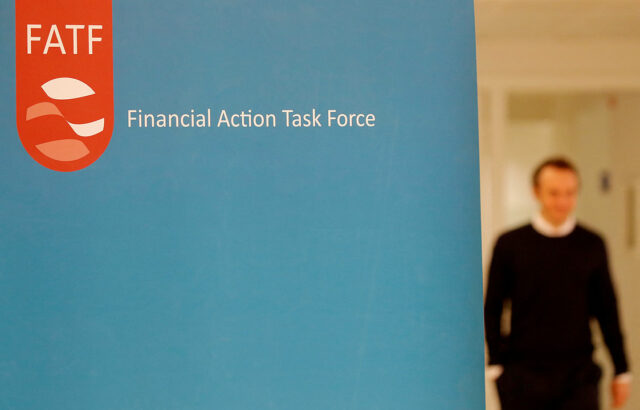
THE LOGO of the Financial Action Task Force (FATF) is seen at the OECD headquarters in Paris, France, Oct. 18, 2019. — REUTERS

By Luz Wendy T. Noble, Reporter

THE Philippines remained on the “gray list” of jurisdictions subjected to increased monitoring for “dirty money” risks, according to the Financial Action Task Force (FATF).

The global financial crime watchdog in a statement on Friday said the Philippines still needs to implement measures to address risks related to casino junkets, nonprofit organizations, and beneficial ownership.

However, the FATF acknowledged the Philippines’ progress in combating financial crimes in terms of policies related to sanctions against terrorism financing and increasing manpower of the Anti-Money Laundering Council (AMLC).

“Since June 2021, when the Philippines made a high-level political commitment to work with the FATF and APG (Asia/Pacific Group on Money Laundering) to strengthen the effectiveness of its anti-money laundering and counter financing of terrorism (AML/CFT regime), the Philippines has taken steps towards improving its AML/CFT regime, including by increasing the resources of its financial intelligence unit (FIU) and utilizing its targeted financial sanction framework for terrorism financing, ahead of any relevant deadlines expiring,” the FATF said in a statement on Friday.

The AMLC in August 2021 opened a new satellite office in Quezon City to accommodate their additional manpower. AMLC Executive Director Mel Georgie B. Racela said they have been hiring more financial intelligence analysts, investigators, and lawyers to boost the operational capabilities of their units on compliance as well as litigation and evaluation.

“Relevant Philippine authorities continue to work together in strengthening the country’s AML/CFT measures and in showing progress toward effectiveness,” Mr. Racela said in a Viber message.

Based on the FATF’s latest assessment, the Philippines needs to show it is implementing effective risk-based supervision of designated nonfinancial businesses and professions. These include jewelry dealers, real estate brokers and developers and service providers for financial businesses. 

The dirty money watchdog also has to improve monitoring controls to mitigate financial crimes associated with casino junkets.

“PAGCOR (Philippine Amusement and Gaming Corp.) is the relevant agency implementing this action plan as it supervises and examines casinos with junket operations. PAGCOR is currently identifying risks posed by junket operations and will subsequently implement necessary measures to mitigate these risks,” Mr. Racela said.

The FATF also said it will continue to track the country’s progress in ensuring beneficial ownership information is streamlined and up to date for better access of law enforcement agencies.

It will also keep a close eye on the Philippines’ implementation of appropriate measures for nonprofit organizations (NPOs) without disrupting their legitimate activities.

Mr. Racela said the AMLC together with the Securities and Exchange Commission, the Department of Social Welfare and Development, and the Securities and Exchange Commission will be working on policy measures for nonprofit groups.

“Measures to be adopted are geared toward good governance of the NPO sector: registration with relevant authorities, annual reporting and compliance with legal requirements, financial transparency and accountability, and program planning and monitoring, among others,” he said.

The FATF will also keep a close eye on the country’s progress in registration requirements for money or value transfer services, as well as imposing sanctions against illegal operators.

Lastly, the watchdog will check if there is an increase in investigations and prosecutions related to money laundering cases, and the effectivity of the targeted financial sanctions framework for both terrorism financing and proliferation financing.

The Philippines will submit its next progress report to the FATF in May.

Officials are hoping that the Philippines will be removed from the FATF’s gray list by January 2023.

It was June 2021 when the country was once again included in the FATF gray list. While the FATF did not call for enhanced due diligence for transactions, the government earlier said some Philippine-related transactions have been subjected to more scrutiny.

BSP chief says PHL credit rating downgrade unlikely

PHILIPPINE STAR/ MICHAEL VARCAS

THE PHILIPPINES’ investment grade rating is unlikely to be downgraded as the country’s outstanding debt remains “manageable,” the central bank governor said.

“[T]he likelihood that the Philippines’ ratings will be downgraded by rating agencies (is) nil,” Bangko Sentral ng Pilipinas (BSP) Governor Benjamin E. Diokno said in a Viber message to reporters.

He said the country’s outstanding public debt is still manageable despite reaching a record P12.03 trillion as of end-January, as economic growth could outpace the increase in debt amid the recovery from the pandemic.

“At its current ratio, the public debt is quite manageable. The country can easily outgrow its debt since we expect the Philippine economy to grow much faster than its debt,” Mr. Diokno, a former Budget secretary, said.

Fitch Ratings last month kept the country’s investment grade “BBB” rating, but maintained the “negative” outlook. A negative outlook means a downgrade is possible within the next 12 to 18 months.

Fitch noted the country still faces hurdles in bringing down debt.

The debt-to-gross domestic product (GDP) ratio was at 60.5% as of end-2021, the highest since the 65.7% in 2005. This was also slightly above the 60% threshold considered as manageable by multilateral lenders for developing economies. The ratio was much higher than the 39.6% seen as of end-2019 prior to the pandemic.

Still, Mr. Diokno said the country’s debt-to-GDP ratio is still much lower compared with other countries with ratios ranging from 100% to 200%. He added that the country’s foreign debt is also less than a third of the borrowings.

“For the Philippines, it [foreign debt-to-GDP ratio) is 27.3% (the lowest in the ASEAN-5 countries), which means the servicing of its foreign debt is fairly manageable. Most of its foreign debt are medium to long term, and a big chunk of which has fixed interest rates,” he said.

Latest data from the Bureau of the Treasury showed that outstanding debt reached a record P12.03 trillion as of end-January, higher by 2.6% from a month prior and by 16.5% a year earlier. The Treasury attributed the month-on-month uptick to the latest P300-billion zero-interest loan from the BSP and more domestic borrowings.

FED JITTERS
Amid worries over the possible impact of the impending rate hike by the US Federal Reserve, Mr. Diokno said the market-driven foreign exchange system and ample gross international reserves (GIR) will guard the economy from possible external shock.

“The Philippines is not the typical emerging economy. Our first line of defense is our market-determined foreign exchange system where we let the supply-demand dynamics determine the exchange rate, subject to BSP’s participation only to smoothen the fluctuations,” he said.

Dollar reserves slipped by 1% month on month to $107.69 billion as of end-January, based on latest BSP data.

This is enough to cover 8.4 times the country’s short-term external debt based on original maturity and 5.7 times based on residual maturity. It is also equivalent to 10.2 months’ worth of imports of goods and payments of services and primary income.

“And we have a steady sources of foreign exchange inflows from overseas Filipino remittances, BPO receipts, exports earnings and surging foreign direct investment,” Mr. Diokno added.

ING Bank N.V. Manila Senior Economist Nicholas Antonio T. Mapa in an e-mail on Friday said that while most of the country’s outstanding debt are peso-denominated, a continued depreciation of the peso versus the dollar could still make borrowings more costly. 

At its close of P51.74 per dollar on Friday, the peso has weakened by 1.45% from its P50.999 finish at the end of 2021.

Last month, Nomura Global Markets Research Chief ASEAN (Association of Southeast Asian Nations) Economist Euben Paracuelles and analyst Rangga Cipta said a ratings downgrade by Fitch is still possible after the election. They said the country’s weak economic recovery, risk of scarring effects, as well as uncertain path for fiscal consolidation may lead to a rating downgrade as the outlook remains negative.

S&P Global Ratings last affirmed the country’s “BBB+” rating with a stable outlook in May last year. Meanwhile, Moody’s last affirmed its “Baa2” credit rating with a stable outlook for the Philippines in July 2020. — Luz Wendy T. Noble

Gross borrowings hit P2.58 trillion in 2021

BW FILE PHOTO

GROSS BORROWINGS by the National Government from domestic and external sources hit P2.58 trillion in 2021, as it continued to finance its pandemic response, data from the Bureau of the Treasury (BTr) showed.

The bureau’s most recent cash operations report showed that total borrowings slipped by 5.9% year on year to P2.58 trillion as of end-December 2021.

Local debt accounted for 78% of this total, while the rest was sourced from foreign creditors.

In December alone, total gross borrowings resulted in a net redemption of P196 billion, which means debts paid back were larger than new borrowings.

Total gross domestic debt that month resulted in a net redemption of P236 billion. This was smaller than the P465-billion net redemption logged in the same month the previous year.

The BTr raised P360 billion from retail Treasury bonds in December, while there was a net redemption of Treasury bills worth P56 billion.

It repaid P540 billion to the central bank for its advances.

Meanwhile, gross external borrowings in December reached P39.86 billion, down nearly 75% year on year.

The government that month took out P13.74 billion in new project loans and P26.12 billion in program loans from foreign sources.

FULL-YEAR 2021
Breaking down total gross borrowings for the year, local debt accounted for P2.01 trillion of the total, inching up by 0.59% year on year.

Broken down, the bulk of local gross borrowings were sourced from fixed-rate Treasury bonds that amounted to P1.26 trillion. Another P823.35 billion came from retail Treasury bonds. Meanwhile, retail onshore dollar bonds reached a total of P80.84 billion.

Treasury bills resulted in a net redemption of P153.34 billion.

Meanwhile, gross external borrowings hit P568.67 billion, slipping by 23.4% year on year.

Broken down, the bureau raised P146.17 billion from global bonds, P121.97 billion from euro-denominated notes, and P24.19 billion in Japanese yen-denominated securities.

The government also recorded P166.1 billion in program loans along with P110.24 billion in project loans.

The government borrows from local and foreign sources to finance a widening budget deficit after the coronavirus pandemic stalled the economy and pulled down tax collections.

Outstanding debt reached a record P12.03 trillion at the end of January this year after it took out another zero-interest loan from the central bank and borrowed locally.

The National Government’s debt level increased by 16.5% year on year. — Jenina P. Ibañez

Obiena jumps season-best 5.91m for silver medal finish in France

OLYMPIAN pole-vaulter Ernest John “EJ” Obiena delivered his best performance of the season as he cleared 5.91 meters in snaring the silver medal in the Perch Elite Tour in Rouen, France on Sunday.

Mr. Obiena, 26, needed just one attempt in eclipsing his previous season best of 5.81m he set twice in Poland last month and the old national record of 5.86m he registered in last year’s Orlen Cup also in Poland.

The World No. 5, whose best is a current Asian record 5.93m he inked in the Golden Roof Challenge in Innsbruck, Austria a year ago, went for a career best 6.01m, but failed in three attempts.

American Chris Nilsen, a 2021 Tokyo Olympics silver medalist, seized the gold with an impressive 6.05m, which matched the season-best first set by Swedish Armand Duplantis last month.

Tokyo bronze medal winner Thiago Braz of Brazil copped the bronze with a 5.91m.

Philippine Athletics Track and Field Association (PATAFA) national training director Renato Unso on Sunday told The STAR that Mr. Obiena’s recent would still be recognized as a national record even if the latter is not part of the national pool and isn’t endorsed by the former.

“All of his records, as long as World Athletics recognized the competition he joined, is valid and okay for PATAFA,” said Mr. Unso.

Mr. Obiena was expelled from the national team following his spat with PATAFA, which accused the former of allegedly falsifying liquidations regarding payments to Ukrainian coach Vitaly Petrov.

The Southeast Asian Games gold medalist denied it. — Joey Villar

Airbus sees signs of gradual recovery in PHL market

AIRBUS.COM

By Arjay L. Balinbin, Senior Reporter

EUROPEAN aerospace company Airbus SE said it is seeing signs of gradual recovery in the Philippines, helping boost demand for new aircraft in the Asia-Pacific region.

“In February, the Philippines reopened its borders to fully vaccinated travelers. We are encouraged that more countries are easing restrictions, which will contribute to air travel recovery in the region,” Airbus Asia-Pacific President Anand Stanley told BusinessWorld in an e-mailed reply to questions last week.

“Airbus is seeing a gradual recovery in the air transport market in Asia-Pacific, with several governments moving to ease border and quarantine measures,” he noted. “The pent-up demand is there, but it is still being restrained by complex and uncoordinated protocols.”

Starting Feb. 10, Philippine borders were opened to fully vaccinated travelers from countries whose citizens enjoy 30-day visa-free entry privileges.

Airlines are also allowed to operate at full capacity in the capital region and 38 other areas placed under the Alert Level 1 status of the lockdown. But public travels between an area with a higher alert level classification and an area under Alert Level 1 will be limited to the capacity of the area at higher risk.

The Transportation department has said the country’s main gateway, the Ninoy Aquino International Airport, is ready to increase its passenger arrival cap to 10,000 from 5,000 in anticipation of the influx of arriving passengers.

“There is a tremendous appetite for people to fly again, reconnect with families and friends, and to restart business,” Mr. Stanley said.

Airbus sees a 5.3% passenger traffic growth per year in the Asia-Pacific region, translating into a need for 17,620 passenger and freighter aircraft.

“Of the demand for 17,620 aircraft, 13,660 are in the small category like the A220 and A320 Family. In the medium and long-range categories, Asia-Pacific will continue to drive demand with some 42% of global requirement. This translates to 2,470 medium and 1,490 large category aircraft,” the company said in a statement posted on its website.

Flag carrier Philippine Airlines (PAL) has said that it is working with Airbus to modify 15 of its aircraft to accommodate more passengers.

Airbus will add more seats to PAL’s 11 A320 aircraft, two A330-300s, and two A350-900s. PAL’s A320 planes will have 24 extra seats, bringing the total seat count to 180. This configuration “suits the airline’s requirements for short-haul inter-island domestic routes,” the flag carrier said.

Paris Fashion Week: Yamamoto plays with layers, volumes while Chloe goes no-fuss

CHLOE — CHLOE.COM

PARIS — True to its codes of draping techniques, layering, and unfinished looks, Yohji Yamamoto’s autumn and winter collection displayed Friday in Paris showcased busy designs with lace skirts, shredded garments and inflated dresses.

The show opened with a succession of blue denim jackets over layers of fluid tunics and skirts.

Models strutted under the fresco ceiling of the French capital’s Hotel de Ville wearing mostly black but two head-to-toe white looks stood out with asymmetrical blazer, ruffled skirt with raw edge details and sneakers.

There were no accessories other than wire hats on grunge hairstyles.

There were passages of tucked skirts and warm jackets, puffer coats and draped shirts, followed up by models wearing to close the show a pile of knitted garments topped with umbrella hats made of wool. (View the show here: https://www.yohjiyamamoto.co.jp/en/projects/yyfemme_aw2022/ )

CHLOE SHOWS OFF NO-FUSS WINTER STYLES
French fashion house Chloe combined sleek lines and cozy fabrics in its new winter collection at Paris Fashion Week on Thursday, with knitted dresses, leather midi skirts and teddy bear coats. (See the show here: https://www.chloe.com/ph )

Model Amber Valletta, wearing minimal makeup, strolled down a sand-covered catwalk in a long patchwork coat at the close of show, showcasing the design house’s understated approach.

Black, ecru, and variations of orange tones dominated most of the looks for the Richemont-owned CFR.S French label, founded by Gaby Aghion and celebrating its 70th anniversary this year.

Models wore thick ponchos with a bohemian touch and long knitted outfits, some sporting wilderness patterns and pantsuits suitable for everyday wear.

Leather was dominant, worked into balloon sleeve dresses, trousers paired with tank tops, belted coats and cowboy boots.

SILKY EVENING GOWNS FROM YSL
French fashion house Yves Saint Laurent hosted an evening catwalk presentation at Paris Fashion Week on Tuesday, showcasing a series of slender cocktail gowns from a catwalk overlooking the base of the Eiffel Tower. (Watch the show here: https://www.ysl.com/en-en/displayname-collections-ws22-fashion-show )

Long-legged models strode across a pale pink carpet in long, sleek dresses, some wispy at the bottom, and wrapped in sharp-shouldered tuxedos and oversize faux-fur coats, as electronic music by French DJ Sebastian played.

In his show notes, creative director Anthony Vaccarello cited the style of 20th century anti-fascist poet Nancy Cunard, known to favor chunky jewelry and masculine silhouettes.

Echoing her look, some outfits were accessorized with stacks of large bracelets or prominent earrings while long coats and low-waisted jackets were worn with the collars turned up.

Soft fabric flowers pinned to dresses and jackets added a touch of romance to the somber color palette of mostly black with touches of ivory and light brown.

The Kering-owned label closed the second day of shows at Paris Fashion Week, which runs through March 8 and caps a month of fashion events in New York, London and Milan.

DIOR TAKES A SURVIVAL THRUST
Dior cast fashion as a means of survival, kicking Paris Fashion Week into full swing last Tuesday with a lineup of house classics, reworked — and rewired — with a technical bent. (See the show at https://www.dior.com/en_int/womens-fashion/ready-to-wear-shows/autumn-winter-2022-2023-ready-to-wear-show )

Models took to a runway set in the French capital’s Tuileries Gardens, parading a collection of polished, feminine looks infused with workwear references, pairing sheer dresses with motorbike jackets and gloves, adding utility pockets to long skirts, and tossing airbags and stylized bullet-proof vests over shoulders.

The LVMH-owned label was the first major brand to show at Paris Fashion Week.

“I think that to explore this kind of territory helps us to understand the real value of fashion,” Maria Grazia Chiuri, womenswear designer for the LVMH-owned label, said in an interview.

“Sometimes we think of fashion only with an idea of an embellishment of our body, not something where our body lives,” she added.

The designer worked with D-Air Lab, an Italian company that makes safety gear with airbags designed for workers that fix wind turbines, and protective clothing for Artic exploration — linked to the label Dainese, of Seventies-era motorcycle suit fame.

The opening look, a catsuit wired with luminescent tubing, came out before the lights went up, setting the stage for those that followed, blending high-tech nylon with cashmere, sheer mesh, cinched bar jackets outfitted with heating systems, corsets and biker shorts, accessorized with futuristic goggles and sparkling head bands, that sat atop tightly-woven braids, tucked closely around the head. — Reuters

Emgrand prix

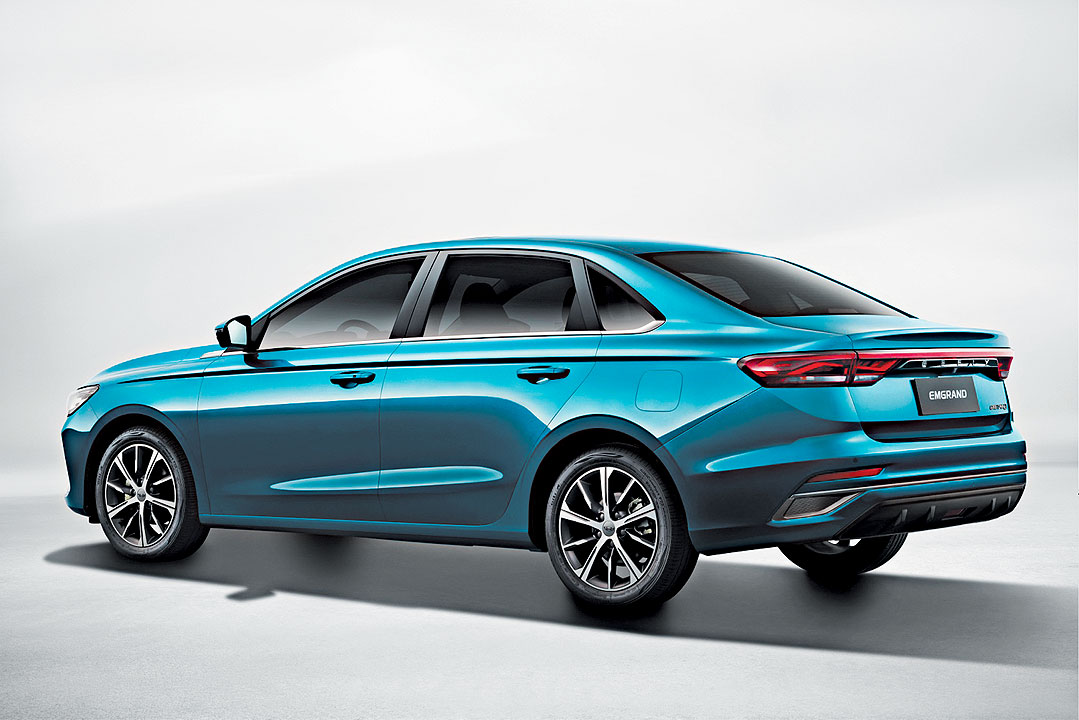
Category killer? For its asking price, the Geely Emgrand subcompact sedan pushes the envelope in terms of size and appointments. — PHOTO FROM GEELY PHILIPPINES

Erstwhile SUV/crossover specialist Geely has joined the subcompact sedan wars. And if size matters, then it’s bringing a bazooka to a swordfight.

SUBCOMPACT CARS like the Toyota Vios, Mitsubishi Mirage, and Honda City represent the entry-level category in sedans. It is the biggest and most popular segment in “automobiledom,” represented by over a dozen car brands from BMW to Volkswagen.

Being an entry-level category, the emphasis has always been on price, with size taking a distant backseat.

Until now.

Erstwhile SUV/crossover specialist Geely has joined the subcompact sedan wars. And if size matters, then it’s bringing a bazooka to a swordfight.

Its new Emgrand sedan is classified in the subcompact sedan class based on its retail price (which starts at P798,000), its engine size, and the fact that its three previous generations have all competed in said category. But don’t tell that to the people who put the 2022 Emgrand together — because they’ve come out with a car that’s a mere 1.5 inches shorter than the all-new and very generously proportioned 2022 Honda Civic.

“The Geely Emgrand aims to continue what we have begun from our young brand. We have heard and listened to our customers and this gave us the confidence to bring in a sedan for the Filipino market. Now we are offering a sedan that will inspire you to elevate your life, be driven and provide you a more worthy vehicle for your daily mobility needs,” said Sojitz G Auto Philippines (SGAP) President and CEO Yosuke Nishi.

The first-generation Emgrand was launched globally in 2009. Since then, it has been a consistent best-selling sedan in China for nine consecutive years with cumulative sales of more than 3.38 million units. The Philippines is the first overseas market to launch the fourth-gen Emgrand after its debut in China last year, a testament to Geely’s high confidence in the Philippine market.

The latest Emgrand is assembled in Geely’s new Changxing factory, an advanced 5G smart factory, allowing it to achieve luxury-car levels of intelligent vehicle manufacturing. For one, the 100% automation welding operations ensure the gap and flush of the vehicle are less than 3.5mm. This factory also enables Geely to adopt the longest roof laser (instead of spot) welding on the Emgrand — increasing its strength by 50%.

The new Emgrand employs the B-segment Modular Architecture (BMA), which was developed within the Geely Auto Group. This platform was also used for the Coolray and was designed to exceed the criteria for any five-star NCAP safety rating. Also, with BMA’s more than five million kilometers of test mileage, higher reliability and durability is expected from the Emgrand. BMA also enables the subcompact sedan to realize bigger space with its wide body, better riding comfort, and achieve better control and stability.

The new Emgrand is powered by a new 1.5-liter dual continuous variable valve timing, normally aspirated engine, which delivers 102hp at 5,600 rpm and 142Nm of torque. The engine is mated with an eight-speed continuous variable transmission (CVT).

Geely designers have created a segment-first, wide-body, low-slung style that’s highly evocative of the much larger Volvo S90 full-size luxury sedan — not surprising given that Geely owns Volvo. It starts with a new “Energy Pulse” radiator grille, auto-on projector LED headlamps (in the Premium variant) and LED daytime running lamps with welcome lights and “follow me home” feature which illuminates your path when approaching or walking away from the vehicle.

For the rear, sharp rhythmic taillights give more visual accent. The rear combination lamps feature 190 LED bulbs which project unique light patterns when you lock or unlock the car.

Overall, it’s a very understated look that should resonate with those looking for an elegant compact or even midsize sedan but whose budget is limited to the subcompact class.

Inside the luxurious cabin, you’ll find seats made of memory foam with light luxury suede and environment-friendly faux leather in an eye-catching white-and-blue combination (in the Premium). The dashboard and door panels are also made of plush, soft-touch materials instead of the usual hard plastic found in many of its rivals.

The steering wheel is also wrapped with constant-temperature leather that’s designed to not feel hot even if you leave the car exposed under direct sunlight — a feature I’d like to try out in a future test drive. With its class-leading exterior dimensions, the Emgrand offers the best seating space and generous headroom to fit three adults comfortably — something you can’t say of most vehicles in its class.

There is plenty of storage space and a trunk that boasts a 500-liter capacity — expandable thanks to the 60:40-split fold-flat back seats. A quiet and relaxing ride is expected as NVH is claimed to be at a decibel level that’s even lower than that of luxury European sedans.

The Emgrand also features a unique Intelligent Scene Air-conditioning System which aids in deodorizing capability, making the air fresh all the time. The air-con is also equipped with a CN95 filter that ensures that the air entering the cabin is free from viruses and bacteria.

Apart from the active and passive safety features such as ABS with EBD, electronic stability program, traction control, hill hold control, electric parking brake with auto-hold, six air bags (Premium), the Emgrand features three ultrasonic reversing radars and HD wide-angle reverse camera (Premium), real-time temperature and tire pressure monitoring system, and a unique rear intelligent monitoring system that gives you a reminder to check the rear seats before getting off the car.

The Emgrand Premium boasts a 12.3-inch HD digital meter with a 3D interface. An eight-inch HD central screen is also standard to support entertainment and control functions of the car such as shifting driving modes from Eco, Comfort or Sport; opening and closing of the sunroof (Premium); and accessing other intelligent features of the air-con.

The entry of the Emgrand in the Philippines following its three SUV siblings beefs up Geely’s strong sales momentum. With only three models in the lineup, Geely Philippines saw its sales almost triple in 2021 with 6,104 units sold. This was a significant increase of 182% from the 2,158 units in 2020. Based on Chamber of Automotive Manufacturers of the Philippines, Inc. (CAMPI) and Association of Vehicle Importers and Distributors (AVID) reports, Geely Philippines has maintained the ninth spot in total industry sales, but has increased its overall market share to 2.1% which is more than double compared to the previous year’s 0.9%.

“Indeed, the new Geely Emgrand packs in enough features you would normally expect from bigger cars minus their expensive price. If I am to sum up the proposition of the Emgrand to the market, it is ‘value for money.’ That’s what Geely is known for and that’s exactly what you get on the all-new Emgrand,” Mr. Nishi added.

The Emgrand comes in six colors: Proud Teal, dark blue, gold, gray, red, and white. Retail prices are P908,000 for the Premium variant and P798,000 for the Comfort. It comes with a five-year/150,000-km warranty.

Considering that the subcompact sedan segment is oversaturated and the seemingly viable contenders can be counted on one hand, the very upmarket new Geely Emgrand seems to be the dark horse that can actually succeed in a cutthroat environment where many others have failed.

From Hermes to Ikea: brands suspend business in Russia

PHOTOS FROM UNSPLASH

PARIS —  The world’s leading luxury brands said on Friday that they planned to temporarily close stores and pause business operations in Russia.

Birkin bag maker Hermes and Cartier owner Richemont were the first firms to announce such moves, followed by LVMH, Kering, and Chanel.

Doing business in Russia has become complex since Russia’s invasion of Ukraine, which prompted the United States, Britain, and the Europe Union to impose sweeping sanctions.

“Given our increasing concerns about the current situation, the growing uncertainty and the complexity to operate, Chanel decided to temporarily pause its business in Russia,” the French luxury fashion house said in a LinkedIn post.

Luxury giant LVMH, which owns such brands as Christian Dior, Givenchy, Kenzo, TAG Heuer, and Bulgari among others, will close its 124 boutiques in Russia from Sunday but will continue to pay the salaries for its 3,500 employees in the country, a spokesperson told Reuters.

French multinational Kering, whose brands include brands as Gucci, Saint Laurent, Bottega Veneta, and Boucheron among others, has two shops and 180 employees, which the company will continue to support.

While affluent Russians are keen consumers of luxury goods, analysts say the proportion of luxury sales generated from Russian nationals is small compared to the industry’s main growth engines, China and the United States.

Richemont, which also owns Dunhill, Jaeger-LeCoultre, Montblanc, Piaget, and Van Cleef & Arpels among other brands, has around a dozen directly operated stores, mostly in Moscow. It said in a statement it had suspended commercial activities in Russia on March 3 after stopping Ukraine operations on Feb. 24, the day Russia launched its invasion.

Hermes, which has three stores in Moscow, had planned to open an outlet in St. Petersburg later this year.

Investment bank Jefferies estimates that Russians account for around $9 billion in annual luxury sales, which is around 6% of Chinese spending and 14% of US spending on luxury goods.

Swiss watchmaker Swatch Group, which owns high end watches and jewelry labels including Harry Winston, said it would continue its operations in Russia, but was putting exports on hold “because of the overall difficult situation.”

L’Oreal, LVMH, and Kering have all pledged financial support to help Ukrainian refugees and Richemont said on Friday it was initiating a “significant donation” to Medecins Sans Frontieres.

IKEA CLOSES RUSSIAN STORES
Sneaker maker Nike and home furnishings firm IKEA shut down stores in Russia on Thursday, as trade restrictions and supply constraints added to political pressure for companies to stop business in Russia because of its invasion of Ukraine.

French bank Societe Generale said it was working to cut its risks in Russia, fearing a tit-for-tat response by Moscow to Western sanctions, as more companies from vodka maker Diageo to Toyota suspended business in the country.

Globally known companies including Apple, Ford, and Shell have condemned Russia’s attack, but some of the announcements on Thursday were more practical, focused on supplies and sanctions as shipping routes closes and governments banned exports to Russia.

Boeing Chief Executive David Calhoun, in a note to staff, acknowledged the violence in Ukraine but avoided politics.

“Moving forward, Boeing will continue to follow the lead of the US government and strictly adhere to the export controls and restrictions that have been announced governing work in Russia,” he said in the note seen by Reuters, which described suspension of work in Russia and Ukraine.

Brazilian plane-maker Embraer joined Airbus and Boeing in halting parts supplies to Russian airlines.

Home furnishings retailer IKEA said it would close outlets in Russia and Russian ally Belarus, affecting 15,000 workers, and described its shutdowns in non-political terms.

“The war has both a huge human impact and is resulting in serious disruptions to supply chain and trading conditions, which is why the company groups have decided to temporarily pause IKEA operations in Russia,” IKEA said in a statement.

Nike, Inc. said it was “deeply troubled by the devastating crisis in Ukraine” and described its closing of stores in this way: “Given the rapidly evolving situation, and the increasing challenges of operating our business, Nike will be pausing operations in Russia.”

Some companies, including McDonald’s Corp., PepsiCo have been quiet about plans.

The chief of New York state’s pension fund said on Thursday that they and other companies with a large footprint in Russia “need to consider whether doing business in Russia is worth the risk during this extraordinarily volatile time.”

The costs of corporate actions are starting to add up, with more than $110 billion in Russia exposure announced by global companies, banks and investors.

Norway’s $1.3 trillion wealth fund said its Russian assets, worth around $3 billion before the invasion, have now become effectively worthless.

“They are pretty much written off,” CEO Nicolai Tangen told Reuters.

TJX Cos, Inc. said on Thursday it would sell its 25% stake in Russian low-cost apparel retailer Familia, which cost it $225 million in 2019. Because of a decline in the rouble and TJX said it may take an impairment charge due to the sale.

SANCTIONS RISKS
Underscoring the challenges global companies are facing as they comply with sanctions against Russia, Societe Generale said on Thursday it could see an “extreme scenario” where Russia strips the bank of its local operations. The lender has a $20 billion exposure to Russia.

Citigroup Inc. said on Wednesday it could face billions of dollars in losses on its exposure to Russia and was looking to exit Russian assets. Bank shares have taken a drubbing in recent days amid fears of possible writedowns and weaker economies.

Western sanctions — including shutting out some Russian banks from the SWIFT global financial network, new export controls, and closure of air space — have led dozens of global companies to pause operations in the country, hammered the rouble and forced the central bank to jack up interest rates.

Spanish fashion retailer Mango said on Thursday it was temporarily closing its shops and its online sale website in Russia, and Spirits company Diageo, the maker of Smirnoff vodka and Guinness, said it had paused exports to Ukraine and Russia. Intel and Cisco said they had stopped sales in Russia.

Accenture said it was discontinuing its Russian business, which had nearly 2,300 employees.

Britain said on Thursday it will ban Russian companies from the London insurance market, the world’s largest commercial and specialty insurance center.

Hundreds of Russian soldiers and Ukrainian civilians have been killed and more than one million people have fled Ukraine in the week since President Vladimir Putin ordered the attack.

Russia calls its actions in Ukraine a “special operation” that it says is not designed to occupy territory but to destroy its southern neighbor’s military capabilities and capture what it regards as dangerous nationalists.

SCRAMBLED SUPPLIES
With a shortage of components, more carmakers are halting production at their factories in Russia, including Russia’s biggest carmaker, Avtovaz — controlled by France’s Renault.

Nissan Motor Co. said on Thursday it has suspended vehicle exports to Russia, while Japanese peer Toyota said it would halt production at its Russian factory from Friday and indefinitely stop vehicle exports to the country.

Auto supplier Magna said it was idling six plants in Russia.

The world’s biggest shipping lines, MSC and Maersk have suspended container shipping to and from Russia.

Japan Airlines and ANA Holdings, which normally use Russian airspace for their Europe flights, said they would cancel all flights to and from Europe on Thursday. — Reuters

Rates of T-bills, bonds may rise

BW FILE PHOTO

RATES of government securities are expected to increase this week ahead of the US Federal Reserve’s planned tightening.

The Bureau of the Treasury (BTr) will offer P15 billion in Treasury bills (T-bills) on Monday, or P5 billion each in 91-, 182- and 364-day securities.

On Tuesday, it will auction off P35 billion in fresh seven-year Treasury bonds (T-bonds).

“We expect steady to upward bias as FOMC (US Federal Open Market Committee) gears for [a] rate hike,” a bond trader said via Viber.

The trader added that US inflation data will be released this week, “which may put players on edge.”

“Locally, local pump prices may continue to rise and may affect inflation expectations.”

Rizal Commercial Banking Corp. Chief Economist Michael L. Ricafort said in a Viber message that T-bill and T-bond yields could continue to increase in line with the weekly rise seen in secondary market rates.

“T-bill auction yields could go up by less than 0.05 [basis point (bp)] week on week,” he said. This is smaller than the hike last week, he added, in view of the rejected bids on Monday’s T-bill auction.

US Federal Reserve Chairman Jerome H. Powell last week said Russia’s invasion of Ukraine has not changed the central bank’s plans to start raising interest rates this month, Reuters reported.

US inflation rose by 7.5% in January, the highest increase in four decades.

In the Philippines, inflation was at 3% for the second consecutive month in February, easing from the 4.2% a year earlier.

Bangko Sentral ng Pilipinas Governor Benjamin E. Diokno said increasing global crude oil prices amid the Russia-Ukraine conflict are causing uncertainty.

Brent crude surged over $100 per barrel for the first time since 2014 after Russia invaded Ukraine on Feb. 24.

At the secondary market on Friday, the 91- 182- and 364-day T-bills were quoted at 1.1685%, 1.2493%, and 1.5943%, respectively, based on the PHP Bloomberg Valuation Reference Rates published on the Philippine Dealing System’s website.

Meanwhile, the seven-year bonds fetched a yield of 5.1329%.

The BTr rejected all tenders for its offers of T-bills and T-bonds last week amid rising rates.

Bids for the T-bills the government offered last week were at P18.54 billion versus the BTr’s plan to raise P15 billion. Tenders for the short-term papers were rejected even as the offer was oversubscribed as investors asked for higher rates.

Broken down, bids for the 91-day securities reached P6.07 billion, higher than the P5-billion plan. Had the Treasury made a full award, the three-month debt papers would have fetched an average rate of 1.49%, up by 59.1 bps from the 0.899% seen the previous week.

The BTr also rejected the P5.65 billion in tenders for the 182-day securities, which was higher than the programmed P5 billion. The average rate of the six-month T-bill would have gone up by 57.9 bps to 1.736% from 1.157% previously had the government made a full award.

Lastly, the government turned down P6.82 billion in bids for the 364-day debt papers from an initial offer of P5 billion. If the tenor was fully awarded, the average yield on the one-year instrument would have stood at 1.865%, up by 29.7 bps from the 1.568% fetched a week earlier.

The BTr plans to raise P250 billion from the domestic market this month, or P75 billion via T-bills and P175 billion from T-bonds.

The government borrows from local and external sources to help fund a budget deficit capped at 7.7% of gross domestic product this year. — Jenina P. Ibañez with Reuters

Fil-Canadian Fernandez advances to Abierto GNP Seguros finals

FIL-CANADIAN Leylah Fernandez — ABIERTO GNP SEGUROS

LEYLAH Fernandez moved on cusp of a successful title defense in Abierto GNP Seguros with an easy 6-1, 6-4 semifinal victory over Brazil’s Beatriz Haddad Maia on Sunday in Monterrey, Mexico.

The Filipina-Canadian needed only one hour and 12 minutes to dispatch the Brazilian challenger on her way to a title showdown against Camila Osorio of Colombia.

Ms. Fernandez, the No. 2 seed, and the fifth-seeded Ms. Osorio duke it out for the Monterrey crown at 6:30 a.m. (Manila time) today.

It will be the first meeting for the two in the pro stage though they have already dueled in the juniors. Ms. Fernandez sports a 2-1 head-to-head upperhand after wins in the 2018 and 2019 Roland Garros junior championships.

In Mexico, they have traveled opposite paths with Ms. Fernandez, despite being a heavy favorite, encountering strong resistance against Chinese aces Qiang Wang and Qinwen Zheng in the Round of 16 and quarterfinals, respectively.

Ranked No. 21 in the Women’s Tennis Association (WTA), the 19-year-old Ms. Fernandez was pushed to the limit in both matches that fortunately paid off in the Final Four, where she was finally on target to complete a sweep victory.

The WTA No. 44 Ms. Osorio, on the other end, caught a big fish on her way to the championship round after pulling the rug from under No. 1 seed Elina Svitolina of Ukraine, 1-6, 7-5, 7-6 (5), in the quarterfinals.

The 20-year-old Ms. Osorio then swept Spain’s Nuria Parrizas-Diaz, 6-4, 6-4, to arrange a title match against Ms. Fernandez, who made a historic finals appearance in the US Open late last year. — John Bryan Ulanday

ICTSI undertaking P15-B MICT expansion to meet demand

LISTED port operator International Container Terminal Services, Inc. (ICTSI) on Sunday said it is expanding the Manila International Container Terminal (MICT) to meet growing demand and serve new-generation container ships.

The company is constructing a new berth at MICT to “handle increasing volume demand and serve new-generation container ships that can carry up to 18,000 TEUs (twenty-foot equivalent units),” it said in an e-mailed statement.

ICTSI noted that there is a growing trend towards larger container ships and that MICT should be ready to service very large container ships “with ease and efficiency.”

“Currently under design, Berth 8 will add a total of 400 meters quay and up to 12 hectares of yard area in phases. Along with port equipment, the expansion is estimated to cost P15 billion. Water alongside will be initially dredged to a depth of 13.5 meters with potential further deepening to 15 meters draft,” the company added.

With Berth 8, MICT’s berthing and total capacities are expected to expand by 21% and 25%, respectively.

At the same time, the company is modernizing MICT’s Berths 1 to 5 and their backup and yard areas.

“The project includes the installation of additional reefer racks by April to accommodate approximately 300 TEUs of reefer cargo,” ICTSI said.

The company is also investing in technology for MICT to improve operational efficiency and productivity.

“In 2020, MICT was among the pilot terminals in the ICTSI Group to leverage blockchain technology by joining the TradeLens platform developed by IBM and Maersk,” it noted.

ICTSI’s capital expenditures (capex) for 2022 are expected to be approximately $330 million from $165 million in 2021, the company said in its annual report released last week.

It said the estimated capex budget will be utilized mainly for the payment of concession extension upfront fees, ongoing expansion projects, equipment acquisitions and upgrades, and maintenance requirements.

“The group expects to fund these capital expenditures through a combination of available cash, internally-generated funds, third-party loans and other fund-raising activities, if necessary,” ICTSI noted.

The company saw its attributable net income for 2021 surge to $428.6 million from $101.8 million a year earlier, mainly due to higher operating income.

Its gross revenues from port operations increased 23.9% to $1.9 billion in 2021 from $1.5 billion previously.

Meanwhile, the company’s expenses were reduced 4.7% to $1.1 billion from $1.2 billion in 2020.

ICTSI handled a total of 11.16 million TEUs in 2021, higher by 10% compared with the 10.19 million TEUs handled in 2020. This is mostly due to volume growth and improvement in trade activities as economies recover from the impact of the pandemic and lockdown restrictions, the company said. — Arjay L. Balinbin

Lexus IS 300h Premier: High breed

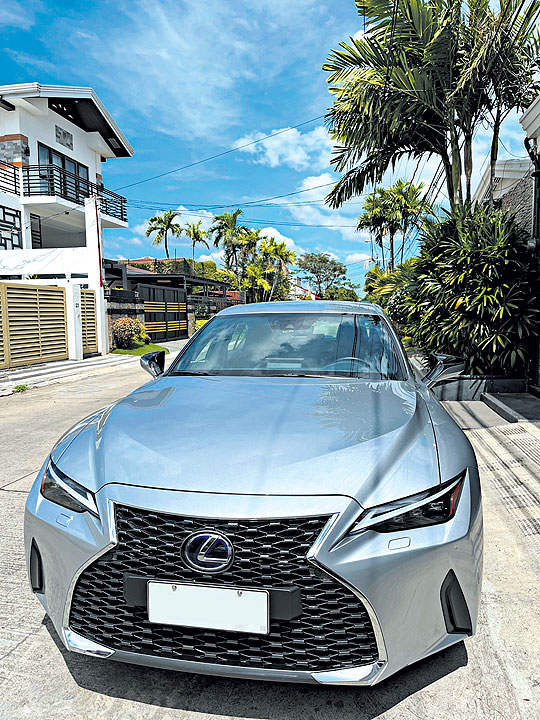
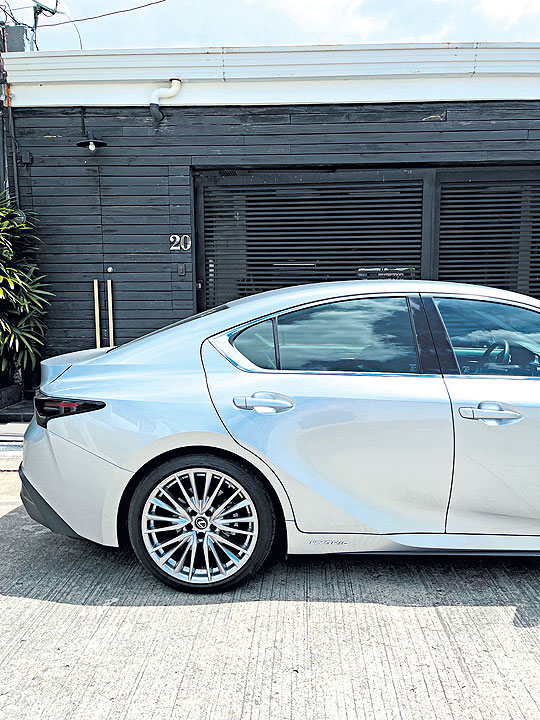
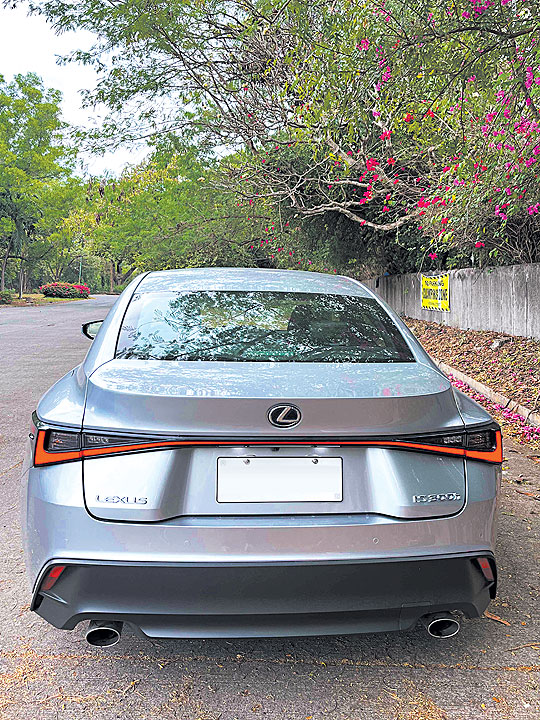
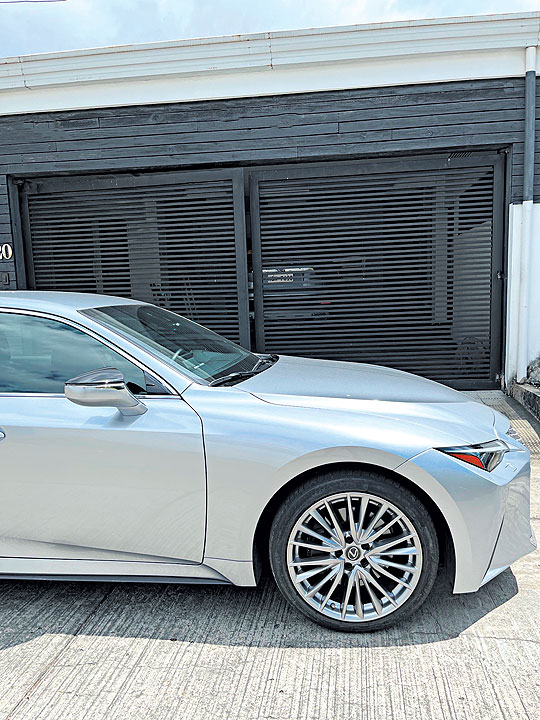
The IS features ‘everything you would expect a luxury car to have.’ — PHOTO BY TANYA T. LARA

Lexus knows luxe and, surely, the rising price of gas, too.

IS THIS REALLY the best weekend to test-drive a hybrid vehicle or did I just pick the worst time to come home to Manila — on a long weekend when everyone is heading out of the city, and cars on the highways are moving at a head-snapping speed of 20kph?

What is a hybrid car anyway — are you just playing with the tip or do you go all the way in (I mean the electric and gasoline systems, obviously)?

There are three models in the Lexus IS series and the one I’m test-driving, the Lexus IS 300h Premier, is in the middle. Priced at P3.3 million, you might say it’s the second most expensive sports sedan in the series or the second least expensive — depending on whether you’re a millionaire or a multi-millionaire. (The IS 300h is P2.9 million; the IS 350 F Sport is P3.8 million.)

Gabby from Lexus explains to me that a hybrid vehicle combines at least one electric motor with a gasoline engine and charges itself through “regenerative braking.”

Say what again?

Basically, it’s an energy-recovery mechanism where kinetic energy is converted and stored back into the battery or used immediately to move the car. The vehicle switches between electric and gas as you drive, and most importantly, you never have to charge it.

Lexus describes the IS series as “designed to change the game.” It’s my first time to drive a hybrid, so I don’t really know, but I’m going to take their word for it because it’s Lexus and it’s made in Japan. And because it’s the world’s fourth largest luxury brand (behind German brands Mercedes, Audi and BMW).

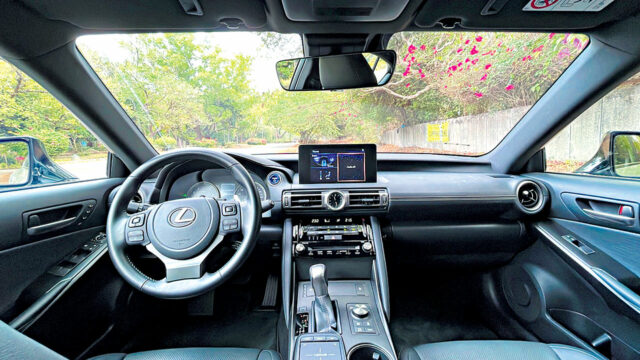
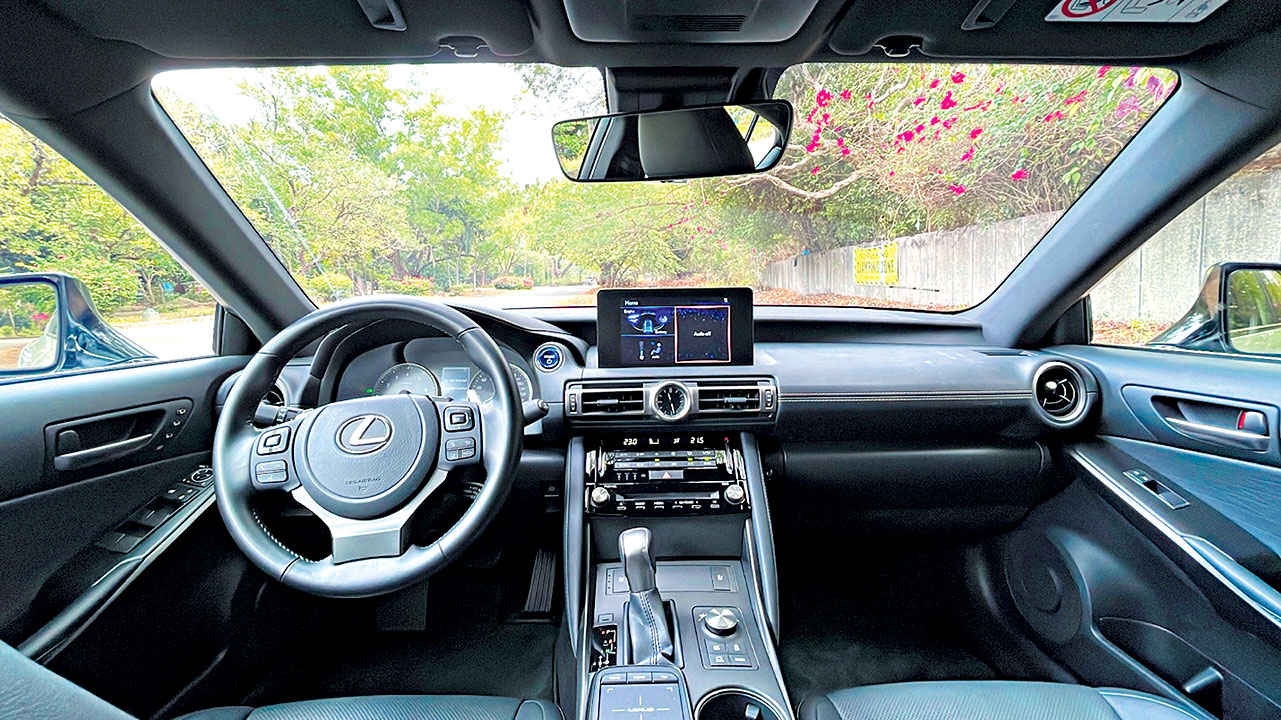
The front grille features the Lexus logo taking on a hybrid identity with a subtle blue tint surrounding it. Inside, it features everything you would expect a luxury car to have: supple leather seats, easy entertainment system controls, and to my surprise, a DVD player! To my second surprise, it doesn’t have wireless Apple CarPlay or Android Auto. I was gobsmacked that you still have to plug your mobile phone into a USB port inside the compartment on the center console.

Everything else delighted me about this hybrid compact sports sedan, like how quiet it is when you start the engine. Several times, I thought, is the car “on” because I can’t hear the hum of an engine. Good thing there’s a “Ready” indicator on the dashboard to tell you, dummy, it is indeed on, so step on it.

The first thing that pops up on the screen is an indicator that tells you whether the vehicle is using the battery (an “EV” lights up) or gas; it also tells you when energy is being stored into the battery or being used.

Driving this luxury vehicle on the Skyway on Saturday was much better because everyone that planned an out-of-town trip had seemingly left on Friday.

Now I can really test its performance. And it is exhilarating to drive! It responds fast and flawlessly when you increase your speed or when you step on the brakes; it flies over humps you ignore and feels like you’re landing on a pillow as it hits the ground; it’s stable when you do sharp turns and you never feel like you’re going to lose control of the vehicle.

I started my driving life with a sedan like most people but since 2006 I’ve been driving SUVs. I’ve forgotten how much more aerodynamic lowered cars are — and the ground clearance of an unladen Lexus IS 300h is only 140 millimeters or 5.5 inches. It feels fast, it is fast. It can accelerate from zero to 100 in 8.5 seconds.

The vehicle also has driver’s aids that keep you safe under the Lexus Safety System+, whose acronym (LSS+) reminds me of some of the best songs that got stuck in my head for days. Anyway, one of the coolest LSS+ features is the automatic high-beam headlights. Driving in my subdivision at night, I notice the headlights going high and then back to normal on a street that has barriers. How cool is it that it detects what my eyes might miss on a dark street?

Another safety feature is the lane-keeping assistance, which I inadvertently used driving at the top allowable speed. Because there are no vehicles around me, I don’t signal to change lanes, and immediately the indicator lights up and I feel the steering wheel gently nudging me back to my lane (of course when you signal, it doesn’t do that).

The car also has forward-collision warning when you’re too close to the vehicle in front; adaptive cruise control; pedestrian detection; automatic emergency braking; and lane-departure warning.

The Lexus IS series was developed at the Toyota Technical Center Shimoyama in Japan, which features a high-performance test course that’s 5.3-kilometer long. This course has a nearly 250-foot change in elevation, sharp turns, corners and different road types to simulate all driving conditions.

You’ll be glad to know that this hybrid gets you a distance of about 19 kilometers per liter of gas (or 100 kilometers per 5.2 liters), so you go twice the distance for the same amount of gas versus compact to midsized SUV. I almost feel like the 66-liter gas tank is a waste because you really don’t use that much gas.

I drove on the Skyway back and forth over the long weekend because I was seeing friends in Makati, Alabang, Pasig and Quezon City — and the needle on the gas gauge hardly moved (okay, it did a little).

It was the best weekend to test-drive a hybrid after all.