Home Blog Page 6245

Wolves end Cavaliers’ eight-game home win streak

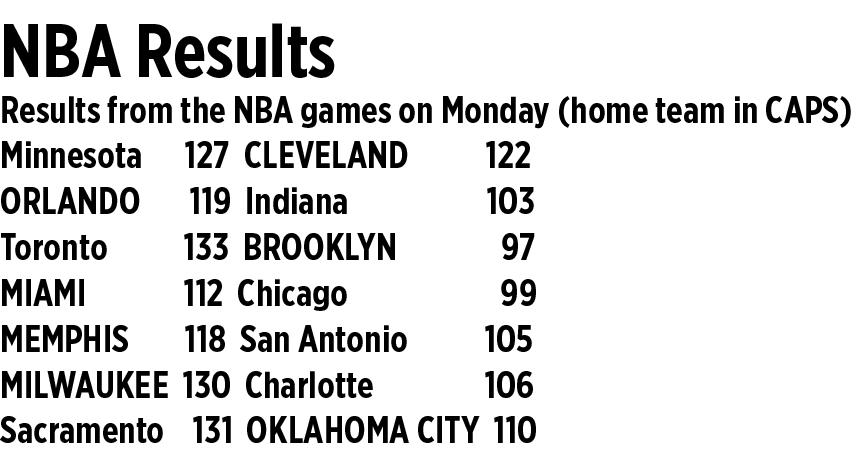
D’ANGELO Russell fired in a team-high 25 points on Monday as the Minnesota Timberwolves snapped the Cleveland Cavaliers’ eight-game home winning streak with a 127-122 victory.

Minnesota’s Karl-Anthony Towns had 17 points, including the game-winning 3-pointer with 12.4 seconds left that snapped a 122-122 tie. Towns won the league’s 3-point contest during All-Star Weekend in Cleveland.

Anthony Edwards and Jaden McDaniels each added 17 points and Patrick Beverley had 11 for the Timberwolves, who shot a sizzing 54.7% from the field.

Kevin Love led all scorers with 26 points for the Cavaliers, who hadn’t dropped a home game since Jan. 4 against the Memphis Grizzlies.
Cedi Osman and Jarrett Allen each had 21 for Cleveland. Brandon Goodwin had his first career double-double with 17 points and 12 assists, and Evan Mobley added 15 points and 10 rebounds.

Minnesota won for the second time in three games while Cleveland fell for the fourth time in five games.

The Cavaliers trailed by 23 points in the third quarter but came all the way back to tie it at 122 on Osman’s 3-pointer with 33.8 seconds left.

Osman missed an off-balanced 3-point attempt that would have tied the score with five seconds remaining. Russell sealed the outcome by sinking two foul shots with 3.2 seconds left.

Russell’s 3-pointer with 4:06 to go in the third extended the Timberwolves’ lead to 93-70.

The third quarter started with a 10-0 run by Minnesota for a 74-61 lead.

The Cavaliers scored 10 unanswered points late in the third and cut the deficit to 101-88 heading into the frantic final period.

The Timberwolves shot 55.8% from the field in the first half, as they led 64-61 at half time. Minnesota outscored Cleveland 38-24 in the second quarter.

McDaniels paced the Timberwolves with 14 first-half points. He was 4 of 6 from 3-point range in the first two quarters.

Goodwin had 15 points and seven assists in the first half for the Cavaliers, who shot 55% from the field before the break.

Allen had 10 points in the opening quarter for Cleveland, which led 37-26 after 12 minutes. — Reuters


Part of problem

If there’s one thing to be said about Lakers fans, it’s that they’re notoriously loyal. They’re passionate about their predispositions, ready and willing to engage with followers of other teams for the slightest of reasons. And it doesn’t matter if their favorites stink up the joint. As far as they’re concerned, no other colors are as significant — even relevant — as purple and gold. Ask Mike D’Antoni, Byron Scott, and Luke Walton, who coached in La-La Land for the better part of the last decade, didn’t have much to show by way of results, and yet fully expected support from Staples Center regulars.

To be sure, the sight of the Crypto.com Arena playing host to boos the other day wasn’t in and of itself jarring. What proved unnerving, even to jaded observers, was that the 17,536 warm bodies reserved their negative reactions for the supposedly beloved Lakers. The third quarter was especially brutal; in the 12 minutes after the break, the hometown heroes turned into heels by allowing the Pelicans to net 44 points while scoring just 25. And the eye test was damning, with cringe-inducing turnovers, lost rotations, poorly executed sets, and close-to-nonexistent defense practically inviting the jeers.

For spectators loath to look at the scoreboard with a modicum of frequency, the Lakers’ body language was all they needed to know of how badly things went. In abundance were long faces, frowns, shaking heads, back and forths with paying patrons. Effort — the least they could have been treated to — proved wanting in every aspect. Showtime became more like slow time, leading to a ninth setback in the last 12 games.

At this point, there can be no doubting that the Lakers are in a rut. They need direction and leadership, and, in recent memory, supposed best of all time LeBron James hasn’t been providing it. He attracted the wrong kind of attention during All-Star Weekend with passive-aggressive statements, voiced out or otherwise, and he seemed inclined to keep at it by engaging with critics off the court instead of worrying about improving the product on the court.

Is the 2021-22 campaign lost? Perhaps. The Lakers are 10th in Western Conference standings and flirting with outright elimination from the postseason. And they’ve got a brutal stretch ahead of them; the Mavericks, Clippers, and Warriors are on tap, followed by a bevy of road outings in the league’s most difficult schedule the rest of the way. There was a time when having James on the roster gave a team — any team — a fighting chance. Not anymore, it appears, and not when he’s part of the problem instead of part of the solution.


Anthony L. Cuaycong has been writing Courtside since BusinessWorld introduced a Sports section in 1994. He is a consultant on strategic planning, operations and Human Resources management, corporate communications, and business development.

Ultra-rich Russians count the cost of $83-B wealth wipeout

A SHEET of 1000 Russian Rouble notes at Goznak printing factory in Moscow, Russia, July 11, 2019. — REUTERS

RUSSIA’s billionaires are starting to feel the heat.

The broadside to their fortunes has been swift since President Vladimir Putin’s decision to invade Ukraine. Russia’s ultra-rich who rank among the world’s 500 wealthiest people have now lost a combined $83 billion this year, according to the Bloomberg Billionaires Index.

Market declines have been so extreme that Russia’s central bank halted local trading on Monday, meaning some of the losses are understated. Shares of London-listed Russian companies, from gas producer Novatek to steelmaker Severstal, tumbled by more than 50% on Monday after the US, UK, European Union (EU) and other countries ratcheted up sanctions.

On top of the paper losses, penalties are starting to hit closer to home.

Roaming the skies in their Boeing, Gulfstream and Bombardier jets is now trickier after the EU joined the UK on Sunday in banning Russian-owned private planes from its airspace. Their discreet purchases of high-end London real estate may get more difficult, too, with the UK fast-tracking legislation that would require foreign property owners to disclose their identities, rather than hiding behind holding companies.

The EU on Monday adopted sanctions on some of Russia’s ultra-wealthy, including metals tycoon Alisher Usmanov, Alfa Group owners Mikhail Fridman and Petr Aven, and steel magnate Alexei Mordashov. The measures also impact Mr. Putin’s longtime spokesman Dmitry Peskov, state-media figures and senior military officials. Also on Monday, Switzerland implemented travel bans on five oligarchs close to the Russian leader and said it will close its airspace to all flights from Russia, including private jets.

Combined with the sanctions already in place in the US and UK, the latest round of targeted penalties suggest governments may be viewing Russia’s rich elite as another key pressure point as Mr. Putin continues his invasion of Ukraine.

Russia’s $1.5-trillion economy is already reeling from sanctions that targeted key banks and may prevent Mr. Putin from accessing the bulk of more than $640 billion in central bank reserves. Those restrictions have roiled the nation’s markets and are having a knock-on effect on some of the country’s largest fortunes.

Lukoil PJSC chairman Vagit Alekperov has seen his net worth tumble by about $13 billion this year, the biggest drop among the 22 Russian billionaires on Bloomberg’s wealth index. The oil company’s London-traded shares slumped 62.8% on Monday.

Gennady Timchenko, one of the first oligarchs to be sanctioned by the UK, has lost almost half of his net worth this year, with his fortune plunging $10.6 billion. Fellow Novatek shareholder Leonid Mikhelson has seen $10.2 billion erased from his wealth in 2022.

The Ukraine crisis has also sharpened the focus on Roman Abramovich, one of the most high-profile billionaires with assets including a stake in steelmaker Evraz Plc and Chelsea Football Club.

Mr. Abramovich handed control of Chelsea FC to the trustees of the Premier League soccer club’s charitable foundation on Saturday. A spokeswoman said he’s also been approached by Ukraine to help broker a peace with Russia.

Aside from the football club, which could be worth more than $2 billion, many of his other assets are also outside of Russia or listed on foreign exchanges. His stake in Evraz is listed in London, as are holdings in energy firms Velocys Plc and AFC Energy Plc, while his position in tech company Yandex is listed in the US.

His real estate holdings range from Israel — where he’s a citizen — and France to a mansion near Kensington Palace in London’s billionaires’ row. New York property records show he transferred a mega-mansion on the Upper East Side to his ex-wife in 2018.

Mr. Abramovich, 55, who is not currently on the UK’s sanctions list, has a net worth of about $13.9 billion, down by about $5 billion this year, according to Bloomberg’s wealth index.

As for those who might be subject to EU sanctions, their private jets are on the move. Usmanov’s Airbus A340 left Munich on Monday and departed EU airspace. As of 3:23 p.m. New York time, it was flying over the Black Sea, destination unknown. — Bloomberg

$10 toothpaste? Household goods makers face blowback on price hikes

REUTERS
Shoppers browse in a supermarket in north St. Louis, Missouri, U.S. April 4, 2020. — REUTERS/LAWRENCE BRYANT

GET READY for the $10 tube of toothpaste.

Colgate-Palmolive Co CEO Noel Wallace said last week at an industry conference that the household goods maker sees its new Optic White Pro Series toothpaste as the type of premium product “vital” to its ability to raise prices, which will help drive profit growth this year.

His remarks come when many consumer products companies are hiking prices as much as they can to offset their own rising costs, a trend that could continue due to the conflict between Russia and Ukraine, whose economic risks include driving up gasoline prices.

So far retailers and consumers seem largely unfazed by higher prices. But some lawmakers and consumer advocates argue that companies are excessively raising prices in order to fuel profits and return money to shareholders.

“We’re seeing significant price hikes on virtually every item consumers purchase,” said US Representative David Cicilline, who is working on proposed antitrust legislation aimed at bringing down prices. “They’re imposing real hardships. People are taking things out of their grocery carts because it’s too expensive.”

In the past, major retailers such as Walmart, Inc. pushed back on price hikes. But now, retailers like Walmart and Target Corp, which is to report quarterly results Tuesday, are mostly going along with them.

The US Federal Trade Commission over the last three months has probed sky-high prices and supply chain disruptions, requiring companies including Procter & Gamble, Kraft Heinz Co., Kroger Co, and Walmart to turn over internal documents on profit margins, pricing and promotions.

Comments on the inquiry are due March 14 and so far show small grocers angry with having to pay more and receive less of crucial products. Consumers wrote in about being unable to find oatmeal, cereal and cat food.

In an interview with Reuters, Cicilline cited Colgate as an example of a company touting price hikes, making basic items too costly, and paying out more to investors.

Colgate expects its margins to widen this year, due in part to higher prices. It also bought back almost 50% more shares last year, a boon for investors.

Raising prices is a “key capability” for Colgate that will help drive profit growth, Mr. Wallace said last week.

A Colgate spokesperson said in a statement that the company has a wide portfolio of products at different price points, and touted its new $10 toothpaste as the first with 5% hydrogen peroxide, with “demonstrated efficacy to whiten teeth.”

Consumer goods companies last year started hiking prices in response to rising raw material costs and labor shortages due to the pandemic.

“There is incredible appetite for our products,” said Katie Denis, a spokeswoman for the Consumer Brands Association, a trade group for consumer-packaged goods companies including Colgate. “We make essentials. And there is no option of not delivering.”

Prices also rose on competing private label items, analysts said.

The White House is targeting corporate profits as it grapples with inflation. Bharat Ramamurti, deputy director of the White House’s National Economic Council, said there are examples of companies outside of the meatpacking industry — which has particularly been in the White House’s crosshairs — increasing prices beyond their own climbing costs.

Lindsay Owens, executive director of the progressive non-profit Groundwork Collaborative, named diapers as a category with little competition, paving the way for aggressive price hikes.

Kimberly-Clark Corp’s margins took a hit in 2021 due to rising costs. The maker of Huggies diapers is betting that consumers will buy pricier options made with plant-based material, helping its profits recover, executives said at last week’s conference.

P&G executives said last week that they expect margins to continue to improve as higher prices hit stores. The company also plans to buy back more stock than originally planned.

“Many companies are taking advantage of high consumer demand to continue to raise prices when they don’t need to,” said Jack Gillis, executive director of the Consumer Federation of America, a non-profit consumer interest group. “As long as consumers are willing to pay those prices, there’s no incentive to lower them.” — Reuters

Hong Kong residents brace for citywide lockdown

HONG KONG  — Hong Kong residents braced for a city-wide lockdown, emptying supermarkets and pharmacies on Tuesday, even as leader Carrie Lam called for calm and appealed for the public not to worry over a compulsory mass coronavirus disease 2019 (COVID-19) testing plan.

Mass testing for the city’s 7.4 million residents is set to take place over nine days starting in the second half of March, the South China Morning Post (SCMP) reported, citing an unidentified source.

The news sparked concerns many people will be forced to isolate and families with members testing positive would be separated.

Officials are planning to test people three times over nine days, with the government still deliberating whether a lockdown would be done on a district basis or citywide, the SCMP said.

Exemptions would be made for those who buy food, seek medical treatment and maintain societal operations. Hong Kong’s stock market would continue to operate, Sing Tao newspaper reported, citing unidentified sources.

Ms. Lam had previously said she was not considering a city-wide lockdown.

On Tuesday, she appealed to the public “not to fall prey to rumors to avoid unnecessary fears being stirred”, saying the supply of food and goods remained normal.

“There is no need for members of the public to worry, they should stay vigilant and pay attention to the information disseminated by the government so as to avoid being misled by rumors,” Ms. Lam said in a statement.

Despite her comments, dozens of people queued to enter pharmacies and banks across the city, while many scoured empty shelves in grocery stores to stock up on whatever essentials they could.

Streets and shopping malls in the heart of the city’s Central financial district were eerily quiet in what would typically be a busy lunchtime period.

The Chinese ruled city has seen coronavirus infections surge some 34 times to over 34,000 on Monday from just over 100 at the start of February. Deaths are also climbing, with facilities for storing dead bodies at hospitals and public mortuaries at maximum capacity.

Hong Kong continues to stick to a COVID policy of “dynamic zero”, the same as mainland China, which seeks to curb all outbreaks at any cost. The Chinese ruled territory has implemented its most draconian measures since the start of the pandemic in 2020.

The rules have exacerbated separation fears among many families, with many fleeing ahead of the mass testing scheme and the build out of tens of thousands of isolation centers.

The former British colony has reported over 205,000 coronavirus infections and 744 deaths in total, however over 400 deaths have been in the past week, with the majority being unvaccinated residents. — Reuters

A Filipino First security strategy for the next president

FREEPIK

A critical step in choosing the next set of leaders in the upcoming 2022 elections is identifying the key issues that have a significant impact on the welfare and development of the Philippines. This entails an assessment of the current administration’s policy agenda and understanding how it unraveled throughout its six-year term. It also delves deep into the present circumstances the country is in — both in its interests within our borders and its regional and global standing.

The Duterte administration was handed a Philippines that had to navigate an Indo-Pacific in the midst of a geopolitical shift as a growing economic and strategically important region. As such, foreign and national security became a top priority.

However, looking back, President Rodrigo Duterte’s appeasement policy and pivot to China — evident in his change of tone from the July 12, 2016, Arbitral Ruling — brought a chain of consequences that radiated beyond maritime and territorial interests. The policy affected the country’s political and defense credibility and allowed preferential treatment of Chinese ventures that proved to be socio-economically corrosive and were even a security risk that other countries would never have tolerated.

The next administration must veer away from this defeatist policy and instead shift to a more assertive but balanced stance that will be responsive to incursions and ready to push back on any move that compromises our national interests. The best way forward is to learn the lessons of Duterte’s term and for the next administration to craft a new security strategy that would demonstrate our resolve to uphold our sovereignty and the rule of law to maintain peace and stability in the region.

MAXIMIZING OPTIONS AND RESOURCES
During the Stratbase Albert Del Rosario Institute’s Virtual International Conference titled “Rethinking Philippine National Security Strategy towards a Stronger Maritime Defense and Security Posture,” experts expressed analogous sentiments on the need to craft a National Security Strategy (NSS) that maximizes immediate resources and options available. They also offered several recommendations moving forward.

According to Dr. Renato de Castro, Trustee and Program Convenor of Stratbase ADRi, the future strategy to be developed must be based on the 2016 arbitral ruling. With this, international law and norms, territorial integrity and national sovereignty are at the core of the NSS. Policies — whether at the tactical, procedural, and administrative levels — will revolve around this. This goes hand in hand with the capacity and capability development of the Armed Forces of the Philippines in addressing further potential threats.

Another important option and resource available to the Philippines is its long-standing alliance with the United States and expanded network of strategic partnerships within the region that have similar vision in maintaining a rules-based order. As emphasized by Dr. Charmaine Misalucha-Willoughby, Associate Professor in the International Studies Department of De La Salle University, given the defense capability of the Philippines, it is within the country’s interest to pursue multilateralism. However, this pursuit does not entail turning away from China completely since economic interdependence is a reality not only to the bilateral relations of the Philippines and China but all states throughout the region and beyond. She emphasized that the next administration must turn away from its neutrality in the face of conflict.

On top of the NSS development and maximizing multilateralism, Richard Heydarian, Non-Resident Fellow for Stratbase ADRi, emphasized the need for inter-agency cooperation and a whole-of-nation approach which will enable an alignment of mandates and policy direction for national agencies — especially those in the defense and foreign policy sector.

THE POWER OF THE ELECTORATE
Presidential candidates have campaigned, debated, and presented their respective policy priorities drawn from the experiences and missteps of the Duterte administration regarding this issue. Campaign pronouncements on their foreign policy agenda, while mostly echoing the advice of the experts, will need to be implemented by a new president who has the intellect and fortitude to face adversarial situations that may become confrontational but must be handled with grace and decorum.

As the 2022 National Elections draws closer, the electorate should keep in mind that the country’s future in the next six years will be shaped by their vote. The people must choose a candidate that has the strategic thinking to appraise the complex dynamics of regional geopolitics and earn the respect of leaders in the international arena.

The next president must always be sensitive to the true will of the people. As proven by scientific national surveys, our sovereign rights in the West Philippine Sea must not be compromised. Any candidate who shows a wavering stance rationalized by a myopic perception of our ability as a nation can easily be rejected by our vote.

We must elect a president who is the embodiment of the good values and aspirations of the Filipino nation.


Victor Andres “Dindo” C. Manhit is the president of the Stratbase ADR Institute.

Origins of the Filipino First mentality

BW FILE PHOTO

(Part 3)

If the Filipino First policy did much harm to the Philippine economy in the last century, it will do even greater harm in this era of the Industrial Revolution (IR) 4.0. As our country is still struggling to combine efforts to complete the IR 1.0 (mechanical revolution), IR 2.0 (electrical revolution), and IR 3.0 (electronics revolution), it would be an impossible task to raise all the long-term capital needed to catch up with the rest of the world in joining the digital era required by IR 4.0 without the help of foreign equity. As Dr. Vaugh Montes points out in his paper (“Long Term Economic Transformation), whether we like it or not, we have to contend with breathtaking developments from the Fourth Industrial Revolution in technology, artificial intelligence, the Internet of Things, big data analytics, etc. which are dramatically transforming the provision of public services in mobile technology, media, healthcare, transportation, logistics, airports, education and others.

The restrictions on foreign ownership of utilities go back 87 years to 1935 when economic conditions and technology for public services were vastly different from today. To cite an obvious example close to the heart of Filipinos — who have the greatest number of smart phones per capita in the world — we can no longer consider telecommunications, media, and advertising as separate economic sectors. They have all merged into one technology-intensive industry. Even education has joined this super-industry if one considers the prevalence of online learning or blended learning, which will obviously not disappear with the pandemic. It does not make sense, therefore, to limit foreign ownership in media, advertising, and education as we liberalize foreign ownership in telecommunications. Sooner or later, we have to amend the Constitution itself which still limits foreign ownership in these three sectors.

The imperative of economic dependence prescribed by the Filipino First policy comes at the cost of restricting the economic freedom of the greater majority of Filipinos. The Overseas Filipino Workers (OFWs) are often praised as modern-day heroes for sending home billions of dollars every year. Even at the height of the pandemic, the OFWs were there to limit the economic sufferings of millions of Filipinos. Many of these Filipinos could be working at home if we had more long-term capital provided by FDIs. The OFW phenomenon has turned necessity into virtue. With their educational levels, working knowledge of English, adaptability, and aptitude for personal services, Filipino workers as OFWs have proven to be the country’s main tradeable resources. The lack of gainful job at home can be partly attributed to lack of foreign investments, curtailing the freedom of the OFWs to choose to work at home and be with their families every day instead of every two years.

The Filipino First mentality has also reinforced the elitist nature of Philippine society. Since the strategic industries in which foreign equity is limited — to only 40% or none at all — are very capital intensive, and since the Philippine capital market is one of the least developed in East Asia, only the rich Filipinos can actually own these very profitable industries. Without foreign competition, they also tend to be monopolistic or oligopolistic. You then have a deadly combination of monopoly and high concentration of wealth in the hands of the rich. What results is that “Filipino First” inevitably leads to “Rich Filipinos First” and damn the rest. Allowing foreign capital into these industries at least addresses the lack of competitiveness in these vital sectors.

Another objection to allowing majority control of strategic industries to be in the hands of foreign individuals or corporations is the possibility of abuse of their presence in the country. The answer to this objection is that abuse can come from any business whatever nationality has majority control. What we have to emulate is the way the Chinese Government has allowed the free entry of some of the largest foreign firms in such strategic sectors as telecommunications, media, education, and information technology. For example, before 2009, China allowed complete freedom of entry of such giant multinationals as Amazon, Google, Twitter, and Facebook that attracted billions of users. In July 2009, Chinese authorities blocked Facebook, along with Twitter and Google services, following riots in Xinjang, a special autonomous region in western China. The crackdown came when the Chinese Government accused these social media enterprises of interfering in local politics by giving voice to independence activists. The point here is not necessarily to condone what the Chinese Government has done in curtailing freedom of expression, but to illustrate the fact that a strong and effective Government can always demand appropriate behavior from businesses controlled by foreigners. We should let them in to benefit the economy by bringing in long-term capital, generating jobs, introducing advanced technology, and training our workers. The very liberal policy of allowing these giant US multimedia enterprises to enter freely led to the transfer of technology and creation of a huge domestic market that gave rise to the now powerful and profitable homegrown Chinese services such as Tiktok, We Chat, Sino Weibo, and Tencent QQ that have flourished under the watchful eye of government censorship.

If enterprises fully owned by foreign investors misbehave and act contrary to the common good of Filipinos (like spying, destroying morals through pornographic sites, condoning false news, destroying the physical environment, etc.) then our Government should be competent and strong enough to censure them and remove their license to operate. That is why it is good governance that is the key to long-term sustainable and inclusive government and not a Filipino First policy which our 75 years of efforts at development have shown to have brought so much economic harm to the nation.

We should give special thanks to the present Congress that has finally removed a serious obstacle to long-term sustainable and inclusive growth of the Philippine economy after many years of attempts of a few brave souls. Let me quote from the remarks of Senate Minority Leader Frank Drilon during the Senate’s ratification of the Bicameral Conference Committee report on the Public Service Act amendments bill: “I filed the first amendments to the Public Service Act, maybe 10 years ago, and this was principally from the very fact that we had a very restrictive foreign investment environment. The other countries kept on attracting foreign investment, because of their more liberal investment, foreign investment laws. Ours was very restrictive because of the Constitution, but we found a way of liberalizing our investment climate without amending the Constitution.

“I wish to thank the leadership of the Senate, led by Senate President Tito Sotto and the chair of our franchise committee, Senator Grace Poe, who really worked hard in order to be able to amend and pass this law. This is a game changer, if I may say so. And I’m glad to have been able to participate in this very important matter.”

Here again is another example of competent political leaders contributing to institution building that will benefit future generations, thanks to their enlightened views about the requirements of authentic development. May their tribe increase.


Bernardo M. Villegas has a Ph.D. in Economics from Harvard, is professor emeritus at the University of Asia and the Pacific, and a visiting professor at the IESE Business School in Barcelona, Spain. He was a member of the 1986 Constitutional Commission.

bernardo.villegas@uap.asia

Prospects of lifting the travel ban

FREEPIK

In view of increased vaccination rates and the ardent desire to reopen the economy, the Philippine government has updated the guidelines on entry, testing, and quarantine protocols of foreign nationals. On Feb. 3, the Inter-Agency Task Force for the Management of Emerging Infectious Diseases (IATF-EID) issued Resolution No. 160-B which temporarily suspended the classification of countries, territories, or jurisdictions into “Green,” “Yellow,” and “Red,” and partially lifted the long-standing travel ban which has been in effect since March 2020.

Effective Feb. 10, fully vaccinated aliens coming from non-visa required countries listed in Executive Order No. 408, s. 1960 may already enter the Philippines, provided that they are entering for purposes of business or leisure. The new guidelines effectively superseded the Department of Foreign Affairs (DFA) Foreign Service Circular No. 29-2020 which suspended visa-free entry privileges to qualified foreign nationals during the COVID-19 pandemic.

Under the new guidelines, an arriving foreign national should present a negative RT-PCR test taken within 48 hours prior to departure from his country of origin or first port of embarkation, an acceptable proof of vaccination, a valid return ticket scheduled not later than 30 days from his date of arrival, a passport valid for a period of at least six months, and proof of insurance for COVID-19 treatment costs with a minimum coverage of $35,000.

The IATF Resolution did not affect the current entry guidelines of visa-required foreign nationals, i.e., they may only enter the Philippines if they have successfully secured an approved entry exemption document from the Department of Foreign Affairs (DFA) and a 9(a)/temporary visitor visa from a Foreign Service Post abroad.

In any case, the new guidelines provide that foreign nationals who are qualified for entry are no longer required to observe facility-based quarantine but shall self-monitor for any COVID-19 symptom for seven days, with the first day being their date of arrival.

In a Press Release dated Feb. 6, Bureau of Immigration Commissioner Jaime H. Morente clarified that unvaccinated foreign nationals, regardless of visa type, as well as those who are unable to present entry exemption documents, if required, shall be subject to exclusion proceedings and will be made to board the next available flight back to their respective ports of origin.

Thereafter, the IATF issued Resolution No. 160-D on Feb. 10 which sought to supplement Resolution No. 160-B. Under the new Resolution, the IATF clarified that non-visa required foreign nationals who intend to stay in the country beyond 30 days, or those coming for purposes other than tourism/leisure (i.e., long-term employment, etc.), are not covered by the partial lifting of the travel ban and should secure an approved entry exemption document from the DFA in order to enter the Philippines. This means that inbound foreign nationals who shall avail of the visa-free privilege upon arrival are expected to leave the country within 30 days. Their 9(a)/temporary visitor visas are non-extendible and cannot be converted to another type of visa.

The issuance of these Resolutions appears to be the national government’s response to the growing clamor to reopen our borders. However, we have yet to see whether the IATF will come up with guidelines that will extend the lifting of the travel ban to those coming for long-term employment. As it stands, local employers who are in need of foreign manpower are first and foremost required to apply for exemption from the DFA and prove the necessity of the foreign national’s physical presence in the country. The current IATF Resolutions seem to favor tourists and temporary visitors, but leave out those who intend to stay in the Philippines for the long-term. We may only hope that these issuances are just initial steps in ultimately relaxing the current travel restrictions, while also considering the status of the health crisis and our readiness to admit more inbound travelers.

The views and opinions expressed in this article are those of the author. This article is for general informational and educational purposes, and is not offered as, and does not constitute, legal advice or opinion.


Napoleon L. Gonzales III is a senior associate of the Immigration Department of the Angara Abello Concepcion Regala & Cruz Law Offices (ACCRALAW).

(632) 8830-8000

nlgonzales@accralaw.com

The pros and cons of on-demand learning setups for law students and lawyers

Among the biggest struggles of the law profession gearing towards the future is the fact that most law schools today tend to remain traditional and generate “20th-century lawyers” when the world logically requires “21st-century lawyers.” This is according to Richard Susskind, who is among the most cited authors in the world when it comes to the future of legal services.

Mr. Susskind asserts that modern lawyers must be able to meet demands for lower-cost legal services that are conveniently available and that can be delivered electronically. He predicts that in the next decade, significant changes can be observed in the legal sector along with the potential transformation of the court system globally.

The COVID-19 pandemic has been expediting the process as virtual lawyering becomes more common (sending of documents via email, consultations and meetings are facilitated through video conferencing sites/apps, and bail reviews and hearings at times are held on virtual settings). Moreover, virtual learning has emerged as the new pedagogy in legal practice and education. This is true in the case of Mandatory Continuing Legal Education or MCLE.

In a non-traditional and online MCLE setup, the most convenient mode is the asynchronous or ‘out of sync’ approach. The learner is given the greatest flexibility — the recorded material can be accessed on-demand or any time of the day, wherever the learner could be. Knowledge assimilation is facilitated at the learner’s own pace and convenience.

Busy professionals like lawyers could easily and logically find the asynchronous learning setup advantageous. It is also best for those who are often in distant or remote areas. Unlike the synchronous or online classroom-type setup, on-demand or asynchronous learning could also be designed to best suit learners in areas with weak connectivity and those using convenient devices (like smartphone or tablet instead of a PC or laptop).

Pros of on-demand learning setup for lawyers and law students

1. Highly esteemed law experts and practitioners moderate, produce, or facilitate the online courses and materials. For instance, in Access MCLE, all the lecturers come from the most reputable law universities. These experts of various legal subject matters are providing updated knowledge and principles amid the changing times in a way that is most convenient for the learners— to be accessed at times and in places most conducive for remote learning.

2. Asynchronous learning setup gives the learner a greater sense of responsibility, which is important in maintaining personal discipline. While the approach allows learners to attend to other obligations (professional or personal), he/she keeps the upper hand in time management.

3. The setup is more practical. Aside from allowing the learner to keep his/her job while taking courses, asynchronous learning programs are less costly because the learner will not incur travel expenses, especially if the learner comes from the Visayas or Mindanao region. Moreover, time spent in Metro Manila traffic is also gold.

Cons of on-demand learning setup for lawyers and law students

1. Instilling discipline to learners can be more challenging for instructors/ lecturers. For instance, Judge Ma. Rowena Alejandria (currently teaching Criminal Law at the PUP College of Law and San Sebastian College-Recoletos) thinks that virtual teaching has altered the conventional way making it harder to train law students to be more responsible and disciplined especially when conducting their selves in actual courts. However, she also believes that the more determined learners could prevail despite the unconventional setup.

2. Asynchronous learning setup could be challenging for learners who have been used to or enjoy learning alongside peers. This approach may take a bit for such learners to get comfortable with being ‘isolated’ from other learners.

Conclusion

Asynchronous or on-demand learning setup is becoming an important component of education not just in the new normal but in the digital age. The disadvantages, which are usually behavioral or social, could easily be addressed but those are instantly outweighed by its beneficial impact to learning and to the learner. For some, it may not be a single-size-fits-all type of solution, but to most, it could be a hand tool that is important to have available.

References:

https://legodesk.com/blog/legal-practice/online-courses-for-lawyers/

https://www.forbes.com/sites/bernardmarr/2020/01/17/the-future-of-lawyers-legal-tech-ai-big-data-and-online-courts/?sh=50697a4f8c46

https://www.thelawyersdaily.ca/articles/20774/virtual-legal-education-how-students-can-maximize-online-learning-daniel-w-dylan

https://www.thelawyersdaily.ca/articles/20709/covid-19-pandemic-brings-sea-change-to-law-schools-as-classes-shift-online?article_related_content=1

https://www.pna.gov.ph/articles/1117221


Spotlight is BusinessWorld’s sponsored section that allows advertisers to amplify their brand and connect with BusinessWorld’s audience by enabling them to publish their stories directly on the BusinessWorld Web site. For more information, send an email to online@bworldonline.com.

Join us on Viber to get more updates from BusinessWorld: https://bit.ly/3hv6bLA.

Roku is removing RT from the Roku Channel Store in Europe – source

Roku Logo | source: www.roku.com

Streaming media company Roku ROKU.O is removing the app for Russian state television network Russia Today from its Roku Channel Store in Europe, a person familiar with the matter said on Monday.

Roku joins other technology companies that have taken steps to restrict access to Russian state media outlets.

Meta Platforms IncFB.O, the parent company of Facebook, announced earlier on Monday that it would restrict access to RT and the news agency Sputnik in the European Union. L1N2V305H

Facebook and Alphabet Inc’s GOOGL.O Google also banned RT and other state media from running ads on their platforms. Google’s YouTube on Saturday said it had suspended several Russian state-media channels from making money on ads.

The major technology companies are under mounting pressure to tackle disinformation related to Russia’s invasion of Ukraine. The premiers of Poland, Lithuania, Latvia and Estonia wrote a joint letter to the four major online platforms on Sunday, urging them to take more steps “to address the Russian government’s unprecedented assault on truth.”

A group of media companies in Ukraine initiated a “switch off” Russian media campaign on Feb. 26, asking pay TV providers and streaming services to replace Russian news outlets with a broadcast out of Ukraine.

So far, providers in Poland, Australia, Slovakia, the Czech Republic, Canada, Estonia, Lithuania, Latvia, Bulgaria and Germany have done so, according to a translated Facebook post from 1+1 Media, a Ukrainian media company that operates seven TV channels, a group of internet sites.- Reuters

China’s factory growth picks up as demand improves, Ukraine crisis raises risks

REUTERS

China’s factory activity expanded slightly in February as new orders improved, pointing to some resilience in the world’s second-largest economy even as downward pressure builds and Russia’s invasion of Ukraine heightens global uncertainty.

The official manufacturing Purchasing Manager’s Index (PMI) registered 50.2 in February, remaining above the 50-point mark, which separates growth from contraction, and picking up a touch from 50.1 in January, data from the National Bureau of Statistics (NBS) showed on Tuesday.

Analysts had expected the PMI to ease to 49.9.

China’s economy rebounded strongly from a pandemic-induced slump in 2020, though momentum started to flag in the summer of last year, as a debt crisis in the property market and strict anti-virus measures hit consumer confidence and spending.

Policymakers have vowed to stabilise growth this year and all eyes are on the annual meeting of its top legislative body that begins on March 5 during which the government will unveil economic targets for the year and likely more stimulus measures.

Russia’s invasion of Ukraine has raised fresh risks for the global economy, adding to months-long strains for China’s factories from worldwide supply chain snags.

“In February, PMI stayed above 50, reinforcing expectations that the economy is on track for a recovery, likely due to pro-growth policies rolled out by the government,” said Zhang Liqun, analyst at China Federation of Logistics & Purchasing.

Zhang said that demand was still weak and inflationary pressures are building. “China should continue to implement various policies to expand domestic demand and boost government investment… and to ensure the supply of raw materials and stabilise prices. ”

New orders grew for the first time since August last year, as demand improved following the Lunar New Year holidays. Sectors such as pharmaceutical, special equipment and auto industries expanded quickly last month.

However, the growth in production slowed, with a sub-index standing at 50.4, compared with 50.9 in January.

“New orders returned to the expansionary territory, suggesting that manufacturing market demand has been quickly released since the holiday,” said Zhao Qinghe, senior statistician at the NBS, in a statement accompanying the data release.

“After the Spring Festival, manufacturing activities have gradually returned to normal.”


INFLATION, SUPPLY CHAIN HEADWINDS

Inflationary pressures continued to build. A gauge for raw material prices stood at the highest in four months.

A separate private PMI survey also showed China’s factory activity returned to growth last month, buoyed by expanding new orders.

The property sector may provide some support this year.

A Reuters poll showed the property market will rebound later in the year as authorities loosen some of the financing curbs on property developers and some localities relax buying requirements, bolstering buyer sentiment. China’s new home prices rose for the first time in January since September

Indeed, an index of construction activity stood at 57.6 in February, up from 55.4 the previous month.

Still, the overall momentum is hostage to persistent headwinds from various sources, some analysts say.

“The latest surveys suggest that the pace of economic growth edged up slightly in February,” Julian Evans-Pritchard, senior China economist at Capital Economics.

“But it remains weak amid continued supply shortages, higher imported inflation and persistent disruption to services activity.”

China is still battling sporadic COVID-19 outbreaks across the country, while imported cases from Hong Kong surged. That had dented consumer sentiment.

A survey on China’s sprawling services sector on Tuesday showed growth picking up slightly in February.

China’s official composite PMI, which combined manufacturing and services, stood at 51.2 in February compared with 50.1 in January. – Reuters

Shell to exit Russia after Ukraine invasion, joining BP

Shell SHEL.L will exit all its Russian operations, including a major liquefied natural gas plant, it said on Monday, becoming the latest major Western energy company to quit the oil-rich country following Moscow’s invasion of Ukraine.

The decision comes a day after rival BP BP.L abandoned its stake in Russian oil giant Rosneft ROSN.MM in a move that could cost the British company over $25 billion. Norway’s Equinor EQNR.OL also plans to exit Russia.

Shell said in a statement it will quit the flagship Sakhalin 2 LNG plant in which it holds a 27.5% stake, and which is 50% owned and operated by Russian gas giant Gazprom GAZP.MM.

Shell said the decision to exit Russian joint ventures will lead to impairments. Shell had around $3 billion in non-current assets in these ventures in Russia at the end of 2021, it said.

“We are shocked by the loss of life in Ukraine, which we deplore, resulting from a senseless act of military aggression which threatens European security,” Shell Chief Executive Ben van Beurden said in a statement.

Rival BP’s Chief Executive Bernard Looney called an urgent meeting with his leadership team on Thursday, just hours after the first Russian bombs fell on Ukrainian capital Kyiv last week, two BP sources told Reuters. Russia calls its actions in Ukraine a “special operation”.

During that previously unreported meeting, Looney made it clear the company’s investment in Rosneft had become untenable, the sources said.

“There was only one decision we could make,” one of the BP insiders said. “The exit was the only viable way.”

Looney held two more board meetings at the weekend, after which board members voted to immediately exit the Rosneft stake, the sources said.

Looney also spoke to British Business Secretary Kwasi Kwarteng on Friday, when Kwarteng expressed his concern about BP’s interests in Russia. Kwarteng welcomed BP’s decision to exit on Twitter on Sunday.


SHELL

Kwarteng had a similar message for Shell on Monday.

“Shell have made the right call to divest from Russia,” he said on Twitter, adding that he had spoken to van Beurden earlier on Monday.

The Sakhalin 2 project, located off Russia’s northeastern coast is huge, producing around 11.5 million tonnes of LNG per year, which is exported to major markets including China and Japan.

For Shell, the world’s largest LNG trader, leaving the project deals a blow to its plans to supply gas to fast-growing markets in the coming decades.

Shell said the Russia exit will not affect its plans to switch to low-carbon and renewables energy.

The company also plans to end its involvement in the Nord Stream 2 Baltic gas pipeline linking Russia to Germany, which it helped finance as a part of a consortium of companies. Germany last week halted the project.

Shell will also exit the Salym Petroleum Development, another joint venture with Gazprom.

Together, Salym and Sakhalin 2 contributed $700 million to Shell’s net earnings in 2021.

“Right decision by the Board of Shell to exit its Russian ventures,” Adam Matthews, chief responsible investment officer for the Church of England Pensions Board, which invests in Shell, said in a LinkedIn post.

“Following BP’s decision the focus is on those that have yet to take such a step,” Matthews said.

Japanese trading houses Mitsui & Co 8031.T and Mitsubishi Corp 8058.T, which own stakes of 12.5% and 10% in Sakhalin 2 respectively, said separately that they are examining Shell’s announcement. They said they would consider the situation with the Japanese government and partners for the project, without giving any further details.

Norway’s Equinor, majority owned by the Norwegian state, said earlier on Monday that it would start divesting from its joint ventures in Russia. That came after the country’s sovereign wealth fund, the world’s largest, said on Sunday it would divest its Russian assets.

Other Western companies including global bank HSBC and the world’s biggest aircraft leasing firm AerCap said they plan to exit Russia as Western governments ratchet up economic sanctions on Moscow. – Reuters