Home Blog Page 6228

DoF upholds IC ruling ordering BFPMBAI to stop its operations

DOF.GOV.PH
FINANCE CHIEF Carlos G. Dominguez III affirmed a ruling declaring the Bureau of Fire Protection Mutual Aid and Beneficiary Association, Inc.’s operations as illegal. — DOF.GOV.PH

THE Department of Finance (DoF) upheld a 2017 ruling by the Insurance Commission (IC) declaring the operations of Bureau of Fire Protection Mutual Aid and Beneficiary Association, Inc. (BFPMBAI) as illegal.

Finance Secretary Carlos G. Dominguez III affirmed the IC ruling in a decision dated May 24 that said the IC has jurisdiction over the case as the “sole government agency mandated to ensure the faithful execution and enforcement of the provisions of the Insurance Code as well as the efficient regulation of the insurance industry.”

“The IC very much appreciates the DoF’s acknowledgment and affirmation in its decision of our mandate to safeguard the rights and interests of the insuring public against the deleterious effects of unsanctioned and unsupervised activities of unregistered entities,” Insurance Commissioner Dennis B. Funa said in a statement.

In 2017, the IC ordered the BFPMBAI to shut down and pay a P200,000 fine for operating as a mutual benefit association (MBA) without a license from the regulator following an administrative case filed by the Fire Service Mutual Benefit Association, Inc. (FSMBAI).

In an administrative case filed before the IC, the BFPMBAI argued it was not operating as an MBA but as a mutual aid and beneficiary association organized under the National Internal Revenue Code (NIRC). The firm denied providing insurance benefits to its members as they are covered by a private insurance company.

The NIRC states that a beneficiary association provides for the payment of life, sickness, accident, and other benefits of its members.

The BFPMBAI argued that based on the NIRC, the IC has no jurisdiction over it, that it was denied the due process of law, and that the IC’s imposition of a cease-and-desist order on its operations was incorrect.

It added that the FSMBAI, which filed an administrative case against it in 2017, should not have been allowed to file to begin with as it was under conservatorship at the time.

FSMBAI is a licensed MBA comprised of officers, employees and retirees of Bureau of Fire Protection and some personnel from the Department of the Interior and Local Government.

For its part, the DoF said the BFPMBAI met the requirements to be considered an MBA, based on Section 430 of the Insurance Code, which effectively places them under the IC’s jurisdiction.

The Insurance Code defines an MBA as a nonstock and nonprofit society, association or corporation organized for the purpose of paying sick benefits to members, furnishing financial support to members while out of employment, or of paying relatives of deceased members.

The DoF also upheld the IC’s finding that FSMBAI had the right to file an administrative case against BFPMBAI as it “had the statutory power under the Corporation Code to sue under its own name.

It added that the BFPMBAI was able to defend itself during the pre-trial and hearings in 2017, in contrast to its claim that it was denied the opportunity to do so. — TJT

Philippines falls to 99th out of 130 countries in business environment resilience list

The Philippines dropped 10 places to 99th out of 130 countries with an overall score of 37.3 (out of a possible 100) in the 2022 edition of FM Global Resilience Index by US-based mutual insurance company FM Global. The index ranked countries based on their overall resilience of business environment based on economic, risk quality, and supply chain data. The Philippines was the third-least resilient business environment compared with its Southeast Asia peers, just ahead of Cambodia (112th overall) and Laos (123rd).

Philippines falls to 99<sup>th</sup> out of 130 countries in business environment resilience list

Oscar-winning screenwriter Paul Haggis arrested in Italy on sexual assault charges

Paul Haggis — PAUL SCHIRALDI/IMDB.COM

OSCAR-winning screenwriter Paul Haggis is under house arrest in southern Italy on charges of sexual assault and aggravated personal injury, accusations that the Canadian director denies, his lawyers said on Monday.

“Mr. Paul Haggis was detained on Sunday with an emergency measure issued by the Brindisi prosecutors and is now under house arrest in Ostuni. He will be questioned by Thursday by a judge who will have to decide whether or not to confirm the detention,” his Italian lawyer Michele Laforgia told Reuters.

Mr. Haggis was charged with forcing a woman to have sexual intercourse over two days in Ostuni, Italy, public prosecutors in Brindisi said in a statement on Sunday.

“Under Italian law, I cannot discuss the evidence. That said, I am confident that all allegations will be dismissed against Mr. Haggis,” Mr. Haggis’ personal attorney Priya Chaudhry said in a statement.

Both lawyers said Mr. Haggis was pleading innocent and would cooperate with the authorities.

“A young foreign woman was forced to seek medical care” following the sexual relations, the prosecutors said in the statement.

They said that on Sunday after the alleged assault that the male suspect accompanied the woman to Brindisi airport, where she was left despite her “precarious physical and psychological conditions.” Prosecutors did not name Mr. Haggis and referred to the suspect by his initials.

An investigative source told Reuters the unidentified woman will be questioned in the coming 10 days in what is known in Italy as an evidentiary incident, setting out evidence for a possible future trial.

Mr. Haggis, 69, wrote Million Dollar Baby and co-wrote and directed crime drama Crash. He won two Oscars for Crash — one for Best Picture and one for Best Original Screenplay.

In 2018 he denied accusations of sexual misconduct made by four women, including two who accused him of rape.

Mr. Haggis was in Ostuni to hold several classes at the Allora Fest, a new film event being launched by Los Angeles-based Italian journalist Silvia Bizio and Spanish art critic Sol Costales Doulton that is set to run from June 21 to June 26.

The Allora Fest said they “learned with dismay and shock the news,” adding that the festival’s directors “immediately proceeded to remove any participation of the director from the event.” — Reuters

Microsoft tapped for Security Bank’s digital transformation

TECHNOLOGY company Microsoft Philippines announced on Tuesday that it was tapped by Security Bank Corp. to help build innovative solutions aimed at ensuring faster and customer-centric banking experience.

“Today, Security Bank’s sales operation process, from preparing proposals to approvals, is fully digital and streamlined,” the company said in an e-mailed statement.

Microsoft noted that Security Bank, a private domestic universal bank, had conducted extensive analyses to identify challenges in its clients’ operations.

“Preparing, completing, and securing approval for sales proposals was one of the growth areas identified, as document handling was done manually, adversely impacting the sales team’s productivity,” Microsoft said.

With Microsoft’s technology and support, the bank developed its Sales Proposal Builder (SPB) application and embedded it into Microsoft Teams, a collaboration platform.

“Embedding SPB into Microsoft Teams made it seamless and easy for the sales team to leverage the new platform,” the technology company said.

“Security Bank has been utilizing Microsoft solutions such as SharePoint and Office 365 for collaboration and Microsoft Teams as its primary communication tool.”

“Part of what makes the SPB application a flexible, scalable and cost-effective solution is that it is hosted on Microsoft Azure. The built-in service Logic apps in Microsoft Azure enable Security Bank to automate document generation and uploading of files to SharePoint,” the company added.

At the same time, the company said that the bank, which has 316 branches, has also benefitted from Azure’s Deployment Slots, which allow it to easily update a solution without any upfront costs.

On the impact of this innovation on the bank’s sales operations, the company said: “With the SPB app, proposal preparation now takes only 15-30 minutes from a previous average of two hours, while the approval process from different internal groups now takes about 24 hours where previously it took two weeks.” — Arjay L. Balinbin

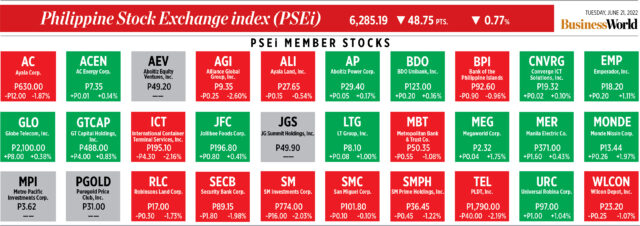
How PSEi member stocks performed — June 21, 2022

Here’s a quick glance at how PSEi stocks fared on Tuesday, June 21, 2022.


Shares drop on worries over peso, BSP decision

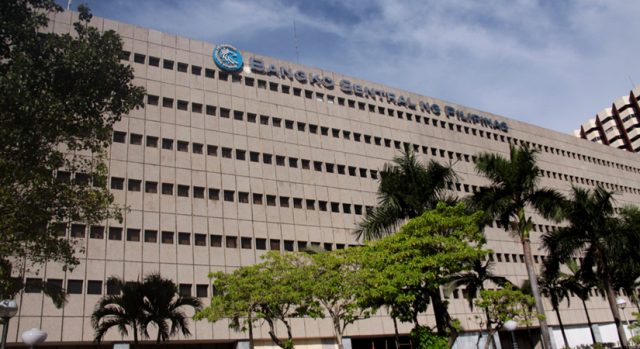
STOCKS declined on Tuesday as the peso weakened further versus the dollar and ahead of the Bangko Sentral ng Pilipinas (BSP) policy meeting where it is expected to raise borrowing costs again.

The benchmark Philippine Stock Exchange index (PSEi) shed 48.75 points or 0.77% to close at 6,285.19 on Tuesday, while the broader all shares index retreated by 19.11 points or 0.56% to 3,368.67.

First Metro Investment Corp. Head of Research Cristina S. Ulang said the peso’s continued decline against the dollar and the BSP’s upcoming review spooked investors.

“The local market closed lower this Tuesday as investors continued to trade cautiously amid the uncertainties over the Bangko Sentral ng Pilipinas’ upcoming policy decision this week. Sentiment was also dampened by the further weakening of the peso below the P54-per-dollar mark,” Philstocks Financial, Inc. Senior Research Analyst Japhet Louis O. Tantiangco said in a Viber message.

Mr. Tantiangco said value turnover on Tuesday remained below the year-to-date average of P6.78 billion, “implying weak trading as many investors stayed out of the market.”

The peso sank further on Tuesday, closing at P54.265 against the dollar, 20 centavos weaker than its P54.065 finish on Monday.

This was the local unit’s worst close in more than three years or since its ended at P54.32 against the greenback on Oct. 4, 2018.

The BSP Monetary Board will meet to review policy settings on Thursday, June 23.

Outgoing BSP Governor Benjamin E. Diokno and his successor Monetary Board member Felipe M. Medalla on Monday affirmed their stance of a gradual tightening, with both signaling a 25-basis-point (bp) hike this week despite market expectations of a 50-bp increase.

A BusinessWorld poll last week showed nine analysts expect the BSP to raise rates by 25 bps, while six see an increase worth 50 bps.

The BSP began its tightening cycle with a 25-bp hike on May 19 to help stem rising prices as headline inflation already reached 5.4% in May, higher than its 4.6% forecast and 2-4% target for the year. Year to date, inflation has averaged 4.1%.

Majority of sectoral indices ended with losses except for industrials, which gained by 49.15 points or 0.55% to close at 8,839.11, and mining and oil, which rose by 22.76 points or 0.19% to 11,493.39.

Meanwhile, services fell by 19.01 points or 1.12% to 1,677.10; holding firms declined by 63.67 points or 1.09% to 5,777.42; property went down by 29.20 points or 0.99% to 2,904.76; and financials lost 7.70 points or 0.49% to end at 1,545.83.

Decliners bested advancers, 94 versus 87, while 53 names ended unchanged.

Value turnover went up to P3.97 billion on Tuesday with 885.42 million shares changing hands from the P3.57 billion with 764.92 million issues seen on Monday.

Net foreign selling climbed to P401.59 million from the P215.28 million recorded the previous trading day. — L.M.J.C. Jocson

Peso weakens further as BoP deficit widens

BW FILE PHOTO

THE PESO sank further versus the greenback on Tuesday as the country’s balance of payments (BoP) position was at a wider deficit in May.

The local unit closed at P54.265 versus the dollar on Tuesday, dropping by 20 centavos from its P54.065 finish on Monday, data from the Bankers Association of the Philippines showed.

This was the local unit’s worst close in more than three years or since its ended at P54.32 against the greenback on Oct. 4, 2018.

The peso opened Tuesday’s trading session at P54.10 versus the dollar. Its intraday best was at P54.05, while its weakest showing was at P54.40 against the greenback.

Dollars exchanged rose to $1.389 billion on Tuesday from $1.015 billion on Monday.

Rizal Commercial Banking Corp. Chief Economist Michael L. Ricafort said the peso weakened versus the dollar as latest BoP data released by the Bangko Sentral ng Pilipinas (BSP) on Tuesday showed the country’s external position was at a deficit last month.

The country posted a $1.61-billion BoP deficit in May, bigger than the $415-million gap in April. This was also wider than the $1.4-billion deficit seen in May 2021 and the widest in 15 months or since the $2.019-billion gap recorded in February 2021.

In the first five months of 2022, the Philippines’ external position was at a $1.53-billion deficit, narrower than the $1.63 billion logged in the comparable year-ago period.

The BSP expects the BoP to yield a deficit of $6.3 billion this year or equivalent to -1.5% of gross domestic product.

The peso also weakened due to concerns over rising coronavirus disease 2019 (COVID-19) cases in the country, Mr. Ricafort said.

An additional 529 new COVID-19 cases were reported on Monday by the Health department, bringing active cases to 4,740.

Monday’s new cases were slightly lower than the 612 recorded on Sunday but were higher compared with the average of 435 recorded from June 13 to 19.

For Wednesday, Mr. Ricafort gave a forecast range of P54.15 to P54.35 per dollar. — K.B. Ta-asan

P20 rice seen possible late in Marcos term; to require massive investment

PHILSTAR

By Luisa Maria Jacinta C. Jocson, Reporter

PRESIDENT-ELECT Ferdinand R. Marcos, Jr.’s campaign promise to lowering the price of rice to P20 per kilo can be accomplished later in his presidency, but will require production and subsidies to ramp up dramatically, farm industry officials and analysts said.

“In a regime like the Philippines that is not 100% self-sufficient because of crop failures brought about by typhoons… (P20 rice) is possible within his six-year term,” Roy S. Kempis, retired Pampanga State Agricultural University professor, said in an e-mail.

“Any number less than or equal to P30 per kilo can be attained early in his term,” he said, adding that approaching the P20 range will come late in the Marcos presidency.

“It is unrealistic though to attain this in 2023 or so. There is a confluence of factors to contend with,” he added.

On Monday, the President-elect announced that he would be heading the Department of Agriculture (DA) for the time being, signaling his intent to follow through on agriculture-related campaign promises with an international food crisis looming.

“From the very beginning, I always said that agriculture was going to be a very critical and foundational part of our economic transformation,” Mr. Marcos said in a news conference.

Mr. Kempis said bringing down commodity prices, in general, depends on abundant supply.

“To have enough supply, you have to increase production of palay (unmilled rice); to increase production of palay, you either do this with technology, or cluster rice farming, or open new land for rice production, or increase the price of palay so rice farmers or those who paused or stopped producing can be enticed to produce palay again,” he said.

“All these can possibly increase production and eventually supply. And still farmers have to contend with the rising cost of inputs, especially those that are dependent on oil or are affected by speculation on the magnitude of price increases of fuel,” he added.

RCBC Chief Economist Michael L. Ricafort said that achieving higher yields will require exploring different varieties and investing in more efficient technology.

“Further increasing productivity of rice harvests per hectare through higher-yield rice varieties and further mechanization to also lower costs would help bring down the price of rice and also help increase food security and reduce reliance on imports,” he said.

Mr. Ricafort added that bringing down prices might be difficult due to the global supply chain disruptions as a result of the pandemic and the Russia-Ukraine war.

“Given the higher prices of agricultural inputs in recent months largely brought about by the Russia-Ukraine conflict, such as oil, which increased transportation costs, fertilizer, and other inputs, it would be tough to bring down the price of rice. In fact, some rice exporting countries plan to increase prices in view of these,” he said in a text message.

“Even importing cheaper rice under the Rice Tariffication Law showed that further lowering of rice prices has been challenging in recent years, even before the Russia-Ukraine war, which sent global commodity prices to elevated levels,” he added.

ING Bank N.V. Manila Senior Economist Nicholas Antonio T. Mapa added that the new administration will need to get creative in finding ways to source inexpensive inputs and increase productivity and efficiency.

Mr. Kempis said that the government will also likely require subsidies if it plans to drastically slash prices.

“We need more production to attain sufficiency, and this is possible, but not instant… there is room for the possibility that Mr. Marcos’ promise can happen, but this has to be aided by some government subsidy in the buying price of palay. This subsidy is going to be the government’s expense and the National Food Authority may incur more debt,” he added.

“It would take a lot of effort to achieve this price goal, such as significantly increasing the yields on rice harvests through greater mechanization and higher-yielding varieties. This would also potentially require huge amounts of subsidies for rice farmers that would also be challenging, given the government’s limited financial resources amid wider budget deficits,” Mr. Ricafort said.

Agriculture industry associations said, with Mr. Marcos in the Department of Agriculture, they expect more attention to be paid to the sector.

“Agri-fisheries will be the major focus of the (next) administration. We expect him to mobilize the powers and resources of the Presidency to revive and strengthen our long neglected sector. Our main wish is that (he) will place full trust and confidence in the willingness and capability of our farmers and other stakeholders to provide food and jobs for our people,” Leonardo Q. Montemayor, chairman of the Federation of Free Farmers, said in a statement.

Current Agriculture Secretary William D. Dar said that he welcomes the President-elect’s decision to take control of the department.

“This is the brand of ‘political will’ that we have been advocating since we assumed office in August 2019. It is a very strategic decision, giving the agriculture sector utmost priority, and thus a bigger budget for the DA in the years to come,” he said in a statement.

“The present leadership is ready to brief the President-elect at his most convenient time, and we assure him of our strong support and cooperation, as we truly want him to succeed,” he added, noting that a transition report was ready for the next administration.

Sorsogon Governor Francis Joseph G. Escudero said in a statement that Mr. Marcos at the DA will be able to “cut a lot of red tape” and put all the resources needed into the department.

Senator-elect Joseph Victor G. Ejercito said that the decision to become Agriculture Secretary indicates the President-elect’s seriousness in addressing the food crisis.

“It’s a strong signal to the agencies under DA that they should all get their acts together,” he added in a statement.

“It may not be the end-all and be-all solution to all the problems besetting the agricultural sector including the food crisis but for sure decision-making will be really fast and solutions can be undertaken and implemented right away,” incoming Senator Jose P. Ejercito, Jr. said in a statement.

A fishermen’s association, Pambansang Lakas ng Kilusang Mamamalakaya ng Pilipinas (PAMALAKAYA), said Mr. Marcos may not be able to address issues plaguing the fisheries industry due to lack of experience.

“PAMALAKAYA said that if Mr. Marcos wants to address the industry’s problems, he should “renounce the liberalization policies that bankrupt the sector.”


DTI’s Lopez supports procurement preference for domestic manufacturers

THE next administration should consider changing government procurement rules to favor domestic manufacturers in some cases, the Department of Trade and Industry (DTI) said.

“Maybe in the next administration, what can be worked out is a refinement of this lowest-bidder rule to make sure that in certain projects, not necessarily in all government procurement programs, there will be a preference that only local manufacturers can participate in the bids, provided that the supply is available and the prices are competitive,” Mr. Lopez said during the Manufacturing Summit 2022 on Tuesday.

“There can just be benchmarking with the prices from abroad just to make sure that the prices are within range. That is what we are trying to inject in the current policy,” he added.  

According to Mr. Lopez, the current rule in government procurement is awarding the contract to the lowest bidder, as spelled out in Republic Act No. 9184 or the Government Procurement Reform Act.

Mr. Lopez said an amendment is needed to grant some preference for domestic manufacturers, in line with a resolution passed by the Task Group on Economic Recovery that is implementing the National Employment Recovery Strategy (NERS).

“You have to amend the law. While the law has yet to be amended, maybe it can be done by changing the terms of reference of some government procurement projects through this NERS resolution that hopefully can be adopted by the President and issue as an executive order,” Mr. Lopez said. 

Mr. Lopez said that some opportunities for Philippine manufacturers lie in supplying clothing and shoes to the military and police. — Revin Mikhael D. Ochave

Balisacan sees National ID target of 92 million achieved by end of 2022

THE National Identification System will meet its target of 92 million registered by the end of the year, incoming Socioeconomic Planning Secretary Arsenio M. Balisacan said.

The ID target is a component of a broader digitalization effort that hopes to facilitate the accelerated distribution of aid to the poor and vulnerable, he said.

In an interview with CNN Philippines on Tuesday, Mr. Balisacan said: “The rapid increase in prices (is) already here, and are likely to get worse before it gets better… We must protect the poorest and vulnerable groups of our society.”

He was conveying the instructions of President-elect Ferdinand R. Marcos, Jr., adding that ramping up digitalization effort would lead to more efficient targeting of the poor and reduce leakage of funds to undeserving recipients.

He clarified that the effort to reach the poor will encompass rural areas as well as urban.

“I understand we have a registry already (for) small farmers, and we have also a registry involving the poor that is with the Department of Social Welfare and Development (DSWD). All we need to do is to (link their ID) with the banks, so that they can access these ayuda (cash aid) without the need for intermediaries,” which Mr. Balisacan identified as a major source of leakage.

He was referring to the farmers eligible to receive subsidies and other forms of support under the Rice Tariffication Law, and families targeted by the DSWD’s Pantawid Pamilyang Pilipino Program (4Ps), whose beneficiaries can receive cash aid if they meet qualifying criteria like keeping children in school and submitting to periodic health checks.

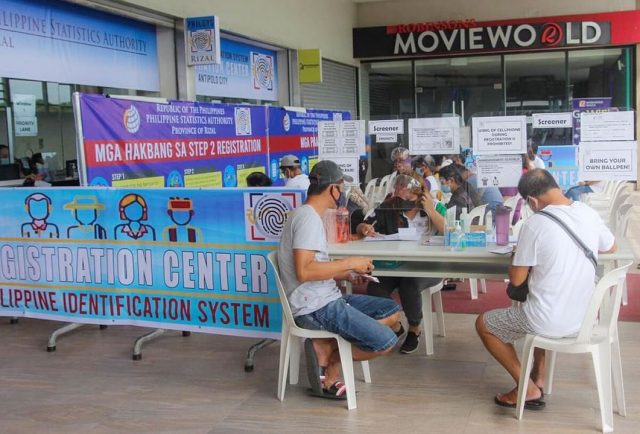
Mr. Balisacan said the 92 million target covers those holding a physical ID as well as those issued an electronic one, with an initial focus on farmers and the poor.

“That’s our target. We’ll still confirm the logistics with the agencies concerned,” he said. “The printing is with the Bangko Sentral (ng Pilipinas), the generation of the e-ID is with the Philippine Statistics Agency. We just need to coordinate these agencies.”

Mr. Balisacan noted that social aid distributed during the pandemic was costly in the absence of the means to identify priority groups in most need of the aid.

“Everybody was given ayuda, whether you are living in luxury villages, in gated subdivisions, or not, and I do think that is an unnecessary use of limited resources.”

The Philippine National Identification System aims to make access to social services, including health, education, and government, easier and more efficient by providing a valid ID accepted nationwide.

As of June 1, the PSA’s 92 million target was 72.9% achieved in terms of those who have completed biometrics capture. Some 13.74 million IDs have been dispatched as of June 3, according to the PSA’s Philippine Identification System’s dashboard. — Tobias Jared Tomas

Council calls higher interest rates, oil prices key risks to financial stability 

THE Financial Stability Coordination Council (FSCC) said rising interest rates and oil prices are the key external risks to financial stability and to the economic recovery.

However, the Bangko Sentral ng Pilipinas (BSP) expressed confidence that the economy is in a strong position to endure the headwinds.

“At a time when COVID-19 is no longer dominating the daily headlines, renewed market pressure is being driven by high inflation, rising interest rates, and sharp increases in the prices of commodities. Financial stability risks are then elevated, with macro financial prospects subject to heightened volatilities and broader uncertainties,” BSP Governor and FSCC Chairman Benjamin E. Diokno said.

“The FSCC also identified repricing risks and developments in the oil market as the two key external challenges. According to the Council, these risks have far reaching consequences because they may affect leverage, liquidity, the macroeconomy, and the country’s climate change initiatives,” the BSP said in a statement.

Rising inflation in advanced and emerging economies has led their central banks to raise policy rates to temper economic activity.

In the Philippines, inflation rose to 5.4% in May, the highest in three and a half years, and well past the BSP’s 2-4% target range, driven by food and fuel prices.

This may lead the BSP to keep adjusting policy rates until inflation is brought into line with the central bank’s target.

The BSP last month raised its average inflation estimate to 4.6% this year from 4.3%.

Rising interest rates benefit savers and investors in financial instruments, but this will also mean higher costs for borrowers, households, businesses, and the government. Holders of marketable assets may also experience losses when their assets are revalued.

“Given the headwinds that we see right now, the primary challenge has to do with valuation in financial assets. So we would grade that as a red box in the schematic that we have, and the rising global interest rates will then change the pricing of risk and will revalue financial assets as well,” Senior Assistant Governor and FSCC Technical Secretariat Head Johnny Noe E. Ravalo said.

However, in the FSCC’s Statement on the State of Financial Stability, Mr. Diokno reiterated that the Philippine situation is significantly different from the rest of the world.

“The Q1 2022 year-on-year GDP growth of 8.3% reflects a trajectory that is markedly different from the prognosis (of multilateral agencies) for 2022 global growth,” Mr. Diokno said.

He added that growth is driven by consumer purchasing power and by economic investments for the future.

“We expect spillovers from the Advanced Economies to Emerging Market Economies through cost-push pressures and higher risk premiums. These are not independent shocks but are interconnected at many levels, creating complex, non-stationary and interlinked cause-and-effect relationships,” the outgoing governor, who becomes Finance Secretary next month, said.

Mr. Diokno also cited the Council’s Systemic Risk Crisis Management (SRCM) Framework, which indicates how the FSCC continuously manages systemic risk. The SRCM was released earlier this month.

Mr. Diokno said the Council is committed to engaging the public so they can make well-informed decisions.

The FSCC is composed of the BSP, the Department of Finance, the Insurance Commission, the Philippine Deposit Insurance Corp., and the Securities and Exchange Commission. — Keisha B. Ta-asan

IPAs on notice from FIRB to file complete data on locators

FINANCE SECRETARY CARLOS G. DOMINGUEZ III

THE Fiscal Incentives Review Board (FIRB) said it has sent letters to the investment promotion agencies (IPAs) holding incomplete information on their locators, in a bid to bring them into compliance with reporting rules set by the Corporate Recovery and Tax Incentives for Enterprises (CREATE) law.

Finance Assistant Secretary Juvy C. Danofrata, who heads the FIRB Secretariat, said in a statement: “The Secretariat has already sent a follow-up letter signed by the Chairman of the FIRB and Finance Secretary, Carlos G. Dominguez III, to each of these IPAs that had incomplete and missing submissions… All IPAs should understand that these reports we require are important for the FIRB to fulfill its oversight functions on the administration and grant of tax incentives.”

Last week, the Department of Finance, which chairs the FIRB, announced that only four IPAs are compliant with the reporting requirements — the Bases Conversion and Development Authority, John Hay Management Corp., Poro Point Management Corp., and the PHIVIDEC Industrial Authority.

IPAs holding incomplete information on locators were identified as the Philippine Economic Zone Authority (PEZA), Tourism Infrastructure and Enterprise Zone Authority (TIEZA), Authority of the Freeport Area of Bataan, Aurora Economic Zone and Freeport Authority, Board of Investments (BoI), Cagayan Economic Zone Authority, Clark Development Corp., Regional Board of Investments-Bangsamoro Autonomous Region in Muslim Mindanao, the Subic Bay Metropolitan Authority, and the Zamboanga City Special Economic Zone Authority.

The information required of IPAs includes the lists of their registered business enterprises, the tax incentives they are entitled to, IPA-approved projects involving investment capital of P1 billion or less, and registered Information Technology and Business Process Management companies that have work-from-home arrangements.

The FIRB Secretariat also said that both PEZA and TIEZA have yet to submit reports on their locators’ actual invested capital, a requirement of the pre-CREATE rules, which was due last August 2021.

CREATE reduced corporate income tax to 20% for micro-, small-, and medium-sized enterprises, and 25% for all other firms.

The DoF said that PEZA has other pending submissions, including its cost-benefit analyses for its investments, tax incentives granted, and a report on technology transferred by its locators, which it also failed to submit last year.

PEZA Director General Charito B. Plaza said in a statement on Tuesday that the reporting shortcomings are “minor” and called for a halt to statements that might unduly alarm investors.

“If there are data still being awaited from our side, (they are) minor and can be clarified without (generating) negative news about compliance,” she said. “We must not rock the boat and create negative signals.”

PEZA was singled out last week for incomplete data, to which Ms. Plaza replied that the FIRB’s statement was “erroneous, misleading and intend(ed) to embarrass PEZA as an IPA.”

Trade Secretary Ramon M. Lopez, who chairs the BoI, said in a Viber message that the compliance issue was “minor.”

“There were submissions made, but (a) new template and info (was) requested. New deadline. So (it is) ongoing, not an issue.”

Asked about the new deadline for compliance, Mr. Lopez said in a Viber message, “Another month, I was told.”

Mr. Dominguez, who also chairs the FIRB, promised to implement stricter measures if noncompliance continues. — Tobias Jared Tomas