Home Blog Page 6218

Never again to a Spoliarium
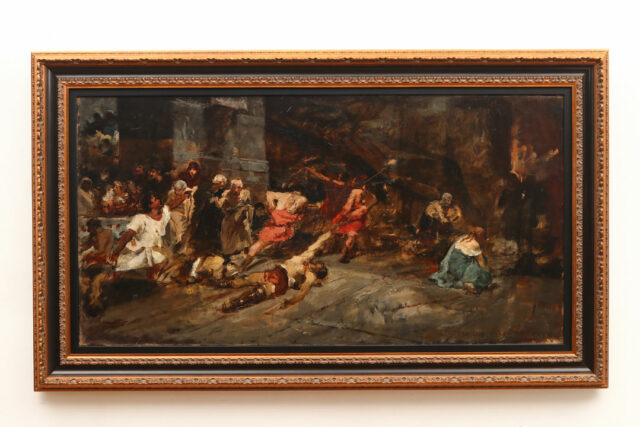
Stripped to his bloodied loin cloth, a dead gladiator is dragged by his right arm by a blood-drenched orderly in the spoliarium (abattoir) of the Roman Coliseum. The gladiator had lost in the spectator sport where two combatants fought “sine missione” (to the death) for the entertainment of the emperor and the leering, jeering, blood-hungry public who had jostled and bribed for bleacher seats in the four-story high Coliseum which had a capacity of 50,000.

Dead or near-dead, the losing gladiator was to officially die at the thumbs-down decision “police verso” — of the emperor. And so, the loser lost their life and all possessions. Two Coliseum attendants are seen lugging out the armor, weapons, and raiment of the conquered — all to be turned over to the winning gladiator. “Please, don’t it take all,” the man in white tunic seems to say to those carting off the spoils of the combat. He was the trainer-coach, the lanista of the fallen warrior, who would then need to set up logistics for his next gladiator-trainee. On the right is a woman in blue, mourning the loss of her loved one, the fallen warrior. Behind her is an old man, seeming to be scavenging for leftover food or abandoned things, or perhaps suffering dementia, looking for his dead son. In the gallery box on the left side of the spoliarium, a crowd with various expressions of sadistic voyeurism watches the goings-on.

It is like walking into the spoliarium of the 4th-6th century AD, when dramatic gladiator contests ingrained in the minds of the people the awesome might of the Roman Empire and the absolute power of the emperors over human life and rights. Our view of how it was in the Roman era comes from the great Filipino artist Juan Luna’s Spoliarium, which I just described.

Painted over eight months in 1884, it won first prize in the Exposición Nacional de Bellas Artes in Madrid, Spain in 1886. Juan Luna, then 27 years old, was with the group of young Filipino intelligentsia who were studying and living in Spain, imbibing the ambience of European liberal thinking. José Protasio Rizal, then 24, intellectual writer and polymath, was in Madrid with Juan Luna and the group of enlightened young Filipino nationalists active at the end of the Spanish colonial period of the Philippines.

“At a gathering of Filipino expatriates in Madrid, José Rizal enthusiastically toasted the triumphs of his two compatriots had achieved, the other being Félix Hidalgo who won a silver medal, calling it ‘fresh proof of racial equality’” (Guerrero, Leon (1974). The First Filipino: A Biography of José Rizal (PDF) (5th ed.). Manila: National Historical Commission. p. 112).

In his congratulatory speech, Rizal said, “Luna’s Spoliarium with its bloody carcasses of slave gladiators being dragged away from the arena where they had entertained their Roman oppressors with their lives… stripped to satisfy the lewd contempt of their Roman persecutors, with their honor embodied the essence of our social, moral and political life: humanity in severe ordeal, humanity unredeemed, reason and idealism in open struggle with prejudice, fanaticism and injustice” (Ibid. p. 114).

“Rizal was inspired to carve a mark of his own to give glory to his country by writing his ‘Spoliarium’ since early that year 1884 ‘he had been toying with the idea of a book’ for he has seen and described the painting as ‘the tumult of the crowd, the shouts of slaves, the metallic clatter of dead men’s armor, the sobs of orphans, the murmured prayers…’. Rizal’s book would be called Noli Me Tangere, ‘the Latin echo of the Spoliarium’” (Ibid., pp. 119-120, 122).

Graciano Lopez-Jaena, contemporary and co-nationalist of Juan Luna and José Rizal said, “For me, if there is something grand, something sublime, in the Spoliarium, it is because behind the canvas, behind the painted figures… there floats the living image of the Filipino people sighing its misfortune. Because… the Philippines is nothing more than a real Spoliarium with all its horrors” (quoted by critic Butch Dalisay, philstar.com, July 17, 2006).

The somber chiaroscuro of dark umbers shocked by impressionistic strokes of light on the main figures in the painting urges a sinking mood of loss and helplessness, perhaps even eliciting some hidden guilt from unsure complicity in the strong message of oppression in society. In the shadows are various blurred faces, not even looking at the dead gladiator, thinking their own thoughts. Some art critics might say it was Juan Luna’s demo of the fin de siècle (French: “end of the century”) artistic climate of sophistication, escapism, extreme aestheticism, world-weariness, and fashionable despair. But no.

The muted but discernible red, white, and blue (the colors of the Philippine flag) triangulated in the tableau of the Spoliarium clearly call for patriotism and the defense of the freedoms of the people. Perhaps because Juan Luna was identified with the expat propagandist group of José Rizal in Madrid, it was mothballed after a three-year exhibition in the Museo del Arte Moderno in Barcelona where it was thereafter in storage until the museum was burned and looted during the Spanish Civil War in 1937. The badly damaged Spoliarium stayed for 20 years more in Spain until Generalissimo Francisco Franco turned over the partially restored painting to the Philippines in January 1958.

The Spoliarium was unveiled and exhibited in the Hall of Flags of the Department of Foreign Affairs (the current-day Department of Justice building on Padre Faura St. in Manila) in December 1962. One might wonder why its coming home was not much-trumpeted, but perhaps the Vietnam War that had started in 1961 and raged until 1975 occupied much of the world’s mind including the Philippines then. Before the Vietnam War even ended, Ferdinand E. Marcos, Sr. declared Martial Law in the country in 1972, to last until 1986, when Marcos was ousted in the Feb. 25, 1986 EDSA People Power Revolution. The message of the Spoliarium did not quite jibe with Martial Law.

After painstaking repair and cleaning by restoration artists over some 40 years, the massive oil-on canvas painting, measuring 9.05 meters by 5.59 meters (framed), now hangs floor-to-ceiling in the main gallery at the first floor of the National Museum of Fine Arts in Manila. It is the first work of art that greets visitors upon entry into the museum.

Before the restrictions of the COVID pandemic, throngs used to queue to view the awesome Spoliarium, even to have pictures taken beside it, almost like being in it, like a location shot for its massiveness. Been there, done that. Seen this, seen that. Is it all there is to view the Spoliarium and be part of that impersonal crowd that Juan Luna painted in, the onlookers to the deathly spectator sport, not quite looking at the fallen gladiator and feeling for the meaning of his death?

The Spoliarium Hall was formerly the House of Representatives Session Hall, site of the 1934 Constitutional Convention. It was the first time the Filipinos under American rule were allowed to write a fundamental law that would guide them towards autonomy and independence. Of the 202 delegates to the 1934 Constitutional Convention, three became Presidents of the Philippines, namely, José Laurel, Manuel Roxas, and Elpidio Quirino.

The same venue was previously used for the inauguration of former presidents Manuel L. Quezon in 1935, José P. Laurel in 1943, and Manuel Roxas in 1946 when it was then known as the Legislative Building.

On June 30, 2022, Ferdinand “Bongbong” R. Marcos, Jr. will be inaugurated as the 17th President of the Philippines — at the National Museum of Fine Arts, in the overpowering aura of the Spoliarium.


Amelia H. C. Ylagan is a doctor of Business Administration from the University of the Philippines.


ahcylagan@yahoo.com

Healthy planet needs ‘ocean action’ from Asian and Pacific countries

FREEPIK

AS THE Second Global Ocean Conference opens today in Lisbon, governments in Asia and the Pacific must seize the opportunity to enhance cooperation and solidarity to address a host of challenges that endanger what is a lifeline for millions of people in the region.

If done right, ocean action will also be climate action but this will require working in concert on a few fronts.

First, we must invest in and support science and technology to produce key solutions. Strengthening science-policy interfaces to bridge practitioners and policymakers contributes to a sound understanding of ocean-climate synergies, thereby enabling better policy design, an important priority of the Indonesian Presidency of the G20 process. Additionally, policy support tools can assist governments in identifying and prioritizing actions through policy and SDG (Sustainable Development Goals) tracking and scenario development.

We must also make the invisible visible through ocean data: just three of 10 targets for the goal on life below water are measurable in Asia and the Pacific. Better data is the foundation of better policies and collective action. The Global Ocean Accounts Partnership (GOAP) is an innovative multi-stakeholder collective established to enable countries and other stakeholders to go beyond GDP and to measure and manage progress towards ocean sustainable development.

Solutions for low-carbon maritime transport are also a key part of the transition to decarbonization by the middle of the century. Countries in Asia and the Pacific recognized this when adopting a new Regional Action Program last December, putting more emphasis on such concrete steps as innovative shipping technologies, cooperation on green shipping corridors, and more efficient use of existing port infrastructure and facilities to make this ambition a reality. Finally, aligning finance with our ocean, climate and broader SDG aspirations provides a crucial foundation for all of our action. Blue bonds are an attractive instrument both for governments interested in raising funds for ocean conservation and for investors interested in contributing to sustainable development in addition to obtaining a return for their investment.

These actions and others are steps towards ensuring the viability of several of the region’s key ocean-based economic sectors, such as seaborne trade, tourism and fisheries. An estimated 50% to 80% of all life on Earth is found under the ocean surface. Seven of every 10 fish caught around the globe come from Pacific waters. And we know that the oceans and coasts are also vital allies in the fight against climate change, with coastal systems such as mangroves, salt marshes, and seagrass meadows at the frontline of climate change, absorbing carbon at rates of up to 50 times those of the same area of tropical forest. But the health of the oceans in Asia and the Pacific is in serious decline: rampant pollution, destructive and illegal fishing practices, inadequate marine governance and continued urbanization along coastlines have destroyed 40% of the coral reefs and approximately 60% of the coastal mangroves, while fish stocks continue to decline and consumption patterns remain unsustainable. These and other pressures exacerbate climate-induced ocean acidification and warming and weaken the capacity of oceans to mitigate the impacts of climate change. Global climate change is also contributing to sea-level rise, which affects coastal and island communities severely, resulting in greater disaster risk, internal displacement, and international migration.

To promote concerted action, ESCAP (the Economic and Social Commission for Asia and the Pacific), in collaboration with partner UN agencies, provides a regional platform in support of SDG14, aligned within the framework of the UN Decade of Ocean Science for Sustainable Development (2021-2030). Through four editions so far of the Asia-Pacific Day for the Ocean, we also support countries in identifying and putting in place solutions and accelerated actions through regional dialogue and cooperation.

It is abundantly clear there can be no healthy planet without a healthy ocean. Our leaders meeting in Lisbon must step up efforts to protect the ocean and its precious resources and to build sustainable blue economies.


Armida Salsiah Alisjahbana is an under-secretary-general of the United Nations and executive secretary of the Economic and Social Commission for Asia and the Pacific (ESCAP).

Monkeypox is not yet a global health emergency — WHO official

AN ELECTRON MICROSCOPIC image shows mature, oval-shaped monkeypox virus particles as well as crescents and spherical particles of immature virions, obtained from a clinical human skin sample associated with the 2003 prairie dog outbreak in this undated image obtained by Reuters on May 18, 2022. — CYNTHIA S. GOLDSMITH, RUSSELL REGNERY/CDC/HANDOUT VIA REUTERS

LONDON — Monkeypox is not yet a global health emergency, the World Health Organization (WHO) ruled on Saturday, although WHO Director-General Tedros Adhanom Ghebreyesus said he was deeply concerned about the outbreak.

“I am deeply concerned about the monkeypox outbreak, this is clearly an evolving health threat that my colleagues and I in the WHO Secretariat are following extremely closely,” Mr. Tedros said in a statement.

WHO said in a separate statement that although there were some differing views within the committee, they ultimately agreed by consensus that at this stage the outbreak is not a Public Health Emergency of International Concern (PHEIC).

The “global emergency” label currently only applies to the coronavirus pandemic and ongoing efforts to eradicate polio, and the U.N. agency has stepped back from applying it to the monkeypox outbreak after advice from a meeting of international experts.

There have been more than 3,200 confirmed cases of monkeypox and one death reported in the last six weeks from 48 countries where it does not usually spread, according to WHO.

So far this year almost 1,500 cases and 70 deaths in central Africa, where the disease is more common, have also been reported, chiefly in the Democratic Republic of Congo.

Monkeypox, a viral illness causing flu-like symptoms and skin lesions, has been spreading largely in men who have sex with men outside the countries where it is endemic.

There are vaccines and treatments available for monkeypox, although they are in limited supply.

Some global health experts said WHO may be have been hesitant to make a declaration because its January 2020 declaration that the new coronavirus represented a public health emergency was largely met with skepticism around the world.

But others said the outbreak met the criteria to be called an emergency.

Gregg Gonsalves, an associate professor of epidemiology at Yale University who advised the committee but who is not a member of WHO, told Reuters by email on Saturday that he thought the decision was “misguided”.

“It met all the criteria but they decided to punt on this momentous decision,” he said. — Reuters

UK PM Johnson aims to stay in power until mid-2030s

British Prime Minister Boris Johnson via Chatham House/Flickr

KIGALI — British Prime Minister Boris Johnson said on Saturday he aims to remain in power until the middle of the next decade, despite calls for him to quit, which would make him the country’s longest continuously serving leader in 200 years.

Earlier this month, Mr. Johnson survived a vote of confidence by Conservative lawmakers in which 41% of his parliamentary colleagues voted to oust him, and he is under investigation for intentionally misleading parliament.

On Friday Conservative candidates lost two parliamentary by-elections held to replace former Conservative incumbents who had to step down, one after being convicted of sexual assault and the other for watching pornography in the House of Commons.

The by-election defeats suggest the broad voter appeal which helped Mr. Johnson win a large parliamentary majority in December 2019 may be fracturing after a scandal over illegal parties held at Downing Street during coronavirus lockdowns.

Under Conservative party rules, its lawmakers cannot formally challenge Mr. Johnson for another year, but overwhelming dissatisfaction or resignations by a series of senior ministers could make his position untenable.

Britain is also in the midst of its deepest cost-of-living crisis in decades, with inflation at a 40-year high.

Former party leader Michael Howard said on Friday it was now time for Mr. Johnson to go, and Conservative party chairman Oliver Dowden quit after the by-election losses.

However, Mr. Johnson said he wanted to serve a third term in office and remain as prime minister until the mid-2030s to give him time to reduce regional economic disparities and make changes to Britain’s legal and immigration systems.

“At the moment I am thinking actively about the third term and, you know, what could happen then. But I will review it when I get to it,” Mr. Johnson told reporters in Rwanda on the final day of a visit for a Commonwealth summit.

Asked what he meant, Mr. Johnson said: “About the third term … this is the mid-2030s.”

Mr. Johnson must call Britain’s next national election by December 2024, and would need a third election victory by 2029.

If he was still in office beyond early 2031, he would beat Margaret Thatcher’s record as the longest continuously serving British prime minister since Robert Banks Jenkinson, the Earl of Liverpool, who was in office from 1812 to 1827.

Mr. Johnson told reporters that he did not expect to have to fight another internal challenge from within his party, and blamed the by-election defeats partly on months of media reporting of lockdown parties at the heart of government.

“People were fed up of hearing about things I had stuffed up, or allegedly stuffed up, or whatever, this endless — completely legitimate, but endless — churn of news,” he said.

Earlier on Saturday, Mr. Johnson told BBC radio he rejected the notion that he should change his behavior.

“If you’re saying you want me to undergo some sort of psychological transformation, I think that our listeners would know that that … is not going to happen.”

Mr. Johnson refused to comment on a report in The Times newspaper that he had planned to get a donor to fund a 150,000-pound ($184,000) treehouse for his son at his state-provided country residence.

The story comes months after his party was fined for failing to accurately report a donation which helped fund the refurbishment of his Downing Street apartment.

“I’m not going to comment on non-existent objects,” Mr. Johnson said when asked if he planned to use a donor’s money to build the treehouse. — Reuters

Ukraine suffers major setback after the fall of Sievierodonetsk

Army soldier figurines are displayed in front of the Ukrainian and Russian flag colors background in this illustration taken, Feb. 13, 2022. — REUTERS/DADO RUVIC/ILLUSTRATION

KYIV/POKROVSK — Ukraine special forces remained in Sievierodonetsk directing artillery fire against Russian-backed troops, said an adviser to Ukraine’s president, after the city fell in a major setback for Kyiv as it struggles to keep control of the country’s east.

Ukrainian shelling on Saturday forced Russian troops to suspend the evacuation of people from a chemical plant in Sievierodonetsk, just hours after Moscow’s forces took the city, Tass news agency quoted local police as saying.

The fall of Sievierodonetsk, following weeks of some of the war’s bloodiest fighting, is the biggest defeat for Ukraine since it lost control of the southern port of Mariupol in May.

Ukraine called its retreat from the city a “tactical withdrawal” to fight from higher ground in Lysychansk on the opposite bank of the Siverskyi Donets river. Pro-Russian separatists said Moscow’s forces were now attacking Lysychansk.

The fall of Sievierodonetsk — once home to more than 100,000 people but now a wasteland — transforms the battlefield in the east after weeks in which Moscow’s huge advantage in firepower had yielded only slow gains.

Russia will now seek to press on and seize more ground on the opposite bank, while Ukraine will hope that the price Moscow paid to capture the ruins of the small city will leave Russia’s forces vulnerable to counterattack.

President Volodymyr Zelensky vowed in a video address that Ukraine would win back the cities it lost, including Sievierodonetsk. But acknowledging the war’s emotional toll, he said: “We don’t have a sense of how long it will last, how many more blows, losses and efforts will be needed before we see victory is on the horizon.”

Kyrylo Budanov, Ukraine’s military intelligence chief, told Reuters that Ukraine was carrying out “a tactical regrouping” by pulling its forces out of Sievierodonetsk.

“Russia is using the tactic … it used in Mariupol: wiping the city from the face of the earth,” he said. “Given the conditions, holding the defense in the ruins and open fields is no longer possible. So the Ukrainian forces are leaving for higher ground to continue the defense operations.”

Russia’s defense ministry said “as a result of successful offensive operations” Russian forces had established full control over Sievierodonetsk and the nearby town of Borivske.

Oleksiy Arestovych, senior adviser to Mr. Zelensky, said some Ukrainian special forces were still in Sievierodonetsk directing artillery fire against the Russians. But he made no mention of those forces putting up any direct resistance.

Russia’s Interfax news agency cited a representative of pro-Russian separatist fighters saying Russian and pro-Russian forces had entered Lysychansk across the river and were fighting in urban areas there.

MISSILES RAIN DOWN
Russia also launched missile strikes across Ukraine on Saturday. At least three people were killed and others may have been buried in rubble in the town of Sarny, some 185 miles (300 km) west of Kyiv, after rockets hit a carwash and a car repair facility, said the head of the local regional military administration.

Russia denies targeting civilians. Kyiv and the West say Russian forces have committed war crimes against civilians.

Russian missiles also struck elsewhere overnight. “48 cruise missiles. At night. Throughout whole Ukraine,” Ukrainian presidential adviser Mykhailo Podolyak said on Twitter. “Russia is still trying to intimidate Ukraine, cause panic.”

Ukraine’s top general Valeriy Zaluzhnyi wrote on the Telegram app that newly arrived, US-supplied advanced HIMARS rocket systems were now deployed and hitting targets in Russian-occupied parts of Ukraine.

Seeking to further tighten the screws on Russia, US President Joseph R. Biden and other Group of Seven (G7) leaders attending a summit in Germany starting on Sunday will agree on an import ban on new gold from Russia, a source familiar with the matter told Reuters.

Britain is ready to guarantee a further $525 million of World Bank loans to Ukraine later this year, taking total fiscal support this year to $1.5 billion, Prime Minister Boris Johnson said ahead of the G7 meeting.

“Ukraine can win and it will win. But they need our backing to do so. Now is not the time to give up on Ukraine,” Mr. Johnson said in a statement on Saturday.

‘IT WAS HORROR’
In the Ukrainian-held Donbas town of Pokrovsk, Elena, an elderly woman in a wheelchair from Lysychansk, was among dozens of evacuees who arrived by bus from frontline areas.

“Lysychansk, it was a horror, the last week. Yesterday we could not take it any more,” she said. “I already told my husband if I die, please bury me behind the house.”

Europe’s biggest land conflict since World War II has entered its fifth month, after Russian President Vladimir Putin sent tens of thousands of troops over the border on Feb. 24 and unleashed a conflict that has killed thousands and uprooted millions. It has also stoked an energy and food crisis that is shaking the global economy.

Since Russia’s forces were defeated in an assault on the capital Kyiv in March, it has shifted focus to the Donbas, an eastern territory made up of Luhansk and Donetsk provinces. Sievierodonetsk and Lysychansk were the last major Ukrainian bastions in Luhansk.

Moscow says Luhansk and Donetsk, where it has backed uprisings since 2014, are independent countries. It demands Ukraine cede the entire territory of the two provinces to separatist administrations. — Reuters

Pro-life is not just opposing abortion, Vatican says after US ruling

AERIAL VIEW of St. Peter’s Basilica, Vatican City — ALAN LIU-UNSPLASH

ANTI-ABORTION ACTIVISTS should be concerned with other issues that can threaten life, such as easy access to guns, poverty and rising maternity mortality rates, the Vatican’s editorial director said on Saturday.

In a media editorial on the United States Supreme Court’s ruling to end the constitutional right to abortion, Andrea Tornielli said those who oppose abortion could not pick and choose pro-life issues.

“Being for life, always, for example, means being concerned if the mortality rates of women due to motherhood increase,” he wrote.

He cited statistics from the Centers for Disease Control and Prevention showing a rise in maternity mortality rates overall and that the rate was nearly three times higher for black women.

“Being for life, always, means asking how to help women welcome new life,” he wrote, citing an unsourced statistic that 75% of women who have abortions live in poverty or are low-wage earners.

He also cited statistics from the Harvard Review of Psychiatry showing that the United States has much lower rates of paid parental leave compared with other rich nations.

“Being for life, always, also means defending it against the threat of firearms, which unfortunately have become a leading cause of death of children and adolescents in the US” he wrote.

The Roman Catholic church teaches that abortion is murder because life begins at the moment of conception and ends with natural death.

Pope Francis has compared having an abortion to “hiring a hit man” to eliminate a problematic person.

But he has tried to steer the US Catholic Church away from seeing abortion as the single, overarching life issue in the country’s so-called culture wars.

The death penalty, gun control, support for families, and immigration are also life issues, he has said.

The Vatican’s Academy for Life praised Friday’s US Supreme Court ruling, saying it challenged the world to reflect on life issues, but also called for social changes to help women keep their children.

US President Joseph R. Biden, a lifelong Catholic, condemned the ruling, calling it a “sad day” for America and labeling the court’s conservatives as “extreme”. — Reuters

PHINMA Corp. to conduct annual stockholders’ meeting through remote communication on July 14


Spotlight is BusinessWorld’s sponsored section that allows advertisers to amplify their brand and connect with BusinessWorld’s audience by enabling them to publish their stories directly on the BusinessWorld Web site. For more information, send an email to online@bworldonline.com.

Join us on Viber to get more updates from BusinessWorld: https://bit.ly/3hv6bLA.

ACE Malolos Doctors announces schedule of hybrid stockholders’ meeting on July 18


Spotlight is BusinessWorld’s sponsored section that allows advertisers to amplify their brand and connect with BusinessWorld’s audience by enabling them to publish their stories directly on the BusinessWorld Web site. For more information, send an email to online@bworldonline.com.

Join us on Viber to get more updates from BusinessWorld: https://bit.ly/3hv6bLA.

ING to exit PHL retail banking business by this year

source: https://bit.ly/2GswBI6

ING BANK N.V.-Manila will leave the Philippine retail banking market before 2022 ends, just about three years after its foray into the space, due to uncertain global conditions that affected its operations in the country.

“ING’s retail business in the Philippines was intended as the first step and foundation for a broader Asia retail banking plan. Since its launch in 2018, the business has demonstrated good progress, commercial momentum and growth potential,” the lender said in a statement on Friday.

“However, the uncertain global macro situation in the last few years led to ING deciding not to expand the activities to other countries, which meant that the retail operations in the Philippines had to be re-assessed for its scalability as a standalone business,” ING Bank added.

The bank assured its retail clients that their funds are safe and will remain accessible as it will continue to operate as usual until its exit from the business.

It said their customers can visit its website for information and updates on the impending shutdown of its retail business, including on how to close their accounts. It will no longer accept account opening requests.

Still, ING Bank said it will retain its wholesale banking business and global shared services operations in the Philippines.

“ING has a history in the Philippines that goes back more than 30 years. In that time, we’ve developed strong and steady partnerships with a number of the country’s largest corporations and financial institutions,” ING Philippines Country Manager Hans B. Sicat was quoted as saying in the statement.

“ING will continue to invest in growing our wholesale banking business to strengthen our position in the country, and we have plans to increase our focus on sustainable finance… We hope to take advantage of the growth prospects in various sectors like renewable energy, technology, media & telecommunications, infrastructure, financial institutions, among others,” Mr. Sicat added.

ING Bank has been operating in the Philippines as a wholesale lender since 1990 and entered the retail banking business in late 2018. It launched an all-digital savings bank platform in early 2019.

In 2013, the lender established ING Business Shared Services B.V. Branch Office or IBSS Manila to provide 24/7 global support for ING in areas including retail operations, financial markets, trade finance, lending services, due diligence, audit, legal, risk management and compliance, and IT and software development, among others.

“Extended capabilities and services have driven our growth and development in recent years. We have had to move to bigger premises several times since 2013; and have plans to take up an additional 12 floors in One Ayala Tower 2 in the next few months to accommodate our growing diverse teams as we take on additional projects and services this year and beyond,” IBSS Manila Chief Executive Officer Cees Ovelgonne said.

ING Bank was the 32nd biggest commercial lender in the country in asset terms with P31.46 billion at end-2021.

The lender’s move comes after Citigroup in 2021 likewise announced its exit from its consumer banking business in the country, along with other Asia-Pacific markets.

Citigroup has sold its Philippine consumer portfolio, including its credit card, personal loans, wealth management and retail deposit businesses, to UnionBank of the Philippines, Inc. for P55 billion.

The acquisition also includes Citi’s real estate interests in relation to Citibank Square in Eastwood, three full-service bank branches, five wealth centers and two bank branch lites. — Keisha B. Ta-asan

Job turnover in NCR improves in second half of 2021

Metro Manila’s job turnover improved in the latter half of 2021, data from the Philippine Statistics Authority showed.

The agency’s Labor Turnover Survey said the National Capital Region (NCR) reported turnover rates — the difference between the rate of hiring and the rate of job termination or resignation — of 0.7% and 0.6% in the third and fourth quarters of 2021, respectively.

This ended the two consecutive quarters of negative turnover rates in the first and second quarter of 2021 at -3.1% and -1.2%, respectively.

The turnover rate in the last two quarters of 2021 showed that for every 1,000 employed by establishments in Metro Manila, seven workers were added in the workforce in the third quarter while six workers were added in the workforce in the fourth quarter.

The accession rate, which represents hiring to either replace former employees or expand the workforce, was 9.6% and 9.7% in the third and fourth quarter last year, up from 7.3% and 7% in the first two quarters of 2021.

The separation rate, which covers termination and resignation, stood at 8.9% and 9.1% in the last two quarters of 2021.

Separation rate for the first quarter last year was at 10.4% and 8.1% for the second quarter.

Only the service sector posted a positive labor turnover rate with 0.7% and 1.1% in the third and fourth quarter last year, respectively.

In the third quarter, only the agriculture sector posted a contraction of 1.2%. Turnover rates for the industry sector logged net employment gains of 0.6%.

On the other hand, the industry sector declined by 1.8% while turnover rates for the agriculture sector increased by 0.4% in the fourth quarter of 2021. — Abigail Marie P. Yraola 


NCR building materials price growth in March fastest in over 10 years

RETAIL price growth of construction materials in Metro Manila accelerated to its fastest pace in more than a decade, the Philippine Statistics Authority (PSA) reported on Friday.

Preliminary data from the PSA showed that retail price growth of building materials in the National Capital Region (NCR) rose by 4.8% year on year in March, higher than the 3.3% seen in February and 1.2% in March last year.

This was the quickest pace in more than 10 years, since the 5.4% in January 2012.

Metro Manila's construction materials retail price index

This brought the NCR’s construction materials retail price index (CMRPI) average in the first quarter to 3.7%, higher than the 1.2% in January–March last year.

Prices for all commodity groups recorded increases that month, led by tinsmithry materials (7.3% in March from 5.2% in February).

Plumbing materials likewise grew by 6.9% year on year in March from 4.5% in February; miscellaneous construction materials (6.7% from 3.4%); electrical materials (3.6% from 2.8%); painting materials and related compounds (2.5% from 2.3%); masonry materials (2.1% from 1.9%); and carpentry materials (1.3% from 1.1%).

The retail construction prices reflect demand from small-scale building projects, such as small contractors. — Abigail Marie P. Yraola


Tax agencies should keep up with global trend toward flexible work — ADB

Cognitive jobs that require data interpretation, analysis, and creative thinking — characteristics that are prevalent among higher educated and more skilled workers — can be done from home, said an Asian Development Bank economist. 

“What we see globally is that enterprises and workers in information-related occupations are shifting towards hybrid and even remote work arrangements,” Sameer Khatiwada, ADB Southeast Asia’s social sector specialist, told BusinessWorld in an e-mail. 

Despite the global trend of hybrid or remote work, business process outsourcing companies (BPOs) in the Philippines that operate in economic zones will be required to operate on location by September 2022, when the extension of the work-from-home set-up approved by the Fiscal and Incentives Review Board ends. 

Instead of requiring onsite work to allow the effective monitoring of fiscal incentives, Mr. Khatiwada said that “tax agencies will need to create innovative ways to strengthen tax surveillance and compliance in hybrid or remote work arrangements.” 

Cognitive jobs that can be done remotely include product design, software development, and call center operations. Back-office operations can also be done from home, although these are at risk of automation, according to Mr. Khatiwada

In a May 17 ADB blog, he differentiated cognitive jobs from manual jobs that cannot be done from home, such as driving a truck or waiting tables at a café. 

According to a 2012 study in the Philippine Review of Economics that examined 427 occupations, only 8%–10% have all tasks classified as remote; 35%–37% cannot be done remotely. The rest are a combination of onsite and remote tasks. 

The pandemic hit some occupations harder than others. Service sectors such as those in food and transportation were casualties of the lockdown and physical distancing measures. So were those in manufacturing and construction who had to cope with these disruptions. 

SOCIAL PROTECTION 

Self-employed workers were likewise harder hit than their salaried counterparts, per ADB’s December 2021 research on the Southeast Asian labor market. The study noted that this segment tends to be in the informal sector, and that those who were lower-skilled were less likely to shift to teleworking.  

As such, they face a higher risk of unemployment and income loss during times of crisis. 

Freelancers can make their incomes more crisis-proof if they can diversify their clients, including by expanding their skillsets to related areas, Mr. Khatiwada said.  

“The pandemic has also highlighted that — given the non-standard form of employment contracts of freelancers — many were ineligible for government support and the safety nets put in place during the pandemic,” he added. “There is a need to rethink and build more comprehensive, inclusive, and sustainable employment or income insurance schemes moving forward.” 

Either an expanded social unemployment insurance or an income protection scheme can be enacted by the government to support all workers’ transition to the “future of work,” according to Kelly Bird, Philippines country director for ADB. 

“Two alternative models that could be applicable to the Philippines is the Malaysian employment insurance scheme and the Chilean unemployment insurance scheme, [the latter of which] comprises of individual savings accounts and a government Solidarity Fund,” he told BusinessWorld in an e-mail. “The second intervention is enterprise-based skills development schemes that allow workers access to lifelong skills training.” 

ADB, Mr. Bird added, is collaborating with the trade and industry, labor and employment, and tourism departments to pilot SkillsUpNet Philippines. 

“This will provide grant funding to networks of enterprises in priority sectors to skill up or reskill workers and job seekers,” he said.  

With these, “networks can incorporate digital skills training, which [in turn] can support hybrid work arrangements.” 

Added Mr. Khatiwada: “Remote work is not possible without connectivity, so governments need to prioritize investments in infrastructure that allow workers to be productive in a hybrid setting.” said Mr. 

Nine of 10 employees prefer a hybrid or remote work setup, based on a survey of 8,184 workers by Sprout Solutions in January. — PBM