Home Blog Page 618

The unique nature of Philippine employment contracts

STOCK PHOTO | Image by Pch.Vector from Freepik

Philippine employment contracts cannot be treated in the same manner as other civil or commercial contracts. To do so may expose one to massive and unexpected liability down the line.

Employment contracts are not only governed by the ordinary rule of negotiation and autonomy, but they are a legal hybrid, a volatile instrument where the State may choose to intervene. This results in an asymmetrical playing field which is constantly tilted in the worker’s favor due to the constitutional mandate of “protection to labor.”

Thus, an employer must understand the volatility of an employment contract, especially the various phases: from perfection, through its active term, and even the enforcement of certain clauses even after the employment has been severed.

For ordinary civil contracts, if a party backs out before the delivery of a service, the remedy may be a case for breach of contract before the regular courts. However, this is not the case for employment contracts in the Philippines.

The Supreme Court’s landmark ruling in Aragones v. Alltech Biotechnology Corp. (G.R. No. 251736, April 2, 2025) held that an employer-employee relationship exists the moment the candidate accepts and signs the job offer. The relationship is legally established immediately upon mutual consent, and the agreed-upon start date is merely a suspensive period.

In Aragones, the employer unilaterally withdrew the offer after the candidate had already accepted, citing redundancy. This was rejected by the Supreme Court declaring that the relationship was already perfected under the protective umbrella of the Labor Code. In this case, the employer’s withdrawal of the job offer was not treated as a simple breach of contract but was ruled an illegal dismissal. Consequently, a candidate who never set foot in the workplace, never clocked in, and never performed a single task can now successfully demand all forms of liabilities or damages associated with illegal dismissal. This includes backwages from the intended start date, damages, so long as the attendant circumstances are present, and attorney’s fees. Thus, a job offer may carry the full burden of security of tenure the moment it is signed.

During the active term of the employment contract, the State is a perpetual party that may impose changes or amendments to the contract. This is perhaps the most unique feature and greatest source of instability for long-term business planning.

Any new law, Department of Labor and Employment (DoLE) regulation, or Supreme Court ruling that is more favorable to labor is immediately and retroactively incorporated into existing employment contracts. While the terms may have been agreed upon yesterday, those terms may be nullified by a new government issuance today.

This means that an employment contract is fluid, and compliance is an ongoing, moving target, not a one-time legal check. Businesses must factor in new mandatory benefits, wage hikes, or holiday declarations, which may lead to unexpected cost surges in existing payroll budgets. Moreover, unforeseen stipulations such as new rules on work-from-home arrangements, or new types of leaves are instantly integrated in these contracts, which immediately changes the employee’s rights and employer’s obligations. Even a single Supreme Court decision, like Aragones, can redefine an existing relationship, instantly turning a standard HR practice into a statutory violation, even if that practice was considered sound before the decision came out. The employment contract shifts gears again after the relationship formally ends, specifically when an employer attempts to enforce post-employment restrictions, such as Non-Compete Agreements, Non-Disclosure, and Non-Solicitation clauses. These are legally recognized under Philippine contracts law as long as they adhere to the principle of contractual autonomy and are not contrary to public policy. It is critical to note that the enforcement of these covenants falls under the realm of Civil Law, not Labor Law, because the breach occurs after the employer-employee relationship has ceased, and the resulting claim is typically one for damages.

Jurisprudence dictates that the restriction should be reasonable and not greater than necessary to protect the employer’s legitimate business interests. Simply wanting to prevent a former employee from competing is not a sufficient justification. A non-compete clause must be tied to a specific, identifiable business interest.

It has been stressed that the restraint may not be unduly harsh or oppressive in curtailing the employee’s legitimate efforts to earn a livelihood, and must be reasonable in light of sound public policy. The clause must not be so broad that it effectively prevents the employee from earning a living in their profession. The prohibition must be limited to the specific line of business in which the employee was directly engaged. A clause that imposes a blanket ban on an entire industry is likely to be struck down as an unreasonable restraint of trade.

In assessing the enforceability of a restriction, the court must consider whether its enforcement would be injurious to the public or cause undue hardship to the employee, and whether the restraint imposed would be greater than necessary to protect the employer. Thus, the court must have evidence relating to the legitimate interests of the employer that might be protected, in terms of time, space, and the types of activity proscribed.

The duration of the restriction must not be indefinite or excessively long. Time periods of one or two years are generally upheld, with one year often considered a local best practice for most industries. A five-year non-compete clause was struck down by the Supreme Court as excessive.

A provision on territorial limitation is necessary to guide an employee as to what constitutes a violation of a restrictive covenant and whether the geographic scope is co-extensive with that in which the employer is doing business. In considering a territorial restriction, the facts and circumstances surrounding each case must be considered. The restriction must be limited to the area where the employer genuinely operates or has a legitimate business presence. While nationwide bans are generally viewed with suspicion, they may be upheld if the employee’s responsibilities were also nationwide.

Philippine employment contracts demand precision, and not generic templates. An employer must consider all three phases, from perfection, the active term, and the post-employment stage to mitigate risks. An employer who fails to consider all existing principles runs the risk of having a contractual clause struck down, or worse, being found liable for non-compliance with unanticipated changes introduced by new government issuances. Employers must manage the risk by mastering the volatility of this unique legal document.

The views and opinions expressed in this article are those of the author. This article is for general informational and educational purposes only and not offered as and does not constitute legal advice or legal opinion.


Martin Luigi G. Samson is a senior associate of the Angara Abello Concepcion Regala & Cruz Law Offices (ACCRALAW), Davao Branch.

(6382) 224-0996

OpenAI backs startup that focuses on blocking AI-enabled bioweapons

REUTERS

SAN FRANCISCO — ChatGPT maker OpenAI on Thursday said it will invest in a startup focused on blocking bad actors from creating biological weapons powered by artificial intelligence (AI).

OpenAI is the lead investor in a $15-million seed round in Red Queen Bio, which is trying to make sure the AI industry’s defenses are growing at least as rapidly as those who seek to exploit models to harm humans, the startup’s co-founder Hannu Rajaniemi said.

The investment is part of OpenAI’s broader effort to invest in startups that seek to contain the risks posed by AI. Last month, the company backed Valthos, a New York-based biosecurity software startup. OpenAI Chief Strategy Officer Jason Kwon said OpenAI would consider investing in other startups focused on similar problems.

“We want to increase the overall resilience of the overall ecosystem,” Mr. Kwon said in an interview. “One of the best ways you can deal with the risk mitigation is more technology.”

Researchers and safety advocates say AI technology could soon accelerate drug development or design new vaccines. But those same capabilities could make it easier for bad actors to develop new and powerful biological weapons.

Red Queen Bio was spun out of Helix Nano, a clinical-stage mRNA therapeutics company that has been using AI more in drug design. Helix Nano has also worked with OpenAI to create tests to determine AI’s biorisks, Mr. Kwon said.

OpenAI CEO Sam Altman and board member Nicole Seligman, who had previously invested in Helix Nano, will receive shares in Red Queen Bio as part of the transaction. Mr. Kwon was indirectly an investor through Y Combinator, a Silicon Valley startup incubator. His stake is valued at less than $2,500, OpenAI said.

The executives did not take part in approving OpenAI’s investment in Red Queen Bio, a company spokesperson said. OpenAI’s chief compliance officer and unconflicted members of OpenAI’s board reviewed and approved the investment.

Red Queen Bio will rely on AI models as well as more traditional laboratory experiments to uncover new risks and develop new defenses. The startup’s name comes from a scene in Lewis Carroll’s book, Through the Looking-Glass.

“It was clear that biological capabilities were advancing faster than we anticipated,” Mr. Rajaniemi said. “We felt we needed to start developing defenses.”

Other investors in Red Queen Bio are Cerberus Ventures, Fifty Years and Halcyon Futures. — Reuters

How PSEi member stocks performed — November 18, 2025

Here’s a quick glance at how PSEi stocks fared on Tuesday, November 18, 2025.


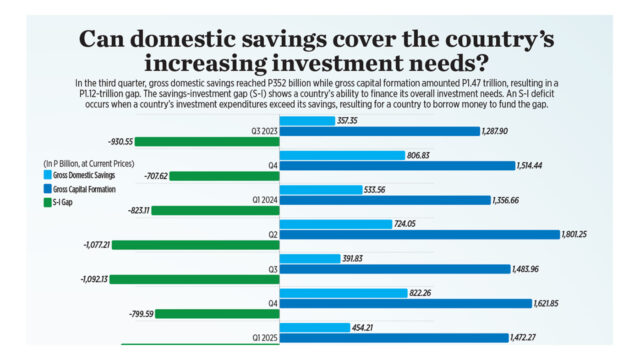
Can domestic savings cover the country’s increasing investment needs?

In the third quarter, gross domestic savings reached P352 billion while gross capital formation amounted P1.47 trillion, resulting in a P1.12-trillion gap. The savings-investment gap (S-I) shows a country’s ability to finance its overall investment needs. An S-I deficit occurs when a country’s investment expenditures exceed its savings, resulting for a country to borrow money to fund the gap.

Can domestic savings cover the country’s increasing investment needs?

Ombudsman files first graft case in flood scandal

OFFICE OF THE OMBUDSMAN PHILIPPINES FACEBOOK PAGE

THE Philippine anti-graft body on Tuesday formally filed criminal charges for graft and malversation against a former lawmaker and several Public Works officials before the Sandiganbayan, marking the first batch of cases brought to the court amid the flood control project scandal.

The Office of the Ombudsman, through Assistant Ombudsman Jose Dominic F. Clavano IV, said the complaints were filed against former Party-list Rep. Elizaldy “Zaldy” S. Co, several officials of the Department of Public Works and Highways (DPWH) in Region IV-B (Mimaropa), including the Regional Director, assistant directors, project and materials engineers, and division chiefs, and the board of directors of Sunwest Corp. as private respondents.

The officials face charges of malversation of public funds through falsification of public documents, and violations of the Anti-Graft and Corrupt Practices Act (RA 3019). Mr. Co additionally faces charges for receiving unwarranted financial benefits.

The complaints stem from a P289.5-million road dike project along the Mag-Asawang Tubig River in Naujan, Oriental Mindoro, which the Independent Commission for Infrastructure (ICI) flagged for serious irregularities in procurement, construction, and implementation.

An inspection last Sept. 9, conducted by Public Works Secretary Vivencio B. Dizon and Oriental Mindoro Governor Humerlito “Bonz” A. Dolor, found that the steel sheet piles used for the dike were grossly below the required 12-meter specification, with embedded lengths totaling only about 3 meters. The material was also deemed substandard.

Mr. Clavano said the findings indicate a scheme that produced unwarranted benefits, technical falsifications, and misuse of public funds. Because the amount involved in malversation exceeds P8.8 million, the Ombudsman has recommended no bail for the malversation charges.

“This is the first case referred by ICI and the first to be filed in court,” Mr. Clavano told a press briefing. “It is also the first of many cases that will be filed. Several others are in the preliminary investigation and fact-finding stages. The Office of the Ombudsman will pursue these cases firmly, independently, and without fear or favor.”

Mr. Co, co-founder of Sunwest Corp. who divested his shares in 2019 to enter public office, resigned from Congress last September and reportedly went abroad initially for medical treatment. He later cited “credible and serious threats” to his life with his lawyer Ruy Alberto S. Rondain confirming he will not return, calling the proceedings an “unfair prosecution.”

The Ombudsman earlier confirmed that Mr. Co had waived his right to file a counter-affidavit after his staff reportedly declined to receive the official order. Mr. Rondain described the decision as strategic, alleging the Ombudsman may have already “prejudged” the case. Mr. Co has denied any wrongdoing.

He released a series of video statements over the weekend, breaking his months-long silence on the issue while implicating President Ferdinand R. Marcos, Jr., former House Speaker Ferdinand Martin G. Romualdez and now-resigned Budget Secretary Amenah F. Pangandaman.

The government is seeking to compel his return, with the Department of Justice (DoJ) requesting a blue notice from Interpol and planning to seek a red notice once the Sandiganbayan issues an arrest warrant for the non-bailable offense.

Malacañang assured the Philippine government will offer him protection, should he decide to return to the country.

In a briefing on Tuesday, Palace Press Officer Clarissa A. Castro said the government extends protection to “any Filipino” who faces threats to their safety, adding that the Office of the Ombudsman has also indicated its willingness to secure Mr. Co, who said he fears for his life should he return to the country.

“Any Filipino who returns to the country and says their life is in danger will be given government protection,” she told a press briefing in Filipino. “And based on what we’ve heard, the Office of the Ombudsman has also said it will protect him.”

The ICI welcomed the filing, which comes less than two months since it made its recommendation on Sept. 29. “Things moved swiftly, and now the case has reached the Sandiganbayan,” ICI Executive Director Brian Keith F. Hosaka said in a separate briefing on Tuesday. “Eventually, warrants of arrest will be issued, and these individuals will be brought to court.”

“The people are understandably impatient and frustrated, but we need to ensure that those responsible are properly held accountable,” added Mr. Dizon. He said that, unlike the “pork barrel” scandal, the current case has progressed to court at an unusually fast pace.

“Looking at the last major scandal, the Napoles case, it took almost a year from filing at the Ombudsman to cases reaching the Sandiganbayan and eventual arrests — from August 2013 to July 2014. This time, thanks to the thorough work of the ICI, DPWH, DoJ, and Ombudsman, it took less than two months for a case to be filed in court,” he said. — Erika Mae P. Sinaking with Chloe Mari A. Hufana

Cabinet reshuffle won’t quickly restore investor confidence in PHL — analysts

PHILIPPINE STAR/NOEL PABALATE

By Aubrey Rose A. Inosante and Justine Irish D. Tabile, Reporters

CABINET changes are unlikely to quickly restore investor confidence in the Philippines as the government pursues a high-profile corruption probe, analysts said.

The Cabinet reshuffle that shed key members of the economic team is still far from investors’ call for the prosecution of involved personalities in the flood control mess, Michael Henry Ll. Yusingco, a fellow at the Ateneo de Manila University Policy Center said.

“I think investors will be more confident when they see all the personalities involved in the pork barrel corruption indicted and prosecuted,” he said in a Facebook Messenger chat on Tuesday.

“The resignations of the relevant department secretaries by themselves contribute very little to the prosecution effort.”

President Ferdinand R. Marcos, Jr. on Monday named former Finance Secretary Ralph G. Recto as the new Executive Secretary, following the resignation of Lucas P. Bersamin and Budget Secretary Amenah F. Pangandaman.

Ms. Pangandaman’s exit followed accusations made by former Party‑list Rep. Elizaldy S. Co, who was allegedly directed to make P100 billion worth of insertions.

Mr. Yusingco also said the investors may not take the reshuffle as a “good sign” that the administration is serious in addressing the corruption problem, given that he did not replace them with new people.

“He merely shuffled people from within his cabinet, which means they could also be linked to the pork barrel corruption,” he added.

For his part, Ibon Foundation Executive Director Jose Enrique “Sonny” A. Africa described the resignations as “clearly defensive” and it confirmed how high up corruption reaches in government.

“They are so highly positioned that it is no longer tenable to presume that their principal, the president, is not implicated,” he said.

“Animal spirits in the economy are shaken up beyond any political crisis in the post-dictatorship era and demands even more decisive accountability and action to be restored.”

Mr. Africa also said this will worsen the economic slowdown that has actually been slowly unfolding since even before the pandemic lockdowns.

Meanwhile, Hansley A. Juliano, a political science lecturer at the Ateneo de Manila University, said Mr. Marcos seems to promote political allies who achieve results related to his term agendas.

“This isn’t much a reshuffle as it is ultimately a consolidation,” he said in a Facebook Messenger chat on Nov. 17. 

NO DISRUPTIONS
Palace Press Officer Clarissa A. Castro on Tuesday said the administration remains committed to meeting economic targets and maintaining investor confidence.

She assured that the reassignments, including former economic czar Frederick D. Go’s transfer to the Finance department, involve personnel already familiar with budget processes. Mr. Marcos also tapped Budget Undersecretary Rolando U. Toledo as officer-in-charge of the department.

“There will be no problem with the timely passing of the 2026 budget,” she added.

The country is deliberating its 2026 spending plan, with President Ferdinand R. Marcos, Jr. expected to sign it before the year ends.

The corruption scandal is deeply tied to the national budget, with insertions worth billions of pesos in public work projects under scrutiny, prompting concerns from both lawmakers and business leaders.

Business groups have publicly voiced dismay at the ongoing controversies, warning that they disrupt operations.

Ms. Castro noted that while calls for public hearings are legitimate, making them widely public can also create instability.

She also framed Mr. Marcos’ anti-corruption efforts as a stabilizing factor for business: “Investors should trust the current administration because the President is fighting corruption and government anomalies.”

American Chamber of Commerce of the Philippines (AmCham) said the response from the business community to new appointments has been “positive.”

“We remain confident that the administration will take the necessary steps to uphold good governance and maintain a stable environment for business and investment,” AmCham Executive Director Ebb Hinchliffe said in a Viber message.

Business groups and investment promotion agencies also said they see the cabinet transitions as key to restoring confidence and stability in the country, as the government tries to address the corruption issue, which has dampened investors’ confidence.

“These transitions come at a crucial time for policy coherence, fiscal stability, and investor confidence,” FPI Chair Elizabeth H. Lee said in a statement on Tuesday.

“FPI affirms its support for continuity and coordination across government agencies to sustain economic momentum,” she added.

The Philippine Chamber of Commerce and Industry (PCCI) commended the appointments and called them “key selections which come at a critical time for our economy.”

“Executive Secretary Recto brings a wealth of legislative and policy expertise, while Secretary Go’s strong background in business and investment promotion will be valuable in steering fiscal policy and driving economic growth,” PCCI President Enunina V. Mangio said in a statement.

Federation of Filipino Chinese Chambers of Commerce and Industry, Inc. (FFCCCII) said under the guidance of Mr. Recto and Mr. Go, the country is expected to see “vigorous pursuit of progressive socio-economic reforms.”

“Their ascension to these pivotal roles is not merely a change of personnel; it is a powerful affirmation of the nation’s commitment to placing its most capable stewards at the helm of our economic destiny,” FFCCCII President Victor Lim said in a statement.

He also said the organization, which represents 170 Filipino Chinese chambers of commerce and other diverse trade organizations, pledges its full and unwavering cooperation to reforms and policies for justice, progress and stability.

Meanwhile, the Philippine Industrial Estates Association, Inc. (PHILEA) said that Secretary Go’s appointment “is a significant boost to the Philippine investment landscape.”

“His commitment to enhancing the country’s competitiveness aligns closely with PHILEA’s mission of attracting long-term, high-quality investments that generate jobs, expand exports, and support sustainable industrial development,” PHILEA President F. Francisco “Chito” S. Zaldarriaga said in a statement.

“PHILEA stands ready to collaborate with Secretary Go and the Department of Finance (DoF) in advancing policies that strengthen economic zones, stimulate private-sector investment, and reinforce the Philippines’ position as a premier investment destination in the region,” he added.

The IT and Business Process Association of the Philippines (IBPAP) also welcomed the appointment, citing Mr. Go’s roll in the passage of the Corporate Recovery and Tax Incentives for Enterprises to Maximize Opportunities for Reinvigorating the Economy (CREATE MORE) Act.

“Through his unrelenting efforts and understanding of information technology and business process management investors’ challenges on ease of doing business, he ensured that the law delivered complete and clear provisions especially on availment of incentives at the national and local government unit levels,” it said.

The Bases Conversion and Development Authority (BCDA) also expressed its support, noting that Mr. Go’s track record “gives the government a steady hand to strengthen fiscal management, reinforce investor confidence, and translate economic strategy into real gains.”

“BCDA looks forward to working closely with Finance Secretary Go to transform idle US military bases and Metro Manila camps into productive districts that boost national and local economies, empower communities, and expand opportunities for more Filipinos,” it said.

Meanwhile, the Philippine Economic Zone Authority (PEZA) welcomed the two officials’ appointments, citing their support for the economic zone program and policies that foster investment and create jobs.

“PEZA looks forward to deepening our collaboration in advancing the ecozone agenda and driving sustainable, innovation-led growth for the Philippines.” with Chloe Mari A. Hufana

Supreme Court asked to void DENR’s FOI manual

BW FILE PHOTO

ENVIRONMENTAL groups on Tuesday asked the Supreme Court (SC) to declare unconstitutional and void the Department of Environment and Natural Resources’ (DENR) use of its Freedom of Information (FOI) Manual, amid concerns that the policy limits public access to crucial environmental documents.

Under the 38-page Petition for Certiorari and Mandamus, Legal Rights and Natural Resources Center, Inc. (LRC) and Most Rev. Cerilo U. Casicas, Bishop of the Diocese of Marbel, South Cotabato claimed that Administrative Order No. 2016-29, which adopts the agency’s FOI manual, effectively bars public access to crucial environmental information, violating the constitutional right to information on matters of public concern.

“Environmental information such as EIAs (Environmental Impact Assessments), mining documents, and other information related to ECC (Environmental Compliance Certificate) application are matters of public concern. These information are not exempted from the operation of the constitutional guarantee” the petition read. They argued that the issuance and continued implementation of the manual violate Filipinos’ rights to information, due process, a balanced and healthful ecology, health, and meaningful participation in social, political, and economic decision-making.

“Public respondents acted with grave abuse of discretion, amounting to lack or excess of jurisdiction,” it added.

The petitioners named newly appointed Executive Secretary Ralph G. Recto and DENR Secretary Raphael Perpetuo “Popo” M. Lotilla as respondents. They did not immediately respond to BusinessWorld’s separate requests for comment.

According to petitioners, the manual lists exceptions that block public access to documents submitted during ECC applications and restrict disclosure of records supporting mining applications for the entire duration of a mining permit.

These restricted documents include feasibility studies, drilling reports, and mineral resource assessments, information the petitioners argue is essential for public participation and environmental oversight.

The petition cites several instances in which the DENR denied requests for records related to major projects, explicitly invoking the FOI Manual as its legal basis, including the Tampakan Copper-Gold Project in Southern Mindanao, one of the world’s largest undeveloped copper-gold deposits.

LRC requested more than 20 documents to evaluate the project’s legal and environmental compliance, including amendments to the Financial or Technical Assistance Agreement (FTAA), the Conditional ECC, and the approved EIA. The Mines and Geosciences Bureau (MGB) released only three documents, refusing the rest by citing Section 26 of Annex C of the FOI Manual and confidentiality clauses under the FTAA.

The petition cited the potential massive scale and risk associated with the project, which covers 26,501 hectares and uses the controversial open-pit method. It warns of potential impacts such as altering river systems across four provinces and clearing old-growth forests, making transparency essential

The petitioners also cited the DENR’s refusal to release documents on anomalous flood control projects as further proof of systemic barriers to public disclosure.

They also warn that continued denial will cause grave and irreparable harm to communities and the public, prompting their request for a Temporary Restraining Order and/or Writ of Preliminary Injunction.

The filing follows a September 2025 letter-petition from LRC and several civil society groups, including the Environmental Legal Assistance Center and Alyansa Tigil Mina, urging the President and the DENR Secretary to amend the FOI Manual. They say no action has been taken so far. — Erika Mae P. Sinaking

No legal actions eyed over Sen. Imee’s drug claims vs Pres. Marcos, Palace says

SCREENGRAB FROM FACEBOOK.COM/IMEEMARCOS

MALACAÑANG on Tuesday said the First Family has no immediate plans to pursue legal action against Senator Ma. Imelda Josefa Remedios “Imee” R. Marcos, after she publicly accused her brother President Ferdinand R. Marcos, Jr. and members of his family of using illegal drugs.

Ms. Marcos on Monday night accused her brother and First Lady Louise Araneta-Marcos among others, of using drugs during the second day of the Iglesia ni Cristo rally in Manila, which drew a crowd of more than half a million. 

Palace Press Officer Clarissa A. Castro, who earlier dismissed the statement as a “desperate move,” said the Palace would “wait and see” how the issue unfolds, adding that any potential investigation would fall under the jurisdiction of agencies such as the Department of Justice or the Office of the Ombudsman.

“These issues have long been debunked,” she told a briefing, citing previous drug test results and findings that artificial intelligence-generated videos circulating online were fake.

Ms. Castro is also confident that it is unlikely that the allegations will affect the President’s governance or international perception.

“We know that the international community assesses, evaluates based on the right data and facts. So, the only ones who can be deceived by these are people who do not think, or those whose sole aim is to destroy the government of President Marcos, Jr.,” she said in mixed English and Filipino.

She said that Malacañang is still reviewing the statements made by Ms. Marcos and other accusers.

The Marcos siblings have been at odds since last year following Vice-President Sara Duterte-Carpio’s resignation as Education secretary and public threats against the First Couple. Ms. Marcos and Ms. Duterte are close allies.

Ms. Castro also dismissed suggestions that the allegations — ranging from corruption claims circulated by former congressman Elizaldy S. Co to the senator’s recent statements — have triggered public outrage toward the President.

Ms. Castro urged the former House Appropriations Chair to return to the Philippines and present evidence to support his allegations, which she described as baseless.

Asked if the President feels compelled to address allegations of corruption and drug use personally, Ms. Castro questioned the need for him to respond to accusations she said lack credible sources.

‘WEB OF LIES’
In a statement on Tuesday, House Majority Leader and Ilocos Norte Rep. Ferdinand Alexander “Sandro” A. Marcos III, who is also accused by the senator, said “it pains me to see how low she has gone to the point that she resorts to a web of lies aimed at destabilizing this government to advance her own political ambitions.”

The presidential son likewise said that his aunt’s accusations were baseless, calling them “not only false, but dangerously irresponsible.”

Meanwhile, Senator Panfilo “Ping” M. Lacson said he found Ms. Marcos’ actions as “very un-Filipino,” saying it is within Filipino culture to keep quarrels within the confines of the home.

“To bring your conflict in front of hundreds of thousands of people at the Luneta, to me that’s unacceptable as a Filipino,” Mr. Lacson said in a statement.

Mr. Lacson added that he was disappointed with the recent remarks from the presidential sister, noting that the rally was hardly the place for such accusations.

“She could have done this in another forum, but not to make accusations whether true or not in front of hundreds of thousands of people,” he said, noting this was driven by political motives.   

“Why discredit your own brother in front of hundreds of thousands of people?”

Separately, Senate President Vicente “Tito” C. Sotto III said in a Viber message to reporters that her allegations could be “It could be the defining moment of her political career.”

Michael Henry Ll. Yusingco, a senior research fellow at the Ateneo de Manila University Policy Center, said Ms. Marcos’ remarks could be a “fatal misstep” due to the potential blowbacks.

“Now we know that she happily campaigned for him in 2022, knowing fully well that he was unfit,” he said, adding her move gives the Dutertes leverage to sow political discord amid growing public outrage against corruption.   

“So, this looks more like a move to provide material for content creation to be used in political warfare.” — Chloe Mari A. Hufana and Adrian H. Halili

PHL reports uptick in disinformation ahead of ASEAN chairmanship

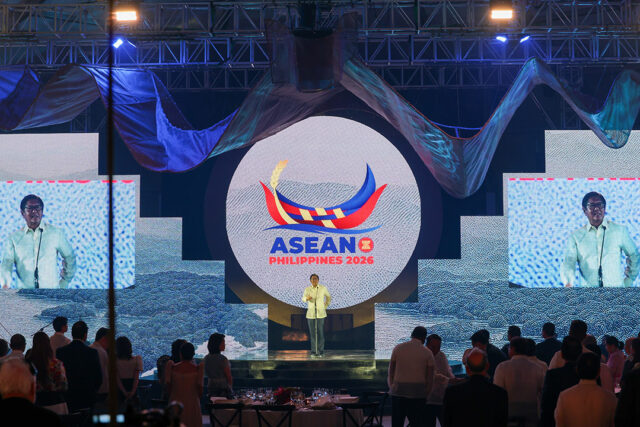
PRESIDENT Ferdinand R. Marcos, Jr. speaks at the official launch of the Philippines’ Chairship of the Association of Southeast Asian Nations (ASEAN) 2026 at Foro de Intramuros in Manila, Nov. 14. — NOEL B. PABALATE / PPA POOL

By Kenneth Christiane L. Basilio, Reporter

THE Philippines’ intelligence agency had observed an uptick in disinformation campaigns and a coordinated cyberattack targeting government and defense officials as Manila prepares to host the regional bloc’s summit next year, its director for cyberthreat operations said on Tuesday.

Lester B. Gastala, National Intelligence Coordinating Agency (NICA) cyberthreat director, warned that the threat of disinformation in the Philippines “is not theoretical,” saying foreign interference could be weaponized to undermine institutions and sway public opinion.

“We have also seen a number of disinformation pertaining to the upcoming ASEAN (Association of Southeast Asian Nations) summit,” he told lawmakers at a House of Representatives hearing.

He added that there is a “growing number of regional spear phishing ASEAN-themed campaigns targeting government and defense entities, diplomatic missions and the associated infrastructure in the Philippines and across Southeast Asia.”

The Philippines is set to assume the chairmanship of the regional bloc in 2026, with Manila aiming to push for a long-delayed code of conduct in the South China Sea.

ASEAN and China pledged in 2002 to come up with the sea code, a framework that seeks to prevent conflict through diplomatic means, but it has remained elusive due to slow progress.

The disputed waterway has emerged as a flashpoint in the Southeast Asia region as China continues to claim and assert sovereignty over almost the entire sea despite a United Nations-backed tribunal voiding its expansive claim in 2016.

Also on Tuesday, a Philippine Navy officer said that the Philippine military is guarding anti-graft protests from foreign interference.

Philippine Rear Admiral Roy Vincent T. Trinidad said the armed forces were pursuing leads after observing “unusual” levels of support at some anti-corruption protests against anomalous flood control deals, stressing that “domestic concerns” must be free of foreign help.

“We are looking at all possible avenues and areas to ensure that domestic concerns will remain domestic, and will not be influenced by foreign funding,” he told a media briefing in Filipino. “Let us not forget we have a neighbor that wants Filipinos to fight among themselves and for the Philippines to be divided.”

Asked which country he was referring to, Mr. Trinidad indirectly named China, describing it as “the big country run by the Chinese Communist Party” that would “do everything it can to sow discord within the Philippines.”

The Chinese Embassy in Manila did not immediately reply to a Viber message seeking comment. Beijing has said it does not meddle in the internal affairs of other countries.

Manila and Beijing have clashed over contested areas in the South China Sea, with tensions escalating into confrontations at sea as both sides seek to uphold their sovereignty in the disputed waters. Philippine officials have warned are attempts to spread disinformation aimed at swaying Filipinos over the territorial dispute with China, among others.

“We have seen different issues, disinformation, misinformation and malinformation being raised against the government,” Mr. Trinidad said. “We have seen a lot of infiltration in our society. We don’t have to look far.”

“Part of their rule book is to make us fight among ourselves.”

In April, former Senator Francis N. Tolentino said that a local marketing firm was allegedly involved in spreading pro-Beijing narratives ahead of the May midterm elections, presenting documents that China hired it to provide “keyboard warriors” to influence public opinion.

DepEd usec in flood mess quits

PILIPPINE STAR/MIGUEL DE GUZMAN

AN EDUCATION undersecretary implicated in the flood control mess resigned on Monday, the Presidential Palace said on Tuesday.

Palace Press Officer Clarissa A. Castro confirmed Education Undersecretary Trygve L. Olaivar tendered his resignation, but did not elaborate whether President Ferdinand R. Marcos, Jr. has acted on it or not.

“We called Usec. Trygve himself and confirmed that he submitted his resignation letter [on Nov. 17],” she told a briefing in Filipino.

Late on Monday, Malacañang announced the resignations of Executive Secretary Lucas P. Bersamin and Budget Secretary Amenah F. Pangandaman, who were both implicated in the flood control scandal.

Education Secretary Jose Edgardo “Sonny” M. Angara was also named in the alleged scandal, but he remains in his post.

When asked if he should also resign “out of delicadeza,” Ms. Castro refused to answer, noting the secretary must answer for himself.

In September, Mr. Olaivar denied allegations linking him to the alleged ghost and substandard flood control projects uncovered in a Senate Blue Ribbon inquiry and said he would take a voluntary leave to allow an impartial investigation. 

His name surfaced after former Public Works Undersecretary Roberto R. Bernardo testified that Mr. Olaivar had asked him in 2024 to prepare a list of unprogrammed appropriations worth P2.85 billion, allegedly for the Office of the Executive Secretary, which Mr. Bersamin earlier held, and that a 15% “commitment” was discussed. 

Mr. Bernardo claimed that engineer Henry C. Alcantara regularly collected and delivered this amount to him, which he then turned over to Mr. Olaivar in various locations.

Mr. Olaivar, in a Sept. 25 statement, rejected the accusations and said he welcomed any probe into the matter.

Meanwhile, Senator Panfilo “Ping” M. Lacson on Tuesday alleged Mr. Olaivar and former Presidential Legislative Liaison Adrian Carlos A. Bersamin received kickbacks from insertions from the 2025 budget.

The senator claimed that kickbacks from the P100-billion budget insertions from last year were received by officials from Malacañang who misrepresented the President.

“What (ex-Party-list Rep. Elizaldy S. Co) is claiming is that he delivered P25 billion representing the 25% kickback for the president, I will attest is not true,” he told the Senate Plenary, citing ex-Public Works Undersecretary Roberto R. Bernardo.

“There are people in Malacañang, not authorized by the President, who misrepresented him,” he said.

The Senator added that they had name dropped the President to Mr. Co making him believe that the funds were meant for the president.

“(Mr. Bersamin) name dropped the President, making Zaldy Co believe that it was the President that wanted to insert P100 billion,” he said.

Earlier, the former lawmaker accused President Ferdinand R. Marcos, Jr. and former House Speaker Martin G. Romualdez of having direct links to the multibillion-peso flood control scandal, according to a series of videos he released on his social media page.   

“(Mr. Bernardo) also said that he had delivered cash not to the President but to Olaivar along with Bersamin, P8 billion in at least 10 deliveries,” Mr. Lacson added.   

The senator said that the ex-government officials brought armored vans to a Makati hotel where deliveries would range from P800 million to P2 billion. — Chloe Mari A. Hufana and Adrian H. Halili

INC abruptly ends anti-graft rally

FACEBOOK.COM/MNLCDRRMO

AN INFLUENTIAL religious group abruptly ended its anti-corruption protest on Monday evening, cutting its planned three-day demonstration in the Philippine capital amid its push for transparency and accountability.

The Iglesia ni Cristo (INC) in a statement said it had achieved its goal of “sending the message” as it urged the government to “decisively address” alleged collusion within and among its agencies to siphon of billions of funds from flood mitigation projects.

“It did not need three days to achieve the goal of sending the message that we are calling for justice, accountability, transparency and peace,” the INC said on Tuesday.

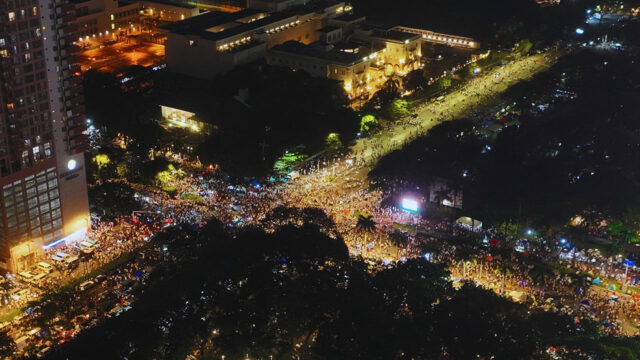
Around 550,000 people joined the INC-led protest at Quirino Grandstand in Manila at 8 p.m. Monday, its disaster management office said in a Facebook post. The crowd peaked at 600,000 an hour earlier, while more or less 650,000 attended on the first day of the demonstration on Sunday.

The religious group holds significant political influence due to its bloc-voting practice. Backers of President Ferdinand R. Marcos, Jr. and Vice-President Sara Duterte-Carpio included the INC, which endorsed both candidates ahead of their landslide victory in the 2022 elections.

“I agree with the statement of INC that it had already achieved within two days its goal of ‘sending the message’ to the government that it should seriously address the public’s call for transparency and accountability,” Dennis C. Coronacion, who heads the Political Science department of the University of Santo Tomas, said in a Facebook chat.

The mega church said its protest was not politically motivated, though figures linked to the Duterte camp have appeared as guests at the demonstrations. Senator Maria Imelda “Imee” R. Marcos, the President’s sister, delivered a scathing speech against Mr. Marcos that included accusations of longtime drug use before the protest was halted.

Palace Press Officer Claire A. Castro said Ms. Marcos’ accusations were baseless and may have been an attempt to divert attention from ongoing investigations into massive corruption that has gripped the Southeast Asian nation.

While the protest showed the INC’s ability to mobilize large crowds, Ms. Marcos’ remarks may have prompted the church to end it early, said Arjan P. Aguirre, who teaches political science at the Ateneo de Manila University.

“The INC mobilization clearly made enough noise to show it can still bring out hundreds of thousands of people. But the impact was blunted once some politicians reframed the gathering as an anti-government protest,” he said in a Facebook Messenger chat, noting Ms. Marcos’ speech “shifted the spotlight away from the flood control scandal and toward internal political conflicts.”

Ederson DT. Tapia, a political science professor at the University of Makati, said the church may have ended the rally to prevent “public fatigue, internal strain or unintended escalation” from its demonstration.

The INC is opposed to any form of violence in addressing the corruption scandal, urging instead that the issue be resolved through legal and constitutional means, its minister Bienvenido Santiago, Jr. said on Sunday.

“From the very start, we have stressed that we are against moves that are against the Constitution,” the INC said. “We started peacefully and we ended peacefully.” — Kenneth Christiane L. Basilio

SC junks plea to produce ICC warrant

PHILSTAR FILE PHOTO

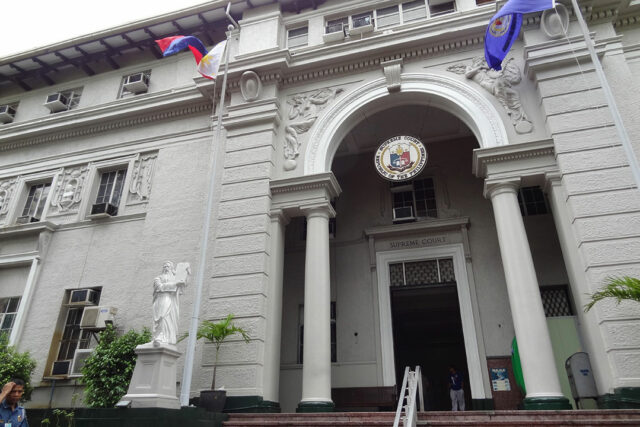
THE Supreme Court (SC) en banc has denied a motion by former President Rodrigo R. Duterte and Senator Ronald “Bato” M. dela Rosa seeking to compel government agencies to produce an alleged International Criminal Court (ICC) arrest warrant against the senator.

The SC on Tuesday ruled that there was no sufficient basis to immediately compel production of the alleged warrant but directed the respondents, including Ombudsman Jesus Crispin C. Remulla, the Department of Justice, and the Department of Foreign Affairs, to submit comments on the petitioners’ claims within 10 days.

“The court acted on the submissions but found no sufficient basis to immediately compel production of the alleged warrant,” the SC said in a statement.

The petition, originally filed on March 11 challenged Mr. Duterte’s potential arrest and the Philippine government’s cooperation with the ICC through the Interpol.

On Nov. 12 the petitioners filed a Very Urgent Motion seeking to compel Mr. Remulla to produce a copy of the alleged ICC warrant against Mr. Dela Rosa. In a separate Very Urgent Manifestation dated Nov. 13, petitioners alleged that Mr. Remulla publicly stated that “an ICC arrest warrant had already been issued” and that a “diffusion order” was in place.

They also claimed he said the government could surrender Mr. Dela Rosa “without undergoing extradition proceedings” and that “the DoJ has placed at least three witnesses under the Witness Protection Program at the ICC’s request.” — Erika Mae P. Sinaking