Home Blog Page 6140

Duterte nixes fuel tax suspension

PHILIPPINE STAR/ MIGUEL DE GUZMAN
Motorcycle riders queue at a gasoline station along España Boulevard in Manila, March 15. — PHILIPPINE STAR/ MIGUEL DE GUZMAN

By Kyle Aristophere T. Atienza, Reporter

PHILIPPINE President Rodrigo R. Duterte rejected calls to suspend the excise tax on fuel products amid soaring pump prices, and instead approved the Finance chief’s recommendation to extend the P200 in monthly aid to poor families for a year.

Acting Presidential Spokesperson Jose Ruperto Martin M. Andanar made the announcement at a regular news conference on Wednesday, just hours after Finance Secretary Carlos G. Dominguez III made the proposals.

Mr. Dominguez told a Cabinet meeting on Tuesday that the fuel excise tax imposed under a highly opposed tax reform program must be retained “because we already budgeted it for salaries of school teachers; “Build, Build, Build” program; and other expenses.”

Calls to suspend the excise tax on petroleum products have grown louder, especially after fuel retailers on Tuesday raised gasoline and diesel prices by P7.10 and P13.15 per liter, respectively.

Mr. Dominguez said the government is expecting to collect P147 billion in taxes this year from fuel products, of which P131.4 billion is from excise taxes. The rest would be from value-added tax (VAT) imposed on oil imports.

The current excise tax rate is P10 per liter for gasoline, P6 per liter for diesel, P5 per liter for kerosene, and P3 per liter for liquefied petroleum gas (LPG).

Mr. Dominguez said suspending excise taxes on fuel products would only force the government to borrow more money and would result in P105.9-billion revenue losses in 2022 or around 0.5% of the country’s gross domestic product (GDP) this year. If implemented over the next 10 years, he said losses are projected to reach P1.76 trillion.

Instead, the Finance chief proposed the government provide direct aid to the most vulnerable sectors, allocating P33 billion for unconditional cash transfers to the bottom 50% of all households or an estimated 74.7 million Filipinos. This would mean each qualified household would receive P200 a month or a total of P2,400 as aid.

Mr. Dominguez admitted the P200 monthly aid might not be enough to cushion the impact of fuel price hikes on poor families, but said this is what the government can afford at this time.

The Finance chief said the funds for the targeted subsidies would be sourced from VAT collections on oil imports.

If Dubai crude oil reaches $110 per barrel, Mr. Dominguez said VAT collections are expected to increase by P26 billion. VAT revenues will increase by P34.6 billion at $125 per barrel Dubai crude oil price, he added.

Russia’s invasion of Ukraine has driven global oil prices higher, affecting countries like the Philippines that import majority of its fuel requirements. Crude prices have fallen below $100 this week as China, the world’s biggest oil importer, implemented lockdowns to curb the spread of the coronavirus.

However, a senator said the amount of cash aid set by the government is not enough.

“Coming in after 11 weeks of successive oil price increases, the government’s proposed P200 per month cash assistance to poor families is a pittance,” Senate Committee on Public Services Chair Mary Grace S. Poe-Llamanzares said in a statement.

She said the people deserve more amid the rising cost of living across the country, joblessness, and the prolonged pandemic. 

Senator Francis “Kiko” N. Pangilinan, who is running for vice-president, and presidential candidate Senator Panfilo M. Lacson also reiterated their calls for the government to suspend the collection of fuel excise taxes.

4-DAY WORKWEEK?
Meanwhile, Socioeconomic Planning Secretary Karl Kendrick T. Chua proposed a four-day workweek to cut the costs for businesses and workers. A similar four-day workweek was implemented in 2008 when fuel prices were also high, he said.

“Let us try to conserve energy and one of the examples here is through the four-day workweek,” Mr. Chua said at the Tuesday Cabinet meeting. “Every Filipino will still have to work 40 hours per week but instead of five days, it will be four days and instead of eight hours, it will be 10 hours per day.”

At the same meeting, Labor Assistant Secretary Dominique R. Tutay proposed a three-month wage subsidy worth P24 billion, which will benefit one million workers.

If approved, the wage subsidy would be distributed from April to June. “Given the indirect impact of the global tension on the Philippine economy, we’re seeing that the wage subsidy will be important for the workers,” she said.

A labor group earlier filed a petition seeking for a P470 increase in the daily minimum wage of workers in the capital region, bringing it to P1,007.

Mr. Chua, who heads the National Economic and Development Authority (NEDA), said a P39 increase in the daily minimum wage in the National Capital Region will add one percentage point to inflation.

Raising jeepney fares by P1.25 will also add 0.4 percentage point to inflation, he added.

Transport groups also have filed several petitions to increase jeepney fares by as much as P6.

GDP TARGET
Meanwhile, Mr. Dominguez said the Philippines’ economic growth target this year may take a hit as the ongoing conflict between Russia and Ukraine drags on.

“The Ukrainian war escalation may shave off 0.4% of our gross domestic product (GDP) target. We are taking a look at it right now. It all depends on how long this crisis will last,” he said at the Bloomberg ASEAN Business Summit held virtually on Wednesday. “The longer it takes, the worse it is for everyone.”

Economic managers are targeting 7-9% GDP growth for this year.

Mr. Dominguez said the crisis is pushing up prices of commodities, and may affect potential investments in the country.

“Last year, we had the highest foreign investments ever at $10 billion, and we think this crisis is making investors in the West look elsewhere,” he said. — with Tobias Jared Tomas


Jan. remittances up despite virus surge

ALEXANDER MIL-UNSPLASH

By Luz Wendy T. Noble, Reporter

MONEY sent home by Filipino migrants rose for an 11th consecutive month in January, reflecting improving employment prospects abroad despite the Omicron-driven surge in coronavirus disease 2019 (COVID-19) infections.

Data released by the Bangko Sentral ng Pilipinas (BSP) on Tuesday evening showed remittances increased by 2.5% to $2.668 billion in January from $2.603 billion a year earlier.

“The growth in cash remittances from the United States, Japan, and Singapore contributed largely to the increase in remittances in January 2022,” the central bank said in a statement.

During the month, the US, Singapore, Japan, Saudi Arabia, the United Kingdom, the United Arab Emirates, Canada, Taiwan, Qatar, and Malaysia, were the 10 biggest sources of remittances. These countries accounted for 79.6% of the total inflows.

Remittances declined by 10.7% from the $2.987 billion in December, reflecting the seasonal dip in inflows as the holiday season ended.

Despite the spike in cases of the Omicron variant in many countries, remittances rose as economic reopening continued and more job opportunities opened up for overseas Filipino workers (OFWs), Rizal Commercial Banking Corp. (RCBC) Chief Economist Michael L. Ricafort said.

Asian Institute of Management (AIM) economist John Paolo R. Rivera said it may have been possible that the Omicron-driven surge in coronavirus infections pushed OFWs to send more money to help their families in the Philippines.

Metro Manila and some provinces returned to a stricter Alert Level 3 in January as COVID-19 cases reached record highs after the holidays.

“Many people were sick. Remittances were sent, by virtue of altruistic motives, to finance medication and hospitalization,” Mr. Rivera said in a Viber message.

Personal remittances, which include inflows in cash, rose by 2.5% to $2.966 billion in January from $2.895 billion in the same month in 2021.

In 2021, cash remittances hit a new record of $31.418 billion, reflecting the improvement in the global economy as countries learned to better handle the pandemic.

The BSP expects remittances to grow by 4% this year, as virus restrictions are further relaxed.

However, RCBC’s Mr. Ricafort said the ongoing war between Russia and Ukraine could slow global growth prospects that may dampen business activities in some host countries.

AIM’s Mr. Rivera also noted that while there could be a decrease in remittance inflows from war-affected economies, OFWs from other countries may send more as they take into account faster inflation caused by rising fuel and food prices.

“Because of the crisis in Eastern Europe that impacted oil prices and affected everyone’s purchasing power driving inflation faster, remittances might be expected to increase to augment the purchasing power of households,” Mr. Rivera said.

Inflows from Russia and Ukraine were at $292,000 and $14,000, respectively, in January. Both are relatively small compared with the $301.872 million worth of inflows sourced from Europe.

Latest data from the Department of Foreign Affairs showed 286 Filipinos have been repatriated, while 84 were evacuated out of war-stricken Ukraine.

BSP still plans to start rate hike cycle in 2nd half

BANGKO SENTRAL NG PILIPINAS GOVERNOR BENJAMIN E. DIOKNO — PHILIPPINE STAR/ GEREMY PINTOLO

THE PHILIPPINE central bank will remain patient and stick to its plan to raise its key policy rate in the second half of the year, despite heightened uncertainty caused by the war in Ukraine, its governor said.

Bangko Sentral ng Pilipinas (BSP) Governor Benjamin E. Diokno said they are also factoring in the policy tightening of the US Federal Reserve.

The US Federal Reserve is widely expected to raise interest rates by at least 25 basis points amid surging prices later on Wednesday.

“Russian invasion of Ukraine is certainly going to change the mood among Fed members. We don’t know yet. That’s why we are waiting for their action. I think that it’s necessary to be patient. For our part, we will be patient,” he said at the Bloomberg ASEAN Business Summit held virtually on Wednesday.

Mr. Diokno is confident the Philippine economy is on the road to recovery.

“The [Philippine] economy grew at 5.6% last year. Assuming we meet our target this year of 7-9%, then I think we’re on track [to recovery]. We plan to adjust in the second half of the year,” he said.

Mr. Diokno has also previously said they would want to see four to six straight quarters of economic growth before considering increasing rates.

The Philippine economy expanded by 7.7% in the last three months of 2021, marking three straight quarters of growth.

First-quarter gross domestic product (GDP) data is scheduled to be released on May 12.

The BSP chief noted that central banks in Southeast Asia are “more patient” in retaining accommodative policies compared with their counterparts in Latin America, noting only South Korea and New Zealand have started increasing interest rates in the Asia-Pacific region.

The Monetary Board will have its next policy review on March 24.

Last month, the BSP kept rates steady as it vowed to continue supporting economic recovery.

While they are not yet keen to increase interest rates, Mr. Diokno said they have started policy normalization for other measures done to support the economy during the pandemic.

He cited that the latest zero-interest loan extended by the central bank to the National Government amounted to P300 billion, lower than the P540-billion previously.

“We expect that [financing] to be down to zero by the third quarter of this year,” he said.

This gradual policy unwinding was also seen in the BSP’s purchase of government securities (GS), Mr. Diokno said.

“We bought something like 19.4% of the GS portfolio [in 2020]. It’s down to 4.8% in 2021 and now it’s down to 0.7%. So we have started the unwinding,” he said.

LESSONS FROM THE PANDEMIC
Two years into the pandemic, Mr. Diokno said the government should carry out responses beyond monetary policy to really drive recovery.

“The most important lesson I learned from the pandemic is that monetary policy has limitations. I think we [BSP] did very well, but there is a strong need for support from the National Government and from each individual and household,” he said at a virtual forum organized by the Asian Development Bank on Wednesday.

Mr. Diokno, the former budget secretary, said international cooperations have been very crucial as well, especially in securing vaccinations against the coronavirus disease 2019.

He is hopeful that the legislation of the Retail Trade Liberalization Act, the Public Service Act, and the Foreign Investment Act would help to attract more foreign investments into the country that could strengthen economic recovery. — Luz Wendy T. Noble

Pandemic sends 4.7M more people into extreme poverty in SE Asia

PHILIPPINE STAR/ RUSSEL PALMA

MANILA — The pandemic added 4.7 million more people to Southeast Asia’s most extreme poor in 2021, reversing gains made in fighting poverty, the Asian Development Bank (ADB) said on Wednesday, while urging governments to take steps to boost economic growth.

The number of people in extreme poverty — defined as those living on less than $1.90 a day — was 24.3 million last year, or 3.7% of Southeast Asia’s collective 650 million population, the ADB said in a report.

Before the pandemic, figures for those in extreme poverty in Southeast Asia had been on the decline, with 14.9 million in 2019, down from 18 million in 2018 and 21.2 million in 2017.

“The pandemic has led to widespread unemployment, worsening inequality, and rising poverty levels, especially among women, younger workers, and the elderly in Southeast Asia,” said ADB President Masatsugu Asakawa.

Mr. Asakawa urged governments to improve health systems, streamline regulations to boost business competitiveness, invest in smart, green infrastructure and adopt technology to speed up growth.

The ADB said there were 9.3 million fewer employed workers in Southeast Asia in 2021 as coronavirus disease 2019 (COVID-19) curbs reduced economic activity, leaving millions without work.

Its 2021 growth forecast for Southeast Asia was 3.0%.

The region was projected to grow by 5.1% this year but the Omicron COVID-19 variant could cut its growth outlook by as much as 0.8 percentage point if it spreads further and triggers supply and demand shocks, the ADB said.

Ramesh Subramaniam, director-general at the ADB, said Southeast Asia’s growth outlook will be revised to reflect the impact of the Russia’s invasion of Ukraine, which he expected to be “manageable.”

“The challenge is going to be what does the medium term holds. Is this going to affect the region’s recovery from the pandemic and the fiscal challenges it will face?” Mr. Subramaniam said at the report’s launch.

“How can we make sure that any knock-on effects don’t become serious in the case of Southeast Asia?”

The conflict has forced Asia’s policy makers to rethink assumptions for 2022, with the risks of weak growth coupled with surging prices adding unwanted complexity to monetary setting plans. — Reuters

SMC bank allots P1-M IPO shares per small investor

SAN MIGUEL Corp. (SMC) affiliate Bank of Commerce has placed the maximum subscription amount for local small investors who will participate in its initial public offering (IPO) at P1 million per investor.

The IPO will have a primary offer of 280,602,800 common shares, with an offer price of P12 per share, or an offering size of about P3.37 billion.

In a listing notice on Wednesday, Bank of Commerce said that it would give priority to accepting smaller subscription orders ahead of larger orders.

The bank tapped Philippine Commercial Capital, Inc. (PCCI) as the financial advisor and issue coordinator, together with BDO Capital & Investment Corp. China Bank Capital Corp., PCCI, and PNB Capital and Investment Corp. as the joint issue managers, joint lead underwriters, and joint bookrunners.

Net proceeds from the IPO will be used to fund its lending activities, acquisition of investment securities, and to finance capital expenditure requirements, which involve upgrading its ATM fleet and its core banking system.

Bank of Commerce is licensed by the Bangko Sentral ng Pilipinas (BSP) and has been operating since 1963. In 2008, it became an affiliate of SMC.

The bank provides “innovative banking solutions and a complete range of products and services in deposit, commercial loans, credit card services, consumer banking, corporate banking, treasury, asset management, transaction banking, and trust and investments.”

Separately, SMC said in a statement on Wednesday that Bank of Commerce “is ramping up investment in technologies to optimize operations and further improve customer experience across multiple channels, ahead of a resurgent economy post-pandemic.”

It said the move comes as the bank completed systems upgrade of key services such as treasury, trust banking and anti-money laundering.

SMC said the bank has also invested in improving its digital capabilities through its enhanced mobile banking and web platform, which are part of its P1.2 billion spending since 2019.

“The banking sector is essential to our country’s post-pandemic recovery, and we want Bank of Commerce to play a more significant role in San Miguel’s overall efforts to help boost our economy,” SMC President and Chief Executive Officer Ramon S. Ang said.

He said the upgrade of the bank’s information technology and digital infrastructure “is key to meeting the challenges of banking in the new normal,” while serving the needs of retail customers, small and medium-sized enterprises, and corporate clients.

“We believe in the bank’s strong potential, that’s why we are investing to upgrade and enhance its capabilities to serve more clients,” Mr. Ang said.

Bank of Commerce President and Chief Executive Officer Michelangelo R. Aguilar said: “We are committed to embracing new technologies to strengthen our core functions and governance, unleash capabilities to integrate our services, realize operational efficiencies, and reduce transaction costs.  Ultimately, this will redound to providing a exceptional customer experience in the new normal.”

The bank has also set aside P1 billion to upgrade its core banking system and refresh its ATM fleet across the country, including the installation of additional machines at strategic offsite locations starting this year, the SMC media release said.

Bank of Commerce has a network of 140 branches and 261 automated teller machines nationwide. — Luisa Maria Jacinta C. Jocson

Aces force sudden-death game

JERON TENG — PBA IMAGES

Alaska hacks out a huge 93-79 victory over NLEX

By Olmin Leyba

DON’T sound the final buzzer yet for Alaska Milk.

With firm resolve, the seventh-seeded Aces hacked out a huge 93-79 victory over No. 2 NLEX on Wednesday to extend the Philippine Basketball Association (PBA) Governors’ Cup quarterfinal duel — and their emotional farewell tour — to a sudden-death game.

To loud cheers from the Alaska faithful at the Smart Araneta Coliseum, the Aces charged back from an early 16-point deficit and did everything needed to prevail and stave off elimination against their twice-to-beat opponents.

From new import Mark Saint Fort to young star Jeron Teng to backup Mike Tolomia and Yousef Taha, coach Jeff Cariaso’s team put up a spirited performance to put itself in position to go all the way to the Final Four with a repeat against NLEX in Saturday’s do-or-die.

Mr. Saint Fort, who arrived four days ago to replace the injury-hampered Olu Ashaolu, debuted with 17 points and 14 rebounds and got enough support from the local crew. Mr. Teng scored 16 with six boards while Abu Tratter had a 12-10 double-double, Mr. Tolomia chipped in 10, and Mr. Taha had 12 rebounds on top of nine points.

“We didn’t want it to be our last game. What makes it harder is compared to the announcement (of Alaska’s PBA departure a month ago), we’re kinda closer to possibly seeing the end,” said Mr. Cariaso.

“That in itself is a challenge and a motivation so we tried to use that to motivate us even more, to focus even more and play together even more.”

Cameron Clark accounted for 25 markers and 16 boards in his maiden appearance for NLEX in lieu of KJ McDaniels.

Mr. Clark banged in 10 in the first quarter as he led NLEX’s hot 55% clip that keyed their breakaway to a 26-12 tear.

Their season under siege, the Aces cranked it defensively up in the second, holding NLEX to a 14.3% shooting, and turned things around with a 28-12 exchange en route to a 40-38 upperhand.

After the break, it was Mike Tolomia’s turn to step into the plate. Mr. Tolomia fired 10 on a 2-of-2 marksmanship from deep as Alaska wrested a 64-52 tear and went into the final canto on top by nine. The Aces didn’t relinquish control.

“Our mental approach on how we’re trying to play early was  focused on the offense so sabi namin, we have to go back to our defense, understanding our defensive schemes and be more physical. When we became more physical defensively, we were moving our feet better and not giving up easy fouls, that allowed our offense to transition for it to be a little bit easier,” said Mr. Cariaso.

THE SCORES:

Alaska 93 – Saint Fort 17, Teng 16, Tratter 12, Tolomia 10, DiGregorio 9, Taha 9, Ahanmisi 6, Bulanadi 5, Ilagan 3, Racal 3, Faundo 3, Stockton 0, Adamos 0

NLEX 79 – Clark 25, Alas 17, Trollano 12, Rosales 7, Paniamogan 5, Quinahan 4, Nieto 3, Chua 2, Ighalo 2, Soyud 2, Miranda 0, Varilla 0

Quarterscores: 12-26, 40-38, 64-55, 93-79

Manila Water spends nearly P14B for service expansion

MANILA Water Co., Inc. spent P13.7 billion last year to improve its service coverage, up 28% from its record capital expenditure the earlier year since the Philippine capital’s east zone water service was privatized in 1997, it said on Wednesday.

“It is imperative for us to focus our capital spending to meet both our water supply and sewerage service obligations,” Manila Water President and Chief Executive Officer Jose Victor Emmanuel A. de Dios said in a media release.

He said despite the challenges posed by the pandemic, the listed water provider continues to serve more than seven million people in its concession area “with safe and reliable water supply, covering over 1.3 million households and with more than 5,000 kilometers of network pipelines.”

Last year’s budget was used for the construction of new facilities and networks to expand service coverage, rehabilitation and improvement of existing assets and facilities for both water and wastewater, compliance projects relating to biological nutrient removal for wastewater facilities, and the implementation of interim water source projects.

“These intervening water sources are critical to ensuring water availability in the coming peak demand months during summer, while major new water sources are still being built by the government. Completed sources include deep wells with a total capacity of over 100 million liters per day (MLD),” Manila Water said.

Manila Water is also working on major water system projects, including the East Bay Water Supply System Project, which will source water from Laguna Lake; the Calawis Water Supply System Project, which will treat and distribute water from the upper Marikina watershed; the Marikina Portable Water Treatment Plant, which will source water from the Marikina River; and the Novaliches-Balara Aqueduct 4 project, which entails the construction of a fourth aqueduct from the La Mesa Dam to the Balara treatment plants.

The landmark aqueduct is the first infrastructure project in Metro Manila to deploy a tunnel boring machine in an urban setting, which is currently tunnelling underneath Commonwealth Ave. in Quezon City, while causing no inconvenience to motorists.

For the coming dry season, Manila Water said it has stopgap supply augmentation plans to ensure water availability for the entire concession area while the government completes the construction of other major water sources for Metro Manila.

Other contingency measures include the maximization of the Cardona Water Treatment Plant and the construction of new and rehabilitation of existing deep wells.

“Currently, these measures are helping keep water supply stable for Manila Water customers even during summer months, when demand increases,” the water concessionaire said.

Apart from water services, Manila Water invested in the construction of more wastewater system projects. Among these are the Mandaluyong West Sewerage System, the Hinulugang Taktak Sewerage System Project, the San Mateo-Rodriguez Sewerage System, and the North and South Pasig Sewerage System.

“For wastewater, we have invested close to P40 billion in capital expenditures over more than 20 years and will invest over P38 billion more until 2022,” Mr. De Dios said, adding that wastewater coverage in the east zone is now over 30%, equivalent to two million people served through nearly 400 kilometers of laid sewer network.

For 2021, Manila Water recorded an attributable net income of P3.67 billion, down 18.4% from P4.5 billion the earlier year.

Revenues dropped due to lower billed volume across all segments in its east zone concession area and lower customer consumption due to the pandemic.

At the stock exchange on Wednesday, Manila Water shares rose by 66 centavos or 3.61% to close at P18.96 each. — Luisa Maria Jacinta C. Jocson

EJ Obiena’s Hanoi SEA Games inclusion funded by PSC

WORLD NO. 5 pole-vaulter Ernest John “EJ” Obiena will get funding from the Philippine Sports Commission (PSC) when he shoots for nothing less than a gold medal in the Hanoi Southeast Asian (SEA) Games slated for May 12 to 23.

The PSC board chaired by William Ramirez decided in its meeting on Wednesday to fund all athletes endorsed by their respective national sports associations to the Philippine Olympic Committee (POC) to represent the country in the biennial games.

And it included the Asian record-holder and SEA Games gold medalist, who was one of the 82 endorsed by POC President Abraham Tolentino, after the former did not get an endorsement from the Philippine Athletics Track and Field Association (PATAFA).

“All athletes and coaches based on the endorsement of POC as initially received and approved by chairman Butch (Ramirez) and the board,” said PSC commissioner and the country’s SEA Games chef de mission.

The development was a boost in the arm to the country’s campaign as Mr. Obiena is a heavy favorite to win the gold in Hanoi being the owner of the Asian mark of 5.93 meters.

In practice, the government sports-funding agency only bankrolls athletes recommended by their NSAs, but the PSC decided to make an exception on this one since a world-class athlete like Mr. Obiena is a special case.

But while the PSC will support all athletes, it may not do so for the more than 300 officials who were in the SEA Games-bound list since it may not have enough money to finance them.

“Officials are for review,” said Mr. Fernandez. — Joey Villar

Asian Terminals to spend over P5 billion on upgrades this year

THE Asian Terminals, Inc. (ATI) on Wednesday said it will be spending more than P5 billion this year, lower than last year’s around P6 billion, for the continuous upgrade of its major port gateways.

The “planned investment for the year will support ongoing ports and logistics infrastructure projects across key sites in Manila, Batangas and Laguna as well as the acquisition of more modern and eco-friendly equipment in step with [the company’s] growth strategy and in line with its investment commitment with the port authority,” ATI said in an e-mailed statement.

“Part of this investment program is the continuing expansion of yard and berth facilities in Manila South Harbor to handle growing container volumes and bigger ships deployed by freight carriers,” it added.

The company is hoping to increase the international trade gateway’s annual throughput capacity to nearly 2 million TEUs (twenty-foot equivalent units) by 2024 from 1.4 million TEUs currently.

It said the first phase of the Batangas Passenger Terminal expansion will be operational by the second quarter of the year.

ATI’s 2021 income attributable to equity holders of the parent company declined 24.1% to P2.24 billion from P2.95 billion in 2020.

This is “due to volume-driven expenses, rising fuel prices, sustained coronavirus resiliency measures, and unfavorable foreign exchange rate impact,” it noted.

The company’s revenues for 2021 stood at P11.16 billion, up by 1.8% from P10.96 billion in 2020 “on account of higher container volumes.”

At the same time, ATI said it handled 1.3 million TEUs last year, 3.7% higher than 2020, with containers in Manila South Harbor and Batangas Container Terminal growing 3.9% and 3.8%, respectively. — Arjay L. Balinbin

It’s a golden era for sparkling wine

Here are 11 surprising bottles to try

By Elin McCoy

A DAILY glass of fizz sustained me during the darkest days of the pandemic. Like so many other wine lovers, I find there’s something about bubbles in wine that makes everything look a little brighter, a little more hopeful — no matter what dire things are happening in the world.

“Let’s face it. Bubbles awaken a pleasure center in your brain,” enthuses Zachary Sussman, author of the recently published Sparkling Wine for Modern Times, via phone.

Luckily, there are more high-quality choices than ever as winemakers around the globe rush to satisfy our thirst.  Sparkling wine has been on an upward sales trajectory for the past decade. It’s now the fastest-growing wine category among American consumers, up 22% for the year ending in July 2021, according to sales data from market research firm Nielsen IQ.

The old idea that sparkling wine is an expensive luxury drink best poured only on special occasions has, well, fizzled.

The bottles we’re popping go way beyond the ur-sparkler Champagne, though we’re drinking plenty of that, too.

Mr. Sussman’s book charts the ways winemakers are experimenting with unfamiliar grapes, new styles, and different production methods to put those dancing bubbles in the bottle. There’s a rebirth of traditions in remote locations (think France’s Savoie) that we’re just learning about. And climate change is creating potential in chilly places such as Japan, Nova Scotia, England, Vermont, and Wisconsin — though few of the wines are yet on US shelves. They will be.

Wine spots we don’t usually associate with sparkling wines, such as Hungary, Austria, and Brazil, have new fizz to share. Even in California, a surprising number of established wineries are dabbling, with one or two sparkling wine cuvées being added line-ups. More than 150 producers in Paso Robles, San Luis Obispo, Santa Barbara, and Santa Ynez counties make at least one example.

Champagne itself even includes a lot of new, exciting projects, such as the Marie Césaire label founded a few years ago by the first Black female Champagne producer.

The world of bubbles has now become so freewheeling and diverse that a sparkling version is on offer in whatever you want to drink: red, white, rosé, or orange.

You may be wondering what drives all this recent activity.

It all started 20 years ago when grower Champagnes (bottles crafted by small family producers cultivating grapes on their own land) made us realize that products from big, well-known brands weren’t the only ones from the region worth drinking.

Then came our embrace of drink-me-now, party-pleaser prosecco from northeast Italy. It’s made by a different method than Champagne — fermented in a tank and sugar and yeast added to cause a second fermentation that creates bubbles.

Prosecco taught us that fizz could be fun, inexpensive enough for a daily splash, and offering a casual appeal completely different from luxury Champagne. The region debuted official rosé versions in 2021 and is also pushing serious, high-end single-vineyard wines.

The natural wine movement introduced us to easy drinking, no-fuss petillant naturel, made by a simpler process referred to as ancestral. Once considered geek wines (they can appear cloudy), pet nats have recently become more mainstream. Partially fermented juice is bottled and sealed with a crown cap; fermentation finishes in the bottle, trapping the bubbles. Because this method doesn’t involve pricy equipment or storage for aging, even small wineries can experiment. This has inspired dozens of producers to offer new, delicious examples.

Until recently, California and Oregon’s sparkling wines came only from wineries dedicated to producing it, such as Schramsberg in Napa and Roederer Estate in Mendocino, both in California. What changed things was a handful of custom crush facilities, like Oregon’s Radiant Sparkling Wine, that offer small-scale winemakers the pricy specialized equipment and facilities required to make bubbly by the traditional Champagne method.

Think of all this as the liberation of sparkling wine. Now, with the global reopening of restaurants and wine bars, you can expect to see a wider variety of bubbles on their lists. I’ve listed some of my recent exciting discoveries below, but could have included dozens more.

Where does Mr. Sussman see the most exciting future for fizz? He has his eye on Central and Eastern Europe in such countries as Hungary and the Czech Republic.

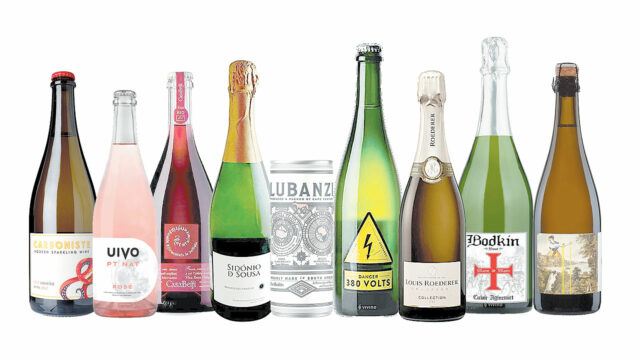
11 EXCITING SPARKLING WINES FROM AROUND THE GLOBE

• NV Sidonio de Sousa Branco Brut Nature ($17)

Portugal has become the go-to spot for terrific bargains, and that includes sparkling wines. This zippy one is from the Bairrada region near the chilly northwest coast. The blend of three local white grapes has aromas of ripe pears and white flowers.

Lubanzi Sparkling Rosé ($18)

This frothy, fruity, fun South African pale-pink fizz will remind you of a dry, crisp prosecco. It’s made from cinsault grapes. The winery is environmentally and socially conscious, a certified B corporation that is also part of One Percent for the Planet, whose members contribute at least 1% of annual sales to environmental causes. The wine comes in a can, too.

2020 Folias de Baco Uivo PET NAT Rosé ($23)

The young winemaker behind the label makes four pet nats in Portugal’s Douro region, land of vintage port. This one is 100% pinot noir. It’s light and lively but intense, with fresh, tart, red-fruit flavors.

NV Bodkin Cuvee Agincourt Brut Sparkling Sauvignon Blanc ($25)

America’s first sparkling sauvignon blanc, made from Lake County grapes in California, is the brainchild of Black winemaker Christensen. First launched in 2012, it’s now more available. It’s light, dry, and aromatic, with a green-apple fruitiness — and made like a prosecco. Christensen is also putting the same wine in 250 ml cans for $8 each.

2020 Casa Belfi Naturalmente Frizzante Rosso ($25)

Savory and slightly herbaceous, with soothing, gentle bubbles, this bold-flavored sparkling red is the color of a Negroni. It’s from prosecco land but has some taste resemblance to a bone-dry, fruity Lambrusco. I’d never heard of the varietal — Raboso Veronese, whose taste reminds me a bit of cabernet franc.

• 2019 Heidi Schrock & Sohne Pinot Blanc Petillant Naturel, v. 2 ($26)

Schrock, with a long history at making wine in Austria, is crafting a new line of natural wines, Nostalgie Naturelle, with her sons. The second vintage of this orange-tinged sparkler, a re-creation of a wine Schrock’s great-grandfather made, is bright and citrusy with floral aromas.

2020 Carboniste Octopus Sparkling Wine Extra Brut ($28)

Dan and Jacqueline Person are making modern sparkling wines in California that don’t aim to be like Champagne. Their flagship, made from aromatic albariño grapes, has softer bubbles and tastes of passion fruit and fresh herbs, not toasty brioche. Serve, of course, with grilled octopus.

2020 Milan Nestarec Danger 380 Volts Pet Nat ($32)

Czech winemaker Milan Nestarec has been called the “enfant terrible” of the country’s leading natural wine group. This unusual mix of Mueller-thurgau, neuburger, and muscat grapes is citrusy and very tart, best for adventurous palates.

2018 Cruse Wine Co. Tradition Sparkling Wine ($45)

Michael Cruse is best known for his very expensive cult sparkler Ultramarine and for pet nats from grapes like valdiguie. This third version of his sunny, lemony, and toasty California-style fizz is his idea of an entry level cuvée made by the Champagne method. The blend of pinot noir and chardonnay has intense fruit aromas and delicious delicate berry and green apple flavors.

NV Louis Roederer Champagne Brut Collection 242 ($45)

Famous Champagne houses don’t want to be left out when it comes to experiments. The maker of luxe favorite Cristal ditched its basic non-vintage wine, replacing it with a stunning multivintage blend — a definite step up. Silky textured and lacy, with lots of energy and complexity, it’s made a little like a sherry solara, with new wine added to a perpetual reserve every year.

2016 Radgonske Gorice Untouched by Light Methode Classique Brut ($290)

The first sparkling wine made in complete darkness, this Slovenian fizz is not just a gimmick: Research has found that exposure of bottled wines to fluorescent or ultraviolet light can cause lightstrike, which affects a sparkling wine’s aromas. This winery is taking no chances. The grapes are harvested on moonless nights and processed in the dark by workers wearing night vision goggles. The wine matures in dark caves and the wine comes in a black glass bottle. All-chardonnay, it’s gentle, creamy textured, and elegant. The only thing not to like is the price tag. — Bloomberg

Navy team captain Oranza silences doubters with thrilling Stage Six victory

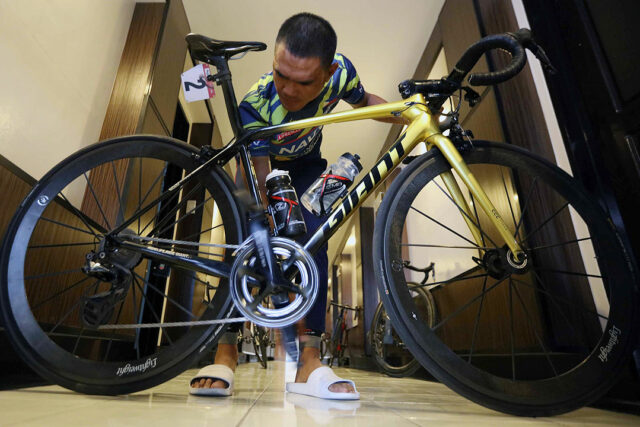
NAVY STANDARD Insurance team captain Ronald Oranza — ERNIE PENAREDONDO

TARLAC CITY — When Ronald Oranza took over from predecessor Jan Paul Morales as new Navy Standard Insurance team captain, questions were raised if he could balance contending for the title and leading a team to another crown in the 11th LBC Ronda Pilipinas.

But after his tour-de-force Stage Six performance on Tuesday in Tagaytay, Mr. Oranza quashed whatever doubts were left and silenced the doubters.

“Coach (Reinhard Gorrantes) believed in me and that’s all I need to do whatever I need to do, as a teammate and a leader,” said Mr. Oranza, who wears the leader’s red LBC jersey in the 180.4-kilometer Lucena-Baler Stage Seven starting at 9 a.m. on Thursday in front of the provincial capitol.

Mr. Oranza bucked a busted rear tire and cramps to deliver a performance to remember in Stage Six that catapulted him straight to the overall lead in 18 hours, 46 minutes and four seconds.

The 2018 Ronda champion spent Wednesday’s break doing light training and hydration to rest his tired legs in preparation for the final four stages where the remaining 90 of the 104 riders tackle the ascents including the dreaded climb at Baguio’s back door from Bayombong, Nueva Vizcaya in penultimate Stage Nine on Saturday.

And the proud son of Villasis, Pangasinan knew leads could vanish with just one mistake in the mountains.

“Will do my best to protect the lead, but it’s going to be tough because the last few stages are toughest in Ronda this year,” he said.

Expected to hound Oranza like pack of wolves are Excellent Noodles’ Mr. Morales (18:46:46), Go for Gold’s Jonel Carcueva (18:49:01), Excellent Noodles’ Mervin Corpuz (18:50:51), Navy Standard Insurance’s Jeremy Lizardo (18:52:36), Excellent Noodles’ Mar Francis Sudario (18:55:01), Navy Standard Insurance’s Ronald Lomotos (18:55:04), Go for Gold’s Jericho Jay Lucero (18:55:10) and Daniel Ven Carino (18:56:21), and Navy Standard Insurance’s John Mark Camingao (18:56:45), who all crowd the top 10.

Mr. Oranza will also give it his best to retain the King of the Mountain race lead and help the Navy men remain atop the team race where they have an aggregate time of 53:41:57 ahead of Go for Gold (54:00:28) and Excellent Noodles (54:29:24).

This annual event stakes a P3.5-million cash pot including P1 million to the champion courtesy of LBC Express, Inc., MVP Sports Foundation, Quad X, Smart, Twin Cycle Gear, Standard Insurance, Print2Go, Elves Bicycles, Elitewheels, Orome, Maynilad, PhilHydro, Garmin, Petron, Boy Kanin, Green Planet Bikeshop, Prolite, Fujiwara, Black Mamba Energy Drink, Lightwater, LBC Foundation, PhilCycling, and the Games and Amusements Board.

Tax court grants SM Investments’ tax refund claim

THE Court of Tax Appeal (CTA) granted the tax refund claim of SM Investments Corp. of P296.2 million of unutilized creditable withholding tax (CWT) for the calendar year 2014.

In a 12-page resolution on March 11, the court’s third division ordered the Bureau of Internal Revenue (BIR) to refund or issue a tax credit certificate representing the company’s excess CWT for 2014.

The appellate court said that the CWT certificate issued by the commissioner of the Bureau of Internal Revenue contained the wrong taxpayer identification number (TIN) of the company and also contained erasures that were not properly countersigned.

The case was based on the company’s appeal to the tax court to reconsider its ruling in 2020 that partially granted P289.8 million of excess CWT.

“Petitioner has sufficiently proven its entitlement to the refund or issuance of a tax credit certificate, representing unutilized excess creditable withholding tax for 2014 in the modified amount of P296.2 million,” the court said in its ruling written by Associate Justice and CTA Third Division Chairperson Erlinda P. Uy.

The commissioner of the BIR, in an appeal for partial reconsideration, said that the company failed to “exhaust administrative remedies” before bringing the case to court in the division. The CTA rejected the appeal and said that the petitioner timely filed its judicial claim, as the country’s tax code provides the appeal to be filed within two years of the tax penalty.

“In this case, there is no showing that respondent ever acted on petitioner’s administrative claim for a refund from the time it was filed on Sept. 21, 2015, up to the filing of its judicial claim on April 7, 2017, when the two-year prescriptive period is about to end,” the court noted.

It reiterated that the company was correct to have elevated the claim for refund before the expiration of the two-year prescriptive period mandated by the tax code.

The court also disagreed with the respondent’s claim that the company’s failure to submit proof of remittances was fatal to the claim for refund.

“Further, it bears emphasis that the payee-refund claimant, such as petitioner in this case, need only prove the fat of withholding taxes, which is established by a copy of the withholding tax statement; and not its actual remittance to the BIR.” — John Victor D. Ordoñez