Home Blog Page 6123

PH, US enhance maritime defense through skills, knowledge exchange

US EMBASSY

THE PHILIPPINES and the United States recently concluded a weeklong exchange of skills and intelligence to enhance counter measures against maritime threats, according to a statement released by the US Embassy on Monday. 

This exchange equipped NCWC (National Coast Watch Center) analysts with the necessary tools to independently conduct Counter Threat Network analytical activities that strengthen the Philippinesefforts to protect its territorial waters and maritime rights,Defense Threat Reduction Agency (DTRA) Partner Engagement Coordinator Dawood Luqman said.  

It also aimed to assist the NCWC in acquiring relevant knowledge and skills to support joint maritime domain and counter threat network operations,the embassy said. 

The exchange, which ended on July 25, included three days of analytical discussion and two days of tabletop exercise that allowed DTRAs experts to expand their knowledge of specific regional maritime security challenges through interactions with the Philippine Coast Guard and NCWC.  

The DTRA, based in Virginia, has long been partners with the Philippine government. It was responsible for constructing the NCWC facility in Manila, Regional Coordination Centers in Cebu and Palawan, among others.  

Since 2012, the DTRA has donated more than $64 million or P3.5 billion to the NCWC for the acquisition of advanced equipment and training of personnel. Alyssa Nicole O. Tan

Companies from India, Israel to join Davao agriculture expo in Sept. 

BW FILE PHOTO

THE EMBASSIES of India and Israel will bring delegations to the 24th Davao Agri-Trade Expo (DATE) next month, which will be highlighting innovations in the agricultural sector.    

Cherrylin B. Casuga, chair of DATE organized by the Davao City Chamber of Commerce and Industry, said the Israel Economic and Commercial Mission to the Philippines and the Embassy of India will be participating in the trade exhibit.   

Up to 10 companies from each country will be joining the hybrid event on Sept. 29-30. 

DATE 2022 will have the theme Innovative Agribusiness: Achieving Productivity and Sustainability for Food Security,and focus on aquaculture, livestock, poultry, hogs, high-value crops, and game fowl.  

We will be featuring innovations, and solutions to address the challenges faced by the agribusiness sector, mostly climate change, biodiversity, biosecurity, and also to be resilient to challenges that we are encountering in agriculture,Ms. Casuga said.  

This years DATE aims to encourage local agri entrepreneurs to adopt new farming techniques and technologies to increase farm productivity, ensure sustainability, and become more competitive in the global market.  

Among the exhibitors that have signed up are Amazon Manufacturing Corporation, Skov Ltd., Philippine Scale Inc., Filinvest Land Inc., Card Pear Marketing, Macondray Plastic Products Inc., Sowing and Reaping Agricultural and Poultry Supply, R.Dan and Co. Inc, and Big Dutchman.  

Apart from the trade exhibit, there will also be forums and networking activities. The physical events will be held at the SMX Convention Center at SM Lanang Premier. Maya M. Padillo

Parañaque mayor calls for development of parks in every village as part of disaster management

THE MAYOR of Parañaque, one of the cities in capital region Metro Manila, has called for the development of public parks in each of the 16 barangays and open spaces in private villages as part of disaster management.   

Parañaque City Mayor Eric L. Olivarez, in a statement of Monday, said these areas would have an important role during disasters such as earthquakes.  

Mr. Olivarez made the call in the aftermath of the magnitude 7 tremor that hit northern Luzon on July 7, which was felt at various intensities in Metro Manila.  

Like other countries in Asia, the Philippines is one of the worlds most disaster-prone countries. Our islands are regularly being hit by floods, typhoons, landslides, earthquakes, and droughts,he said.   

For public areas, It is necessary to provide open spaces that are easily accessible from all barangays as the first evacuation sites during and post disaster,he said, assuring funding support.   

Of the 16 barangays, only six had built public parks in the last three decades, he said.  

The mayor also urged communities within private and gated subdivisions, which usually have park areas, to have more than one access point to facilitate evacuations.

Manalo to skip ASEAN meet after testing positive for COVID-19

FOREIGN Affairs Secretary Enrique A. Manalo has tested positive for COVID-19, he said in a tweet on Monday, which means he will have to skip the 55th Association of Southeast Asian Nations (ASEAN) Foreign Ministers’ Meeting in Phnom Penh, Cambodia this week.   

This would have been my first ASEAN engagement in my capacity as Secretary for Foreign Affairs, so it is unfortunate that my absence happens at this important time,he said.   

Foreign Affairs Undersecretary for Bilateral Relations and ASEAN Affairs Theresa P. Lazaro will represent the Philippines in the event.   

I will concentrate on recovery so I can go back to working at DFA (Department of Foreign Affairs) as soon as possible, and I look forward to the next opportunity to meet with ASEAN colleagues and our dialogue partners,Mr. Manalo said.  

During the meeting, the regions foreign leaders will witness the signing of the instruments of accession to the Treaty of Amity and Cooperation in Southeast Asia by Denmark, Greece, the Netherlands, Oman, Qatar and the United Arab Emirates, according to a statement last week from Cambodias foreign ministry. Alyssa Nicole O. Tan

House adopts national medium-term fiscal plan as guide for annual budget deliberation

HOUSE OF REPRESENTATIVES

THE HOUSE of Representatives on Monday adopted a resolution that supports the national medium-term fiscal framework (MTFF), which will be used as guide by lawmakers for the annual budget deliberations.   

House Concurrent Resolution 2 aims to consolidate the national government’s resources to achieve maximum benefits for the economy.   

“It is important that Congressional initiatives are aligned with the economic recovery programs of the National Government,said Marikina Rep. Stella Luz A. Quimbo, vice-chair of the Appropriations committee, who sponsored the resolution.  

“I stand before this august chamber today to sponsor a resolution adopting the national governments Medium Term Fiscal Framework or MTFF as anchor for the annual spending and financing plan of the national government and for Congress when preparing the annual budget,” Ms. Quimbo said in her sponsorship speech.  

Albay Rep. Jose Ma. Sarte Salceda, chair of the Ways and Means Committee and was also a sponsor of the resolution, said the MTFF is an international best practice.  

Some of our best neighbors and comparators are already doing that. Indonesia, Thailand, and Korea have it in their statutes. Malaysia, Singapore, and Japan do it regularly in their budgets,he said in a statement. Matthew Carl L. Montecillo 

Road to Sipalay beaches

DPWH

THE DEPARTMENT of Public Works and Highways (DPWH) has finished paving a 3.5-kilometer coastal road that provides access to white sand beaches and other potential tourism destinations in Sipalay City in central Philippines.

Business empires dominate PBA

JC GELLIDON-UNSPLASH

Big Business won big time in the Philippine Basketball Association (PBA) last Wednesday. The flagship teams of business empires San Miguel Corp. (SMC) and Metro Pacific Investments Corp. (MPIC) eliminated their opponents from further competition in this year’s Philippine Cup Conference. They beat them in the same fashion their parent company meets competitors.

The San Miguel Beermen smashed Blackwater Bossing by the lopsided score of 123-93 and TNT Tropang Giga demolished Converge FiberXers by 21 points, 116-95. That reduced the quarterfinals of the conference to a battle between SMC and MPIC ball clubs.

The triumph of San Miguel and TNT can only be attributed to their overabundance of talent. Their powerhouse rosters were made possible by the huge budgets of the two ball clubs.

The Beermen include players who were top 10 draftees. Three of them were No. 1 overall, Jun Mar Fajardo in 2012, Moala Tautuaa in 2015, CJ Perez in 2019; Chris Ross was No. 3 in 2009, Marcio Lassiter No. 4 in 2011, Rodney Brondial No. 6 and Jericho Cruz No. 9 in 2014, and Vic Manuel No. 9 in 2012. Except for Fajardo, the players mentioned were drafted by other teams. San Miguel acquired them through trade. San Miguel’s right to pick No. 1 in 2012 was itself acquired through trade.

Among the TNT top 10 draftees are Kelly Williams, No. 1 in 2006, Troy Rosario No. 2 in 2015, Jason Castro No. 3 in 2008, Mikey Williams No. 4 in 2020, and Glenn Khobuntin No. 10 in 2015. Except for Castro, they were all drafted by other teams. The right to pick No. 3 in 2008 was acquired through trade.

Neither Ever Bilena, Inc., owner of the Blackwater team, or Converge ICT, owner of the Converge FiberExers, is a corporate giant that can assemble a powerhouse team similar to San Miguel Beer or TNT Tropang Giga.

Blackwater through the years drafted Juami Tiongson, Brian Heruela, Art Dela Cruz, Almond Vosotros, Mac Belo, Reymar Jose, Bobby Rey Parks, Rey Suerte, Maurice Shaw, and, this year, Brandon Ganuelas-Rosser. It traded its rights to pick first in 2015 to TNT which picked Tautuaa, and to pick third in 2021 to NLEX, which chose Calvin Oftana. If it had kept all its draftees and used its rights in 2015 and 2021, Blackwater Bossing could have given the Beermen a decent fight.

Highly regarded players who have donned the black and red jersey and who now play for other teams are Mac Belo, J.P. Erram, Brian Heruela, Dave Marcelo, Kyle Pascual, Aillen Maliksi, Don Trollano, Art dela Cruz, and Bobby Ray Parks. Seven of the former Elite/Bossing now play for Metro Pacific teams — Erram, Heruela, and Marcelo for TNT, Belo, Maliksi, and Pascual for Miracle, and Trollano for NLEX.

The practice of big budget teams acquiring top draft picks in exchange for several so-so players was severely criticized by Fred Uytengsu, owner of the Alaska Milk Aces ball club in 2017. Kia Picanto traded its rights to pick first to San Miguel for several players.

San Miguel used its right and picked Christian Standhardinger, who was the consensus No. 1 overall pick that year. In return, Kia got from San Miguel Ronald Tubid, Jay-R Reyes, both already nearing retirement at the time, and seldom used reserve Fil-Am Rashaw McCarthy.

Uytengsu said, “The purpose of the draft is to strengthen the weaker teams. However, what we have seen lately is these weaker teams end up selling their top draft picks because if you look at who is being traded in return, it clearly doesn’t make basketball sense for the weaker teams, unless there is other consideration.”

Another issue Uytengsu raised was league balance and salary cap compliance. “If you look at the composition of SMB and Ginebra, you will see they are stacked with first to third picks. Many of those players came to them from curious trades. It’s difficult to comprehend how a team can fit within the team salary cap, paying those players all at approved maximum PBA salaries while still maintaining a strong sixth through eighth players. I’ve done the math and it doesn’t work,” said Uytengsu.

He cited four-time MVP June Mar Fajardo, Arwind Santos, Chris Ross, Marcio Lassiter, and Alex Cabagnot for the Beermen and the likes of Greg Slaughter, Japeth Aguilar, Joe Devance, LA Tenorio, Scottie Thompson, and Kevin Ferrer for the Kings, making him wonder if both franchises don’t go over the ceiling as far as players’ salaries are concerned.

In 2019, Global Port/NorthPort traded its 2014 top draft pick to Ginebra San Miguel for Sol Mercado, Jervy Cruz, and Kevin Ferrer. Mercado is out of the PBA and Cruz has not been fielded this conference. In 2021, Terrafirma Dyip/Kia Picanto sent to San Miguel CJ Perez, No. 1 pick overall in 2018. Dyip got Russel Escoto, Gelo Alolino, and Matt Ganuelas Rosser.

The continued practice of weak teams selling their top draft picks to lavishly funded ball clubs must have so exasperated Uytengsu that he decided to leave the PBA fold for good by selling his Alaska Milk Aces franchise to Converge ICT.

I doubt if Dennis Anthony H. Uy, owner of the Converge FiberExers, is in a position or inclined to outbid the owners of the SMC and MPIC ball clubs for the best talent. In two years, emissaries from those two business empires will be talking to Converge’s prized recruits Justin Arana and Jeo Ambohot.

Billionaire Mikee Romero, owner of the NorthPort Batang Pier could not hold on to Stanley Pringle. The other Dennis A. (for Ang) Uy, owner of Super LPG Fuel Masters, has not manifested any intention or inclination to keep Mathew Wright, Phoenix’ first draft choice when it joined the league during the Commissioner’s Cup of 2016. Phoenix Petroleum Philippines, Inc. is one of the principal units of Udenna Corp., Uy’s business empire.

Anyway, the pricey players of SMC and MPIC showed their true worth last Sunday. Each empire scored one victory and one loss. Both games — Magnolia vs. NLEX and Meralco vs. Ginebra — went down to the wire. Magnolia and NLEX were tied at the end of the regulation period. Magnolia prevailed in the end. The second game was decided in the last few seconds when Stanley Pringle missed a perimeter jump shot that could have tied the game.

Both games were hard fought. It showed in the unusually high number of jump balls. There were hard fouls but not dirty. There were many double fouls, too. Both games were brilliantly coached. I am tempted to say that it took Luigi Trillo, a co-villager and former classmate of my son, to get the monkey off the back of Meralco.

The quality of officiating was high. A foul called against the driving Scottie Thompson of Ginebra was crucial. It could have decided the game in favor of Meralco because the shot was nullified and Scottie fouled out on that call in the dying seconds of the game. But the replay clearly showed Scottie pushing off the defender as he drove for the basket.

Both games were among the most exciting in years. My only disappointment was the lack of analysis in the Magnolia — NLEX game. Dominic Uy merely joined sportscaster Charlie Cuna in giving an account of the game. He was there to annotate. Andy Jao and Ryan Gregorio tell the viewer what play can be expected, why the offense is stifled, or what the defender should have done, or who can match better against so-and-so, etc. Quinito Henson, also my co-villager (so are Tim Cone and San Miguel Asst. Coach Jorge Gallent) and my former player in the AIM intramurals, does that too but he does it like after every other sequence.

The business conglomerates continue to wage their battle in court — the basketball court. Magnolia will go up against TNT and Meralco against San Miguel beginning tomorrow.


Oscar P. Lagman, Jr. is a retired corporate executive, business consultant, and management professor. He has been a politicized citizen since his college days in the late 1950s.


Outsourcing in times of pandemic

MATT REAMES-UNSPLASH

I was seated beside a senior executive of a large BPO (business process outsourcing) in the country in the first face-to-face general membership meeting of MAP — Management Association of the Philippines — and we got to talk about the developments in the BPO industry in light of the pandemic. From our conversation, I gleaned three very interesting pieces of information.

Firstly, the outsourcing business increased and even accelerated during the pandemic; secondly, the employees and even applicants gained greater power and influence, making this an employees’ market; and, finally, as a spawn of the second item, the birth of “direct hires” employees.

The pandemic has forced many governments to impose lockdowns. Since they are continuing despite the lockdowns, businesses have to adopt work-from-home (WFH) models (in different degrees), mainly copying from what outsourcing has been doing for many years. Since everyone is working from home, everyone has been cooperating and has been making the WFH set-up work.

Many companies realized that WFH equates to outsourcing. And, outsourcing or WFH, in a way, is just a matter of distance. Outsourcing to the Philippines is farther away but essentially still a WFH. The Philippines, having established itself as an outsourcing haven, has taken many new clients. The WFH in the US became WFH in the Philippines, but cheaper.

While this is mainly good news for the local outsourcing industry, it has inadvertently led to issues of personnel and staffing. The Philippines has imposed several recurring lockdowns of varying degrees. Thus, many workers in the outsourcing industry have to do WFH as well. And mostly, these workers found WFH to be convenient, not physically draining, and easier. And many of them do not want to report back to the office but rather continue under a WFH set-up.

This desire of the workers runs counter to the desire of some clients and some government agencies, like the FIRB — Fiscal Incentives Review Board. Some clients have requirements that the outsourcing provider has to house the workers in an office.

Accordingly, the outsourcing provider has to open up the office or, in some cases, has to even open a new facility.

On the other hand, FIRB, in its desire to help the government stimulate the economy, has mandated that all PEZA-registered companies should follow a 70% (onsite) — 30% (WFH) set-up starting April 1, 2022. (Note: The Philippine Economic Zone Authority, or PEZA, I was told, was more inclined to continue the 90% WFH and 10% onsite set-up, which was adopted at the height of the pandemic.) Otherwise, these companies would lose their tax privileges and incentives.

Unfortunately, many providers have been unable to comply with this mandate as employees would rather resign than be forced to report onsite. And, providers also found that new applicants have WFH as one of their criteria for accepting work.

Consequently, according to the executive I talked to, the industry has a shortage of workers of 10% to 15%. In terms of numbers, this translates to about 100,000 to 150,000 workers, considering that PEZA estimated that those employed in the outsourcing industry as of 2021 to be about 1 million.

So, where are the workers? And why are they so bold as to resign (if already employed) or refuse the offer of employment (if still applying)?

It turns out that many young people are now working directly for companies abroad without the umbrella of a corporate entity. The outsourcing industry calls this arrangement — “virtual assistants” — primarily “direct hires” by companies abroad. Many of our young workers have adopted and accepted this work arrangement since they remain to be doing WFH and, moreover, they get significant increases in salaries compared to what they were getting while employed in local companies.

In some instances, these “direct hires” are even provided computers and related tools of the trade.

The WFH and the outsourcing practices have been adopted by the global business community for some time, primarily due to advances in technology and the agility of management. The pandemic has just accelerated these practices and made their adoption more widespread and easier.

The companies have adjusted, the employees have adjusted; but unfortunately, for most parts, the government/regulatory agencies are lagging far behind.

Looking at the actions of FIRB and other regulatory agencies, they seem to be missing critical points of these issues and are not attuned to the developments. For example, with the 70% — 30% mandate, some PEZA-registered companies are looking at foregoing their tax privileges and incentives just so they can keep their people.

Moreover, there seems to be a lack of action on the issue of “direct hires.” For me, more than the issue of the government losing taxes on revenues (and even payroll taxes), contributions to the Social Security System (SSS) and to health insurance (PhilHealth), the government should look after the general welfare of the “direct hires” — making sure that they are not abused nor short-changed in the end.

These issues of outsourcing and the new “trend” of “virtual assistants”/“direct hires” are surely not unique to the Philippine situation. It is likely being done in other outsourcing countries, like India, Brazil, and Poland.

Also, there might be new trends coming. The government should work hand in hand with the outsourcing industry in acting on and resolving these issues. There should be more creative solutions as the outsourcing industry continues to flourish even in the pandemic.

The article reflects the personal opinion of the author and does not reflect the official stand of the Management Association of the Philippines or MAP.


Jessie C. Carpio is a member of the MAP ESG Committee. He recently retired as partner of P&A Grant Thornton where he took on various leadership roles, such as head of Audit and Assurance Division, president of its outsourcing division, and International Liaison director.

map@map.org.ph

jccarpio627@gmail.com

The Post-SONA Economic Briefing; FVR’s economy

There were a number of important economic events that occurred last week, I will discuss four of them here.

FIRST SONA OF PFMJ
Last Monday, July 25, President Ferdinand Marcos, Jr. (PFMJ) delivered his first State of the Nation Address (SONA). It was a 3S — sane, statesman, sensible — address by a head of state. No cursing, no threats like “I will expropriate your business” that we heard in the SONAs of the previous administration.

Instead, the opening statements were all about the economy: “sound fiscal management… Tax administration reforms… spending efficiency… Productivity-enhancing investments… Ecozones supported… tax system adjusted to the digital economy… ease of paying taxes.”

“GDP growth targets 6.5 to 7.5% in 2022, 6.5 to 8% in 2023-2028… 9% or single-digit poverty rate by 2028. Three percent deficit to GDP ratio by 2028. Less than 60% debt-to-GDP ratio by 2025. At least $4,256 income (GNI) per capita and the attainment of upper middle-income status by 2024… objectives of this Medium-Term Fiscal Framework (MTFF) being submitted to Congress.”

For me this indicates one thing: the economy, not politics and populist pandering is primary on PFMJ’s mind. Which implies that if those economic goals contradict with politics and populist lobbying, the former will prevail over the latter. Good start, Mr. President.

POST-SONA ECONOMIC BRIEFING
The next day, July 26, there was a big event, the Post-SONA Economic Briefing at the Philippine International Convention Center (PICC). I was invited and I attended it. There were three panel discussions: Economic, Infrastructure, and Social Sectors, and these provided more details that were not elaborated on in the SONA.

In a panel by the economic team, all five heads came and spoke — Finance Secretary Benjamin Diokno, NEDA (National Economic and Development Authority) Secretary Arsenio Balisacan, Trade and Industry Secretary Alfredo Pascual, Budget and Management Secretary Amenah Pangandaman, Central Bank Governor Felipe Medalla.

In a panel by the infrastructure team, speakers were Public Works and Highways Secretary Manuel Bonoan, Information and Communication Technology Secretary Ivan John Uy, Tourism Secretary Ma. Esperanza Christina Garcia Frasco, Energy Secretary Raphael Lotilla (by phone) and Energy Director Mario Marasigan, plus Transportation Undersecretary Cesar Bermejo Chavez and Agriculture Assistant Secretary Arnel de Mesa.

And in the Social or Human Development team, the speakers were Vice-President and Education Secretary Sara Duterte, Social Welfare and Development Secretary Erwin Tulfo, Labor Secretary Bienvenido Laguesma, Environment and Natural Resources Secretary Maria Antonia Yulo Loyzaga, Migrant Workers Secretary Susan Ople, and Health Officer-in-Charge Maria Rosario Vergeire. Program hosts and panel Moderators were Budget and Management Undersecretary Margaux Salcedo and Central Bank Managing Director Antonio Joselito Lambino II.

A total of 12 Secretaries including VP Sara plus the Central Bank Governor spoke. Plus undersecretaries of some departments. It was a huge event and many corporate leaders, other government officials, and practically all media networks were there.

In a presentation for the Economic team, Finance Secretary Diokno showed the Philippines’ GDP growth trend from 2015 to 2021 and the projections until 2028, and net foreign direct investments (FDI) inflows from 2015 to 2021, extended to January-April 2022. There is a rising trend — good.

To further situate the Philippines growth trends, I created this table extending the period from 2005 to 2021 and covered five other major ASEAN countries. Data came from the International Monetary Fund’s (IMF) World Economic Outlook (WEO), and UN Conference on Trade and Development’s (UNCTAD) World Investment Report (WIR) 2022.

Pre-pandemic — 2015-2019 — the Philippines was the second fastest growing economy in the ASEAN-6 next to Vietnam. And when it came to FDI (foreign direct investments) inflows, the Philippines had the lowest in the ASEAN-6 in 2005-2009, but by 2015-2019 the Philippines had caught up with Malaysia and Thailand (Table 1).

These are good trends — except for the deep contraction of 2020, -9.6%, due to the severe and business-killing lockdown imposed by the previous administration.

Budget and Management Secretary Pangandaman made a good distinction and division of labor between national and local governments. Big infrastructure projects by the national government, support and smaller infra by the local governments. And the agency’s “rightsizing” program will complement this new division of labor, not only in infrastructure but also in the social sectors. Some agencies will shrink if they are not abolished, other agencies can expand.

Economics Secretary Balisacan briefly discussed the Philippine Development Plan (PDP) 2023-2028 that includes the Eight-Point Agenda, among which are: protect households’ purchasing power, sound macroeconomic fundamentals, ensure a level playing field, and uphold public order.

Central Bank Governor Medalla signaled an additional mild interest rate hike this August when the Monetary Board meets, while ruling out an additional “off-cycle” big rate hike.

In a presentation for the Infrastructure team, Public Works and Highways Secretary Bonoan showed a map of the Luzon Spine Expressway Network (LSEN) program, a total of 1,213 kilometers of completed, under construction, and proposed toll roads that will reduce travel from the Ilocos to Bicol regions from 20 to just nine hours. Then there are the Inter-island Linkage/Mega Bridge program, including the Bataan-Cavite bridge (32.2 kms) and Panay-Guimaras-Negros bridges (32.5 kms). And the various seaport, airport, and railway projects. Beautiful grand plans that will need fast and sustained economic growth to finance and materialize them.

Energy Secretary Lotilla emphasized the need to have more power plants, a bigger power supply base, and wider or more diversified energy sources. Such energy diversification will include nuclear power and new natural gas via investment incentives to the upstream sector. I support these, plus the additional target to have 100% electrification of households nationwide including far-flung barangays.

The dirtiest and most dangerous power sources are candles and household gensets, not coal and nuclear power plants. A friend based in Calapan, Oriental Mindoro told me that until now they still have blackouts of three to five hours a day, sometimes two times a day — horrible. More candles mean more fires and more destruction of property if not deaths of people. More gensets mean more air and noise pollution.

DECELERATING GROWTH OF THE WEST
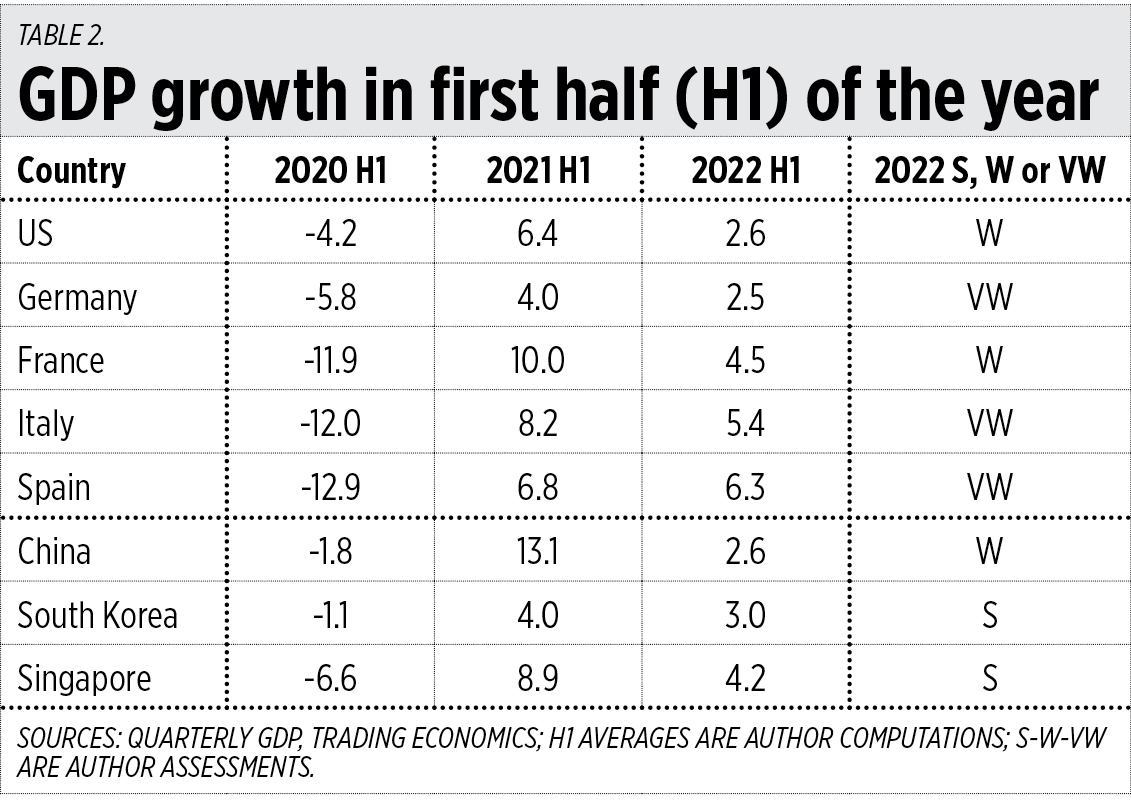
Last week, the GDP growth for the second quarter (Q2) of 2022 were released by a number of industrial and Asian countries. I averaged the Q1 and Q2 growths into first half (H1) and commented whether H1 2022 was a strong (S), weak (W), or very weak (VW) recovery in Table 2. I say VW when H1 2022 growth is low on the already low recovery in H1 2022.

RIP, FVR
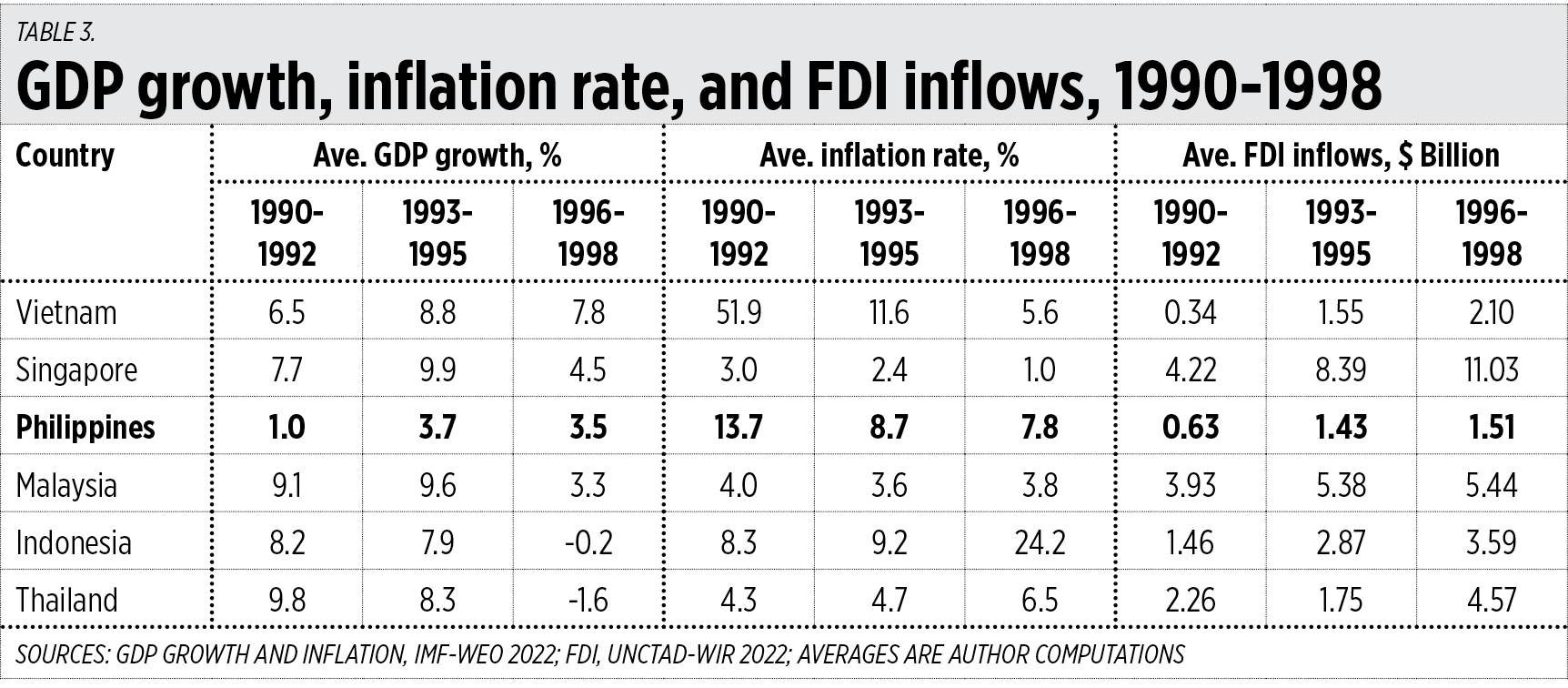
Last Sunday, former President Fidel V. Ramos died at the age of 94. I went back to the macroeconomic numbers during his presidency (July 1992-June 1998), with the last three years of the Cory Aquino administration (1990-1992) as the base period, and compared it with five other major economies of the ASEAN-6 (Table 3).

The Mt. Pinatubo eruption, the big earthquake in Luzon, and major blackouts all occurred in 1990-1991, so growth was adversely affected and supply chains were tangled, so inflation was high. President Ramos was able to make a quick economic recovery in his first three years and reduce the inflation rate. And he sustained the momentum when the Asian Financial Crisis occurred in 1997-1998 — the Philippines grew 3.5% in 1996-1998 while Indonesia and Thailand experienced contractions.

You did well as President of the Philippines, Sir. Peaceful journey.


Bienvenido S. Oplas, Jr. is the president of Minimal Government Thinkers.

minimalgovernment@gmail.com

A personal farewell to fully online education

COMPARE FIBRE-UNSPLASH

Two years ago, I was given the opportunity to teach management subjects again at De La Salle University. Half a year later, I received a similar offer from De La Salle-College of Saint Benilde. Armed with an adequate internet connection, I accepted both offers on the condition that everything would be done purely online. I made clear that as soon as face-to-face instruction would be required, I would stop teaching again. I was not yet willing to deal with the risk of exposure to COVID-19 and, as was true when I stopped teaching back in 2018, I was no longer willing to deal with the transportation-related costs. I was fortunate to have been given the chance to teach again under the more workable conditions of the fully online set-up, but the challenges that came with it became evident right away.

One of the challenges that stood out was how difficult it was to get to know my students individually. I believe my reduced ability to individualize my teaching style and to personalize interactional and motivational approaches significantly affected my effectiveness as a learning facilitator. It is quite difficult to know a person, much more so to know how to effectively interact with and motivate a student, based solely on how the person uses chat boxes. This is often a limitation that teachers need to work with because chat boxes are what many students, including those who claim to have internet connection problems, end up using as their primary medium for class participation.

This brings us to the next challenge: the tedious process of reading through these chat boxes. I have had class discussions where I was only able to read answers to questions half an hour after they had been asked. This was not due to a lack of attention to the chat box. If anything, I probably paid too much attention to it. It often happened that several answers and comments needed to be addressed first, and it took that much time to get through all the implications and relevant side discussions that each chat message brought forth. Sometimes, I felt like I was talking to myself for hours when no other voice was willing to be heard. I tried disallowing chat box participation, but ended up allowing it again after the deafening silence that followed. Knowing that the sessions are recorded and that their classmates would eventually have access to their sound bites, many students shy away from using their mics. In too many instances, I asked a question that I would never ask in a face-to-face set-up: “Are you there?”

Another significant challenge that comes with the fully online set-up is the difficulty of detecting whether a student is physically and mentally present or not. Early on, I conceded that I simply could not confirm their presence in synchronous sessions. It was too easy for students to park their names on online meetings while doing other things. Even when they failed to respond when called upon, many plausible excuses were ready for their choosing. Despite this, students could choose to pay attention while watching the recording instead. In contrast, the same cannot be said about scatterbrained students in face-to-face set-ups who nod at everything the teacher says without listening to a single word.

Also, there are several subjects for which there is no adequate substitute for experiential learning and face-to-face interaction. Fortunately, my subjects were not of the type that suffered from the lack of such opportunities. Things worked out quite well despite everything, and I believe that fully online classes should continue to be provided to students and teachers who prefer them.

Last month, I finally attended my first in-person academic activity of this decade when our department had an in-person meeting. A week later, I finally met one of my pandemic students in person. However, he just happened to be a neighbor who joined our basketball session that day. It seems crazy to think that it took two years to meet a single student out of the hundreds that I had taught online. Such is the world that we live in now.

As my current teaching stint comes to an end, I would like to thank everyone who made these wonderful opportunities possible. Also, best of health and luck to all face-to-face teachers in all your future endeavors!


Engr. Rafael Gerardo S. Tensuan is a lecturer at the Department of Management and Organization of the Ramon V. Del Rosario College of Business of De La Salle University.

rstensuan@gmail.com

Myanmar junta extends emergency rule

REUTERS

THE HEAD of Myanmar’s junta on Monday blamed instability for stalling efforts to implement a peace plan agreed with other Southeast Asian countries as he extended emergency rule for another six months.

The junta first declared a state of emergency after seizing power from the elected government of Aung San Suu Kyi in a coup in February last year.

Myanmar has been in chaos since then, with conflict spreading after the army crushed mostly peaceful protests in towns and cities.

The 10-member Association of Southeast Asian Nations (ASEAN) agreed a five-point “consensus” to end hostilities last year, but there has been little sign of the junta implementing the five-point plan, which includes an end to violence and dialogue.

Junta leader Min Aung Hlaing said in a speech aired on state media that Myanmar had been striving to overcome the challenges of the coronavirus pandemic while facing internal violence.

“So it was difficult to implement the ASEAN consensus due to the lack of stability,” said Min Aung Hlaing, adding that only when the situation was “normal” could progress be made.

Western governments denounced the coup and the detention on various charges of Nobel laureate Ms. Suu Kyi and numerous members of her party and supporters.

Some members of ASEAN, of which Myanmar is a member and which has a tradition of non-interference in each other’s internal affairs, also criticized the generals.

While the junta has failed to implement the ASEAN plan, it has never rejected it.

“Our country is an ASEAN state so we value the conventions of ASEAN,” Min Aung Hlaing said.

While Min Aung Hlaing did not mention the extension of the emergency in his speech, state media reported that a military government defense and security council had unanimously approved his request for six more months.

The junta said it had to take power last year because of voting fraud in a November 2020 general election that Ms. Suu Kyi’s party easily won. Election monitoring groups found no evidence of mass fraud.

The military has pledged to hold new elections in August 2023 though the timetable has already slipped and opponents do not believe it would be free and fair.

Security forces have killed more than 2,100 people since the coup, according to the Assistance Association for political prisoners, an activist group. The junta has said such tolls are exaggerated.

The true picture of the violence has become more difficult to assess since lightly armed People’s Defence Forces have sprung up to take on the army, often in more remote areas where ethnic minority insurgents are also fighting the military.

In his speech, Min Aung Hlaing blamed “terrorists” for inflicting casualties. The military has branded as “terrorists” its armed opponents and a rival shadow National Unity Government set up by pro-democracy politicians.

The junta has faced sanctions from many Western countries and last week saw further condemnation after the execution of four democracy activists it accused of “terror acts”.

Min Aung Hlaing also brought up the economy, which has slumped since the pandemic and as the coup ended a decade of reform.

“I think progress can be seen within six months,” he said, citing the prospect of more jobs and a focus on farming.

The World Bank projects Myanmar’s economy will grow 3% this fiscal year following an 18% contraction last year and warned that a return to pre-pandemic levels was unlikely in the near term. — Reuters

S.Korea teachers, parents protest plan to lower school entry age

STUDENTS wearing masks rest in Seoul, South Korea, Aug. 25, 2020. — REUTERS

SEOUL — South Korean parents and teachers’ groups protested on Monday against a plan to bring forward school enrollment by one year to age five, saying such young kids were intellectually unprepared and the change would increase difficulty in finding childcare.

The education ministry said last week it would lower the age in stages, beginning as early as 2025, if it gained consensus public support.

The plan was aimed at expanding the labor force by completing people’s education earlier, it said. The labor force is shrinking, because South Korea’s fertility rate is so low.

A coalition of 36 teachers and parents’ groups staged a rally in front of the presidential office on Monday, calling for the plan to be dropped.

Many parents have opposed it because of the difficulty of finding ways of looking after the children following the early-afternoon end of the school day. In most families, both parents work, and childcare centres generally offer only full-day care.

Parents already face the problem, but not until children go to school at age six.

The teachers’ objections are that five-year-olds are too young to go to school and that the earlier start for schooling will mean even more use of private tutoring as parents compete to get their children ahead.

“Considering cognitive and emotional development, early entry to school is inappropriate, and it is likely to cause side effects, such as intensifying private education and competition for college entrance exams,” the coalition said in a statement.

“It would only increase the burden on parents at a time when many are giving up their jobs to support their children as they enter elementary school.”

In 2019, children began education at age six in 26 of the 38 member countries of the Organization for Economic Cooperation and Development and at age five in three — Australia, New Zealand and Ireland.

The education ministry said it expected to have enough public feedback on its plan by the end of this year and would devise measures to expand childcare and other support before launching a pilot program.

A mother of two infants, who gave only her surname, Oh, said the government should help schools secure more teachers to better take care of children.

“This means schools would play a dual role of education and childcare,” she said. — Reuters

ADVERTISEMENT
ADVERTISEMENT