
How PSEi member stocks performed — April 1, 2022

Here’s a quick glance at how PSEi stocks fared on Friday, April 1, 2022.


Here’s a quick glance at how PSEi stocks fared on Friday, April 1, 2022.

HEADLINE INFLATION likely accelerated in March as the spike in global crude oil prices probably caused a faster increase in food and transport costs, according to analysts. Read the full story.

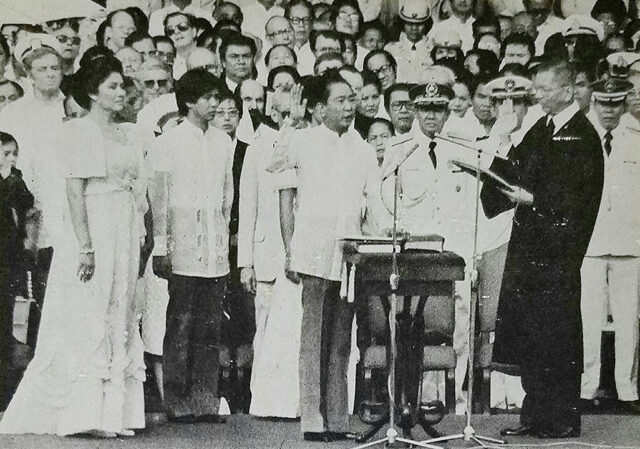
A SENATOR wants the Senate to investigate the government’s failure to collect billions of pesos of taxes from the heirs of the late dictator Ferdinand E. Marcos.
In a resolution dated March 28 but released only on Sunday, Senator Aquilino “Koko” L. Pimentel III sought the probe “in aid of legislation.” He also wants to identify past and current tax officials responsible for the oversight.
“There is an urgent and pressing need for the Senate to look into the reasons” why the Bureau of Internal Revenue (BIR) had failed to collect the taxes that have ballooned to almost P204 billion ($3.96 billion), according to a copy of Senate Resolution 998.
Both the country’s tax agency and a body formed in the 1980s to recover ill-gotten wealth of the dictator and his cronies this month confirmed the tax assessments, but did not say why these have not been paid.
The country’s tax agency had demanded payment of the taxes from Marcos estate administrators, Finance Secretary Carlos G. Dominguez III told reporters in a Viber message on Wednesday, citing the Bureau of Internal Revenue (BIR).
Internal Revenue Commissioner Caesar R. Dulay on March 14 said his office did send a written demand letter to the Marcos heirs on Dec. 2, 2021 regarding their tax liabilities.
The Presidential Commission on Good Government (PCGG) separately said the tax agency in 1991 assessed the estate of Ferdinand Marcos P23.29 billion in estate taxes, P184.16 million in unpaid income taxes of Mr. Marcos and his wife Imelda for 1985 and 1986, and P20,410 in unpaid income taxes against the dictator for 1982 to 1985.
In 1993, BIR levied and sold 11 Marcos properties in Tacloban after the family failed to file an administrative protest. The lots were awarded to the state in the absence of bidders, it said.
The Supreme Court in 1997 denied a plea by Marcos, Jr. to void the levies as it ruled the tax assessments had become final and unappealable.
Mr. Marcos’s detractors have pressed his family to pay the taxes, which have supposedly ballooned to more than P200 billion due to interest and other penalties.
Senator Imee Marcos said any debt owed to the government must be paid, as she questioned the timing of the revival of her family’s estate tax issue and blamed “rotten politics” for it.
Mr. Pimentel in his resolution said the tax case had become final and executory as early as late 1990s “and hence should be fully implemented and executed.”
He also said the government could use the money to fund subsidies to the poor amid a coronavirus pandemic and surging global oil prices.
“There is no clear funding source for these proposed subsidies and it is immediately obvious that the government would be hard-pressed to source the much needed funds in order to support these social alleviation measures,” Mr. Pimentel said.
President Rodrigo R. Duterte on Tuesday night asked why the estate taxes had remained unpaid.
“In our taxation, the government can only prod,” he said in a taped speech. “The Bureau of Internal Revenue is there. Let’s ask them why the estate tax is still unpaid.”
The Finance department has said the estate tax would be an additional revenue source for the government amid surging global oil prices.
Critics including retired Supreme Court Justice Antonio T. Carpio have been calling on the tax agency to file a criminal case against the Marcoses for refusing to pay the taxes.
A rival political party earlier warned that the debt could get erased if the tax agency fails to collect the tax by June 30, in case former Senator Ferdinand “Bongbong” R. Marcos, Jr., who is leading in presidential opinion polls wins the election.
Government could no longer collect the estate taxes if the son and namesake of the late dictator becomes president, Mr. Carpio told the ABS-CBN News Channel on Thursday. He insists the Supreme Court decided in 1997 that the tax assessment had become final and executory.
“The president should be the No. 1 model for the country,” he said. “He’s the father of the nation. Government runs on taxes, its fuel. Without taxes, government cannot run.”
Mr. Carpio said the president must set an example. “Everybody’s saying now, ‘If he doesn’t pay, why should I?’ It has to be settled before the election date.”
The dictator stole as much as $10 billion (P521 billion) from the Filipino people, according to government estimates, earning him a Guinness World Record for the “greatest robbery of a government.” PCGG has recovered about P171 billion. — Norman P. Aquino
By Kyle Aristophere T. Atienza, Reporter
and Jaspearl Emerald G. Tan
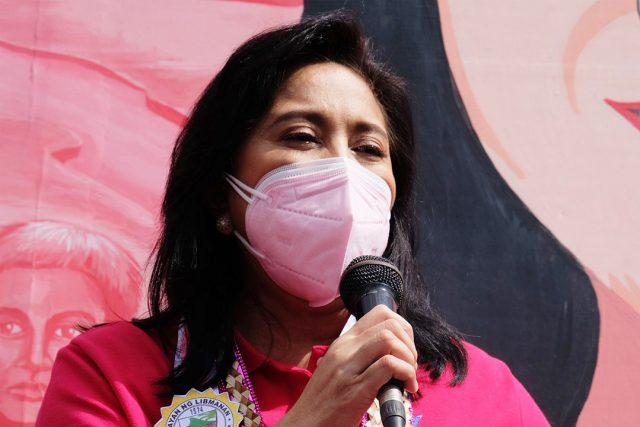
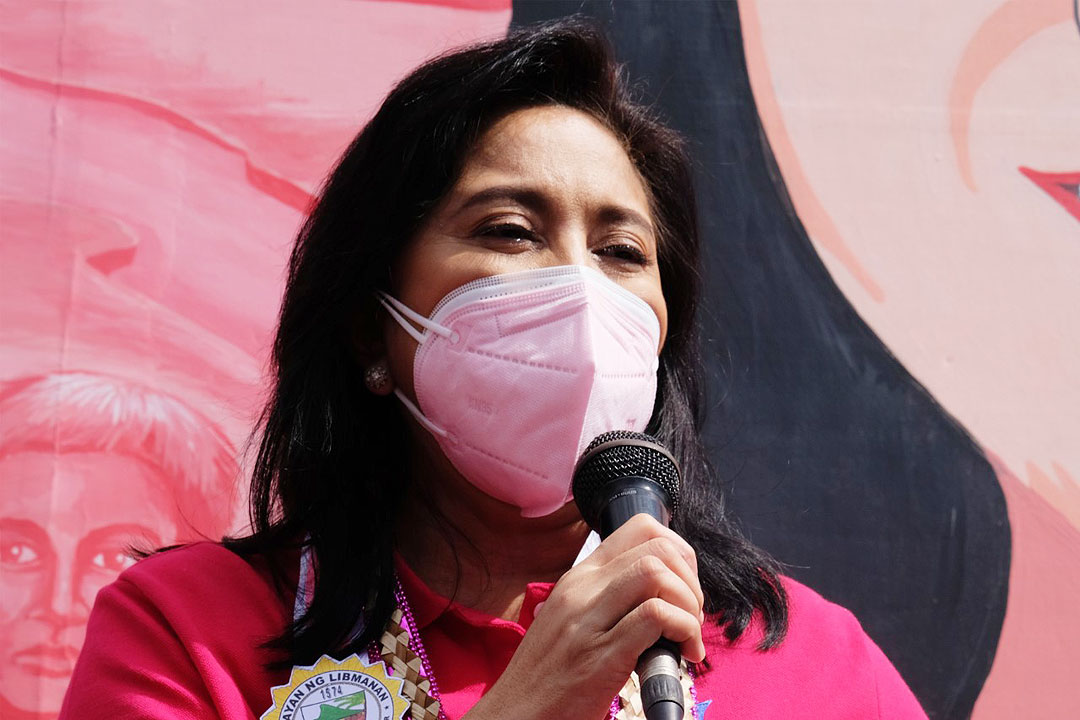
VICE President Maria Leonor “Leni” G. Robredo’s camp started a house-to-house campaign at the weekend to swing the votes from undecided Filipinos exactly five weeks before the May 9 election.
She is a far second from Ferdinand “Bongbong” R. Marcos, Jr. — the son and namesake of the late dictator Ferdinand E. Marcos — in presidential opinion polls.
The house-to-house drive would have a greater impact than indirect campaigns that rely on village officials as intermediaries, said Dennis C. Coronacion, who heads the Political Science department of the University of Santo Tomas (UST).
“The Robredo camp is leaving no stone unturned to ensure the victory of the Leni-Kiko tandem and upend the survey results showing a possible victory for Bongbong Marcos and Sara Duterte,” he said in a text message.
Mr. Marcos is being supported by the biggest traditional political groups in the country, including the party headed by Philippine billionaire Manuel “Manny” B. Villar, Jr. and a PDP-Laban faction headed by President Rodrigo R. Duterte.
The endorsement came as ranking officials of mainstream political parties change their strategies at the last minute. Presidential candidate Senator Panfilo “Ping” M. Lacson has left Partido Reporma, which is now headed by a former administration ally, after it endorsed Ms. Robredo for president.
Reporma President Pantaleon D. Alvarez, a Duterte ally when he was House speaker, on Saturday said more members of his party and independent local candidates across the country had backed his endorsement of Ms. Robredo.
Ms. Robredo won by a hair against Mr. Marcos in the 2016 vice-presidential race. She will have to beat the late dictator’s son again, which some see as a rerun of the 1986 snap elections, when widow Corazon C. Aquino ran against the older Mr. Marcos. That year, a popular street uprising toppled the dictator’s regime and sent him and his family into self-exile in the United States.
The ground campaign should seek to broaden support for the opposition tandem in “key election battlegrounds like the National Capital Region and the 30 biggest provinces that constitute at least 73% of the voter population,” said Victor Andres C. Manhit, president of think tank Stratbase ADR Institute.
Ms. Robredo should get more support from the D and E socioeconomic classes, which include workers and the unemployed, and “get them out to vote come election day,” he said in a Facebook Messenger chat.
He said it would be easy for the vice-president to focus on the house-to-house campaign because volunteers had driven her political machinery.
Some party-list groups backed Ms. Robredo in January, vowing to deliver three million votes.
Political observers have said the endorsement from the House of Representatives Makabayan bloc, whose members Mr. Duterte has accused of being communists, would boost Ms. Robredo’s campaign given its wide community network.
The grassroots drive is a consolidation of the opposition camp’s campaign strategies, said Maria Ela L. Atienza, a political science professor from the University of the Philippines (UP).
“There is more effort now to coordinate and promote the face-to-face campaigns that started out as very decentralized and uncoordinated,” she said in a Viber message, citing the growing support from progressive and traditional politicians for the vice-president.
“April is a crucial time for the campaign based on the trends in previous elections,” Ms. Atienza said. “It is correct to combine many strategies and focus on the strengths of the very diverse set of volunteers and supporters of the Robredo campaign.”
Civic groups have intensified their campaign against Mr. Marcos, Ms. Robredo’s main rival, after the country’s tax agency disclosed that his family still owes the government billions of pesos in estate and income taxes.
The P23-billion estate tax had ballooned to P203.8 billion due to interests and penalties after the Marcos family refused to pay it, according to another rival political party, citing computations by retired Supreme Court Justice Antonio T. Carpio in a Sept. 30, 2021 column for the Philippine Daily Inquirer.
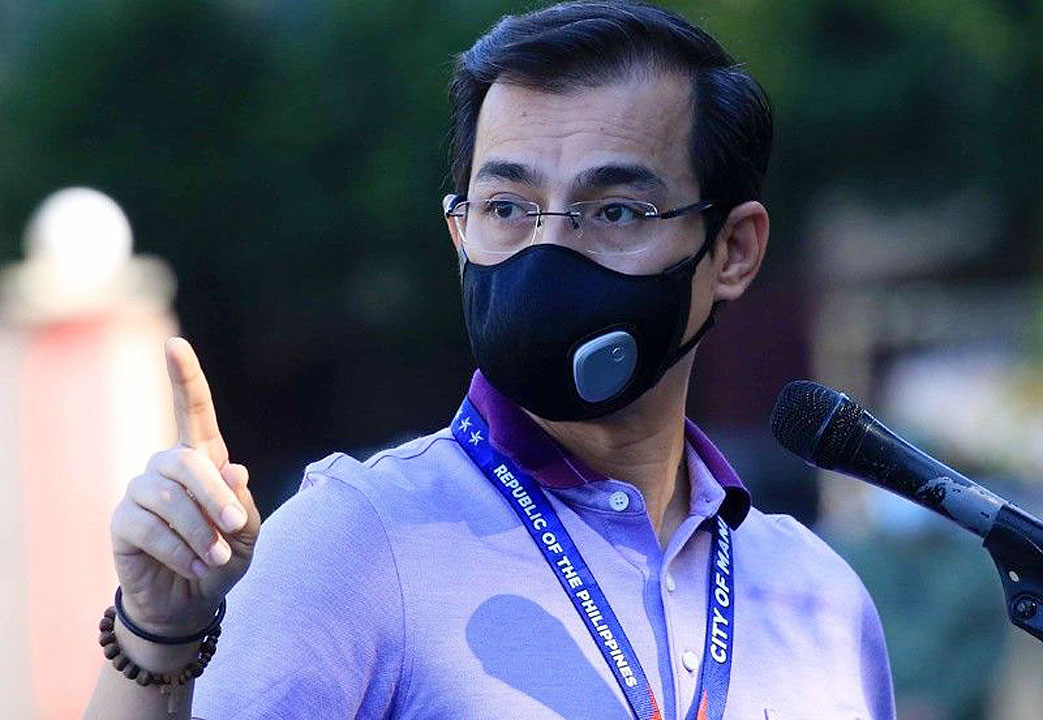
Meanwhile, Manila Mayor and presidential bet Francisco “Isko” M. Domagoso promoting himself as a crisis manager is not enough to sway undecided voters, political analysts said.
“Without disputing the claims of Mayor Isko as a credible crisis manager, I do not see this as moving the needle, so to speak, in his favor in terms of voter preference,” Michael Henry Ll. Yusingco, a senior research fellow at the Ateneo de Manila University Policy Center, said in an e-mail.
He said this might not resonate with other voters outside Manila since the capital had not experienced a major calamity under him.
“Voters in the National Capital Region might appreciate Mayor Isko’s claim as a credible crisis manager, precisely because of his actions during the coronavirus health crisis,” Mr. Yusingco said.
“But Mayor Isko was only one of many managing the health crisis and his responsibility covered only Manila,” he said.
Mr. Domagoso’s rags to riches story is “not exactly innovative,” said Hansley A. Juliano, a former political science professor studying at Nagoya University’s Graduate School of International Development in Japan.
“We’ve seen it with Joseph E. Estrada and Manuel B. Villar, Jr.,” he said in a Facebook Messenger chat, noting that both had tried to depict themselves as pro-poor because they were poor once.
Most of the policies of Mr. Domagoso, a former matinee idol who used to collect garbage as a boy in a Manila slum, tended to favor the middle class and not the masses, Mr. Juliano said.
Mr. Domagoso’s personal experiences and background are not enough to sway more voters since some of his successful rivals used to be poor like him, including Senator and boxing champion Emmanuel “Manny” D. Pacquiao, UP’s Ms. Atienza said.
“There are also so many outstanding mayors and other local chief executives in the Philippines who faced crises during their terms such as calamities and conflicts and succeeded,” she said in a Viber message.” Many local government officials were able to address the coronavirus pandemic with innovative and appropriate solutions.”
“Mayor Isko only served for a single term as mayor,” she said. “He could have done more for Manila if he ran again. It takes more than three years to institutionalize reforms and changes.”
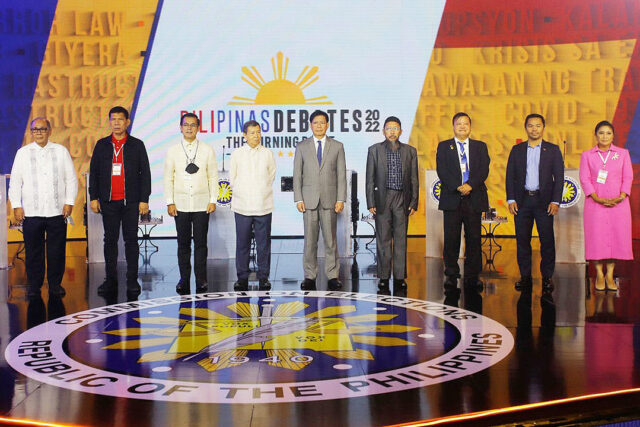
THE COMMISSION on Elections (Comelec) should centralize forums and debates involving presidential and vice-presidential candidates to empower those who don’t have the political and financial machinery, according to a presidential contender.
“Comelec should centralize its activities that introduce the candidates to marginalized voters so that billionaires who finance traditional campaigns do not maintain their influence,” labor leader and presidential candidate Leodegario “Ka Leody” de Guzman said in a Viber message at the weekend in Filipino.
Election Commissioner George Erwin M. Garcia last week said they might ask Congress to pass a law that will punish presidential candidates who skip national debates.
Comelec earlier said it would ban candidates who snub its debates from live-streamed e-rallies on its Facebook page.
“I agree with the proposal to impose penalties on candidates who do not participate in the forums and activities organized by Comelec,” Mr. de Guzman said. “This is a step in the right direction.”
Former Senator Ferdinand “Bongbong” R. Marcos, Jr., who is leading in presidential opinion polls, was the only candidate among 10 who skipped Comelec’s presidential debate earlier this month. His running mate, Davao City Mayor and presidential daughter Sara Duterte-Carpio also snubbed the vice-presidential debate.
Mr. de Guzman’s running mate, Walden F. Bello, earlier called Comelec’s punishment for debate skippers weak.
“We need stronger penalties for these people because this is so undemocratic that they are not here,” he said at the Comelec vice-presidential debate.
Mr. Garcia earlier said it is difficult to impose more sanctions on candidates who snub debates in the absence of a law.
“We are asking for help from our law department and I cannot add any more to the sanctions because there is no law for it,” he said. “Whatever we may impose may be questioned as unconstitutional.
Comelec spokesman James B. Jimenez earlier said the second presidential debate set for April 3 would let candidates discuss topics in greater detail.
Candidates would be asked a general question per segment and in each succeeding portion, the candidates will be divided into groups of three to debate on a topic, he said last week.
Each presidential candidate would be given two minutes to answer each question and 60 seconds for their closing remarks, he added.
The presidential debate was to be held at the Sofitel Harbor Garden Tent in Pasay City. There would still be no live audience except for the companions of the candidates and some journalists.
As of Thursday, Mr. Marcos had not told the Comelec whether he would join the debate.
“The people will suffer because of the indebtedness these candidates have to businessmen and their lobby groups,” Mr. de Guzman said. “Those who get elected prioritize the interests of big business, in exchange for the financing and materials they received during the campaign period.”
Mr. de Guzman earlier this month cited the need to reform the party-list system, which he said has been abused by traditional and elitist politicians.
Meanwhile, Comelec had finished printing all 67.4 million ballots for the May 9 national and local elections, it said on Facebook.
About 179,000 ballots were found to be defective and 319,138 were being evaluated, Mr. Garcia said in a Viber message on Saturday. — John Victor D. Ordoñez

THE DEPARTMENT of Public Works and Highways (DPWH) has drawn up an initial $50 million worth of road and water supply projects in Sulu, an island province in southwestern Philippines, and it is eyeing support from the World Bank for the program rollout.
In a statement on Sunday, the department said World Bank and DPWH officials visited Sulu on April 1 to strengthen coordination with local leaders and representatives of appropriate offices for the design and implementation of the proposed infrastructure projects.
“With the help of World Bank, we are looking forward to implement development infrastructure projects in Sulu as an opportunity to improve social service delivery to reduce poverty and boost peace-building efforts that will help ensure inclusive growth,” said DPWH Undersecretary Emil K. Sadain, the chief implementer of the Build, Build, Build program and focal person for projects in the Bangsamoro region.
Mr. Sadain said initial discussions have been undertaken with World Bank officials for financing support on the rehabilitation and upgrading of roads as well as water supply improvement in the remote province that has been saddled by security problems.
The $50-million initial fund will cover repairs and improvement on the 162-kilometer Sulu Island Circumferential Road “and to address the problem of lack of access to safe water,” according to DPWH.
The visiting party conducted an ocular visit and field assessment of the existing groundwater supply system.
“It was the first time for a World Bank team to reach Sulu… a place blessed with the most fertile of lands, sweetest of fruits and freshest aquamarine products, but has been battered with decades of armed hostilities because of violent extremist groups and banditry including clan disputes,” DPWH said. — Marifi S. Jara
A PHILIPPINE human rights alliance on Sunday slammed an anti-communist task force spokesperson for interviewing a jailed former military official who was found guilty of kidnapping university students.
“The National Task Force to End Local Communist Armed Conflict (NTF-ELCAC) is desperately dipping its feet in the business of valorizing criminals,” Karapatan said in a statement after the task force’s spokesperson interviewed Jovito Salvaña Palparan, Jr., who was sentenced to life in 2018 for kidnapping two University of the Philippines (UP) students.
The interview was aired last week on the television network owned by Filipino religious leader Apollo C. Quiboloy, who is wanted in the United States for sex trafficking and other charges.
The Philippine justice department said last week that it did not receive any permission for the interview. Justice Secretary Menardo I. Guevarra said that a justice official was set to investigate the issue.
“It comes as no surprise that the NTF ELCAC, through the unhinged (Undersecretary) Lorraine Badoy and this pathetic excuse of a ‘media network’ owned by a wanted sex trafficker, is desperately dipping its feet in the business of valorizing criminals and human rights violators like Palparan to further its rabid red-tagging campaign,” Karapatan Secretary General Cristina E. Palabay said.
“After all, criminal minds think alike — yet such expectation does not make this despicable attempt to vindicate Palparan any less repugnant, especially when the families of his many victims still continue to cry for justice to this day,” she added.
In 2018, a regional trial court found Mr. Palparan and two co-accused guilty of kidnapping UP students Karen Empeño and Sherlyn Cadapan on June 26, 2006 in the town of Hagonoy in Bulacan province, 36 kilometers north of the capital Manila.
Ms. Empeño was then doing field work for her thesis, while Ms. Cadapan was a volunteer for a peasant group in the province when they were abducted. They were believed to have been tortured, raped and later killed by soldiers, but their bodies have yet to be found.
“The NTF-ELCAC eagerly wants to whitewash, and at the same time replicate, Palparan’s foul record of violations of people’s rights and fascist attacks against the people with Badoy’s revolting SMNI interview — but if Palparan’s conviction tells us anything, it is that red-taggers will face justice for their bloody crimes,” Ms. Palabay said.
Karapatan and other civic groups last week filed administrative complaints against Ms. Badoy, who also serves as undersecretary for the Presidential Communications Operations Office, before the Ombudsman’s office for linking presidential candidate Vice President Maria Leonor “Leni” G. Robredo and her supporters with the communist movement on a government platform.
Ms. Robredo has criticized the anti-communist task force for tagging administration critics as communists, while her main rival Ferdinand “Bongbong” R. Marcos, Jr. has vowed to support its programs.
Mr. Marcos has already received the support of Mr. Quiboloy.
Economists and political experts have said that foreign investors are closely watching the views of Philippine presidential candidates on human rights issues. — Kyle Aristophere T. Atienza

BUSES bound to Laguna and Batangas resumed services from the Araneta City Bus Station on April 2.
The Batangas trips between 5:30 a.m. to 8:30 p.m. — going to and from San Juan, Batangas City, and Lipa City, Batangas – are provided by Alps and GoldStar Transport.
The Laguna routes — Calamba, Pansol, Los Baños, and Sta. Cruz — are covered by HM Transport from 7:00 a.m. to 5 p.m.
Araneta City Bus Station’s property manager, Mon Legazpi, said health protocols set by the government are implemented, such as a QR code system for contact tracing, wearing of face mask, and bus unit sanitation.
“The public are also encouraged to strictly follow existing health precautions and social distancing measures. Passengers may be asked to present a vaccination ID or any proof of vaccination,” Mr. Legazpi said in a statement.
Buses going to and from the northern provinces of Pampanga and Bulacan are also operational at the Araneta City Bus Station.
THE Department of Finance (DoF) on Saturday called for continued support for the pandemic containment effort to ensure that the economy’s growth is sustained.
In an Economic Bulletin, the DoF said a “robust” vaccination effort must continue alongside a “prudent reopening of the economy to sustain economic momentum.”
“The country must continue to hedge against risks posed by coronavirus disease 2019 (COVID-19) through a robust vaccination program and prudent reopening of the economy to sustain recovery momentum,” the DoF said.
As of March 30, over 140 million COVID-19 doses have been administered, with an average of 105,000 doses administered daily, according to the Department of Health’s website.
Metro Manila and 48 other areas will remain under Alert Level 1, the most relaxed quarantine setting, between April 1 and 15.
The DoF said that the Retail Trade Liberalization Act, the Foreign Investments Act, and the Public Service Act will play a critical role in the economic recovery.
The recently amended Public Service Act now allows 100% foreign ownership in industries formerly classified as public utilities, including telecommunications, airports, and shipping.
Rizal Commercial Banking Corp. Chief Economist Michael L. Ricafort said in a text message that easing restrictions could cause the Purchasing Managers’ Index (PMI) to rise in the coming months as manufacturing revives.
“Local manufacturing activities could continue to recover in the coming months fundamentally due to additional measures to further reopen the economy, with the shift towards granular lockdowns and latest shift to Alert Level 1 in more areas around the country,” he said.
He added that as more industries open up, such as tourism and education, businesses that depend on such traffic will benefit, with the recovery eventually filtering down to manufacturing as well.
“Firms sustained hopes that COVID-19 will pose a lesser threat to the economy and demand will continue to pick up.” Maryam Baluch, economist at S&P Global said in their report on the Philippines PMI.
Philippine manufacturers remained positive about their output growth for the coming year, due to easing restrictions and higher demand, with some citing a “positive election outcome,” S&P Global said.
S&P Global Philippines, which merged with IHS Markit last month, reported that the S&P Global Philippines Manufacturing PMI improved to 53.2 in March, from 52.8 in February. This also matches the PMI reading in December 2018, the highest in over three years.
The PMI is a leading indicator based on surveys of purchasing managers, who help determine how much raw material to order for their companies, which in turn signals the level of expected manufacturing activity a few months into the future. The PMI is presented on a 50-point scale, with a reading above 50 suggesting that manufacturing activity is expected to increase. A reading below 50 signals a contraction.
Ms. Baluch said the easing of alert levels and mobility restrictions could be offset by geopolitical concerns, which are causing inflation to rise, mainly because of the fallout from the Russia-Ukraine war in the form of disrupted markets for oil, wheat, and fertilizer.
S&P Global said its survey data point to an increase in new orders and output in March. Demand for domestic goods was at its highest in over three years since 2019, and also matched the reading for February 2022.
Manufacturing companies’ output and new orders grew in March, S&P Global said, citing higher demand, which caused manufacturers to expand inventories and to sustain production.
However, inflation had an impact in March, “as supply and demand imbalances pushed up raw material prices,” S&P Global said, causing manufacturers to increase factory gate prices or lay off workers to reduce operating expenses.
Export orders declined after having registered an increase for the first time in seven months in February.
The Russian invasion of Ukraine, which began on Feb. 24, caused shipment delays and high fuel prices during the month, adding to pressure on supply chains.
“The war in Ukraine, COVID-19 cases rising in China, scarcity of materials and supply bottlenecks led to further worsening of supplier delivery times.” Ms. Baluch said. “Moreover, inflationary pressures reached record-highs as cost burdens and selling prices rose at faster paces.”
Employment levels continued to drop as a result of resignations and cost-cutting, she said. — Tobias Jared Tomas
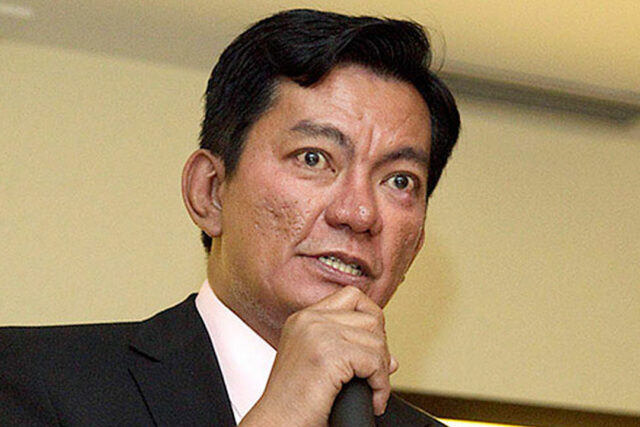
A SENIOR legislator said he believes foreign direct investment (FDI) could rise to $20 billion within five years, following a major tax reform and three key liberalization bills.
“The goal should be $20 billion in FDI by 2026, or five years after CREATE (Corporate Recovery and Tax Incentives for Enterprises),” House and Ways Chairman and Albay Rep. Jose Ma. Clemente S. Salceda said in a statement.
“I think with CREATE, PSA (Public Service Act) amendments, and the other liberalization measures and doing business reforms, we will get there.”
CREATE is the second package of the Comprehensive Tax Reform Program. It reduces the corporate income tax rate to 20% from 30%, and makes fiscal incentives more time-bound and performance-based. It was signed into law by President Rodrigo R. Duterte on March 26, 2021.
The amendments to the PSA allows full foreign ownership in industries formerly classified as utilities, including telecommunications, air carriers, domestic shipping, railways and subways, and canals and irrigation.
Mr. Salceda said he has been told by the Department of Trade and Industry (DTI) of the completion of final draft of the Strategic Investment Priorities Plan (SIPP), presented it to the Fiscal Incentives Review Board, and will send it to the President for approval.
“(DTI) Usec. (Ceferino S. Rodolfo) told me they will transmit this to (the Palace) next week,” he said.
“That means all the basic implementing guidelines of CREATE will be in effect before (the President’s) term ends. That’s a very big gift to whoever the next president will be.”
The SIPP is a companion document to CREATE and identifies the industries where investors will enjoy tax breaks.
“Give it around a month, and the President will likely be ready to issue it,” he said. — Jaspearl Emerald G. Tan

INDIA considers the health and technology sectors as the most likely areas of collaboration with Philippine companies, in the interest of broadening supply chains to reduce both countries’ vulnerability to disruption, India’s Ambassador to the Philippines Shambhu Kumaran said.
Speaking at the Indian Technical and Economic Cooperation (ITEC) event last week, Mr. Kumaran said the pandemic has revealed vulnerabilities that must be addressed so both countries can “come through in similar situations in the future.”
“Countries like India and the Philippines should have supply-chain redundancy, meaning we should have options of more than one partner so that whenever there’s a disruption like we had in the pandemic, … we don’t have to struggle to find the things that we need,” Mr. Kumaran said.
“The experience of dealing with something like COVID-19 (coronavirus disease 2019) will remain very relevant, whether it’s a variant or a related kind of virus… these will remain important for the forthcoming years,” he said.
Mr. Kumaran added that collaboration “can happen through investment,” noting Indian interest in investing in the Philippines’ health and medical technology industries.
He said India is currently in talks with the Philippines to find ways to increase two-way trade, and identified tariffs as a key element in unlocking the potential of the trade relationship.
The ITEC program was reformatted to get around travel restrictions by making it more digital-oriented, becoming e-ITEC, through which it offered courses that had strong take-up from the Philippine side, including pandemic management, disaster management, documentation of cultural heritage, and environmental impact assessment.
Last month, a customized course was prepared for 33 Philippine government officials in consultation with the Technical Education and Skills Development Authority (TESDA), Department of Finance, and Department of Budget and Management.
For the upcoming year, Mr. Kumaran said India will offer 50 defense personnel training slots to the Philippines, the largest such allocation in Southeast Asia.
“India’s approach to development partnership is based on the principles of equity and mutual respect,” he said. “It is shaped by our belief that strengthening and augmenting national capacities are essential for bringing progress and prosperity for our people.”
Some 1,100 Filipinos have undergone ITEC training since the program’s launch in 1964.
“The dedication of ITEC in continuously improving the curricula and providing training to our countrymen is commendable. We appreciate it,” said TESDA Director General Isidro S. Lapeña at the event, noting the potential of sharing best practices for boosting the economy.
Labor and Employment Undersecretary Renato L. Ebarle noted the need for training channels offered by ITEC in the context of the radically altered labor market landscape in the wake of the pandemic.
“As more businesses shift from manual to digital, highly specialized to multi-disciplinary, the need for human resource capacity building to enable a digitally and multi-skilled labor force has been greatly emphasized,” he said. — Alyssa Nicole O. Tan

Significant changes are bound to happen to the way manufacturers of products with plastic packaging do business once legislators give final approval to the bills institutionalizing the country’s policy and practice of Extended Producer Responsibility (EPR). Mandates for cutting plastic waste footprint will be clear and measurable. Producers will have to deal with compliance reports, internal systems to record waste reduction, third-party audits, and hefty fines for violations.
Plastic generation has continued to rise to approximately 400 million tons per year worldwide, according to the 5th United Nations Environment Assembly, and is estimated to double by 2040. Filipinos use up about 2.15 million tons of plastics annually, and more than one-third of these reach the environment, said the World Wide Fund for Nature.
In response, the government has started responding to global efforts and targets. In 2019, the National Economic and Development Authority (NEDA) published the Philippine Action Plan for Sustainable Consumption and Production. House Bill (HB) 9147, also known as the “Single-use Plastic Products Regulation Act,” seeks to promote plastic circularity through reduce, reuse, and recycle practices, as well as the EPR.
Senate Bill (SB) 2425 and HB 10696 focus on institutionalizing EPR schemes to tackle the plastic waste problem. Both seek to prevent plastic waste from leaking into the environment by holding those that generate waste responsible for the whole life cycle of their products. The bills, which are currently pending joint resolution, push for the amendment of the Ecological Solid Waste Management Act of 2000 (RA 9003).
UNDERSTANDING EPR
EPR is the environmental policy and practice that gives obliged companies (or producers) responsibility over the entire life cycle of their products. With the EPR, producers should ensure proper and effective recovery, treatment, recycling, and disposal of residual plastics from their products, and should adopt ways to improve plastic recyclability or reusability.
EPR schemes are designed for participation by relevant stakeholders — the producers themselves, government, producer responsibility organizations (PRO), waste management operators, and other relevant parties such as the informal sector and third-party auditors.
The latest iterations of the bills have two major differences that must be reconciled. SB 2425 obliges large companies only while HB 10696 encompasses medium and large companies. SB 2425 requires companies to target 10% recovery in the first year of implementation and 80% by the eighth year. Meanwhile, HB 10696 starts with 20% in the first year, and targets 80% by the fifth year.
To encourage compliance, rewards and recognition will be given to outstanding and innovative initiatives. Tax and duty exemptions on imported capital equipment and vehicles used for the EPR scheme may also be awarded to qualified organizations. On the other hand, organizations who submit false documents, misrepresent themselves or fail to meet targets are liable for hefty fines ranging from one to twenty million pesos depending on the size of the organization. Business permits will also be automatically withdrawn for third offenses.
BUSINESSES MUST CONSIDER ZERO-WASTE STRATEGIES
These bills, if passed into law, will surely affect how obliged companies conduct business. Within nine months upon the effectivity of the law, producers or their authorized PRO, shall register their EPR programs with the National Solid Waste Management Council and align their strategies and programs with the mandated recovery targets. Moreover, they will have to submit annual reports to monitor compliance with their respective EPR schemes and targets. Businesses must establish an internal system to record and report their plastic waste footprint, which must be audited by an independent third-party. Recovery or offsetting reports by waste management operators or diverters must also be audited.
Waste management operators must ensure that national targets are met. They must coordinate closely with PROs and obliged companies, possibly set up more materials recovery facilities (MRFs) and prepare the necessary resources. Based on the experience of other countries, integration of the informal sector is crucial to the success of EPR schemes since the current bulk of plastic collection, sorting and recycling relies on them. This raises the possibility of developing a plastic management ecosystem where the informal sector provides their knowledge and expertise to the process, and in return, operators can develop formal programs aimed at providing informal workers with secure livelihoods and social protection.
EPR also requires buy-in from the consumers. PROs must conduct extensive awareness campaigns on the importance of segregation and sustainability. It is worth noting though that worldwide, it is consumers themselves who are showing preference for brands that are true to their sustainability claims.
The EY Future Consumer Index shows that younger generations are critical, skeptical, and willing to switch brand loyalty if expectations are not met. Twenty-four percent of Gen Z and Millennials check the sustainability claims brands make, compared to 4% of Boomers, and they take action, too. Twenty-one percent of Gen Z and Millennials have stopped buying a product because the brand isn’t doing enough for the environment.
The point is that while it may be difficult to strike a balance between sustainability and preserving product quality with attractive packaging that ends up in the environment and landfills, consumer attitudes point to a reputational risk for brands that insist on the status quo. It won’t be a surprise if future consumers switch to alternatives and dump brands that are reluctant to change their packaging to more sustainable forms.
While waiting for the final passing of the bills, businesses should start monitoring their plastic waste flow and build partnerships for the smoother implementation of their EPR program. They can also start redesigning their products or packaging to reduce their plastic footprint. Ultimately, EPR presents an opportunity for businesses to improve their products, show commitment to the achievement of global climate change targets, and transition towards a circular economy.
This article is for general information only and is not a substitute for professional advice where the facts and circumstances warrant. The views and opinions expressed above are those of the authors and do not necessarily represent the views of SGV & Co.
Benjamin N. Villacorte is a partner and Erika N. Courteille is a manager from the Climate Change and Sustainability Services team of SGV & Co.
