Home Blog Page 6094

More sanctions on Russia seen bringing crude to $200 per barrel in worst case
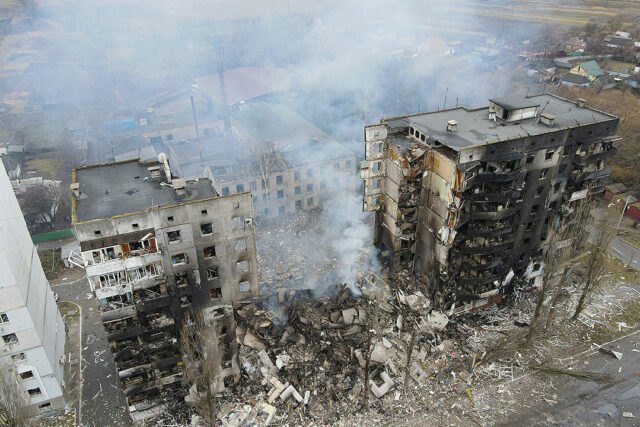
REUTERS

ADDITIONAL sanctions on Russia if it escalates the Ukraine war could lead to higher pump prices paid by consumers in Asia, with the crude oil price benchmark for the region possibly rising as high as $200 per barrel, the Asian Development Bank (ADB) said.

The projection was contained in a report, the Asian Development Outlook 2022 Supplement.

The bank said the main driver for prices will be the supply-demand gap of about 3.5 to 7 million barrels a day, as suppliers fall short of their targets amid supply chain disruptions, leveraged positions, and rising costs, the ADB said.

Rizal Commercial Banking Corp. (RCBC) Chief Economist Michael L. Ricafort said $200 crude is likely in the event of “further sanctions on Russia, and if Russia retaliates using oil (and) energy supplies as leverage.”

“That’s beyond our control. Rich countries can do that anytime in anyway they want. It›s really possible given that they are taking the economic approach to stop the war,” said John Paolo R. Rivera, an economist at the Asian Institute of Management.

Oil prices peaked at $140 per barrel ($180 in today’s money) in June 2008, absent of any geopolitical issues, the ADB added.

The Philippines is highly dependent on oil imports, making its economy sensitive to global oil price swings.

“While I believe we have supply, we might not be able to manage prices as we have seen in previous months,” Mr. Rivera said in a Viber message.

The ADB said its scenarios for developing Asia include, on the optimistic end, a short-term shock in the remaining months of the year, in which gross domestic product growth is unaffected and inflation hits 5.1% before easing to 2.4% in 2023.

Last week, the ADB downgraded its 2022 growth forecast for developing Asia to 4.6% from the 5.2% projection in April.

It also raised its inflation forecast for this year to 4.2% and next year to 3.5%.

“The more plausible scenario is the war escalating in conjunction with a $200 per barrel price shock (which) will set off significant secondary effects. One possibility is an increase in inflation expectations that requires additional monetary policy tightening, which will also result in falling consumer confidence and business sentiment,” ADB said.

In such a case, the region will post downgraded growth of 3.2% in 2022 and 4.5% in 2023. The latter is lower than the 5.2% forecast for that year.

At the same time, inflation will increase to 5.8% and 5.3% in 2022 and 2023 respectively.

The severe scenario involves global financial turmoil in 2023 driven by expectations of heightened inflation and monetary policy tightening, with developing Asia growing by only 2.2% and several economies contracting.

Nonetheless, RCBC’s Mr. Ricafort said that global oil prices have already declined to their lowest levels in about four months, with Nymex crude oil falling to $95 from its $130 peak during the Russia-Ukraine conflict.

“Some COVID-19 lockdowns in China, which is the world’s second largest economy, also led to the recent declines in the prices of global crude oil and other major global commodities,” he said in a Viber message.

While the ADB projects elevated oil prices relative to prices last year, the possibility of $200 per barrel remains low after the European Union decided to phase out Russian oil imports gradually.

“Doing this rather than abruptly ending imports will allow for an orderly transition to alternative supplies and keep prices more stable and affordable for consumers,” the ADB said.

“Further reduction of reliance on imported crude oil (and) petroleum products would (be) among the structural solutions, by increasing the shift to more renewable power sources such as solar, wind, hydro, (and) geothermal, as well as accelerating the shift to electric vehicles,” Mr. Ricafort said.

“Conservation measures would also help reduce demand for imported crude oil (and) petroleum products,” he added.

The Philippine government’s economic assumptions are for Dubai crude — the price benchmark for Asia — to average $90-$110 per barrel this year, $80-100 per barrel in 2023, and $70-90 per barrel from 2024 to 2028. — Diego Gabriel C. Robles


PhilMech to provide P5B worth of equipment to rice farmers

PHILSTAR FILE PHOTO

THE Philippine Center for Postharvest Development and Mechanization (PhilMech) said it expects to provide P5 billion worth of equipment to rice farmers in the remaining months of the year.

“PhilMech will provide rice processing and drying equipment to more qualified farmers’ cooperatives and associations (FCAs) and local government units (LGUs), and the acquisition of the processing and drying facilities will be included in the P5-billion allocation,” PhilMech Director Dionisio G. Alvindia said in a virtual briefing.

“PhilMech will also sustain the distribution of farm machines from crop establishment to harvesting,” he added.

In June, the agency began the procurement process for farm machinery covered by the P5-billion allocation for 2022. These modernization initiatives are funded by rice import tariffs channelled into the Rice Competitiveness Enhancement Fund.

To date, the agency has delivered over 20,000 units of farm machinery worth P15 billion between 2019 and 2021. — Luisa Maria Jacinta C. Jocson

Cross-border exchange of tax-related information

With the continuing improvement of information and technology, it is becoming easier and easier for taxpayers to transact business on a global scale. While this situation provides a number of opportunities, issues with tax administration appear to be an inevitable consequence. One of the main issues is the risk the taxpayer will shift revenue to a low-tax country.

Thus, in an effort to deter tax fraud and evasion, the various tax jurisdictions have resorted to exchanging information. The Bureau of Internal Revenue (BIR) issued Revenue Regulation (RR) 11–2022. It prescribes the guidelines for the spontaneous exchange of taxpayer specific rulings between the Philippines and other countries to ensure the timely exchange of information.

The spontaneous exchange of information provides tax administrators access to timely information on rulings that have been granted to a foreign related party or a permanent establishment of their resident taxpayer, which can be used in conducting risk assessments.

Information subject to exchange include rulings related to preferential regime; cross-border unilateral Advance Pricing Arrangements (APAs) and any other cross-border unilateral tax ruling covering transfer pricing or the application of transfer pricing principles; cross-border rulings giving a unilateral downward adjustment to the taxpayer’s taxable profits in the country giving the ruling; Permanent Establishment (PE) rulings; and Related party conduit rulings.

How will the above spontaneous exchange of information affect Philippine taxpayers?

In RR 11-2022, the BIR mentioned the following:

• If the past ruling does not contain sufficient information to enable identification of the relevant countries with which the information needs to be exchanged, the BIR may obtain information from the domestic withholding agent or from a representative in the Philippines. These past rulings pertain only to PE rulings or rulings concerning the existence or absence of a PE of a foreign enterprise in the Philippines that were issued either:

a. On or after Jan. 1, 2015 but before Sept. 1, 2017; or

b. On or after Jan. 1, 2012 but before Jan. 1, 2015, provided they were still in effect as of Jan. 1, 2015.

• With regard to future rulings, the BIR may require the amendment of the ruling process, and if necessary, the amendment of the BIR Forms that must be submitted by the taxpayer when requesting a confirmatory ruling, and the inclusion of transfer pricing documentation as part of the documentary requirements among others.

• Also, for those rulings exchanged with the BIR, if it is established, upon evaluation, that the ruling will aid the tax examiners in their tax investigation, a copy thereof shall be immediately forwarded to the Revenue District Office having jurisdiction over the domestic taxpayer.

Hence, at the very least, a Philippine taxpayer may be asked for information by the BIR; there could also be changes in the taxpayer’s submission of request for BIR rulings, and a Philippine taxpayer may also be affected by the exchange of information during a BIR audit investigation.

It will also be noted above that, basically, the covered entities of the exchange of information are the related parties.

WHAT SHOULD THE PHILIPPINE TAXPAYERS DO THEN?
The following should be considered by Philippine taxpayers:

1.  Ensure that the Philippine taxpayer is dealing with its foreign related parties on an arm’s length basis.

According to the Organization for Economic Cooperation and Development (OECD), arm’s length means that a transaction between related entities reflects the conditions and remuneration set in comparable transactions between unrelated entities. Thus, in transacting business with foreign related parties, transfer pricing analysis must be considered to verify whether the transactions with related entities comply with the arm’s length principle. The pricing of the goods or services must be assessed, to ensure that this is comparable to the pricing of independent entities in more or less similar conditions and circumstances.

2. Document the reasonableness of the transaction.

The issuances of the BIR on transfer pricing detail the requirements for the submission of transfer pricing documentation (TPD). The authorities have given taxpayers certain guidelines to follow in preparing TPD in compliance with transfer pricing rules. The TPD will serve as the taxpayer’s proof that its transactions with related parties are not arbitrarily priced, and that there is no malicious shifting of revenue and expenses among the related parties.

The above actions would be helpful in a taxpayer’s preparations for possible application for a tax ruling with the BIR in the future. At any rate, even without thinking about a possible application for a tax ruling in the future, a taxpayer is required to ensure that its transactions with related parties are reasonable and not carried in a manner leading to tax evasion.

As we know, cross-border transactions are growing rapidly as technology has been making the world smaller. The tax authorities have also been adapting to this. The exchange of information is part of the process of addressing possible gaps in the tax system. As taxpayers, in turn, we should also take care to ensure that we comply with international tax principles and best practices.

Let’s Talk Tax is a weekly newspaper column of P&A Grant Thornton that aims to keep the public informed of various developments in taxation. This article is not intended to be a substitute for competent professional advice.


Maricel P. Katigbak is a senior manager of the Tax Advisory & Compliance division of P&A Grant Thornton, the Philippine member firm of Grant Thornton International Ltd.

pagrantthornton@ph.gt.com

Activists, human rights campaigners protest on Marcos’ first SONA 

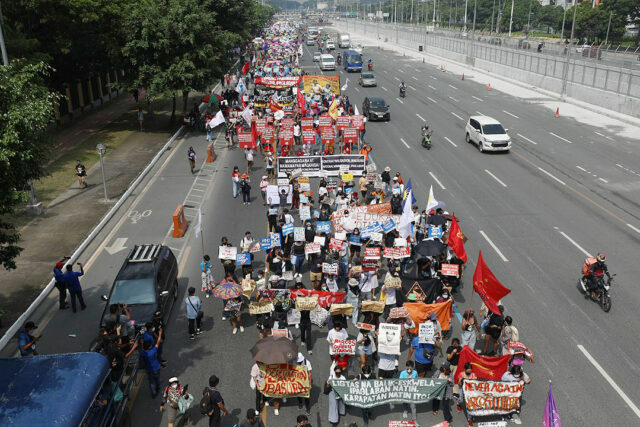
ACTIVISTS and campaigners for various sectors march along Commonwealth Avenue in Quezon City on July 25, 2022 ahead of President Ferdinand R. Marcos, Jr.’s first State of the Nation Address. — PHILIPPINE STAR/ RUSSELL PALMA

HUMAN rights campaigners and progressive groups on Monday held protests before President Ferdinand R. Marcos, Jr.s first address to Congress, calling attention to accountability and pressing economic issues.   

An estimated 5,000 protesters joined the multi-sectoral march along Commonwealth Avenue, according to the Quezon City Police Districts estimate.  

Samahan ng Ex-Detainees Laban sa Detensyon (SELDA), a group for Martial Law victims and survivors, said it joined hundreds of former political prisoners in seeking accountability for the human rights violations during the regime of the late dictator Ferdinand E. Marcos Sr., father of the President.  

“Marcos Jr. cannot claim that he is innocent and is off the hook from being liable for the violations inflicted upon us by his fathers bloody regime,” SELDA said in a statement. 

More than 70,000 people were jailed, about 34,000 were tortured and more than 3,000 people died under martial rule, according to Amnesty International. 

The group also slammed the anti-graft court Sandiganbayan’s recent decision allowing the Marcos family to present evidence in an ill-gotten wealth case.  

“We are deeply concerned that this move is an absolution of the cases of corruption and ill-gotten wealth of the Marcoses,” said Danilo dela Fuente, SELDA’S vice chairperson. 

“We fear that this could be the signal for the halt in the recovery of the stolen wealth of the Marcos family, which are rightfully owned by the Filipino people.” 

The Presidential Commission on Good Government filed the ill-gotten wealth case in 1987, accusing business associates of the elder Mr. Marcos and his wife Imelda of acting as their dummies to acquire ill-gotten wealth using state funds.  

In 2003, the Supreme Court awarded the Philippine government $658 million from the frozen Swiss bank deposits of the former president.  

The Philippines Highest Court ruled that only about $304,000 of the Marcos familys income was lawful since they did not file any statement of assets and liabilities required by law.  

The group said it will continue to seek accountability and reparations from the President for victims of human rights violations.  

Meanwhile, progressive groups under the Bagong Alyansang Makabayan (Bayan) coalition marched along Commonwealth Avenue as it called for Mr. Marcos to address rising prices of commodities, ensure environmental protection, and prioritize human rights violations.  

Gabriela Women’s Party-list also held a protest urging the President to increase wages and to present concrete economic measures to the Filipino people.  

The group said Mr. Marcos should employ measures to boost local food production to combat the hike in basic goods.   

“No revisionism or lofty narratives can cover up empty stomachs and escalating prices,Gabriela Party-list Rep. Arlene D. Brosas said in a statement. John Victor D. Ordoñez 

Sustained smuggling stifles rice tariff law benefits

DA

CONTINUED smuggling operations undermine the goals of the rice tariff law of modernizing Philippine agriculture, improving farmersincome and reducing the retail price of the staple food, said a senator on Monday.  

(T)he problem here is that it is not going down fast enough because the issue of smuggling remains prevalent,Senator Mary Grace S. Poe-Llamanzares, presumptive chair of the Economic Affairs Committee at the upper chamber, said in Filipino.  

The Rice Tariffication Law under Republic Act 11203, deregulated rice imports. It allows private parties to import with fewer restrictions with a tariff of 35% on grain brought in from Southeast Asia.  

The tariff collection supports the Rice Competitiveness Enhancement Fund to the extent of P10 billion a year.    

Various sectors have been calling for an amendment or repeal of the law. 

Ms. Poe, however, said smuggling is the more pressing issue that has to be addressed.   

Now that the President himself is sitting there in the Department of Agriculture, I hope those who try to smuggle or those who have already smuggled will be afraid. Its the same people doing the same things until today,Ms. Poe said.  

Senator Maria Imelda ImeeR. Marcos urged her brother, President Ferdinand BongbongR. Marcos, Jr. who has also designated himself as concurrent Agriculture secretary, to fiercely go after smugglers of agricultural goods.   

As a super sister, I want Bongbong to be angry. I want him to go crazy and name all the agricultural smugglers who are destroying our local farming,she told the media in Filipino during an ambush interview on Monday.  

Hopefully, he will scare and file cases against all of those in the government that are well-known to be corrupt in the BoC (Bureau of Customs), BIR (Bureau of Internal Revenue) and other agencies,she added.  

A report by the Senate Committee of the Whole in the last Congress indicated that around P667.5 million worth of agri-fishery products were technically smuggledinto the country from 2019 to 2022. It also listed 22 government officials and personalities allegedly involved in the illegal operations. Alyssa Nicole O. Tan 

Taraka local gov’t-funded irrigation, household water supply project nears completion

OFFICIALS of the Taraka local government, Mindanao Development Authority, and the Development Bank of the Philippines lead the inauguration of the partially operational solar-powered irrigation system on Aug. 10, 2021. — TARAKA MUNICIPAL GOV’T

A PIONEERING solar-powered irrigation and water supply project in Taraka, a small agricultural town in southern Philippines, nears completion with farmers of 700 hectares of land and over 27,000 residents seen to benefit from the infrastructure, according to the Mindanao Development Authority (MinDA).   

Four of the six irrigation systems are already operational while the water supply system is 60% done, MinDA said in an update posted on Monday following a site visit last week.  

The project is the first local government-funded undertaking under MinDAs water supply program aimed at assisting unserved and underserved municipalities establish sources of water for drinking and agriculture.   

State-owned Development Bank of the Philippines (DBP), a partner in the MinDAWater program, provided a P115-million loan to the Taraka municipal government.   

DBP and MinDA signed a partnership agreement in 2019 to support proposed ventures that will bring economic development in Mindanao, especially the Bangsamoro region.    

Launched in January 2021, the project had a formal inauguration in August after three of the irrigation systems were completed.  

The solar-powered irrigation infrastructure has an automatic system for water extraction and regulation to avoid flooding.  

The irrigated farmlands are eyed for the production of high-quality rice, to be branded Premium Maranao Rice.    

Other government agencies assisting the program include the Philippine Rice Research Institute, the Bangsamoro regions Ministry of Agriculture, the Department of Agricultures Northern Mindanao office, and the Philippine Center for Postharvest Development and Mechanization. MSJ 

Making the mix work: Diversity and inclusion

FREEPIK

The concept of diversity and inclusion (D&I) remains a topic of debate. Starting with the feminist movement, many organizations have made great efforts to promote progressive and liberal ideologies in the last 50 years. The discourse has shifted significantly from addressing women as one group, to recognizing the heterogeneity of experiences and addressing the inequalities that people experience at home, in the workplace, or in society.

While there is an increasing awareness on how D&I provides a basis for creativity, innovation, and economic success, there is often a lack of effective action brought about by our unconscious biases. We have achieved remarkable progress and fueled social justice movements to redefine equality as a basic right, yet long-held and deep-seated societal beliefs continue to dominate and challenge what we have achieved. Because of this, the fight for equality is far from over.

THE SYNERGY BETWEEN DIVERSITY AND INCLUSION
Our identities extend beyond traditional considerations, such as those based on ability, age, culture, race, gender identity, socio-economic background, and more. On the one hand, diversity is about representation or the make-up of an entity. Diversity allows the exploration of individual differences in a safe, positive, and nurturing environment, as in Southeast Asia, one of the most diverse places in the world — a rich mosaic of people, ethnic groups, languages, and beliefs. On the other hand, inclusion is about how well the contributions, presence, and perspectives of different groups of people are elicited and integrated into an environment. In other words, inclusion is a culture that gives everyone a seat at the table.

Diverse and inclusive cultures allow people to feel respected and valued for who they are as an individual or as a group. In the workplace, inclusion is one of the most important tools for employee retention. It is when employees feel that their ideas and contributions are taken seriously by the organization.

To put it simply, as one author noted, “Diversity is the mix and inclusion is getting the mix to work well together.”

WALKING THE TALK
In 2021, the Institute of Corporate Directors (ICD) was one of the few, if not the first, among major business organizations to achieve a gender-equal board. Aside from gender parity, the ICD Board is made up of trustees with varied industry experiences and coming from different age groups. With this profile, you can imagine the level of discussion that takes place in the board meetings. Certainly, the perspectives of all board members are given due course. Moving forward, the recent ICD board election will enhance the other dimensions of diversity as the new trustees who are serving their first term are relatively younger and are “tech savvy” with strong IT backgrounds. Indeed, D&I initiatives should be led from the top and must begin in the boardroom.

Another best example is Lamoiyan Corp., the manufacturer of the beloved Filipino brand Hapee Toothpaste. President and CEO Cecilio Pedro implemented the “Equal Employment Program” for the purpose of providing opportunities to persons with disabilities. The program includes free housing for more than 30 deaf-mute staff, and training in sign language for company managers as a means of communicating with the disabled staff. The company’s values are deeply rooted in the belief that businesses should not only focus on making profits but should also contribute to the greater good of all. Lamoiyan Corp. was recognized for having the Most Outstanding Program for Equal Employment Opportunity by providing employment to the country’s hearing-impaired community members.

THE ROAD TO D&I
You may ask, “Where do I start?” Here are some practical tips that you may consider to jumpstart your D&I journey:

1. Figure out your “why” and identify what you want to achieve. A deeper examination of motives and goals is necessary. You need to know why such initiatives are critical for your business.

2. Use company data to measure, monitor, evaluate, and improve policies and practices on D&I.

3. Dive down to the team level. Each industry should look at the diversity of teams, not just the company as a whole. What matters is that each team is diverse and that under-represented groups are distributed across the company. The team level is where you are going to feel the impact of D&I. As they say, “A diversity of perspectives makes better decisions to arrive at better outcomes.”

4. Most importantly, to make these happen, lead change from the top. Make it clear to the employees, investors, shareholders, and consumers that D&I is a key principle of good corporate governance.

I spoke recently about D&I in ICD’s Masterclass Series as a preview to a full-blown course scheduled at a later date. I discussed the basic concepts of corporate D&I and how business leaders can ensure that their leadership style promotes a culture of belonginess. Likewise, MAP, in partnership with IBPAP, is organizing a webinar on “Diversity and Inclusion in the Workplace” to rally business leaders to personally commit and promote D&I, not just as a good thing to do, but as a business imperative for an organization to work better and thrive.

There is more to learn about harnessing the power of diverse and inclusive teams but one thing is clear: leaders who consciously and purposefully practice D&I will reap the benefits of the superior performance of their teams.

This article reflects the personal opinion of the author and does not reflect the official stand of the Management Association of the Philippines or MAP.


Ma. Aurora “Boots” D. Geotina-Garcia is a member of the MAP D&I Committee and the MAP ESG Committee. She is vice-chair and president of ICD. She is founding chair and president of the Philippine Women’s Economic Network (PhilWEN) and co-chair of Philippine Business Coalition for Women Empowerment (PBCWE). She is also president of Mageo Consulting, Inc., a corporate finance advisory services firm.

map@map.org.ph

magg@mageo.net

The tension in Japan’s dialed-up defense ambitions

STEVEN DIAZ-UNSPLASH

JAPAN is on the cusp of two big decisions: extent to which it can expand its defense capabilities and where to find the money to pay for it. The belligerent region Japan inhabits requires more resources devoted to national security, regardless of the ambivalence voters have historically felt toward a more assertive military.

Prime Minister Fumio Kishida must reconcile competing strategic, electoral, and budget priorities. In his favor are important shifts in Japan’s internal politics. Issues related to defense and diplomacy that were no-go zones a generation ago are now freely aired by politicians. The late Shinzo Abe was as much a reflection of the transformation as its driver.

Is the economy ready for a steep defense bill and how does the nation buttress its armed services with a contracting population? I spoke with  Sheila A. Smith, senior fellow for Asia-Pacific Studies at the Council on Foreign Relations and the author of several books on Japanese diplomacy and politics. The conversation has been edited for clarity and length.

Daniel Moss: How has Japan’s strategic posture changed in past two decades? Did Abe instigate that or merely channel it?

Sheila A. Smith: He was always hawkish and wanted Japan to be more self-reliant. There are several pieces that came together during his time in office. One was the rise of China, which is a very significant shift in the balance of power. Japan’s complex relationship with its own past is baked into that, along with differences in the political systems of the two countries. So, Japan had to rethink its approach. It also has to contend with a more assertive Russia and North Korea.

Abe is often portrayed as a right-winger. I’m not sure that’s the right way to understand him. He was on the conservative side of interpreting Japan’s post-war experience, deeply uncomfortable with the US-written constitution and didn’t think Japan should always have to apologize. From 2012 until he stepped down in 2020, you saw a man who was coming to terms with his aspiration to lead and, critically, a Japan that is confronting a world that is changing. There was an intersection.

DM: To what extent has the ruling Liberal Democratic Party (LDP) changed? Center-right parties globally have become more right-wing and nationalist.

SS: The conservative right in many democracies has also become populist, less establishment. That is the difference with the LDP. The party has become more conservative in recent years without embracing the populist bit. You see now, after Abe, a fairly large swathe of people in the LDP who want a stronger military, want to lift defense spending to 2% of gross domestic product. They don’t support nuclear weapons, but want to be able to reach out and touch an adversary with conventional weapons as a means of deterrence.

These used to be very right-wing views. Not anymore. You have generational change, a leadership in the LDP that is much more assertive about bringing up what used to be taboo. That reflects a region where everyone is demonstrating military capabilities and inviting questions about whether self-restraint is the best way for Japan to protect itself. 

DM: I still meet people who think Japan has no military to speak of and that everything has been outsourced to the US. In substance, how big a player in the defense industry is Japan?

SS: Traditionally, Japan’s leaders hadn’t seen the global defense industry as a place where Japanese companies ought to play. There were restrictions adopted in the 1950s that said Japan shouldn’t sell weapons. Abe opened that up. During the Abe era they were encouraged and urged to participate in the arms market. Could they be significant? We’ll see. For Japanese industrial companies, defense is only a small part of their operations. But now they are expected to be out and about and showing what they can do. I don’t think executives are fully on board. They feel there’s a lot of reputational risk with their brand being too associated with the military.

More broadly, it’s not true that Japan has delegated everything to the US. Credible estimates of defense spending and investment tend to show Japan, depending on what the yen is doing, consistently in the top 10. Not that different from, say, France or the UK. Japan is around the same as the NATO allies.

DM: The government has begun a comprehensive review of Japan’s defense strategy. Why is that important and what are the likely outcomes?

SS: A new national security strategy document is going to be issued. The first leader to issue [one] was Shinzo Abe, in 2013. So, this will be only the second statement by Japan, ever. It’s significant this is all together in one place, not just bombs and bullets. It’s about what Japan needs to do to achieve its interests in the world and how to proceed. In 2013, the language on China was pretty benign compared with what I think we will see in the next one. Russia will be near the top of concerns after the Ukraine invasion. North Korea continues to be a problem, given its missiles and the ability to launch them undetected.

There will also be a cabinet decision in December on the next 10-year defense plan. This is where we will see how serious Kishida is about defense. Within the 10-year plan will be a five-year plan on how much Japan spends and on what. The other issue that needs to be handled deftly is that of counterstrike capability.

DM: Japan is one of the most indebted economies. How does all this get financed?

SS: I don’t know how they pay for it. Debt servicing is somewhere near 23% of Japan’s budget. Social security is about a third. The budget doesn’t have a lot of latitude. I’m not convinced about 2% of GDP, but let’s use that as a reference point. Last year, Japan spent about 1.3% of GDP on defense. You get to 2%, you are basically doubling it. That’s big.

Kishida may back off a specific number and instead talk about substantial spending over a period of time. We will have to watch his maneuvering. He will have to show that spending goes up in a way that is demonstrable. He promised Joe Biden. So where does that come from? It is zero sum. It’s not like Japan’s economy is about to really take off.

DM: Article 9 of Japan’s constitution renounces war as a sovereign right and a means to settle disputes. It also says that to accomplish that aim, forces won’t be maintained. Is the constitution misunderstood?

SS: People have this idea that Article 9 means Japan can’t do anything, which isn’t correct. There needs to be some kind of self-defense. How much is necessary? That is the political elasticity and where Abe tried to push the envelope. If we read the parliamentary deliberations in the early 1950s when Japan was creating the self-defense force, they never used the word nuclear, but they do talk about modern weapons, which was code for nuclear. They aren’t banned, if needed for self-defense. That is where interpretations come in.

That aside, there is an acutely sensitive antennae among the Japanese public that pays great attention when weapons systems are discussed. Even in the conventional strike debate, the public reaction is going to be very interesting. You may have some people who say China has missiles, North Korea has missiles and so does Russia, so we need them, too. But there will be a lot of people who say this takes us way beyond where we are ready to go and increases the chances of war. We shouldn’t dismiss the balancing act required here.

DM:  Japan has huge demographic challenges. How do you reconcile a shrinking population and limited appetite for immigration with boosting the military?

SS: There is the fiscal burden of an aging population, which gets us back to the tug and pull on the budget. Pension reform in the name of higher military spending is a tough sell. So, you will see more automation, you will see more emphasis on women serving. You are just now starting to see women take on command positions. There will be more robotics. That is where the opening to the international arms market will happen, the use of Japan’s technological ability to get economies of scale. There will be much more emphasis on battle drones, undersea drones, surveillance and reconnaissance. There are recruitment problems. Big challenges, demographically. That has implications for how quickly Japan can deploy.

BLOOMBERG OPINION

State of the world, state of the nation

This paper will expand my hypothesis that I mentioned last week — that Europe and North America will deindustrialize in the short- to medium-term and many companies there will migrate to Asia. The Philippines should prepare for this.

DEGROWTH AND BLACKOUT ECONOMICS
I encountered for the first time the concept of Degrowth economics from these articles:

1. “Climate Change Modeling of ‘Degrowth’ Scenarios — Reduction in GDP, Energy and Material Use” by University of Sydney, scitechdaily.com, May 11, 2021;

2. “1.5°C degrowth scenarios suggest the need for new mitigation pathways” by Lorenz T. Keyßer and Manfred Lenzen, nature.com, May 11, 2021;

3. “Degrowth: Universities Push Permanent Poverty as the Solution to Climate Change” by Eric Worrall, wattsupwiththat.com, May 13, 2021.

To argue for reduced production of material goods and services to “save the planet” is irresponsible and insane, and the idea comes from the academe.

Then when there were frequent yellow-red alerts in the Philippines in May-June 2021, and electricity prices in Europe started rising due to less windy and more cloudy condition and thin reserves in July 2021 onwards, I started writing about “Blackout economics” in this column in BusinessWorld: “Ten indicators of blackout economics” (June 14, 2021), “Blackout economics, COP26 and Negros’ power prices” (Nov. 15, 2021), “Europe’s blackout economics and the Philippines’ path to brownouts” (Dec. 27, 2021).

EUROPE DECLINING POWER GENERATION
Energy is development. Insufficient and unstable energy supply means slow and unsustained growth, higher power and consumer prices. Meanwhile, a high and stable electricity supply means there is a high capacity for power-intensive manufacturing, malls, residential and office condos and villages, hospitals, etc. to keep humming and producing various goods and services 24/7.

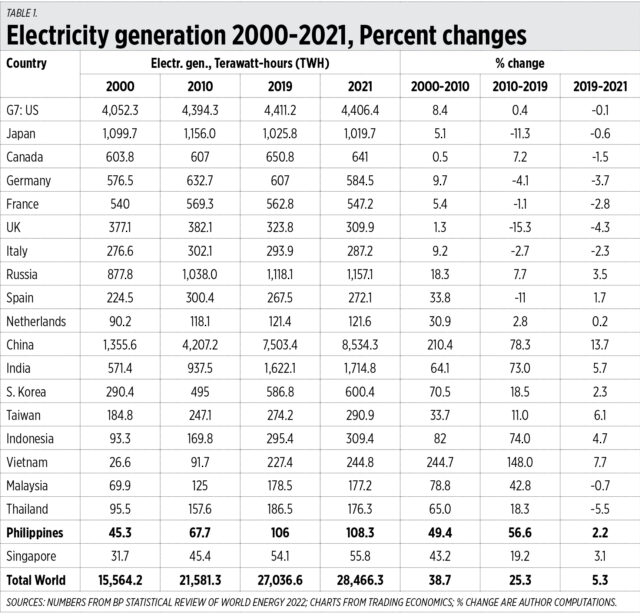
The Group of Seven (G7) industrialized countries of the world are in the forefront of “decarbonization” and “net zero” campaigns to fight “man-made” climate change. They do not believe that there is natural and cyclical climate change. The last two decades showed a drastic reduction in power generation of G7, also in two other big European countries with a GDP size of at least $1 trillion, Spain and Netherlands.

East and South Asia, excluding Japan, just paid lip-service to “decarbonization” and went on to make huge increases in power generation, based mainly on fossil fuels, especially China, India, Vietnam, and Indonesia. Russia took the East Asian path, though at a slower pace. Overall global power generation saw continued growth in energy production (Table 1).

The G7 and other European countries have a sustained belief in climate and energy alarmism. This will lead them to a path of deindustrialization.

STATE OF THE WORLD IN INFLATION AND GROWTH
Industrialized countries by default have low inflation because their technological advancement means they can mass produce many things, and have efficient storage and transportation logistics for a huge volume of goods 24/7. Thus, the average inflation rate from 1990-2010 were: Italy 3.1%, the UK 2.7%, the US 2.6%, Canada 2.1%, Germany 2%, France 1.8%, and Japan 0.4%.

Insufficient power generation and expensive electricity relative to their high industrial and commercial demand contributed to 37- to 49-years of high inflation in G7 countries except Japan. They have had anemic GDP growth over the past two decades, with 2.3% average growth already considered “very high.”

In contrast, East and South Asians that pursued high power generation would consider average growth of 3.3% as “very low” because their growth would range from 4-10% (Table 2).

STATE OF THE NATION IN TAX COMPETITIVENESS
My view is that North America and Europe will further deteriorate economically, and are likely to experience “stagflation” or stagnant/low growth with high inflation. So, many companies there will start migrating to Asia where growth is fast, where consumers are in the billions, and where energy policies are not held fully hostage by climate alarmism.

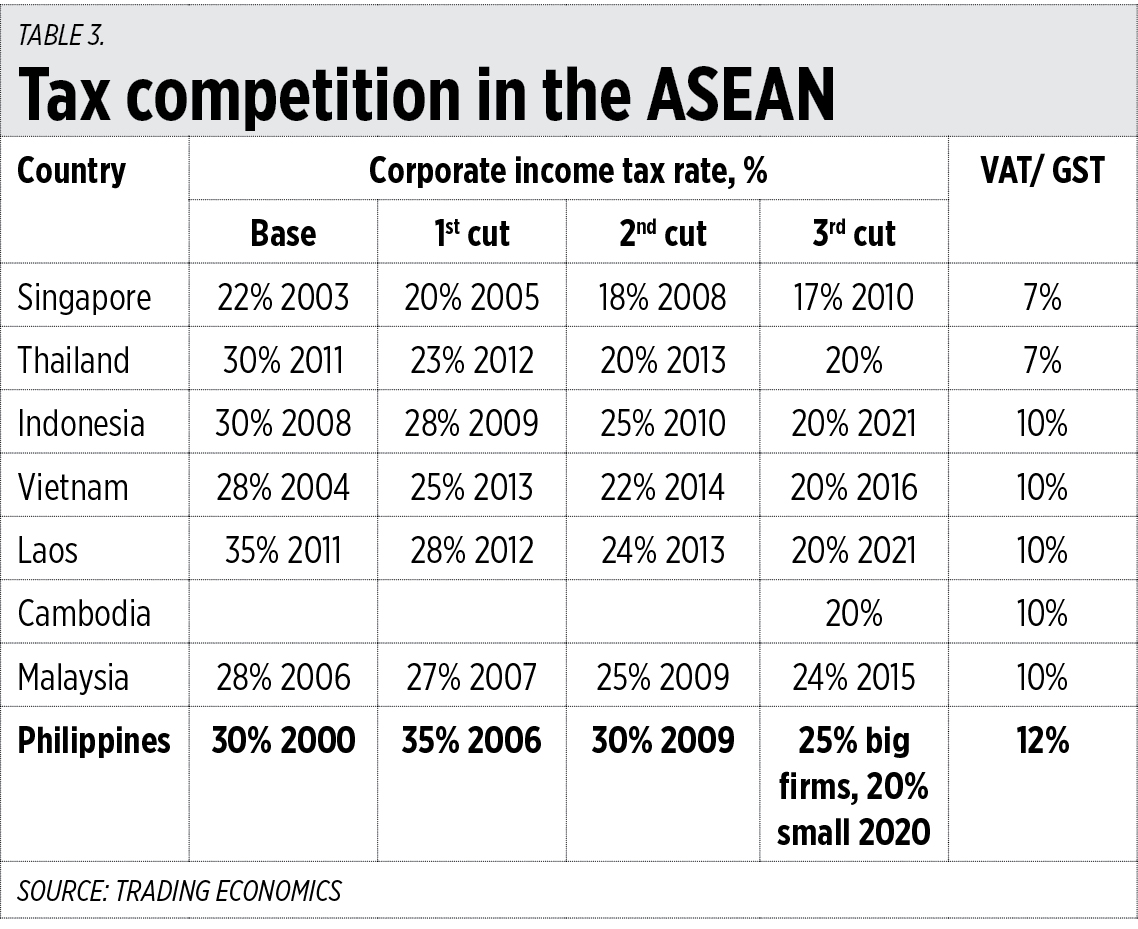
The Philippines should continue down the path of lower tax rates and a broader tax base that can lead to stable and high revenues. The Corporate Recovery and Tax Incentives for Enterprises (CREATE) Act of 2021 (RA 11534) has reduced the corporate income tax rate from 30% to 25% for big corporations and 20% for small and medium enterprises (SMEs) with net taxable income of P5 million or lower, and total assets of P100 million or lower excluding land. This was a good move by the Duterte administration.

The next challenge would be to reduce the value-added tax (VAT) from 12% to around 10% and reduce the number of exempted sectors to have a broader tax base. We have the highest VAT or gross sales tax (GST) rate in the ASEAN and this is not good for us (Table 3).

The current strategy of Finance Secretary Benjamin Diokno of further broadening the tax base is good — I support it. Then there is the improvement in tax administration via digitalization and the taxation of many online transactions to be at par with taxation in malls, shops, and groceries. But no amount of raising revenues will be sufficient to reduce our huge public debt, outstanding and guaranteed debt — only P8.2 trillion in 2019, P12.2 trillion in 2021, and P12.9 trillion in May 2022 — unless there is corresponding fiscal discipline and cuts in expenditures or subsidies. This column will discuss more fiscal policies in future articles.

To summarize, the state of the world is there is generally more economic sanity but it is the rich, industrialized, and influential countries like G7 that lead in economic and energy irrationality. The Philippines should prepare for companies migrating from the west. The government’s economic team, local business, labor, and even civil society sectors should prepare for this.


Bienvenido S. Oplas, Jr. is the president of Minimal Government Thinkers.

minimalgovernment@gmail.com

Myanmar executes 4 democracy activists

FLOWERS hang during a nationwide flower campaign against the military coup in Yangon, Myanmar, April 2, 2021. — REUTERS

MYANMAR’s military junta on Monday said it had executed four democracy activists accused of helping to carry out “terror acts” in the Southeast Asian nation’s first executions in decades, sparking widespread condemnation.

Sentenced to death in closed-door trials in January and April, the four men had been accused of helping militias to fight the army that seized power in a coup last year and unleashed a bloody crackdown on its opponents.

Myanmar’s National Unity Government (NUG), a shadow administration outlawed by the ruling military junta, condemned the executions and called for international action against Myanmar’s junta.

“Extremely saddened…condemn the junta’s cruelty…,” the NUG president’s office spokesman Kyaw Zaw told Reuters via message. “The global community must punish their cruelty.”

Among those executed were democracy figure Kyaw Min Yu, better known as Jimmy, and former lawmaker and hip-hop artist Phyo Zeya Thaw, the Global New Light of Myanmar newspaper said.

Kyaw Min Yu, 53, and Phyo Zeya Thaw, a 41-year-old ally of ousted Myanmar leader Aung San Suu Kyi, lost their appeals against the sentences in June. The two others executed were Hla Myo Aung and Aung Thura Zaw.

“These executions amount to arbitrary deprivation of lives and are another example of Myanmar’s atrocious human rights record,” said Erwin Van Der Borght, regional director of rights group Amnesty International.

“The four men were convicted by a military court in highly secretive and deeply unfair trials. The international community must act immediately as more than 100 people are believed to be on death row after being convicted in similar proceedings.”

Thazin Nyunt Aung, the wife of Phyo Zeya Thaw, said she had not been told of her husband’s execution. Other relatives could not immediately be reached for comment.

“My heart goes out to their families, friends and loved ones and indeed all the people in Myanmar who are victims of the junta’s escalating atrocities,” the U.N. special rapporteur on human rights in Myanmar, Tom Andrews, said in a statement.

The men had been held in the colonial-era Insein prison and a person with knowledge of the events said their families visited the prison last Friday. Only one relative was allowed to speak to the detainees via the Zoom online platform, said the person.

Myanmar’s state media on Monday reported the executions had taken place and junta spokesman Zaw Min Tun later confirmed the executions to Voice of Myanmar. Neither gave any details about when the executions occurred.

Previous executions in Myanmar have been by hanging.

An activist group, the Assistance Association of Political Prisoners (AAPP), said Myanmar’s last judicial executions were in the late 1980s.

Last month junta spokesman Zaw Min Tun defended the death penalty, saying it was justified and used in many countries.

“At least 50 innocent civilians, excluding security forces, died because of them,” he told a televised news conference.

“How can you say this is not justice?” he asked. “Required actions are needed to be done in the required moments.”

Cambodian Prime Minister Hun Sen, chair of the Association of Southeast Asian Nations (ASEAN), appealed in a letter in June to junta leader Min Aung Hlaing not to carry out the executions, relaying deep concern among Myanmar’s neighbors.

Myanmar’s ruling junta has condemned foreign statements about the execution orders as “reckless and interfering”.

Myanmar has been in chaos since last year’s coup, with conflict spreading nationwide after the army crushed mostly peaceful protests in cities.

“These horrendous executions were murders. They’re a part of the junta’s ongoing crimes against humanity and attack on the civilian population,” Matthew Smith, head of Southeast Asia’s Fortify Rights, told Reuters.

“The junta would be completely wrong to think this would instill fear in the hearts of the revolution.”

The AAPP says more than 2,100 people have been killed by the security forces since the coup. The junta says that figure is exaggerated.

The true picture of violence has been hard to assess as clashes have spread to more remote areas where ethnic minority insurgent groups are also fighting the military.

Last Friday, the World Court rejected Myanmar’s objections to a genocide case over its treatment of the Muslim Rohingya minority, paving the way for the case to be heard in full.

The latest executions close off any chance of ending the unrest in the country, said Myanmar analyst Richard Horsey, of the International CRISIS group.

“Any possibility of dialogue to end the crisis created by the coup has now been removed,” Mr. Horsey told Reuters.

“This is the regime demonstrating that it will do what it wants and listen to no one. It sees this as a demonstration of strength, but it may be a serious miscalculation.”

Acting Asia director of Human Rights Watch, Elaine Pearson, said the executions aimed to chill the anti-coup protest movement.

“European Union member states, the United States, and other governments should show the junta that there will be a reckoning for its crimes,” said Ms. Pearson.

“They should demand immediate measures, including the release of all political prisoners, and let the junta know the atrocities it commits have consequences.” Reuters

Bavarian Nordic monkeypox vaccine wins EU approval

OSLO — Danish biotechnology company Bavarian Nordic said on Monday the European Commission had given permission for its Imvanex vaccine to be marketed as protection against monkeypox, as recommended last week by the European Medicines Agency (EMA).

The approval comes just one day after the World Health Organization issued a high-level alert declaring the rapidly spreading monkeypox outbreak as a global health emergency.

“The availability of an approved vaccine can significantly improve nations’ readiness to fight emerging diseases, but only through investments and structured planning of the biological preparedness,” Bavarian Chief Executive Paul Chaplin said.

Bavarian’s vaccine, the only one to have won approval for the prevention of monkeypox disease in the United States and Canada, has in the European Union (EU) so far only been approved to treat smallpox.

But the company has supplied the vaccine to several EU countries during the current monkeypox outbreak for what is known as “off-label” use.

The approval is valid in all European Union Member States as well as in Iceland, Liechtenstein, and Norway, Bavarian Nordic said in a statement.

The development of Imvanex was made possible through significant investments from the US government during the past two decades, the company added.

Bavarian’s share price has risen by 122% in the last three months, driven by strong demand for the monkeypox vaccine. — Reuters

Musk denies ‘romantic’ affair with Google co-founder Brin’s wife

DANIEL OBERHAUS-FLICKER

TESLA, INC. boss Elon Musk said late on Sunday on Twitter that he and Google co-founder Sergey Brin remain friends and denied a report that he had been involved in an affair with Brin’s wife Nicole Shanahan.

Mr. Musk’s tweets came after a Wall Street Journal report that cited unidentified sources saying he had engaged in a brief affair with Ms. Shanahan. The paper said the affair prompted Mr. Brin to file for divorce from Ms. Shanahan earlier this year and ended the tech billionaires’ long friendship.

Dismissing the report, Mr. Musk tweeted, “Sergey and I are friends and were at a party together last night! I’ve only seen Nicole twice in three years, both times with many other people around. Nothing romantic.”

Tesla and Google, whose parent company is Alphabet, Inc., did not immediately respond to Reuters’ requests for comments outside regular business hours.

Reuters wasn’t immediately able to reach Mr. Brin or Ms. Shanahan for comment. A lawyer for Mr. Brin declined to comment to the WSJ, and Shanahan didn’t respond to requests from the paper for comment.

Mr. Brin filed for divorce citing “irreconcilable differences,” the Journal said, quoting records it said were filed in Santa Clara County Superior Court. Reuters wasn’t able to determine independently whether divorce papers have been filed.

In its report, the WSJ also said Mr. Brin instructed his advisers to sell personal investments in Mr. Musk’s companies after he came to know about the affair. The paper said it wasn’t able to determine how large those investments were, nor whether any sales were made.

The Wall Street Journal did not immediately respond to Reuters’ request for comment on Mr. Musk’s denial of the report outside of regular US business hours. — Reuters