Home Blog Page 6036

Singapore will decriminalize sex between men, no change in marriage rules — PM

PIXABAY 

SINGAPORE — Singapore will decriminalize sex between men but has no plans to change the legal definition of marriage as being between a man and a woman, Prime Minister Lee Hsien Loong said on Sunday. 

LGBTQ groups welcomed Mr. Lee’s decision to repeal Section 377A of the penal code, a colonial-era law that criminalizes sex between men, but also expressed concern that ruling out same-sex marriage would help to perpetuate discrimination. 

In his annual national day rally speech, Mr. Lee said Singaporean society, especially young people in the city-state, were becoming more accepting of gay people. 

“I believe this is the right thing to do, and something that most Singaporeans will now accept,” he said. 

It was unclear when exactly Section 377A would be repealed. 

Singapore becomes the latest Asian country to move toward ending discrimination against members of the LGBTQ community. 

In 2018, India’s highest court scrapped a colonial-era ban on gay sex, while Thailand has recently edged closer to legalizing same-sex unions. 

Under Singapore’s Section 377A, offenders can be jailed for up to two years under the law, but it is not currently actively enforced. There have been no known convictions for sex between consenting adult males for decades and the law does not include sex between women or other genders. 

Lesbian, gay, bisexual, transgender, and queer (LGBTQ) groups have brought multiple legal challenges attempting to strike down the law, but none has succeeded. 

On Sunday, several LGBTQ rights groups said in a joint statement they were “relieved” by Mr. Lee’s announcement. 

“For everyone who has experienced the kinds of bullying, rejection and harassment enabled by this law, repeal finally enables us to begin the process of healing. For those that long for a more equal and inclusive Singapore, repeal signifies that change is indeed possible,” they said in the statement. 

But the groups also urged the government not to heed calls from religious conservatives to enshrine the definition of marriage in the constitution, saying this would signal that LGBTQ+ citizens were not equal. 

RESISTANCE 

In February, Singapore’s highest court had ruled that since the law was not being enforced, it did not breach constitutional rights, as the plaintiffs had argued, and it reaffirmed that the law could not be used to prosecute men for having gay sex. 

Some religious groups including Muslims, Catholics and some Protestants continued to resist any repeal of the law, Mr. Lee said. 

An alliance of more than 80 churches expressed strong disappointment on Sunday over the government’s decision. 

“The repeal is an extremely regrettable decision which will have a profound impact on the culture that our children and future generations of Singaporeans will live in,” it said. 

Singapore is a multi-racial and multi-religious society of 5.5 million, of whom about 16% are Muslim, with bigger Buddhist and Christian communities. It has a predominantly ethnic Chinese population with sizable Malay and Indian minorities, according to the 2020 census. 

Stressing his government’s continued support for the traditional definition of marriage, Mr. Lee said: “We believe that marriage should be between a man and a woman, that children should be raised within such families, that the traditional family should form the basic building block of society.” 

Singapore will “protect the definition of marriage from being challenged constitutionally in the courts”, he said. “This will help us repeal Section 377A in a controlled and carefully considered way.” — Reuters

[B-SIDE Podcast] Building a great place to work

Follow us on Spotify BusinessWorld B-Side

Teleperformance Philippines (TP) received its fifth consecutive “Great Place to Work” certification this year, based on responses from a 2022 trust index survey conducted by the Great Place to Work, an international institute that does research on company culture.

In this B-Side episode, TP senior vice president for human capital resource management Jeffrey Johnson tells BusinessWorld reporter Brontë H. Lacsamana how companies can keep a human touch in a hybrid workplace.

“It’s really important that you listen to employees because the employees will tell you what it is they want when it comes to engaging from a digital perspective,” he said. 

“As long as you’re listening and then actively applying solutions for that, I think that’s a key success factor to making sure that you’re able to drive the right engagement.” 

TAKEAWAYS 

Train employees to have a continuous learning mindset. 

“You need a lot of training to understand the changing situation at work. That can be both self-driven and organizationally driven,” said Mr. Johnson. 

TP, which has more than 55,000 employees, understands that each person in its organization learns in different ways and encourages them: some may prefer to read and process on their own while others might want to take an e-learning course. 

“When you have that culture, people are more likely to succeed,” said Mr. Johnson. 

Upgrade programs, policies, and partnerships to suit the times.  

On a macro level, a large organization can influence the local community by improving its policies, implementing new programs, and entering public and private partnerships. 

Teleperformance Cloud Campus, for example, is a long-term remote work solution that connects employees through a suite of software for those working from home. There are also hubs and microsites for those who want face-to-face meetings, training, and support. 

TP just opened its first microsite in Laoag City in Ilocos, with the next one slated to open in General Santos City in Mindanao. 

“We fully support the efforts of government and private telcos to make sure that digital penetration reaches as far into the countryside as possible, and it is reliable, consistent, and fast — all the things you need in a digital world,” he said. 

Employee feedback is the north star for better policies. 

For an information technology-business process management (IT-BPM) company to provide good services, its employees have to be taken care of. 

This means leaders must ask each team member how they want to engage and connect, said Mr. Johnson. Meanwhile, on a company scale, sentiment and satisfaction surveys will give important insights into what policies can be improved. 

Diversity, equity, and inclusion (DEI) policies, for example, have been found to address concerns about maternity leaves for men and women, and healthcare benefits and restroom access for lesbian, gay, bisexual, and trans (LGBT+) employees. 

“We make sure we go back and listen. Once we make adjustments, what do employees say? Then change course and correct,” Mr. Johnson said. “It’s a constant process.” 


Recorded remotely on August 11, 2022. Produced by Earl R. Lagundino and Sam L. Marcelo.

Follow us on Spotify BusinessWorld B-Side

Pag-IBIG launches official mobile app

Pag-IBIG members can now view their Pag-IBIG Savings and annual dividends, payments history, and loan balance and dues using their mobile phones with the launch of the agency’s official mobile app – the Virtual Pag-IBIG Mobile App – its top officials announced Thursday (18 August).

“Pag-IBIG Fund continues to bring its services closer to its members, this time through the use of information technology. The Virtual Pag-IBIG Mobile App is among our many ways of adhering to the call of President Ferdinand R. Marcos, Jr. to make Pag-IBIG’s services and benefits even more accessible to our members,” said Secretary Jose Rizalino L. Acuzar of the Department of Human Settlements and Urban Development (DHSUD), who serves as chairperson of the 11-member Pag-IBIG Fund Board of Trustees.

The mobile app allows members to view their Pag-IBIG Savings and annual dividends, confirm savings remitted and loan payments made through all channels, and monitor their loan balances and due dates. The mobile app can be accessed by members using their Virtual Pag-IBIG accounts to ensure data protection and security.

Pag-IBIG Fund Chief Executive Officer Acmad Rizaldy P. Moti, meanwhile, stated that members can expect more services to be made available via the Virtual Pag-IBIG Mobile App over the coming weeks. These services include online application for housing and cash loans, as well as online payments.

“We developed the Virtual Pag-IBIG Mobile App following the success of our online service facility, the Virtual Pag-IBIG, which has now served over 3.6 million members since its launch in 2019. And, just like our online service facility, we shall continuously develop our mobile app to have our full range of services so that it can provide all our members another safe, convenient and secure means of accessing their Pag-IBIG benefits, 24/7. With the Virtual Pag-IBIG Mobile App, we are truly bringing Pag-IBIG Fund’s services to the palm of our members’ hands,” Moti said.

The Virtual Pag-IBIG Mobile App is now available via Google Play at https://play.google.com/store/apps/details?id=pagibigfund.virtualpagibigapp&raii=pagibigfund.virtualpagibigapp, and shall soon be available on the Apple App Store.


Spotlight is BusinessWorld’s sponsored section that allows advertisers to amplify their brand and connect with BusinessWorld’s audience by enabling them to publish their stories directly on the BusinessWorld Web site. For more information, send an email to online@bworldonline.com.

Join us on Viber to get more updates from BusinessWorld: https://bit.ly/3hv6bLA.

Unlocking opportunities in education through technology

Technology has taken the spotlight in the wake of the COVID-19 pandemic, as organizations from governments and corporations to schools and restaurants adapted to the challenges posed by the crisis. Technology, particularly online digital platforms, played an essential role in addressing the gaps created by pandemic restrictions, allowing merchants and consumers to continue business safely and securely.

Needless to say, these benefits extended to education, where digital platforms allowed students and teachers to keep to curricula despite the disruptions. According to observations by the World Bank, all countries were able to deploy remote learning technologies using a combination of TV, radio, online and mobile platforms.

However, this dependence on technology has magnified issues such as inequality and accessibility, as many children in low-income countries could not participate in remote learning. The World Bank Group, in a survey with UNESCO and UNICEF, found that in about a third of low-income countries, 50% of children had not been reached by digital education.

This meant that the pandemic has led to significant losses in learning for many students. Furthermore, school closures and limited access to remote learning means that learning poverty has likely worsened during the period, especially in low-income countries where no remediation interventions have been taken.

“The crisis has starkly highlighted the inequalities in digital access and that ‘business as usual’ will not work for delivery of education to all children,” the World Bank wrote on its website.

“To close the digital divides in Education and leverage the power of technology to accelerate learning, reduce learning poverty, and support skills development a focus must be placed in bridging the gaps in: i) digital infrastructure (connectivity, devices and software); ii) human infrastructure (teacher capacity, student skills and parental support); and iii) logistical and administrative systems to deploy and maintain tech architecture.”

During a panel discussion in the BusinessWorld Virtual Economic Forum 2021 Special Edition, Andrés Ortola, country general manager of Microsoft Philippines, dove deeper into the topic of bridging the digital divide in education by noting the value of activating partnerships and collaborations to provide for students struggling to access quality online learning.

“We must continue building coalitions, partnerships, and initiatives to tackle this digital divide,” he said, adding that public and private institutions coming together to tackle societal problems is needed to create new economies.

The idea is to create a future digital society that is built in the pillars of trust, inclusion, growth, and security. “It’s our responsibility as leaders to ensure inclusive access, leverage technology to reach millions of people, and empower them with the necessary skills to thrive in the digital era,” he said.

He also said that while many technologies are already available, the greater challenge is driving innovation in a more pervasive way.

In the same panel, Kevin C. Chua, senior economist at World Bank, pointed to several barriers causing the digital divide that should be paid due attention, including gaps in material access, pertaining to gadgets and network connection; gaps in skills access, referring to digital literacy and competency; gaps in usage access, having to do with the systematic use of programs, applications, content, and services; and gaps in motivational access, which refers to the trust and confidence in using technologies.

Identifying these factors is key in addressing these gaps, particularly in expanding accessibility for digital education among students from low-income families. Mr. Chua noted that income becomes the determining factor, with well-off consumers more able to afford gadgets and connectivity. In terms of digital skills, age generates the gap, with the younger population being more tech-savvy and receptive to change.

The senior economist added that while there are indications that the digital divide may be narrowing in the Philippines, including surge in the number of Internet and digital payments users, much work remains to be done. “There’s a lot of catching up [which] will require addressing these barriers to material, skills, usage, and motivational access,” he said.

Trends in the technology space

The recent years witnessed a lot of advancements in the realm of technology. And much likely, there are more innovations to anticipate in the future.

Technology is clearly embedded in the day-to-day of many individuals and organizations. There are many advancing and emerging technology trends that could impact their lives, and here are a few of them.

Metaverse

Perhaps metaverse is one of the most heard terms in the tech space today. While the word ‘metaverse’ has been in existence since 1992 in Neal Stephenson’s novel Snow Crash, it has become a buzzword in the past year, especially with the rebranding of Facebook as Meta.

Various definitions are associated with the metaverse, one of which is that it is made up of extended reality (XR).

Accenture, in its Technology Vision 2022 report, considered metaverse as a continuum that extends a spectrum of digitally enhanced worlds, realities, and business models. And it is primed to transform life and business in the next decade. 

The vision of the metaverse is still being built. And it would not be fully realized until the next five to 10 years, Meta Philippines’ country director John Rubio mentioned during the BusinessWorld Virtual Economic Forum last May. But businesses are now urged to prepare for this future.

“This [metaverse] continuum is bringing the next major wave of digital change to enterprises, and leaders need to start making big leaps forward in how they think about their business — today,” Accenture said in the report.

5G connectivity

Although thoughts still vary on whether the fifth generation mobile technology (5G) has already reached mainstream now or just soon to be, its usage has increased since it came out around 2018.

Subscription penetration of 5G grew in the first quarter of 2022 with 70 million subscriptions added, according to Ericsson Mobility Report in June.

5G has also advanced in the Philippines. Ookla saw that 5G availability in the country nearly doubled in just a year, increasing to 18.1% in the first quarter of 2022 from 9.4% in the same quarter of 2021.

Smart took the lead in 5G availability with 25.5% in the first quarter, ahead of Globe’s 15.3%. In the same quarter, Smart recorded 1.6 million connected 5G unique devices on its network, more than triple of its 376,000 in the first quarter last year. Globe registered more than two million devices in its 5G network at the end of March this year.

Ericsson expected 5G subscriptions to exceed one billion by the end of 2022.

Blockchain

Blockchain, a distributed ledger technology (DLT) most known for its role in cryptocurrency, is deemed ready to revolutionize enterprises.

“Blockchain and DLT platforms have crossed the disillusionment trough of the hype cycle and are well on their way to driving real productivity,” said Deloitte in its Tech Trends 2022 report. “They are fundamentally changing the nature of doing business across organizational boundaries and helping companies reimagine how they make and manage identity, data, brand, provenance, professional certifications, copyrights, and other tangible and digital assets.”

Currently boosting blockchain and DLT platforms adoption among organizations beyond the financial services sector are technical developments and regulatory standards, especially in non-public networks and platforms, according to Deloitte.

Looking at Internet users, Finder’s Cryptocurrency Adoption Index August 2022 report showed that global crypto ownership is at 15%. The Philippines placed 10th out of the selected 26 countries for crypto adoption with a 16% ownership rate.

Sustainability

Technological advancements could also be harnessed in working towards sustainability. And one of such instances is utilizing artificial intelligence (AI) for renewable energy. According to DAMO Academy, a global research initiative of Alibaba Group, in its Top Ten Technology Trends for 2022, there are certain challenges in adding renewables to the power grid. But leveraging AI could be pivotal to improving the efficiency and automation of electric power systems, which thus maximizes resource usage and stability. This then will be conducive to reaching carbon neutrality.


DAMO added that AI is projected to pave the way for incorporating renewable energy sources into the power grid in the next three years and help in the power grid’s safe, efficient, and reliable operation. — Chelsey Keith P. Ignacio

Opportunities to upskill auditing

In the new normal, industries and organizations have been embracing several transformations that were either caused or accelerated by the coronavirus pandemic, such as digital transformation and sustainability. The auditing industry continues to grapple with these changes, especially in terms of getting the right talent, yet opportunities are within their reach.

According to a recent survey by technological research and consulting firm Gartner, Inc., attracting talent with nontraditional skills is found to be the top challenge for audit leaders or chief audit executives (CAEs), represented by 57% of the respondents.

Related challenges cited by over half of audit leaders surveyed as important to solve in the next 12 months include: making the leap to more advanced analytics applications (e.g., continuous monitoring, automation and artificial intelligence) (56%); inadequate assurance over cybersecurity (53%); IT auditing practices not keeping pace with the need to audit new technologies and IT risks (53%); and measuring the impact of higher-value activities our team performs (51%).

“Top challenges for audit leaders reflect the increasing need for their audit teams to provide assurance over rapidly evolving technologies and expanded digital transformation initiatives,” Gartner’s report noted.

This difficulty in attracting talent to internal audit is even seen as a major factor driving many of the other top challenging facing audit leaders.

“[M]any audit leaders also expressed lower confidence in their team’s ability to audit evolving areas, such as cybersecurity, ESG (environmental, social, and governance standard) and talent risks in the broader organization, and increase the department’s use of data analytics and technology,” the report read. “These areas often require specialized skills audit teams are trying to attract or effectively upskilling existing talent, which also presents its own challenges.”

Such findings mirror what was explored by the Internal Audit Foundation (IAF) of the Institute of Internal Auditors, in collaboration with professional services firm Deloitte, in a research report published last year that assessed internal audit competency.

The report highlighted that while internal auditors are confirmed to have strong competence in core knowledge areas, a critical need is sought for them to have an additional focus on the use of innovative technologies.

“Business strategy and technology strategy are converging. Today, many business models could not exist without digital technologies, such as cloud-based platforms, automation, machine learning, advanced analytics, and blockchain,” read the report. “Despite the criticality of these technologies, many auditors do not believe they have the skills needed to provide effective assurance and advisory services in these areas.”

These seen gaps, nonetheless, can be considered as opportunities for auditors moving forward.

“This unique point in time offers internal auditors an opportunity to articulate the value they could add to their organizations if adequately enabled by relevant transformative technology and upskilling opportunities,” Mike Schor, risk & financial advisory partner at Deloitte, was quoted as saying in a comment to the report’s findings.

Opportunities amid risks

In an annual perspective of its internal audit specialists, Deloitte identified key risks and opportunities that it believes internal auditors should consider in their audit plans this year.

Among the numerous considerations, Deloitte agrees that adopting the ESG standard is imminent in several major economies, and so internal audit should not delay in tackling the issue, “as the stakes are simply too high, with pressure exerted by regulators, investors, customers, third-party affiliates, and society at large.”

A challenge internal audit (IA) functions just starting on their ESG journey should brace for is identifying responsible parties within the organization, the firm noted.

“Oftentimes, we find the CFO (chief financial officer) pointing to investor relations, who look to HR (human resource), which passes the buck to legal, who redirects to marketing. Effective coordination among these groups and a focal point of responsibility will be critical to progress,” Deloitte wrote in the report.

Deloitte also recommends initiating training as needed to fill knowledge gaps, both within IA and throughout the organization at large.

“Invest in resources with the right experience and skillset to understand, recognize, and assess ESG risks. Consider creating ESG-dedicated position(s) within internal audit to allow for specialized expertise and increased focus,” Deloitte added.

IA functions are also encouraged to get involved with organizations as they embark on automation in order to realize business value.

“Start by helping management find a balance between risk taking and risk appetite. Connect early in the process, when strategic decisions about automation are first being made. Ideally, the relationship will include both advisory and assurance elements — helping the organization realize [return of investment] and then providing assurance services for its automation deployment,” Deloitte explained.

“Simultaneously, adapt your audit plan to the new environment,” the firm added. “Risk assess new capabilities (impacted business processes, ways of working, and new enabling technologies) across key risk domains, such as financial, operational, regulatory, technology, and strategic, and then prioritize based on impact and vulnerability criteria.”

Regarding cybersecurity, CAEs are advised to pay particular attention to leveraging the “cyber cloud skills” of auditors as the cloud bring a concurrent set of risks while enhancing the ability to quickly leverage new capabilities such as AI, machine learning, blockchain, and data lakes.

“Consider approaches such as a risk-based “assurance by design” cloud migration strategy; take advantage of native cloud services; and embed security and engage in a multi-cloud strategy. For IT IA, cloud assurance will be a multi-year journey — not one audit and done,” Deloitte advised. — Adrian Paul B. Conoza

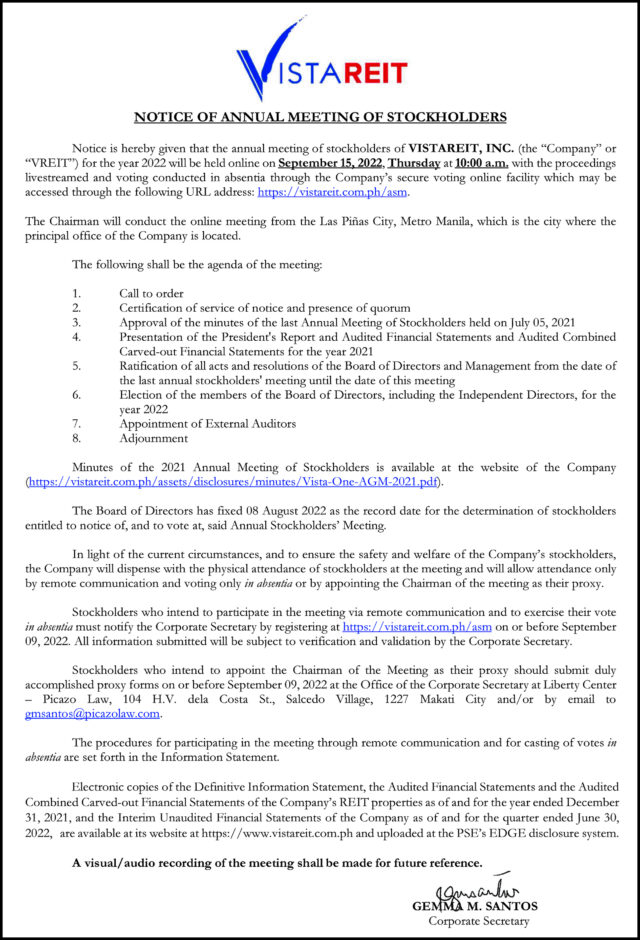
VistaREIT, Inc. to hold annual stockholders’ meeting on Sept. 15


Spotlight is BusinessWorld’s sponsored section that allows advertisers to amplify their brand and connect with BusinessWorld’s audience by enabling them to publish their stories directly on the BusinessWorld Web site. For more information, send an email to online@bworldonline.com.

Join us on Viber to get more updates from BusinessWorld: https://bit.ly/3hv6bLA.

Gov’t drafts rules on digital payments

Bureau of Internal Revenue (BIR) staff check the income tax returns submitted by individuals and business owners at the BIR Office in Intramuros, Manila, April 18, 2022. — PHILIPPINE STAR/ RUSSELL A. PALMA

GOVERNMENT AGENCIES may be given six months to less than three years to transition to digital disbursement and collection, according to the draft rules on the government’s adoption of digital payments.

The Finance department, along with other government agencies, drafted the implementing rules and regulations (IRR) of Executive Order (EO) No. 170, which mandates the adoption of digital payments for government disbursements and collections.

Under the draft rules, all covered agencies will have to fully implement digital disbursements within six months of the effectivity date.

“For the implementation of digital collections, a tiered transition period not exceeding three (3) years shall apply,” the rules stated.

The transition period would depend on the agency’s operational readiness and capability.

If the covered agency is already offering a digital mode of collecting payments through a gateway system or a collection agreement with financial institutions, it should implement digital disbursements within one year from the effectivity date of the IRR.

The transition period for an agency not yet offering digital collection will be more than one year, but less than three years.

The payments digitalization team of the covered agencies will be required to submit a transition plan that includes timelines to fully implement digital payments, strategies for capacity development, and key performance indicators and targets.

“The transition plan shall be officially transmitted by the head of agency to the TWG (technical working group), through the Secretariat, within 60 days after the effectivity of this IRR,” the draft rules stated.

The draft rules also proposed the creation of a TWG on the adoption of digital payments, composed of representatives from the departments of Finance and Budget and Management, Bureau of the Treasury, Bureau of Internal Revenue, and the Government Procurement Policy Board Technical Support Office.

The TWG will determine which agencies are capable of adopting digital payments within a shorter or longer period.

“The transition plan will be used as part of the basis for monitoring compliance of the Covered Agencies. Whenever necessary, the TWG may recommend adjustments in the transition plan in line with the requirements and objectives of EO No. 170,” the draft rules stated.

The IRR of EO No. 170 is in line with the government’s effort to develop an inclusive digital financial ecosystem.

Stakeholders are given until Aug. 24 to give their feedback on the draft rules.

In May, then-President Rodrigo R. Duterte signed the EO No. 170 to ensure “safe and efficient” digital disbursement, including distribution of financial assistance and payment of salaries, wages and allowances to employees. — KBT

New SRA board expected to work closely with stakeholders

A MAN repacks sugar in packets at a public market in Taguig City, Aug. 27, 2008. — REUTERS/CHERYL RAVELO

By Kyle Aristophere T. Atienza, Reporter

INDUSTRY PLAYERS expect the Sugar Regulatory Administration (SRA) to improve its coordination with stakeholders and ensure the protection of local producers after President Ferdinand R. Marcos, Jr. appointed new officials.

“The recent appointments by President Marcos give us hope that we will have a better SRA that will truly work for and be there for the industry stakeholders,” United Sugar Producers Federation President Manuel R. Lamata said in a Viber message.

The appointments were recommended by Negros Oriental Vice-Governor Jeffrey Ferrer, Mr. Lamata said.

Negros Oriental is one of the Philippines’ largest sugar producers.

Mr. Lamata said the SRA’s regulations should undergo thorough consultation to come up with a “collective and cohesive win-win solution that is fair to all stakeholders and for the consumers especially.”

He emphasized that sugar importation should be a “last remedy” to address a supply shortage.

“SRA must do a balancing act between the producers, the consumers, the millers, and industrial users to ensure that no sector takes advantage of the others,” Mr. Lamata said.

Mr. Marcos on Saturday named three new officials of the Sugar Regulatory Board (SRB), including David John Thaddeus P. Alba as SRA acting administrator.

Mr. Alba replaced Hermenegildo R. Serafica, who resigned along with other board officials after the agency approved an order allowing the importation of 300,000 metric tons (MT) of sugar, which Mr. Marcos’ office considered as “illegal” or “unauthorized.”

Other appointees named by Mr. Marcos, who chairs the sugar board as Agriculture chief, are Pablo Luis S. Azcona, who will represent sugar planters, and Mitzi V. Mangwag, who will represent sugar millers.

“We do have to rethink the SRA. It has not been very effective in its role of local industry development,” Albay Representative and House Ways and Means Committee Chair Jose Ma. Clemente S. Salceda said in a Viber message.

“Low utilization rates of the Sugarcane Industry Development Act (SIDA) and the Tax Reform for Acceleration and Inclusion (TRAIN) law funds have hounded that agency,” he added, calling SRA a “failed agency.”

The TRAIN law raised excise taxes on petroleum products and sugar-sweetened beverages (SSB). Under the law, a significant portion of taxes from SSB should be allocated to the sugar industry. 

Mr. Salceda said there should be “a more technical panel” headed by the Department of Agriculture and composed of planters, millers, industrial users, consumer groups “to deliberate on whether we need to import sugar and how much.” 

The panel should also include a representative from the Bangko Sentral ng Pilipinas “for inflation targeting” and the National Economic and Development Authority (NEDA) to assess “economic impacts,” Mr. Salceda said.

George T. Barcelon, president of the Philippine Chamber of Commerce and Industry, hopes that the Department of Trade and Industry (DTI) will play a more crucial role in ensuring that sugar supply is adequate and prices remain low.

“The SRA should also work with the DTI. We hope to see the active role of the DTI. It should be on top of sugar price increases,” Mr. Barcelon said by telephone. “Businesses need affordable sugar.”

LIBERALIZATION
Meanwhile, Mr. Salceda warned against plans to allow importation of sugar without any government regulation, saying it “will definitely hurt farms — especially in this time of high fertilizer, fuel, and labor prices.”

“As I warned before, we have to be circumspect about the liberalization of the sugar sector. The sugar production sector is among the most labor-intensive sectors in the agriculture sector, needing 1.4 workers per hectare on average compared to 0.6 worker for rice, and 0.7 for the whole sector,” he said, adding the benefits are not clear.

The government has intensified its crackdown on market players allegedly hoarding sugar, making surprise inspections in some warehouses since last week.

On Saturday night, Mr. Marcos’ office announced the seizure of at least 60,000 bags of sugar in a series of inspections in different warehouses in Bulacan.

Customs personnel used their visitorial power to inspect four warehouses in Guiguinto, Bulacan late Saturday afternoon, Press Secretary Trixie Cruz-Angeles said in a news release.

She said authorities found imported sugar from Thailand at 50 kilograms per sack. Authorities also learned that the import permit used for the Thai sugar “was the allocation for Sugar Order No. 3 issued last February by the SRB,” she added.

Before the inspection in Bulacan, personnel of the Subic Port customs have also seized 140,000 bags of imported sugar from Thailand equivalent to 7,000 MT.

“The huge volume of sugar discovered by authorities in the various inspected warehouses in Luzon has led Malacañang to conclude that the sugar shortage is artificial, brought about by the hoarding of sugar traders who want to rake-in huge profits from the sudden spike in sugar prices.”

Mr. Marcos, Senate President Juan Miguel F. Zubiri, and sugar stakeholders recently reached a consensus to import 150,000 MT of sugar.

Philippines plans $3-4 billion foreign bond sales this year

REUTERS

THE PHILIPPINES plans to raise a further $3 billion to $4 billion from foreign bond sales this year, according to a person familiar with the matter.

The amount is based on the borrowing program for 2022, the person said on Friday, asking not to be identified because the matter isn’t public.

The Philippines is stepping up its fundraising with a local-currency bond sale aimed at retail investors set to begin this month, a debt offering that may also raise billions of dollars.

While bond sales in emerging markets have dried up in the past few months, few nations have entered the market, with Mexico raising $2.2 billion from a dollar bond offering earlier this month.         

Philippine dollar bonds due 2032 were indicated 0.1 centavo higher at P115.58 per dollar on Friday. President Ferdinand R. Marcos, Jr. plans a record spending spree to boost the nation’s recovery from the pandemic.

The Philippines last sold dollar bonds in March, raising $2.25 billion. The nation also raised $500 million in a yen bond sale in April. — Bloomberg

Shipping industry backs bill seeking devolution of PPA’s regulatory functions

REUTERS

THE PHILIPPINE Liner Shipping Association (PLSA) has expressed support for a proposed measure that seeks to strip the Philippine Ports Authority (PPA) of its regulatory functions.

“In principle, we support the devolution of the regulatory functions of PPA,” PLSA President Mark Matthew F. Parco told BusinessWorld in a recent phone interview.

The current setup of PPA, an attached agency of the Department of Transportation (DoTr), allows it to function as a “for-profit company” and as a regulator of the industry at the same time, Mr. Parco said.

“It makes sense that the regulatory power is not with the port corporation,” he added.

A legislator recently refiled a bill seeking to reorganize the PPA by separating its regulatory and commercial functions.

Bagong Henerasyon Party-list Rep. Bernadette Herrera-Dy filed on July 6 House Bill No. 1400, which aims to convert the agency into Philippine Ports Corp. (Philports) and transfer its regulatory functions to the Maritime Industry Authority (MARINA).

“Through the years, the port users, including domestic shippers, exporters, and importers, have complained of low service levels, inefficient port operations and ever-increasing port charges,” Ms. Herrera-Dy said in the bill’s explanatory note.

“They claim that the high cost of transport serves as an efficient barrier to increased trade (both local and foreign) and undermines the country’s competitiveness,” she added.

The PPA was established by Presidential Decree (PD) No. 505, which was subsequently amended by P.D. No. 857 in 1975. It is tasked with facilitating the implementation of an integrated program for the planning, development, financing, operation and maintenance of ports or port districts for the entire country.

The agency has yet to respond to a request for comment as of press time.

The bill seeks to reform the administration of ports by separating PPA’s regulatory, commercial and development functions. It aims to “avoid the conflict of interest arising from regulatory agencies vested in both regulatory and development or commercial functions.”

“Under no circumstances should a regulatory agency benefit from its own regulation and/or use its own regulatory powers to protect itself from competition at the expense of public interest,” the bill stated.

Under the bill, PPA will be converted into Philports to handle development, management and operation of public ports. Philports will collect port fees and dues approved by MARINA, which will fund port development, modernization, and expansion, among others.

Separation of PPA’s functions is one of the recommendations made by the Organization for Economic Co-operation and Development (OECD) in its 2020 competition assessment review for the logistics sector in the Philippines.

The OECD said the Philippines should enact a measure to “ensure the separation of PPA’s functions, avoid conflicts of interest, and ensure that PPA is incentivized to develop, modernize and expand its ports.”

“Establishing the regulator with a degree of independence (both from those it regulates and from government) can provide greater confidence and trust that regulatory decisions are made with integrity,” it said. “A high level of integrity improves outcomes of the regulatory decisions.”

The OECD said regulators should not be given conflicting or competing functions or goals.

“The assignment of potentially conflicting functions to any regulator should only occur if there is a clear public benefit in combining these functions and the risks of conflict can be managed effectively.”

Meanwhile, Mr. Parco welcomed Transportation Secretary Jaime J. Bautista’s plans to improve ports and cut the cost of shipping and travel.

Shipping companies have raised their freight charges by an average of 25% starting March.

The PPA also said last month that it was already looking into reducing port costs by reviewing fees.

In the first half, the PPA reported that passengers using its facilities surged by 144% with the resumption of domestic tourism, trade, and regular travel activity.

Passenger volume for the first half of 2022 rose to 26.053 million, from 10.692 million a year earlier. Meanwhile, cargo throughput for the period fell by 1.46% year on year to 125.485 million metric tons. — Arjay L. Balinbin

BusinessWorld bags top Philippine Quill award

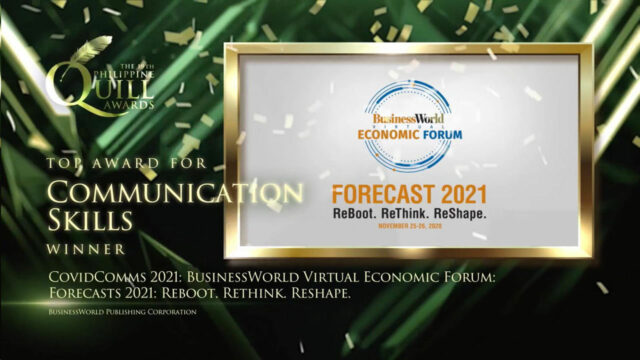
BUSINESSWORLD Publishing Corp. received the top award at the Philippine Quill Awards for its flagship economic forum, which went virtual for the first time in 2020.

“BusinessWorld Virtual Economic Forum (BVEF): Forecasts 2021: Reboot. Rethink. Reshape” was given the Top Award in the Communication Skills division of the 19th Philippine Quill Awards, besting other four top contenders and 148 excellence awardees.

The BVEF is one of the groundbreaking projects that BusinessWorld launched during the coronavirus disease 2019 (COVID-19) pandemic.

Over 60 international and local experts gathered in November 2020 for the two-day virtual forum, which tackled the most urgent issues faced by the Philippine business community.

Keynote speakers included Børge Brende, president of the World Economic Forum; Bernardo Mariano, Jr., chief digital and information officer of the World Health Organization; Ndiamé Diop, country director for Brunei, Malaysia, Philippines and Thailand of the World Bank; and Kelly Bird, country director of the Asian Development Bank.

Around 1,200 attended the forum, with 40% comprising C-level executives and department heads. It also attracted 33 sponsors and partners.

The BVEF, now with four editions, has become a valuable asset for BusinessWorld, allowing the company to stand out in the industry.

The Philippine Quill is the country’s most prestigious awards program in the field of business communication.