Home Blog Page 6020

Brutality and rape as weapons of war

UKRAINE President Volodymyr Zelensky with international jounalists — WWW.PRESIDENT.GOV.UA

There seems to be no dispute that the brutality of Russian troops in its invasion of Ukraine is simply a repetition of what has become its template for war. Brutality is part of Russian war policy as it demonstrated in its invasion of Afghanistan in 1979, the Chechen uprising, the bloody bombing of Aleppo in Syria, and in dealing with its own citizens who courageously take on the role of dissidents and opponents of Putin and his clique.

As Tom Mockaitis wrote in The Hill on April 11 (https://bit.ly/TheHill_Ukraine), “The horrifying atrocities committed by Russian soldiers in Ukraine come as no surprise to military historians. The Russian army and its Soviet predecessor have a long and ugly history of systematic brutality in warfare.”

His narrative states that “following the October Revolution of 1917, the Bolsheviks fought a five-year civil war to consolidate control of the country. The conflict took the lives of perhaps 10 million people, most of them civilians.” Mockaitis wrote that “the Red Army and the Cheka (secret police) employed a strategy of ‘mass terror.’ ‘No mercy for these enemies of the people,’ Vladimir Lenin declared. He described anyone who opposed the revolution or even resisted communism as ‘these dregs of humanity, these hopelessly decayed and atrophied limbs, this contagion, this plague, this ulcer that socialism has inherited from capitalism.’”

Labelling of persons not in agreement with Lenin’s (and Hitler’s and other violent autocrats’ world view), always preceded mass murder and other ways of “persuasion.”

Mockaitis writes that “the Soviet Union entered World War II not as an ally of the west but as Germany’s partner in carving up Poland. Although it did little fighting, the Red Army captured up to 200,000 Polish prisoners which it handed over to the notorious NKVD,” the People’s Commissariat for Internal Affairs or internal security service. Actually, the NKVD was more than a security service. It was originally given the role of conducting police work and supervising and controlling the country’s prison and labor camps.

Mockaitis wrote that “in the spring of 1940, the NKVD summarily executed 21,857 prisoners of war, including approximately 10,000 Polish military officers, in the infamous Katyn Forest (in Poland) massacre in April and May 1940.”

“Red Army atrocities did not end with the fighting,” Mockaitis wrote. “Soviet soldiers raped as many as two million German women, from young girls to old women: an estimated 240,000 of them died of from injuries, venereal disease and suicide as a result. Rapes, also occurred in other occupied countries. When communist leader Milovan Djilas complained to Josdef Stalin about the sexual assaults perpetrated by Soviet troops in Yugoslavia, the premier replied, ‘Can’t you understand it if a soldier who has crossed thousands of kilometers through blood and fire and death has fun with a woman?’”

Stalin’s comment reflects the attitude of enemies of democracy who don’t give any importance to human dignity and human rights. It also brings up the bigger question of rape as a weapon of war. And documenting instances of rape in a war is itself a big challenge.

Aleksandr Kasatkin’s article in Radio Free Europe Radio Liberty (rferl.org), “Part of Russia’s Arsenal: Allegations of Rape by Russian Forces in Ukraine Increasing,” quotes Ukrainian Prosecutor General Iryna Venediktova who said, “According to preliminary information, there have been a lot of rapes — an awful lot. All the cases will be investigated as territory is liberated.”

Kasatkin writes that “in a report published on April 3, New York-based Human Rights Watch (HRW) documented the first reported rape allegations. A 31-year-old woman, who asked not to be identified, from the village of Malaya Roohan, near the eastern city of Kharkiv, said a Russian soldier broke into the basement of a local school where a group of women and children were sheltering on the night of March 13-14. She said the soldier took her to a classroom on the second floor and forced her at gunpoint to undress and perform oral sex on him.

“‘The whole time. He held a gun near my temple or put it into my face,’ she was quoted as saying. ‘Twice he shot at the ceiling and said it was to give me more ‘motivation.’

“The soldier then raped her twice, she said. He cut her face and neck with a knife, then let her go.

“The next day, she and her family walked to Kharkiv where she was given help.

“‘I am lucky to be alive,’ she said.”

Kasatkin wrote that on “the same day, British Ambassador to Ukraine Melinda Simmons posted on Twitter that rape is ‘a weapon of war.’” Simmons continued, “Although we don’t yet know the full extent of its use in Ukraine, it’s already clear it was part of Russia’s arsenal… Women raped in front of their kids, girls in front of their families, as a deliberate act of subjugation.”

More than 50 days since the start of what Russia calls, “special military operations,” thousands of Ukranian soldiers and innocent civilians have perished. Putin is nowhere near his goal of obliterating Ukraine which he considers a “manufactured” state, and surrounding Ukraine so that it becomes a landlocked unviable state. The invasion has united the west and heretofore neutral countries like Finland (once locked in a bloody war with Russia which eventually gobbled up 10-15% of the tiny country) and Sweden have made known their desire to join NATO.

This development, an unwanted consequence of the war for Putin, simply shows that the former KGB operative did not properly analyze the whole situation and the different directions the war could take. The conflict also tends to reveal that Putin is not really interested in Russia’s national interest but his personal survival.

It is becoming increasingly clear that the war is meant to distract the attention of Russians who are becoming increasingly dissatisfied with his regime despite surveys Putin has commissioned that show overwhelming approval of his policies. One school of thought, however, is that Putin does not need the support of the populace for his survival — all he needs to do is to continue squelching and eliminating all forms of dissent. How to get off that tiger, represented by eventual widespread dissent will be his serious problem, which is the same dilemma that all dictators and autocrats have until they are violently eliminated or banished.

The Biden administration continues to support Ukrainian President Volodymyr Zelensky. The US security assistance program has provided $2.6 billion out of the total commitment of $3.2 billion. Russia’s economy is suffering and the rest of the world including America is experiencing inflationary pressures as gas prices go up while ironically GDP continues to rise and unemployment is at a low 3.6%.

The Philippines is expected to suffer similar economic difficulties, especially as the banking system becomes more nervous at the ability of borrowers to pay back loans as the former similarly become compromised as receivables pile up.

The challenge is indeed formidable. It will become even worse with know-nothing, do-nothing and ambitious officials who want to lord it over the country.


Philip Ella Juico’s areas of interest include the protection and promotion of democracy, free markets, sustainable development, social responsibility and sports as a tool for social development. He obtained his doctorate in business at De La Salle University. Dr. Juico served as secretary of Agrarian Reform during the Corazon C. Aquino administration.

Applicable or not?

SNOWING FREEPIK

QUESTIONNAIRES, surveys, and applications for employment or visas have certain items that are not applicable to certain respondents — Have you ever been convicted of a crime? After the answer in the negative, follow-up questions (How long was your jail sentence?) are deemed “NA” (Not Applicable).

Pollsters and researchers make sure of their sample’s qualification to answer certain questions by adding a default box to tick “NA” (Not Applicable) — When was the last time you ran for office? — last three years, last six years, over a decade… NA.

Here’s the rub. The self-assessment on applicability leaves it to the respondent to determine his own eligibility to respond. Also, a person qualified to answer may opt to simply check the NA box, especially when dealing with inconvenient facts.

Applicability is not limited to questionnaires. They are even more appropriate for rules and regulations. The usual assertion that “no one is above the law” is about as reliable a statement as— that tax issue is still unresolved in the courts.

Here are some examples of rules that are “not applicable” to certain groups.

There are now special lines for senior citizens and persons with disabilities for some counters like property tax payments, fast food counters, and vaccinations. This non-applicability for certain sectors of the queueing rule on a first-come/first-served basis is now accepted.

Even in theme parks there are certain premium passes for VIPs that allow the visitor to enter through a back entrance and avoid the long queue outside. Premium tickets are also made available by airlines allowing business class passengers to wait in a shorter line at the counter, have wider leg space in the plane, and bigger baggage allowances.

The suspension of applicable rules can be temporary and may depend on one’s current position. The simple rule of wearing an ID inside corporate premises is routinely waived for senior executives. The habit of walking around heedless of ID restrictions comes home to the individual who has retired from the company he is dropping by to visit for coffee. (Sir, can you sign in and leave your passport and wallet.) This is also true of members in a proprietary club who have already sold their shares but insist on standing around in the lobby to be rescued and treated by friends who are still members.

It is the sign of a country’s advanced level of development that rules are seen to apply equally to everybody from top to bottom. This universal principle of applying to all citizens without exception leads to equal access to government services and greater efficiency.

Simplification of rules and application of these rules to everyone is the effort being undertaken to improve “ease of doing business” here. It also raises our competitiveness with other countries.

There should only be one line. If nobody can jump the queue for a taxi or tax refund, it is easier to plan and introduce systems that eliminate human intervention and dispense with “VIP handling.” In the queuing for bank services, a computer just coughs out the next number in the queue, and does not discriminate on attire, face mask, and escort. (Number 603 to Teller #5.)

Corruption starts with providing exemption from the rules like the proper payment of taxes or showing up for a job interview. The rationale for graft rests on the simple notion that in exchange for power (including by affinity) or money (larger sums for larger exemptions and benefits) one is allowed the privilege of ignoring rules or applying non-existent guidelines to one’s enemies.

It was the declaration of war against the “wang wang” (car sirens) culture that distinguished the inaugural address of a past president. That simple policy declared that no one was above the law. Everybody is stuck in traffic or moving smoothly together. Nobody is above the law.

So, when an invitation to be subjected to media scrutiny for the public’s appreciation of qualifications and programs is turned down, is it acceptable to get the reply — Not Applicable to me?

The road to economic recovery rests on the clarity of the rules and ease of compliance to ensure universal application. Can candidates make a pact and declare as their motto — I will apply the rules to myself first? (Can we put payment of taxes at the top?)

Those who find this simple declaration of compliance with valid laws difficult… need not apply.


Tony Samson is chairman and CEO of TOUCH xda

ar.samson@yahoo.com

IMF, World Bank chiefs raise debt alarm as options vanish

REUTERS

THE HEADS of the world’s biggest international finance institutions sounded the alarm about record global debt levels, with the International Monetary Fund’s (IMF) chief saying options to deal with the billions owed by poor nations are disappearing.

“We see the problem for many countries getting worse and the tools to deal with this problem are disappearing,” Kristalina Georgieva said in an online discussion with World Bank President David Malpass on Tuesday. “The debt problem is knocking on the door louder and louder.”

Both organizations have for months flagged risks from rising debt levels in emerging markets, particularly as interest rates start to increase to cool accelerating inflation. The World Bank estimates that the poorest countries — whose fragile economies have been decimated by the pandemic — owe $35 billion in payments in 2022.

The urgency to avert what Ms. Georgieva has termed “economic collapse” for some countries is growing after the Group of 20 biggest nations’ reprieve on debt-service payments for about 70 struggling nations — in place since May 2020 — expired at the end of 2021.

A plan forged by the G-20 in late 2020 to rework the debt of countries in danger of defaulting — known as the Common Framework — has been hampered by a lack of coordination, transparency and clarity.

“We don’t have the Debt Service Suspension Initiative anymore, the Common Framework has not yet delivered on its promise,” Ms. Georgieva said. “If we don’t want to see countries going into debt distress and from there into not servicing debt — as Sri Lanka just did — let’s get serious about the Common Framework.”

Sri Lanka on Monday asked the IMF for a speedy bailout package as officials battle to save the island nation from economic troubles that have snowballed into a deepening political crisis. President Gotabaya Rajapaksa also said that the nation should have gone to the IMF to request a program earlier.

The country is seeking up to $4 billion this year to tide over problems and pay creditors amid dwindling foreign reserves and Asia’s fastest inflation. Last week, the country halted payments on foreign debt, leading to a series of downgrades of the nation’s credit rating.

While the G-20 meetings in the past two years have been a forum to review the progress of debt relief initiatives and address need for changes, this week’s gathering of finance ministers and central bankers during the IMF and World Bank spring meetings is shaping up to be dominated by a focus on Russia’s invasion of Ukraine.

The World Bank has had “substantial success” over the last year helping countries convert floating-rate debt to fixed-rate securities amid the prospects of interest rates going up globally, Mr. Malpass said. This is “going to help a little bit,” he added.

The $35 billion owed this year by the world’s poorest countries — those eligible for assistance under the bank’s International Development Association — is both to bilateral lenders and private creditors.

“There needs to be relief on that front — some of the official creditors have large amounts outstanding and that needs to really be considered as interest rates go up,” Mr. Malpass said. “It’s just adding to the urgency of this process.” — Bloomberg

Ukraine’s military gets more aircraft — Pentagon

THE PENTAGON is seen from the air in Washington, US, March 3. — REUTERS

WASHINGTON — Ukraine’s military has received additional aircraft as well parts for repairs to get damaged aircraft flying again, the Pentagon said on Tuesday.

Ukraine has defied expectations of allies and military experts by not only keeping its air force operational nearly two months after the start of Russia’s invasion but actually repairing aircraft and, apparently, adding to its inventory.

Pentagon spokesman John Kirby did not offer details on which countries provided aircraft, but acknowledged new transfers and said Ukraine had more operable fighter aircraft than it had two weeks ago.

“They have received additional aircraft and aircraft parts to help them get more aircraft in the air,” Mr. Kirby told a news briefing, without elaborating.

Mr. Kirby said Washington had not provided any aircraft to Kyiv.

“We certainly have helped with the trans-shipment of some additional spare parts that have helped with their aircraft needs, but we have not transported whole aircraft,” he said.

Still, that might soon change. The United States has announced plans to transfer Russian-made helicopters to Ukraine that had once been intended for Afghanistan.

More than 50 days into the war, the skies over Ukraine are still contested in part due to Ukraine’s fleet of aircraft and air defenses, including portable, shoulder-fired surface-to-air missiles provided by the United States and its allies.

That has allowed Ukraine to wage a much more effective ground campaign than if Russia had air dominance and could defend its invading forces from the skies. — Reuters

Moderna says its dual variant booster with Beta more effective vs Omicron than current shot

MODERNA, INC. on Tuesday said a coronavirus disease 2019 (COVID-19) booster designed to target the Beta variant as well as the original coronavirus generated a better immune response against a number of virus variants including Omicron.

Moderna said the results were a good sign for the company’s plans for future shots targeting two COVID-19 variants.

Dr. Jacqueline Miller, a top Moderna scientist, said the company had no immediate plans to file for authorization of the bivalent vaccine including the Beta variant. It will submit the data to the US Food and Drug Administration in order to lay the groundwork for a future bivalent vaccine candidate that includes the Omicron variant as a target.

The company said the bivalent vaccine with Beta generated higher neutralizing antibody titers against the Omicron variant at one and six months after the shot was given than the booster of its original vaccine currently in use.

The company said it was especially encouraging that the bivalent vaccine induced higher antibody responses against variants that were not specifically included in the vaccine.

The 50-microgram bivalent booster, which the company calls mRNA 1273.211, was tested in 300 people.

Moderna has started testing a different bivalent shot that combines an Omicron-specific vaccine with its original. Initial data from that vaccine is expected later in the second quarter, Moderna said.

It is also testing a monovalent booster targeted at Omicron alone.

“In order to be ready for the fall, we’ve had to start manufacturing at risk,” Ms.Miller said. “Our belief is that the bivalent, based on the data that we have already observed … offers the best hope for longer and more durable protection.” — Reuters

Television station apologizes after mistakenly reporting Chinese attack in Taipei

REUTERS

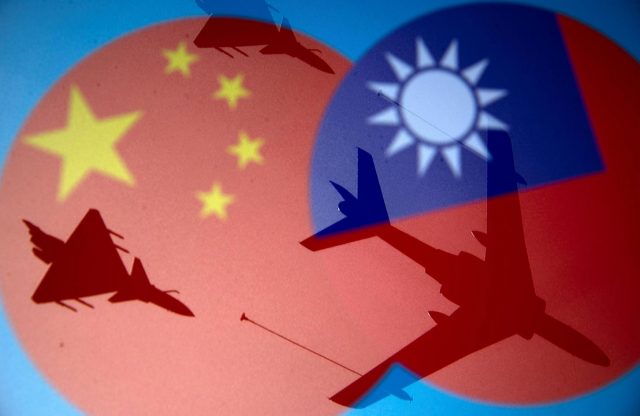
TAIPEI — A Taiwan government-backed television station apologized and urged people not to panic on Wednesday after mistakenly reporting a Chinese attack in Taipei, amid rising military tensions with Beijing.

During a live news broadcast on Wednesday morning, Chinese Television System mistakenly showed news ticker alerts at the bottom of the screen about military ships and critical infrastructure near Taipei being hit by Chinese missiles, according to local media reports.

The alerts included messages such as “a war could break out,” a major train station in Taipei being set fire by “Chinese agents” and Taiwan’s president declaring a state of emergency.

“Citizens, please don’t be overly panicked. We hereby clarify the information and apologize,” an anchor said in the network’s news bulletin at 10 a.m.

She said the alerts were meant for a drill with the Fire Department in New Taipei City on Tuesday but were mistakenly displayed on Wednesday morning because of a technical error.

There were no overt signs of panic in Taipei after the accidental bulletins.

China has never renounced the use of force to bring Taiwan under its control, and has stepped up military activities nearby in the past two years to press the island into accepting Beijing’s sovereignty claims.

Taiwan has raised its alert level since Russia invaded Ukraine, wary of China making a similar move, though the government has not reported any signs an attack is imminent.

The war in Ukraine, which Russia calls a “special military operation,” has prompted debate on the implications for Taiwan and ways to boost preparedness, such as reforms to the training of reservists.

Last week, Taiwan’s military released a handbook on civil defense for the first time, giving citizens survival guidance in a war scenario. — Reuters

Hong Kong activist jailed for sedition in city’s first case since 1997 handover

HONG KONG — A Hong Kong opposition activist was jailed for 40 months on Wednesday after the city’s first sedition trial since its handover from British to Chinese rule nearly 25 years ago.

Sentencing politician and former radio host Tam Tak-chi in the District Court, judge Stanley Chan said he could not ignore the “social-political reality” of Hong Kong given the protracted protests and violence that rocked the city in 2019.

Noting Mr. Tam’s offenses took place in the first half of 2020, Mr. Chan said in his judgement that “the court could not take away the social and political reality as the background for sentencing, which also allowed a better understanding of the seriousness of the defendant’s crime and its political purpose.”

He sentenced Mr. Tam to 11 charges that included uttering seditious words, public disorder and incitement to take part in an unauthorized assembly. Mr. Tam was also fined HK$5,000 ($638).

Mr. Tam was arrested in July 2020 — weeks after Beijing imposed a sweeping national security law on the city.

While the charges involved existing offences that pre-dated the new law, his case was dealt with by judge Chan, part of a new panel selected by Hong Kong Chief Executive Carrie Lam to handle national security cases.

Judge Chan earlier accepted the prosecution’s argument that Tam’s public use of the protest slogan, popular in 2019, “liberate Hong Kong, revolution of our times”, carried pro-independence connotations.

Mr. Tam’s defense lawyers said in court that he had long been passionate about politics and social issues and wanted change for society, not his own benefits.

Legal scholars have said the colonial-era sedition offence had not been used for decades, but is likely to be used more after the security law was imposed. Other activists have since been jailed for sedition offences after Mr. Tam’s arrest.

Western governments and other critics say the national security law has put freedoms at risk with tough bail provisions and expanded police powers under a legal regime that punishes subversion, terrorism and collusion with foreign forces with up to life in prison.

Hong Kong and Chinese officials say the law was vital to ensure stability after the 2019 protests, and say prosecutions are not political.

Mr. Tam said on his Facebook page on Wednesday that he would appeal, saying “my sentencing will affect Hongkongers’ freedom of speech”. — Reuters

Globe sends aid to over 16K families affected by Typhoon Odette

Digital communications, health services provided

Leading digital solutions platform Globe has contributed millions in aid to families and communities affected by Typhoon Odette, which ravaged parts of the country in December.

Globe collected a total of P36.7 million worth of donations for immediate assistance to over 16,000 families, and enabled Globe, TM, and GOMO customers to raise over P2.9 million more worth of aid for typhoon victims.

Globe, through its on ground teams, extended assistance to 5,094 families in communities across Palawan, Butuan, Cagayan de Oro, Camiguin, Dinagat Islands, Surigao del Norte, Bohol, Cebu, Iloilo, Negros Occidental and Oriental, and Southern Leyte.

Likewise, efforts with partner organizations such as the Ayala Foundation, GMA Kapuso Foundation, and Rise Against Hunger Philippines, have also provided relief and support for 11,777 families in affected areas.

Globe also set up over 130 Libreng Tawag and Libreng Charging sites across the affected regions, ensuring that typhoon survivors stay connected with their loved ones. Likewise, the company’s technical teams continue with tireless restoration work to bring services back to normal in the remaining affected areas.

“We know that this is still a difficult time for our kababayans. Typhoon Odette hit the country last December, but its effects are still being felt to this day. We want our customers to know that we are doing everything we can to serve and extend help in the affected communities,” said Yoly Crisanto, Globe Chief Sustainability Officer and SVP Group Corporate Communications Officer.

The following are other assistance that Globe provided to Odette-stricken communities:

  • Free and unlimited GoWifi services in select malls, airports and government offices
  • Discounted promos and free 1-month subscription to telehealth provider KonsultaMD for Globe and TM customers
  • Three days of free 5 GB connectivity for 107,000 Globe At Home Prepaid WiFi customers
  • 1 month free KonsultaMD subscription for 147,000 broadband customers
  • Reseeding of unused and expired load for Globe Business prepaid customers
  • Extended payment due dates for affected Globe Business, Globe At Home, Globe Platinum, and Globe Postpaid mobile customers, along with a Financial Care Program
  • Bill rebates for severely affected customers
  • Relief fund access to over 200 businesses
  • Priority access to customer hotline for around 86,000 Globe At Home Postpaid subscribers
  • After-sales fast lane access for Globe Business customers
  • Broadcast messaging service support for 83 typhoon-hit localities and MSMEs for one month via M360

Globe’s several fundraising campaigns through Globe Rewards and GCash also continue, with donation channels still open through the New GlobeOne app at glbe.co/NewGlobeONE and #GCashGivesBack. Customers can donate through this LINK, where they can access QR Codes of partner beneficiaries. To date, P32.4 million has been raised via GCash.

“Situations on-ground have been challenging, but with the persistence of our teams and the constant support of our partners, we were able to support families affected by Typhoon Odette with essential needs such as food and water as timely as possible,” said Jomar Fleras, Rise Against Hunger Philippines Executive Director.

Typhoon Odette, the strongest storm to hit the country in 2021, struck parts of Southern Luzon, Visayas and Mindanao with lashing winds and heavy rains just before Christmas, destroying over 400,000 houses and damaging a million more.

The GSMA Mobile for Development, a team from the GSMA driving innovation in digital technology to reduce inequalities in the world, recently featured Globe’s efforts in a report entitled “Typhoon Rai Response: The role of the mobile industry.” Those interested may access the report on their official website.

Globe supports the United Nations Sustainable Development Goals, particularly UN SDG No. 9, highlighting the roles of infrastructure and innovation as crucial drivers of economic growth and development. Globe is committed to upholding the United Nations Global Compact principles and contributing to 10 UN SDGs.

To learn more about Globe, visit www.globe.com.ph.


Spotlight is BusinessWorld’s sponsored section that allows advertisers to amplify their brand and connect with BusinessWorld’s audience by enabling them to publish their stories directly on the BusinessWorld Web site. For more information, send an email to online@bworldonline.com.

Join us on Viber to get more updates from BusinessWorld: https://bit.ly/3hv6bLA.

Sanofi breaks ground on its evolutive vaccine facility in Singapore 

Present at the Sanofi groundbreaking ceremony of its first-in-Asia Evolutive Vaccine Facility in Singapore were: [L-R] Eric Mansion, Head of Asia Zone, Vaccines, Sanofi; Thomas Triomphe, Executive Vice-President, Vaccines, Sanofi; Heng Swee Keat, Singapore’s Deputy Prime Minister and Coordinating Minister for Economic Policies; Marc Abensour, French Ambassador to Singapore; and, Koh Liang Hong, Singapore Evolutive Facility Site Head, Sanofi.

Pharmaceutical firm Sanofi broke ground on its evolutive vaccine facility (EVF) in Singapore on April 20. Aimed to be fully operational by 2025, the EVF is a digitalized, modular facility designed to manufacture multiple vaccines — including mRNA, enzymes, and monoclonal bodies.  

As the term “evolutive” suggests, the EVF can respond quickly to future pandemic risks and with the capacity to produce at a massive scale, according to Heng Swee Keat, deputy prime minister of Singapore and coordinating minister for Economic Policies, at the ground-breaking ceremony. 

“COVID-19 has reinforced the importance of pandemic preparedness and supply chain resilience. We must not take our foot off the pedal when the pandemic fades. Disease X will not be a matter of if, but when,” he said.  

Added Mr. Heng, “By enhancing our capacity for manufacturing vaccines in Singapore, the region will be in a stronger position for dealing with future pandemics and the ensuing economic shocks.”  

Singapore’s EVF has features such as a leak detection system, plus digital twins for each of its platforms for problem simulation and risk reduction. It is designed around a central unit comprised of several modules which can produce up to four vaccines simultaneously — regardless of the vaccine technology used (protein, mRNA, etc.).  

Current industrial sites are able to produce one vaccine at a time.  

The new bioproduction facility will furthermore reduce both resource consumption and waste production with the use of solar panels and green electricity purchase, minimizing its environmental impact.   

INVESTMENTS FOR INNOVATION
On the same day as the groundbreaking, Sanofi also announced its investment of €900 million over five years to create two EVFs – one in Singapore, and another in France. These EVFs pave the way for future vaccine innovation worldwide.  

Sanofi chose  Singapore because of its top-class environment for science and innovation, as well as its ecosystem that gathers universities, startups, and corporates, said Marc Abensour, French ambassador to Singapore. 

“The significant investment of Sanofi… signifies a high level of trust in our bilateral partnership, of which innovation is one of the strongest pillars,” he told the participants of the ceremony.  

Per Mr. Heng, Singapore is committed to investing about 1% of its GDP (gross domestic product) in research, innovation, and enterprise. Part of the local government’s efforts in this regard includes talent development programs in biopharma manufacturing.  

“To support innovation and leading-edge production, human capital is critical. This new facility will create 200 good jobs and we need to ensure that our people have the skills to take on these opportunities,” he said. — Patricia Mirasol

IMF economist sees risks that inflation expectations climb upward

The International Monetary Fund’s new chief economist said on Tuesday he is concerned about increasing signals that inflation expectations are on the rise and may become entrenched at elevated levels, prompting more aggressive monetary policy tightening in advanced economies.

Pierre-Olivier Gourinchas, who started transitioning to the IMF‘s economic counselor role in January, told Reuters in an interview that the war in Ukraine, which has caused sharp energy and food price increases, may damage expectations for decades-high inflation to start to subside this year.

A “very, very tight labor market” in the United States is increasing demands for wage increases to “catch up” with higher prices that could help fuel expectations among consumers and businesses that prices will keep rising, the French-born former University of California-Berkeley economist said.

“So there is definitely a risk that we could have a wage-price spiral,” Gourinchas said. “And there’s a risk also that as we live through a period of elevated inflation, and we hear that it goes from five to six to seven to eight (percent) – and we don’t see it turning around – people will start reassessing what they think inflation will be in the future and businesses will also do the same thing.”

That would be bad news for the Federal Reserve and other developed-world central banks, which have argued that inflation expectations among consumers and businesses have remained reasonably anchored at levels well below the current high readings of measured inflation.

Some Fed officials have begun to fret publicly that they may have a limited window now to ensure that that remains the case and an aggressive run of rate hikes this year is needed to pull that off. Read full story

Market signals from elevated Treasury yields have been ahead of consensus private forecasts for inflation, but both are pointing higher than the 2% inflation targets of many central banks, and forecasts have been “sort of moving up,” Gourinchas said.

“And that’s really, you know, the red alarm signal on the dashboard here,” he said. “If you see that and you’re a central banker, you don’t have a choice. You have to step in more forcefully to make sure people really anticipate that inflation will remain stable, even if it’s elevated right now.”


WAGE PRESSURES

The duration of elevated inflation readings is a downside risk for the United States and some other advanced economies.

“If inflation remains elevated for more than just a couple more months, if it keeps drifting upwards, we see these wage pressures building, we see these inflation expectations drifting more permanently and in particular the consensus forecast, then I think we would see a much more aggressive tightening of monetary policy going forward.”

Earlier on Tuesday, the IMF revised down its global economic growth outlook by nearly a percentage point from January due to shocks from Russia’s war in Ukraine, with significant downside risks from tighter sanctions. It called inflation “a clear and present danger” for many countries. Read full story

Gourinchas said the Fund’s baseline forecast anticipated that inflation will peak in the current quarter and start to decline as pandemic-driven supply chain bottlenecks ease and the withdrawal of pandemic fiscal support helps cool demand.

But while a faster tightening of U.S. monetary policy would slow U.S. growth further, it would be unlikely to cause a recession, based on the current baseline of still-robust 3.7% U.S. growth for 2022, Gourinchas said.

Steeper rate hikes, energy sanctions on Russia that spike prices further or a big drop in asset prices that stokes volatility could “bring us closer” to recession, he said.

“How close we could be, that’s not something we can assess precisely at this point. Our baseline is basically the U.S. economy is still going to be growing in 2022 and 2023,” Gourinchas said.

On China, he said recent data showed that its slowdown caused by renewed COVID-19 lockdowns may be a steeper than in the IMF‘s baseline, but the Chinese government had room for more monetary and fiscal stimulus actions to counteract these trends. – Reuters

U.S. concerned after China says it signs security pact with Solomon Islands

China said on Tuesday it had signed a security pact with the Solomon Islands, a move set to heighten concerns of the United States and allies Australia and New Zealand about growing Chinese influence in a region traditionally under their sway.

However, Solomon Islands officials earlier appeared to suggest no agreement had yet been signed.

Douglas Ete, chairman of Parliament’s public accounts committee, told fellow lawmakers that Chinese officials would arrive in mid-May to sign cooperation pacts. Prime Minister Manasseh Sogavare told Parliament that a proposed security agreement would not include a Chinese military base.

Ete said the agreements would increase cooperation on trade, education and fisheries, but that he opposed the idea of allowing China to establish a military base.

In Washington, the White House, which is sending a high-level U.S. delegation to the Solomons’ capital, Honiara, this week, said it was concerned about “the lack of transparency and unspecified nature” of the pact. Read full story

Australian officials said China appeared to want to pre-empt the arrival of the U.S. delegation in Honiara, which the White House said would discuss concerns about China, as well as the reopening of a U.S. embassy. Read full story

Chinese foreign ministry spokesperson Wang Wenbin said the framework pact had been signed recently by State Councilor Wang Yi and Solomon Islands Foreign Minister Jeremiah Manele. He did not detail where or when the signing took place.

A spokesperson for the White House National Security Council (NSC) said the reported signing “follows a pattern of China offering shadowy, vague deals with little regional consultation in fishing, resource management, development assistance and now security practices.”

The NSC later said the United States would “intensify its engagement in the region to meet 21st-century challenges, from maritime security and economic development to the climate crisis and COVID-19.”


AUSTRALIAN CONCERNS

Canberra is concerned that the pact could be a step towards a Chinese military presence less than 2,000 km (1,200 miles) from Australia’s shores.

Foreign Minister Marise Payne said Australia was “deeply disappointed” and continued to seek details of the terms of the agreement, noting that the signing had been announced by China.

She also expressed concern about a lack of transparency and said the pact had the “potential to undermine stability in our region.”

Australian national broadcaster ABC said Sogavare planned to make an announcement in coming days.

Solomon Islands officials had previously initialed a security pact with the Chinese Embassy that would allow Chinese police to protect infrastructure and social order, but ministers had not yet signed it.

Last week, Zed Seselja, Australia’s minister for international development and the Pacific, visited Honiara to ask Sogavare not to sign. Read full story

Greg Poling, an Asia maritime security expert at Washington’s Center for Strategic and International Studies, said it was still not clear whether an agreement had been finalized.

“So the U.S. delegation, as with the recent Australian delegation that visited, are trying to convince the Solomons’ government to reverse course if possible, or at least to clarify the details and plans for implementation if not,” he said.

“The language leaked last week is quite vague and so there’s plenty of room to mitigate damage by narrowing how it will be implemented.”

A leaked memo surfaced on social media last week showing that Beijing had told the Solomon Islands in December it wanted to send a team of 10 Chinese police with weapons including a sniper rifle and machine guns as well as listening devices to protect embassy staff in the wake of riots in Honiara. Read full story

A separate leaked draft of a security pact included provisions for Chinese police to protect companies and infrastructure, and for Chinese naval vessels to replenish in Honiara.

Chinese spokesperson Wang dismissed the planned U.S. visit.

“Deliberate attempts to inflate tensions and mobilize rival camps are also doomed to fail,” he said. – Reuters

New surrender deadline in Mariupol as West promises Ukraine more arms

Army soldier figurines are displayed in front of the Ukrainian and Russian flag colors background in this illustration taken, Feb. 13, 2022. — REUTERS/DADO RUVIC/ILLUSTRATION

Russia gave Ukrainian fighters still holding out in Mariupol a fresh ultimatum to surrender on Wednesday as it pushed for a decisive victory in its new eastern offensive, while Western governments pledged more military help to Kyiv.

Thousands of Russian troops backed by artillery and rocket barrages were advancing in what Ukrainian officials have called the Battle of the Donbas.

Russia’s nearly eight-week-long invasion has failed to capture any of Ukraine‘s largest cities, forcing Moscow to refocus in and around separatist regions.

The biggest attack on a European state since 1945 has, however, seen nearly 5 million people flee abroad and reduced cities to rubble.

Russia was hitting the Azovstal steel plant, the main remaining stronghold in Mariupol, with bunker-buster bombs, a Ukrainian presidential adviser said late on Tuesday. Reuters could not verify the details.

“The world watches the murder of children online and remains silent,” adviser Mykhailo Podolyak wrote on Twitter.

After an earlier ultimatum to surrender lapsed and as midnight approached, Russia’s defence ministry said not a single Ukrainian soldier had laid down their weapons and it renewed the proposal. Ukrainian commanders have vowed not to surrender.

“Russia’s armed forces, based purely on humanitarian principles, again propose that the fighters of nationalist battalions and foreign mercenaries cease their military operations from 1400 Moscow time on 20th April and lay down arms,” the Russian Defence Ministry said.

The United States, Canada and Britain said they would send more artillery weaponry, and the White House said new sanctions were being prepared.

U.S. President Joe Biden is expected to announce a new military aid package about the same size as last week’s $800 million one in the coming days, sources told Reuters.

U.N. Secretary-General Antonio Guterres called for a four-day humanitarian pause in the fighting this coming weekend, when Orthodox Christians celebrate Easter, to allow civilians to escape and humanitarian aid to be delivered.

Russia’s war in Ukraine is to blame for exacerbating “already dire” world food insecurity, with price and supply shocks adding to global inflationary pressures, U.S. Treasury Secretary Janet Yellen said. Read full story


CITY CAPTURED

Russia says it launched what it calls a “special military operation” on Feb. 24 to demilitarise and “denazify” Ukraine. Kyiv and its Western allies reject that as a false pretext.

Ukraine said the new assault had resulted in the capture of Kreminna, an administrative centre of 18,000 people in Luhansk, one of the two Donbas provinces.

Russian Foreign Minister Sergei Lavrov confirmed that “another stage of this operation is beginning”.

Driven back by Ukrainian forces in March from an assault on Kyiv in the north, Russia has instead poured troops into the east for the Donbas offensive.

It has also made long-distance strikes at other targets including the capital and the northeastern city of Kharkiv, where at least four people were killed by missiles, authorities said on Tuesday.

In one suburban street, the body of an elderly man lay face down near a park, a thick ribbon of blood running into the gutter.

“He worked in security not far from here,” a resident named Maksym told Reuters. “The shelling began and everyone fled. Then we came out here, the old guy was already dead.”


MARIUPOL

In Mariupol, scene of the war’s heaviest fighting and worst humanitarian catastrophe, about 120 civilians living next to the Azovstal steel plant left via humanitarian corridors, the Interfax news agency said on Tuesday, quoting Russian state TV.

A drone footage captured on Tuesday shows people buying food and other necessities at a makeshift market, as well as charging their mobile phones from a generator for about $1.35.

A Reuters correspondent said prices at the market were extremely high versus what people would normally pay there.

Mariupol has been besieged since the war’s early days. Tens of thousands of residents have been trapped and Ukraine believes more than 20,000 civilians have died there.

“The Russian army will forever inscribe itself in world history as perhaps the most barbaric and inhuman army in the world,” Ukrainian President Volodymyr Zelenskiy said.

“Deliberately killing civilians, destroying residential quarters and civilian infrastructure, and using all kinds of weapons, including those prohibited by international conventions, is already the brand signature of the Russian army,” he added in a video address.

Russia has denied using banned weapons or targeting civilians in its invasion of Ukraine and says, without evidence, that signs of atrocities were staged.

Video released by Ukraine‘s Azov battalion purported to show people living in the underground network beneath the sprawling steel plant, where they say hundreds of women, children and elderly civilians are sheltering with diminishing supplies.

“We lost our home; we lost our livelihood. We want to live a normal, peaceful life. We want to get out of here,” an unidentified woman says in the video.

“There are lots of children in here – they’re hungry. Get us out of here, we beg you. We’ve already cried out all the tears we have. We can’t cry anymore,” she added.

Reuters could not independently verify where or when the video was shot. – Reuters