
How PSEi member stocks performed — May 2, 2022

Here’s a quick glance at how PSEi stocks fared on Monday, May 2, 2022.


Here’s a quick glance at how PSEi stocks fared on Monday, May 2, 2022.
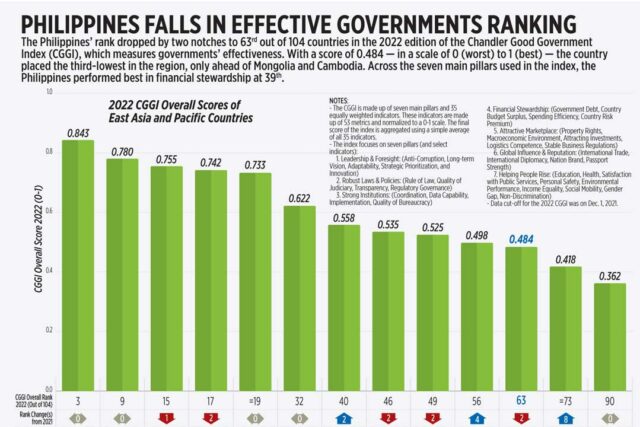
The Philippines’ rank dropped by two notches to 63rd out of 104 countries in the 2022 edition of the Chandler Good Government Index (CGGI), which measures governments’ effectiveness. With a score of 0.484 — in a scale of 0 (worst) to 1 (best) — the country placed the third-lowest in the region, only ahead of Mongolia and Cambodia. Across the seven main pillars used in the index, the Philippines performed best in financial stewardship at 39th.



THE PESO weakened on Monday as the market positioned ahead of an expected interest rate hike by the US Federal Reserve at its meeting this week.
The local unit closed at P52.365 per dollar on Monday, shedding 17.5 centavos from its P52.19 finish on Friday, based on Bankers Association of the Philippines data.
The peso opened Monday’s session at P52.25 against the dollar. Its weakest showing was at P52.40, while its intraday best was at P52.22 versus the greenback.
Dollars exchanged dropped to $840.7 million on Monday from $1.199 billion on Friday.
The peso depreciated as the market anticipates the Fed to hike rates again at its meeting this week, Rizal Commercial Banking Corp. Chief Economist Michael L. Ricafort said in a Viber message.
Investors expect the Fed to hike rates by 50 basis points (bps) when it meets on May 3-4 and the uncertainty is around how hawkish Fed Chair Jerome H. Powell will sound in comments following the decision, Reuters reported.
Markets are pricing in an aggressive run of rate hikes from the Fed as it tries to tame soaring inflation amid the ongoing Russia-Ukraine crisis, continuing lockdowns in China, and soaring global commodity prices.
The Fed began its tightening cycle at its March meeting, hiking borrowing costs by 25 bps.
Mr. Ricafort said losses in the local stock market also caused the peso to depreciate.
Shares continued to decline on Monday ahead of the Fed’s policy meeting and the release of Philippine inflation data.
The benchmark Philippine Stock Exchange index dropped by 10.17 points or 0.15% to close at 6,721.08, while the broader all shares index went down by 8.31 points or 0.23% to 3,596.83.
Meanwhile, a trader in an e-mail said the peso weakened following stronger-than-expected US personal consumption expenditure data.
The US Commerce department on Friday said consumer spending, which is more than two-thirds of the economy, increased by 1.1% in March. This is faster than the 0.7% forecast by economists polled by Reuters.
Meanwhile, the personal consumer expenditure price index jumped by 6.6% in March, its quickest pace since January 1982.
Philippine financial markets are closed on Tuesday in observance of Eid’l Fitr.
For Wednesday, Mr. Ricafort gave a forecast range of P52.22 to P52.42 per dollar, while the trader expects the local unit to move within P52.25 to P52.45. — L.W.T. Noble with Reuters

SHARES continued to decline on Monday ahead of the US Federal Reserve’s policy meeting and the release of Philippine inflation data.
The benchmark Philippine Stock Exchange index (PSEi) dropped by 10.17 points or 0.15% to close at 6,721.08, while the broader all shares index went down by 8.31 points or 0.23% to 3,596.83.
“Philippine stocks remained in a downturn on Monday as investors kept on their risk-off trading. The market was weak ahead of the Fed meeting and local inflation data this week. The Fed is expected to raise interest rates by 50 bps, but will be leaning on a higher hike by June as US inflation stayed elevated,” Papa Securities Corp. Equities Strategist Manny P. Cruz said in a Viber message.
“On the local scene, April inflation data will be reported this Thursday and the consensus is at 4.6%, higher than the 4% cap set by monetary authorities,” Mr. Cruz added.
“Very slim volumes on the exchange today ahead of tomorrow’s non-trading holiday. We have two key events in the short term, with the US Fed’s interest rate decision this Thursday and the national election next week. I expect trading volumes to remain thin until these events pass,” AAA Southeast Equities, Inc. President William M. Cabangon said in a Viber message on Monday.
Philippine financial markets will be closed on Tuesday in observance of Eid’l Fitr.
Investors expecting the Fed to hike rates by 50 basis points when it meets on May 3-4 and the uncertainty is around how hawkish Fed Chair Jerome Powell will sound in comments following the decision, Reuters reported.
Markets are pricing in an aggressive run of rate hikes from the Fed as it tries to tame soaring inflation amid the ongoing Russia-Ukraine crisis, continuing lockdowns in China, and soaring global commodity prices.
Meanwhile, a BusinessWorld poll of 17 analysts yielded a median estimate of 4.6% for April inflation, matching the midpoint of the central bank’s 4.2% to 5% forecast and going beyond its 2-4% target.
April inflation data will be released on May 5.
The majority of sectoral indices closed lower except for industrials, which gained 97.28 points or 1.06% to 9,278.71.
Meanwhile, financials sank by 19.03 points or 1.18% to 1,588.82; services dropped 12.59 points or 0.66% to 1,869.53; mining and oil lost 49.05 points or 0.42% to end at 11,475.71; property went down by 4.97 points or 0.16% to 3,051.16; and holding firms declined by 3.57 points or 0.05% to 6,338.
The MidCap index retreated by 6.51 point or 0.58% to 1,114.79 and the Dividend Yield index dropped by 4.82 points or 0.30% to close at 1,586.72.
Decliners overwhelmed advancers, 99 versus 60, while 67 names ended unchanged.
Value turnover decreased to P3.61 billion with 795.48 million shares changing hands on Monday from the P7.92 billion with 840.3 million issues seen the previous day.
Net foreign selling dropped to P491.11 million from the P1.68 billion seen on Friday. — Luisa Maria Jacinta C. Jocson with Reuters
By Kyle Aristophere T. Atienza, Reporter
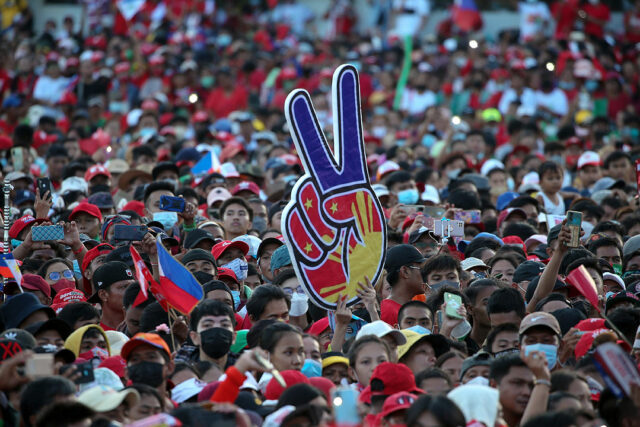
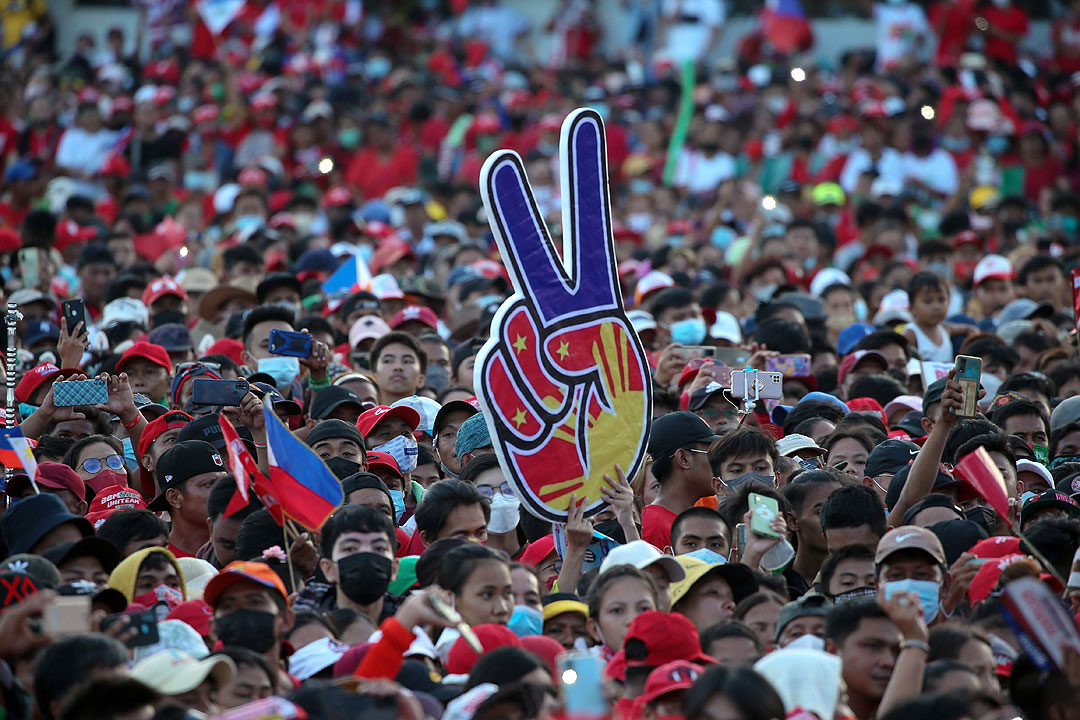
Former Senator Ferdinand “Bongbong” R. Marcos, Jr. kept his lead in Pulse Asia Research, Inc.’s presidential opinion poll exactly a week before this year’s election.
In a statement posted on its website on Monday, the pollster said 56% of Filipinos would vote for Mr. Marcos. His April rating was unchanged from the previous month.
Still at a distant second place was Vice-President Maria Leonor “Leni” G. Robredo with 23%, 1 point lower than her March score.
Senator and boxing champion Emmanuel “Manny” D. Pacquiao overtook Manila City Mayor Francisco “Isko” M. Domagoso with 7%, gaining a point. The mayor lost 4 points to 4%.
Senator Panfilo “Ping” M. Lacson remained in fifth place with 2%.
Davao City Mayor and presidential daughter Sara Duterte-Carpio, Mr. Marcos’s vice-presidential mate, kept the top spot with 55%, a point lower than in March, Pulse Asia said.
Still in second place was Senator Vicente C. Sotto III with 18%, 2 points lower than in March, followed by Senator Francis “Kiko” N. Pangilinan who gained a point at 16%
Pulse Asia said Mr. Marcos got the majority in most areas, from 54% to 67%, while in central Philippines, less than half of votes or 47% expressed support for Mr. Marcos. “These figures are virtually the same as those recorded by the latter in March 2022.”
It added that support for Ms. Robredo ranged from 11% in Mindanao to 34% in the Visayas.
Ms. Robredo’s score rose by 9 points in Metro Manila and fell by 6 points for the rest of Luzon from March, Pulse said. “These movements fall short of being significant given the relevant error margins for these subgroupings.”
“It seems like the numbers of VP Robredo did not move,” Arjan P. Aguirre, who teaches political science at the Ateneo De Manila University, said in a Facebook Messenger chat. “But upon closer look, the Leni-Kiko tandem is making a dent in terms of gaining points in Metro Manila and being statistically tied at second place, respectively.”
Mr. Aguirre said Ms. Robredo and her running mate Senator Francis “Kiko” N. Pangilinan have managed to secure the second spot, sending a message to voters that they are part of the emerging two-way race.
“The house-to-house efforts, recent endorsements and mammoth rallies are working for them,” he said. “They started at the bottom before the onset of the election, look how much they have improved in the polls — at second place in a likely two-way race.”
In a statement, Ms. Robredo’s spokesman said her numbers were encouraging even if the poll did not capture the series of rallies for the opposition tandem from mid-April onward, including the record-breaking rally near Manila, the capital that drew more than 400,000 supporters.
“The remaining weeks of the campaign have seen intensified efforts at house-to-house, person to person campaigning by thousands of volunteers, which we believe will translate to support on election day,” said Ibarra M. Gutierrez III.
“This has truly become a people’s campaign, a grassroots movement of Filipinos from all walks of life and from all over the Philippines.”
Mr. Sotto, Mr. Lacson’s vice-presidential running mate, said he is confident of winning on May 9, adding that opinion polls and large campaign rallies would not guarantee a candidate’s victory. “We can still win this fight,” he said in a statement in Filipino.
“The people know who will truly serve them. On election day, I believe that the people will use their mind and heart in voting for the next set of leaders of our country.”
Pulse Asia interviewed 2,400 adult voters for the April 16-21 poll, which had an error margin of ±2 points.
Among the major events during the polling period were the dismissal of the disqualification cases against Mr. Marcos, his family’s P203-billion estate tax liabilities and Mr. Domagoso’s call for Ms. Robredo to quit the presidential race. — with Norman P. Aquino
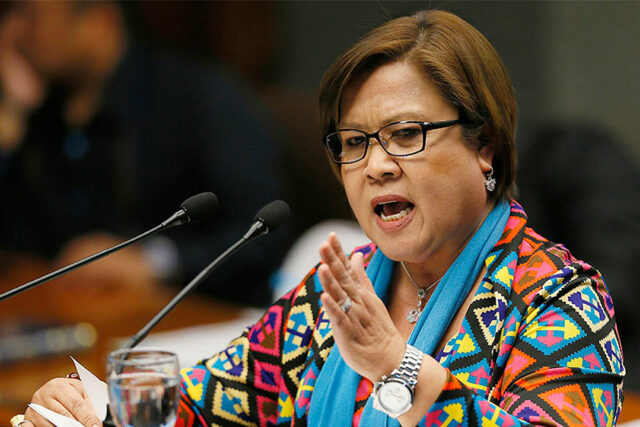
ANOTHER key witness has taken back his allegations against Senator Leila M. de Lima, who has been in jail since Feb. 2017 on drug trafficking charges.
In a four-page affidavit dated April 30, former Bureau of Corrections Director General and ex-National Bureau of Investigation (NBI) Deputy Director Rafael Z. Ragos claimed to have been coerced into testifying against one of President Rodrigo R. Duterte’s most outspoken critics.
“There is no truth whatsoever to any of these affidavits or House and court testimonies, or any other statement made in the media or other investigatory proceedings, including the Senate and Department of Justice (DoJ),” according to a copy of his statement sent to reporters on Monday.
“I did not expect, at least at this stage… Rafael Ragos to retract his statements and testimonies implicating me in the Bilibid drug trade,” Ms. De Lima said in a statement.
“After all, he played along with my persecutors in the Duterte administration for so long I no longer hoped that he still had any remaining ounce of integrity in himself,” she said, adding that these retractions have affirmed her innocence.
Mr. Ragos had accused Ms. De Lima of accepting P5 million in drug money from him when she was still Justice secretary in 2012. She allegedly used the fund to finance her senatorial run in 2016.
The former jail official earlier claimed the money had come from convicted drug lord Peter Co.
He claimed to have been coerced by a former Justice chief into testifying against Ms. De Lima.
“Fearing for my life and my family, I had no choice but to follow everything that these people asked me to do,” he said. “I also did not want to go to jail for fear of being the subject of acts of revenge by criminals I put in jail as an NBI official.”
“All these happened before I became secretary of justice,” Justice Secretary Menardo I. Guevarra told reporters in a Viber message on Monday. “Allow me to discuss these matters with the prosecutors concerned.”
Last week, self-confessed drug lord Kerwin Espinosa also recanted his statements that implicated Ms. De Lima in the illegal drug trade.
He said police had coerced him to testify against the senator during Senate hearings investigating the illegal drug trade inside the national jail when Ms. De Lima was still Justice secretary.
Mr. Guevarra told reporters in a Viber message on Friday he would discuss with a panel of prosecutors if Mr. Espinosa should be charged with perjury.
The Department of Justice (DoJ) earlier said Mr. Espinosa’s counter-affidavit “bears no weight” because he was not used as a witness against Ms. De Lima.
“It is very clear that the truth is starting to come out and the sinister plot of Rodrigo Duterte and the entire government is already revealing itself,” Dino S. de Leon, Ms. De Lima’s spokesman, told the ABS-CBN News Channel on Monday.
He urged the DoJ to investigate personnel within its ranks involved in the case, which he called “the greatest frame-up” in Philippine history.
“It has been more than five years since Senator Leila de Lima was imprisoned, but not even one gram of illegal drugs or one page of documentary evidence was presented against her,” Vice-President and presidential candidate Maria Leonor “Leni” G. Robredo said in a statement in Filipino. “I am one with the belief of every Filipino in their call for justice: Free Leila now.”
Human rights lawyer and senatorial bet Jose Manuel “Chel” I. Diokno said officials involved in the intimidation of witnesses should be held accountable.
“If Department of Justice officials can intimidate witnesses like Ragos and get away with it, what kind of justice can we expect?” he said in a statement on Monday. “If they were able to do this to an incumbent senator, what more can they do to an ordinary citizen?”
“The pattern of political persecution and trumped-up charges used against Senator De Lima is clear,” Anakpawis Party-List National Vice-President Ariel B. Casilao said in a statement in Filipino. “It is the same tactic used against activists who are victims of the fascistic movement of the Duterte regime.”
Meanwhile, presidential spokesman Jose Martin M. Andanar said the government respects the independence of the court handling the case of Ms. De Lima, one of the fiercest critics of Mr. Duterte’s war on drugs that has killed thousands of suspects.
“We respect the independence of the court handling the case of Senator De Lima, particularly in evaluating the evidence presented,” he said in a statement.
“At the same time, we continue to trust the Department of Justice and the National Prosecution Service in performing their mandates in investigating and prosecuting the charges against the lady senator,” he added. — John Victor D. Ordoñez

PRESIDENT Rodrigo R. Duterte on Monday declared May 3 a regular holiday to mark the end of Ramadan.
In a proclamation, Mr. Duterte said the holiday had been recommended by the National Commission on Muslim Filipinos.
Mr. Duterte made the declaration just a day after the Islamic religious authority in the Bangsamoro region recommended to the National Government that the Eid’l Fitr holiday be set for May 2.
Late holiday announcements could affect business preparations, said John Paolo R. Rivera, an economist at the Asian Institute of Management.
“Some organizations have already anticipated the announcement, pushing them to make plans in advance despite the lack of an official announcement,” he said in a Viber message.
“Late declarations have been an issue since the pandemic,” Mr. Rivera said. “Organizations should have learned contingency planning because we know how disruptive late announcements are.”
Michael L. Ricafort, chief economist at Rizal Commercial Banking Corp., said holidays should be announced early so businesses could prepare properly.
“It would definitely help businesses and other institutions to prepare their respective operations and prevent any potential disruptions,” he said in a Viber message. “It is a delicate balancing act for the economy.”
Eid’l Fitr, a significant occasion in Islam, is observed by Muslims for one to three days after a month-long fasting, which some economists say cuts economic output in some countries.
A 2014 report by the US-based National Bureau of Economic Research said Ramadan “showed causal evidence of an effect of Ramadan fasting on labor market status.”
Longer Ramadan fasting has a “robust negative effect” on output growth in Muslim countries, according to the study, which used data from Muslims fasting in 167 countries over 60 years. It said lengthening the fast by a single hour could reduce economic growth by 0.7 percentage points.
On the other hand, Ramadan was “accompanied by an increase in the levels of self-reported happiness and life satisfaction among Muslims.”
“In general, holidays and special days of celebration should boost consumer spending,” Emy Ruth Gianan, who teaches economics at the Polytechnic University of the Philippines, said in a Facebook Messenger chat.
“We usually save up some money to fulfill traditions and in the case of our Muslim brothers and sisters, they decorate their homes, prepare sumptuous meals and share gifts.”
Alile Hissah, a 24-year-old Muslim Filipino, said Muslims usually prepare festive meals and share these with relatives and neighbors — Kyle Aristophere Atienza
By Alyssa Nicole O. Tan, Reporter
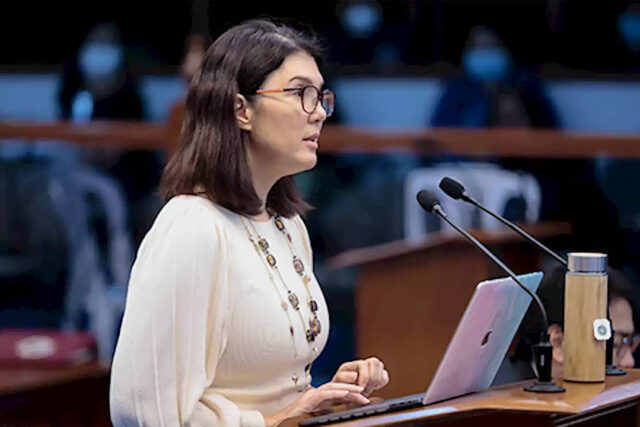
GOVERNMENT AGENCIES and industry representatives told a Senate committee that they support a bill seeking to impose a 12% value-added tax (VAT) on digital transactions, in order to ensure equal tax treatment for traditional and digital businesses.
The measure clarifies the VAT status of digital service providers, according to Senator Pilar Juliana S. Cayetano, who chairs her chamber’s Ways and Means committee, during a hearing on House Bill 7425.
“This measure will also generate revenue from new sources to fund the country’s efforts to recover from COVID and other expenses. Digital transactions soared during the pandemic. Lockdowns and the quarantine restrictions pushed cost-conscious consumers and suppliers into the digital economy,” she added.
Citing data from the 2020 World Bank Digital Report, the Department of Finance reported that the number of internet users in the Philippines increased to 73 million during the most restrictive phases of the quarantine. Average hours spent by Filipinos on the internet exceeded five hours from four previously due to mobility restrictions.
“We fully support the passage of this bill. It is a timely legislation,” Bureau of Internal Revenue Assistant Commissioner Larry M. Barcelo said at the hearing.
“It is high time to put businesses, especially those conducted by foreign non-resident entities, on equal footing with the traditional brick and mortar businesses in order to even the playing field,” he added.
Trade and Industry Assistant Director Marie Sherylyn D. Aquia of the Bureau of International Trade Relations said the Trade department welcome a feature of the bill defining the tax treatment of facilitated goods and services, in light of the explosion in the delivery of goods ordered online.
“The government should continue to seek ways to address the gaps in the tax system that allow some companies to shift profits away from where the economic activity and value creation are taking place,” she said.
The measure would impose a 12% VAT on the digital sale of services such as online advertising, subscription services, and the supply of other electronic and online services that can be delivered through the internet such as mobile applications, online marketplaces, online licensing of software, and webcasts, among others.
It would also add a new section in the National Internal Revenue Code of 1997 that would require foreign digital service providers to collect and remit VAT for all transactions that go through their platforms.
Bangko Sentral ng Pilipinas (BSP) Payment System Oversight Department Deputy Director Bridget Rose M. Mesina-Romero said the measure is necessary to update the VAT regime in a manner that helps it keep up with the rapid transformation of the digital economy.
However, the additional tax burden may hinder the recovery of smaller enterprises, including gig workers who rely on digital channels to continue their livelihood, as it may lead to lower income, she said.
As such, the BSP proposed VAT exemptions for low-value digital transactions of up to P500, as well as for service fees charged by payment service providers for the use of digital payments.
“This is consistent with the intent of the TRAIN (Tax Reform for Acceleration and Inclusion Law) to exempt from personal income tax the individuals whose annual taxable income does not exceed a certain threshold,” she said, adding that by exempting small digital payments from VAT, minimum wage income earners will not be unduly burdened. The potential negative impacts on the poor and marginalized sectors that shift to digital services will be minimized, she added.
Ms. Cayetano said she was interested in exploring the BSP’s proposals and defined her intended approach to taxation as “reverse discrimination,” which she hopes will encourage digital transactions via the effective 12% discount for those eligible for the exemption.
Ms. Mesina-Romero said the proposed service fee exemption will help encourage the use of digital services by individuals, business and government institutions.
Chairman of the FinTech Alliance.ph, Angelito M. Villanueva supported the BSP position.
Netflix APAC Indirect Tax Manager Davy Chen said the company’s input was solicited in drafting the bill at the House. Netflix supports the legislation.
“Under the proposed rules of the VAT bill, non-resident suppliers like Netflix will be able to register remotely for VAT only in the Philippines, then collect and remit the tax to the Philippines via simplified compliance mechanisms,” he said.
The simplified supplier VAT registration regime benefits both non-resident companies and the Philippine government, he added, as it would limit the compliance burden to non-resident VAT suppliers, while maximizing government revenue and limit costs.
However, there were calls to clarify the process for overseas suppliers transacting through intermediaries. The bill should specify the entity responsible for remitting and collecting VAT in that situation to avoid confusion and double taxation, the committee was told.
Asia Cloud Computing Association Secretariat Bensen Koh, who also represented the Asia Internet Coalition, also expressed support for the work being done by the Senate Committee, saying it should be in line with international best practices put forward by the Organisation for Economic Cooperation and Development and the International Monetary Fund.
On payments to government agencies, which are subject to 5% withholding tax and where non-resident service providers cannot claim input VAT, Mr. Koh sought clarification on the tax treatment for such transactions.
“In terms of providing a grace period for this transition, we propose that 9 to 12 months be provided after the promulgation of the details, implementing rules and regulations so that companies have the time to ensure compliance,” he said.
Ms. Cayetano said although she was unsure how far the bill will go before Congress adjourns on June 3, the goal was to get the discussions rolling on the scope of the proposed law.

TRADE Secretary Ramon M. Lopez said business process outsourcing (BPO) companies investing in the Philippines are engaging in higher-value activity, enabling the industry to climb the value chain.
“Our country is increasing its capacity to become a global player in IT-enabled services through the provision of analytical and AI skills development, competitive enabling environment, and cost efficiencies. This ensures that investors can profitably serve international and fast-growing regional markets,” Mr. Lopez said in a statement.
Mr. Lopez said he met with Mphasis Corp. Chief Executive Nitin Rakesh and Industry Solutions Group SVP & Global Head Indranil Roy in April to discuss the company’s plans to enter the Philippine BPO market.
The US information technology company expressed interest in the Philippines as a major destination for high-value services, and expects to hire an initial 1,500 to 2,000 for call center jobs.
According to the Department of Trade and Industry (DTI), Mr. Roy said the company services major banks and insurance companies, which made the recommendation to Mphasis to try the Philippines.
Mr. Lopez said the Philippine BPO industry, which refers to itself as the Information Technology-Business Process Management (IT-BPM) industry, remained resilient over the pandemic, as it did not lay off workers.
“Resources would not be a problem as the country has a workforce of 49 million, generates 800,000 graduates annually, with 30% coming from the science, technology, engineering, and mathematics (STEM) field,” he added.
The Board of Investments (BoI) Managing Head and Trade Undersecretary Ceferino S. Rodolfo also said the BoI can match Mphasis Corp. with various educational institutions should it seek to develop talent at the school level with a custom curriculum.
“Another resource that they can tap into is the returning overseas Filipino workers (OFWs) who have an advantage in terms of experience with their new knowledge and skills acquired from their respective countries,” he added.
The Philippines holds 13% of the global IT-BPM market, and accounts for 1.3 million direct jobs and 4.5 million jobs overall, with more than 700 BPO companies in the country, according to the DTI.
“Our continued efforts to upskill our workforce and liberalize our industries through major economic reforms… have proven our capability to position the Philippines as an ideal investment hub in Southeast Asia. We look forward to how the next generation of leaders can further build on these successes,” Mr. Lopez added. — Luisa Maria Jacinta C. Jocson

DOMESTIC TRADE by value in 2021 rose by 21.6% to P718.44 billion, the Philippine Statistics Authority (PSA) said, reflecting a recovery in the economy from the low base formed by 2020, the first year of the pandemic.
The finding was contained in the PSA’s Commodity Flow in the Philippines final report in released on Monday.
By volume, domestic trade increased by 24.6% to 20.22 million tons.
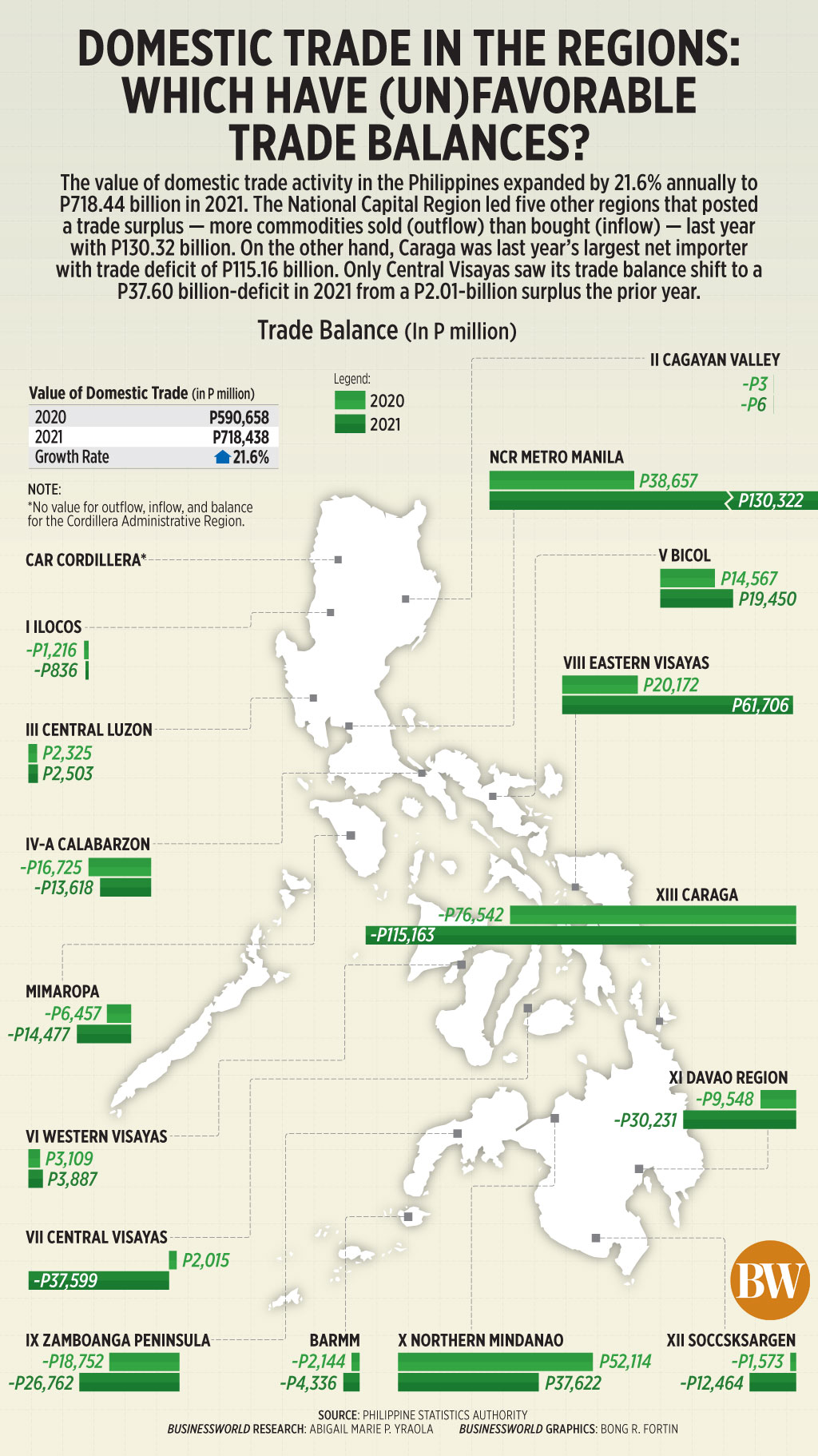 Commodity flow, also known as domestic trade, refers to the flow of goods through water, air, and rail transport systems. The greater portion of domestic trade was waterborne.
ING Bank N.V. Manila Branch Senior Economist Nicholas Antonio T. Mapa said last year’s jump in trade was due to base effects.
“Gradual reopening of the economy was carried out during periods of low virus caseloads and this helped bolster trade numbers,” he said in an e-mail.
Mr. Mapa expects domestic trade this year “to stay positive although we may need to (anticipate) more moderation as base effects are washed out.”
Seven out of 10 commodity groups grew by value last year. Machinery and transport equipment, which accounted for 27.9% of domestic trade, grew by a third to P200.55 billion. By volume, trade in this segment rose by 26.1% to 2 million tons.
The value of animal and vegetable oils, fats, and waxes contracted by 46.6% to P2.42 billion. By volume, trade in these goods declined by 42.1% to 56,698 tons.
Crude materials, inedible, except fuels, posted the top volume growth rate to 1.97 million tons in 2021 from 846,762 tons a year earlier. By value, the category grew by 54.6% year on year to P15.56 billion.
The National Capital Region was the top source of commodities last year with total outflows amounting to P198.17 billion, for a trade surplus of P130.32 billion.
The top destination of commodities was the Central Visayas, which posted inflows valued at P135.54 billion for a P37.60-billion trade deficit. — Keisha B. Ta-asan

THE Department of Public Works and Highways (DPWH) said on Monday that civil works have started on a major pumping station serving a flood-prone area of Valenzuela City.
The project is expected to boost the city’s resilience to climate change, the department said in a statement.
The station is being implemented by DPWH Metro Manila 3rd District Engineering Office and is “expected to address the city’s perennial flooding problem as well as of neighboring areas along Meycauayan River,” it added.
Once the P234-million project in Barangay Veinte Reales is completed, it will complement the current network of 17 pumping stations in Valenzuela City.
In the DPWH’s flood management master plan for the Greater Metro Manila area, the measures being pursued include a rainwater catchment system that will enable some communities to store rainwater for reuse.
In February, the DPWH regional office in Metro Manila said it was evaluating sites for catch basins to minimize flooding in the capital.
The World Bank estimates that the Philippines was visited by 94 destructive typhoons between 2011 and 2015, or 9.3% more than the number of such typhoons between 2006 and 2010.
It also noted that many areas in Metro Manila are low-lying and designated as flood prone, with insufficient protection against frequent inundation as natural drainage is often restricted during rainfall events by high river and sea water levels.
The World Bank provided technical and financial assistance for the department’s flood management master plan for Greater Metro Manila. — Arjay L. Balinbin

TAXES collected from marked fuel products amounted to P452.03 billion as of April 28, counting back to 2019 when the program started, according to the Department of Finance.
This total includes P422.22 billion from customs duties as of April 28 and P29.81 billion from excise taxes collected as of Oct. 28, 2021.
The volume of marked fuel was 40.81 billion liters as of April 29, according to data provided by Finance Secretary Carlos G. Dominguez III via Viber on Monday.
The fuel marking program was launched on Sept. 4, 2019. Fuel marked with a special dye is deemed tax compliant, while the absence of the dye is considered an indication that the fuel may be smuggled.
Luzon accounted for over 73% of all marked fuel, or over 30 billion liters, while 8.5 and 2.2 billion liters were marked in Mindanao and the Visayas, respectively.
Marked diesel accounted for 60.70% of all marked fuel, while gasoline took up 38.79%, and kerosene the remainder at 0.51%.
There are currently 28 oil firms participating in the fuel marking program.
Fuel marking is authorized under Republic Act 10963, or the Tax Reform for Acceleration and Inclusion law, as a smuggling deterrent.
The Bureau of Customs marked a total of 11.68 billion liters of fuel this year as of the end of April. Last year, it marked 17 billion liters.
Customs collected P60.15 billion in duties and taxes from its fuel marking program in the first quarter of the year.
Mr. Dominguez said that the government expects to collect P147.1 billion in fuel excise tax and VAT in 2022. — Tobias Jared Tomas
