Home Blog Page 5919

Spectrum, Toyota switch on solar rooftop project in Laguna plant

MSPECTRUM, Inc. and Toyota Motors Philippines Corp. (TMP) have energized a 460-kilowatt-peak (kWp) solar rooftop installation at the car manufacturer’s plant in Sta. Rosa, Laguna.

In a statement on Thursday, solar power firm MSpectrum, also known as Spectrum, said the solar project is an expansion of TMP’s 1-megawatt (MW) facility.

Spectrum, a wholly-owned subsidiary of electricity distributor Manila Electric Co. (Meralco), also installed the car maker’s existing solar power source in December 2018.

“The expansion project is expected to generate approximately 625,700 kWh (kilowatt-hour) of clean energy per year, translating to an estimated annual savings in energy costs amounting to P3.5 million,” the solar company said.

It is also seen to result in a reduction of about 446 metric tons of carbon emission, equivalent to more than 45,000 trees planted or 1,775,148 kilometers less in vehicle travel per year.

“I am extremely proud of the work that the TMP Solar Project Team, Meralco, and Spectrum have been doing for several months to complete this expansion project and achieve full operation. For TMP, I am confident to say that Plant Carbon Neutrality by 2035 is possible,” TMP President Atsuhiro Okamoto said.

The new solar facility further speeds up TMP’s sustainability journey as it supplements its earlier solar project that has generated about 4,753,561.58 kWh of clean energy since its commercial operations.

Thus far, the company has saved around P31.6 million in energy costs and lessen its carbon footprint by 3,385 metric tons.

“Through stronger collaboration within the Toyota network, we will continue to work hand-in-hand with our stakeholders to achieve Plant Carbon Neutrality and our Toyota Environmental Challenge (TEC) 2050 targets. Our global vision may be ambitious, but we will continue to challenge ourselves to ‘move our world’ by creating a net positive impact and a more sustainable society for future generations,” Mr. Okamoto said.

Patrick Henry T. Panlilio, Spectrum’s chief operations officer, said: “We have been in partnership with Toyota since 2018 and now, we are celebrating a huge milestone with the expansion of their original solar array. With this, the clean energy that TMP will generate will increase by approximately 16% per annum.”

Renewable energy company Spectrum has been providing services and solutions to help its clients cut costs while doing good for the planet.

TMP is the largest automotive company in the country.
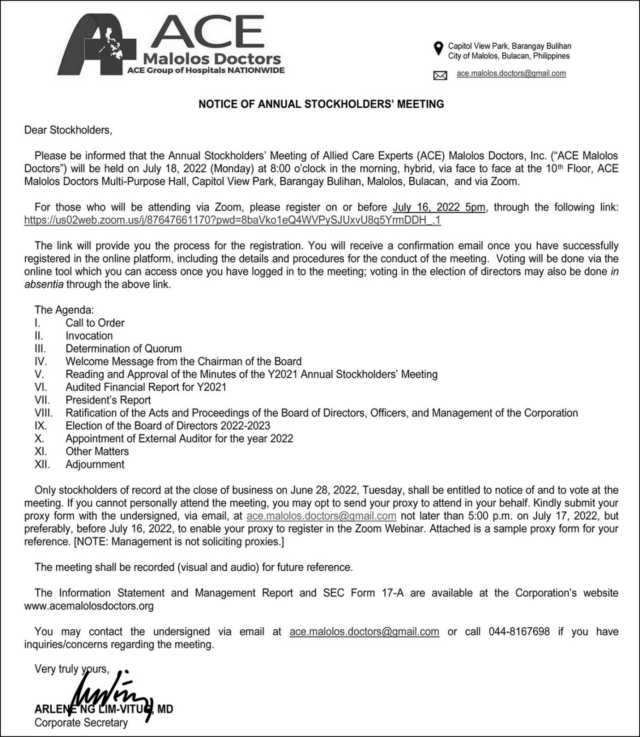
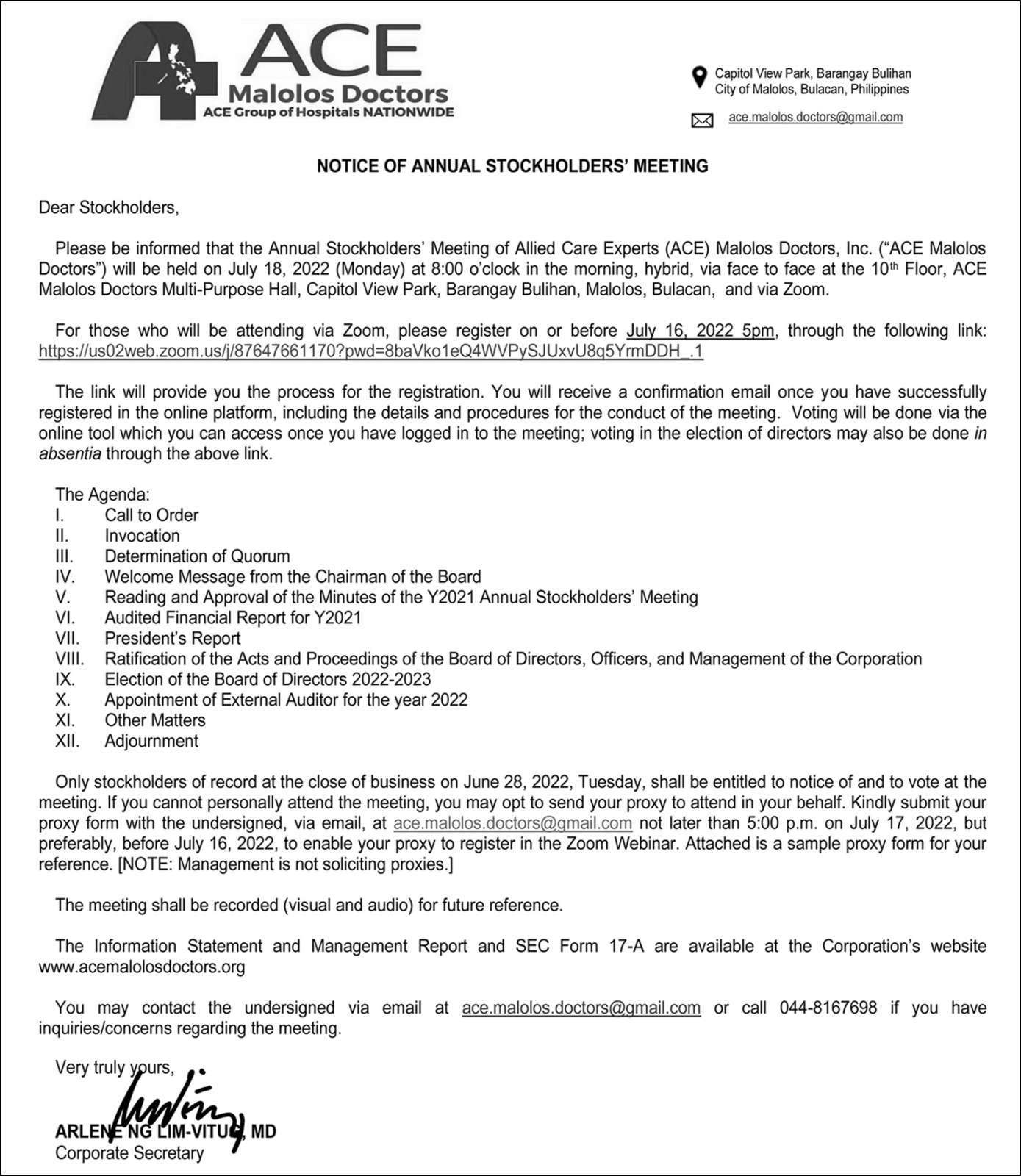
ACE Malolos Doctors announces schedule of hybrid stockholders’ meeting on July 18


Spotlight is BusinessWorld’s sponsored section that allows advertisers to amplify their brand and connect with BusinessWorld’s audience by enabling them to publish their stories directly on the BusinessWorld Web site. For more information, send an email to online@bworldonline.com.

Join us on Viber to get more updates from BusinessWorld: https://bit.ly/3hv6bLA.

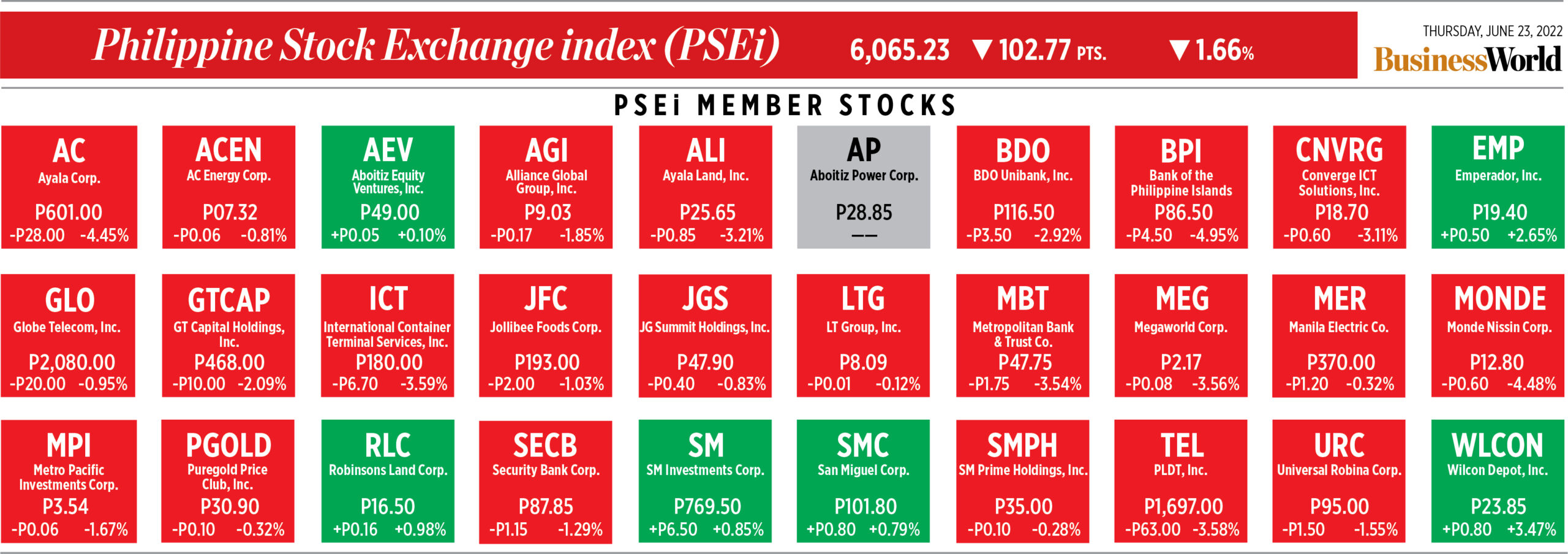
How PSEi member stocks performed — June 23, 2022

Here’s a quick glance at how PSEi stocks fared on Thursday, June 23, 2022.


PHL stocks decline ahead of BSP policy decision

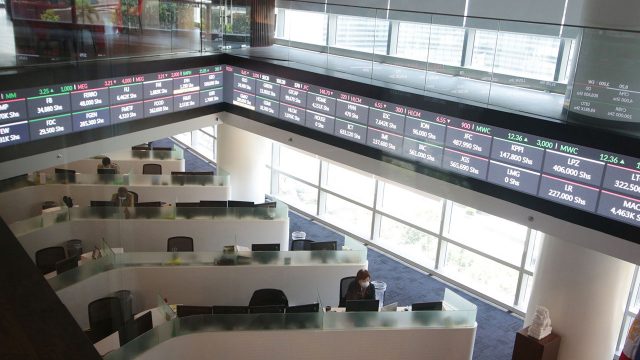
BW FILE PHOTO

PHILIPPINE SHARES fell on Thursday as investors awaited the central bank’s policy decision announced after the market closed.

The bellwether Philippine Stock Exchange index (PSEi) retreated by 102.77 points or 1.66% to end at 6,065.23 on Thursday while the broader all shares index fell 43.62 points or 1.31% to 3,284.73.

Thursday’s close is the PSEi’s worst showing since it finished at 6,019.26 on Oct. 19, 2020.

Philstocks Financial, Inc. Senior Research Analyst Japhet Louis O. Tantiangco said in a Viber message that the local bourse dropped as investors were cautious ahead of the policy decision of the Bangko Sentral ng Pilipinas (BSP).

“Investors traded cautiously while waiting for the BSP’s policy decision. The Philippine peso, which has been declining below the P54 per US dollar level, is seen to pose upside risks to inflation and discourage foreign investors from parking their funds in the Philippine market,” Mr. Tantiangco said.

First Metro Investment Corp. Head of Research Cristina S. Ulang said in a Viber message that the local market dropped on inflation worries. 

“Market bearish largely on jitters over higher inflation trajectory based on government pronouncements,” Ms. Ulang said.

After the market’s close, the BSP announced that its policy-setting Monetary Board decided to hike borrowing costs by 25 basis points (bps), bringing the key rate to 2.5%, to help stem rising inflation. This is despite market expectations of a 50-bp move following the US Federal Reserve’s hawkish turn.

Thursday’s hike followed an increase of the same magnitude at its May 19 meeting that kicked off the BSP’s tightening cycle following the cumulative 200 bps in cuts made in 2020 to support the economy amid the coronavirus pandemic.

Headline inflation reached 5.4% in May, faster than the BSP’s 2-4% target for the year. Year to date, inflation has averaged 4.1%.

The BSP on Thursday also raised its inflation forecasts. For 2022, it now sees inflation averaging 5% from 4.6% previously, which, if realized, would be the fastest since the 5.2% print logged in 2018. The 2023 forecast was also hiked to 4.2% from 3.9% previously.

Following the BSP’s decision, the peso closed at P54.70 per dollar, down 23 centavos from the previous day and the weakest since Nov. 21, 2005’s finish of P54.74.

All sectoral indices declined on Thursday. Mining and oil went down 454.15 points or 3.98% to 10,945.02; financials retreated 50.95 points or 3.34% to 1,471.22; services fell 39.40 points or 2.39% to 1,604.49; property decreased 36.66 points or 1.30% to 2,764.26; industrials dropped 91.91 points or 1.04% to 8,743.86; and holding firms lost 41.25 points or 0.72% to end at 5,663.91.

Decliners beat advancers, 143 against 65, while 36 names ended unchanged. Value turnover on Thursday reached P5.42 billion with 1.08 billion shares switching hands, higher than the P4.27 billion with 905.48 million shares logged the previous trading day.

Net foreign selling declined to P478.57 million from P560.32 million on Wednesday. — R.M.D. Ochave

Philippine-China oil exploration terminated  

Fisherfolks in Scarborough Shoal area in Masinloc, Zambales. — REUTERS

OIL and gas explorations between the Philippines and China have been completely terminated, according to Manila’s top envoy.  

“The president had spoken,” Foreign Affairs Secretary Teodoro L. Locsin, Jr. said in a speech in Manila, referring to President Rodrigo R. Duterte. “I carried out his instructions to the letter: Oil and gas discussions are terminated completely.”  

“Nothing is pending; everything is over,” he added. “Three years on and we had not achieved our objective of developing oil and gas resources so critical for the Philippines — but not at the price of sovereignty; not even a particle of it.”  

Outgoing President Rodrigo R. Duterte had ignored the country’s arbitral victory against China in exchange for infrastructure pledges from its neighbor. He also agreed to pursue a joint exploration with China in the South China Sea.  

In March, the tough-talking leader asked the next government to honor the Philippines’ commitment to the proposed joint oil exploration with China and avoid any conflict.  

The South China Sea, a key global shipping route, is subject to overlapping territorial claims involving China, Brunei, Malaysia, the Philippines, Taiwan and Vietnam. Each year, trillions of dollars of trade flow through the sea, which is also rich in fish and gas.  

 Mr. Locsin noted that despite attempts to reconcile issues in the disputed sea, not much has changed. 

“I tried for three years to come to an agreement to facilitate exploration for and exploitation of oil and gas in the West Philippine Sea,” he said, referring to areas of the waterway within the country’s exclusive economic zone. “We got as far as it is constitutionally possible to go.” 

“We had both tried to go as far as we could — without renouncing China’s aspiration on his part; and constitutional limitations on my part,” he added, citing discussions with Chinese State Councilor and Foreign Minister Wang Yi. “I shut down shop completely.”  

Nearing the end of his term, Mr. Locsin said the Philippines has not “surrendered a single inch of territory or a drop of our waters.”  

“Not by word or deed have we weakened our right to everything in the West Philippine Sea,” he said. “Without inviting pity by asking, we achieved an international consensus that right is with us and might cannot ever take it away.”  

Mr. Locsin said differences between the two nations should not lead to endless conflict.  

President-elect Ferdinand R. Marcos, Jr. has said Mr. Duterte’s nonconfrontational stance on the sea dispute with China  was “the right way.” He also said he would pursue an independent foreign policy.  

China has promised continued bilateral relations with the Philippines as the country transitions to a new government.   

Foreign Ministry spokesman Zhao Lijian earlier said China would stay committed to the friendship of both nations and focus on post-pandemic growth. — Alyssa Nicole O. Tan 

Media groups cite ‘chilling effect’ of website ban

A PHILIPPINE government order to block websites with alleged links to the Maoist movement could force self-censorship and push them to toe the government’s line, media organizations said on Thursday.

“This order by the National Telecommunications Commission (NTC) has a chilling effect,” Ronalyn V. Olea, managing editor at news website Bulatlat.com told the ABS-CBN News Channel.

Anyone who covers the other side that is considered an enemy of the state might also be considered one, she added.

The National Telecommunications Commission on June 8 ordered local internet service providers to block websites that allegedly support terrorists and terrorist organizations.

NTC Commissioner Gamaliel A. Cordoba issued the order upon the request of Hermogenes C. Esperon, Jr., the national security adviser of President Rodrigo R. Duterte.

Mr. Esperon on June 6 asked the NTC to order internet service providers to block access to 26 websites that it accused of supporting the Communist Party of the Philippines (CPP), New People’s Army (NPA), and the National Democratic Front of the Philippines (NDFP).

The Anti-Terrorism Council has labeled these terrorist groups.

The websites of alternative media Bulatlat and Pinoy Weekly, which have been reporting on grassroots situations, were among those listed by Mr. Esperon in his letter.

Also blocked were the websites of fisherfolk group Pamalakaya and Bagong Alyansang Makabayan, which are among Mr. Duterte’s fiercest critics.

The websites of Pamalakaya, Bulatlat, and Bayan were still inaccessible as of press time.

“This could be the start,” Ms. Olea said. “There is this level of anxiety because anyone red-tagged here in the Philippines could face other dangers, including harassment, surveillance and extrajudicial killing.”

Bulatlat did not get a notice from the government before it was blocked, she said. “We were not given any notice so there was no due process. We have the right to at least be notified of any government action.”

Ms. Olea said state forces usually start their attacks on the press with alternative media. “The cyber-attacks also started with Bulatlat and then later on, it also targeted other media outfits.”

“So we call on our colleagues, we thank our colleagues for standing up for press freedom because this is not only an issue for Bulatlat.”

Some Philippine news websites experienced cyber-attacks last year, according to a report by Sweden-based digital forensic group Quirium Media.

It traced the attacks on Bulatlat and Altermidya to computer networks of the Department of Science and Technology (DoST) and the Philippine Army.

A unit of the Department of Science and Technology later confirmed that the source of the attacks was the army.

The decision to block websites should not fall on the National Security Council and NTC, Jonathan de Santos, who heads the National Union of Journalists of the Philippines, told the same news channel. “It should not just fall on a small group of people.”

This is more within the purview of the courts, he pointed out. “The incident could start with Bulatlat and Pinoy Weekly, but it could easily spread to other news sites.”

Mr. De Santos separately told ABS-CBN Teleradyo the blocking of critical websites was arbitrary. “Their basis for blocking them — the alleged affiliation with CPP-NPA-NDF — is very vague.”

“Bulatlat and Pinoy Weekly are not designated [as terrorist groups],” he said. “The alleged connection, if any, is far-fetched.”

He said covering revolutionary and progressive groups does not necessarily mean supporting their cause.

Mr. De Santos said critics of the Anti-Terrorism Act who questioned its validity at the Supreme Court had raised concerns that journalists who interview rebels might get accused of being supporters.

“Journalists have to look at all points of view, and giving that point of view space or air time doesn’t mean support for it,” he said. “It doesn’t mean we’re encouraging people to join… It’s part of the job, you have to get their side as well.” — Kyle Aristophere T. Atienza

IBP scores arrest of journalists in Tarlac City land dispute

UNYON NG MGA MANGGAGAWA SA AGRIKULTURA FACEBOOK PAGE

A LAWYERS’ group on Thursday denounced the arrest of journalists who were covering a land protest in Tarlac City.

“Journalists should not have to run the risk of arrest and criminal charges when they are discharging their constitutionally protected duties of covering and reporting on matters of public consequence, such as land disputes,” the Integrated Bar of the Philippines (IBP) said in a statement.

“Any intrusion into this liberty of speech and of the press risks depriving the public of crucial knowledge of government affairs.”

Authorities arrested more than 90 people, including journalists, farmers and activists in the village of Tinang in Tarlac City for illegal assembly. Some of them were released shortly after, while 83 were charged.

“Journalists and other members of the press enjoy a wide latitude of discretion in investigating and reporting news relating to public affairs,” IBP said. Police should also respect citizens’ right to due process, it added.

Acting National Police chief Vicente D. Danao earlier questioned the presence of journalists in the protest, accusing them of meddling.

“What are you doing here and why are you meddling inside?” he told a press briefing last week, addressing the journalists. “Maybe you are the ones agitating these groups.“

The National Union of People’s Lawyers (NUPL) earlier said the protesters should not be punished for exercising their constitutional right to peaceful assembly.

Last week, the Commission on Human Rights said it would investigate the arrest after farmers filed a complaint at its Central Luzon regional office.

Vice President Maria Leonor G. Robredo also denounced the mass arrest, saying the protesters only wanted to provide for their families.

“A heavy-handed approach to the charge of illegal assembly guts the freedom to peaceably assemble and petition the government for redress of grievances,” IBP said. — John Victor D. Ordoñez

Bongbong as Agri chief: ill-advised or a bold move, says think tank

PRESIDENT FERDINAND R. MARCOS, JR. FACEBOOK PAGE

PHILIPPINE President-elect Ferdinand R. Marcos, Jr.’s decision to head the Agriculture department might have been ill-advised, a foreign think tank said on Thursday, noting that the sector could end up “having to endure unhelpful flip-flopping.”

While the move might be bold, “some look at this as a looming first fumble,” GlobalSource Partners, Inc. said in a note sent to BusinessWorld, citing views from insiders.

“By not providing for a buffer, i.e., a person he can fire if things fall apart, the president-elect may end up regretting this boldness, especially since the risks are manifold, from procurement to unexpected outcomes,” it said.

Victor D. Rodriguez, Mr. Marcos’ incoming executive secretary, did not immediately reply to a Viber message seeking comment.

On the other hand, GlobalSource said some see the move as a timely way of using his political capital “for what will likely be many unpopular decisions.”

The think tank said Mr. Marcos’ popularity could allow him to act as a referee between those who lobby for liberal trade policies and those who have a protectionist stance.

“We note that his sister, a senator, is one of the louder critics of the current administration’s resort to importation to address food shortages,” it said.

Popularity concerns “have a way of being shifted to the fiscal area,” the group said, citing Mr. Marcos’ campaign promise of lowering the price of rice to P20 a kilo, which the outgoing Agriculture chief said would cost the government about P123 billion yearly.

“People who know the sector well believe that his reform success depends on who his point person will be, i.e., his senior undersecretary,” GlobalSource said.

“But at the end of the day, we cannot also dismiss what this decision may be about, i.e., the president-elect’s failure to find a suitable candidate prepared to take on a difficult job at a difficult time,” it said. “In which case, we hope for the sake of the macro economy that he finds the right man soonest.” — Kyle Aristophere T. Atienza

No decision on BNPP; gov’t evaluating modular reactors

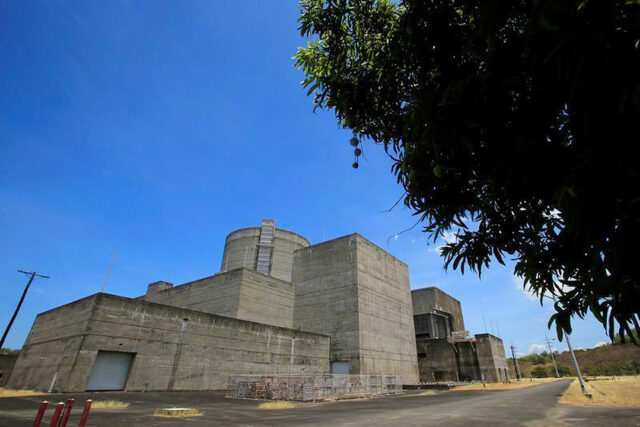
REUTERS

THE Climate Change Commission (CCC) said studies are still ongoing to determine the fate of the Bataan Nuclear Power Plant (BNPP), in compliance with the executive order (EO) that gave the go-signal for tapping nuclear power.

“We are aware that based on the EO, studies still have to be undertaken. That’s why we are also engaging our experts here, along with other national agencies” to ensure the appropriate policy that accords with scientific opinion, CCC Policy Research and Development Division Chief Jerome E. Ilagan said during the Second Virtual Philippine Life Insurance Summit on Thursday.

President Rodrigo R. Duterte signed EO No. 164 in February, authorizing the exploration of nuclear power as a possible addition to the energy mix.

In 2020, the Philippines’ power mix consisted of 57% coal-fired, 21% renewable energy (RE), 19% natural gas, and 2% oil.

Michael O. Sinocruz, the Department of Energy’s (DoE) Energy Policy and Planning Bureau officer-in-charge and director, said EO No. 164 has also triggered studies on the development of small modular reactors with capacity of about 50 megawatts.

Mr. Sinocruz said that compared to other sources of energy, nuclear energy is among the cheapest options, but will require significant spending to ensure safety.

“If you are going to compare nuclear with other energy sources, nuclear is the cheapest, but because of the additional safety measures (to be undertaken) due to Fukushima, the capital cost increased slightly, so now they are at roughly the same level with coal in terms of cost,” he said.

He added that when all costs are considered for nuclear, coal remains cheaper and its disadvantages can be mitigated by more efficient low-emission technology, which promise lower carbon dioxide emissions.

The DoE will implement the National Renewable Energy Program (NREP) 2020-2040 within the year. NREP sets a target of 35% renewable energy in the generation mix by 2030, driving this further to 50% by 2040.

About $153 billion in investment is needed, with $94.3 billion going to the construction of RE power plants and $510 million needed for renewable energy pre-development activities.

Mr. Sinocruz said that there were also currently talks with the Star Scientific Ltd., of Australia and Tokyo-based Hydrogen Technology, Inc. to introduce hydrogen as an alternative energy source.

Mr. Ilagan said the Philippine pledge to reduce greenhouse gas emissions by 2030 as part of the Paris Agreement on Climate change should not serve as a deterrent to seeking out other energy sources, adding that the country needs to get “creative.”

“Based on what we call the carbon budget, we still have space to emit (greenhouse gases),” he added. “But in the solidarity with the world, and since we also suffer when greenhouse gases go up, we commit to lowering future emissions; but we ask: give us support in terms of technology, capacity, and finance.” — Tobias Jared Tomas

PEZA calls for agro-industrial, aquamarine ecozones on gov’t land

THE Philippine Economic Zone Authority (PEZA) said 12 million hectares of government land needs to be tapped for agro-industrial and aquamarine economic zones (ecozones), to address the looming food crisis.

PEZA Director-General Charito B. Plaza said in a statement on Thursday that “For years, we have been hearing of plans for production and food sufficiency, yet we continue to be an import and consumption-dependent economy, despite the millions of hectares of idle land.”

“Our focus (must be) to utilize responsibly our very fertile land and rich natural resources towards self-reliance (and a) self-sustaining and resource-generating economy,” Ms. Plaza added.

Ms. Plaza said President-elect Ferdinand R. Marcos, Jr.’s decision to take control of the Department of Agriculture (DA) has opened up an opportunity for PEZA to explore the expansion of production via the ecozone route, with corresponding incentives to locators.

“PEZA will contribute in our own way… by transforming public land into viable agro-industrial and aquamarine (production centers to achieve) food security,” she added.

On May 31, the PEZA signed a memorandum of understanding (MoU) with the Department of Environment and Natural Resources (DENR) to create more ecozones in the countryside. The ecozone development program will be piloted in the Caraga region.

“Under the MoU, PEZA and DENR have agreed to pursue the establishment of special ecozones in potential areas within the jurisdiction of the DENR that are suitable for development as agro-industrial, agro-forestry, mineral processing, and eco-tourism (zones). We hope to truly implement these partnerships in the coming years under the administration of President-elect Marcos,” Ms. Plaza said.

“We aim to restore the once major industry of wood and bring order to the utilization of the raw minerals processed into many other products in Caraga, which has (major) timberland and mining land,” she added.

PEZA and DENR identified seven sites in the region viable for ecozone development. Four of the proposed economic zones will be in Agusan del Norte, while one site each has been nominated for Agusan del Sur, Surigao del Norte, and Surigao del Sur.

“Once proclaimed, these will be in addition to the 23 operating agro-industrial ecozones in PEZA, four of which are located in Luzon, five in Visayas, and 13 in Mindanao,” PEZA said. — Revin Mikhael D. Ochave

BSP studying 3 key market infra technologies

THE Bangko Sentral ng Pilipinas (BSP) is exploring three new technologies that will be crucial to the development of new financial market infrastructure (FMI), making the Philippines one of the more open jurisdictions in the region to new financial tools, the Asian Development Bank (ADB) said.

The ADB said the BSP is currently developing proofs of concept for artificial intelligence, open API (application programming interface), and cloud computing, three of the six technologies it identified as instrumental to the FMI of the future.

The  other three tools for the development of new FMI are distributed ledger technology (DLT), big data analytics, and cybersecurity.

The ADB said that according to a survey it conducted, five central banks in the ASEAN + 3 region have explored a single new technology; three have explored two; six have explored three; and two have explored four.

“Twenty of the 25 Cross-Border Settlement Infrastructure Forum (CSIF) member institutions responded to the survey in 2021. Sixteen of the 20 institutions stated that they have explored at least one of the six new technologies” ADB Financial Sector Specialist Byung Wook Ahn said in a webinar on Thursday.

“All central banks and central securities depositories (CSDs) in this region… really need to consider those emerging technologies. Regardless, if they only focus on one path or many, this is really the fact. The more important thing (is that) I realized, many of our CSIF members are already developing a proof of concept or already in the production level,” ADB advisor Satoru Yamadera said in the webinar.  

The Philippine CSD — the Bureau of the Treasury (BTr) — is deemed to be in the production stage in terms of cybersecurity and is developing a pilot case for DLT, also known as blockchain.

“The BSP has been exploring engagements with potential providers of blockchain analyzer solutions that could facilitate, among others, surveillance of supervised financial institutions utilizing cryptocurrency and blockchain technology in their businesses (i.e., virtual asset service providers)” the ADB said in its report detailing the outcome of the survey.

Recently, the BSP announced a pilot project that will test the use of a wholesale central bank digital currency (CBDC) for large-value financial transactions involving selected financial institutions.

This project will experiment with CBDC to move large-value transactions round the clock to advance the understanding of risks and opportunities involved in wholesale CBDCs.

The BSP and the State Bank of Vietnam (SBV) are the only institutions that have application cases in cloud computing, the ADB noted.

“These findings appear to mirror the challenges inherent in cloud adoption such as security and compliance concerns, efficient cloud spending, and cloud adoption and data transfer,” the report added.

The ADB found the BSP to be venturing into a “unified regulatory and supervisory technology end-to-end solution to streamline and automate regulatory supervision, reporting, and compliance assessment of cybersecurity risk management of BSP-supervised financial institutions.”

The BSP’s open finance framework was classified as having reached proof of concept stage and is working towards open API standardization.

The ADB said cybersecurity threats remain despite the pursuit of new infrastructure.

“Unfortunately, there is no easy solution. We simply need to create more awareness and understanding. There may be some areas where we can analyze (human) behavior (to facilitate the blocking of) these intrusions. But again, this is not easy. Central banks and CSDs particularly, since we need more investment in the deep critical market infrastructure,” Mr. Yamadera said. — Ana Olivia A. Tirona