Home Blog Page 5909

Stephen Curry, Warriors edge Grizzlies for 3-1 series lead

STEPHEN Curry had a game-high 32 points, including two key free throws with 45.7 seconds remaining, and the host Golden State Warriors held on to beat the Ja Morant-less Memphis Grizzlies 101-98 for a 3-1 lead in their Western Conference semifinal playoff series Monday night.

Despite having coach Steve Kerr on the sidelines due to a positive COVID test, the Warriors were able to overcome 9-for-37 shooting on 3-pointers to move within one game of their sixth trip to the Western Finals in the last eight seasons.

Warriors assistant Mike Brown, named earlier in the day as the next head coach of the Sacramento Kings, replaced Kerr at the front of the bench.

With Morant unable to play because of a right knee injury sustained in the fourth quarter of Game 3, the Grizzlies stunned the Warriors with a 15-8 start and led by as many as 12 early on.

Memphis, in fact, never trailed until the final minute.

After Curry had drawn the Warriors even on a jumper with 3:25 remaining, the Grizzlies went back up 93-90 on a Jaren Jackson, Jr. interior hoop and Kyle Anderson free throw with 2:32 to go.

Neither team scored again until Jordan Poole hit two free throws with 1:11 remaining to make it a one-point game, setting the stage for a Curry parade to the foul line.

After Dillon Brooks misfired on a 3-point attempt, Curry drew a foul on a drive to the hoop and hit his go-ahead free throws with 45.7 seconds left.

Jackson missed on a short floating attempt to regain the lead for Memphis, and when Curry was fouled on the rebound, he dropped in two more free throws to extend the margin to three.

Curry capped his 32-point performance with four subsequent free throws and Andrew Wiggins hit one, allowing the Warriors to survive a buzzer-beating 3-pointer by Brooks.

Curry’s game-high point total came despite 4-for-14 shooting on 3-pointers. Klay Thompson went 0-for-7 from deep on a 14-point night, while Poole was 0-for-3 from long range en route to 14 points.

Wiggins finished with 17 points and Otto Porter, Jr. 12 — all on 3-pointers — for the Warriors, who shot just 40% overall. Wiggins completed a double-double with 10 rebounds, while Draymond Green grabbed a team-high 11 boards to complement five assists and two points.

Jackson paced the Grizzlies with 21 points, while Tyus Jones, starting in place of Morant, contributed 19 points, six rebounds and five assists to the losing cause.

Coming back from a one-game suspension, Brooks had 12 points and a game-high-tying eight assists, while Kyle Anderson put up 17 points and Steven Adams registered a 10-point, 15-rebound double-double.

The Grizzlies hit just nine of their 35 3-point attempts, with Jones’ 3-for-7 effort leading the way. — Reuters

Al Horford helps Celtics pull even with Bucks

AL Horford poured in a career-playoff-high 30 points as the visiting Boston Celtics earned a 116-108 win over the Milwaukee Bucks on Monday night to even their Eastern Conference semifinal series at two games apiece.

The 15-year NBA veteran shot 11 of 14 from the field, including a 5-of-7 mark from 3-point range, to swing homecourt advantage back in Boston’s favor. The Celtics overcame an 11-point, third-quarter deficit.

Game 5 in the best-of-seven series is scheduled for Wednesday in Boston.

Jayson Tatum also had 30 points and grabbed 13 rebounds for the Celtics, and Jaylen Brown and Marcus Smart both tallied 18 points. Smart dished out eight assists.

Giannis Antetokounmpo was outstanding once again, pacing Milwaukee with 34 points, 18 rebounds and five assists. He shot 14 of 32 from the floor.

Jrue Holiday contributed 16 points, seven rebounds and nine assists, and Brook Lopez supplied 17 points and seven rebounds.

Boston went on a 10-0 run spanning the third and fourth quarters to tie the game, and the Celtics outscored the Bucks 43-28 in the final period. It was the Celtics’ highest-scoring quarter through eight postseason games this year.

Horford scored two buckets in the opening 2:09 of the fourth quarter, including a dunk that tied it at 80-80. He later made two go-ahead 3-pointers, putting Boston ahead 88-85 and later giving the Celtics a 95-94 edge that it never relinquished.

The Bucks had made their move in the third quarter behind 13 points from Antetokounmpo, leading by as much as 76-65. The Celtics pulled within seven by the start of the fourth.

After once leading by 10 in the first half, the Bucks went into the break with a narrow 48-47 lead.

Antetokounmpo led all scorers with 15 points and 11 rebounds before half time and was the only Milwaukee scorer in double figures.

The Bucks were extremely active on defense in the opening half, turning seven Boston turnovers into 11 points. Milwaukee also won the battle on the glass prior to halftime, hauling in 29 rebounds compared to the Celtics’ 21.

Brown and Horford each went for 11 points, and Tatum added nine despite going just 1-of-6 from beyond the arc.

Tatum finished 3 of 10 from long distance, while the rest of the Celtics were a respectable 11 of 27 (40.7%). The Bucks hit 9 of 27 (33.3%) from 3-point range, and they wound up with a 48-38 rebounding advantage. — Reuters

MVP choices

Depending on where you stood, you met the news of the Nuggets’ Nikola Jokić claiming a second straight Most Valuable Player award with either acceptance or derision. Even as the Maurice Podoloff Trophy was still in his mantel, he could not be deemed not a fashionable choice; that distinction belonged to the likes of the Sixers’ Joel Embiid and the Bucks’ Giannis Antetokounmpo, in part because of the way those around them performed — or, to be more precise, did not perform — in their absence.

Yet, it’s precisely because Jokić was a steady and steadying presence that his name proved to be the first on the ballots of majority of voters for the honor. He played the highest number of games of the three candidates, and he wound up with the best numbers in terms of advanced statistics. In other words, his impact became clear once the figures were parsed — in addition, of course, to the fact that he led the Nuggets to a 48-34 slate, good for an outright playoff berth, despite the absence of vital cogs Jamal Murray and Michael Porter, Jr.

Don’t tell that to Embiid supporters, though. The Process was in the process of garnering momentum as the postseason drew closer; he wound up with the scoring title while burning rubber in a career-high 68 matches. And, make no mistake, the Sixers needed every bit of him, the arrival of formed MVP awardee James Harden notwithstanding. The same goes for Antetokounmpo, the engine that makes the defending champions running smoothly.

Ironically, Jokić is as close to an objective choice as any. He had the best sabermetrics numbers of any bona fide candidate — make that of any player in the National Basketball Association — by far, and he continually filled the lines every time he suited up. Meanwhile, the Sixers and Bucks have, without question, gone only so far as Embiid and Antetokounmpo have taken them. Supporters need look no farther than their second-round set-tos to buttress the contention.

That said, longtime habitués know that: 1) the MVP award is for regular season exploits; and 2) justifications for votes can cut any number of ways. There can be no arguing against subjective decisions, period. And if Jokić emerged the winner, it’s only because more of the panelists and broadcasters tasked to make the choice had him on their ballots. It’s not a knock on Embiid, or on Antetokounmpo. It’s just an acknowledgment of the singular efforts of the lone player in league history to amass 2,000 points, 1,000 rebounds, and 500 assists in a single season — all while sharing the court with relatively less illustrious teammates.

Bottom line, each of the three would have been deserving of the MVP award. That Jokić emerged with it when the battlesmoke cleared is, for lack of a better term, what it is. Even casual observers know the NBA has more than enough examples of bad choices throughout its history. This isn’t one of them.


Anthony L. Cuaycong has been writing Courtside since BusinessWorld introduced a Sports section in 1994. He is a consultant on strategic planning, operations and Human Resources management, corporate communications, and business development.

Building the Filipino nation anew

PHILIPPINE STAR/ MIGUEL DE GUZMAN

Under a new political environment, we can expect three things to happen to our social and business relationships. There will be pockets of change here and there. Either more sustainable reforms will be realized, or the status quo will persist.

Government operations and political processes in the next six years will certainly affect the everyday lives of Filipinos — economically, socially, politically.

The new government must keep in mind that the issues confronting the nation have numerous dimensions and must be addressed on multiple fronts. This should dictate what solutions are needed, and how these will be set in motion in order to achieve recovery and growth, more than two years after the pandemic first reached our shores.

These issues are known intimately by no less than the people themselves. In Pulse Asia’s February 2022 survey on the “Most Urgent National Concerns for a Presidential Candidate to Address,” the five top-of-mind concerns of the people were “Controlling inflation” (48%), “Improving/Increasing the pay of workers” (38%), “Reducing poverty of many Filipinos” (33%), “Fighting graft and corruption in government” (32%), and “Creating more jobs” (29%).

In March 2022, Pulse Asia also conducted a survey on the “Most Urgent National Concerns” and the findings showed the most pressing economic concerns of Filipinos — “Controlling inflation” (58%), “Increasing the pay of workers” (43%), “Creating more jobs” (31%), “Reducing the poverty of many Filipinos” (31%), and “Fighting graft and corruption in government” (26%).

The Philippine Statistics Authority (PSA) currently reported that “The headline inflation in the Philippines increased further to 4.9% in April 2022, from 4% in March 2022. This is the highest recorded inflation since January 2019. Inflation in April 2021 was lower at 4.1%. The average inflation for the first four months of the year stood at 3.7%.”

These days, inflation is primarily driven by the economic scarring caused by the Duterte administration’s mismanagement of the health crisis and the sustained increase in oil prices due to the Russia-Ukraine war.

As to the rate of joblessness, the PSA showed that an additional 1.64 million employed individuals have been added to the employed population of 45.33 million in March 2021, as the labor participation rate marginally increased to 65.4% in March 2022.

Estimates on the rate of unemployment eased from 6.4% in February to 5.8% in March 2022, while the employment rate registered at 93.6% and 94.2% respectively in the same period. This, however, is still lower than the 94.7% employment rate in January 2020.

On the ground, Filipinos are feeling the pinch more than ever because of the high prices of commodities.

If it is at all any consolation, economic hardships triggered by the pandemic are now alleviated by the reopening of more business operations, spurred by the nationwide downgrading of alert restrictions.

The new president’s priorities to rebuild our much-battered nation could best be captured by the following:

First, pandemic management should always consider the economic and social consequences of any decision. The past two years have shown how feeble the country’s healthcare and social protection systems are. The poorer, more vulnerable segments of society suffered from these gaps. An enhanced social protection system will provide a bigger cushion for externalities and disasters.

Second, an enabling and stable environment should be laid down for the private and non-government sectors.

The past administration’s whimsical and arbitrary decisions and pronouncements created the culture of animosity between government, the private sector, and civil society. The initiatives of the private sector and civil society in alleviating the crisis and reinvigorating the economy were downplayed.

Without this, the private sector could have accomplished greater deeds. If it were only seen as a valuable partner by the government, it could have done more to uplift the economic and social lives of the people.

With the new political set-up, a three-way trusting relationship between government, the private sector, and civil society will be essential in the promotion of business operations, social relations, and national recovery and development efforts.

Third, the state-centered approach of the past administration should be relaxed, if not put to rest. More significantly, it would be much better if the new government became more citizen-responsive. The delivery of public services could be more effective and driven by Filipinos’ most urgent concerns.

Rebuilding the Filipino nation, corroded by the COVID-19 pandemic and management gaps, needs the establishment of a socio-economic consensus toward post pandemic recovery and growth.

There must be a meeting of minds between the new president and the different stakeholders and sectors of society. Only this will guarantee an inclusive and sustainable national development.

With good wishes and aspirations for the Filipino people, let us all tread past the old order and move forward to a new direction and future.


Victor Andres “Dindo” C. Manhit is the president of the Stratbase ADR Institute.

The future of the Philippine film industry

FREEPIK

Government support, from safety to classes

(Part 3)

As a response to the peculiar circumstances that prevailed during the COVID-19 pandemic, the Film Development Council of the Philippines (FDCP) launched in July 2020 the Safe Filming program with the aim of ensuring that safety measures are in place for the resumption of film and audiovisual production activities once the pandemic is put under control.

With an active website, Safe Filming makes an accessible platform for productions to register their activities so that the FDCP may provide them with the appropriate resources and the guidelines they need to comply with during their activities. As regards the all-important objective of preserving safety and health during these perilous times, the FDCP offers a training program called the Safety and Health Officers Training Seminar (SHOTS), a free, online, 40-hour basic occupational safety and health training course for audiovisual companies, done in partnership with the Department of Labor and Employment-Occupational Safety and Health Center (DOLE-OSHC).

Since the film industry is one of those most susceptible to rapid technological change, the FDCP has been quick in offering training programs geared towards upskilling, reskilling, and retooling aspiring film workers and professionals so that they can excel in their work.

Pursuant to FDCP-DOLE Joint Memorandum No. 001, Series of 2020, producers were required to register their audiovisual activities at the FDCP Safety Filming Program so that the agency may provide endorsements and assistance to the activities.

Highlighting the importance of Public Private Partnership (PPP), the Full Circle Lab Philippines (FCL PH) is a joint venture of the FDCP with Tatino Films offering a capacity-building program aimed at supporting Filipino and Southeast Asian film makers by organizing various labs that can range from the stages of pre-production to post-production. The program enhances selected projects from around the globe, elevating a particular film to its highest potential and allowing it to reach international standards. The labs offered are First Cut Lab, the Creative Producers Lab, the Story Editing Lab, the Fiction Lab, the Series Lab, and the Animation Lab.

The Philippine film industry is made up of animation companies, film studios, equipment providers and post-production/VFX enterprises. Parenthetically, VFX or Visual Effects is a term used to describe imagery created, manipulated, or enhanced for any film, or other moving media that does not take place during live-action shooting. VFX often involves the integration between actual footage and this manipulated imagery to create realistic looking environments for the context. These environments created are either too dangerous to actually shoot, or do not exist in the real world. They use computer-generated imagery (CGI) and particular VFX software to make it happen. VFX producers communicate with directors and cinematographers to determine which scenes require them to shoot with green screens. Visual effects are different from special effects because visual effects require a computer and are added in after shooting. Special effects, or SFX are realized on set — they are things like purposeful and controlled explosions, fake gunshot wounds, etc. An example of VFX would be the dragons flying through the sky in Game of Thrones, or a spaceship flying through space in Star Wars.

The leading Philippine animation companies are Animation Vertigo, Rocketsheep Studios, Santelmo Studio Inc., Synergy 88, Toei Animation Philippines Inc., Toon City Animation, Top Draw Animation, and Top Peg Animation Studio. The film studios are ABS-CBN, Big Foot Studios, Siren Studios, and Shooting Gallery Studios. There are two equipment providers: CMB Film Services and RSVP Film Studios. Post-Production/VFX outfits are Black Ops Asia, Central Digital Lab, Hit Productions, Mothership, Inc., Quantum Films, Riot, Inc. and Widsound Studios.

In order to expand the supply of filmmakers, the FDCP is currently working on a partnership with the Korean Government for establishing a film training center, which will offer various film courses geared toward both students and professional filmmakers in order to develop or further enhance their skills in various aspects of film making.

Aspiring filmmakers who have the financial resources to study abroad may consider the following leading film schools in the United States: the University of Southern California, the AFI Conservatory, New York University, Chapman University, CalArts School of Film/Video, Emerson College, Columbia University, UCLA, Loyola Marymount University, and the University of North Carolina School of Arts. In the Philippines, the leading film schools are the University of the Philippines Film Institute, De La Salle College of St. Benilde, International Academy of Film and Television, the Asia Pacific Film Institute, and School of Intermedia, Film and Technology (SHIFT).

I have personal knowledge of a university in Spain that offers a bachelor degree in film, photography, and media. A grandnephew of mine is about to graduate from a course in filmmaking at the University of Navarre, Pamplona, Spain, where there is a sizable number of Filipino students who are enrolled in this third ranking university in teaching quality (by THE Teaching Ranking—2019) in the whole of Europe after Oxford and Cambridge. High school graduates who are attracted to filmmaking as a profession may want to consider enrolling in this university which offers a bachelor’s degree in film, photography, and media.

The course will help the student specialize in one of the popular visual arts of the present. One may choose to study for a degree that will teach the inner workings that make a feature movie, documentary, or short film come to life. Or, study for a degree in photography, teaching one the subtleties of capturing shape, light, color, and framing as artistically as possible. A media degree may explore ways of combining film and photography with other emerging visual tools such as digital integration.

Having been a Visiting Professor in the business school attached to this world class university in Spain, the IESE Business School, I can attest to the very high quality of the education imparted by the University of Navarre both in professional or technical terms, as well as in the human formation aspects of education.

More evidence of stronger support from the Government for the film industry is the launching of Pugad Sining, the Film and Audiovisual Industry’s Creative Hub. Each Pugad Sining is unique to its artistic nature, the arts community served, and the people who support its work.

This trend towards a more proactive stance taken by the Philippine Government, hopefully following the South Korean example, will be matched by a greater willingness of the private sector to invest in film production. Among the private investments that are forthcoming are film financing services for film productions, e.g. raising private equity financing from individual investors, preselling film tax incentives to fund firms, options for loans, etc. Also forthcoming are venture capital investments which involve investing in startup film productions, not only money-wise but also by bringing connections and a vast knowledge of financial and industry-specific business knowledge to the table. Also in the investment horizon are financial bonds which involve the establishment of a completion guarantee that ensures a film will be finished and delivered on schedule and within budget.

It is hoped that in the administration that will be in place after the elections, there will be enough public officials (especially among the legislators) who will capitalize on these emerging trends that augur well for a bright future for the Philippine film industry.


Bernardo M. Villegas has a Ph.D. in Economics from Harvard, is professor emeritus at the University of Asia and the Pacific, and a visiting professor at the IESE Business School in Barcelona, Spain. He was a member of the 1986 Constitutional Commission.

bernardo.villegas@uap.asia

Chinese consumers fall out of love with Big Tech

CREATIVE ART-FREEPIK

CHINA’S consumer-tech companies are riding an endless train of trouble. Just as the government seems to be easing its regulatory crackdown, consumer fatigue — even disinterest — is setting in.

At an April meeting of the Politburo, the top government policymaking body, Beijing vowed to support the healthy growth of platform companies, a statement interpreted by many analysts as the end of the government’s year-long campaign to rein in big tech across a wide range of issues, from antitrust to data security. Beijing’s crackdown cost tech companies as much as $2 trillion of market value, the equivalent of 11% of China’s gross domestic product, estimates Goldman Sachs Group, Inc.

But a potentially bigger threat looms: Citywide lockdowns are forcing consumers to seek alternatives and question how useful Big Tech really is.

For years, e-commerce was the crown jewel of Chinese tech industry, with online shopping accounting for a much bigger share of retail sales than in the US Companies such as Alibaba Group Holding Ltd., JD.com Inc., and Meituan invested heavily to build distribution and logistics networks, going as far as sourcing fresh produce directly from farmers and recruiting armies of migrant workers for speedy deliveries.

The Shanghai lockdown, which started on April 1, disrupted the entire business model. The price of hiring riders has soared, and a large number of delivery workers are stuck at home. As for those who can work, many can’t go back to their families at the end of the day because the government wants to minimize traffic in and out of residential areas. As a result, e-commerce companies have to offer free accommodation or risk their riders going homeless.

Last month, internet companies dispatched about 20,000 riders to fill 2.5 million grocery orders a day to the city of 25 million, according to the Shanghai government. While this number looked sizable, that’s only about one-third of pre-lockdown levels, according to CLSA estimates.

So instead of e-commerce, Shanghai residents have turned to analog strategies — their social skills and the kindness of their neighbors — to meet basic needs. Community buying, in which residents at the same address band together to make bulk purchases of groceries in a single order from suppliers and restaurants, has become very popular. Neighborhood volunteers take it upon themselves to contact merchants and couriers, drop off each order door-to-door, and check on the elderly who don’t know how to use smartphones.

Meanwhile, WeChat, operated by Tencent Holdings Ltd., is no longer serving as the digital town square where users remain endlessly engaged. The social media super-app has been quick to censor criticism and skepticism of President Xi Jinping’s COVID-zero policy, deleting plenty of content — from a six-minute video that documented the pleas of Shanghai residents, to photo blogs of old people dragged to makeshift quarantine centers, and even articles on China’s cybersecurity law and censorship regulations.

Nowadays, when one tries to open a link, “unable to view this activity” seems to be the norm. Increasingly, people use code words to describe sensitive topics such as COVID-zero and emigration out of China, and many who used to be chatty on WeChat have gone silent. Some migrated to Telegram. WeChat has become a digital contact list — and nothing more. It ruined user experience, many of us feel.

Before the pandemic, tech companies made life easy. Bubble tea could be delivered to your office within 15 minutes, and WeChat messages lit up all day along. Now, COVID lockdowns have left many of us with that sour aftertaste. We remember the futile attempts to place online grocery orders at 6 a.m., and the spite that wells up when social media is censored.

So, when millions of Chinese re-emerge from their lockdowns — whenever that is — many might find they’ve broken their addiction, preferring real face time with humans instead of the virtual kind. Sometimes, to connect with others, you have to disconnect from the phone. But what does that mean for the business models of Big Tech, which is all about hooking users to their screens?

BLOOMBERG OPINION

Post Clearance Audits, visitorial, and police authority of the Customs Bureau

BW FILE PHOTO

The Bureau of Customs (BoC) has enhanced its collection efforts in recent years. In the first quarter of 2022, the BoC collected approximately P534.29 million through its Post Clearance Audit (PCA) and Prior Disclosure Program (PDP). The BoC has met 35% and 44.5% of its 2021 and 2020 collections, respectively, in a mere quarter. Importers can expect its steadfast collection efforts to continue this year.

The BoC is mandated to prevent and curtail fraud and illegality in importations. Last January, the BoC, together with the National Bureau of Investigation (NBI) and the Philippine Coast Guard, seized fake COVID-19 test kits and counterfeit face masks, among others, in a warehouse in San Miguel, Manila. In the same month, it seized various smuggled goods in a warehouse in Pandi, Bulacan.

With the BoC’s enhanced collection efforts, corresponding rules have been issued to protect the rights of each importer and stakeholder, so that each is protected and aware of the nature, basis, and extent of each investigation.

POST CLEARANCE AUDIT
Customs Administrative Order (CAO) 01-2019 authorizes the Post Clearance Audit Group-Compliance Assessment Office (PCAG-CAO), to conduct an audit examination, verification, and investigation of records pertaining to any goods declaration for the purpose of ascertaining its correctness and determining the liability of the importer for duties, taxes, and other charges, including any fine or penalty within three years from the date of final payment of duties and taxes or customs clearance.

Similar to a Letter of Authority issued by the Commissioner of Internal Revenue, the PCAG-CAO PCA may only be performed if the Commissioner of Customs issues an Audit Notification Letter (ANL). When served with an ANL, an importer may safeguard its rights by observing the possible issues that could arise during its implementation:

a. Issuance of ANLs past the prescribed period to audit, which should only be within the three-year period;

b. Conduct of audit by personnel not explicitly listed in the ANL;

c. Performance of audit procedures not expressly approved by the Commissioner of the BoC.

EXERCISE OF POLICE AUTHORITY
As mentioned earlier, unlike the revenue generating purpose of a PCA, the BoC is duty-bound to prevent and suppress smuggling and other customs fraud. Thus, CAO 03-2019 was enacted to implement the fortification of the BoC’s police authority and the Commissioner’s visitorial power emphasized by the CMTA. In fact, this CAO was supplemented by OCOM Memorandum No. 162-2021 (OCOM Memo) which was issued in late November last year.

These two issuances taken in tandem highlight that although the CMTA explicitly authorizes [Section 214, CMTA] certain persons to conduct searches, seizures, and arrests, such actions must be performed pursuant to various documentary requirements, particularly a valid Disposition Form (DF), Letter of Authority (BoC LOA), Mission Order (MO), and Deputization Order, all signed by the Commissioner.

The above documents are different from an ANL discussed in the previous section. The BoC LOA is issued based on derogatory information that imported goods, which are probably smuggled, regulated, prohibited, or restricted, are being openly offered for sale or kept in a particular store, stalls, exhibition places, warehouses, and/or enclosures. [Section 2.2, OCOM Memo. No. 162-202]

Notwithstanding the dissimilarities in basis, BoC’s exercise of police authority must also be implemented with due regard to the following due process considerations:

a. The search and seizures cannot be conducted in the absence of a valid BoC LOA;

b. Entering the premises without the presence of the lawful occupant or the other persons listed under Section 2.9 of the OCOM Memo;

c. Irregularities in the contents of the BoC LOA: i. Location of place to be searched; ii. Implementing team’s lack of proper authorization; and,

d. Confiscation of prohibited goods in violation of the Plain View Doctrine.

Despite the seemingly convoluted guidelines surrounding PCAs and the exercise of police authority, it all boils down to acknowledging that these rules are in place to protect both the BoC, importers, and all stakeholders. On one hand, the government seeks lawful collection of revenue under the lifeblood doctrine. On the other, importers and/or stakeholders expect the corresponding fruits of its due contributions while upholding their rights to substantive and procedural due process.

Thus, balancing of their particular interests through their respective compliance with the prescribed rules is fundamental to this symbiotic relationship.

The views and opinions expressed in this article are those of the author. This article is for general information and educational purposes, and is not offered as, and does not constitute, legal advice or legal opinion.


Rex Wilbert L. Rivera is an Associate of the Tax Department of the Angara Abello Concepcion Regala Cruz Law Offices.

rlrivera@accralaw.com

02-8830-8000

Missiles pound Odesa after Russia marks WW2 victory

A RUSSIAN FLAG flies with the Spasskaya Tower of the Kremlin in the background in Moscow, Russia, Feb. 27, 2019. — REUTERS

KYIV/KHARKIV, Ukraine — Buildings in Odesa lay in ruins on Tuesday, a day after Kremlin forces pounded the southern Ukrainian port with missiles and Russian President Vladimir Putin led defiant celebrations marking the Soviet’s victory over Nazi Germany in World War II.

While Mr. Putin was silent about plans for any escalation in Ukraine, there was no letup in fighting with a renewed push by Russian forces on Monday to defeat the last Ukrainian troops holding out in a steelworks in ruined Mariupol.

“You are fighting for the Motherland, for its future, so that no one forgets the lessons of World War II. So that there is no place in the world for executioners, castigators and Nazis,” Mr. Putin said.

Ukraine’s President Volodymyr Zelensky, in his own speech on Monday, promised Ukrainians would triumph.

“On the Day of Victory over Nazism, we are fighting for a new victory. The road to it is difficult, but we have no doubt that we will win,” said Zelensky.

In Odesa, the major Black Sea port for exporting agricultural products, one person was killed and five people were injured when seven missiles hit a shopping center and a depot, Ukraine’s armed forces said on Facebook.

Video footage from the scene showed fire and rescue workers combing through piles of rubble dousing still smoking wreckage.

Ukraine — a major maize and wheat producer — and its allies have intensified efforts on how to unblock ports or provide alternate routes for exporting grain, wheat and corn.

European Council President Charles Michel visited Odesa on Monday, urging afterwards a global response to aid Ukraine.

A meeting between Mr. Michel and Ukrainian Prime Minister Denys Shmyhal in Odesa was interrupted by the missile attack, forcing the men into a bomb shelter, according to Mr. Shmyhal’s official Twitter account.

In the town of Bogodukhov, northwest of Kharkiv, four people were killed and several homes were destroyed in Russian attacks, local media quoted Kharkiv officials as saying.

In some eastern regions of Ukraine, Luhansk, Kharkiv and Dnipro, air raid sirens could be heard early on Tuesday.

Ukraine’s defense ministry said Russian forces backed by tanks and artillery were conducting “storming operations” at Mariupol’s Azovstal plant, where hundreds of Ukrainian defenders have held out through months of siege.

Mariupol lies between the Crimean Peninsula, seized by Moscow in 2014, and parts of eastern Ukraine under the control of Russia-backed separatists. Capturing the city would allow Moscow to link the two areas.

More than 5.5 million Ukrainians have fled their country since Russia’s invasion on Feb. 24, according to the United Nations, which has called it Europe’s fastest-growing refugee crisis since World War II.

Moscow’s gains from the invasion, however, have been slow at best and it has little to show for it beyond a strip of territory in the south and marginal gains in the east.

US President Joseph R. Biden said he was worried that Mr. Putin “doesn’t have a way out right now, and I’m trying to figure out what we do about that.”

Sources say US Democratic lawmakers have agreed on a $40-billion aid proposal for Ukraine, including a massive new weapons package.

The White House had earlier described Mr. Putin’s remarks during his Victory Day speech as “revisionist history that took the form of disinformation.”

The Soviet victory in World War II has acquired almost religious status in Russia under Mr. Putin, who has invoked the memory of the “Great Patriotic War” throughout what he calls a “special military operation” in Ukraine. — Reuters

TV binges, heated toilets targeted in Tokyo’s energy saving push

REUTERS

THE DRIVE to conserve energy is coming for Tokyo residents’ living rooms, bathrooms and kitchens.

With governments globally grappling with surging electricity prices as the war in Ukraine strains fossil fuel supply chains, authorities are examining almost every possibility to reduce power demand. In Tokyo, officials are urging residents to watch an hour less TV a day, switch off the keep-warm mode on rice cookers, and refrain from using heater functions on toilet seats until winter.

The suggested measures also ask households to keep their air-conditioning temperature at around 28 °C (82.4 °F).

Tokyo’s appeal comes after a power crunch in March that nearly brought blackouts to Japan’s capital and with tight electricity supplies expected through the summer and next winter. The effort underscores a new urgency from governments as they target energy-sucking luxuries inside peoples’ homes as extreme weather from Texas to New Delhi strains power grids.

“We need to share this sense of crisis,” Tokyo Governor Yuriko Koike said during a May 6 press conference. “We need the support of Tokyo residents and business owners.”

Japan’s efforts to ensure electricity supply also include more conventional methods. Residents and businesses are being encouraged to install more rooftop solar, while Tokyo’s government is pressing the city’s main electricity provider for the restart of retired and idled power plants.

Prime Minister Fumio Kishida has also urged the country to consider using more nuclear power to help limit the nation’s reliance on fuel imports. — Reuters

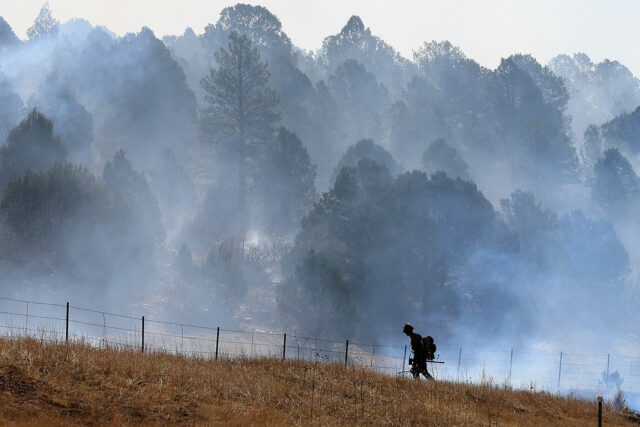
‘Our mountains are gone’: Grief as sacred New Mexico forests burn

A firefighter works to combat the Hermits Peak and Calf Canyon wildfire, near Las Vegas, New Mexico, US, May 4. — REUTERS

ANGOSTURA, N.M. — Forests in Ella Arellano’s family for nine generations burned in a day on Monday as fierce winds drove the United States’ largest wildfire through a New Mexico valley towards a third county.

Ms. Arellano sat in an evacuation center in Peñasco on Monday and grieved the loss of timbered mountainsides around her home in Holman after the fire leaped across the Mora valley about 40 miles (64 km) northeast of the state capital Santa Fe.

“I’m of the land,” said Ms. Arellano, a mayordoma in charge of irrigation channels known as acequias, as she wiped away tears. “Our mountains are gone and it’s still burning.”

The so-called Hermits Peak Calf Canyon fire, larger than the city of Chicago, has been contained to the east but is racing north through land that has deep religious significance to Indo-Hispano villages established two centuries ago.

Around 35 miles in length, the blaze has destroyed hundreds of homes and other structures and triggered evacuation orders for 12,000 homes in San Miguel and Mora counties.

After more than a month of wildfires, residents of Taos County on Monday for the first time were told to prepare to evacuate as the fire advanced towards the villages of Angostura and Tres Ritos as well as the Sipapu ski area around 15 miles south of the town of Taos.

Winds gusting up to 66 mph blew a rancher off his feet as he hosed down his Angostura home in preparation for embers flying over a mile from the fire.

He was in shock as a blaze that started 20 miles distant when a US Forest Service controlled burn got out of hand on April 6 burned less than 5 miles away.

A few miles down the road in Tres Ritos, ski area employees emptied belongings from a storage unit in preparation for a fire they believed was coming.

“They’ve been fighting it for a month in wilderness, they can’t stop it,” said Greg Payne, facilities maintenance manager at Sipapu ski area two miles down the valley.

The fire has burned 76,890 hectares and is 43% contained. — Reuters

Yoon faces early North Korea, inflation tests

SEOUL — South Korea’s new president, Yoon Suk-yeol, will face two major problems as soon as he takes over on Tuesday, a belligerent North Korea testing new weapons and inflation threatening to undermine an economic recovery from two years of coronavirus disease 2019 (COVID-19) gloom.

Mr. Yoon, 61, won a tight election in March as the standard bearer of the main conservative People Power Party, less than a year after entering politics after a 26-year career as a prosecutor.

He will be sworn in early on Tuesday at a ceremony in front of parliament in Seoul.

Yoon won the election on a platform of fighting corruption and creating a more level economic playing field, amid deepening public frustration with inequality and housing prices, as well as simmering gender and generational rivalry.

South Korea’s inflation hit a more than 13-year high last month as Russia’s invasion of Ukraine sent commodity prices soaring, boosting expectations of more central bank interest rate rises, which could threaten growth prospects.

Mr. Yoon could find himself at the center of international uproar over North Korea within days if it carries out its first nuclear test in five years, as US and South Korean officials suspect it might.

North Korea put its weapons tests back on top of the agenda when it broke a 2017 moratorium on long-range missile testing in March.

Mr. Yoon has vowed to strengthen the deterrent capability of the staunch US ally as it confronts the North’s evolving threats, while seeking a reset of relations with China. Both issues will likely dominate his first summit with US President Joseph R. Biden this month.

Mr. Yoon formally assumed his duties at midnight on Monday with a bell-tolling ceremony at Bosingak Pavilion in downtown Seoul.

The inauguration will be held on the front lawn of parliament, attended by some 40,000 people.

Three hundred foreign guests will include Chinese Vice-President Wang Qishan, Japanese Foreign Minister Yoshimasa Hayashi, and Douglas Emhoff, the husband of US Vice-President Kamala Harris.

The inauguration has been given the slogan “Again, Republic of Korea! A new country of the people” which reflects Mr. Yoon’s commitment to the people and to resolving regional, class and generational divisions and fostering unity, his team said.

After the inauguration, Mr. Yoon will begin work at a new office at a former defense ministry building inside a sprawling compound.

He has moved the presidential office and residence from the traditional Blue House under a plan, that is estimated will end up costing $40 million, criticized by outgoing President Moon Jae-in as rushed and a national security risk. — Reuters

S.Korea’s Yoon suggests ‘audacious’ economic plan if N.Korea abandons nukes

South Korean President Yoon Suk-yeol. — REUTERS

South Korea’s new president, Yoon Suk-yeol, said on Tuesday that North Korea’s weapons programs pose a threat but that he is ready to provide an “audacious” economic plan if the North is committed to denuclearization.

Mr. Yoon gave the remarks in his inauguration speech after being sworn in at a ceremony in Seoul. He won a tight election in March as the standard bearer of the main conservative People Power Party, less than a year after entering politics following a 26-year career as a prosecutor. Read full story

Mr. Yoon, 61, will face two major problems as he takes office: a belligerent North Korea testing new weapons and inflation threatening to undermine an economic recovery from two years of COVID-19 gloom.

He has signaled a tougher line on North Korea, warning of a preemptive strike if there is a sign of an imminent attack and vowing to strengthen the South’s deterrent capability. But his speech was seen as focused more on his willingness to reopen stalled denuclearization talks with Pyongyang. Read full story

“While North Korea’s nuclear weapon programs are a threat not only to our security and that of Northeast Asia, the door to dialogue will remain open so that we can peacefully resolve this threat,” Mr. Yoon said.

“If North Korea genuinely embarks on a process to complete denuclearization, we are prepared to work with the international community to present an audacious plan that will vastly strengthen North Korea’s economy and improve the quality of life for its people,” he added.

Mr. Yoon did not elaborate on his re-engagement or economic plan for the North. But his national security adviser, Kim Sung-han, told Reuters in February that his team would devise a roadmap in early days in which Pyongyang could quickly earn sanctions relief or economic aid in exchange for denuclearization measures. Read full story

Mr. Yoon could face a security crisis if North Korea carries out its first nuclear test in five years, as U.S. and South Korean officials warned, after it broke a 2017 moratorium on long-range missile testing in March. Read full story


NO MORE BLUE HOUSE

Mr. Yoon won the election on a platform of fighting corruption and creating a more level economic playing field amid deepening public frustration with inequality and housing prices, as well as simmering gender and generational rivalry.

South Korea’s inflation hit a more than 13-year high last month as Russia’s invasion of Ukraine sent commodity prices soaring, which could dampen growth prospects. Read full story

Mr. Yoon did not mention inflation, but cited low growth, rising unemployment and wage gaps as key economic challenges, pledging to address those by focusing on developing science, technology and innovation.

Some 40,000 people attended the ceremony on the front lawn of parliament, including about 300 foreign guests, including Chinese Vice President Wang Qishan, Japanese Foreign Minister Yoshimasa Hayashi, and Douglas Emhoff, the husband of U.S. Vice President Kamala Harris.

Mr. Wang, at a meeting with Mr. Yoon, relayed Chinese President Xi Jinping’s letter and invitation to China, and expressed Beijing’s hopes for stronger cooperation on North Korea, bilateral and global issues.

Mr. Yoon separately met Mr. Hayashi and thanked him for conveying a letter from Prime Minister Fumio Kishida, saying he hoped to meet him soon and work together to improve relations.

Mr. Yoon promised stronger support for the U.S. alliance to Emhoff, who also delivered a letter from President Joe Biden and said Biden was looking forward to their first summit, scheduled for this month, and was hoping for closer cooperation.

After the inauguration, Yoon moved to a new office at a former defence ministry building, holding his first meeting with aides and appointing seven cabinet nominees who had passed their confirmation hearings, including finance and defence ministers.

He has moved the presidential office and residence from the traditional Blue House under a $40 million plan, though his predecessor Moon Jae-in criticised it as rushed and a national security risk. Read full story

A separate event was held at the Blue House, where 74 citizens selected by lottery entered the long enclosed complex, which was opened to the public for the first time in 74 years.

Mr. Yoon had called the office a “symbol of absolute power,” and said it would be used as a public park and cultural space. – Reuters