Home Blog Page 5896

Philippine stocks rebound on bargain hunting
BW FILE PHOTO

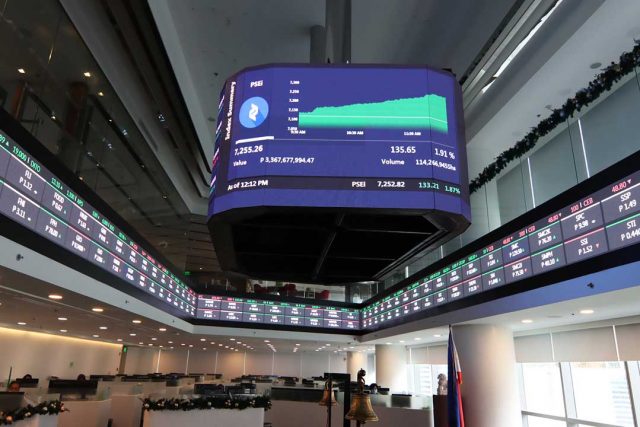
STOCKS recovered on bargain hunting on Tuesday despite data showing faster inflation in May.

The benchmark Philippine Stock Exchange index (PSEi) improved by 37.13 points or 0.55% to close at 6,754.01 on Tuesday, while the broader all shares index inched up by 12.66 points or 0.35% to 3,598.51.

“Philippine shares rebounded today on bargain hunting. The market has already factored in the headline inflation for May that jumped to 5.4%, the highest recorded since the 6.1% seen in November 2018,” Papa Securities Corp. Equities Strategist Manny P. Cruz said in a Viber message on Tuesday.

“Consequently, the monetary authorities are looking to raise rates in their June and August meetings to contain inflation pressure. On top of this, the central bank is also looking to cut the reserve ratio by 200 bps (basis points) to 10% by yearend,” Mr. Cruz added.

“Philippine shares edged higher in a relatively quiet session despite the release of the May CPI (consumer price index) reading… which was in line with the Bloomberg median consensus, making this more of a non-event. Food and transportation were the main culprits as usual…,” Regina Capital Development Corp. Head of Sales Luis A. Limlingan said in a Viber message.

Headline inflation in May surged by 5.4% year on year from 4.9% in April and 4.1% a year ago, preliminary data from the Philippine Statistics Authority released on Tuesday showed.

Year to date, inflation averaged 4.1%. This is lower than the central bank’s 4.6% forecast but above its 2-4% target for the year.

On Tuesday, Monetary Board member and incoming Bangko Sentral ng Pilipinas (BSP) chief Felipe M. Medalla said in a Bloomberg interview that they are “almost” sure to hike at their June 23 meeting and there is also a “90% chance” of another increase at their subsequent review on Aug. 18.

Mr. Medalla said the real question is if an August hike would be the last one for the year and noted decisions beyond this would be data-dependent.

Increases worth 25 bps in the Monetary Board’s June and August meetings would bring the benchmark rate to 2.75% from 2.25% currently following a hike of the same magnitude at its last May 19 meeting to curb growing inflationary pressures.

All sectoral indices ended in the green on Tuesday. Mining and oil advanced by 233.03 points or 1.91% to 12,431.34; holding firms rose by 56.13 points or 0.90% to 6,260.49; property climbed by 16.39 points or 0.51% to 3,182.34; services went up by 6.20 points or 0.33% to 1,856.46; financials gained 2.64 points or 0.22% to 1,611.51; and industrials added 13.18 points or 0.14% to end at 9,132.22.

Advancers beat decliners, 96 versus 90, while 42 names ended unchanged.

Value turnover slid to P4.96 billion with 877.07 million shares changing hands from the P5.94 billion with 1.88 billion issues seen the previous trading day.

Net foreign selling grew to P512.12 million on Tuesday from P287.1 million on Monday. — Luisa Maria Jacinta C. Jocson with Bloomberg

Finance dep’t sees deficit falling without sacrificing infrastructure

PHILIPPINE STAR/ MICHAEL VARCAS

THE Department of Finance (DoF) said infrastructure spending need not be “sacrificed” in the process of reducing the budget deficit, which is expected to contract even with no new taxes and shrink even faster if the government can find additional funding of P250 billion a year.

In an economic bulletin on Tuesday, DoF Chief Economist Gil S. Beltran said the way forward will involve “shoring up revenue and cutting non-priority expenditure… without sacrificing infrastructure spending.”

He said that assuming no new taxes, the deficit is expected to hit the equivalent of 4.1% of gross domestic product (GDP) by 2025, down from the 2021 deficit-to-GDP ratio of 8.6%. Raising an additional P250 billion a year would bring the ratio down to 3.2% by 2025, just under the pre-pandemic level of 3.4%.

“It is therefore important to restore fiscal health and build up reserves when the economic weather is fine so as to have the capacity to respond again should shocks materialize,” Mr. Beltran added. “This is akin to having an insurance (policy) that covers for contingencies. Not having one is a fool’s game and fiscal heartaches hit the hardest when it’s too late.”

Separately, Manulife Philippines Head of Equities Mark A. Canizares said in a statement on Tuesday that it considers infrastructure and mining to be critical for the incoming administration.

The statement, which referenced Manulife Investment Management’s outlook for the market in the context of the impending change of government, declared the Philippines to be on a recovery path from the pandemic, after the economy posted 8.3% growth during the first quarter.

“Infrastructure-related sectors are likely to benefit from the priorities of the incoming administration,” Mr. Canizares said. “We expect a continuation of the decentralization of infrastructure investment.”

Mr. Canizares noted that under the Duterte administration, Mindanao was a main recipient of infrastructure projects, including the Davao City Bypass Construction and Coastal Road projects, the loans for which were obtained at the height of the pandemic in 2020.

“Mining is another sector that could be in focus. Marcos has previously said that he wants better laws and regulations on mining for the industry to contribute more to the economy,” he added.

He said his view on the utility sector is more subdued, given Mr. Marcos’ comments on lowering energy costs.

Aside from continuing with the Build, Build, Build program, Mr. Marcos also earlier signaled his plans to reduce the price of rice to P20 per kilo and reopen the Bataan Nuclear Power Plant.

“Key to the success of these programs is the passage of revenue-enhancing measures that can expand the contribution of fiscal spending to economic growth. This will allay fears of a blowup in the country’s fiscal balances and a runaway increase in debt levels which hounded the later years of the first Marcos presidency.”

Mr. Canizares also warned that the economic recovery remains fragile, with consumer spending at risk of slowing down due to the continued increase in prices.

Headline inflation in May was 5.4%, accelerating from the 4.9% posted in April. The May result was within the central bank’s 5-5.8% target range.

Inflation was driven mainly by rising costs of food, non-alcoholic beverages, and fuel. — Tobias Jared Tomas

Hanjin shipyard collapse leaves FIRB wary on future incentive grants

HANJIN FACEBOOK PAGE

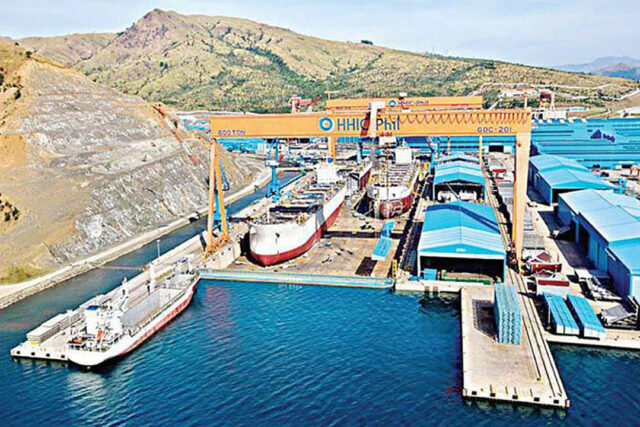
THE Fiscal Incentives Review Board (FIRB) said it will have to evaluate grants of incentives more thoroughly in the wake of the 2019 collapse of Hanjin Heavy Industries and Construction Philippines, Inc. (HHIC-Phil), the operator of a shipyard in Subic Bay.

“This is the reason why we must impose stringent evaluation and impact analysis before the grant of tax incentives,” Finance Assistant Secretary and FIRB Secretariat head Juvy C. Danofarata said.

“Given the failure of this shipyard in Subic, jobs were lost and productivity in the area declined. The project cost the government so much money in foregone revenue that could have been granted to performing and more deserving business enterprises.”

The DoF said that in 2015, HHIC-Phil received tax incentives totaling P370 million. It had first sought tax perks from the Subic Bay Metropolitan Authority and the Board of Investments in 2006 and 2009, respectively.

HHIC-Phil is a subsidiary of South Korean shipbuilder Hanjin Heavy Industries & Construction Co., Ltd.

“During the company’s existence, it was granted seven years of income tax holiday (ITH) and a special corporate income tax (SCIT) rate of 5% on gross income earned (GIE) upon the expiration of its ITH,” the DoF said.

It was also granted additional tax and duty-free import privileges on raw materials and equipment.

“HHIC-Phil also received power subsidies for its operations at the Subic Bay Freeport Zone amounting to P5.17 billion from 2009 to 2018,” the DoF said.

However, HHIC-Phil failed to maintain an employment of an estimated 20,000 workers, and abandoned a $2-billion Mindanao shipyard in 2008, which was supposed to generate 30,000 jobs.

Hanjin Shipyard, formerly owned by HHIC-Phil, was acquired by US private equity firm Cerberus Capital Management for $300 million.

When HHIC-Phil filed for corporate rehabilitation in 2019 with an Olongapo court, it left $412 million in outstanding loans with BDO Unibank, Inc., Metropolitan Bank & Trust Co., Land Bank of the Philippines, Bank of the Philippine Islands, and Rizal Commercial Banking Corp.

HHIC-Phil owed Korean lenders another $900 million. — Tobias Jared Tomas

Frasco’s DoT to highlight domestic tourism, food, marketable crafts

FACEBOOK.COM/FILIPINOFOODMONTHOFFICIAL

THE incoming Tourism Secretary said she plans to develop domestic tourism in order not to be left vulnerable to disruptions in international travel, while playing up untapped strengths in food and crafts and continuing to promote areas of outstanding beauty, in a so-called “multi-dimensional” approach to promoting the Philippines as a destination.

Tourism Secretary-designate Maria Esperanza Christina G. Frasco said in a television interview on Tuesday that such an approach would “capitalize not only on the beauty of our natural resources, but also on the wealth of talent of our people as well as their products, including food, clothing, and other items that could be marketable as well both to local and foreign tourists.”

“What the pandemic has also taught us, (in the wake of) restrictions on travel from abroad, is that it is very important to capitalize on domestic tourism and not be solely dependent on foreign tourism alone. The effort should be comprehensive to include both domestic tourism and foreign tourism. Especially now with the further relaxation of the requirements for entry into the Philippines,” she added.

Ms. Frasco said investment in tourism infrastructure is needed to improve the access to various destinations.

She called for “investing heavily in infrastructure to improve connectivity and access to our tourist sites. So, that means coordination closely with relevant government agencies for the improvement of roads, bridges, access to seaports, airports, as well as modes of public transportation,” Ms. Frasco said.

Ms. Frasco said she plans to make use of digitalization and online platforms to boost underpromoted destinations.

“Providing our lesser-known destinations with access through digitalization and through the introduction of online platforms is also very important,” Ms. Frasco said.

“What the pandemic has taught us is that you can actually continue to market your products… by way of mobile applications, through online platforms notwithstanding the restrictions of physical contact,” she added.

Ms. Frasco said she considers Mindanao to be capable of becoming a major driver of growth, adding that the south has not been given “equal opportunity” in terms of tourism development.

“Mindanao in general is a very, very beautiful part of our country that is endowed with natural beauty. However, due to challenges (like law and order) in certain areas, the potential of the region, perhaps, has not been fully harnessed,” Ms. Frasco said.

On May 30, Rose Beatrix Cruz-Angeles, the press secretary nominee of President-elect Ferdinand R. Marcos, Jr., announced that Ms. Frasco will be appointed to head the Tourism department.

Ms. Frasco is currently the spokesperson of Vice-President-elect Sara Z. Duterte-Carpio, and was recently re-elected as the mayor of Liloan town in Cebu province. She is also the daughter of Cebu Governor Gwendolyn F. Garcia. — Revin Mikhael D. Ochave

P20/kg rice to require budget of ‘at least’ P400 billion

THE Marcos campaign pledge to bring down the price of rice to P20 per kilogram (/kg) is achievable with “full support” from the government, including a budget of about P400 billion to upgrade production, a party-list legislator said on Tuesday.

Magsasaka Party-list Representative Argel Joseph T. Cabatbat added that legislators need to “have faith in Filipino farmers by giving them all the support they need to revitalize rice planting activities.”

President-elect Ferdinand R. Marcos, Jr. campaigned on a promise of P20 rice, though he later called that an “aspirational” target.

“We should not doubt the capability of farmers to produce cheap and quality rice. With enough support, appropriate policy changes, the removal of middlemen or brokers, and the right managers in the Department of Agriculture who are pro-farmer, P20 per kilo of rice is possible,” Mr. Cabatbat said in a statement.

He said such an effort will cost at least P400 billion to fund basic support services and infrastructure.

Increased funding will bring down the cost of production and marketing, he added.

Mr. Cabatbat said he wants to make use of the Agrarian Reform department’s “megafarm” concept and use as a model the Provincial Food Council of Nueva Ecija’s program to increase farmer yields and profits.

Mr. Cabatbat also called for a review of the Rice Tariffication Law, which liberalized rice imports.

“We depend too much on other countries for our food. We are not aware that it is killing the agricultural sector and the economy because we are dependent,” he said. 

Agriculture Secretary William D. Dar has said he expects the next administration to raise spending on the agriculture sector and raise his department’s budgets accordingly. — Alyssa Nicole O. Tan

Full capacity allowed in Alert Level 1 areas

REUTERS

THE GOVERNMENT has allowed businesses in Alert Level 1 areas to operate at full capacity, including public transport vehicles, though participants in mass gatherings will still need to present proof of full vaccination, the Palace said.

Palace Spokesman Jose Ruperto Martin M. Andanar said in a statement that the decision was arrived at by the Inter-Agency Task Force on Emerging Infectious Diseases and applies to areas under Alert Level 1, the most permissive quarantine setting.

Most of the Philippines, including the capital region, is under Alert Level 1 between June 1 and 15.

The government also relaxed face mask rules for athletic activities in well-ventilated areas, and outdoor sports or exercise in areas where “physical distance can be maintained.”

All government work is to be performed onsite under Alert Level 1.

The full capacity rule for public transport does not apply when traveling to areas where the alert level is less permissive. — Kyle Aristophere T. Atienza

Easing land rules for foreigners could boost renewables industry

TRINA SOLAR FB PAGE

THE Philippines’ plans to develop its renewables industry will require an easing of land ownership restrictions currently in place for foreigners, Bain & Co. and Temasek Holdings Ltd. said in a report.

The “Southeast Asia’s Green Economy 2022: Investing behind new realities” report, prepared with the participation of Microsoft Corp., said investment will hinge on foreign companies being able to access land.

“(The government should) eliminate land restrictions for foreign firms to further facilitate foreign investment in renewables,” the report said. “It should also develop clear decarbonization targets and establish decarbonization roadmap,” it added.

The report backed the establishment of a carbon tax and emissions trading scheme, increasing renewable sourcing requirements, and removing contractual obligations to produce energy from coal.

“(The Philippines has made the) slowest progress among Southeast Asian nations towards a carbon tax. (There are) ongoing discussions over the last few years but no concrete decision and/or implementation plan,” the report said.  

The report noted that the Philippines is aiming to reduce carbon emissions by 75% by 2030, of which is 72.29% is conditional on the availability of foreign funding.

However, the report said the Philippines has not defined its net-zero target.

As a result, one challenge is that emissions may continue to rise under current policy rather than drop to meet the conditional target.

“Recent implementation of a coal power moratorium (is) encouraging. However, it is essential to also enact a moratorium on current pipeline projects and phase out all coal by 2040,” according to the report.  

In October 2020, the Energy department stopped approving new coal-fired power plants.

The report also noted improvement in Philippine policy towards electric vehicle (EV) manufacturers, though it cited the absence of incentives to spur consumer demand.

In March, the Trade department announced that it is pushing for the implementation of a zero-tariff regime for imported EVs to encourage adoption.

Bain and Temasek, the Singapore government-controlled investment firm, called the Philippine renewables sector “attractive” due to government support and capacity potential.

Some opportunities include sustainable farming via farmer service platforms that boost production with the use of digitalization; commercial and industrial solar power; onshore and offshore wind; and energy efficiency in the built environment.

They said the downsides include a lack of government advocacy and support for digital agriculture; lengthy and complex procedures for obtaining solar project permits; and the weakness of the regulatory regime. 

“With its vibrant and dynamic digital-fueled economy, Southeast Asia has tremendous potential to make a long-term, meaningful impact in the global green transition,” Temasek Chief Sustainability Officer Steve Howard said.

“The opportunities are immense, but it will take collective will, unprecedented collaboration and meaningful financing to unlock the full potential of decarbonization levers across all green investment asset classes,” he added. — Revin Mikhael D. Ochave

DBM says 2022 budget release rate tops 88%

BW FILE PHOTO

THE Department of Budget and Management (DBM) said on Tuesday that it had released P4.46 trillion, or 88.8% of the national budget, to national agencies and local government units as of the end of May.

The DBM said in its Allotment Releases report for May that P562.50 billion remains to be distributed.

The release rate is running ahead of the pace in 2021. That year, the DBM had released P3.74 trillion or nearly 83% of the budget by the end of May 2021.

In May 2022, releases to government agencies and departments amounted to P2.74 trillion, or 95.1% of their allocations.

Special Purpose (SP) funds released by the end of the month amounted to P251.56 billion, or 55% of the SP budget.

SP funds include budget support for local government units, the Contingent Fund, the Miscellaneous Personnel Benefits Fund, and the National Disaster Risk Reduction and Management Fund.

Automatic Appropriation releases amounted to P1.33 trillion, representing 79.4% of the funds allocated to them.

This includes P10 billion for the Rice Competitiveness Enhancement Fund and P1.60 billion in funding for retirement and life insurance premiums of various National Government agencies, the DBM said.

Other automatic appropriations include the internal revenue allotment for local governments, block grants, interest payments, the tax expenditure fund, and customs duties and taxes.

The national budget for 2022 is configured to bring about a recovery from the pandemic. The budget is equal to 21.8% of the projected gross domestic product, with about a fifth set aside for capital outlays, which include infrastructure spending. — Tobias Jared Tomas

Duterte urges Filipinos to fully support Marcos

GERMAN Ambassador Anke Reiffenstuel pays President-elect Ferdinand R. Marcos, Jr. a courtesy call. — BONGBONG MARCOS MEDIA BUREAU

OUTGOING Philippine President Rodrigo R. Duterte has asked Filipinos to support and avoid criticizing his successor, whom he called a weak leader during the campaign.

“I am leaving, I will say nothing,” Mr. Duterte, 77, said at a taped briefing aired on state television on Monday night. “What I don’t want is, some will still be politicking and just plain criticizing the new administration. You do not do that. We have no room for politicking or actions that are divisive to the country.”

Mr. Duterte  said the government of president-elect Ferdinand R. Marcos, Jr., needs the cooperation of all Filipinos.

“We must give it to him,” he said. “That is democracy, that is how we operate,” said  the tough-talking leader, whose daughter Sara Duterte-Carpio will take her oath as vice-president this month.

Mr. Duterte likened criticism to efforts meant to destroy the government. “So the better policy is just to ignore them and that’s what we did,” he said.  “We never bothered to even hear what they were uttering or complaining about.”

Mr. Duterte also used his parting message to pitch the continuation of his war on drugs that has killed thousands and his government’s anti-insurgency campaign, which Filipino lawyers said had led to the arrest of activists and other dissenters.

Political analysts have said a quiet retirement for Mr. Duterte, whose six-year term ends on June 30, is unlikely as his critics try to make him accountable for the deaths of thousands of Filipinos.

Reuters recently reported that the official death certificates of at least 15 drug war victims had been falsified to “show they died of natural causes.”

On Tuesday, Senator Leila M. de Lima, who was sent to jail after she launched a probe into extrajudicial killings involving Mr. Duterte and his former police chief, urged the Department of Justice to conduct a deeper and comprehensive investigation into the falsified death certificates.

Foreign and local analysts have said the international community would closely watch the moves of Mr. Marcos after he stayed mum on key issues during the campaign.

The human rights situation in the Philippines had worsened under the Duterte administration, according to a European Union (EU) report on human rights and democracy in 2017.

On Tuesday, Germany’s envoy to the Philippines Anke Reiffenstuel underscored the importance of human rights and the rule of law during her meeting with Mr. Marcos.

“I underlined the importance Germany attaches to rule of law and safeguarding human rights and assured him of our continued commitment in this regard,” Ms. Reiffenstuel told a news briefing after her courtesy call on Mr. Marcos. 

More than 70,000 people were jailed, about 34,000 were tortured and more than 3,000 people died under the martial rule of Mr. Marcos’ late father, according to Amnesty International.

The European Parliament has consistently condemned extrajudicial killings and harassment of critics under the Duterte administration.

The European Commission last year said it was closely monitoring political developments in the Philippines after flagging “serious concerns” about the country’s human rights situation.

The European Parliament in 2020 asked the commission to start the process of withdrawing trade incentives from the Philippines after the government failed to improve the human rights situation.

More than 6,000 Philippine products enjoy zero-tariff entry to the European Union (EU) as long as the country complies with 27 core international conventions that include human and labor rights, environmental protection and good governance. — Kyle Aristophere T. Atienza

Court acquits 21 protesters in food aid rally in 2020

PHILIPPINE STAR/ MICHAEL VARS

A QUEZON City metropolitan court on Tuesday acquitted 21 people whom police arrested in 2020 for violating lockdown rules during a protest where they demanded food aid amid a coronavirus pandemic.

In a 14-page order, Presiding Judge Boomsri S. Rodolfo said the protesters did not violate the law in their attempt to get food at the start of the lockdowns imposed nationwide. They were within their rights to protest and could not have resisted arrest, it added.

“The accused were acting within their rights when they were outside of their respective residences to plea for food,” the court said. “The police officers, at the time they confronted the accused and under the circumstances established in this case, cannot compel the latter to obey their directive to go home.”

The law on public assemblies only punishes organizers who fail to secure permits to hold a rally, the court said.

“Even if we assume for the sake of argument that the accused indeed engaged in a rally without the required permit under the law, they cannot be convicted as charged in the information because section 13 of the said law is limited to penalizing the leaders of organizers,” it added.

The lawyers of the 21 residents of San Roque in Quezon City said justice had been served. “The dismissal of the motley of trumped-up charges against the residents seeking aid in the midst of a lockdown is a triumph we share with the many others who helped and empathized,” The National Union of Peoples’ Lawyers said in a statement. 

“Political repression always thrives on fear and sheer might,” it said. “But with the law in our favor, the people should always have the right to reason and resist.”

The government had banned mass gatherings and required physical distancing to contain the pandemic that has killed more than 6 million people worldwide.

In 2020, former police chief Debold M. Sinas threatened to arrest and charge people who violate quarantine protocols. He was later caught attending a birthday party with friends amid the lockdowns.

“Let this case not be remembered for the inhumanity of President Rodrigo R. Duterte’s administration’s grossly disproportionate and incongruent response to a public health problem; let it stand testament to the enduring spirit of bayanihan in each one of us,” the lawyers said. — John Victor D. Ordoñez

43 Immigration officials charged for illegal scheme

SCREENGRAB FROM YOUTUBE/SENATE OF THE PHILIPPINES

THE OMBUDSMAN has charged with corruption 43 former Immigration officials who allegedly extorted money from Chinese nationals in exchange for a trouble-free entry to the country.

The bail for each of the accused was set at P90,000.

The officials committed graft when they allowed Chinese nationals to bypass procedures to enter the country, according to a 17-page indictment paper submitted to the anti-graft court Sandiganbayan by Ombudsman Samuel R. Martires.

Allowing the foreigners to enter the Philippines without the stringent profiling and screening processes were to the “prejudice of the government and public interest,” according to a copy of the document.

The rolls of money received by the agents were made to look like a Filipino treat called pastillas, from which the scheme got its name.

The Department of Justice’s own investigation of the scam would be finished soon, Justice Secretary Menardo I. Guevarra told reporters in a Viber message.

He said the administrative complaint filed before the agency had a set of immigration officers different from the Ombudsman’s case.

In 2020, Senator Risa N. Hontiveros-Baraquel led a Senate investigation of the scam. A whistleblower from the Immigration bureau testified at a hearing that the Chinese nationals involved in the scheme had been blacklisted from the country and entered through a “special arrangement.”

President Rodrigo R. Duterte relieved all the immigration officers involved in the scam that year. — John Victor D. Ordoñez

DoH posts 3 more BA.5 cases, 7 more BA.2.12 infections

THE PHILIPPINES on Tuesday reported three more infections involving the BA.5 Omicron subvariant of the coronavirus, bringing the total to five.

Seven more cases of the BA.2.12.1 Omicron subvariant were also detected in the latest genome sequencing of 190 samples on June 6, Health Undersecretary Maria Rosario S. Vergeire said in a statement.

Two of the BA.5 patients were from the Calabarzon region, while the location of the third was still being verified, she said.

The third patient had been fully vaccinated against the coronavirus, while one of the patients from Calabarzon was unvaccinated. The status of the other patient was still being verified.

All three patients have recovered, but the Department of Health was looking at the symptoms that they and they close contacts had experienced, Ms. Vergeire said.

Of the total samples, 114 or 60% were Omicron, 14 or 7.4 percent were Delta, one had “other lineages“ and 61 had no lineage, she added. — KATA