


How PSEi member stocks performed — September 23, 2022

Here’s a quick glance at how PSEi stocks fared on Friday, September 23, 2022.


Shares seen to move sideways on record-low peso

LOCAL STOCKS may move sideways this week on the lingering effects of the interest rate hikes by the US Federal Reserve and the Bangko Sentral ng Pilipinas (BSP) amid the depreciating peso.
The bellwether Philippine Stock Exchange index (PSEi) slipped by 42.17 points or 0.66% to close at 6,259.54 on Friday, while the broader all shares index went down by 14.95 points or 0.44% to 3,341.29.
Week on week, the PSEi declined by 289.23 points or 4.42% from its close of 6,548.77 on Sept. 16.
“Selling marked this week’s trades, given the Fed’s 75 basis points (bps) and BSP’s 50-bp rate hike adjustment,” online brokerage 2TradeAsia.com said in a report.
In a Viber message, Salisbury Securities Corp. Equity Sales Trader JP Dela Cruz said the market was down again “due to the more hawkish stance of the Fed” while the Philippine market is expecting the BSP “to continue hiking rates in line with the Fed to protect the peso and slow down inflation.”
Last week, the Fed raised its monetary policy rate by 75 bps for a third time, bringing the Fed’s cumulative hikes for this year to 300 bps.
Meanwhile, the BSP raised benchmark rates by 50 bps for a second straight meeting to bring the hike in borrowing costs to a total of 225 bps since May.
For the week, Salisbury Securities’ Mr. Dela Cruz said that the PSEi “has more room to go down.”
“[However,] we remain bullish and investors or traders should take advantage of these dips going into the fourth quarter of 2022,” he added.
Meanwhile, Philstocks Financial, Inc. Senior Research Analyst Japhet Louis O. Tantiangco said that “trading may remain tepid as the market continues to move without a positive catalyst.”
“We do not expect a significant rally from the market yet as it is seen to continue dealing with expectations of further policy rate hikes by the Federal Reserve and the Bangko Sentral ng Pilipinas,” Mr. Tantiangco said.
He added that the Philippine peso, which is now below the P58-per-US-dollar level, “is also expected to continue weighing on sentiment.”
On Friday, the local unit closed at P58.50 versus the greenback from its P58.49 finish on Thursday, data from the Bankers Association of the Philippines showed.
Year to date, the peso has weakened by 14.7% or P7.49 from its P51-close in the previous year.
“For now, a defensive portfolio with strong balance sheets should be able to weather the brunt of weak currency, higher cost of debt, and generally volatile inputs market,” 2TradeAsia.com said. It placed the PSEi’s immediate support at 6,000 and resistance at 6,400.
Philstocks Financial’s Mr. Tantiangco put the PSEi’s immediate support at 6,200, key support between the 6,000 and 6,100 range, and resistance at the 6,400 level.
Salisbury Securities’ Mr. Dela Cruz placed the index’s support at 6,000 and resistance at 6,300. — Justine Irish D. Tabile
Experts see return of steady PHL-US relations under Marcos Jr.
By Kyle Aristophere T. Atienza, Reporter
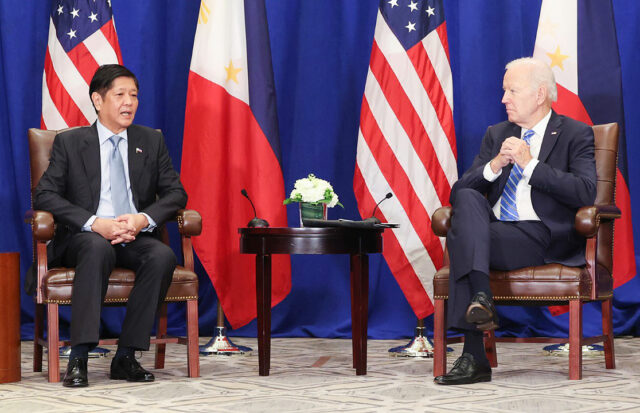
FOREIGN policy experts are detecting signs of steady relations between the Philippines and the United States under the administration of President Ferdinand R. Marcos, Jr. who is seen veering away from his predecessor’s conciliatory stance toward Beijing.
However, some experts said the Philippines’ foreign policy towards China and other rising powers remains vague, noting that it should be among the top concerns of the national security sector.
During his US visit last week, Mr. Marcos expressed his commitment to preserving the Philippines’ alliance with the US, which has been calling for a rules-based order in the Indo-Pacific region amid China’s expansive activities.
“In the context of the country’s current approach toward China, the recent pronouncements and initiatives of President Marcos indicate a shift in the country’s foreign policy,” said Victor Andres “Dindo” C. Manhit, president of Stratbase ADR Institute for Strategic and International Studies.
“Unlike the previous government, which repeatedly announced the country’s separation from the US, the President has been more open to the idea of broadening the country’s network of allies and strategic partners,” he said in a Messenger chat.
Mr. Manhit said a return to US-Philippines relations at a level before former President Rodrigo R. Duterte’s administration is being driven by Mr. Marcos’ “view of the multipolar world” and not a “competition between China and the US that Duterte got drawn in.”
“This marks a clear departure from the foreign policy position pursued by the previous administration.”
Mr. Marcos said in New York on Saturday (PHL time) that his country has no territorial conflict with China, noting that it is Beijing that is claiming Philippine territories.
“I think it’s no surprise to anyone that the Philippines has some of these conflicts with the People’s Republic of China. And the position that the Philippines takes is that we have no territorial conflict with China. What we have is China claiming territory that belongs to the Philippines,” he told Asia Society CEO and former Australian prime minister Kevin Rudd in an interview.
This is the position the Philippines and its American partners “have promoted,” said Mr. Marcos, who said US-Philippines ties could keep tensions in the region at bay.
“That statement is the finest rhetoric from President Marcos,” said Chester B. Cabalza, who studied national security and policymaking at the University of Delaware.
“I think Marcos Jr. is prepared for the consequences of his statements in Washington,” he said. “We will get the feel of the entirety of his core foreign policy, after his official visit to Beijing.”
In a meeting with US President Joseph R. Biden, Jr. last week, Mr. Marcos recognized Washington’s role in maintaining stability in the region.
“That is much appreciated by all the countries in the regions and the Philippines especially,” he said.
“His utterances to Biden is a sound of music to Washington, in time when allegations arise in Beijing that Xi Jinping is being deposed by the Chinese Communist Party (CCP),” said Mr. Cabalza, who has observed “evolving and proactive” US-Philippines relations under Mr. Marcos.
“It is symbolic.”
Several social media posts published by some media outlets based in India showed that Chinese President Xi Jinping has been under house arrest after he was forcibly removed as head of China’s People Liberation Army. The state media and the ruling Chinese Communist Party have yet to release an official confirmation.
“Any monumental shift like that in China will definitely compel Marcos to recalibrate,” Hansley A. Juliano, who has written on global political economy, said in a Messenger chat.
CHINA POLICY
Mr. Juliano and Robin Michael U. Garcia, who teaches political economy at the University of Asia and the Pacific, both believe that Mr. Marcos’ China policy remains vague and lacks substance.
“This is still not a concrete China policy. It is broad and vague,” Mr. Garcia said in a Messenger chat. “There is nothing new with the President’s statement actually. It also does not tell China and the US that much.”
Mr. Garcia said Beijing’s concern is the extent to which the Philippines is willing to compromise and negotiate, while the US is concerned with the level of Philippines’ commitment to asserting its territories in the South China Sea “and the extent to which we’re willing to ally with them.”
“There is not much difference in the motherhood statements he is speaking about here,” Mr. Juliano said.
“As a given countries are supposed to balance their treaty commitments even with competing blocs or groups,” he said. “However, what world leaders do is not give away their strategy publicly.”
Mr. Juliano said changes in the Philippines’ foreign policy, or the rule of engagement with China for that matter, would reflect in the country’s trade as well as international relations (IR) commitments.
“Will the Department of Foreign Affairs under Marcos Jr. and other relevant agencies recalibrate our trade and IR commitments,” he asked. “Or will it remain business as usual?”
“Sometimes the conversation here is not just the individual will of the President, but more his economic managers and business allies,” Mr. Juliano noted. “It has been the case with Duterte and Marcos, and even to a lesser extent Arroyo and Aquino III.”
At the House of Representatives, Speaker Martin G. Romualdez said on Sunday that the chamber will pass any legislation that the President needs to fulfill investment pledges.
“If the President needs any piece of legislation to materialize the objectives of these bilateral trade and investment agreements, we will answer the call,” Mr. Romualdez said in a statement.
Mr. Marcos urged global investors, traders, and other guests at the New York Stock Exchange to come to the Philippines and tap its potential as one of the fastest-growing economies in Asia.
In terms of economic policy, maintaining the Philippines relationship with mainland China is “weightier,” Mr. Juliano said. “However, there has been more consistent cultural and economic ties with the Philippines by virtue of our shared American alliance.”
In his interview with the Asia Society, Mr. Marcos said while his government would maintain its position on the sea dispute with China, it will continue to engage Beijing on other aspects.
The Philippine leader told Philippine media after the event that he’s willing to explore all options in the handling of territorial disputes with China.
Experts have said the Philippines’ foreign policy direction would likely be tested by the escalating dispute between China and Taiwan, which is just 190 kilometers away from northern Philippines.
“The ongoing conflict between China and Taiwan poses a risk to the Philippines and the rest of the region,” Mr. Manhit said. “This should be viewed as a part of a more complex and multifaceted geopolitical landscape that the Philippines should navigate.”
The Philippines should strategize with the intent of minimizing risks and safeguarding the country’s national interests, he said.
Mr. Biden earlier said American forces would defend Taiwan in case of a Chinese invasion, according to a Reuters report. US officials have made the same commitment to Manila, but local experts have doubted Washington would keep its promise.
Mr. Cabalza, meanwhile, said the government’s food security push should prompt Mr. Marcos to protect Filipino fishermen being harassed by Beijing.
His action on food security as agriculture secretary will open doors on how he will protect Filipino fishermen who are disallowed to fish in their traditional fishing ground in the contested waterways,” he said. “He needs to use his political capital to safeguard our territorial integrity and national sovereignty from encroachment and illegal fishing of Chinese fishing fleets.”
A comprehensive territorial defense should involve the Bureau of Food and Aquatic Resources and Department of Agriculture, which should be responsible in protecting marine natural resources, Mr. Cabalza said.
Mr. Marcos took office in June, vowing to make the Philippines “a friend to all and an enemy to none.” — with a report from Kyanna Angela Bulan
Northern PHL braces for super typhoon

EVACUATION of residents was underway on Sunday in several areas as northern Philippines, including the capital region Metro Manila, braced for the onslaught of a storm that quickly developed into a super typhoon, authorities said.
Super typhoon Karding, with designated international name Noru, was expected to make landfall Sunday evening in the northern portion of Quezon province or in neighboring Aurora, state weather bureau PAGASA said in its 2 p.m. Sunday bulletin.
“The possibility of an earlier (afternoon) landfall or close approach in the vicinity of Polillo Islands is not ruled out,” it added.
Tropical wind signal #5, the highest under PAGASA’s warning system, was raised over Quezon and Polilio Islands as of early Sunday afternoon.
Warning signals #1 to #4 were also up in various parts of Luzon, the Philippine northern mainland.
Quezon Governor Angelina “Helen” L. Tan said she has directed emergency response teams and other concerned offices to focus on preemptive evacuation and other preparedness measures, the provincial government said in a statement following a coordination meeting on Saturday.
Super typhoon Karding became a category 3 typhoon following an “explosive intensification” overnight on Saturday, PAGASA said.
A super typhoon is defined by the Philippine weather agency as having maximum wind speed above 185 kilometers per hour.
“Hopefully, this typhoon moves fast, although it brings strong winds,” said national disaster agency spokesperson Bernardo Rafaelito Alejandro.
Authorities are on alert for landslides, flooding and destructive winds, he said.
PAGASA Deputy Administrator Nathaniel T. Servando, in a press briefing Sunday noon, warned that Karding, the 11th typhoon to enter the country this year, is “very dangerous.”
He said the agency is on full alert as it monitors possible changes on the typhoon’s strength and direction.
Meanwhile, the energy and telecommunications sectors as well as the Department of Public Works and Highways (DPWH) were also preparing for emergency response measures.
The country’s major telecommunications companies, Globe Telecom, Inc. and PLDT, Inc., said on Sunday that they were prepared to deploy emergency services in areas where Karding may strike.
Globe said its technical and support teams were on standby in areas forecast to be impacted by the storm to ensure the stability of network operations.
“Network facilities also have generators ready in case of power outages in storm-hit areas,” the telco said in an e-mailed statement.
The company said it would deploy free call, charging, and WiFi services.
PLDT and its wireless arm said they had pre-positioned mission-critical manpower and equipment.
“Quick-response teams [were activated] and generator sets [were deployed] in Tuguegarao and Gattaran, Cagayan,” the PLDT group said in an e-mailed statement.
“Currently, there are no reported signal disruptions and power interruptions in these areas,” it added.
The group would also deploy free calls and free charging stations.
DPWH, for its part, said its disaster risk reduction and management teams were already deployed to strategic road sections.
“Quick-response teams consisting of 8,963 personnel … have been told to monitor the state of the roads in entire Luzon and Western Visayas as early as Saturday,” the department said in a statement.
For power infrastructure, Energy Undersecretary Felix William B. Fuentebella said in a briefing Sunday afternoon that “the task force on energy resiliency is ready for response recovery for the typhoon.”
The National Grid Corp. of the Philippines (NGCP) said in its latest advisory that it has activated its command centers to monitor the status of transmission lines.
Meanwhile, Manila Electric Co., (Meralco) has placed its systems and personnel on alert, the listed power distributor announced on Sunday. “As a 24–hour service company, we are ready to respond to these types of emergencies. Our crews are on standby to attend to any trouble that may affect our facilities in areas that might be hit by the typhoon,” Meralco Vice President and Head of Corporate Communications Joe R. Zaldarriaga said in a media release.
The Department of Agriculture also said its regional offices in areas on the typhoon’s path have prepositioned farm and livestock inputs for distribution to farmers who will be affected.
President Ferdinand R. Marcos Jr. said in a statement on Sunday that he is in “constant communication” with key officials involved in disaster management. — Reports from Marifi S. Jara, Ashley Erika O. Jose, Arjay L. Balinbin, Kyle Aristophere T. Atienza, and Reuters
SIM card registration bill will lessen scams but legal experts warn vs privacy threats

A PROPOSED law requiring the registration of subscriber identity module (SIM) cards could help address scams and other crimes using mobile phones, but legal experts warned against accompanying threats to privacy, including those coming from the government.
“The bill may not fully eradicate such crimes perpetrated by the use of mobile phones, but it will definitely help law enforcement agencies in identifying sources of these crimes which has been a pain for them recently,” Numeriano G. Hernandez, Jr., a lawyer and data privacy practitioner, said in a Facebook Messenger chat.
“But it may help lessen mobile text scams or any other fraudulent activities done through smishing, which has been increasing in the past couple of months,” he added.
However, he raised concerns on surveillance and data security provisions in the bill, which as approved on third reading last week by the House of Representatives.
“Having SIM cards registered may give access to the government and enable them to track activities of citizens through their transactions based on records being given to them,” he said.
“For law enforcement, this may be a good thing when targeting criminals and suspected terrorists,” he said. “However, for a normal citizen, this could be seen more as intrusive to the privacy rights of the individual.”
Mr. Hernandez noted that the government is considered the biggest information controller of citizens’ personal data, yet not all government agencies and instrumentalities are up-to-date with their compliance with the Data Privacy Act of 2012 and strong cyber security practices.
“This may lessen the confidence of some people and may not fully trust the government with their data,” he said.
Jose Gabrielle G. Petrache, a lawyer and data protection officer, said in a Facebook Messenger chat, that although the bill’s objective is noble, its effectiveness will lie in its implementation.
“Although crimes involving telecommunication should be given the utmost attention, the regulation of modern technology should also be met with modern solutions, not another layer of government regulation that purely relies on human intervention,” he said.
The bill can also result in data privacy violations since the registration process itself will be the gateway for these violations, Mr. Petrache added.
“From a Data Protection Officer’s standpoint, there is no 100% guarantee on privacy and security in modern technology,” he added. “The best we can do is perform preventive measures in our dealings with face-to-face and online transactions.”
The proposed SIM card registration law is aimed to mitigate crimes aided by mobile phones, but Mr. Petrache pointed out that criminals have been able to adapt to every regulatory measure passed by the government.
When technology advances, scammers and fraudsters will become more creative as well, he said.
“The passing of the law may breed a black market for unregistered SIM cards; similar to a burner phone,” he said.
A similar version of the pending bill was approved during the 18th Congress but was vetoed by former President Rodrigo Roa R. Duterte, citing the inclusion of social media accounts in the coverage. — Kyanna Angela Bulan
LANDBANK distributes P83.1B for various cash aid programs

STATE-RUN Land Bank of the Philippines (LANDBANK) has distributed a total of P83.1 billion to beneficiaries of the government’s various cash transfer programs in the January to August period, it said in a press release on Sunday.
“As the main distribution arm of the government’s social protection programs, LANDBANK facilitates the regular disbursement of financial assistance under the Conditional Cash Transfer (CCT) and Unconditional Cash Transfer (UCT) programs of the DSWD (Department of Social Welfare and Development),” it said.
Broken down, P63.3 billion has been released under the CCT program, which is meant for 4.4 million low-income families for their expenses on education, health, and daily essentials.
Another P11.5 billion earmarked for 3.2 million UCT recipients was delivered, in line with the support interventions under the Tax Reform for Acceleration and Inclusion (TRAIN) Law.
The LANDBANK also said that P8.3 billion has been given to 8.3 million Filipino households under the Targeted Cash Transfer (TCT) program that was initiated in response to elevated inflation.
“Amid the rising prices of fuel and goods, LANDBANK is working closely with the DSWD in implementing the TCT Program to support around 12.4 million vulnerable households belonging to the bottom 50% of Filipino households,” the state-run bank said.
The consumer price index climbed to 6.3% year on year in August from the nearly four-year high of 6.4% a month earlier and 4.4% a year ago. It was the fifth straight month that inflation exceeded the Bangko Sentral ng Pilipinas’ 2-4% target this year.
The LANDBANK also upgraded the typical cash cards into transaction accounts, allowing beneficiaries to avail of wider access to banking services such as cash card loading, fund transfers, and cash-in. — Diego Gabriel C. Robles
Red-tagging seen to continue even after court ruling on communist movement

PHILIPPINE government representatives involved in the anti-communist campaign are likely to continue tagging groups and individuals as terrorists despite a Manila court ruling released last week recognizing Reds as a legitimate political movement, political analysts said over the weekend.
“It will not affect the ongoing efforts to harass movements, opposition forces, and personalities who are going against the government,” Arjan P. Aguirre, who teaches political science at the Ateneo de Manila University, said in a Facebook Messenger chat.
“In fact, this decision will be used by some state actors to rally and further mobilize pro-government supporters through their social media platforms.”
On Saturday, a group of Philippine trial court judges denounced the practice of red-tagging after Manila Judge Marlo A. Madgoza-Malagar who issued the ruling was supposedly labeled as a supporter of the communist party by a former spokesperson of the government’s anti-communist task force.
“Let us not normalize the use of violence against persons as a form of redress by being silent,” the group Hukom said in a statement.
“And we appeal to all sectors to help us serve the public better by allowing us the space to do so without threats, pressures and improper interference,” it said.
Press Secretary Trixie Cruz-Angeles did not immediately reply to a Viber message seeking comment.
Michael Henry LI. Yusingco, a policy analyst, said the government will likely move past its anti-insurgency campaign and focus on its “war on terror.”
“The government’s campaign against these groups effectively removes the political aspect of the crime and characterizes the group as merely motivated by hate and mayhem and the state and society must be protected against them at any and all cost,” Mr. Yusingco said in a Facebook Messenger chat.
Ms. Malagar ruled in her decision that the Communist Party of the Philippines (CPP) and its armed wing, the New People’s Army (NPA), were not formed for the purpose of engaging in terrorism based on their platform.
She said the group’s “armed struggle” is only a “means” to achieve its purpose.
The case stems from a petition filed in 2018 by the Justice department under the previous administration seeking to declare the CPP-NPA as “terrorist and outlawed organizations” under the Human Security Act of 2007.
The law has since been repealed by the Anti-Terrorist Act of 2020.
Justice Secretary Jesus Crispin C. Remulla told CNN Philippines last week that his department will take the case against the communist organizations before the Court of Appeals.
CPP Chief Information Officer Marco L. Valbuena said in a statement last week that the ruling was a “pleasant surprise amid efforts to arbitrarily label groups as terrorists.” — John Victor D. Ordoñez
Rep. of typhoon-hit Dinagat Islands wants reforms in disaster management

THE CONGRESSIONAL representative of Dinagat Islands, one of the worst-hit provinces during last year’s strongest typhoon, has called for the passage of legislative reforms to streamline disaster response measures and strengthen capacity across all regions.
“Simply remembering disasters is not enough, we need to institutionalize our learnings so that we can minimize the future damage typhoons will bring,” Dinagat Islands Rep. Alan 1 B. Ecleo said in a statement on Sunday.
“We have paid dearly for these lessons, with Ondoy last 2009, Yolanda last 2013, and Super Typhoon Odette just last year.”
Mr. Ecleo said changes in the disaster management system — from response to rehabilitation — are needed so that affected local government units can have easier and faster access to resources before and after every calamity.
He noted that provinces and regions have different levels of capacity to respond and rebuild, which contributes to disparity in terms of disaster resilience and economic development.
Small and poor provinces must be equipped in terms of infrastructure and agriculture, as they are more vulnerable to climate-related disasters, he said.
“We cannot keep rebuilding the same projects over and over,” he said. “The design and architecture of buildings, especially public ones, must be updated to account for the increased frequency and intensity of typhoons.”
On September 13, the committee on Basic Education and Culture passed House Resolution 289, filed by Mr. Ecleo, which directed agencies to enter into an agreement for the establishment and implementation of disaster resilient master design and architectural plans for all primary and secondary schools in coastal areas. — Kyanna Angela Bulan
Senator says time to overhaul election law to keep up with technology
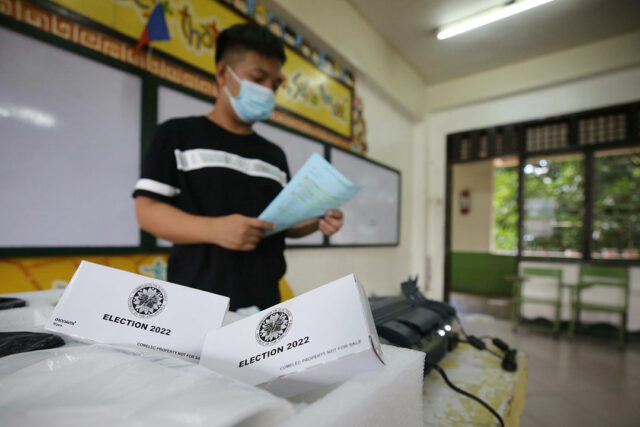
A SENATOR on Sunday said it is time for a total overhaul of the country’s election law rather than simply making amendments to specific provisions given technological advancements that could make the voting process more flexible and transparent.
“It has been discussed that the amendments to the Omnibus Election Code should no longer be limited to piecemeal provisions, so it’s a total overhaul,” Senator Francis N. Tolentino said in a mix of English and Filipino in a statement.
It must “consider today’s technology, the modern technology, to become more efficient, fast, and if the code is changed, it should not be simultaneous in a day to allow the Commission on Elections to act,” he said.
Mr. Tolentino cited as an example how thousands of Filipino maritime workers were being disenfranchised given the nature of their jobs.
“For example, you are riding on a ship today, you land in Rotterdam which is a huge port area. Your vote is in the Hague in Amsterdam, so the distance is large. You will still have to travel far which will make it difficult to vote,” he said.
“Maybe it’s the same in Hong Kong, where you still have to go to our consulates,” he added.
The Philippines, known to be the seafaring capital of the world, had 217,223 seafarers deployed overseas in 2020, a drop of 54% from the 2019 total due to the global coronavirus pandemic.
Mr. Tolentino renewed his call for hybrid elections, stressing the need for not only quick results through automated transmissions but also transparent processes through manual counting.
The Commission on Elections earlier said that it was open to adopting a hybrid election system. — Alyssa Nicole O. Tan
House bill seeks to strengthen police academy

A SOLON has a filed a bill at the House of Representatives that seeks to strengthen the police academy as a public higher educational institution.
House Bill 3507 provides for the conversion of the Philippine National Police Academy (PNPA) into an autonomous institution in accordance with the Constitution’s mandate for higher learning institutions to determine “who may teach, what may be taught, how it shall be taught, and who may be admitted to study.”
Currently, the PNPA is supervised by a command group composed of police generals who occupy director, deputy director and chief of staff positions.
“In the years ahead, we are counting on the PNPA to produce the best and the brightest law enforcement officers imbued with exceptional leadership qualities and the highest standards of professional competence and personal integrity,” Pantawid Pamilyang Pilipino Project (4Ps) Party-list Rep. Marcelino C. Libanan said in a statement on Sunday.
Under the proposed measure, the PNPA will provide advanced and specialized education in public safety, social defense, internal security, human rights, and other relevant fields of study.
The bill also states the academy will be governed by a nine-member board of trustees, with the secretary of the Interior and Local Government and the chief of the Philippine National Police sitting as chairperson and co-chairperson, respectively. — Matthew Carl L. Montecillo
Aircraft maintenance industry sees new airports driving growth

By Arjay L. Balinbin, Senior Reporter
THE government’s plan to upgrade airports or build new ones is expected to open up opportunities for the aircraft maintenance, repair and overhaul (MRO) industry, Dornier Technology said.
“With the new airports being built, we expect airlines to grow their fleets even more, which means more demand as well for our base maintenance from domestic carriers,” Dornier Technology Chief Operating Officer Joseph M. Espiritu told BusinessWorld in an e-mail interview.
A new international airport is being built in Bulacan, while Cavite province is currently preparing to start building Sangley international airport.
In his first address to Congress in July, President Ferdinand R. Marcos, Jr. said he hopes to provide a boost to the tourism industry.
“We will first and foremost make basic developments such as road improvements for easier access to tourism spots. We will also upgrade our airports and create more international airports to help decongest the bottleneck at the Manila airport,” he said.
Dornier Technology expects to operate in 15 domestic locations by 2025, according to Mr. Espiritu.
The company currently operates in Clark, Manila, Cebu, Bohol, Kalibo, Caticlan, Iloilo, Puerto Princesa, and Davao.
“By the end of this year, we are targeting to add another line maintenance station to cater to the requirements of our domestic customers,” Mr. Espiritu said.
“By 2025, we are targeting to operate in 15 domestic stations in collaboration with our partner Transnational Aviation Support Services,” he added.
The demand for low-cost and all-in aircraft maintenance services solutions, he said, is at an “all-time high” as airlines look for ways to sustain their operations.
The company described its performance for the first half of the year as “almost comparable to 2021.”
“Beginning of this year, we are very proud to announce that we did our first (Airbus) A320 C-check. And as of this writing, we are doing our second A320 C-check,” Mr. Espiritu said, referring to an extensive scheduled maintenance inspection process that typically takes the aircraft out of service for several days.
“For line maintenance, we have reactivated our line stations in Bohol and Kalibo,” he noted, adding that the company now also services three South Korean carriers: Jeju Air, Air Seoul, and Air Busan.
For the second half of the year, he said the company expects a further surge in MRO demand.
“Our projection is that we will end the year very strong, with demand for base maintenance slots increasing in preparation for the Christmas peak season,” Mr. Espiritu said.
“Now that Dornier Technology has serviced most of the local airlines, we are gearing towards the global market by amplifying our capabilities and certifications to enable us to cater to clients outside the Philippines,” he added.
Dornier Technology is positioning itself as a “center of excellence” for base maintenance of turboprop aircraft like the ATR family of aircraft, made by a joint venture between Airbus SE and Leonardo SpA; and the Dash-8 line, made by Dehavilland Aircraft of Canada Ltd.
It also has the capability to service narrow-body aircraft like the Airbus A320 and the Boeing 737.
“During the pandemic, our base maintenance was focused on the ATR C-checks; but at the beginning of this year, we have started to do base maintenance for the Airbus A320,” Mr. Espiritu said.
“We have two hangars in Clark, and we are looking at fully utilizing both hangars (operating a simultaneous line for both turboprop and narrow body),” he noted. “We will also expand our current hangar to add additional slots to our operations in Clark.”
Regarding manpower shortages, rising labor costs, and a lack of experienced workers, he said: “We intensify our efforts for talent acquisition, retention (in terms of people engagement), and skills development.”
“We are also proud to announce the establishment of Dornier Academy, which (will provide) a steady supply of technical talent and also support the talent needs of the industry through various training programs.”
Airlines in the Philippines, Mr. Espiritu also noted, are bringing in newer and more technologically advanced aircraft. “Dornier considers the technological advancement as an opportunity rather than a challenge. Opportunity to further expand our capabilities to include the new generation aircraft.”