Home Blog Page 5876

Blackwater Bossing, Bay Area Dragons kick off Commissioner’s Cup

Game Today
(MOA Arena)
3 p.m. — Blackwater vs Bay Area Dragons
5:45 p.m. — NorthPort vs Phoenix

TWO teams that figured in separate blockbuster trades just before the opening tip. A squad that starts a new journey minus its long-time gunner. A high-powered guest entry from Hong Kong that is capable of winning it all.

With this cast, the PBA fires off the Commissioner’s Cup today at the MOA Arena, marking the return of the mid-season tournament after a pandemic-forced absence in 2020 and 2021.

Blackwater Bossing, fresh from acquiring Troy Rosario and Gab Banal in a three-way swap with TNT and NLEX, and the Dragons, in their PBA debut, raise the curtains at 3 p.m.

The NorthPort Batang Pier, coming off a switch with Ginebra and San Miguel Beer that landed them Arvin Tolentino, Prince Caperal, Jeff Chan and Kent Salado, duels with Phoenix, now without franchise player Matthew Wright, in the main game at 5:45 p.m.

Major trades grabbed the spotlight on the eve of the Commissioner’s Cup tipoff.

As a result of yesterday’s deal among NorthPort, SMB and Ginebra, the Gin Kings acquired Fil-Am Jamie Malonzo and Von Pessumal while the Beermen got the Batang Pier’s 2024 and 2025 second-round draft picks. In addition to the four players, NorthPort also received Ginebra’s 2023 first-round

This came after another big trade where the Bossing unloaded No. 1 pick Brandon Rosser and their second-round choices in the 2022 and 2025 drafts, who eventually went to NLEX, while the Tropang Giga got Calvin Oftana and Raul Soyud.

Three imports are making their maiden PBA appearances in the double-header — Blackwater’s Cameron Krutwig, Kaleb Weeson of Phoenix, and either Andrew Nicholson or Myles Powell of Bay Area. NorthPort, meanwhile, is bringing back balik-import Prince Ibeh.

“We would like to build on our playoff run last conference,” said coach Ariel Vanguardia, who is banking on JVee Casio, Baser Amer, Ato Ular and Rey Suerte, aside from Krutwig and the two former TNT players, in this endeavor.

They’re up against a Dragons team bannered by NBA veteran import and Chinese-born and Chinese foreign-born Hong Kong resident ID holders.

“Tall, talented and unpredictable,’ Mr. Vanguardia said of the Dragons, who beat them and other PBA teams in tuneup games. “We still don’t know which import they will use so it gives them an advantage.” — Olmin Leyba

Becky Hammon

Getting swept in the 2020 Women’s National Basketball Association Finals after posting a pacesetting 18-4 slate in the regular season was not pleasant for the Aces, and so they set their sights on going all the way the next time around. Unfortunately, there was no redemption in 2021, as a heartbreaking Game Five loss to the overachieving Mercury in the semifinal round put an end to their campaign, and, as it turns out, to the head coaching stint of Bill Laimbeer. For all his accomplishments with a clipboard in hand, all and sundry knew they needed fresh blood to change their fortunes. After all, they weren’t about to engage in insanity by doing the same thing anew and expecting a different result.

And so the Aces thought outside the box. They didn’t just look for another bench tactician. They went about hiring one with both significant coaching National Basketball Association experience and significant playing WNBA experience — and Becky Hammon fit the bill to a T. She didn’t come cheap; she agreed to the job only after being guaranteed $1 million per year. And she didn’t come without criticism; naysayers loudly questioned her fitness for the role, not to mention the fact that her salary was multiple times that of the highest-paid players.

The good news is that Hammon could bank on decades of practice being doubted, and, more importantly, of turning critics into believers. It helped in no small measure that she oozed with self-confidence; she promptly put her money where her mouth was, instituting wholesale changes in the Aces’ offensive and defensive sets — a move that would have fazed most others in her position. She didn’t just need to get buy-in from her charges; she needed to thereafter make sure the changes led to success.

Considering the Aces’ path to the championship, Hammon clearly carries a big stick, and knows how to wield it. If nothing else, the individual accolades reflect the manner in which she is able to squeeze the most out of the talents at her disposal. Most Valuable Player and Defensive Player of the Year status for A’ja Wilson, a first All-WNBA berth for Kelsey Plum, a Most Improved Player award for Jackie Young, Finals MVP recognition for Chelsea Gray — all these show how she managed to get them to keep their eyes on the ultimate prize by, well, being themselves, or, to be more precise, the finest versions of themselves.

Given all the blessings that have come the Aces’ way under Hammon’s tutelage, it’s no wonder she wound up with the Coach of the Year trophy as well. Anticlimactic? Perhaps, but only because she proved to be head and shoulders above her so-called peers. In retrospect, her pay is a bargain. She met expectations, and more. And she’s bent on continuing to meet them, as she invariably has throughout her career.


Anthony L. Cuaycong has been writing Courtside since BusinessWorld introduced a Sports section in 1994. He is a consultant on strategic planning, oprerations and Human Resources management, corporate communications, and business development.

Institution building is the key

BW FILE PHOTO

A recent poll among business leaders revealed that 52% of the respondents are still bearish about the Philippine business environment, expecting full recovery from the pandemic to take two more years to happen. This goes against expectations of international organizations like the World Bank and the Asian Development Bank that the growth of Philippine GDP will among the highest in the Indo-Pacific region in the next two to three years, together with India and Vietnam.

These institutions expect our GDP to grow at the 6-7% growth rate that had systematically been attained during two Administrations (2011 to 2019) just before the pandemic. Despite very obvious differences between the two former Presidents, i.e., Noynoy Aquino and Rodrigo Duterte, annual GDP growth was sustained at 6-7% during the last decade because both of them appointed the best and brightest to key positions in their respective Cabinets. Since President Ferdinand Marcos, Jr. also has some of the most competent, honest and experienced members in his Cabinet, I expect the 6-7% growth to be the minimum that our economy will register for the six-year term of the present Administration.

Despite the ongoing global economic crisis, this average growth rate can be attained through the continued large remittances from OFWs, double-digit growth rates of the business process outsourcing-information technology (BPO-IT) sector, the strong rebound of domestic tourism, and increased Foreign Direct Investments (FDIs) which from day one President Marcos Jr. has been aggressively promoting, thanks to an improved climate fostered by the amendment of the Public Service Act (PSA) that now allows 100% foreign ownership of infrastructure in telecoms and transport (e.g., airports, seaports, railways, etc.)

The upside is that our GDP can grow at a faster rate of 8-10% if the present Administration can respond to the 2022 CEO Survey which emphasized the need to take concrete steps against corruption.

The respondents to the Survey were disappointed that “anticorruption initiatives were not laid out during the President’s State of the Nation Address.” The Survey showed that 67% of the respondents believe that the government should give more priority to fighting corruption than to attracting FDIs. These business executives have been disheartened by what they saw in the last Administration: undocumented health spending and misallocated healthcare funds and procurement of outdated equipment. Let me add the relapse to crony capitalism reminiscent of the martial law years. If these concerns are addressed by the present Administration, the billions of pesos that can be saved from the leakages resulting from corruption can add at least two percentage points to GDP growth.

The President can learn some lessons from what has occurred in the Bureau of Customs (BoC) over the last few years, even under the less-than-optimal conditions of the Duterte Administration.

Thanks to the efforts of a private sector initiative led by the Institute for Corporate Directors (ICD) and the Institute for Solidarity Asia (ISA) whose leadership until he was appointed to the present Cabinet was under current Department of Trade and Industry Secretary Alfredo Pascual, the BoC — which used to be one the more corrupt institutions in the Philippines — has undergone a transformation in core values such as professionalism, integrity, and accountability. The BoC has been surprising everyone with record increases in its collections. For example, for the month of August, the BoC surpassed its target collection for the 8th consecutive time during the current year. It collected 34% more than its target of P58.8 billion for the month of August. All of its 17 ports surpassed their respective targets. This outstanding performance of the BoC, under the leadership of Commissioner Yogi Filemon Ruiz, is attributed to intensified collection efforts, streamlining, digitalizing and modernization of its systems, coupled with the improving revenues resulting in higher volume of imports.

I am sure that Secretary Pascual — with his experience in ICD and ISA — can work closely with the President to replicate this success in good governance in other government agencies.

Prospects for higher revenues are also bright in the Bureau of Internal Revenues (BIR) as digitalization-savvy BIR Commissioner Lilia C. Guillermo, has announced that it is her objective to make 100% of taxpayers electronically file and pay their taxes. It may also be pointed out that the ICD and ISA are working closely with Local Government Units (LGUs) — such as La Union, Bataan, Iloilo and a few others — to improve good governance and reduce corruption at the LGU level. From my own personal experience, I can cite the city of Pasig and the province of Batangas as other examples of good governance.

The Founder of ICD and ISA is Dr. Jess Estanislao, former Secretary of Finance under the Administration of the late Corazon Aquino. In his recently published pamphlet, “A Perspective on Dream PH: Philippines 2040s, Let Us Get There,” he outlined a very comprehensive approach to improving governance at all levels of Philippine society. He emphasizes that we cannot continue giving the default answer, “let government do it.” Let the Congress pass a law; let the President and Congress set up new institutions that would address the numerous demands for transparency, accountability, fairness and responsibility in carrying out several government functions, particularly those tainted by graft and other corrupt practices; let us elect a President who could act as a knight in shining armor to banish all evil and all evil doers!

Indeed, the Government is indispensable. We can never give up on government. Its role is irreplaceable in promoting the common good. It has to set clear strategic priorities for the country and in mobilizing resources to provide critical public facilities and other much needed infrastructures. The list of essential Government functions is a long one, and there can be no substitute for government.

Jess points out, however, that the Government is not a monolith. Nor does it function in a vacuum. Other than the President, the Congress, and the Supreme Court, there are many different government agencies and local government units. In addition, the Government necessarily has to work with non-governmental players in various sectors of society, and especially the economy, and, ultimately, with individual private citizens. There is no way we can attain the good governance needed for socio-economic progress without working with the many instrumentalities of government and the public sector.

From the positive experiences of ICD and ISA for more than a decade, Jess highlights the critical importance of institution building, the key to long-term sustainable and equitable development. There has been no lack of formulation of a vision among our leaders and of the setting up of priorities. The missing link has been the sustained institutional strengthening and transformation program on the part of the many institutions in both the public and private sectors. This process calls for aligning the institutional transformation roadmap with the country’s strategic priorities, and delivering substantive contributions towards meeting those national priorities. More importantly, every institution seeks the transformation of those individuals who work there into their ultimate governance assets, while at the same time attaining higher levels of productivity and efficacy through continuing improvement of both their internal and external value chains.

As has already happened with the Bureau of Customs with the cooperation of ICD and ISA, and much before in the Central Bank of the Philippines, we can say that there are already institutions in both the public and private sectors that have accomplished this transformation process. They have already proven that within a few years (from three to five years), they had “transformed” themselves from corruption-ridden agencies to some of the most improved in transparency and professionalism. Jess speaks from experience when he optimistically asserts: “Transformation: it can be done, yes, right here in PH. The task ahead is to scale their number up: their ‘tribe’ must be made to increase, so we reach a critical mass for the institutional strengthening process to become inexorable and irreversible in the Philippines.”

Let us hope and pray that, despite continuing doubts and reservations among those who did not vote for him, President Ferdinand Marcos, Jr. will have the resolve and perseverance to follow the advice of Dr. Jesus Estanislao and the people who are behind the Institute for Corporate Directors and Institute for Solidarity Asia.


Bernardo M. Villegas has a Ph.D. in Economics from Harvard, is professor emeritus at the University of Asia and the Pacific, and a visiting professor at the IESE Business School in Barcelona, Spain. He was a member of the 1986 Constitutional Commission.

bernardo.villegas@uap.asia

An enduring Japan-Philippines strategic partnership

MALACAÑANG PHOTO BUREAU PRESIDENT BENIGNO C. AQUINO III receives a Topographical Map of Mindanao from Prime Minister of Japan Shinzo Abe on July 27, 2013. — MALACAÑANG PHOTO BUREAU

On July 13, the foreign secretaries of the Philippines and Japan reaffirmed the strategic partnership between the two countries following the first Philippines-Japan Foreign and Defense Ministerial Meeting or 2+2 in Tokyo earlier this year.

Under various government leaderships, diplomatic relations between the Philippines and Japan have remained strong since its establishment in 1956.

The agreement to elevate the relations to a “strengthened strategic partnership” was made in June 2015 under the administration of the late Philippine President Benigno Aquino III and the late Japanese Prime Minister Shinzo Abe. This will be further reaffirmed as President Ferdinand “Bongbong” Marcos, Jr. and Prime Minister Fumio Kishida meet at the upcoming United Nations General Assembly (UNGA).

Recognizing the emergence of security challenges in the Indo-Pacific region, the strategic partnership focuses on cooperation in achieving the shared vision of peace, stability, and economic growth. The mutual concerns in the region, particularly in the maritime sector, have continued to push the Philippines and Japan to foster cooperation and strengthen their partnership. The latest economic initiatives between the Philippines and Japan demonstrate their enduring alliance.

The 2020 Official Development Assistance Portfolio Review Report of the National Economic and Development Authority (NEDA) lists Japan as the top contributor of official development assistance (ODA) in the Philippines, with $11.2 billion (36.4%) worth of loans and grants. Moreover, the Philippine Statistics Authority (PSA) records Japan as the second top major export trading partner of the Philippines as of July 2022, at $903.62 million (14.5%).

At the April 2+2 Meeting in Tokyo, Japanese Foreign Minister Hayashi Yoshimasa spoke of Prime Minister Kishida’s statement that the relations between the two countries are in their “golden age.” This is attributed mainly to the infrastructure cooperation where projects worth one trillion yen (approximately P401 billion) have already been completed since 2017. Currently, the two countries have a loan agreement valued at 253.3 billion yen (approximately P112.1 billion) for the Metro Manila Subway Project Phase 1, which is crucial to the country’s economic recovery.

The public health crisis also brought an opportunity for deeper cooperation between the two countries. Japan was one of the major sources of assistance during the critical first year of the COVID-19 pandemic through its provision of medical equipment and other important resources.

Aside from the growing economic ties and pandemic assistance, the strategic partnership is also founded on the shared value of a rules-based international order, particularly on the issue of maritime territorial disputes that both countries confront.

In the case of the West Philippine Sea, Japan proved itself a consistent supporter of the Philippines. On the 6th anniversary of the Arbitral Ruling that favored the Philippines in July, the Ministry of Foreign Affairs of Japan stated that the award is treated as final and legally binding. Tokyo urged China and the Philippines to comply with it. In this context, continuous support from the international community is crucial in asserting the country’s sovereign rights in its territory.

The sustained initiatives between the two countries have also placed Japan as one of the most trusted countries by Filipinos (at 78%), as reflected in the Social Weather Stations survey commissioned by the Stratbase Albert Del Rosario Institute in June.

The late Prime Minister Abe was largely responsible for the Philippines’ stable and dynamic partnership with Japan. As a global leader, he laid the groundwork for continued cooperation on economic and defense fronts as part of his vision of a free and open Indo-Pacific region. The strategic partnership of the two countries, as key players in the region, serves as a pillar in fostering multilateral and inclusive cooperation.

Abe’s initiatives at the multilateral and bilateral levels became a strong foundation for building trust among states and set the stage for enduring partnerships in the Indo-Pacific. This was demonstrated by his founding role in the influential Quad partnership in 2006 and its revival in 2017 with the United States, Australia, and India.

Beyond his resignation from office in 2020 and his passing in July this year, Abe’s lasting legacy in global and regional affairs is demonstrated by the consistent advancement and promotion of a free and open Indo-Pacific region. His exceptional leadership at the international level contributed to the realization that the peace and prosperity of the region is a shared responsibility among states.

Recognizing the need to collectively manage the Indo-Pacific’s current security landscape, states have continued to maximize their roles through their respective foreign policy strategies that also reflect Abe’s vision of a free and open region. The international community has high regard and admiration for his contributions to the Indo-Pacific region, as well as the strategic partnership between the Philippines and Japan.

With Abe’s untimely death, the greatest tribute that world leaders can pay to the late prime minister is to carry on his vision of a free and open Indo-Pacific. This will be made possible by enhancing connectivity as well as strengthening strategic partnerships and alliances in the region based on fundamental principles such as the rule of law and freedom of navigation.

In pursuing an independent foreign policy, the Philippines must draw on its long-standing strategic partnership with Japan and other like-minded states to conclusively contribute to maintaining peace and stability in the Indo-Pacific region.


Victor Andres “Dindo” C. Manhit is the president of the Stratbase ADR Institute.

Frustrated and snubbed, Putin is running out of options

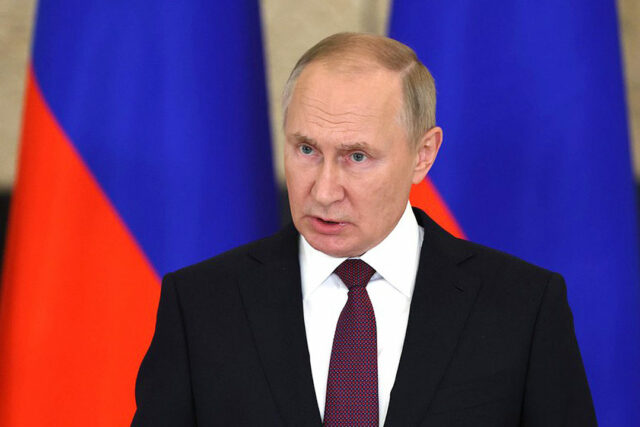
Russian President Vladimir Putin — KREMLIN.RU

IT’S BEEN a bad few weeks for Vladimir Putin.

First, a significant strategic defeat in Ukraine, after a stunning counteroffensive that dealt a blow to the Kremlin’s ambitions in the east. Then, what was supposed to be a gathering of likeminded leaders in Uzbekistan mostly served to remind him of his weakened status, as the Russian president was given short shrift by China and then chided by India. Meanwhile, in a neighborhood where Moscow is supposedly security guarantor, there has been fighting between Armenia and Azerbaijan, and clashes continue on the border between Kyrgyzstan and Tajikistan.

Putin is under pressure at home, too, with criticism from surprising corners. On Sunday, Alla Pugacheva, a much-loved pop singer who has been a household name for Russians for decades, posted a message criticizing “illusory aims” in Ukraine that have made Russia “a pariah” that weighs “heavily on the lives of its citizens.” On the other side, nationalists are furious at inept military leadership, forcing Kremlin spokesman Dmitry Peskov to warn that criticism would be fine — until it wasn’t: “The line is extremely thin. One should be very careful here.”

Yet it’s hard to avoid the reality of an unravelling campaign, and calls for national mobilization to solve all these concerns are growing too loud to ignore. Putin said last week that there was “no hurry” in Ukraine — his assumption clearly remains that the Russian regime can outlast Western resolve — and there would be no changes to the plan. But he made a point of saying Russia was “not fighting with a full army.”

For many, given the expansive goals at stake, that’s the problem.

They argue Putin can’t win with his current strategy. National mobilization would add resources and manpower, widening the pool of fighters. But that’s theory. In practice, calling a spade a spade is all but unthinkable for the Kremlin, which still has no clearly articulated plan for Ukraine and has spent months separating ordinary Russians from reality on the frontline. Worst of all, it may already be too late, anyway.

For now, it’s certainly an unusually sonorous public discussion. In a rare outburst, former MP Boris Nadezhdin argued during a television talk show that it would be impossible to “beat Ukraine with these resources, with this ‘colonial war’ method, with contract soldiers, mercenaries, and no general mobilization.” He added: “We either call for mobilization and go for a full-scale war, or we get out.” He suggested peace talks; other participants shouted him down.

Days later, Gennady Zyuganov, the head of Russia’s Communist Party and voice of the Kremlin-tolerated opposition, sought “maximum mobilization” and became the highest-profile figure to call the assault a war. “A war is something you can’t stop even if you want to,” he said in the Duma last week. “You have to fight to the end.”

For Zyuganov, security-forces hawks or figures like Ramzan Kadyrov, the pro-regime leader of the southern region of Chechnya whose militia is fighting in Ukraine, the benefit of mobilization is to add manpower and move the economy onto a war footing, focusing squarely on military production. But it’s an option that Putin, who depends on an illusion of stability and normalcy, is reluctant to take.

Three reasons come to mind. Most obviously, it would be an admission of failure. A special military operation that, seven months in, becomes a war, is hard to portray as a success.

Second, mobilization requires undoing the passivity on which Putin has built his regime. It involves galvanizing citizens who have largely been encouraged to sit out a war that was supposed to be surgical and swift. This was an assault that — unlike, say, the disastrous Soviet decade in Afghanistan — was supposed to be fought by paid volunteers, recruited from the country’s poorest (and often ethnically non-Russian) provinces, places like Tuva or Dagestan. Ordinary folks in larger cities could support a war that demanded nothing from them.

As Yuval Weber of Texas A&M’s Bush School of Government and Public Service in Washington, DC put it to me, these masses in the middle are the real risk for the Kremlin, far more than the nationalist right. They are the ones on whom the regime has long relied, men and women who have been lulled into apathy but would now need to be whipped into a frenzy. More involved (and sending their own kin to war), they may well start asking awkward questions about Putin’s effectiveness.

Then there’s the third problem — mass mobilization will be a huge challenge. The logistics are complex. The economy will not easily stomach the cost of losing workers, resistance to the draft is escalating and will only keep increasing as soldiers return from the front. Not to mention that men are needed now — but getting recruits through training will take months, given Russia does not have a strong, well-prepared reserve force. Nor is it clear how reservists and young conscripts, for now officially spared the frontline, can solve fundamental problems of leadership, morale, and materiel.

And yet Russia can’t remain stuck fighting an existential war it has waged with too few men, losing them and their weapons at a staggering rate — US officials last month put the figure for killed or wounded since the start of the war at up to 80,000, though numbers vary widely.

There’s still danger Russia that could escalate, or use a supposedly growing threat to push through a declaration of war. As Ben Noble of University College London points out, increasing Kremlin talk of unprecedented NATO support for Ukraine may well be creating options for a regime that sees very few. The West, officials could eventually argue, forced Moscow’s hand.

But for now the Kremlin is betting on the next best thing — encouraging regions and mercenaries to mobilize on the state’s behalf, ignoring already deep coordination problems between fighting units.

Footage emerged last week of a man bearing a striking resemblance to sanctioned businessman Yevgeny Prigozhin addressing detainees in a prison on behalf of mercenary group Wagner, promising to commute sentences for service. “If you serve six months (in Wagner), you are free,” he says. “If you arrive in Ukraine and decide it’s not for you, we will execute you.”

Even more telling, though, was Prigozhin’s response on social media after the video went viral: “It’s either private military companies and prisoners, or your children,” he wrote. “Decide for yourself.”

BLOOMBERG OPINION

Ukraine marches further into liberated lands

BRANDON MORALES-UNSPLASH

IZIUM, Ukraine — Ukraine said its troops have marched farther east into territory recently abandoned by Russia, paving the way for a potential assault on Moscow’s occupation forces in the Donbas region as Kyiv seeks more Western arms.

“The occupiers are clearly in a panic,” Ukrainian President Volodymyr Zelensky said in a televised address late on Monday, adding that he was now focused on “speed” in liberated areas.

“The speed at which our troops are moving. The speed in restoring normal life,” Mr. Zelensky said.

The Ukrainian leader also hinted he would use a video address to the United Nations General Assembly on Wednesday to call on countries to accelerate weapons and aid deliveries.

“We are doing everything to ensure Ukraine’s needs are met at all levels — defense, financial, economic, diplomatic,” Mr. Zelensky said.

Ukraine’s armed forces had regained complete control of the village of Bilohorivka, and were preparing to retake all of Luhansk province from Russian occupiers, provincial Governor Serhiy Gaidai said. The village is only 10 km west of Lysychansk city, which fell to the Russians after weeks of grinding battles in July.

“There will be fighting for every centimeter,” Mr. Gaidai wrote on Telegram. “The enemy is preparing their defense. So we will not simply march in.”

Luhansk and the neighboring province of Donetsk comprise the industrialized eastern region of Donbas, which Moscow says it intends to seize as a primary aim of what it calls the “special military operation” in Ukraine.

Ukrainian troops have begun to push into Luhansk since driving Russian forces out of northeastern Kharkiv province in a lightning counter-offensive this month.

In a sign of nervousness from a Moscow-backed administration in Donbas about the success of Ukraine’s recent offensive, its leader called for urgent referendums on the region becoming part of Russia.

Denis Pushilin, head of the Moscow-based separatist administration in Donetsk, called on his fellow separatist leader in Luhansk to combine efforts toward preparing a referendum on joining Russia.

The Ukraine general staff said fighting in the past 24 hours had been limited to the Donetsk region, and Russian attacks had been repelled near Mayorsk, Vesele, Kurdyumivka, and Novomykhailivka settlements.

In the south, where another Ukrainian counter-offensive has been making slower progress, Ukraine’s armed forces said they had sunk a barge carrying Russian troops and equipment across a river near Nova Kakhovka in the Kherson region.

“Attempts to build a crossing failed to withstand fire from Ukrainian forces and were halted. The barge … became an addition to the occupiers’ submarine force,” the military said in a statement on Facebook.

Reuters could not independently verify either side’s battlefield reports.

Increased Ukrainian long-range strike capability had likely forced Russia’s Black Sea fleet to relocate some of its submarines from the port of Sevastopol in Crimea to Novorossiysk in Krasnodor Krai in southern Russia, the British military said on Tuesday.

GRIM GRAVES
Ukraine is still assessing what took place in areas that were under Russian control for months before a rout of Russian troops dramatically changed the dynamic of the war earlier this month.

At a vast makeshift cemetery in woods near the recaptured town of Izium, Ukrainian forensic experts have so far dug up 146 bodies buried without coffins, Kharkiv regional governor Oleh Synehubov said on Monday. Some 450 graves have been found at the site, Mr. Zelensky has said.

Fanning out in groups beneath the trees, workers used shovels to exhume the partially decomposed bodies, some of which locals said had lain in the town streets long after they died before being buried.

The government has not yet said how most of the people died, though officials say dozens were killed in the shelling of an apartment building, and there are signs others were killed by shrapnel.

According to preliminary examinations, four showed signs of torture, with their hands tied behind their backs, or in one case a rope tied round their neck, Serhiy Bolvinov, the head of investigative police in the Kharkiv region, told Reuters at the burial ground.

Mr. Bolvinov said the great majority of the bodies appeared to be civilians. Locals have been identifying their dead by matching names to numbers on flimsy wooden crosses marking the graves. “Soldiers had their hands tied, there were signs of torture on civilians,” Mr. Bolvinov said. Ukraine says 17 soldiers were in a mass grave at the site.

Reuters could not corroborate Ukraine’s allegations of torture.

The Kremlin denied on Monday that Russia was to blame for atrocities that Ukraine says it has uncovered in the recaptured territory.

“It’s a lie, and of course we will defend the truth in this story,” Kremlin spokesman Dmitry Peskov said, comparing the allegations to incidents earlier in the war where Russia claimed without evidence that atrocities were staged by Ukrainians.

ALARM OVER NUCLEAR PLANT
Ukraine accused Russian forces on Monday of shelling near the Pivdennoukrainsk nuclear power plant in the country’s southern Mykolaiv region.

A blast occurred 300 meters away from the reactors and damaged power plant buildings shortly after midnight on Monday, Ukraine’s atomic power operator Energoatom said in a statement.

The reactors were not damaged and no staff were hurt, it said, publishing photographs showing a huge crater it said was caused by the blast.

“Russia endangers the whole world. We have to stop it before it’s too late,” Mr. Zelensky said in a social media post.

The strikes will add to global concern over the potential for an atomic disaster, already elevated by fighting around another nuclear power plant in the south, Zaporizhzhia, captured by Russian forces in March. — Reuters


Biden hints at risky policy shift on Taiwan independence

DAVID EMRICH-UNSPLASH

By Michael Martina and David Brunnstrom

WASHINGTON -— Overshadowed by US President Joseph R. Biden’s headline-grabbing vow that American forces would defend Taiwan against a Chinese attack was his hint at possibly shifting US policy to support the island’s right to self-determination.

Though the White House has taken pains to say Mr. Biden’s most explicit statement yet about defending the Chinese-claimed island, made during an interview broadcast on Sunday, did not signify a policy change, some analysts say he may have undercut — intentionally or not — a US stance of not taking a position on Taiwan’s independence.

Chinese leader Xi Jinping has long-vowed to bring Taiwan under Beijing’s control and has not ruled out the use of force to do so. Democratically governed Taiwan strongly objects to China’s claims but says it does not need to declare independence because it is already an independent country.

US officials, including Secretary of State Antony Blinken and Defense Secretary Lloyd Austin, have underscored this year that the United States does not support Taiwan independence.

Their assurances are a part of a non-committal policy assiduously adhered to over decades to dissuade Beijing from an unprovoked attack and convince Taiwan to not make a formal independence declaration. In Washington parlance, it is known as “dual deterrence.”

But Mr. Biden told CBS 60 Minutes that while he is not encouraging the move, such a decision was up to Taiwan.

“Taiwan makes their own judgments about their independence. We are not encouraging their being independent. That’s their decision,” Mr. Biden said.

BIDEN’S REMARKS DIVIDE
The president’s critics argue China will perceive his comments as tacit support for an independence declaration, a redline for Beijing. They also say Mr. Biden’s comments are more likely to aggravate hostilities than overt defense commitments since Beijing already likely assumes Washington will defend Taiwan.

“It is incoherent to argue that America’s Taiwan policy has not changed while also claiming that the US has a commitment to fight for Taiwan and that Taiwan makes its own judgments about independence,” said Craig Singleton, a China policy expert at the Foundation for Defense of Democracies. He added Beijing will likely worry that Mr. Biden is suggesting Taiwan can decide itself whether it is independent.

White House Indo-Pacific coordinator Kurt Campbell told a forum on Monday the president’s remarks “speak for themselves” after some Republicans, including Senator Ben Sasse, praised the president’s comments but slammed the White House for walking them back.

“The President directly affirmed the United States’ longstanding one China policy,” said Adrienne Watson, a spokesperson for Mr. Biden’s National Security Council.

Mr. Biden also garnered support from some US allied countries, such as from the visiting speaker of Lithuania’s parliament, Viktorija Cmilyte-Nielsen, who told Reuters that Mr. Biden’s comments were “meaningful and timely.”

“I think it’s a strong statement and it’s definitely a welcome tone,” she said.

‘PRECISION OF LANGUAGE’
Taiwan’s Foreign Ministry responded to Mr. Biden’s remarks by expressing its “sincere appreciation” for his staunch support of the island.

China’s Washington embassy spokesperson Liu Pengyu said the United States should not send the wrong signal to Taiwan’s separatist forces lest it risk undermining peace across the Taiwan Strait and China-US relations.

Jude Blanchette, a China expert at the Center for Strategic and International Studies think tank, said Mr. Biden’s remarks confused rather than clarified US policy.

“One issue where the precision of language is paramount is the discourse on our Taiwan policy,” Mr. Blanchette said.

“If we are going to make a fundamental policy shift that we are going to defend Taiwan even if they declare independence, then that’s one that deserves a more robust discussion than everyone being informed on a 60 Minutes interview,” he said. — Reuters

As UN mulls Myanmar action, Malaysia pushes ASEAN to review peace plan

SAW WUNNA-UNSPLASH

NEW YORK — Southeast Asian nations must decide if they are going to push ahead with a so-far failed five-point peace plan for Myanmar or “decide what’s next” before their leaders meet in November, Malaysia’s Foreign Minister Saifuddin Abdullah said on Monday.

Myanmar has been in crisis since the army ousted leader Aung San Suu Kyi’s elected government in February last year, detaining her and other officials and launching a bloody crackdown on protests and dissent.

The Association of Southeast Asian Nations (ASEAN), of which Myanmar is a member, has been leading peace efforts.

“Between now and the ASEAN summit in November ASEAN must seriously review if the five-point consensus is still relevant, and if it should be replaced with something better,” Mr. Abdullah said. “By the time we meet in November, we must ask that hard question and we must have the answer during that time.”

Speaking to reporters on the sidelines of the annual gathering of world leaders for the UN General Assembly in New York, Mr. Abdullah also said he hoped the 15-member UN Security Council would not fail the people of Myanmar.

The UN Security Council is considering a British-drafted resolution — circulated on Friday — that would demand an end to all violence in Myanmar, urges an immediate end to the transfer of arms to Myanmar and threatens UN sanctions.

It would also call on the Myanmar junta to release all political prisoners, including Ms. Suu Kyi, implement the ASEAN peace plan and allow a democratic transition.

However, the Security Council has long been split on Myanmar with diplomats saying China and Russia would likely shield the country from any strong action and negotiations on the British draft resolution are likely to take some time.

To be adopted, a Security Council resolution needs at least nine votes in favor and no vetoes by Russia, China, the United States, France, or Britain. — Reuters

Lucky Me tops Kantar ranking of FMCG brands of the decade

Lucky Me!/Facebook

Lucky Me, a line of instant noodles under Monde Nissin Corp., emerged as both Brand of the Decade and Most Chosen Brand of 2021, according to data compiled by marketing data and analytics company Kantar Group. 

The noodle brand, which landed in the news this July for containing traces of pesticide, topped Kantar’s Brand Footprint 2022 report, a ranking of fast moving consumer goods (FMCG) based on Consumer Reach Points (CRP), which combines population or the number of households in the country; penetration or the percentage of households purchasing the brand; and the frequency of the brand being chosen by Filipinos over the course of 12 months. 

Lucky Me was bought by 98.4% of Filipino homes and was chosen by local shoppers 31 times per year over the past decade, giving it a total of 9.4 billion CRP.  

Aside from Lucky Me, other food and beverage brands in the top 10 brands of the decade in the Philippines are:

  • Nescafé (7.3 billion CRP), in second;
  • Silver Swan (5.4 billion CRP), in fourth;
  • Bear Brand (4.9 billion CRP), in sixth;
  • Milo (4.9 billion CRP), in seventh;
  • And Ajinomoto (4.6 billion CRP), eighth.

Rounding out the list are three personal care brands and one lone homecare brand: detergent brand Surf (5.6 billion CRP) in third; Palmolive (5.2 billion CRP), fifth; Safeguard (4.2 billion CRP), in ninth; and Cream Silk (4.1 billion CRP), tenth. 

Meanwhile, the top 10 most chosen FMCG brands of 2021 are:

  • Lucky Me
  • Silver Swan
  • Bear Brand
  • Nescafé
  • Surf
  • Kopiko
  • Coca-Cola
  • Datu Puti
  • Palmolive
  • Safeguard

The combination of high penetration and frequency are the two chief drivers of brand growth, said Bea D. Coronol, client manager at Kantar Philippines, in a Sept. 20 briefing.   

“In fact, 88% of brands in the country have achieved growth this way during the last 10 years,” she said, adding that retail sizes affect brand popularity.  

“Generally, the Philippines is a sachet market. Filipinos make weekly trips to supermarket and sari-sari stores,” said Ms. Coronel. “Having diverse sizes in a portfolio can cater to as many households as possible.”   

“FMCG brands should get to know the behaviors of their target consumers better, be more present in places where they shop, and communicate effectively with them to create more moments where they can catch their attention,” said Nino C. Nierva, client director at Kantar Philippines, in a Sept. 20 statement.  

“They must find ways to innovate and address the emerging needs of consumers, or offer more categories for them to choose from,” he added.  

Kantar also saw an increase in e-commerce purchases for FMCG, with 10% of Filipino households purchasing FMCG products from e-commerce outlets

“But we consider e-commerce as a niche source of purchase for Filipino shoppers, given that it mostly caters to Metro Manila, and for those with stable internet access,” said Mr. Nierva.  

E-commerce for FMCG is less than 1% of the total FMCG market in the Philippines, said Des Deocareza-Lozano, director of the Worldpanel Division of Kantar Philippines. 

“The challenge now for e-commerce is that, as the economy reopens and mobility is increasing, e-commerce has to differentiate itself,” Ms. Deocareza-Lozano said. “That will be the challenge now for e-commerce — how differentiated the offer is, and how we can overcome barriers like data cost and delivery charges.”    

The number of households worldwide grew to 25.4 million in 2021 from 19.5 million in 2012, or an increase of 30%. This, Kantar said, offers opportunities for brands to target more shoppers. — P. B. Mirasol

IDB begins reviewing report on bank chief’s alleged ties to staffer, source says

 – The Inter-American Development Bank‘s (IDB) board of directors on Monday began reviewing an independent report on whistleblower allegations that the bank‘s chief, Mauricio Claver-Carone, had an intimate relationship with a staffer and misused IDB funds, a source familiar with the matter told Reuters.

Latin America’s main development bank, which is headquartered in Washington, hired legal firm Davis Polk to investigate the allegations after holding several meetings on the issue in April. Read full story

Board members received the report prepared by Davis Polk on Monday and met later in the day to review it, said the source, who was not authorized to speak publicly.

The findings of the report were not immediately available.

Mr. Claver-Carone in April denied the allegations and said he was the target of an “anonymous political media campaign.” Read full story

Mr. Claver-Carone, in New York on Monday for meetings on the sidelines of the United Nations General Assembly, could not immediately be reached for comment. An IDB official who works closely with him told Reuters that Mr. Claver-Carone has not received or seen a copy of the report, despite repeated requests by his attorneys.

He met with investigators from the law firm on two occasions, with the first lasting for over five hours, said the IDB official, who declined to be named.

The bank‘s ethics rules and code of conduct require employees or staff to be given 15 business days to review and respond to any perceived factual errors before a report on alleged wrongdoing is finalized, the official said.

Reuters reported in April that the whistleblower had sent an anonymous email to the board of directors and the bank‘s ethics officer, accusing Mr. Claver-Carone, a former Trump administration official, of carrying out a relationship with a senior strategist who reported to him, and of misusing IDB funds. Read full story

Reuters has seen the email, which requested a “thorough, transparent, independent investigation.” Reuters was unable to confirm the claims about the alleged relationship, which, if verified, would appear to be against the bank‘s rules.

The United States, the bank‘s largest shareholder, “takes all ethics allegations at the international financial institutions (IFIs) very seriously, and we strongly support whistleblower protections,” a spokesperson for the U.S. Treasury Department said. “We also support a prompt and fair process for assessing such allegations.”

One source familiar with the matter said it would be “weeks, not days” before any decision on Mr. Claver-Carone’s future.

Mr. Claver-Carone, a hard-line Cuba hawk, faced a strong backlash ahead of his election to the IDB presidency in 2020 by some member states, including Argentina and Mexico, who bristled at breaking the bank‘s tradition since 1959 of having a president from a Latin American country. – Reuters

EU, France see no better deal for Iran

STOCK PHOTO - Pixabay.com

 – France said on Monday that there would not be a better offer for Iran to revive a nuclear deal with world powers and it was up to Tehran to decide now with the EU coordinator for the talks saying he saw little chance of progress this week.

Months of indirect talks between Iran and the United States have foundered over several issues, including Tehran’s insistence the International Atomic Energy Agency (IAEA) close an investigation into uranium traces found at three undeclared sites before the pact is revived, and a US guarantee that Washington would not walk out of any nuclear agreement again.

“There will not be a better offer on the table and it’s up to Iran to take the right decisions,” French Foreign Minister Catherine Colonna told reporters on the sidelines of the United Nations’ General Assembly in New York, adding that no initiatives were underway to unblock the situation.

Her comments were echoed by EU foreign policy chief Josep Borrell, the negotiations’ coordinator, who told reporters in New York that he saw no prospect of any progress during this week’s gathering of world leaders.

“There is a proposal from the (EU) coordinator on the table and it will remain on the table. I don’t see a better solution and it won’t become caduc (null and void),” he said.

Western diplomats have said there are no active negotiations at the moment and it was unlikely that a breakthrough could happen before the U.S. mid-term elections in November. They have accused Iran of going backwards in the talks, something Tehran denies.

“There are indications that the IAEA intends to close the case of the three sites … ,” Iran’s nuclear chief Mohammad Eslami said in remarks carried by Iranian state media on Monday. “We hope that they will be honest and do not waste more time in order to pressure Iran.”

European officials have been adamant that Iran must give credible answers to the IAEA’s questions, fearing that if the issue was swept under the carpet it could weaken the Nuclear Proliferation Treaty, the framework to halt the spread of nuclear weapons-making capability.

Colonna said the United States and its European partners shared an identical position on the question of resolving an investigation.

Borrell’s comments sparked a response from Russia’s envoy to the talks, Mikhail Ulyanov, who said on Twitter the finger pointing showed things had reached a stalemate.

“Attempts to put all the blame on #Iran aren’t fair. The talks are too much dependent on the domestic political schedule of another participant,” he said, referring to the upcoming U.S. elections.

Iranian President Ebrahim Raisi, who addresses world leaders at the UN on Wednesday, said on Sunday that Iran would be serious about reviving the nuclear deal if there were guarantees the United States would not again withdraw from it as it had done under President Donald Trump.

The U.S. has offered certain guarantees for 2.5 years, diplomats said, but is unable to go beyond that.

A source close to Iran’s nuclear team said Tehran had lost interest in reviving a deal that can only last 2 years.

“Our nuclear program is advancing every day and this time is on our side. Let them be worried about it,” the source said.

Ecuador reaches deal with China to restructure debt

STOCK PHOTO | Image by DEZALB from Pixabay

Ecuador has reached an agreement to restructure its debt with Chinese banks, the government said in a statement on Monday, providing debt relief worth some $1.4 billion until 2025.

Ecuador‘s President Guillermo Lasso announced in February that he was looking to restructure the country’s debt and improve the conditions of long-term oil sales contracts with Beijing.

China has become Ecuador‘s main financial partner in the past decade.

Agreements were reached with both the China Development Bank and the Export-Import Bank of China (Eximbank) for loans worth $1.4 billion and $1.8 billion respectively, extending the loans’ maturity and reducing amortization.

“As a result of these agreements, the maturities are extended to 2027 for China Development Bank and 2032 for Eximbank, allowing the cash-flow relief to support government priorities,” the president’s press team said in the statement.

Ecuador also managed to reduce certain applicable interest rates and suspend all amortizations with China Eximbank for a six-month grace period, the government said.

The loans were agreed during the government of former President Rafael Correa, while several were linked to long-term oil sales contracts with Chinese companies.

The agreements also involve freeing up certain amounts of exports to Chinese oil company CNPC under oil-backed contracts, allowing Ecuador to sell an unspecified quantity of oil at market prices, the statement said.

State-owned energy company Petroecuador reached an agreement with Petrochina 601857.SS last week on a number of crude oil deliveries.

Since taking office last May, Lasso has turned to multilateral organizations for financing to reactivate Ecuador‘s economy, which was battered by the coronavirus pandemic, and renegotiated a $6.5 billion credit agreement with the International Monetary Fund, which ends this year.

The Wall Street Journal first reported on Monday that Lasso had announced a deal to with China to restructure $4.4 billion worth of debt. – Reuters