
Philippine companies seen to hike 2023 salaries by 5.7%
PHILIPPINE EMPLOYERS will probably increase their budget for pay increases next year amid a tight labor market and rising prices, according to Willis Towers Watson (WTW). Read the full story.

PHILIPPINE EMPLOYERS will probably increase their budget for pay increases next year amid a tight labor market and rising prices, according to Willis Towers Watson (WTW). Read the full story.

By Diego Gabriel C. Robles
PHILIPPINE EMPLOYERS will probably increase their budget for pay increases next year amid a tight labor market and rising prices, according to Willis Towers Watson (WTW).
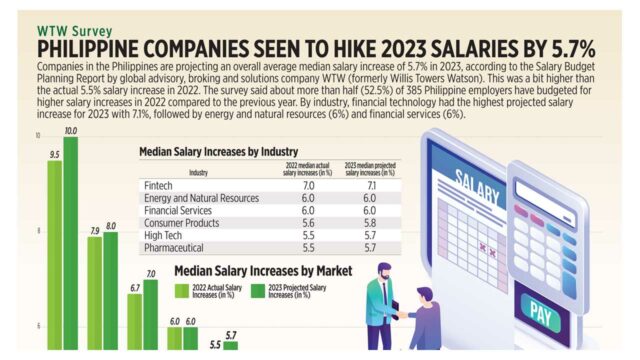
Private companies are allotting an average median increase of 5.7% in salaries for 2023, higher than the actual 5.5% increase this year and at any time during the pandemic, the insurance advisor company said, citing the results of its survey for the Asia-Pacific region.
“Compounding economic conditions and new ways of working are leading organizations to continually reassess their salary budgets to remain competitive,” Patrick Marquina, Work and Rewards Leader at WTW Philippines, said in a statement.
“Although higher salary increases are expected, various industries are showing different developing rhythms. With such a dynamic environment, it’s imperative for organizations not only to have a clear compensation strategy but also a keen understanding and appreciation of the factors that influence compensation growth,” he added.
Sergio Ortiz-Luis, Jr., president of the Employers Confederation of the Philippines, and Raymond Democrito C. Mendoza, party-list representative of the Trade Union Congress of the Philippines, did not immediately reply to separate Viber messages seeking comment.
The Philippines ranked fifth out of 14 countries, with India (10%), Vietnam (8%), Indonesia (7%) and China (6%) at the top. The country was also fifth for actual pay raises this year.
Willis Towers Watson said 52.5% of 385 employers in the Philippines who participated in the survey had increased their salary increase budgets this year from last year.
“When asked whether they have changed their 2022 salary increases from their original projections, only 32.5% have made further adjustment from what they have initially planned for, while 51% have maintained the pay budgets they set at the start of 2022,” it said.
Consumer product companies are expected to increase their pay hike budgets next year to 5.8% from 5.6%, while high-tech and pharmaceutical companies will increase theirs to 5.7% from 5.5%.
The fintech industry would probably increase its budget to 7.1% from 7%, while energy and natural resources and financial services would both remain unchanged at 6%, Willis Towers Watson said.
The most cited reasons for the higher actual pay raise this year were a tighter labor market (59%), cost management such as inflation and rising supply costs (58%) and employee expectations (44%).
Despite inflation concerns, 65% of the companies said they would not make more frequent salary increases, while the rest said they already did or were planning to increase how often they raise salaries. Among these, 98% said they have or will adjust salaries twice a year.
Willis Towers Watson said 86% of companies said they were experiencing difficulties attracting talent this year, but only 38% expect the same next year.
While 84% of companies reported difficulty keeping workers this year, the number is expected to drop to 49% next year.
Information technology skills were the most sought after by companies, with 64% of companies in the Philippines looking to recruit digital talent in the next 12 months.
A third of companies said that they experienced problems in attracting (74%) and retaining (66%) these professionals.
Most companies are taking nonmonetary actions to attract and keep talent, with 65% having increased workplace flexibility and 20% planning to do so soon.
This includes putting more emphasis on diversity, equity and inclusion (58%) and allowing remote work (52%).
“With significant risks in the global economy, continued high inflation and employers grappling with talent supply challenges, organizations need to get more creative to address attraction and retention challenges,” Mr. Marquina said.
“The workforce is composed of a diverse employee population, each with their own unique dynamics. Employers are challenged to meet their preferences and needs while delivering on a superior employee experience for all.”
Some companies were also using monetary incentives such as sign-on bonuses and incentive awards (45%) and changing compensation programs (40%).
“The optimism is based on the continuing normalization of socioeconomic activity leading into a steady, pre-pandemic pace of expansion, which should keep inflation relatively stable with energy prices likely to decelerate,” James G. Matti, head of WTW Philippines, said in a text message.
“Moreover, the recovery in tourism and private investments, coupled with sustained public spending on large infrastructure projects and robust remittances from overseas Filipino workers should enhance the continuous pace of economic recovery,” he added.
Mr. Matti said lockdowns spurred by another pandemic and runaway inflation could halt the expected salary increases next year.

Philippine President Ferdinand R. Marcos, Jr. on Monday certified as urgent the proposed P5.268-trillion national budget for next year, citing the need for continuous government operations.
In a letter to Speaker Ferdinand Martin G. Romualdez, the president said passing the budget bill on time would also allow the state to “respond more effectively to the COVID-19 pandemic and support initiatives toward national economic recovery.”
The certification allows the House of Representatives to approve the budget bill on second and third reading on the same day.
“We are right on track with our schedule,” Mr. Romualdez said in a separate statement, adding that congressmen would probably approve the measure on Wednesday.
Also yesterday, the House passed on final reading a bill that seeks to modernize tax administration and improve tax compliance.
It unanimously approved House Bill 4125 or the proposed Ease of Paying Taxes Act, which will simplify the filing of tax returns for small taxpayers.
The measure will introduce a medium-sized taxpayer classification and create a special unit in the Bureau of Internal Revenue that will focus on improving taxpayer services.
It will also remove the distinction between sales invoices and official receipts, legislate taxpayers’ bill of rights and do away with the P500 annual taxpayer registration fee.
Congressmen also passed on final reading House Bill 5001 or the Free College Entrance Examinations Act.
The measure mandates all private higher education institutions to waive college entrance exam fees for poor graduating high school students and graduates who belong to the top 10% of the graduating class. — Matthew Carl L. Montecillo and Kyanna Angela Bulan





GOING to new places outside the usual itinerary, learning from the locals’ stories, and giving back to the community are the focus of Cignal TV’s new “infotainment” travel show Woman in Action, hosted by Gretchen Ho.
Gretchen Ong Ho, a former collegiate volleyball athlete for the Ateneo Lady Eagles from 2008 to 2013, debuted as an anchor and sports program broadcaster in various ABS-CBN programs before joining TV5 in 2021.
The show began as an online platform which Ms. Ho launched during the height of the COVID-19 pandemic in April 2020. She then extended the platform to a television show. As host and producer of Woman in Action, Ms. Ho will explore remote places in the country, highlighting adventures and the unique stories and the situation of these communities.
The show’s main goal is to “show the heart of the Filipino story through travel and adventure,” Ms. Ho said during an online press conference on Sept. 23.
In Woman in Action, Ms. Ho showcases the outgoing side of herself. “It’s fun for me to share that side of me,” she said. As host and producer, she said that “there is a conscious effort to annotate, to narrate and really immerse” herself in the places and communities she visits.
Ms. Ho added that the show will also focus on “courageous” travel and not just limit it to resorts and hotels.
“We wanted to show a different side [about the destination]. We traveled through the different stories of people,” she said.
In the first episode, Ms. Ho travels to a community in La Union. As a kickoff to the program, Ms. Ho noted that their team wanted to show the tourism status as it is the province’s major industry.
“…We wanted it to start by asking the question ‘Paano ba bumabangon iyung ating mga kapatid na frontliners sa [tourism] industry?’ (How do our fellow tourism frontliners in the industry raise themselves up?),” she said, adding that the episode showcases more of the province than just its famous surfing spots.
During the pandemic, Ms. Ho also launched the “Donate a Bike Save a Job” campaign which ended up helping a thousand families, with more than 1,500 bicycles donated to frontliners and workers for easier transportation at a time when public transportation was scarce.
Ms. Ho and her team were able to donate 100 bikes to the community she visited in La Union.
The next episodes will include a sustainable public service component in every community the show visited. Ms. Ho is working with NGOs to bring their work to the public’s attention, and hopefully gain sponsors to help the communities.
“That’s one thing we want to teach in our episodes — every time you go to a place, you can actually leave a mark that will last,” she said.
Other places to be featured in the show include Bukidnon where Ms. Ho climbs Mount Dulang-Dulang — the second highest mountain in the Philippines; and Siargao where they will visit communities affected by Typhoon Odette which trashed the area in December last year. The show also features trips abroad, such as an episode in Singapore where they feature the Formula One race and stories about the Overseas Filipino Workers (OFWs).
One significant episode, Ms. Ho said, revolves around a trip to Rizal Province with 2020 Tokyo Olympics Gold medalist Hidilyn Diaz-Naranjo and her coach and husband Julius Naranjo, where they visit a training camp for young athletes. Ms. Diaz has a seven-year-old niece who is an athlete training there.
“Their efforts there and what their lives are, is something to watch out for. I’m excited to tell that story,” Ms. Ho said.
For Ms. Ho, being a woman in action means “making things happen.”
“Marami akong ideas noon (I had many ideas before)…The only way that is going to come true is if I act on the vision,” she said. “I really did not want this to be exclusive to women… It’s really a call to action to anyone na if you want to pursue something… all you need to do is to take courage [and work] towards it.”
Woman in Action premieres on Oct. 1, 7:30 p.m., on One News via Cignal, available on CH. 8 SD and CH. 250 HD. The episodes will be replayed the following day at 8 p.m. on One PH, CH. 1, and will also be available on SatLite CH. 60 and on the Cignal Play app. — Michelle Anne P. Soliman

INTERNATIONAL tourist arrivals in the Asia-Pacific (APAC) region have surged in the seven months to July this year, but the numbers are still far from pre-pandemic levels, according to the United Nations World Tourism Organization (UNWTO).
In a statement on Monday, the UNWTO said its latest World Tourism Barometer showed that arrivals in the APAC region rose by 165% during the January-to-July period this year.
“Asia and the Pacific (+165%) saw arrivals more than double in the first seven months of 2022, though they remained 86% below 2019 levels, as some borders remained closed to non-essential travel,” it said.
Further, the organization said that international tourism from January to July posted a 172% increase compared with the same period last year, which is equivalent to 57% of pre-pandemic levels.
“An estimated 474 million tourists travelled internationally over the period, compared to the 175 million in the same months of 2021. An estimated 207 million international arrivals were recorded in June and July 2022 combined, over twice the numbers seen in the same two months last year. These months represent 44% of the total arrivals recorded in the first seven months of 2022,” the UNWTO said.
According to the UNWTO, Europe and the Middle East posted 74% and 76% of 2019 levels, respectively, during the period. Other regions that recorded strong growth during the seven months include the Americas at 103% and Africa at 171%.
“Tourism continues to recover steadily, yet several challenges remain, from geopolitical to economic. The sector is bringing back hope and opportunity for people everywhere. Now is also the time to rethink tourism, where it is going and how it impacts people and planet,” UNWTO Secretary-General Zurab Pololikashvili said.
John Paolo R. Rivera, associate director at the Asian Institute of Management’s Dr. Andrew L. Tan Center for Tourism, said in a Viber message that arrivals in the APAC region were below pre-pandemic levels because it remained cautious compared with other regions.
“APAC is not as liberal as the US and Europe. APAC tourism is affected because they rely on foreign tourists,” Mr. Rivera said.
However, Mr. Rivera said that the figures do not have a “significant” effect on the Philippines due to its domestic tourism.
“The Philippines is not significantly affected because our tourism industry can flourish with domestic tourism alone accounting for 80% of tourism receipts. Foreign tourists are just [a] bonus for us,” Mr. Rivera said.
Meanwhile, the UNWTO said that its panel of tourism experts is cautiously optimistic for the rest of 2022.
“Prospects for the remainder of the year are cautiously optimistic,” it said. “Almost half of experts (47%) see positive prospects for the period September-December 2022, while 24% expect no particular change and 28% consider it could be worse.”
The UNWTO added that the experts have reversed their projection for a return of international tourism to pre-pandemic levels in the near term.
“Some 61% of experts now see a potential return of international arrivals to 2019 levels in 2024 or later while those indicating a return to pre-pandemic levels in 2023 has diminished (27%) compared to the May survey (48%),” it said.
“According to experts, the economic environment continues to be the main factor weighing on the recovery of international tourism. Rising inflation and the spike in oil prices results in higher transport and accommodation costs, while putting consumer purchasing power and savings under pressure,” it added.
For Mr. Rivera, the UNWTO’s projection may not apply to the Philippines due to its target market.
“I think they are rushing it because they believe tourism will recover as fast as it collapsed in 2020. Travel and tourism will definitely recover but at a different pace because it is transitioning into a more resilient one given the lessons learned from the pandemic,” Mr. Rivera said.
“This may not be the case in the Philippines because Filipinos are reliable target market for Philippine tourism. We keep money circulating in our country. And it’s cheaper to travel in the Philippines now given currency depreciation,” he added. — Revin Mikhael D. Ochave

 NETFLIX, Inc. dropped its lawsuit against the creators of The Unofficial Bridgerton Musical after reaching a settlement, according to person familiar with the matter.
The streaming service filed a copyright infringement suit against Abigail Barlow and Emily Bear in Washington in late July, three days after a sold-out performance of The Unofficial Bridgerton Musical in the US capital’s Kennedy Center.
Netflix disclosed in documents filed Friday in federal district court that it had dismissed the case “with prejudice,” meaning it cannot bring the case again.
After Bridgerton debuted on Netflix in December 2020, the creative duo known as Barlow & Bear began posting about the series on TikTok, composing songs based on characters, scenes, dialog and plot points. They subsequently released an album of titled The Unofficial Bridgerton Musical, which won a Grammy Award and led to the stage show.
The Netflix series is based on the Regency-era romance novels by Julia Quinn.
“Barlow & Bear’s conduct began on social media, but stretches ‘fan fiction’ well past its breaking point,” Netflix said in its original complaint. “It is blatant infringement of intellectual property rights.”
Barlow & Bear canceled a performance at the Royal Albert Hall in London that had been scheduled for September, according to a post on Instagram account of The Unofficial Bridgerton Musical.
Ms. Barlow and Ms. Bear did not respond to a request for comment. — Reuters

RIHANNA will perform at the Super Bowl halftime show in February in Glendale, Arizona, the National Football League announced on Sunday.
The Grammy-winning Barbadian singer is filling one of the most coveted slots in the US music calendar, watched by millions of television viewers annually. Previous halftime performers have included Michael Jackson, Prince, Beyoncé, Missy Elliott, Lady Gaga, the Rolling Stones, Paul McCartney, Madonna, Bruce Springsteen and the Who.
The Super Bowl, the biggest event in American football, takes place at Glendale’s State Farm Stadium on Feb. 12.
Rihanna’s fans have waited for years for the promised follow-up to her 8th studio album Anti from 2016, which included the hit single “Work.” — Reuters

ACCENTURE, Inc. will keep a hybrid work arrangement in the Philippines, a company official said, as its employees ease into a “flexible and omni-connected future of work.”
“We’ve proven that we can do and stay productive without having to go to the office. But we also knew that there are some things that we cannot do from home alone. And so, as we said, our future is going to be a hybrid,” Accenture (Philippines) Country Managing Director Manolito T. Tayag said in a forum led by Makati Business Club.
“And we know that for all industries there are going to be very few who will stay 100% working from home and there are very few who are going to be 100% back to the office,” he added.
Mr. Tayag said the future of work for the information technology and business process management industry and for other industries will be defined by the requirements of their people and clients.
Apart from keeping the hybrid setup, Mr. Tayag cited a need to reimagine workspaces.
“We had to redesign them for more collaboration-focused activities and multi-purpose offices for engagement and this is something we had to make investments on as well,” he added.
He also pointed to enhancing the employee experience in the new setup, which he calls “omni-connectedness” in which Accenture uses new technology including new collaboration tools, the metaverse, and artificial intelligence.
Mr. Tayag said that part of future-proofing work is to invest in employees’ technical and soft skills. “We need to invest in the skills of the future and among them are both technical and soft skills.”
Among the technical skills he cited are cloud computing, data science, analytics, and artificial intelligence.
He also cited the importance of sustainability in future-proofing work, calling it “the new digital.”
“It is important to champion sustainability. Just as in the past, we said that every business is a digital business, moving forward every business is a sustainable business,” Mr. Tayag said.
“[In Accenture], we use the larger umbrella of sustainability which will include many areas beyond the environment. It includes, in fact, many of the sustainable goals of the United Nations,” he added.
Among Accenture’s sustainability efforts are a net-zero path, accelerating equality in terms of inclusion and diversity programs, and embedding sustainability services.
Mr. Tayag said that he believes that the industry will continue to have the opportunity to create hundreds of thousands more jobs in the next five to six years.
“And as we create these quality jobs, we will continue to remain a pillar of the Philippine industry,” he added.
Quoting Accenture’s Chief Executive Officer Julie Therese Sweet, Mr. Tayag said that “in order to be a great place to work, [we need to] have access to clients in the industry and we have to be creator of talents through investments and technology.”
“And that is the way so that we will continue to be able to not only survive but to thrive and be successful and grow in the future and become a major player in the Philippine economy,” Mr. Tayag added. — Justine Irish D. Tabile

ACTRESS Louise Fletcher, who won an Academy Award for her role in the 1975 film One Flew Over the Cuckoo’s Nest, has died at 88, the Associated Press reported late Friday.
Ms. Fletcher died in her sleep surrounded by family at her home in Montdurausse, France, her agent David Shaul told the news agency, without giving a cause for her death.
Andrew Bick, her son, told The Hollywood Reporter that she died on Friday of natural causes. She had survived two bouts with breast cancer.
Reuters was not immediately able to reach Ms. Fletcher’s agent or son for comment.
The actress won the Academy Award for Best Leading Actress in 1976 for her portrayal of ruthless nurse Mildred Ratched in Milos Forman’s adaptation of Ken Kesey’s 1962 novel of the same name. The movie also won awards for Best Picture, Best Director, Best Leading Actor, and Best Screenplay.
In her acceptance speech that night, she used American Sign Language to thank her deaf parents and thanked audiences for hating her.
Her portrayal of the character in the film was so memorable, streaming platform Netflix made a series called Ratched in 2020, which tells the origin story of the nurse-turned-villain.
Born Estelle Louise Fletcher on July 22, 1934, she was the second of four children.
She married producer Jerry Bick in the early 1960s and had two sons, John and Andrew. Fletcher divorced Bick in 1977 and is survived by her sons, according to the Associated Press. — Reuters

ASIAN MARKETS risk a reprise of crisis-level stress as two of the region’s most important currencies crumble under the onslaught of relentless dollar strength.
The yuan and yen are both tumbling due to the growing disparity between an uber-hawkish US Federal Reserve and dovish policy makers in China and Japan. While other Asian nations are digging deep into foreign-exchange reserves to mitigate the dollar’s damage, the yuan and yen’s slump is making things worse for everyone, threatening the region’s mantle as a preferred destination for risk investors.
“The renminbi and yen are big anchors and their weakness risks destabilizing currencies to trade and investments in Asia,” said Vishnu Varathan, head of economics and strategy at Mizuho Bank Ltd. in Singapore, using another name for China’s currency. “We’re already heading toward global financial crisis levels of stress in some aspects, then the next step would be the Asian financial crisis if losses deepen.”
The gravitational pull of China and Japan are evident in the sheer influence of their economies and trade relationships. China has been the largest trading partner of Southeast Asian nations for 13 straight years, according to a Chinese government statement. Japan, the world’s third-biggest economy, is a major exporter of capital and credit.
The tumble in the currencies of the region’s two largest economies may swell into a full-fledged crisis if it spooks overseas funds into pulling money out of Asia as a whole, leading to massive capital flight. Alternatively, the declines may set off a vicious cycle of competitive devaluations and a slide in demand and consumer confidence.
‘BIGGER THREAT’
“Currency risk is a bigger threat for Asian nations than interest rates,” said Taimur Baig, chief economist at DBS Group Ltd. in Singapore. “At the end of the day, all of Asia are exporters and we could see a reprise of 1997 or 1998 without the massive collateral damage.”
Investors have already been busy pulling money from the region. Global funds have taken about $44 billion out from Taiwan’s shares this year, $20 billion from India’s equities, and $13.7 billion from Korean stocks, according to data compiled by Bloomberg. Indonesia’s bond market has suffered $8.2 billion in outflows.
Beijing and Tokyo’s heft is even more pronounced in financial markets. The yuan makes up more than a quarter of the weighting of Asian currency indexes, according to analysis by BNY Mellon Investment Management. The yen is the third-most-traded global currency, so its weakness has had an outsized impact on its Asian counterparts.
The rising potential for spillover between the two largest regional currencies and their smaller peers can be seen in the fact they are moving in ever closer alignment as the dollar surges. The 120-day correlation between the yen and the MSCI EM Currency Index jumped to more than 0.9 last week, the highest since 2015, after the two were briefly inversely correlated as recently as April.
The threat of a spillover has become even more severe as currency declines accelerate. The yen tumbled passed 145 per dollar for the first time in more than two decades Thursday after US-Japan monetary policy divergence widened further when the Fed raised interest rates for a fifth straight meeting the day before. The yen retraced some of its losses after the authorities intervened but few see the action as doing anything other than slowing its inevitable decline.
The yuan slid past its own key level of 7 per dollar earlier this month, under pressure from the hawkish Fed and slowing growth in China caused by Covid-Zero lockdowns and a property-market crisis. The onshore currency extended losses on Friday to a level closest to the weak end of its allowed trading band since a shock currency devaluation in 2015.
TRIGGER POINT
Specific levels such as the yen at 150 may bring on turmoil on the scale of the 1997 Asian financial crisis, according to market veteran Jim O’Neill, previously chief currency economist at Goldman Sachs Group, Inc. Others say the velocity of declines is more important than individual trigger points.
A rapid drop of the yen and yuan “can quickly become a ‘deadweight’ for other regional currencies,” said Aninda Mitra, head of Asia macro and investment strategy at BNY Mellon Investment Management in Singapore. “Much further yuan depreciation could be more troubling from here for the rest of the region.”
Of course, there’s no certainty further losses in the yuan and yen will bring on a financial upheaval. Nations in the region are in a far stronger position than they were in the run-up to the Asian financial crisis on the late 1990s, having greater foreign-exchange reserves and less exposure to dollar borrowing. Still, there are pockets of risk.
“The most vulnerable currencies are those with the deficit current-account positions such as the Korean won, Philippine peso, and to a lesser extent, the Thai baht,” said Trang Thuy Le, a strategist at Macquarie Capital Ltd. in Hong Kong. When the yuan and yen both fall, “the pressure can translate to dollar buying and hedging demand for those exposed to emerging-market currencies,” she said. — Bloomberg

REAL ESTATE developer DMCI Homes said on Thursday that Fortis Residences, its premium condominium in Makati which is expected to generate up to P12.4 billion in sales, will be completed by December 2027.
The 37-storey building will be located along Chino Roces Ave., as part of a special mixed-use zone called Makati Southwest Gateway.
DMCI Homes President Alfredo R. Austria revealed at the launch that, with units to be sold at about P240,000 per square meter (sq.m.), it is their most upscale project yet.
“We’re excited to be in the exclusive, more upscale market because, as you know, since 1999 we’ve been doing mid-market projects,” he said at the Sept. 22 media briefing.
Fortis Residences is also the company’s second condominium under the premium brand DMCI Homes Exclusive. The first is Oak Harbor Residences, located along Jackson Avenue in Asiaworld, Parañaque City.
“We feel we’re prepared to be in a higher-market segment … The pandemic didn’t stop us from exerting effort in the pre-development stage of the project,” Mr. Austria added.
The main selling point of the high-end residential tower is its location within a mixed-use development in Makati City, which is accessible yet modern. It will be within walking distance of the Magallanes MRT-3 station and a few minutes’ drive from the airport.
Two-bedroom units in Fortis Residences will range from 72.5 to 92.5 sq.m. while three-bedroom units will range from 100 to 152.5 sq.m. Each unit will come with appliances like split-type air-conditioners, cabinets, a rangehood, water heater, and digital locks.
The property will have built-in commercial-grade internet service and a hotel-like concierge. It will also have a full water-recycling facility that collects and treats wastewater to be reused for maintenance and landscape irrigation. — Brontë H. Lacsamana

FEDERAL Land, Inc., together with Nomura Real Estate Development Co., Ltd. and Isetan Mitsukoshi Holdings Ltd., topped off the second tower of its The Seasons Residences, the firm said on Monday.
“The event marks the structural completion of the second tower of the development — a testament to Federal Land’s commitment to developing well-built structures and bringing in a piece of Japan in Bonifacio Global City (BGC),” the firm said in a press release.
Federal Land capped off Natsu Tower, the second tower of the Seasons Residences which is a mixed-used development inspired by the four seasons of Japan.
“[It] marries Japanese tradition of innovation and excellence with Filipino sense of community,” the company said.
The Seasons Residences will feature four towers of “high-end homes, curated amenities, and the first Mitsukoshi in the country.”
Mitsukoshi is an international department store based in Japan under Isetan Mitsukoshi Holdings. It will open at the podium level of the Seasons Residences.
The development is part of Federal Land’s Grand Central Park — a master-planned community in BGC and an integrated-use development that is home to Grand Hyatt Manila.
According to the company’s website, the target completion date for the Seasons Residences is on Dec. 31, 2027, with Sunshine Fort North Bonifacio Realty Development Corp. as its developer.
Federal Land is a real estate developer and a subsidiary of the listed holding firm GT Capital Holdings, Inc. — Justine Irish D. Tabile
