Home Blog Page 5863

Peso weakens on hawkish comments from Fed official

BW FILE PHOTO

THE PESO weakened against the dollar on Tuesday after a US Federal Reserve official said the central bank may hike rates by 50 basis points (bps) several times to curb rising inflation.

The local unit closed at P52.37 versus the greenback on Tuesday, declining by six centavos from its P52.31 finish on Monday, Bankers Association of the Philippines data showed.

The peso opened Tuesday’s session at P52.40 against the dollar. Its weakest showing was at P52.43, while its intraday best was at P52.37 versus the greenback.

Dollars exchanged decreased to $925.62 million on Tuesday from $1.19 billion on Monday, the data showed.

“The peso weakened after Fed official Waller hinted of more 50-bp rate hikes to bring US inflation within the central bank’s 2% target,” a trader said in an e-mail.

Fed Governor Christopher Waller said the US central bank should be ready to raise interest rates by a half percentage point at every policy meeting until inflation is brought down, Reuters reported.

“I am advocating 50 (basis point hikes) on the table every meeting until we see substantial reductions in inflation. Until we get that, I don’t see the point of stopping,” Mr. Waller said following a speech to the Institute for Monetary and Financial Stability in Frankfurt, Germany.

Meanwhile, Rizal Commercial Banking Corp. Chief Economist Michael L. Ricafort attributed the peso’s decline to rising global oil prices as European leaders agreed to a partial ban on Russian oil.

Oil prices extended gains on Tuesday after the EU agreed to slash oil imports from Russia, fueling worries of a tighter market already strained for supply amid rising demand ahead of peak US and European summer driving season, Reuters reported.

Brent crude for July, which expires on Tuesday, rose $2.19, or 1.8%, to $123.86 a barrel at 0650 GMT, after earlier rising to $124.10 — its highest since March 9. The more active August contract rose $2.25 to $119.85.

For Wednesday, the trader expects the local unit to move between P52.30 and P52.50 versus the dollar, while Mr. Ricafort gave a forecast range of P52.25 to P52.45. — Keisha B. Ta-asan with Reuters

PSEi drops as EU agrees on Russian oil embargo

BW FILE PHOTO

SHARES dropped on Tuesday as global oil prices surged after the European Union (EU) said it aims to cut oil imports from Russia by 90% by this year’s end.

The benchmark Philippine Stock Exchange index (PSEi) dropped by 47.64 points or 0.69% to close at 6,774.68 on Tuesday, while the broader all shares index went down by 26.16 points or 0.72% to 3,606.91.

“The local market pulled back this Tuesday as investors took profits from its preceding four-day rally. The rise in oil prices caused by the EU decision to cut 90% of its Russian crude imports by the end of the year contributed to the decline,” Philstocks Financial, Inc. Senior Research Analyst Japhet Louis O. Tantiangco said in a Viber message.

“Oil prices rose to two-month highs as traders waited to see if the EU would reach an agreement on banning Russian oil ahead of a meeting on a sixth package of sanctions against Moscow for its invasion of Ukraine,” Regina Capital Development Corp. Head of Sales Luis A. Limlingan added in a Viber message.

European Union leaders handed Hungary concessions to agree an oil embargo on Russia over its invasion of Ukraine, sealing a deal in the wee hours on Tuesday that aims to cut 90% of Russia’s crude imports into the bloc by the end of the year, Reuters reported.

The embargo — once legally imposed in the coming days — will hit seaborne shipments of Russian oil and encompass most imports from Russia once Poland and Germany stop buying it by the end of 2022, which diplomats and officials from both countries said was now government policy.

Oil prices extended gains on Tuesday after the EU agreed to slash oil imports from Russia, fueling worries of a tighter market already strained for supply amid rising demand ahead of peak US and European summer driving season.

US West Texas Intermediate crude was trading at $119.12 a barrel up $4.05 or 3.5% from Friday’s close. There was no settlement on Monday due to a US public holiday. Both benchmarks have posted daily gains since Wednesday.

First Metro Investment Corp. Head of Research Cristina S. Ulang said in a Viber message that the market corrected slightly following the full implementation of the MSCI rebalancing.

The majority of the sectoral indices ended in the red, except for financials, which gained by 20.29 points or 1.23% to 1,658.62, and mining and oil, which rose by 22.23 points or 0.18% to 11,920.22.

Meanwhile, services declined by 35.66 points or 1.87% to 1,870.55; property gave up by 43.90 points or 1.41% to end at 3,049.62; industrials fell by 100.87 points or 1.06% to 9,351.59; and holding firms contracted by 15.83 points or 0.25% to 6,291.16.

Decliners bested advancers, 113 versus 76, while 48 names ended unchanged.

Value turnover surged to P35.71 billion with 2.17 billion shares changing hands from the P7 billion with 890.17 million issues seen the previous trading day.

Foreigners turned sellers on Tuesday with P232.01 million in net selling versus the P69.01 million in net purchases seen on Monday. — L.M.J.C. Jocson with Reuters

PEZA scouting public land for potential economic zone sites

THE Philippine Economic Zone Authority (PEZA) said it is evaluating the government’s land holdings with the help of the Department of Environment and Natural Resources (DENR) to seek out sites with the potential to be converted into economic zones (ecozones).

“We (are) signing a memorandum of understanding (MoU) with the DENR for the utilization of timber land, agricultural land, mining land, and nature tourism sites which we are going to convert to agro-industrial, agro forestry, mineral processing, and eco-tourism special ecozones,” PEZA Director-General Charito B. Plaza said during the signing ceremony on Tuesday.

Under the MoU, the DENR will provide an inventory of public lands and islands under its jurisdiction to PEZA to narrow down those sites with potential as sustainable mineral and agro-forestry processing economic zones, oil depots, refinery ecozones, ecotourism sites, and agro-industrial special economic zones. 

PEZA is authorized to push ecozone development to the countryside by Administrative Order No. 18 issued by Malacañang in June 2019.

DENR Assistant Secretary Michelle Angelica D. Go said that the pilot areas for the site search will be in the Caraga region.

“We are already in the advanced stage of identifying the potential ecozone areas in Caraga — there are seven (areas). We are hoping to forge a MoA before June 30,” Ms. Go said.

According to Ms. Plaza, “Soon, we will see new and different types of ecozones nationwide as we partner with the DENR in attaining total development and the Philippines as an investment destination,” Ms. Plaza said.

“We will put a stop on our being import-dependent, and grow an economy that is self-reliant, self–sustaining, and resource-generating,” she added. — Revin Mikhael D. Ochave

Senate, House ratify creative industries bill bicam report

PHILSTAR FILE PHOTO

BOTH CHAMBERS of Congress ratified the bicameral report of a bill seeking to promote the creative industries by designating the Philippine Creative Industry Development Council to oversee the sector’s development.

The consolidated version of Senate Bill 2455 and House bill 10107, the proposed Act Providing for the Development and Promotion of the Philippine Creative Industries, adopted the House version as the working draft. 

“The versions of this legislation passed by the Senate and the House of Representatives work in unison to establish the Creative Industry Development Council, mandated to implement a long-term plan for the development and promotion of the Philippine creative industries with programs aimed at creating opportunities and employment, nurturing human resources, ensuring financial enabling mechanisms, and providing incentives to encourage and sustain Filipino excellence in the creative industries,” Senator Aquilino L. Pimentel III, the primary sponsor of the bill, said during his plenary speech late on Monday.

The reconciled version authorizes the Creative Workers Welfare Standing Committee to ensure that creative freelancers and workers have access to “sustainable and dignified work in the creative industries.”

A secretariat for the council was also established within the Department of Trade and Industry (DTI) to be headed by an executive director and assisted by two deputy executive directors. The secretariat staff will consist of at least 10 officers and employees.

If passed, a Philippine Creative Cities Network (PCCN) will be a permanent project of the council to ensure mutual support, exchange of ideas and collaboration among cities.

“The PCCN is envisioned (to help) cities that want to explore their creative resources and opportunities for growth in the creative field and to accelerate cities that are emerging as creative cities towards accreditation by the UNESCO to form part of the UNESCO Creative Cities Network,” Mr. Pimentel said.

The council membership was set at 19 members — 10 from various government agencies and nine from the private sector.

The bill, if signed, will establish the infrastructure, including research and development and innovation support for the creative industry.

Micro, small and medium enterprises (MSMEs) and other stakeholders will also be granted access to digital services and digital training platforms, along with technical and financial assistance.

Government-owned, controlled, or supported financial institutions will be required to prioritize creative industries in the provision of credit assistance and guarantee schemes. A creative voucher system will be established to systematize the granting of support, aid, and entities.

Creative industries covered by the bill include audio and audiovisual media; digital interactive media; creative services; design; publishing and printed media; performing arts; visual arts; traditional cultural expressions; and cultural sites. — Alyssa Nicole O. Tan

PPA awards management contracts for 3 ports

THE GOVERNMENT has awarded terminal management contracts for ports of Sasa, Pagadian, and Pasig, the Philippine Ports Authority (PPA) said.

The management contract for Sasa Port in Davao was awarded to the Pasig City-based Joint Venture of GlobalPort Terminals, Inc. and GlobalPort Ozamis Terminal, Inc. It has a concession fee of P8.635 billion.

The port terminal management contract for Pagadian was awarded to Manila-based Mega Lifters Cargo Handling Corp. The project has a concession fee of P132.167 million exclusive of all taxes, according to a document posted on the PPA website.

The same company was awarded the management contract for the Port of Pasig — an unidentified site along the Pasig River, which allows access for shipments from both Manila Bay and Laguna de Bay — with a concession fee of P2.490 billion exclusive of all taxes.

The bid documents do not specify the exact location of the Port of Pasig, with the PPA saying only that the concession area covers 43,247.07 square meters (sq.m.) on both banks of the river. Informal settlers occupy 1,194.05 sq.m. of the site.

The award notices were signed by PPA General Manager Jay Daniel R. Santiago.

The Transportation department said on Monday that the agency has completed 579 seaport projects since 2016.

The projects include the ports of Puerto Princesa, San Fernando, Bataraza, and Borac, Palawan; Tagbilaran, Maribojoc, Loon (Catagbacan), Talibon, Jagna, Tapal, and Ubay in Bohol, as well as the Dumaguete Port, Cagayan De Oro Port, Babak Port in Davao, Makar Wharf in General Santos City, Batangas Port, and Zamboanga Port.

The department also said the PPA is working on the completion of 163 more.

“The projects that were completed… prepared the country to take in the shipping and logistical demands both from local and international players in the short to midterm as the world transitions to normal,” PPA’s Mr. Santiago said in a recent statement.

“The remaining days of this administration are now focused on further streamlining systems and procedures to achieve seamless interconnectivity not only of the ports, but also processes, resulting in efficiency across all aspects of PPA operations,” he added.

The agency has said it targets to complete and inaugurate 31 more port projects before President Rodrigo R. Duterte’s term ends on June 30. — Arjay L. Balinbin

Agri modernization seen as first step in achieving P20 rice, but costs could be high

PHILSTAR FILE PHOTO

PRESIDENT-ELECT Ferdinand R. Marcos, Jr.’s campaign promise to bring rice prices down to P20 per kilo is premised on the necessary step of thoroughly modernizing the industry, though the costs could be overwhelming, economists said.

“(In) transforming a campaign promise (into) reality, there are constraints that have to be addressed,” Asian Institute of Management economist John Paolo R. Rivera said. “There really is a need to modernize the agriculture sector so that it can produce sufficient rice for domestic consumption and export.”

On Thursday, Mr. Marcos began laying the groundwork for achieving P20 rice, noting the opportunity to attract young people to farming via the employment of technology. He also signaled his intention to ensure farmers are protected by carefully reviewing the impact of the Regional Comprehensive Economic Partnership (RCEP).

Economists said one way of meeting the P20 pledge will depend on modernizing agriculture and joining RCEP.

Mr. Rivera said modernization will entail broader use of technology and greater efficiencies in the transport of produce.

“In the short run, government subsidies will be needed, but there will be (a) question of funding,” he said.

Mr. Rivera said the Philippines has much to gain from RCEP such as technology and know-how from other countries.

RCEP is a free trade agreement that covers the Association of Southeast Asian Nations (ASEAN), China, Japan, South Korea, Australia, and New Zealand. It aims to reduce red tape and significantly lower tariffs on products, facilitating easier trade.

UnionBank of the Philippines, Inc. Chief Economist Ruben Carlo O. Asuncion said that the incoming administration is in a “great position” to modernize the agriculture sector, citing the Rice Tariffication Law (RTL).

“However, I do know that there will be challenges going after this goal and there should be a clear and effective plan or road map that needs to be determined.”

Mr. Asuncion added that the need to modernize should not be solely centered on rice, but should extend to other forms of produce. He considers the focus on rice “a good step forward.”

Mr. Asuncion said because the Philippines cannot compete with subsidized agriculture in developed RCEP countries, the best course of action would be “to strengthen our own local agriculture sector first,” and eventually export should surpluses arise, he added.

“However, demand for high-value crops like bananas and others should further be encouraged and supported to help these expand and thrive,” he added. “Overall, the incoming administration would be very wise to pick its battles and make sure that trade will not only be free, but most importantly, fair to all parties as well.”

Economics Professor Leonardo A. Lanzona, who teaches at the Ateneo de Manila, said he was worried about what such a program would cost.

“Scientifically, I do not see any way this will work. If ever we are going to undertake this, the costs will be enormous,” Mr. Lanzona said, adding that attempting to return to “self-sufficiency” would cause rice shortages and give rise to corruption.

“Our agricultural sector can be competitive, but this means we have to remain open to trade,” Mr. Lanzona added. “The concept of infant industry and protectionism is already (out of date). The goal now should be to allow markets to determine the products where we have comparative advantage. In this case, trade with RCEP is a crucial element.”

Mr. Lanzona said that the “engine of growth” lies in other sectors, primarily in services and manufacturing.

“Spillovers from the growth in these sectors can spur agricultural production, but not the other way around as seen from our own history as well in other countries,” he added, citing the failure of the Masagana 99 agriculture program in 1973.

To address the Philippines’ inability to compete with more advanced agriculture industries, Mr. Lanzona said that “we can nonetheless develop niche markets in agriculture where production does not have to be large scale, but this will involve producing processed commodities combined with the manufacturing and service sectors, not just raw products.”

Last week, Socioeconomic Planning Secretary Karl Kendrick T. Chua and Trade  Secretary Ramon M. Lopez backed RCEP participation, amid concerns from industry groups about the possible negative impact on the agriculture sector.

“In 1978, the population of the Philippines was around 46 million. Today, the population is 110 million. However, our land area is not going to increase. Imports are part of a temporary solution to address hunger and food shortages while we improve agricultural productivity,” Mr. Chua was quoted as saying.

“Joining RCEP will preserve 98.1% of tariff lines, which corresponds to 228 commodities or $16.9 billion of imports. Only 15 agricultural commodities representing 33 tariff lines will see lower tariff rates,” NEDA said.

President Rodrigo R. Duterte signed the RCEP agreement last year, but the Senate has yet to give its concurrence. — Tobias Jared Tomas


Philippine April motor vehicle output falls; lagging growth elsewhere in ASEAN 

BW FILE PHOTO

PHILIPPINE motor vehicle output in April fell 4.2% year on year in April to 5,943 units, making it the only ASEAN country to report a decline in production.  

The ASEAN Automotive Federation (AAF) said on its website that Myanmar posted 45,600% growth, Thailand 12.9%, Indonesia 11%, Malaysia 6.5%, and Vietnam 4.5% growth.

Year-to-date motor vehicle production also showed the Philippines with the only decline in Southeast Asia, down 6.7% at 24,080 units.

Myanmar posted year-to-date growth of 124.7% during the period, followed by Indonesia with 36.2%, Vietnam 27.8%, Thailand 8%, and Malaysia 5.2%.

In the region, year-to-date motor vehicle production grew 16.5% to 1.41 million units.

In terms of sales, Philippine deliveries in April in April rose 40.9% year on year to 25,149 units, putting sales growth at third in the region behind Myanmar with 132.6% growth and Vietnam 40.9%. Indonesia posted 31.2% growth, and Thailand 9.1%. The only decline in sales was posted by Singapore at minus 28.9%.

Year-to-date sales in the Philippines rose 13.3% to 99,903 units. The sales growth leader for the period was Indonesia with 38.6%, Vietnam 31.5%, Myanmar 19.3%, and Thailand 2.7%. Singapore sales dropped 40.1% during the period.

Philippine motorcycle and scooter production in April fell 19.1% year on year to 63,529 units. Malaysia and Thailand also posted declines of 2.9% and 0.5%.  

In the year to date, Philippine motorcycle and scooter output fell 14.1% to 291,557 units. The corresponding declines in Malaysia and Thailand were 11.1% and 4.3% respectively.

Philippine motorcycle and scooter sales in April rose 46.9% to 120,655 units. Declines were recorded in Thailand (minus 9%), Singapore (minus 4.9%), and Malaysia (minus 2.3%).

Year-to-date sales of motorcycles and scooters in the Philippines rose 2.1% to 504,010 units. Thai sales rose 0.1%, while Malaysia sales fell 12.1% and Singapore sales fell 4.3%. — Revin Mikhael D. Ochave

ERC orders 3 electric cooperatives to refund nearly P294M

THE Energy Regulatory Commission (ERC) has ordered three electric cooperatives to refund a combined P293.89-million worth of customer charges, including some billed as far back as 2004.

In separate notices, the regulator sent its order to Central Negros Electric Cooperative, Inc. (Ceneco), Pangasinan I Electric Cooperative, Inc. (Panelco I), and La Union Electric Co., Inc. (Lueco).

The refund represents “over-recoveries,” which happen when the rate initially charged to customers breaches the rate later computed by the electric cooperatives or distribution utilities (DUs) when cost adjustments are factored in.

In a statement on Tuesday, ERC Chairperson and Chief Executive Officer Agnes VST Devanadera said the commission resolved to approve with modifications the respective applications of the three electric cooperatives for under-recoveries. 

“The Commission issues the Notice of Resolution so that the concerned DUs can already reflect the necessary bill adjustment and the consumers, in turn, will immediately benefit from the refund, considering the time between the approval of the Commission and the promulgation [of] the official Decision,” Ms. Devanadera said.

The formal decision will be issued “as soon as possible,” she added.

Ms. Devanadera said the computation of the over-recoveries was based on the ERC formula on the various automatic cost adjustments and true-up mechanisms, and a corresponding confirmation process.

In the notice of resolution issued by the ERC, it ordered Ceneco to refund total net over-recoveries amounting to around P237.95 million, which was collected from February 2004 to December 2017.

Panelco I was ordered to refund around P24.9 million for the period January 2014 to December 2016. Lueco was directed to refund about P31.04 million for the period covering January 2014 to December 2016.

“The DUs were directed to submit a monthly report showing the effected refund until the amount shall have been fully refunded,” the regulator said. — Victor V. Saulon

ECCP backs gov’t financial inclusion efforts

UBX.PH

THE European Chamber of Commerce of the Philippine (ECCP) said it intends to support the government’s attempts to bring financial services to all by setting up a Special Committee on Open Finance and Financial Inclusion (SCOFFI).

“The role of financial inclusion in developing the economy should not be underestimated. In fact, it should be a priority. After all, including critical segments into the country’s financial systems is crucial to helping the economy recover from the ill effects of the pandemic. Hence, we at the ECCP-SCOFFI vow to support the incoming administration in its initiatives towards financial inclusion and open finance,” ECCP-SCOFFI Chair John Januszczak said.

The goals of open finance are to lower transaction costs by promoting consent-driven data portability, interoperability, and collaboration among financial institutions and third-party providers.

Under this approach, industry participants “are able to create customer-centric products and provide better access to critical financial services such as savings, insurance, and credit.”

Along with UBx Philippines Corp., the fintech arm of UnionBank of the Philippines, Inc., SCOFFI has been helping the Bangko Sentral ng Pilipinas (BSP) prepare standards and procedures for implementing open finance.

“This wholly-inclusive ecosystem seeks to close the gap when it comes to access to formal financial institutions,” UnionBank said in a statement on Tuesday.

The key targets of the initiative include micro, small and medium-sized enterprises (MSMEs).

“Businesses under this umbrella — sari-sari stores, carinderia, and fish stalls — rely on small loans to keep their businesses afloat. Lack of financing and capital is the main barrier in spurring growth in the sector. With financial inclusivity, credit access from legitimate lenders will be faster,” UnionBank said.

Farmers are also expected to benefit from financial inclusion as they gear up for expanding production.

“Financial inclusion requires deliberate and coordinated action among all of the stakeholders, and the government plays a major role in pushing for this agenda. I truly hope that our new leaders will be keen on advocating for the vulnerable sectors to be included in our financial systems,” according to Mr. Januszczak, who also serves as President and CEO of UBX. — Keisha B. Ta-asan

Philippines protests annual Chinese fishing ban

WIKIMEDIA COMMONS/ NOTTHEBESTUSERNAME

By Alyssa Nicole O. Tan, Reporter

THE PHILIPPINES on Monday filed a diplomatic protest against China for its unilateral imposition of a three-and-half-month fishing ban in some areas of the South China Sea.

The Philippines has “sovereignty, sovereign rights and jurisdiction” over the disputed areas of the waterway, its Department of Foreign Affairs (DFA) said in a diplomatic note dated May 30, citing the country’s 2016 arbitral award by a United Nations (UN)-backed tribunal that invalidated China’s claim to more than 80% of the sea.

The fishing ban is expected to last until Aug. 16.

The South China Sea, a key global shipping route, is subject to overlapping territorial claims involving China, Brunei, Malaysia, the Philippines, Taiwan and Vietnam.

“The DFA reiterated its continuing protest of China’s annual practice of declaring a fishing ban over areas that extend far beyond China’s legitimate maritime entitlements under the 1982 United Nations Convention on the Law of the Sea (UNCLOS),” it said in a statement on Monday night.

“The declaration of a moratorium on fishing that extends to the West Philippine Sea has no basis in law, and undermines the mutual trust, confidence and respect that should underpin bilateral relations, as affirmed most recently by President Rodrigo R. Duterte and President Xi Jinping during their telesummit on April 8,” it added.

The Philippines asked China to comply with international law and stop illegal actions that violate Philippine sovereignty and jurisdiction in its maritime zones. China should likewise adhere to its commitments under the 2002 Declaration on the Conduct of Parties in the South China Sea, it added.

Meanwhile, the Philippines has summoned a senior Chinese Embassy official as it accused Beijing of harassing a research vessel near the Second Thomas Shoal in the South China Sea.

“The Philippine Department of Foreign Affairs takes appropriate diplomatic action for violations of Philippine sovereignty and sovereign rights within our maritime jurisdiction,” the agency said in a statement on Monday night.

The shoal, which the Philippines calls Ayungin, forms part of its exclusive economic zone and continental shelf, DFA said, citing a 2016 arbitral award by a United Nations-backed tribunal against China.

The Philippines issued the summons on April 13 to protest the alleged bullying of RV Legend, which was conducting an authorized marine scientific research activity, by a Chinese vessel, Foreign Affairs Deputy Assistant Secretary Gonar B. Musor told reporters via WhatsApp.

The Chinese Embassy in Manila did not immediately reply to a mobile phone message seeking comment.

The US-based research organization Asia Maritime Transparency Initiative (AMTI) said China’s coast guard and militia vessels have harassed Filipino ships in its exclusive economic zone three times in the past two months.

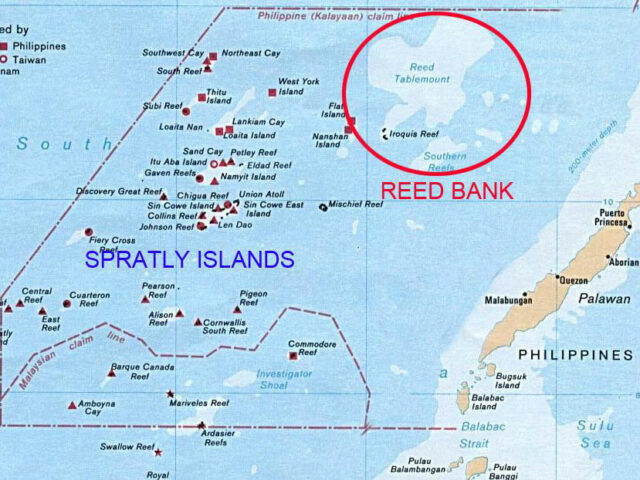
The incidents occurred near Reed Bank, where there were oil exploration activities led by Philippine companies and marine scientific research by the University of the Philippines National Institute of Geological Sciences.

AMTI has said the incidents “demonstrate Beijing’s determination to control maritime activity within the nine-dash line, and to create a high risk of collisions at sea to do so.”

DFA said these “are not consistent with innocent passage and are clear violations” of Philippine maritime jurisdiction. It was reviewing the incidents so it could file a diplomatic protest, it added.

The agency said the Philippine Coast Guard “has enforcement jurisdiction over these waters. “The presence of foreign vessels following tracks that are neither continuous nor expeditious, that are not consistent with Article 19 of the UNCLOS on innocent passage are against the interests of the Philippines.”

“We assure the Filipino people that the role of the DFA in upholding Philippine interests and protecting and preserving national security and territorial integrity will remain firm.”

In a related development, the Philippines condemned the North Korea’s missile test last week.

DFA said this “undermines the peace and stability in the Korean Peninsula, the entire region and the world.”

“We reiterate our call on the Democratic People’s Republic of Korea to comply with its international obligations under relevant UN Security Council resolutions, and commit to the process of constructive and peaceful dialogue,” it added.

North Korea fired three ballistic missiles toward the Sea of Japan hours after US President Joseph R. Biden left South Korea, the last leg of a five-day tour of the region. US officials had warned that North Korean leader Kim Jong-un could hold a nuclear test run while the US president was in the region.

At the end of his trip to Seoul, Mr. Biden said the US was “prepared for anything North Korea does.”

Philippines adds 5 cases of Omicron subvariant to 22

THE PHILIPPINES has detected five more cases of the Omicron BA.2.12.1 subvariant in Western Visayas, bringing the total to 22.

All of the patients had been fully vaccinated, Beverly Ho, a bureau director at the Department of Health (DoH), told a virtual news briefing on Tuesday. Three of them were returning Filipinos from the US, while two were locals, she added.

The agency had identified seven close contacts of the five patients, two of whom were exposed to the locals, while five to the returning Filipinos. All of them finished isolation and have recovered, she added.

DoH said it had identified 33 more close contacts of the country’s first Omicron BA.4 case, who is now tagged as recovered.

Authorities were still verifying the vaccination status and testing details of the 33 passengers who were on the same plane he/she took coming home, the agency said.

DoH has seen a slow uptick in coronavirus cases in Metro Manila and nearby provinces and the rest of Luzon in mid-May.

Ms. Ho said Metro Manila, Bulacan, Cavite, Laguna Rizal provinces, as well as the rest of Luzon had experienced a decline in infections in the past days, while infections in the Visayas and Mindanao regions were flat.

“Despite the slow uptick in cases in the past few weeks, the country remains at low risk,” she said.

The Education department on Monday said it expects all basic education schools in the country to hold physical classes in the coming school year.

“By June, which is already a few days away from now, in the next academic school year, we are expecting to fully implement face-to-face classes,” Education Secretary Leonor Mirasol M. Briones told a televised news briefing.

She said 34,238 schools — 33,604 public and 1,174 private schools or 73% of the total — have been nominated to hold face-to-face classes.

Meanwhile, the government had fully vaccinated about 69 million people or 77.03% of the target population as of May 30, palace spokesman Martin M. Andanar told a televised news briefing. Almost 14.14 million people have received booster shots. — Kyle Aristophere T. Atienza

De Lima asks DoJ to review drug trafficking charge

PHILIPPINE STAR/ MICHAEL VARCAS

SENATOR Leila M. de Lima, who lost in this year’s senatorial race, is seeking a review of her drug trafficking charges by the incoming Justice secretary, according to her lawyer and spokesman.

“Regardless of who shall be the Justice secretary, considering the three recantations, it is very evident that these contrived charges are starting to fall and it is important to review the case,” lawyer Dindo S. de Leon told the ABS-CBN News Channel on Tuesday.

At least three witnesses have retracted their testimonies implicating Ms. De Lima — one of the most outspoken critics of President Rodrigo R. Duterte’s war on drugs — in the illegal drug trade. They claimed to have been coerced by government officials into falsely accusing her.

Last week, incoming Justice Secretary and Cavite Rep. Jesus Crispin C. Remulla said he was open to reviewing the case against the senator, who has been in jail since February 2017. He also noted that courts generally frown upon retractions.  

“Hopefully Incoming Secretary Remulla would review the case,” Mr. de Leon said. “Any reasonable person or lawyer would see that these are authored, contrived charges by the state to persecute somebody who was telling the truth.”

Another witness, Joel Capones, on Monday testified in a Muntinlupa court that he did not have knowledge of the alleged drug money worth P1.4 million that allegedly went to Ms. De Lima.

Mr. De Leon said Mr. Capones is a crucial witness since he was the only one to have admitted having engaged in the illegal drug trade.

He said the drug trader initially claimed to have seen Ms. De Lima receiving the drug money from convicted drug lord Jaybee Sebastian inside the national penitentiary.

Last week, a Muntinlupa trial court dismissed a contempt case against the senator and her lawyer.

Mr. Remulla on Monday said he would abide by the constitution once he assumes office, amid worries from various rights groups over his history of labeling political activists communists. — John Victor D. Ordoñez