Home Blog Page 5826

Pandemic bolsters developers’ interest in ‘green’ buildings

PHILIPPINE STAR/ MICHAEL VARCAS
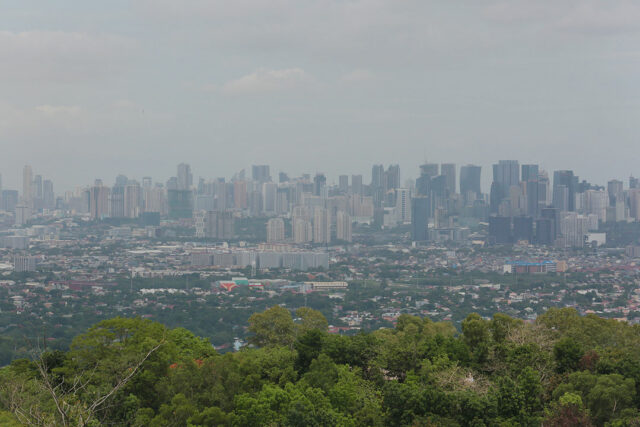
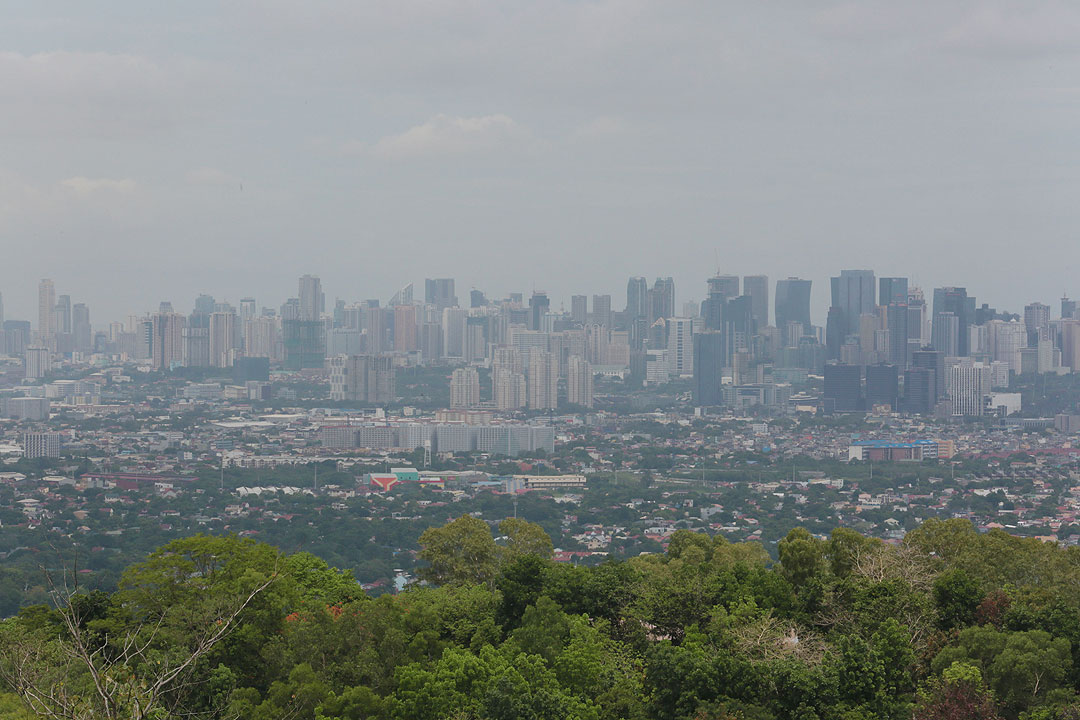
THE Ortigas business district is seen from Antipolo. — PHILIPPINE STAR/ MICHAEL VARCAS

By Cathy Rose A. Garcia, Managing Editor 

THE PHILIPPINES saw an increase in the number of buildings certified as “green” during the coronavirus disease 2019 (COVID-19) pandemic.

Angelo Tan, country lead for the Philippines at the Climate Business Department of the International Finance Corp. (IFC), said there are currently over 50 projects, which cover roughly 86,0000 square meters (sq.m.), that have received EDGE (Excellence in Design for Greater Efficiencies) certifications in the country.

“What is interesting is that more than half of those projects were certified in 2022 alone. You’re seeing a lot of interest in recent years. In addition to that we have 3.7 million sq.m. in the pipeline that are pursuing EDGE,” he said during a fireside chat at the BusinessWorld Virtual Economic Forum on May 25.

EDGE is a building certification system created by the IFC for emerging markets. It seeks to promote resource efficiency in buildings by adopting designs that help reduce materials, water, and electricity consumption.  The IFC is a member of the World Bank Group.

“During the lockdowns people had to pause and reevaluate how they can ensure a green, resilient and inclusive recovery from pandemic. At the same time, the pause allowed them to think how they can do retrofits for their projects,” Mr. Tan said.

However, the development of green buildings in the Philippines is still slow compared to its Southeast Asian neighbors.

“In the area of green buildings so far, we have a little over 200 plus green buildings — the majority of which are office towers in Metro Manila. It’s been very slow, largely focused on the elite segment of the property sector. We need to make green and resilient infrastructure more accessible to a greater part of the population,” Mr. Tan said.

The IFC is working to dispel the widespread notion that green buildings are expensive and complex.

“What we do in the IFC Climate Business Department is we develop standards such as EDGE and Building Resilience Index that make it easy and less expensive to develop green and resilient buildings… We are able to come up with demonstration projects that have the image of greater accessibility for more people,” Mr. Tan said.

With EDGE, the IFC has brought down the price of certification fees for green buildings compared to other conventional green building certifications.

“We offer a lot of flexibility so developers can reach the required levels of green building certifications… We also reduce the complexity of the green building process… by identifying the most cost-effective measures to build green,” he said. “(EDGE) streamlines the green building certification process.”

One of the EDGE “champions” is Imperial Homes Corp., whose affordable housing projects received EDGE certifications.

“Their projects have reached a very high level of sustainability, high and advanced level of certification. If projects like that can be designed and built as green, then even other projects can achieve the same level of sustainability,” he said.

Aside from housing projects, Mr. Tan said they have also working on projects not traditionally seen as “green” such as industrial warehouses, a healthcare facility, hotel and resort.

“By reaching out to other building typologies, we are sending out the message that green is not just for high-end office towers in Metro Manila,” he said.

Local government units (LGU) can also help support the advancement of green buildings by creating an enabling environment.

“Governments can put in place incentives that can help encourage the creation of more green buildings. These don’t have to be financial of fiscal incentives, it can be non-financial incentives… Non-financial incentives include an increase in allowable floor area or building height if they certify their projects as green,” Mr. Tan said.

Mr. Tan believes green buildings are not just a trend, but are here to stay. He cited the buildings’ efficiencies that result in savings for owners and tenants, as well as the positive impact on real estate brands.

“We’re seeing lot of investors now want to put money in climate smart investments. They are right to believe brown assets can stagnate in a couple of years… Green buildings make sense. A lot of early adopters are benefiting from the advantages of green building certification,” he said.

Worst COVID outbreak leaves Taiwan insurers bracing for more than $1 billion in claims

TAIWAN’S worst coronavirus disease 2019 (COVID-19) outbreak has left the island’s insurers bracing for more than $1 billion in claims that the financial regulator is urging them to honor.

The head of the Financial Supervisory Commission (FSC), Huang Tien-mu, has ordered insurers to pay out on valid COVID-related insurance policies after they faced criticism from lawmakers for dismissing claims, canceling policies and delaying payouts.

Insurers are looking to limit their losses on policies after underestimating the extent of the disease. There are currently more than 6.3 million still-active COVID-related policies and another million waiting for approval, according to the FSC. This year, insurers have already paid out more to customers — NT$2.6 billion ($89 million) — than the NT$2.1 billion in revenue they have received from premiums. 

And with only around 2% of policies subject to claims so far and Taiwan’s outbreak showing no sign of abating, insurers are facing a wave of further claims in June and July. Speaking to lawmakers last Monday, Huang said payouts will likely be higher than the NT$41 billion estimate mentioned by lawmakers.

While that is just a tiny fraction of the NT$2 trillion in net assets held by Taiwan’s insurance industry, the majority of those are held by the large life insurers. The potential claims represent around 25% of the assets held by property insurance companies, which were among the most active in selling COVID-19 policies.

RISK MODELS
Property insurers, which focus primarily on car protection, have struggled to find growth in recent years and saw COVID-19 as a great opportunity, according to Andy Chang, director of Taiwan Ratings Corp. When working out their risk models, many miscalculated the potential number of cases by a factor of almost 100. They also didn’t adequately estimate the necessary capital buffer.

“They shouldn’t have just said, ‘how much are our competitors selling? We want to sell that much too,’” Chang said in a phone interview.

Even Taiwan’s largest insurers are likely to take a hit. Claims at Fubon Life Insurance Co. and Cathay Life Insurance Co. could reach NT$5 billion, equivalent to about 2% of their net income this year, Bloomberg Intelligence analyst Steven Lam wrote in a May 13 note.

The generosity of the policies insurers sold is a major part of the problem. Since the beginning of the pandemic, many companies have offered policies protecting customers against negative health impacts of COVID-19 and the associated costs.

Quarantine insurance is among the most popular. For as little as NT$666 a year, the insurers guarantee to pay out NT$50,000 if the customer is required by the government to isolate. If the client later tests positive for COVID-19, they can get another NT$50,000.

‘BLOW UP’
Until recently, Taiwan had managed to keep the pandemic broadly under control, making COVID-related policies a solid source of revenue. But cases began surging in late April as the omicron variant breached the island’s border controls.

Taiwan reported more than 76,000 local cases and a record-high 145 deaths on Sunday, according to data from the Centers for Disease Control. The health minister has said around 15% of the population — about 3.5 million people —could end up getting COVID-19.

Siang Lin, a financial industry professional working in Taiwan, bought a COVID-19 insurance policy that he renewed once it expired.

“I thought, sooner or later it’s going to blow up here,” he said. “We’re all going to end up getting it — that’s why I extended my policy.”

Lin was right. He got COVID-19 in early May and is currently awaiting his NT$50,000 payout. — Bloomberg

Chess players reap honors for country in several tournaments

By Joey Villar

FILIPINO chess players reaped honors for the country as Michael Concio, Jr. and the Philippine Para Team standouts Jasper Rom, Menandro Redor and Cheryl Angot all emerged triumphant in separate tournaments.

Mr. Concio, 17, ruled the Hanoi International Master (IM) Tournament in Vietnam after finishing unbeaten with seven points on five wins and four draws while Messrs. Rom, Redor and Ms. Angot topped their respective divisions in the Asian Online Championships for People with Disabilities over the weekend.

Backed by Dasmariñas congressman Pidi Barzaga, Mr. Concio needed just a ninth and final-round draw with Indonesian Aditya Bagus Arfan to claim the win and the 121.2 FIDE rating points that went with it.

In the concurrent Grandmaster Tournament also in Hanoi, another Filipino IM Daniel Quizon finished fourth with five points and also gained rating points.

Thanks to their efforts, the 17-year-old Mr. Concio zoomed to a 2,380 live rating while the 18-year-old Mr. Quizon to 2,420.

For Mr. Rom, he reigned supreme in the Physically Impaired Open division by ending up with 4.5 points in five rounds while Mr. Redor was a cut above the rest in the Visually Impaired Open category also with 4.5 points.

Ms. Angot, for her part, shocked heavy favorite WIM Irina Ostry of Kyrgyzstan in the last round to strike gold in the Physically Impaired women section likewise with 4.5 points.

Mr. Mendoza smashed Indian R.P. Kanishri to deliver the country’s only silver with 3.5 points.

“These are all for country and flag,” said national para team coach James Infiesto, who thanked the PSC, Philippine Paralympic Committee and the NCFP for their support.

Rising inflation, borrowing costs spell financial market uncertainty

BW FILE PHOTO

FINANCIAL MARKETS could experience another volatility in the near term as major central banks turned hawkish amid inflationary pressures due to the ongoing Russia-Ukraine war, analysts said.

In the first three months of the year, the Philippine Stock Exchange index (PSEi) averaged 7,230.08, up by 0.3% quarter on quarter from the 7,208.37 seen in the fourth quarter of last year, data from the local bourse showed. Annually, the benchmark PSEi went up 5% from the 6,882.77 average in the first quarter a year ago.

On an end-period basis, the PSEi was 1.1% higher in the first quarter at 7,203.47 versus the preceding quarter.

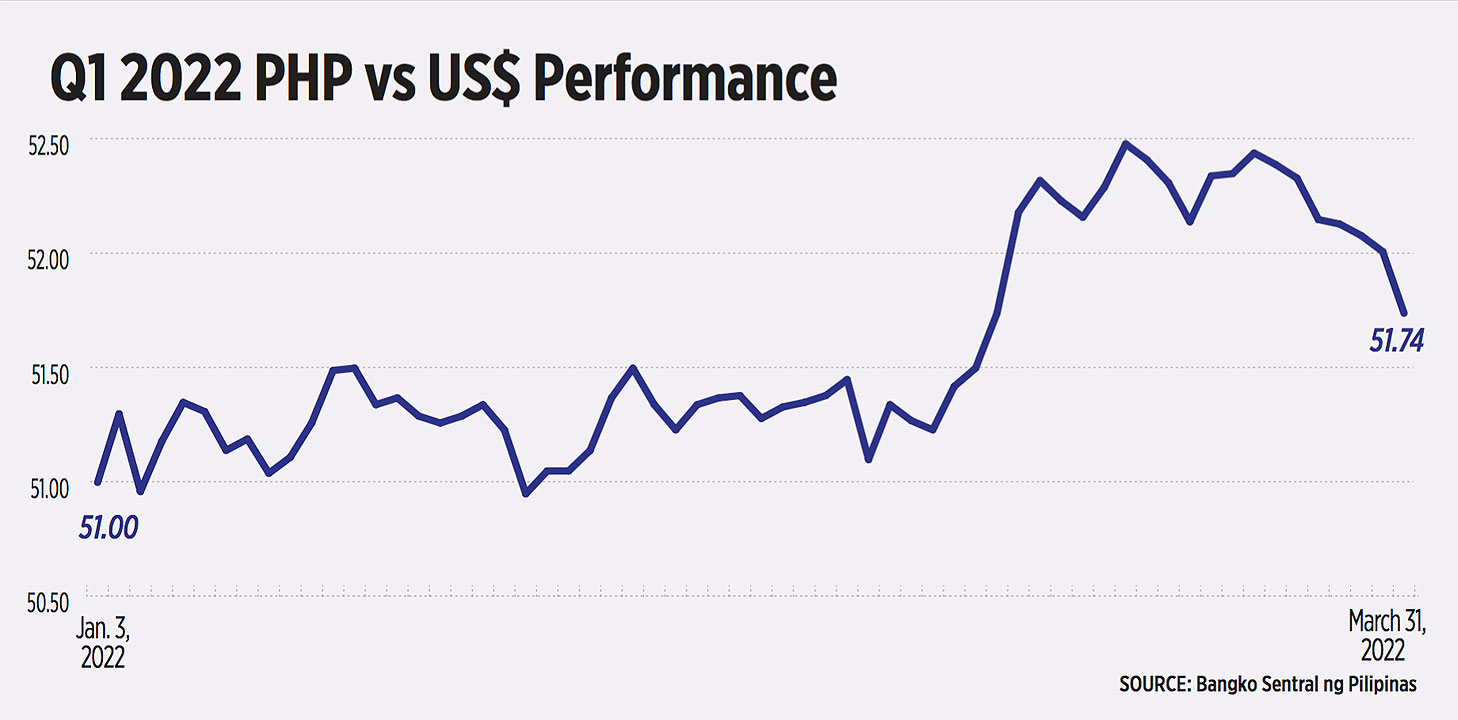
Meanwhile, Bangko ng Sentral ng Pilipinas (BSP) data showed the peso depreciated to P51.96 against the dollar as of end-March from P48.466:$1 last year.

Demand for government bonds remained strong during the period. Treasury bill (T-bill) auctions conducted in the first quarter saw total subscription for the quarter amounting to around P614.2 billion, which is around 4.1 times the P148-billion aggregate offered amount. This oversubscription amount of P466.2 billion, however, was lower than the P311.6 billion in the previous quarter.

Demand for Treasury bonds (T-bonds) were likewise robust with a total subscription amount of P519.4 billion, almost twice more than the offered amount of P225.9 billion.

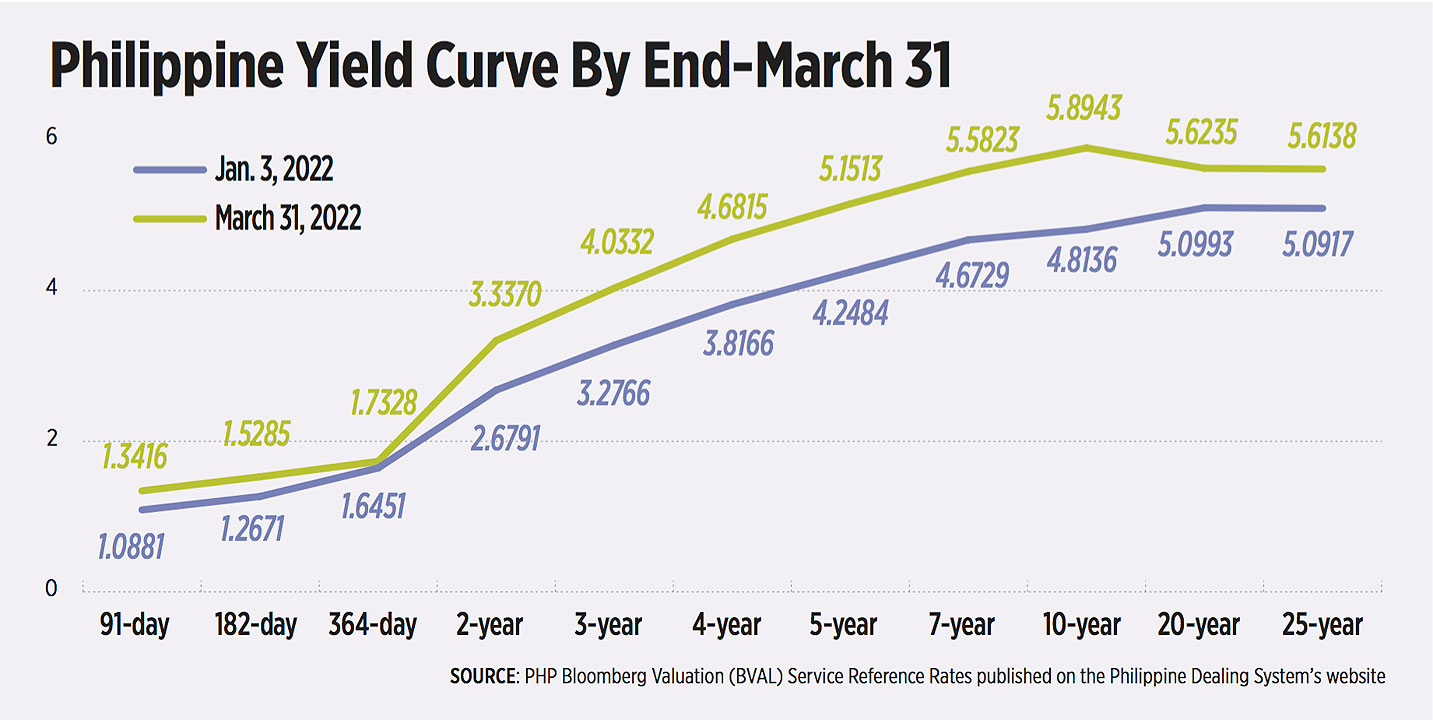
At the secondary bond market, domestic yields were higher by a range of 90.94 basis points (bps) for the seven-year T-bond to the 108.07 bps for the 10-year paper compared with end-December 2021 levels.

Yields rose across the board on a quarter-on-quarter basis. In the first quarter, rates were higher by an average of 62.01 bps during the reference period, according to the PHP Bloomberg Valuation Service Reference Rates published on the Philippine Dealing System’s website.

The Philippines welcomed the first quarter with the resumption of strict Alert Level 3 in various parts of the country to contain the Omicron-driven surge. It was subsequently relaxed to Alert Level 2 in February then to a more lenient Alert Level 1 starting March.

However, as the economy slowly gains ground from the lockdowns, Russia’s invasion of Ukraine started in on Feb. 24. With Russia being the world’s second largest producer of crude oil, news of the war sent global oil prices — and other commodities — to multi-year highs.

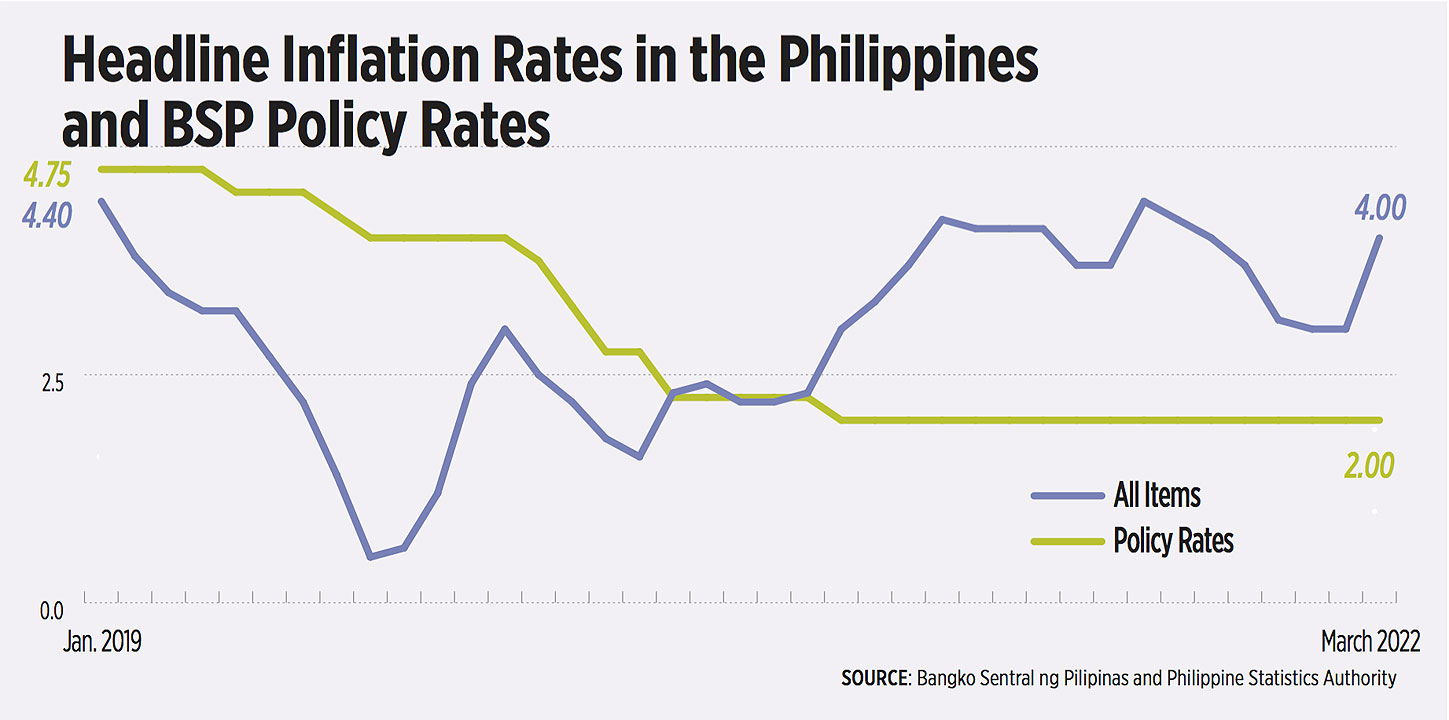
Inflationary pressures brought by the war triggered various economies, including the Philippines, to start hiking record-low borrowing costs in order to quell fast-rising inflation.

Despite these, the country’s economic output firmed up by market-beating 8.3% in the first quarter. For the first time since 2018, the BSP decided to hike benchmark interest rates by 25 bps in May to control above-target domestic inflation. It signaled another rate increase by June.

Consumer price index peaked to a 40-month high of 4.9% year on year in April from a 4% print in March, latest data from the Philippine Statistics Authority (PSA) showed.

WHAT INDICATORS TO WATCH OUT FOR
Despite the ongoing economic effects of the Russia-Ukraine conflict, analysts advise investors to remain cautious of the US Federal Reserve’s upcoming rate hikes amid global and local inflationary pressures in the months ahead.

“Russia-Ukraine conflict still highly uncertain: Risk that it could drag on. Possible turning point if it suddenly ends, but this is still highly speculative,” Rizal Commercial Banking Corp. Chief Economist Michael L. Ricafort said in an e-mail interview.

University of Asia and the Pacific Chief Senior Economist Cid L. Terosa said as the Russia-Ukraine war drags on, it will continue to exert upward pressure of prices and interest rates.

“Higher inflation will negatively affect the equities market since it could lower sales and profits of firms. Higher interest rates could negatively affect the equities market since it is more attractive to deposit money in banks or purchase fixed-income securities,” Mr. Terosa said in an e-mail.

“Conversely, higher interest rates can lead to higher demand for fixed-income securities because investors can purchase fixed-income securities with higher interest rates,” he added.

UnionBank of the Philippines, Inc. Chief Economist Ruben Carlo O. Asuncion said investors should also anticipate the US Fed’s rate tightening implications.

“The 10-year US treasury rate will provide a picture of the ripple effects of a more hawkish US Fed. As such, investors should expect US/offshore rates to exert influence on local bond yields,” he said in an e-mail.

“Oil prices may also bloat the trade deficit and further challenge the local currency, which is already assumed to be impacted by the sustained lockdowns in China. Aside from these, inflation expectations should need to be watched carefully moving forward,” Mr. Asuncion said.

At the domestic front, ING Bank NV Manila Senior Economist Nicholas Antonio T. Mapa said the market should keep an eye out for inflation, fiscal position, and economic growth.

Looking at global markets, we may need to monitor developments surrounding the direction of monetary policy (US Fed, European Central Bank, Bank of England, etc.), and global growth, most notably the state of China’s economy,” Mr. Mapa said in an e-mail.

RATE HIKE IMPLICATIONS
The central bank’s decision to hike rates will help support the peso, Mr. Mapa said, “but this is not a hard and fast rule.”

“We remember well that in 2018, BSP resorted to an aggressive 175 bps rate hike cycle that did very little to shield the currency. Higher inflation and rising interest rates tend to slow down economic growth, especially ones that rely heavily on consumption for much of its activity,” Mr. Mapa said.

Meanwhile, the US Fed’s aggressive rate hike for the year could dampen the Philippines’ financial market growth.

“The Federal Reserve rate hike will most probably slow down the recovery and growth of Philippine financial markets in Q2 2022 and for the rest of the year. The BSP, however, has taken an important measure to stem the outflow of funds by raising policy rates,” Mr. Terosa said.

“This move by the BSP will stabilize the growth and recovery of Philippine financial markets, but the performance of Philippine financial markets in Q2 2022 and the rest of the year won’t be stronger than Q1 2022,” he added.

With the incoming new administration, political and economic stability as well as investor sentiment will most likely figure significantly after the second quarter, Mr. Terosa said.

“The new administration has to induce positive investor sentiment in the first three to six months of its term in order to boost Philippine financial markets for the rest of the year,” he said.

With these in mind, below are the analysts’ outlook for each of the key markets.

FIXED-INCOME
Mr. Asuncion: “Bonds are more sensitive to interest rate adjustment with a hike resulting to bond prices falling (because of higher interest rates). The continuing tightening of US financial markets may result to attraction of US bonds over emerging market ones. This can leave markets like PH with lower trading volume and interest from foreign players.”

Mr. Ricafort: “Rising trend in US/global interest rates and bond yields amid the continued Russia-Ukraine war and more aggressive Fed monetary tightening would still be important exogenous factors.

“The local fixed income market would also take cue from the incoming administration’s economic team, which needs to reduce the country’s debt-to-GDP ratio from the 17-year high of 63.5% as of Q1 2022 after the government’s wider budget deficits and more borrowings since the pandemic, through intensified tax collections, tax and other fiscal reform measures, disciplined spending through anti-wastage/anti-leakages/anti-corruption and other good governance measures to improve the country’s fiscal performance and overall debt management over the long term and for the coming generations.”

Mr. Mapa: “Bond markets will continue to see pressure on yields to increase as policy rates (and inflation) exert pressure on borrowing costs to rise.”

Mr. Terosa: “Higher interest rates can lead to higher demand for fixed-income securities because investors can purchase fixed-income securities with higher interest rates.”

EQUITIES
Mr. Asuncion: “On the equities side, market upside will be tempered by an environment of higher interest rates here and abroad which is likely to spill over into a restrained macro and earnings outlook… higher interest rates may result for higher demand for emerging market stocks and other equities.”

Mr. Ricafort: “Reflecting relatively elevated inflation could be a drag on stock markets amid higher borrowing/financing costs and the resulting slower economic recovery prospects and even potential risk of recession that could lead to some slowdown in sales, lower earnings, tighter margins, and lower valuation.”

Mr. Terosa: “Higher interest rates, however, will negatively affect the equities market this quarter because an increase in interest rate will make it more attractive to park funds in bank deposits or fixed-income securities.”

FOREIGN EXCHANGE
Mr. Asuncion: “Peso weakness as an outcome of May elections is expected — in sync with previous election cycle trends… A more hawkish US Fed actions may result to a weaker PHP and, thus, more exchange rate management moves from the BSP with the strong conviction to maintain the 52.50 level through suspected BSP agent banks. Any rally beyond the said price has been met by strong offers by the BSP through its market conduits.”

Mr. Ricafort: “Election-related catalysts could also partly determine the direction of the exchange rate in view of the honeymoon period for the incoming administration starting the first 100 days and then about six months to one year for any signals and clearer direction on policy priorities including foreign policy, reform measures, and anti-corruption/governance standards (especially adherence of Environmental, Social, and Governance standards that are increasingly encouraged if not even required by global investors and regulators) that would matter on the economy and fiscal performance/debt management.”

Mr. Mapa: “The Fed rate hike may prompt local investors to exit in favor of more attractive returns relative to risk in the developed markets.  This in turn will, at least to some extent, exert pressure on BSP to continue its rate hike cycle to maintain attractiveness relative to our risk profile. The exchange rate will likely be impacted, as will bond markets as local interest rates rise. Likely, under depreciation pressure given both current account (trade deficit) and financial account (interest rate differentials) dynamics.”

Mr. Terosa: “If inflation persists, the peso will weaken in Q2 2022. As the peso weakens, upward pressure on inflation is expected. Consequently, the equities market will undergo persistent downward pressures.

“Hence, it appears that both the equities and foreign exchange markets will contend with negative pressures arising from higher interest rates and inflation in Q2 2022. The fixed-income market will most probably perform better than the equities market in Q2 2022.” — Ana Olivia A. Tirona


EDC remits P12.4M to geothermal facility’s host towns

LOPEZ-LED Energy Development Corp. (EDC) has turned over P12.4 million to two local government units in Leyte that host its geothermal facility, a move called for by a government circular.

In a statement on Monday, the subsidiary of publicly listed First Gen Corp. said checks had been handed over to officials of Ormoc City and the Municipality of Kananga, the hosts of its 726.7-megawatt facility, which is said to be the world’s largest geothermal steamfield.

The turnover is in compliance with the Department of Energy’s Circular No. DC2018-08-0021 that requires energy generation companies or energy resource developers to directly provide their Energy Regulations (ER) No. 1-94 benefits equivalent to one centavo per kilowatt-hour of the total electricity sales to their host communities.

The so-called ER 1-94 funds are meant to hasten the host communities’ socioeconomic development. The Energy department used to be the one releasing the funds.

EDC said that for the past two years, the two local government units used the funds for the construction of quarantine or isolation facilities and other initiatives during the pandemic.

This year, the hosts will still allocate a portion of the funds for their coronavirus disease 2019 (COVID-19) response and for some infrastructure projects in their respective areas, it added.

“This strong partnership enables EDC to continue its mission of generating 100% renewable energy to decarbonize our country for its regenerative future,” said Allan V. Barcena, head of EDC’s corporate relations and communications division.

EDC’s facility straddles Ormoc City and the Municipality of Kananga. It supplies more than 30% of the country’s installed geothermal capacity, the company said, adding that the facility puts the Philippines on the map as the world’s largest geothermal producer.

The plant has been providing a reliable supply of clean power to Luzon and the Visayas for almost 40 years, it added.

“We are thankful that our bond with our partners in progress from both the Municipality of Kananga and Ormoc City became even stronger as we all worked together to triumph over this COVID-19 pandemic these past two years,” Mr. Barcena said.

Ukraine’s Kalush Orchestra raises $900,000 for military by auctioning Eurovision trophy

Kalush — PHOTO FROM INSTAGRAM.COM/KALUSH.OFFICIAL

UKRAINE’s Kalush Orchestra, which won the Eurovision Song Contest earlier this month, raised $900,000 for the country’s military battling the Russian invasion by selling the contest’s trophy.

The group won Eurovision with their entry “Stefania,” surfing a wave of public support to claim an emotional victory that was welcomed by the country’s president.

On Sunday they sold the crystal microphone they were awarded in a Facebook auction led by Ukrainian TV presenter Serhiy Prytula.

The funds raised will be used to purchase for the armed forces the PD-2 unmanned aerial system, which includes three aircraft and a ground control station, Prytula said at the auction.

Russia’s invasion on Ukraine, now in its fourth month, has claimed thousands of civilian lives, sent millions of Ukrainians fleeing and reduced cities to rubble.

Moscow calls its actions a “special military operation” to disarm Ukraine and protect it from fascists. Ukraine and the West say the fascist allegation is baseless and that the war is an unprovoked act of aggression.

Over the weekend, Ukrainian forces endured heavy artillery barrages as they held off Russian attempts to capture Sievierodonetsk, the largest city Ukraine still controls in the eastern region of Luhansk. — Reuters

Clark aims to be MICE hub with SMX Convention Center

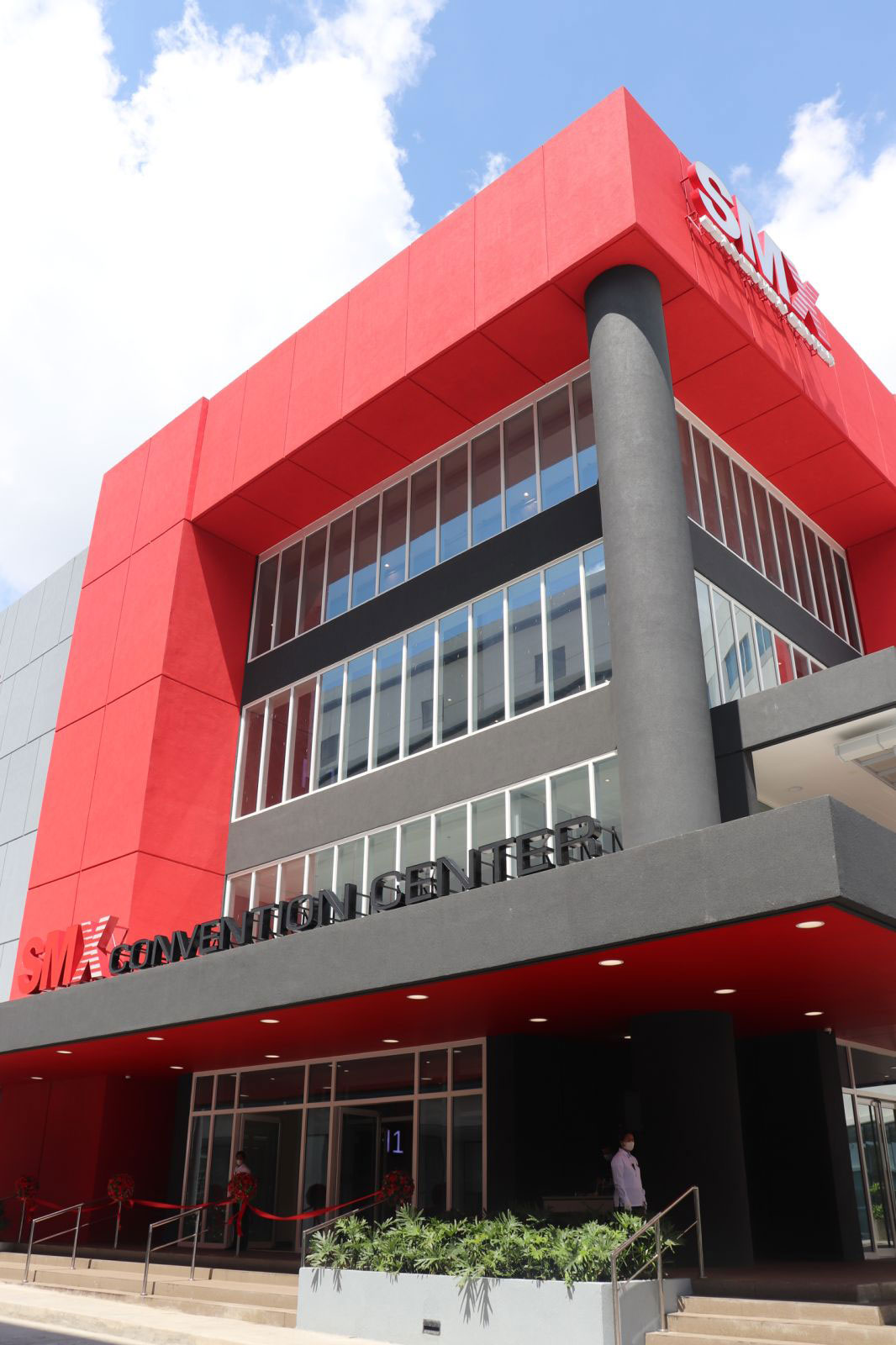
SMX Convention Center Clark officially opened on May 24. — COMPANY HANDOUT

FOUR THOUSAND square meters (sq.m.) of leasable space and a location in a burgeoning MICE (meetings, incentives, conferences, and exhibitions) capital are the selling points of the new SMX Convention Center in Clark, Pampanga.

SMX Convention Center Clark, which was originally set to open two years ago, finally opened on May 24.

“We were having a lot of demand for having a conference facility or an exhibition facility in the North of NCR (National Capital Region),” SM Hotels and Conventions Corp. (SMHCC) Senior Vice-President for Operations Walid Wafik said during a press conference prior to the ribbon-cutting ceremony and tour. “That’s when the idea of SMX Clark came on board, and we were supported fully by SM and by the top management to allow us to have an SMX branch.”

The SMX Convention Center in Clark is the second stand-alone convention center after SMX Manila.

There are also SMX facilities in Olongapo, Bacolod, Manila, SM Aura and Davao.

A smaller one in Cebu called the Skyhall also exists. SMHCC Executive Vice-President Peggy E. Angeles said a full-fledged SMX Convention Center will be up in Cebu in four years.

The latest SMX Convention Center is located within the SM City Clark complex, near the mall and Park Inn Radisson Clark. It boasts three trade halls, three function rooms, and 14 meeting rooms.

“The great formula that we have come to, which is by the mall, our main locator; and then we complement the mall with having a hotel, with having a convention center. This is to augment foot traffic and more business for the entire compound,” Mr. Wafik said.

Ann Olalo, Park Inn by Radisson general manager, said Clark’s location is very convenient for exhibitions and conferences.

“We get feedback from our key accounts that Clark seems to be the most convenient, most accessible destination if they want to have conferences and events outside Manila,” she said.

Dennis Legaspi, Clark Development Corp. (CDC) vice-president for engineering services, said Clark will soon be launched as a MICE destination in the Philippines.

Meanwhile, the waning pandemic of two years and counting has made SMX Convention Center executives more mindful of health and safety precautions.

SMX Convention Center Clark Senior Branch Manager Miguel Morato said each facility now undergoes misting, wipe-downs and washdowns before and after every event. Antivirus and antibacterial handrails and fixtures are installed in the elevators.

“These are the new norms that we will carry on,” said Mr. Wafik. — Joseph L. Garcia

Thailand poised for record sale of bonds to retail investors next month

THAILAND will sell 55 billion baht ($1.6 billion) of sovereign bonds to retail investors next month, on course to raise a record amount from savings notes to lower its reliance on the volatile institutional market for funding.

The Finance Ministry’s issuance of savings securities will total 165 billion in the fiscal year ending Sept. 30, 33% higher than it was a year ago and more than the 150 billion baht it planned earlier, according to Public Debt Management Office Director-General Patricia Mongkhonvanit Monday.

“There is a lot of government bond supply in the secondary market, so we decided we would raise funds by selling savings bonds now,” said Patricia, adding that bond yields in the institutional market have stabilized and that the ministry aims to “avoid an oversupply situation” of government securities.

Thailand has tried to lower the costs of its bond borrowing from surging yields by tweaking the mix of short- and longer-term debt instruments it has sold as well as by using a variety of borrowing tools. Selling bonds to the general public achieves the government’s dual goal of not just reducing how much it taps institutional investors, but also gets retail investors to develop a savings alternative to bank deposits.

Southeast Asia’s second-largest economy is expected to borrow around 1.1 trillion baht this fiscal year from many types of debt instruments, excluding savings bonds. Government borrowing should drop next fiscal year as the burden of COVID-relief spending eases, Patricia said. Thailand has issued special laws that allowed it to borrow as much as 1.5 trillion baht during the pandemic.

The yield on benchmark 10-year Thai bonds has spiked by more than 90 basis points this year in tandem with those of US Treasury bonds. At its peak earlier this month, the yield jumped to a more-than-seven-year high even though the Bank of Thailand held the nation’s key rate at a record low of 0.5% to support the country’s nascent economic recovery.   

The savings bonds to be sold in June is the last of three tranches slated for the current year and will be used for funding the country’s budget deficit. The average yield for the 5-year bonds will be 2.9% and 3.6% for the 10-year bonds, Patricia said. — Bloomberg

Santo Tomas shoots for sweep vs reigning titlist Ateneo

UNIVERSITY of Santo Tomas Golden Tigresses led by Eya Laure (far right). — THE UAAP

STREAKING Santo Tomas shoots for a sweep of reigning champion Ateneo to firm up hold of second spot and stay lurking behind unbeaten National University (NU) entering the crucial stretch of the University Athletic Association of the Philippines (UAAP) Season 84 women’s volleyball tournament second round at the Mall of Asia Arena in Pasay City.

The Golden Tigresses (7-2) tie knots with the struggling Blue Eagles (4-5) at 10 a.m. in the second rematch of the last UAAP volleyball finals before the pandemic with a win for them beefing up their Final Four aspirations.

Fourth-running Adamson (5-4) battles Far Eastern University (FEU) (1-8) at 12:30 p.m. to stay in the playoff picture so far followed by La Salle (5-3) and University of the Philippines (UP) (4-5) at 4 p.m. in the pivotal duel at the middle pack of team standings.

In the main game at 6:30 p.m., unblemished NU (9-0) aims to move four games away from notching an outright finals berth against also-ran University of the East (UE) (0-9).

Led by UAAP top scorer Eya Laure, Santo Tomas last tasted a loss against No. 1 NU in the first round before going on a four-game winning spree including a tough 25-19, 25-21, 29-31, 33-31 win over Ateneo.

The Golden Tigresses last week came off a gutsy 25-20, 18-25, 26-24, 25-23 win over UP, paving for an expected uphill climb against the Blue Eagles that are out for sweet vengeance to boost their own Final Four drive.

Coach Kungfu Reyes said Santo Tomas fended off a strong UP resistance for a huge win before gauging Ateneo anew.

Santo Tomas finished runner-up in Season 81 before the UAAP hiatus behind Ateneo, which is yet to spread its wings in a tough title retention bid so far.

After a 0-3 start, the Blue Eagles are having a back and forth campaign marred by another 25-18, 20-25, 19-25, 18-25 loss against NU over the weekend. — John Bryan Ulanday

Analysts remain bullish on banks as borrowing costs rise

FREEPIK

THE LISTED BANKS were more resilient in the first quarter despite rising inflation environment worsened by the ongoing Russia’s invasion of Ukraine.

After the central bank hiked borrowing costs, these lenders could see a boost in profitability this year, analysts said.

The Philippine Stock Exchange index (PSEi) ended the first quarter at 7,203.47, increasing by 1.1% on a quarter-on-quarter basis from 7,122.63 in the last quarter of 2021.

The financial subindex, which included banks, rose by 5.5% to 1,694.89, lower than the 14.4% growth recorded in the fourth quarter.

The first quarter saw six out of 16 listed banks’ share prices increase on a quarter-on-quarter basis. BDO Unibank, Inc. led with 9.9% growth, followed by Bank of the Philippine Islands (BPI, 8.1%); China Banking Corp. (CHIB, 3.8%), Rizal Commercial Banking Corp. (RCBC, 2.5%), Metropolitan Bank & Trust Co. (MBT, 2.3%); and Asia United Bank (AUB, 1.3%).

Meanwhile, share price of Philippine Business Bank (PBB) dropped the most by 13.4%, followed by East West Banking Corp. (EW, -12.2%); Philippine Trust Co. (-8.5%); and Security Bank Corp. (-8.4%).

“In terms of stock price performance, BDO and BPI stood out as they returned 9.9% and 8.1%, respectively in the first quarter, which may be attributed to investors’ bullishness in the sector given that BPI and BDO are the heaviest weighted bank stocks in the PSEi and the financial subindex,” China Bank Securities Corp. Research Director Rastine Mackie D. Mercado said in an e-mail.

“This may also be reflective of investors’ continuing interest in the digital initiatives of these two banks, which continue to gain more visibility,” he said.

Mr. Mercado said BPI and Security Bank Corp. (SECB) stood out the most in terms attributable net income for the first three months of the year, growing by 60% and 66%, respectively.

“Despite the positive industry outlook for 2022, lingering pandemic-related obstacles, geopolitical tensions, US rate hikes and tapering, global inflation, and a new Philippine president by mid-year all weighed on the banking sector over [first-quarter] 2022,” Globalinks Securities and Stocks, Inc. Head of Sales Trading Toby Allan C. Arce said in an e-mail.

Philippine National Bank (PNB) Research Senior Equity Research Analyst Wendy Estacio said the market is uncertain in the first quarter on the impact of rising interest rates and high inflation environment worsened by the ongoing Russia-Ukraine war.

“While stock prices across the board were adversely affected by geopolitical and inflation concerns, bank stocks were notably more resilient,” China Bank’s Mr. Mercado said.

Central bank data showed total net income of the big banks increased by 26.7% year on year to P61.38 billion in the first quarter.

Meanwhile, provision for credit losses by universal and commercial banks fell by 8.8% as of end-March to P18.79 billion from P20.61 billion in 2021, the BSP data showed.

Total loan portfolio of the big lenders went up 8.6% as of March to P10.20 trillion from P9.39 trillion last year.

Gross nonperforming loans ratio of universal and commercial banks improved to 3.73% as of March from 3.87% in February.

After the Philippine gross domestic product rose 8.3% in the first quarter, the central bank hiked interest rates by 25 basis points (bps) last May to contain fast-rising inflation.

However, analysts see the rate hike as a “benefit” for banks as their profitability would also increase but also warned the risks on other aspects of the economy.

“In theory, it would buoy the bank’s profitability this year. However, since the pandemic still lingers, the timing of rate hikes is crucial, as lenders would gauge how fast they can pass through the hike to their clients,” Regina Capital Development Corp. Head of Sales Luis A. Limlingan said in an e-mail.

“If improperly timed, borrowers might be pushed on the verge of default. Hence, we see that the banks would be able to absorb a marginal climb in the rates, albeit with a slight lag,” he said.

“The liftoff by the central bank may likely dent demand and employment recovery, especially in the absence of fiscal support to cushion the economy from higher borrowing costs,” Mr. Arce said.

“Inflation is tilting the outlook towards the downside as higher prices for food and fuel challenge the central bank’s accommodative monetary policy settings, and there is increasing pressure to arrest inflation pressures by hiking interest rates as early as this month. Households are likely to face stronger headwinds as softer property price growth and higher living costs add pressure to household budgets,” he added.

Ms. Estacio said that the rate hikes could improve the banks’ net interest margins (NIMs) this year, adding that they are looking at 10-20 bps addition in NIMs if the central bank hikes by 50 bps.

Latest data by the BSP showed net interest margin — the ratio that measure banks’ efficiency in investing their funds by dividing annualized net interest income to average earning asset — slightly increased to 3.23% as of end-March from 3.21% in end-December. However, this was lower than the 3.49% recorded in end-March last year.

OUTLOOK
For the rest of the year, analysts see a favorable time for banks and investing in bank stocks as the country continues to lower down the quarantine levels, and the economy slowly picking up again after the bumps in the first quarter.

“Philippine banks are seen getting back its pre-pandemic profitability levels this year with a recovering economy and imminent resumption of business activity,” Mr. Arce said.

“The industry’s comfortable capitalization and stable funding profiles will underpin banks’ credit profiles. Overall credit conditions are expected to provide ample support to economic activity. Bank lending appears to have turned the corner in recent months. Lending activity continues to gain traction amid businesses’ optimistic outlook due to the continued rollout of vaccines and easing restrictions,” he added.

Both PNB’s Ms. Estacio and China Bank’s Mr. Mercado estimate growths in loans and NIMs as the central bank started to raise borrowing costs.

Ms. Estacio expects an average loan growth of 8% this year for banks under their coverage, and their NIMs to increase by 15 bps. She also see banks’ earnings to rise by an average of 17% year on year on lower loan loss provisions.

“For 2022, investors should factor in a recovery in loan portfolios as banks start to become less conservative in lending attributable to better economic growth. Wider margins from the possible policy rate hikes could also improve banks’ profitability,” Ms. Estacio said.

“Investors should look into a possible rise in operating expenses of banks given the initiatives to improve their digital operations,” she added.

However, Mr. Arce also reminded risks that could affect the glowing outlook for the year, such as another COVID-19 resurgence, and rapid rise of interest rates that could affect the credit demand and put pressure on small and medium enterprises (SMEs) who are still recovering from the pandemic.

“While we continue to be generally bullish on bank stocks, we think investors will continue to pay attention to banks: (1) that continue to post stronger [year-on-year] bottom line performance, (2) that have made larger strides in expanding their loan books, (3) that continue to improve their asset qualities (as evidenced by declining non-performing loan ratios) and book more normalized loan loss provisions, and; (4) that continue to invest and provide better visibility to digital initiatives. It is also worthy to note that [Philippine] banks remain well-capitalized and have ample buffers to weather any further shocks,” Mr. Mercado said. — Bernadette Therese M. Gadon

AbaCore incurs P13-M net loss

ABACORE Capital Holdings, Inc. incurred a net loss of P13.24 million in the first quarter, reversing its P74.8 million net income attributable to owners a year ago, after a decline in its revenues during the period.

“The company posted a gross income of P2.09 million or 98% lower compared to the gross income of P104.07 million for the comparative period last year. This is due mainly to that bulk amount in previous year’s came from the trading gain of P103.79 million which comprises nearly 100% of gross income,” the company said in a disclosure on Monday.

The company also reported that in 2021, it returned to profitability with a comprehensive net income of P5 billion, turning around from a net loss of P101 million the year before.

The firm said in a statement that its financial results for 2021 reflect a more “stable operating environment and the strength of the company’s franchise.”

“ABA’s (AbaCore’s stock symbol) financial results for 2021 were positively impacted by secular trends involving the Batangas economy, with more businesses expanding their operations into the province given its attractive proposition as an economic powerhouse,” Chairman Raul B. De Mesa said.

The holdings company said that of its earnings, around P580 million is regular income while the rest was a fair value adjustment on its properties as a result of the various partnerships it entered with investors.

“As such, the value of land in Batangas has significantly appreciated in recent years, therefore increasing ABA’s bottom line and boosting our shareholders’ return on their investments,” Mr. De Mesa said.

In 2021, ABA entered into a $100-million joint venture with Starfleet Innotech to provide land to the New Zealand-based asset management company for a resort-like condotel development.

It is also continuing to pursue its plans to build ABA Energy Hub, a 103-hectare energy facility in the province. The company also agreed to provide land to a subsidiary of A. Brown & Co., Inc. for the development of a liquefied natural gas facility.

“ABA has a land bank of about 330 hectares, which grants us the flexibility and capacity to partner with various entities that are interested in investing in Batangas,” Mr. De Mesa said.

“Our 2021 financial results demonstrate we have been successful in pursuing partnerships that fully take advantage of Batangas’ potential, and we expect this success to continue in 2022 as more investors and businesses recognize the economic viability of the province,” he added.

ABA is a holding company with interests in real estate, tourism, financial services, and energy.

At the stock exchange on Monday, ABA shares went up by 7.63% or ten centavos to finish at P1.41.

Super Trouper: ABBA returns to stage as virtual avatars for London gigs

PHOTO FROM ABBAVOYAGE.COM/

LONDON — Performing their much-loved hits like “Mamma Mia!” and “Dancing Queen,” Swedish supergroup ABBA returned to the stage on Thursday, albeit as digital avatars, for a new London concert residency.

The band —  Bjorn Ulvaeus, Benny Andersson, Agnetha Faltskog and Anni-Frid Lyngstad —  have been brought to virtual life as digital versions of themselves from their 1970s heyday, thanks to motion-capture technology. Their last performance together was some 40 years ago.

The foursome, all now in their seventies, posed for pictures together at the concerts’ red carpet premiere on Thursday at a purpose-built venue, dubbed ABBA Arena.

“I think we all are very happy to be back in London because I haven’t been here for I don’t know how many years,” Ms. Faltskog told Reuters. “It is so nice to see all the faces and all the expectations and everything. It goes right into your heart.”

ABBA worked with an 850-strong team from Industrial Light & Magic, founded by Star Wars creator George Lucas, for the project.

Accompanied by a live band, the avatars, or ABBA-tars, perform some 20 songs during the 90-minute show, called Voyage. During the show, they made jokes and even had costume changes.

The real ABBA watched among the audience and came on stage at the end, hugging each other and waving to the crowd.

The concerts, which officially began on Friday, are part of a hugely successful comeback for the band, who topped charts last November with Voyage, their first album in 40 years.

Formed in 1972, ABBA won legions of fans around the world and has sold an estimated 385 million records.

They split in the early 1980s, with rumors swirling for years they would reunite on stage.

“ABBA has never left us,” Ms. Faltskog told one reporter.

Asked if this was it for the band, Ms. Lyngstad told Reuters: “Depends how long we stay alive… If we are lucky.”

“I don’t think we’ll do another one… Definitely no but never say never,” Mr. Andersson added.

“The avatars go on living,” Ulvaeus said. — Reuters