Home Blog Page 5795

Marcos eyes fertilizer deals with China, Russia

A woman buys vegetables at a market in Metro Manila, July 10. — PHILIPPINE STAR/EDD GUMBAN

By Kyle Aristophere T. Atienza, Reporter

PHILIPPINE President Ferdinand R. Marcos, Jr. is looking to pursue government-to-government deals with some of the world’s top suppliers of fertilizer such as Russia and China, as he aims to boost the country’s agriculture production.

However, experts said Mr. Marcos should thoroughly study the move as it may force him to offer concessions that will not be beneficial to the country.

Mr. Marcos is considering communicating with the governments of China, Indonesia, United Arab Emirates, Malaysia, and Russia to purchase cheaper fertilizer through bilateral deals, the Palace said in a press release.

“They want to help and approach us, so let’s take advantage of that. Give us fertilizers that are affordable. That’s the whole point of government-to-government deals,” Mr. Marcos told Agriculture officials at a meeting on Monday, according to a media release.

Mr. Marcos, who heads the Agriculture department, said they could send letters to those governments and “say that we are in the market to buy this volume of fertilizer.”

The President also asked Agriculture officials to provide data on the sources and prices of fertilizer.

The Philippines imports much of its fertilizer supply, which has been disrupted by the ongoing Russia-Ukraine war. Higher fertilizer prices are expected to drive up costs of agricultural commodities in the next few months.

It is already expected that Mr. Marcos would gravitate to Russia and China, among others, “since other countries probably have major issues either supporting him or being seen trading with his government,” said Hansley A. Juliano, a political economy researcher studying at Nagoya University’s Graduate School of International Development in Japan.

Mr. Juliano said the move signals that the Philippine leader does not care about how his foreign policy is perceived, “considering that just a few days ago, reportage on infrastructure projects under his predecessor were left hanging due to Chinese funding not forthcoming or properly allocated for.”

“China hasn’t exactly proven itself reliable in one economic engagement and now you’re relying on it again?” he said. “It’s like going back to a bad electronics store that gave you a bad warranty policy.”

Arjan P. Aguirre, who teaches political science at the Ateneo de Manila University, urged the administration to consult with the Philippines’ fertilizer industry and other concerned sectors before making any policy decision.

“I hope they could also reveal alternative options so that stakeholders can weigh on them,” Mr. Aguirre said in a Messenger chat. “I hope this was not done unilaterally on the part of the government without consultation and due diligence.”

He also urged the government to be careful in dealing with countries that have been “neglectful of their obligations.”

Mr. Marcos told the Transportation department to renegotiate loan agreements with China for railway projects worth $4.90 billion. Transportation officials last week said the loan applications were considered “withdrawn” after the Chinese government “failed to act on the funding requests” made by the Duterte administration.

Retail sector nears pre-pandemic vacancy rate

A WOMAN fixes the store display at a mall in Mandaluyong City, May 27, 2021. — PHILIPPINE STAR/ MICHAEL VARCAS

THE PHILIPPINE commercial real estate sectors, particularly retail, is making a strong comeback, thanks to pent-up consumer demand, looser travel restrictions and return-to-office mandates, according to real estate services firm Santos Knight Frank.

Jan D. Custodio, Santos Knight Frank Research & Consultancy senior director, projected that the vacancy rate in the retail sector can reach pre-pandemic levels by the end of 2022.   

“For the retail, we’re seeing that it is slowly picking up to near pre-pandemic levels. Probably towards the end of the year (it can reach pre-pandemic levels), barring new variants coming in and stymying the people’s drive to go out,” Mr. Custodio said during a virtual briefing on Tuesday.

As mobility restrictions eased, more Filipinos are now flocking to malls and eating in restaurants more regularly.

However, Mr. Custodio said improving public transportation is key to the retail sector’s sustained recovery.

Kash B. Salvador, Santos Knight Frank Investment & Capital Markets director, said the second-quarter vacancy rate in the retail sector is now approaching the pre-pandemic level.

“As of Q2 2022, in comparison to Q4 2019, the vacancy rate is now at 4.6%, with the pre-pandemic levels at 3.6%. More and more stores are opening with the continuous lowering of restrictions and we’re seeing a lot of strong activity in this sector,” he said.

Santos Knight Frank data showed food and beverage outlets and clothing stores account for two in every three upcoming stores in malls in Metro Manila.

Average retail lease rates in the second quarter have recovered, and are now just 4.4% lower than the rates in the fourth quarter of 2019.

OFFICE DEMAND
Meanwhile, office space demand is still not likely to reach pre-pandemic levels this year due to the reduced demand from Philippine offshore gaming operators (POGOs).

“The (office) demand is picking up in the second quarter and we will start to see more of it in the latter half of this year. But I’m not sure that we’re not going to get there in 2022. The good news is that demand has been picking up,” Santos Knight Frank Occupier Strategy & Solutions Senior Director Morgan A. McGilvray said at a virtual briefing on Tuesday.

Demand from business process outsourcing firms (BPOs) may have been getting better, but there’s no evidence it may return to the same levels seen in 2018 and 2019, he said.

According to Mr. McGilvray, there was a surge in leasing activity during the second quarter as employees returned to their offices. This includes workers employed by companies registered with the Philippine Economic Zone Authority (PEZA).

Despite this, Metro Manila’s office space vacancy rate for the second quarter still increased to 23% due to the introduction of 228,500 square meters of new office space, Mr. McGilvray said.

The vacancy rates may decline as demand for offices in Metro Manila starts to increase.

“We’re going to continue to get supply but not as much as we’ve been getting over the last few years and so the balance of that is that the vacancy rate would be expected to start creeping downward again moving forward,” Mr. McGilvray said.

Rick M. Santos, Santos Knight Frank chairman and chief executive officer, said the office demand from BPO firms will be driven by multinational companies that want to cut costs and outsource to other countries like the Philippines.

“Negative earnings of companies in the US means job cuts, which means they need to supplement that with more jobs being outsourced to the Philippines and India,” Mr. Santos said.

Santos Knight Frank also noted that PEZA-registered companies may require additional office space in the coming months, as they will have to comply with 90% work-from-office requirement by September. — Revin Mikhael D. Ochave

Silverlens to open in NY

YEE I-LANN, Measuring Project: Chapter 1, digital inkjet pigment print on Hahnemühle Photo Rag paper, 2021 (detail). — IMAGE COURTESY SILVERLENS GALLERY

(if they can make it there, they can make it anywhere)

By Sam L. Marcelo, Multimedia Editor

SILVERLENS, the 18-year-old Manila-based gallery, is opening in New York City this September with solo shows by Martha Atienza and Yee I-Lann — bucking the trend of businesses closing due to the coronavirus pandemic, surging inflation, and a global economy on the brink of recession.

Silverlens co-owners Isa Lorenzo and Rachel Rillo bought an airy 2,500-square-foot space in the Chelsea Arts District that used to house Bryce Wolkowitz Gallery.

“It’s like we’re jumping off a cliff and we don’t know what’s at the bottom,” said Ms. Rillo, in a Zoom call with BusinessWorld on July 16.

“And we don’t know if it’s a five-foot cliff or a five-kilometer cliff,” Ms. Lorenzo added.

Now being renovated, the New York space has a footprint comparable to Silverlens’ home in Makati City — which the gallery rents in Lapanday Center along Chino Roces Extension — but with the advantage of a higher ceiling height of 20 feet and massive skylights.

Located right by the High Line, on 505 W 24th Street, Silverlens NY will enter a district crowded with big names, such as Lehmann Maupin, Lisson Gallery, Marianne Boesky Gallery, and Gagosian.

“If you go to New York and you’re going to spend one day looking at galleries, you’re going to go to Chelsea. … It’s amazing to be in this neighborhood,” said Ms. Lorenzo of the Manhattan borough’s gravitational pull.

The gallerists declined to share how much they were investing in the space, saying only that it was “a commitment.”

Listing portal StreetEasy, a subsidiary of real-estate marketplace company Zillow, estimates the average price per square foot in West Chelsea at $2,362 as of this writing.

‘TRULY NUTS’
This “trans-continental move,” as Ms. Lorenzo and Ms. Rillo described it, was driven by the coronavirus disease 2019 (COVID-19) pandemic.

When lockdowns pushed everyone and everything online, Silverlens found that 25% to 30% of its website visitors were from the United States.

“We had a team that was watching who was watching us,” said Ms. Rillo.

Curious as to whether their website analytics translated into a genuine market for Silverlens artists in the United States, Ms. Lorenzo and Ms. Rillo flew to New York City in the middle of 2021 to meet with curators and art habitués they befriended in the decade or so that Silverlens has been participating in the art fair circuit.

Their month-long trip solidified their desire to be part of the New York art scene and the stars aligned quickly once they decided that they wanted to be there: The space was offered this January; it was turned over in April; Silverlens NY opens this September.

“It’s truly nuts,” said Ms. Rillo. “The more we tell people about this timeline in the art world, the more they don’t believe us. They think we’ve been planning this for five years.”

BRICK-AND-MORTAR VS THE METAVERSE
Opening a brick-and-mortar space halfway around the world might seem ironic, given the emphasis on e-commerce and the rise of virtual galleries that specialize in digital artworks that exist as non-fungible tokens (NFTs).

However, a report titled “Future of New York” published this February by UBS Financial Services, Inc., is bullish on the physical gallery.

“I don’t see a shift away from gallery spaces in New York for two reasons. The foreign galleries benefited tremendously from the fact that they were within walking and driving distance of this great body of collectors. … Henceforth, gallery owners will, if anything, see the need to have more of a foothold in New York, not less,” said Marc Spiegler, global director of Art Basel, who was interviewed in the report.

“And just as importantly, galleries are investing in New York real estate. … So this meme that ‘the gallery space is over,’ that ‘everyone’s going to move into the metaverse,’ is just not sustained by the evidence on the ground,” he continued.

The UBS report also stated that “New York’s position as a global center of the art market will continue uninterrupted.”

The Art Market 2022,” an Art Basel and UBS report published this March, noted that US collectors had the highest share overall (53%) of new and emerging artists’ works.

‘THE OPPORTUNITY OF A PANDEMIC’
The New York art scene, in the past few years, has consolidated, making room for international players like Silverlens.

Galleries from Brazil, Korea, Mexico (and now, the Philippines) have moved into the industrial spaces in Chelsea vacated by medium-sized American galleries, which, depending on their fortunes, either closed or relocated to the historic cast-iron buildings of posh Tribeca.

“We couldn’t let the opportunity of a pandemic pass us by,” said Ms. Lorenzo.

“There’s a lot of movement. What’s happening in Chelsea right now is you have a lot of the big blue-chip guys and then you have the migrants. There’s space,” she added, using “space” in terms of real estate and diversity.

The very attributes that would have made it impossible for Ms. Lorenzo and Ms. Rillo to set up shop in New York in the early aughts now make them appealing: they are queer BIPOC (Black, Indigenous, and people of color).

“They need BIPOC representation. And that’s what we are,” said Ms. Lorenzo. Added Ms. Rillo: “We tick off quite a number of boxes so we’re going to jump on board.”

The West’s cultural reckoning — provoked by the immigration debate, the #MeToo movement, the Black Lives Matter movement, anti-Asian violence, and the climate crisis, among others — have put marginalized communities front and center.

“It’s a pivotal moment, specifically in the United States,” said Ms. Lorenzo. “We are squarely in that spotlight because we are brown. There is a sense of being seen.”

These global issues inform the positioning of Silverlens NY as shown by the two artists featured in the inaugural show: Dutch-Filipino video and installation artist Ms. Atienza and Malaysian photomedia-based artist Ms. Yee, whose works are both rife with geopolitical tension.

Ms. Atienza’s The Protectors features the fisherfolk of Bantayan Island and “explores environment, community, and development” while questioning who owns the land and who owns the sea.

In Roof of the Mouth, meanwhile, Ms. Yee collaborates with indigenous Malaysian weavers to present a body of work that “claims and celebrates communities and their geographies, often at the peripheries, that give shape to the center.”

The primary goal of Silverlens NY is to get institutions and museums to collect the work of its artists and provide a Southeast Asian perspective to topics, such as climate change and circular economies, that have a direct impact on the Philippines and the region.

“We want to be part of the conversation,” said Ms. Lorenzo. “There are so many issues that they are championing and talking about over there [in the West] but we’re the ones who are living this on a daily basis.”

NO LONGER AN ISLAND
Silverlens NY is not the first time that Ms. Lorenzo and Ms. Rillo are venturing beyond the Philippines. From 2012 to 2015, they operated in Singapore at Gillman Barracks, where they focused on the artists on their roster.

“We were like an island, just showing our own thing,” said Ms. Lorenzo.

The lessons they learned from their three-year stint in Singapore influenced their New York programming, which will be composed of two-month exhibitions that are gallery-curated — as in Gillman Barracks — and curator-led, thus broadening Silverlens’ horizons.

“We’re going to invite curators from there [the United States] to put up shows with our artists and artists in their radar,” said Ms. Rillo. “I’m excited about that because then there’s a sense of discovery for us.”

Silverlens is eyeing artists who are part of the Asian diaspora, reflective of the backgrounds of both gallerists. Prior to founding Silverlens, Ms. Lorenzo studied at the Parsons School of Design in New York City and worked at the International Center of Photography, also in the same city; Ms. Rillo, meanwhile, was on the opposite coast: she studied at the Academy of Art College (now known as Academy of Art University) in San Francisco and was a photographer based in Los Angeles.

Also related to this migratory/trans-continental experience is the matter of currency and whether there is a danger of skewing the prices of their artists out of the Philippine market.

“We’ve been working at this price level for many years. We don’t need to create an international price and a local price — it doesn’t work that way,” said Ms. Lorenzo. “We’re pretty much established and our artists are also established — it’s not so much an issue.”

“We just happen to be in the Philippines,” she added. “I already feel like we are running a very international standard program. It’s just a matter of applying ourselves and what we already do in Manila to New York.”

Silverlens will present the first New York solo gallery shows by artists Martha Atienza and Yee I-Lann, on Sept. 8, at Silverlens NY, 505 W 24th Street, New York, NY. For more information, visit www.silverlensgalleries.com.


The new NCCA chairman’s priorities

RENE R. ESCALANTE, Chairman of National Commission for Culture and the Arts (NCCA). — FACEBOOK.COM/NCCAOFFICIAL/

THE NEWLY ELECTED National Commission for Culture and the Arts (NCCA) chairman, Rene R. Escalante, plans to focus on the full restoration and use of the Metropolitan Theater and planning for COVID-19 recovery efforts in the arts and culture sector, among others.

Mr. Escalante, who is also the current chairman of National Historical Commission of the Philippines (NHCP), was elected during a Board of Commissioners meeting at the Metropolitan Theater in Manila on July 7.

The Board of Commissioners is composed of 15 members from other government agencies, the House of Representatives, and the Senate, plus the NCCA subcommission heads.

The election was called after the resignation of Cultural Center of the Philippines (CCP) president and concurrent NCCA chairman Arsenio “Nick” J. Lizaso.

“We did not really expect that Nick Lizaso will give up his post [at the] end of June because we were expecting to finish [his term] but unfortunately because of some personal reasons he decided to give up the position,” Mr. Escalante said in a press conference on July 18 at the NCCA office in Intramuros.

Mr. Escalante will be serving as NCCA Chairman for the remaining six months of 2022. He will also serve as concurrent Chairman of the NHCP.

“My tenure will only be until December 2022, because I will just be serving the unexpired term of former chairman Nick Lizaso,” he said. “I’m not sure what will happen in December so let us not move beyond that date.”

Mr. Escalante is a professor of history and a former chair of the Department of History of De La Salle University Manila. He began his time in government in 2004 as secretary of the NCCA National Committee on Historical Research (NCHR) until 2007. In 2010, he was appointed Commissioner of the NHCP before he was elected agency chairman in 2017. Mr. Escalante also served as the Executive Director of the National Quincentennial Committee for the Quincentennial Commemoration in the Philippines from 2020 to 2021.

THE METROPOLITAN THEATER
For 2022, the NCCA has an allotted National Endowment Fund for Culture and the Arts (NEFCA) of P500.4 million — P112 million for administrative and operations; and P388.4 million for 264 projects nationwide — and P26.9 million from the annual General Appropriations Act (GAA).

The newly elected chairman noted that his office is currently at the planning stage for several projects.

First among his priorities is to finish the full restoration of the Metropolitan Theater. The theater’s restoration is currently in its third and final phase. (related story: www.bworldonline.com/arts-and-leisure/2021/08/11/388298/a-long-awaited-revival/).

“We have some pending things to decide on the ground floor of the two buildings, and also with courtyard along the Burgos wing,” said Mr. Escalante who was also the project’s overseer.

He assured reporters that no part of the building was severely affected by the fire on June 17. Mr. Escalante said that the area where the fire occurred was near the workers’ barracks where the old theater seats and costumes were kept in storage.

Some of the seats which were in good condition were donated to the cultural center in Sorsogon and the old costumes left in storage were not disposed of “because of the possibility that they might have some owners,” he explained.

“The impact [of the fire] was minimal and the items that were damaged will no longer be used by the theater,” he said.

Also on the agenda for the theater is planning for the venue’s sustainability.

“We are deciding on whether to commercialize portions of Met to make it sustainable. So, we are not very dependent on the NEFCA or the GAA,” he said, adding that there is the option to open food and beverage establishments “for income to shoulder utilities and regular expenses.”

Another area of focus for the 990-seat main theater is maximizing its use for shows. Negotiations for shows this year are ongoing with National Artist for Music Ryan Cayabyab and National Artist for Dance Alice Reyes.

Mr. Escalante also added that he wants to get in touch with nearby universities which are welcome to host programs or culture shows there.

“If they (students) need a good venue, it is very accessible and big enough. This is open to them,” he said.

COORDINATION
Mr. Escalante’s second priority is to meet with the new heads of the Film Development Council of the Philippines (FDCP) and the CCP.

On July 6, veteran actor Tirso Cruz III took his oath of office as the new Chairperson of the FDCP.

“One of the things that I revised in the old plan the Met is to go beyond the traditional shows. That’s why we invested a lot on the cinema facility of the Met,” he said.

The theater’s cinema is now equipped with a Dolby Atmos cinema system. Mr. Escalante hopes that more Filipino films and remastered classics will be available for screening.

The ticket prices for shows at the Met, Mr. Escalante said, are targeted to not go beyond four figures.

“It’s never our intention to compete with the Cultural Center. I want to know their priorities and where they are heading to so that we can also plan,” he said.

The CCP has yet to officially announce its new administrators.

REVISING NATIONAL ARTIST RULES
The third priority is the supervision of the awarding grants for NEFCA beneficiaries which will be decided on before the end of the year. The grants will be for implementation in the 2023 fiscal year.

The fourth priority is the proposal to review and revise the rules on the selection of the Order of the National Artists.

“In the course of our deliberation, we were able to identify some areas that need to be reviewed. So, we created a committee [whose] primary purpose is to come up with some proposals on how to enhance the selection process of the National Artist,” Mr. Escalante said.

As for the pandemic recovery of the arts and culture sector, Mr. Escalante said that a dialogue between the agency and the stakeholders is the first step in identifying the best way to help.

Kailangan din naming marinig kung ano ang naging effect sa kanila ng pandemiya at adjustments na kailangan nilang gawin na dapat malaman namin nang sa ganoon ay matugunan namin ang kanilang pangangailangan (We need to know how they were affected by the pandemic to know the adjustments we have to make to provide them of their needs),” he said.

“I hope that stakeholders will also be very open and honest in sharing whatever concern they have,” he added.

Lastly, Mr. Escalante wants to make sure the election of the new chairperson will push through as scheduled in January 2023.

While his office is currently in the planning stage, other priorities include the continuation of the agency’s online programs to gain a wider reach, awareness, and participation; and preparing programs that give focus on the importance of historical research.

As for more long-term projects, he said: “I have things in mind, but I decided to keep it first for myself because I don’t want to be presumptuous.” — Michelle Anne P. Soliman

PAL, AirAsia to increase fuel surcharge next month

STOCK PHOTO | Image from Pixabay

Cebu Pacific ‘still assessing the situation’

By Arjay L. Balinbin, Senior Reporter

FLAG carrier Philippine Airlines, Inc. (PAL) and low-cost carrier Philippines AirAsia, Inc. (AirAsia Philippines) said they have filed an application with the Civil Aeronautics Board (CAB) to impose a higher fuel surcharge in the coming month.

The CAB said it now allows airlines to impose a Level 12 fuel surcharge in August from Level 11 currently, citing a higher average price of jet fuel from June 10 to July 9 of P54.73 per liter.

“Airlines wishing to impose or collect fuel surcharge for the same period must file their application with this office on or before the effectivity period,” CAB Officer-in-Charge Maria Elben SL. Moro said in an advisory.

“We filed our application for authority to adjust fuel surcharge on passenger tickets to Level 12, the applicable fuel surcharge rate for August 2022 as authorized by CAB,” PAL Spokesperson Cielo C. Villaluna said in a phone message to BusinessWorld on Tuesday, when asked for an update.

Fuel surcharge is a tool used by airlines globally to transparently reflect the impact of fuel price volatility, she noted.

The flag carrier, she also said, will “remain faithful to the CAB matrix on fuel surcharge implementation.”

Under Level 12 of the CAB matrix, the fuel surcharge per passenger ranges from P389 to P1,137 for domestic flights and from P1,284.40 to P9,550.13 for international flights.

Under Level 11 currently, the fuel surcharge per passenger ranges from P335 to P1,038 for domestic flights and from P1,172.07 to P8,714.84 for international flights.

AirAsia Philippines Spokesperson and Head of Communications and Public Affairs Steve F. Dailisan said the low-cost airline has also “applied” for a higher fuel surcharge.

The airline will “continue to be true to its promise of affordable world-class flights, notwithstanding the adjustments in fuel surcharge cost.”

“AirAsia understands that this slight movement in the fuel surcharge cost might be of concern to some guests. This is why we complement this uptick with regular sale promos, such as the ongoing P77 base fare in select domestic and international routes and the upcoming AirAsia BIG Sale happening next week,” Mr. Dailisan said in a phone message.

Budget carrier Cebu Pacific, operated by Cebu Air, Inc., said it was still studying the situation.

“We are still assessing the situation. In the meantime, we are encouraging our customers to take advantage of Cebu Pacific seat sales which provide great value to passengers,” Cebu Pacific Chief Commercial Officer Xander Lao said in a statement to BusinessWorld.

Cebu Pacific Chief Financial Officer Mark V. Cezar said recently that the budget airline is still able to keep its fares lower this year than they were before the pandemic despite the higher levels of fuel surcharge being imposed.

The budget carrier absorbs some of the costs, he told reporters.

Claes Oldenburg, who turned the everyday into art, 93

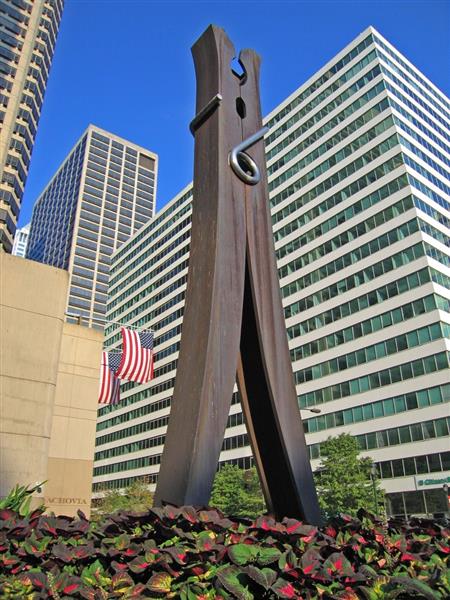
CLOTHESPIN (1976) by Claes Oldenburg — CLAES OLDENBURG /WIKIART.ORG

SWEDISH-born artist Claes Oldenburg, who turned everyday objects such as a clothespin, a baseball bat, or a flashlight into giant sculptures of public art in the United States and around the world, died on Monday at age 93, the Paula Cooper Gallery said.

Mr. Oldenburg came to prominence in New York City in the 1950s, forming part of the pop art movement that elevated the ordinary, and later worked in collaboration with his wife, Coosje van Bruggen, who died in 2009 at age 66.

“The strikingly original early work was hugely influential on many artists, who were informed by his freedom of thought and radical mode of expression,” Ms. Cooper, who worked with Oldenburg since the 1960s and whose Manhattan gallery represented him, said in a statement mourning his death.

“It was thrilling to work with Claes, whose odd take on things was delightful, and could completely turn one’s mood around,” she said.

Mr. Oldenburg moved to New York in 1956 and soon rose to prominence with works such as The Street in 1960. Staged at a church near Washington Square Park, it invited viewers into “an abject array of urban detritus —  cardboard, tattered papers, dirtied pieces of newsprint,” according to ARTnews.

He followed up with The Store in 1961, a rented storefront that displayed small plaster sculptures of dresses, shoes, and desserts.

He met Van Bruggen in 1970 and began a “lifelong artistic partnership,” the Cooper Gallery said. Together they planned and installed the works that became Mr. Oldenburg’s trademark: monumentally scaled sculptures of ordinary items.

Among his best-known pieces is Clothespin in Philadelphia’s Center Square Plaza, a 45-foot (13.7-meter) tall steel clothespin installed during the US bicentennial year of 1976.

In Chicago, the 96-foot (29-meter) Batcolumn of 1977 depicts a baseball bat. In Las Vegas, Flashlight rises 38 feet (11.7 meters) high.

Other works of public art stand in Germany, Japan, Norway, South Korea, Italy, Britain, Spain, France, the Netherlands and cities across the United States, according to the Oldenburg/van Bruggen website. — Reuters

PLDT: Gov’t should address connectivity in remote areas 

FINANCIALLY unviable areas fall under the purview of the government, according to the PLDT group, in response to a Senate bill that seeks to require public telecommunications entities and internet service providers to cover all unserved and underserved areas within a three-year period.

“Projects in remote or missionary areas — including areas where armed conflict exists — that are not financially viable are the natural domain of government as provider of basic infrastructure and social services for development and the citizens’ well-being,” PLDT, Inc. and Smart Communications, Inc. President and Chief Executive Officer Alfredo S. Panlilio told BusinessWorld in an e-mailed reply to questions on Tuesday.

“PLDT has built extensive connectivity and fiber infrastructure that currently covers 96% of the entire country,” he added.

Senator Mary Grace S. Poe-Llamanzares’ Senate Bill No. 329, or the Better Internet Act, seeks to require all public telecommunications entities and internet service providers to extend and expand the service coverage of fixed and mobile internet service in all unserved and underserved areas “within three years from the effectivity of the measure.”

“PLDT will continue to partner with the government in enhancing connectivity for the Philippines and hopes that such partnership will maintain the distinct roles of government and the private sector separate so that the private sector can continue to serve the Filipino people and the country using private funds, while the government continues its role of providing the basic infrastructure and social services, including missionary projects,” Mr. Panlilio said.

The proposed measure requires the Department of Information and Communications Technology to identify unserved and underserved areas in the Philippines. The goal is to provide fast, reliable, secure, and affordable internet to Filipinos all over the country.

The bill also wants service providers to adhere to minimum standards for connection, reception, pricing, and billing practices to uphold and protect consumer rights.

“Our mission is to keep our countrymen connected by ensuring that our network is reliable and accessible to more Filipinos, wherever they may be in the country,” Mr. Panlilio said.

“With price points that provide real value for money, our fixed and wireless internet services are also designed to cater to all segments of the market,” he added.

The group said it has the country’s most extensive fiber network, at 803,000 kilometers as of March 2022.

PLDT’s mobile arm Smart Communications has deployed, as of end-March, around 76,600 base stations nationwide to serve its users, it noted.

“Network-related initiatives made up the bulk of the P89 billion spend for 2021. This brings total capex (capital expenditure) spent over the last 10 years to P518.5 billion. Capex guidance for 2022 is P85 billion,” the group also said.

Citing a report from Ookla, the network testing company behind Speedtest, the group said it swept the Ookla Speedtest Awards in all the quarters of 2021.

“Ookla declared Smart as the winner of its Speedtest Awards for (third quarter and fourth quarter of) 2021 with a speed score of 201.95, median download speed of 218.82 megabits per second (Mbps) and a median upload speed of 22.46 Mbps,” it noted.

“Ookla also found that PLDT is the country’s fastest broadband for the same period with a speed score of 77.24, top download speeds of 203.97 Mbps and top upload speeds of 217.07 Mbps.”

Hastings Holdings, Inc., a unit of PLDT Beneficial Trust Fund subsidiary MediaQuest Holdings, Inc., has a majority stake in BusinessWorld through the Philippine Star Group, which it controls. — Arjay L. Balinbin

Amid rising cases, event organizers encourage mask wearing to prevent COVID spread

Courtesy of Makati Diamond Residences.

THE local meetings, incentives, conferences, and exhibitions (MICE) industry is picking up, as is in-person worship, despite the recent increase in coronavirus disease 2019 (COVID-19) cases.  

Organizers are relying on safety protocols such as temperature checks, mask wearing, social distancing, and “cough etiquette” to prevent their events from becoming superspreaders. 

At the Cultural Center of the Philippines (CCP), where the Cinemalaya Independent Film Festival will be back with onsite screenings from Aug. 5 to 14, temperature checks are required at the entrances.  

Patrons are likewise asked to wear face masks and present their vaccination records, said the venue operations division of the CCP’s production and exhibition department. 

“Although we are already allowed to accommodate up to 100% venue capacity, the CCP venues remain at 80% seating capacity,” the department told BusinessWorld in a July 15 e-mail.  

In March 2020, CCP canceled 800 shows that would have welcomed 800,000 visitors as a result of the first pandemic-induced lockdown.  

At Makati Diamond Residences, event participants are “excited, happy, and eager” to experience face-to-face events again, said Lili-An S. Popa, director of sales and marketing of the luxury serviced apartment in Legaspi Village. “We’ve made it a point to keep in touch with our previous clients. Having a good business relationship with them has paid off.” 

Like CCP, social distancing at Makati Diamond Residences is “still highly encouraged.”  

Event reservations at the serviced apartment are typically for 60 guests. 

“We would like to be optimistic in assessing that the global situation is improving,” Ms. Popa said in a separate July 15 e-mail. “However, there are still other factors affecting the Philippine economy. Thus, the MICE market is treading carefully in the planning, marketing, and implementing of activities.” 

CCP and Makati Diamond Residences moreover have HEPA filters in its air-handling units and ducts. 

Religious organizations such as the Jehovah’s Witnesses have also started welcoming its members back in hybrid worship. 

“There is a collective shout of joy among Jehovah’s Witnesses around the world,” said James Ryan G. Morales, Philippine spokesman of Jehovah’s Witnesses. “While we have prospered in many ways as individuals and congregations using technology to bring us together, nothing can adequately replace being together in person.” 

Meetings, which draw about 100 attendees, are conducted nationwide across its 2,436 Kingdom Halls either in-person or through the remote conferencing app Zoom. Guidelines for in-person attendees include mask wearing, as well as proof of full vaccination status for individuals 18 years and above. 

As with both CCP and Makati Diamond Residences, each of the Kingdom Halls have stations equipped with sanitizers. Each hall also has liquid soaps and paper towels made available to meeting attendees. 

“High-touch surfaces such as chairs, doorknobs, countertops, and faucets are cleaned and sanitized after each congregation meeting,” Mr. Morales said. “Virtual attendance via Zoom continues to function for unvaccinated individuals, or for those who show symptoms of sickness or prefer to stay at home.” 

Resuming in-person meetings “brings us closer together as we endure the hardships of inflation, tragedies, and anxiety,” added Mr. Morales. 

The government, through the Inter-Agency Task Force, has allowed 100% capacity in establishments in areas under Alert Level 1 on June 4.  

The Department of Health (DoH) encourages the public to continue to wear masks, follow health protocols, and get vaccinated. 

As of this writing, the agency has yet to set its vaccination and booster targets for the Marcos administration’s first 100 days. 

In a July 18 Viber message to reporters, the DoH said that  15,592,533 individuals out of the total eligible population of 65,340,001 have been boosted.  

According to the DoH’s latest COVID bulletin, there were 14,640 coronavirus infections in the past week, with a daily average of 2,091 cases. The daily average from July 11 to 17 rose by 44% from a week earlier, it added. — Patricia B. Mirasol 

Arts & Culture (07/20/22)

Maalat Man Matamis Din by Ambrocio Mallari

Ambrocio Mallari holds first solo show

SIXTY-five-year-old artist Ambrocio Mallari mounts his first solo art exhibition entitled “Nostalgia: Ode to Art Journey” at the Robinsons Land ARTablado, Level 3 of the Robinsons Galleria. The artworks in the collection are primarily inspired by iconic pop culture figures from the past. The exhibition is open from July 16 to 31.

Kaida presents group art exhibition

“ALIGAGA” is a group exhibition presented by Kaida Contemporary, that focuses on themes of stress, and anxious anticipation. “Aligaga” features works by Mark Arcamo, Arnold Bornios, Melvin Culaba, Raphael David, Caloy Gernale, Neil Pasilan, Kirby Roxas, Jojit Solano, Angelo Tabije, David Ryan Viray, and Jose Tence Ruiz. The exhibit will be on view from July 18 to 31, with an Artist’s Reception on July 18 from 6 to 10 p.m. at the ArtistSpace at Ground Level, Ayala Museum Annex, Makati Ave. corner De La Rosa St., Greenbelt Park, Makati City. For queries on the exhibition, contact Kaida Contemporary at kaida529@yahoo.com.ph, 0927-929-7129, and 7940-8196.

Exhibit looks at art and disability

IN time for the 44th National Disability Prevention and Rehabilitation Week, the National Commission for Culture and the Arts opened a special exhibit dubbed, “Arts and Disability 20/20: Artful Connection in the Time of Pandemic”. The exhibit features artwork from at least 90 artists, selected by University of the Philippines Fine Arts Professor Amos V. Manlangit. It is on view at the Farmer’s Plaza Atrium in Araneta City, Cubao, Quezon City from July 18 to 23.

Participants for VLF Writing Fellowship in Visayas

THE CULTURAL Center of the Philippines has announced the fellows accepted to the Virgin Labfest (VLF) Writing Fellowship Program in the Visayas which will take place on July 19-31 in Bacolod City. They are Archel G. Barayoga, Jasper John V. Cabra, Faye Lisette P. Gachon, Nicole Garganera, Pnuema Lorena C. Lorenzo, Jim Benedict D. Lubrico, Rocky O. Nicor, and Daveson E. Torculas. The Virgin Labfest Writing Fellowship Program in the Visayas is a two-week mentorship program on the study and practice of dramatic writing for the stage. Participants will attend lectures, discussions, and workshops on playwriting and script critiquing. They will also be given the opportunity to participate in the talkback and interaction with known playwrights and directors. The eight fellows accepted to the program will be mentored by multi-award-winning playwright Glenn Sevilla Mas, and will be given access to past festival plays as part of their mentorship. The Fellowship Program will conclude in a staged reading of the fellows’ works, directed by Dennis Marasigan, which will take place at the Negros Museum on July 31, 6:30 p.m.

The Empty Chair Project reprised

CONTINUING its advocacy for mental health and the need for dialogue about depression, grief, and other related issues, The Empty Chair Project is continued by the Visual Arts Helping Hands Foundation, Inc. in collaboration with Art Lounge Manila. With over 58 artists contributing to this effort, the project not only hopes to bring art and healing together, but also raise funds for the art community’s medical needs. The Empty Chair Project runs until July 30  at Art Lounge Manila, at the Podium, Ortigas Center.

USTPH announces new, upcoming titles

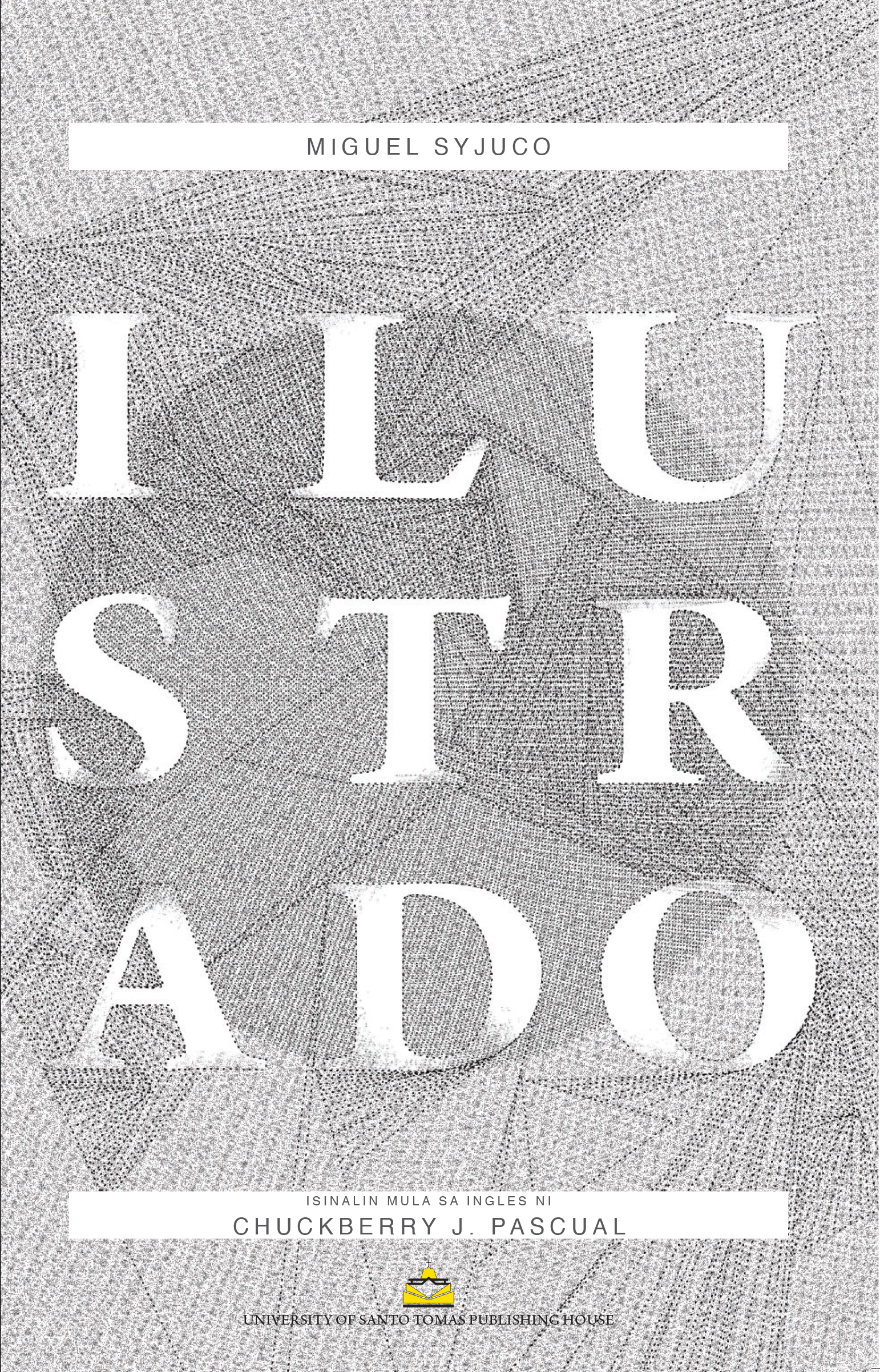
THE UST Publishing House (USTPH) is set to launch new titles in the coming weeks. The books include Mga Screenplays ni Ricky Lee Vol. 1: Brutal, Moral, Karnal, Chuckberry Pascual’s Filipino translation of Ilustrado by Miguel Syjuco, an anthology entitled Shooting the Zombie Apocalypse by U Z Eliserio, and Duterte Watch: Descent into Authoritarianism by Vergel Santos, among others. The new releases will be available through the USTPH Shopee and Lazada stores soon. For updates and sale announcements, follow the USTPH social media accounts on Facebook and Instagram (@ustpublishinghouse). For other inquiries, send an e-mail to publishing.bookstore@ust.edu.ph.

Group show at ARTablado

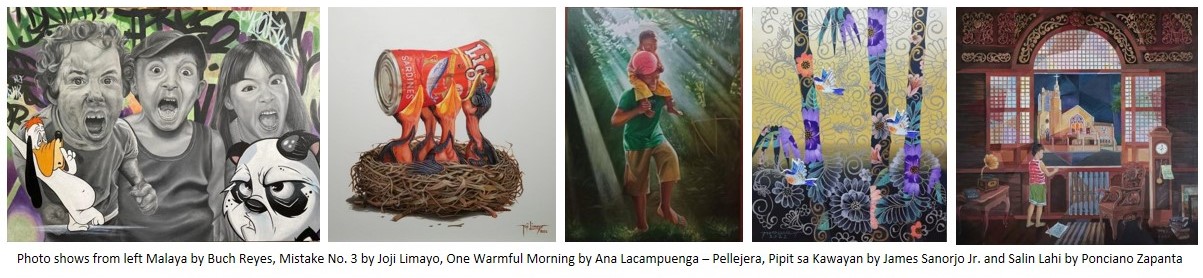
FIFTEEN artists from Taytay, Rizal showcase some of their latest works that encompass different artistic styles from portraits, surrealism, impressionism, and abstractionism, in ARTablado’s latest exhibit “Balintataw”. Balintataw means imagination and there is abundance of it in this exhibition by the members of Tropang Pintor ng Taytay. The participating artists are: self-taught artist Linda Ang; Fashion Institute of the Philippines fashion consultant Chino del Pilar; 73-year-old sculptor Fernando Javellano; photorealistic painter Ana Lacampuenga-Pellejera; self-taught artist Reggie Lim; multidisciplinary artist Jerel Limayo; animator Joji Limayo; multi-awarded artist and photographer Ronald Limayo; architectural designer Gerry Marasigan; portraitist Jonalyn Villar-Montero; UP graduate Victor Olano; self-taught artist John Perry Pellejera; tattoo artist Butch Reyes; a teacher who won first place in the 17th GSIS Art Competition James Sanorjo, Jr.; and, multi-awarded artist Ponciano Zapanta. “Balintataw” runs until July 31 at Robinsons Place Antipolo’s ARTablado.

Minimum health standards can curb monkeypox transmission

PHILIPPINE STAR/ MICHAEL VARCAS

No cases in PHL detected 

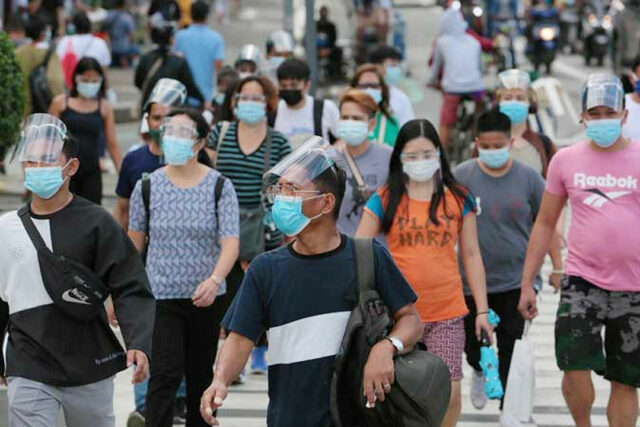
HEALTH PROTOCOLS like mask wearing, handwashing, and physical distancing, which were put in place due to the coronavirus pandemic, will also be effective in preventing the transmission of monkeypox, according to an infectious disease expert.   

Though the Philippines has not seen any cases so far, it’s possible for the virus first detected in West and Central Africa to enter the country through incoming travelers, said Dr. Rontgene M. Solante, a disease expert on the government’s pandemic response panel, at a Philippine College of Physicians forum on Tuesday.  

“Minimum health standards are then important to maintain because both droplets and close contact are potential modes of transmission,” he said.  

Data from the World Health Organization (WHO) shows that most of this year’s cases of monkeypox are reported in non-endemic countries, with 65% of the 7,892 active cases from Jan. 1 to July 7, occurring in Europe.  

Dr. Solante warned that even though the risk for the general population is considered low, children, elderly, pregnant women, and the immunocompromised are at high risk.  

The common symptoms are rashes, lesions, fever, and lymphadenopathy (swollen lymph nodes). The case fatality rate is 3% to 6%.  

“There’s a vaccine and antiviral treatment being researched abroad, but data is still limited. The treatment so far is usually supportive, meaning bed rest, isolation,” he said.  

The Research Institute for Tropical Medicine is working on monkeypox testing to prepare for a scenario in which the virus enters the Philippines.  

WHO’s data on monkeypox also found that majority of the infected are men who have sex with men (MSM) — 78% of confirmed cases are males aged 18 to 44 years old, 98% of which identified as MSM and 41% of which are also positive for human immunodeficiency virus.  

However, this doesn’t mean that monkeypox itself is a sexually transmitted disease, as it can also be contracted from droplets and close or direct contact, Dr. Solante noted.  

“Public health measures should be in place to effectively prevent an outbreak,” he said. — Brontë H. Lacsamana

AbaCore enters coal operating deal with ORVI

ABACORE Capital Holdings, Inc. said on Tuesday that it upgraded an existing venture with Oriental Vision Mining Philippines Corp. (ORVI) from exploration and development to a coal operating agreement.

“This is a development that will deliver long-term value to the holding company’s shareholders,” the company said in a press release.

Abacus Coal Exploration Development Corp. (Abacoal), a subsidiary of AbaCore, will provide three coal blocks that it owns in Surigao Del Norte for ORVI to develop.

The agreement allows ORVI to develop a total of 3,000 hectares of coal blocks — 84, 85 and 86 — that Abacoal owns in the municipalities of Tago and Marihatag.

AbaCore said that ORVI agreed to commercially operate coal block 85 within six months after signing and coal blocks 84 and 86 within a year.

As part of the agreement, ORVI paid P10 million to Abacoal as advance royalty which will be deducted from the royalties Abacoal will receive from ORVI throughout the agreement.

“We are pleased to enter into the next phase of our partnership with ORVI that will allow us to fully unlock the strategic value if the assets that we own in Surigao del Sur,” AbaCore President and Chief Executive Officer Raul B. de Mesa said.

Mr. De Mesa added that the venture will help AbaCore in increasing its revenue and in strengthening its liquidity amid the price inflation of coal in the world market.

Abacoal will generate revenue from its coal assets through the royalty fees ORVI will pay out. The fee is set at 8% of the gross selling price of coal per metric ton.

Abacoal will pay a royalty fee amounting to 5% of the gross price per ton of other minerals aside from coal that ORVI will find during its exploration.

Mr. De Mesa said that AbaCore is confident in ORVI’s expertise and experience in the industry, thus it allowed the operation of its coal assets.

“We look forward to a productive partnership that will provide long-term benefits to our stakeholders and the communities we serve,” he added.

On Tuesday, AbaCore shares ended higher by 2.34% or P0.04 to close at P1.75 apiece on the stock market. — Justine Irish D. Tabile

Hidden Van Gogh self-portrait found behind painting in Scotland

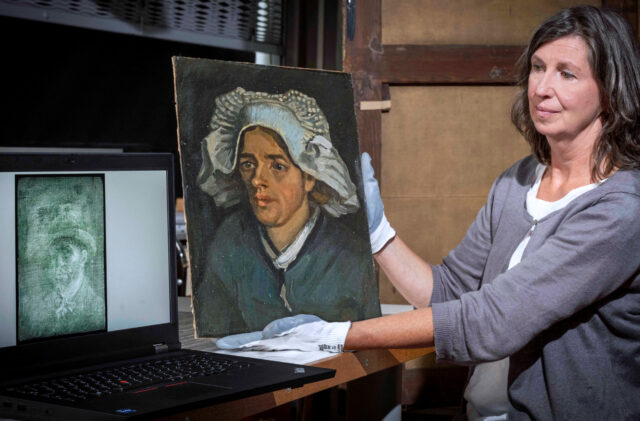
VAN GOGH’s self-portrait detected under cardboard and glue and Head of a Peasant Woman by Vincent Van Gogh are displayed, in Edinburgh, Scotland, Britain, June 21. — NEIL HANNA/HANDOUT VIA REUTERS

LONDON —  A self-portrait of Dutch post-Impressionist artist Vincent van Gogh has been uncovered hidden behind one of his paintings.

National Galleries of Scotland said on Thursday that art conservators made the discovery, believed to be a first for a UK institution, during an X-ray examination of Van Gogh’s 1885 artwork Head of a Peasant Woman for an upcoming exhibition.

It said the X-ray showed “a bearded sitter in a brimmed hat with a neckerchief loosely tied at the throat. He fixes the viewer with an intense stare, the right side of his face in shadow and his left ear clearly visible.”

The image was hidden behind cardboard and layers of glue.

“When we saw the X-ray for the first time of course we were hugely excited,” senior paintings conservator Lesley Stevenson said in a video shared by National Galleries of Scotland.

“Such a major discovery happens once, twice in a conservator’s lifetime… To have an image, as elusive as it presently is, is something very, very special.”

Van Gogh is known to have often re-used his canvases, working on their reverse as well.

National Galleries of Scotland said its experts were looking at how to remove the glue and cardboard covering the self-portrait without damaging Head of a Peasant Woman.

The X-ray image will feature at the July 30-Nov. 13 exhibition, called A Taste for Impressionism, at the Royal Scottish Academy in Edinburgh. — Reuters