Home Blog Page 5754

Five ideas that will reshape Capitalism’s next century

STOCK PHOTO | Image by micheile henderson from Unsplash

By Adrian Wooldridge

(Part 2)

(In Part one, the author introduced the idea of trends that will “reshape management just as dramatically as did world wars, whether hot or cold, or the invention of the computer.” Here are the final four of the five trends.)

THE GREAT KNOWLEDGE-WORKER CULL
First, they came for the agricultural workers. Then they came for the industrial workers. Now they are coming for the knowledge workers. The great labor relations theme of the rest of the current century is that intelligent machines will do for workers by brain what dumber machines did previously for workers by hand — destroying their jobs, suppressing their wages, battering their psyches, and generally driving them to the margins of society.

Techno-optimists like to put a positive spin on the march of the machines. Knowledge workers will become more productive by working with machines rather than against them, they said; machines would stop at the most sophisticated jobs — making leaps of imagination of thinking profound thoughts — thereby leaving human beings to do what they do best while the grunt work is taken care of by computers. Don’t believe a word of it.

Intelligent machines have already moved on from jobs that simply involve processing lots of data (compiling tax returns or reading medical charts or searching for the best value stocks) to jobs that require what used to be regarded as “the human touch.” Machines can produce plausible-sounding news reports. IBM Corp. and the Baylor College of Medicine have developed a system called KnIT (“knowledge integration toolkit”) that scans the medical literature and generates new hypotheses for research problems. Software regularly outperforms humans in predicting the outcome of court cases ranging from patent disputes to landmark Supreme Court rulings.

The great problem of management will shift inexorably from how to manage knowledge workers (who will be progressively “outplaced”) to how to manage the marginalization of knowledge workers. Ever more senior figures who have spent their lives celebrating technological progress and decrying Luddism will find themselves surplus to requirements (imagine the howl from columnists as columns are automated!) Ever more university graduates will find themselves working in the bowels of the service economy. And ever more university departments, having profited briefly from the academic arms race, will have to close as potential students realize that no number of qualifications will save them from the knowledge-worker cull.

Disappointed brainworkers have always provided combustible fuel for revolutions in the past: Look at the role that alienated intellectuals played in driving the Russian revolution or downwardly mobile graduates played in the rise of Nazism in Germany. From a social point of view, the next wave of technological progress is likely to prove the most disruptive yet.

THE RISE OF THE TRILLION-DOLLAR TRUST FUND BABY
In the next decade or so we will see the birth of a new kind of baby: trillion-dollar trust fund babies who are destined to inherit fortunes that are bigger than the GDPs of small countries or the stock-market valuations of large companies.

These trillion-dollar trustafarians are the product of two trends. The first is the return of giant fortunes that are comparable with those of Rockefeller and Carnegie. The second is a concerted campaign from the right, particularly in the United States, to reduce or even abolish the inheritance tax (which conservatives have brilliantly rebranded “the death tax”). “Only morons pay estate tax,” was the proud boast of one of Donald Trump’s economic advisers, Gary Cohn, of a tax that, for 35 years after 1941, stood at 77%. Over the next 25 years about half of the $72 billion that will be passed from one generation to another will come from the richest 1.5% of households.

The rise of the trillion-dollar trust-fund baby will put yet more strain on the meritocratic idea that is the rocket fuel of capitalism. How can you talk about equality of opportunity when some people inherit fortunes that outstrip the endowments of entire universities? And how can you laud the work ethic when we have an ever-expanding permanent leisure class?

The rise of trillion-dollar babies will further tilt the overall economy away from wealth creation and toward inheritance curation: Why risk your hand at entrepreneurship when you can have a highly remunerated career as a “money-butler” to the super-rich, either as a lawyer devising ever more elaborate trusts, a political consultant lowering the inheritance tax still further, or a private banker making giant fortunes even bigger still.

THE NEXT FRONTIER OF COMPETITIVE ADVANTAGE: GENETICS
The West has understandably remained nervous about exploiting the potential of genetic science since the horrors of the Holocaust. That is likely to change in the coming decades — indeed genetic science may be for the next 40 years what computer science was for the past 40 years.

There are lots of reasons for this. Genetics has been advancing at an astonishing rate since the sequencing of the human genome, not just as an abstract science but as a set of technologies. The unease engendered by the memories of the 1940s is fading. Genetic screening for abnormalities is now commonplace, and is sometimes followed by the termination of pregnancies. The fashion for enhancing your body with computer parts is spreading from university-based sub-cultures into wider society. What will really tip the balance, however, will be China, which has already tolerated the selective abortion of millions of female fetuses, and where researchers sparked controversy by editing the genome of a human embryo. Notwithstanding the subsequent official condemnation of that work, China will surely be tempted to exploit the military, and perhaps the commercial, possibilities of genetic science.

This will put a series of profound questions at the heart of business (and create a thriving sub-discipline in management ethics). What limits should the West place on genetic research? Should we impose tighter limits on the IVF industry? Or should they be free to sell, in effect, genetically superior offspring? Should insurance companies be given access to DNA tests that predict an individuals’ potential to fall ill? And should regular companies be able to select their employees based on “polygenic scores,” based on computerized surveys of thousands of genetic differences that predict their ability to thrive in their jobs? Can the West retain its focus on individual rights in the face of an economic and military competitor which might use genetic screening to discover and even create superior human beings? Or will further abandoning liberal individualism be just another price we have to pay in order to remain competitive?

THE NEW ROAD TO SERFDOM
The great clarion call of market societies is freedom: freedom to exchange the fruits of our labor in the marketplace for goods and freedom to express our views in the marketplace of ideas. Yet there is a growing risk that we are losing our freedoms not only to a new generation of intellectual censors but to watchers who monitor our every move.

Friedrich A. Hayek warned that the road to serfdom was being paved by the state — and certainly the Chinese government has led the way to our current dystopia with its construction of the world’s most elaborate surveillance society. But the great free marketeer failed to reckon with the opportunism of the private sector. Internet giants grow fat by sucking up information about our spending habits and selling it to third parties. Corporations increasingly used spyware of various kinds to monitor their workers ever more closely and sanction them if they paused in their productivity.

If the road to hell is paved with good intentions, the road to serfdom is paved with minor conveniences. Consumers wanted the “free services” that Google and its fellow surveillance capitalists offered (smilers with knives underneath their coats, to borrow a phrase from Chaucer). So, they gave them the right to spy on their lives. Workers wanted the convenience of being able to work from home. So, they allowed their employers to monitor their productivity from afar.

Can capitalism be revamped so that we can reclaim our lost freedoms without losing the benefit of our improved capacity to, say, fight crime or improve productivity? We need a new generation of management thinkers to devote themselves to thinking about this subject. Should we allow individuals to charge companies to use their data? Or should we go for the opposite approach and simply nationalize the IT giants on the grounds that private entities should not be trusted with such intimate knowledge? But alas at present the few people with the intellectual firepower and technical expertise to answer these questions either work for the IT companies themselves or for think tanks that depend on Silicon Valley money.

The best management gurus have played an outstanding role not only in identifying business problems but also in helping to solve them. Peter Drucker persuaded his readers to take more responsibility for “managing themselves” in order to cope with the disappearance of jobs-for-life and the extension of life expectancies. Michael Jensen arguably delayed the onset of the recent stagnation by unleashing the creative force of leveraged buyouts and private equity (though for a contrary view see Nicholas Lemann’s excellent Transaction Man). Clay Christensen helped young companies to take advantage of disruptive new technologies that changed the way that businesses operated.

During its first 100 years, the Harvard Business Review (HBR) has been an invaluable bridge between the management theory industry on the one hand and the broader business public on the other. That bridge will be needed more than ever, given the tendency of academics to turn in on themselves and as businesses obsess over the long term. But in order to succeed, HBR will have to be more honest about why it has made such glaring mistakes in the past. It will also have to broaden its current somewhat blinkered focus — not only giving space to a wider range of voices on fashionable topics such as corporate social responsibility but also looking to the darker forces all too likely to transform business in the century ahead.

BLOOMBERG OPINION

Fear driving China’s tech manipulation poses threat to all -UK spy chief

 – China is using its financial and scientific muscle to manipulate technologies in a manner that risks global security, Britain’s top cyber spy will say on Tuesday, warning that Beijing’s actions could represent “a huge threat to us all.”

In a speech, Jeremy Fleming, director of the GCHQ spy agency, will say that the Chinese leadership was seeking to use technologies such as digital currencies and its Beidou satellite navigation network to tighten its grip over its citizens at home, while spreading its influence abroad.

“They seek to secure their advantage through scale and through control,” Fleming will say in the annual security lecture at the Royal United Services Institute think tank, according to extracts released by his office.

“This means they see opportunities to control the Chinese people rather than looking for ways to support and unleash their citizens’ potential. They see nations as either potential adversaries or potential client states, to be threatened, bribed, or coerced.”

The remarks are Fleming’s latest public warnings about Beijing’s behavior and aspirations. Last year, he said the West faced a battle to ensure China did not dominate important emerging technologies such as artificial intelligence, synthetic biology and genetics.

Fleming will say the Chinese leadership was driven by a fear of their own citizens, of freedom of speech, of free trade and open technological standards and alliances, “the whole open, democratic order and the international rules-based system.”

That fear combined with China’s strength was driving it “into actions that could represent a huge threat to us all,” he will say.

China has previously described similar accusations from Western governments as being groundless and politically motivated smears.

Fleming will also highlight technologies where he says China is seeking to gain leverage, such as its development of a centralized, digital currency to allow it to monitor the transactions of users, as well as to possibly evade the sort of sanctions Russia has faced since its invasion of Ukraine.

He will also point to Beidou, China’s answer to the U.S.-owned GPS navigation system.

“Many believe that China is building a powerful anti-satellite capability, with a doctrine of denying other nations access to space in the event of a conflict,” he will say. “And there are fears the technology could be used to track individuals.” – Reuters

World Bank to launch new trust fund for emissions reduction grants

 – The World Bank said on Monday it is launching a trust fund aimed at pooling public funds to provide grants for projects to reduce carbon emissions, including decommissioning coal-fired power plants.

The Scaling Climate Action by Lowering Emissions (SCALE) fund will provide grants to developing countries as they deliver pre-agreed results in reducing greenhouse gas emissions, World Bank President David Malpass said in a LinkedIn post.

SCALE will be the new umbrella trust fund for the bank‘s results-based climate finance activities. Malpass said the World Bank was in the process of capitalizing the new fund, with the aim of launching it at the COP27 climate change conference in Egypt in November.

In a paper provided to the World Bank‘s and International Monetary Fund‘s joint Development Committee, the bank said it has identified three areas that are particularly well suited to such results-based financing grants: natural climate solutions based on agriculture, forestry, land-use and oceans; sustainable infrastructure such as energy and transport; and fiscal and financial solutions that directly or indirectly mobilize resources for climate actions.

The bank said the SCALE fund will bring new resources to emissions reduction projects in low- and middle-income countries, help generate larger projects, generate high-quality carbon credit assets and help countries enhance access to international carbon markets.

The World Bank did not identify a projected size for the new fund. The world‘s biggest multilateral development lender in fiscal 2022, ending on June 30, delivered over $30 billion in climate-related finance.

But U.S. Treasury Secretary Janet Yellen last Thursday urged the World Bank and other multilateral development banks to shift their business models beyond country-specific project finance and to dramatically boost lending to address climate change and other pressing global needsRead full storyReuters

Debt costs overshadow climate finance in small island states-report

PIXABAY

LONDON -Small developing island states heavily exposed to the effects of climate change and often in critical debt situations spend at least 18 times more on debt servicing than they receive in climate finance, a report showed.

A group of 37 island states, home to some 65 million people, “urgently need to increase their fiscal space to tackle the multiple challenges and crises facing them,” wrote Iolanda Fresnillo, one of the authors of the European Network on Debt and Development (Eurodad) report.

The Eurodad report found that the island states from Guinea-Bisseau to the Dominican Republic to Samoa received just $1.5 billion in climate finance between them between 2016-2020.

Over the same period, 22 of the nations paid more than $26.6 billion to their external creditors, which comprises 50 non-governmental organisation, it said.

Public debt levels in the island states had risen from an average of near 66% of GDP in 2019 to nearly 83% in 2020 and were set to remain above 70% until 2025, the report found.

This in turn meant governments needed to spend more revenue on debt servicing, with countries like Belize, Cape Verde, Dominican Republic, Jamaica, Maldives, Grenada and Papua New Guinea allocating between 15%-40% to pay their external creditors, it said.

More countries had turned to the International Monetary Fund for help, with the number of countries having programmes with the fund jumping from three in 2019 to 20 between 2020 and 2021.

In June, the fund’s executive board approved a $60 million programme for Cape Verde while Barbados struck a deal for $293 million in late September.

The report found that more than 80% of the island states were in debt difficulties under criteria established by the IMF and World Bank Debt Sustainability Analysis, or by civil society groups Debt Justice UK and Jubilee Germany.

How to shore up fragile, smaller economies buckling under the strain of fallout from COVID-19 and Russia’s war in Ukraine is poised to garner much focus this week when policy makers from around the globe gather in Washington for the annual IMF/World Bank meeting until Oct. 16. — Reuters

Biden’s new Arctic strategy foresees competition with Russia, China

US PRESIDENT JOSEPH R. BIDEN — WHITEHOUSE.GOV

WASHINGTON — The United States on Friday unveiled a new strategy for the Arctic that foresees increasing competition with Russia and China in the strategic region.

“We will exercise US government presence required to protect the American people and defend our sovereign territory,” said a fact sheet about the new strategy released by the White House.

Russia has reopened hundreds of Soviet-era military sites in the region, NATO Secretary General Jens Stoltenberg said in August, adding that Russian capabilities there pose a strategic challenge to the 30-nation alliance.

China, which describes itself as a “near-Arctic” state, also has ambitions in the region and has said it intended to build a “Polar Silk Road.” China has its eye on mineral resources and new shipping routes as ice caps recede with rising temperatures.

The new US strategy, an update of its 2013 predecessor, says the United States seeks an Arctic region that is “peaceful, stable, prosperous, and cooperative.” It addresses climate change with greater urgency and directs new investments in sustainable development to improve livelihoods for Arctic residents, while conserving the environment.

The strategy “also accounts for increasing strategic competition in the Arctic, exacerbated by Russia’s unprovoked war in Ukraine and the People’s Republic of China’s increased efforts to garner influence in the region, and seeks to position the United States to both effectively compete and manage tensions,” the White House said.

The White House said the United States “will deter threats to the US homeland and our allies by enhancing the capabilities required to defend our interests in the Arctic, while coordinating shared approaches to security with allies and partners and mitigating risks of unintended escalation.” — Reuters

Tycoon Razon postpones $474 million Prime Infrastructure IPO on bearish market

PHILIPPINE STAR/KRIZ JOHN ROSALES

MANILA – Philippine tycoon Enrique Razon has delayed to the middle of next year plans to launch an up to P28 billion ($474 million) listing for his infrastructure and energy holding firm because of a market downturn, its underwriter said on Monday.

The initial public offering (IPO) of Prime Infrastructure Capital Inc, originally set for October, could have been the Philippines’ largest this year.

“We will wait for the markets to recover,” Eduardo Francisco, president of deal underwriter BDO Capital, told reporters at the sidelines of a media forum.

The earliest an IPO for Prime Infrastructure could occur would be May or June next year, enough time to wait for global economy to rebound, inflation to ease and markets to recover, Francisco said.

Eight companies, mostly small firms, have listed in the Philippine bourse, whose broader index has fallen 18% and is Southeast Asia’s second worst performer year-to-date.

In June, Prime Infrastructure filed its listing documents with the corporate regulator. It planned to sell up to 1.93 billion shares, including an over-allotment option, at a maximum price of 14.60 pesos each. In Philippine filings, IPO prices are typically set above final selling prices.

Prime Infrastructure planned to use IPO proceeds to finance its energy, water, and waste and sustainable fuels businesses.

Razon, who Forbes says is the second-richest person in the Philippines with a net worth of $5.6 billion, built his fortune through global port operator International Container Terminal Services and casino owner Bloomberry Resorts. — Reuters

Aug. trade deficit hit record $6 billion

The country’s trade balance swung further into record $6-billion deficit in August as imports growth rose to a two-month high while exports slid for the second straight month, the Philippine Statistics Authority (PSA) reported on Tuesday morning.

Preliminary PSA data showed the value of merchandise exports shrank by 2% year on year to $6.410 billion in August, a reversal from the 18.9% growth in the same month in 2021.

However, it marked the second straight month of year-on-year contraction in exports after the revised 4.1% drop in July.

Meanwhile, the country’s merchandise imports rose 26% to $12.413 billion in August. This was slower than the 28.3% growth in August 2021 but faster than the 22.2% import in the previous month.

This was the highest import print in two months or since the 26.3% growth in June.

This brought the trade-in-goods deficit — the difference between exports and imports — to $6.003 billion in August, nearly double the $3.310-billion shortfall of the same month last year. It was also wider than the $5.989-billion gap in July.

Total trade — the sum of exports and imports — grew by 14.8% to $18.823 billion. This pace was faster than the 11.8% in July, but lower than the 24.4% in August 2021.

In the eight months to August, exports grew by 4.4% year on year to $51.155 billion, below the 7% growth target set by the Development Budget Coordination Committee.

Imports during the same period climbed by 26% to $92.966 billion. This was already above the government’s 18% full-year target this year.

Year to date, the trade balance ballooned to a $41.811-billion deficit, wider than the $24.77-billion trade gap in the comparable eight months last year. — Lourdes O. Pilar

FDI inflows slump to 14-month low

PHILSTAR FILE PHOTO

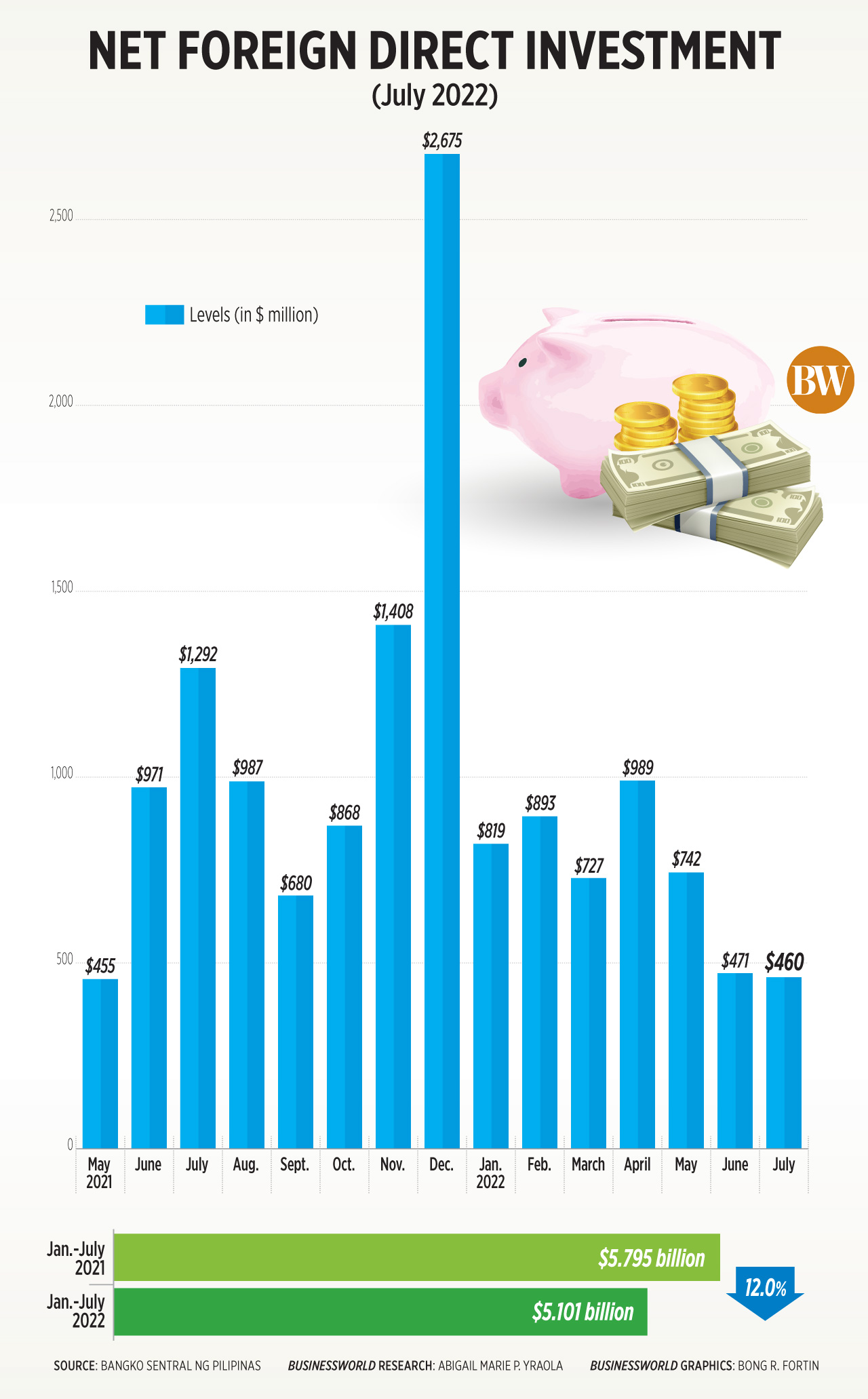
FOREIGN DIRECT investment (FDI) net inflows declined for a third straight month in July, slumping to the lowest level in 14 months as investors remained cautious amid elevated inflation and slowing global growth.

Data released by the Bangko Sentral ng Pilipinas (BSP) on Monday showed FDI net inflows fell by 64.4% to $460 million in July from $1.29 billion a year earlier. 

This was the lowest monthly FDI inflow recorded since the $455 million posted in May 2021.

Net foreign direct investmentsMonth on month, FDI net inflows dropped by 2.3% from $471 million in June.

“In July 2022, FDI net inflows decreased due largely to the lower non-residents’ net investments in debt instruments of their local affiliates. This decrease more than offset the growth in their net investments in equity capital,” the BSP said in a statement. 

By component, non-residents’ net investments in debt instruments of local affiliates plunged by 80.6% to $213 million in July, from $1.093 billion a year ago.

In contrast, investments in equity and investment fund shares rose by 24.7% in July to $248 million. 

FDIs in equity capital (other than reinvestment of earnings) surged by 268.2% to $137 million in July from $37 million in the same month last year.   

Broken down, equity capital placements jumped by 63.5% annually to $155 million, while withdrawals dropped by 69.1% to $18 million.   

For the month, equity placements were mainly from Singapore, Japan, and the United States. These were placed mostly in construction, manufacturing, and real estate industries.

Reinvestment of earnings dropped by 31.4% to $111 million year on year in July, from the $162 million in 2021.

The latest FDI data reflected worries over an expected global recession as many economies are expected to slow down next year, China Banking Corp. Chief Economist Domini S. Velasquez said in a Viber message.

“Tighter financial conditions in major source countries could have contributed to lower FDI. A rising interest rate environment, more pessimistic business environment, and higher cost may refrain foreign companies from investing in the near term,” she said.   

Heightened market volatility may have also contributed to the drop in FDI inflows in July, when the US Federal Reserve delivered another large rate hike, Rizal Commercial Banking Corp. Chief Economist Michael L. Ricafort said in an e-mail note.

“(FDI) was also partly weighed (down) by higher inflation and interest rates that are drags to new investments/FDIs globally and locally,” Mr. Ricafort added.   

In an off-cycle move, the BSP raised its benchmark interest rate by 75 bps in July, bringing it to 3.25% in an attempt to curb inflation.

Inflation climbed to 6.4% year on year in July, from 6.1% in June and 3.7% a year ago. It was also the fourth straight month that inflation breached the BSP’s 2-4% target.   

For the first seven months of the year, total FDI net inflows fell by 12% to $5.101 billion from $5.795 billion during the same period in 2021.

“All major FDI components yielded lower net inflows in January-July 2022 as foreign investors remained cautious amid continued adverse global conditions,” the BSP said.   

In the January to July period, foreign investments in debt instruments slipped by 12.6% year on year to $3.555 billion.

Investments in equity and investment fund shares declined by 10.4% to $1.546 billion in the first seven months.

Net foreign investments in equity capital dropped by 13.7% to $876 million. Equity capital placements fell by 21.6% to $977 million, while withdrawals decreased by 56.2% to $101 million.   

Most of these placements were from Japan, the United States, Singapore, and Malaysia.

Reinvestment of earnings was down by 5.7% to $670 million in the first seven months of the year.

According to Mr. Ricafort, there may still be an uptick in FDI inflows in the coming months as the Marcos administration secured investment commitments during the President’s visits to Indonesia, Singapore, and United States.

Investors could also become more decisive on expansion projects as the economy further reopens, Mr. Ricafort said.   

“As evident in industries that are experiencing positive inflows, such as construction, real estate, and manufacturing, medium-term outlook in the Philippines remain bullish,” Ms. Velasquez said.   

The central bank projects FDI net inflows will reach $10.5 billion this year. — Keisha B. Ta-asan

Congress vows to approve Marcos’ legislative priorities

President Ferdinand R. Marcos, Jr. and Vice-President Sara Duterte-Carpio attend the Legislative Executive Development Advisory Council meeting in Malacañan Palace, Manila, Oct. 10, 2023. — JONATHAN CELLONA/PPA POOL

LEADERS OF CONGRESS on Monday agreed to approve 30 bills identified as priorities of the Marcos administration, including the amendments to the Build-Operate-Transfer (BOT) Law and the National Government rightsizing program.

President Ferdinand R. Marcos, Jr. on Monday convened the 20-member Legislative-Executive Development Advisory Council (LEDAC) for the first time under his administration.

During Monday’s meeting, the LEDAC listed 32 bills under the common legislative agenda, which includes 20 priority measures earlier mentioned by Mr. Marcos during his State of the Nation Address in July.

Twelve measures were added by Congress leaders including the SIM Registration Act, which was signed into law on Monday, and the postponement of the Barangay and Sangguniang Kabataan elections.

In a statement, Senate President Juan Miguel F. Zubiri said the Senate and House agreed to approve six of the 30 measures by yearend, namely the amendments to the BOT Law, Medical Reserve Corps, National Disease Prevention Management Authority/Center for Disease Prevention and Control, Virology Science and Technology Institute of the Philippines, mandatory Reserve Officers’ Training Corps and National Service Training Program (ROTC/NSTP), and Condonation of Unpaid Amortization and Interest on Loans of Agrarian Reform Beneficiaries.

House Speaker Martin G. Romualdez said in a separate statement that legislators will give the “utmost priority” to the remaining 30 bills under the common legislative agenda.

“The House is in full support of the President’s entire legislative agenda, including the key priority measures for legislation he has asked Congress to consider. We will act on these with dispatch,” Mr. Romualdez said.

Aside from the six measures earlier mentioned, Mr. Marcos’ legislative agenda includes the National Government Rightsizing Program, amendments to the Electric Power Industry Reform Act (EPIRA), the Real Property Valuation Reform Bill, Passive Income and Financial Intermediary Taxation Act, E-Governance Act, E-Government Act, Internet Transaction Act, Government Financial Institutions Unified Initiatives to Distressed Enterprises for Economic Recovery (GUIDE) Bill, Unified System of Separation, Retirement and Pension Bill, Department of Water Resources Bill, National Land Use Act, Budget Modernization Bill, National Defense Act, and the Enabling Law for the Natural Gas Industry.

The House and Senate identified their priority measures, which included the establishment of Regional Specialty Hospitals, the Magna Carta of Filipino Seafarers, establishing the Negros Island Region, New Philippine Passport Act, Waste-to-Energy Bill, Apprenticeship Act, a bill providing free legal assistance for military and uniformed personnel, Magna Carta of Barangay Health Workers, creation of the Leyte Ecological Industrial Zone, and creation of the Eastern Visayas Development Authority.

To expedite the passage of these bills, Mr. Romualdez said the House will continue to use a rule that allows committees to immediately dispose of priority measures that were approved on third reading in the previous Congress.

SUPPORT NEEDED
“The passage of many of these bills banks on the popularity of the president. In fact, these bills can facilitate the president’s agenda: infrastructure program, reforms in the ROTC/NSTP, and interventions in the agriculture sector,” Jan Robert S. Go, a political analyst, said in a Messenger chat. “Right now, Marcos enjoys the support of both chambers.”

Leonardo A. Lanzona, who teaches economics at the Ateneo de Manila University, said in a Messenger chat that the Marcos administration’s priority bills “fail to take into account the current situation that most households are faced with.”

“This involves an assessment of the current problems arising from the economic crisis and the capacity of the institutions designed to enforce them,” he said.

Mr. Lanzona noted the government needs to “focus only on two or three measures and to strengthen the institutions that will implement these measures.”

“Amendments to the BOT Law should not go the current route of its IRR amendment, in which tariff and fees may be raised by private proponents even prior to regulatory approval,” Terry L. Ridon, a public investment analyst, said in a Messenger chat.

Mr. Ridon noted amending the EPIRA, which paved the way for the privatization of the energy sector, would be difficult.

“Energy companies with political allies in Congress will certainly make sure to further limit the government’s regulatory powers,” he said.

Mr. Ridon said amendments to EPIRA and BOT Law “should only be undertaken to enhance protection for consumers and end-users and to prevent regulatory capture by interest groups.” — Kyle Aristophere T. Atienza

Meralco rates drop in October

Linemen of Manila Electric Co. fix electric posts in Tondo, Manila in this file photo. — PHILIPPINE STAR/ RUSSELL PALMA

HOUSEHOLDS in Metro Manila can expect lower electricity bills this month, with typical households set to see a P15 reduction, the Philippine capital’s largest power distribution utility said on Monday.

In a statement, Manila Electric Co. (Meralco) said the overall electricity rate dropped by P0.0737 per kilowatt-hour (kWh) to P9.8628 in October from P9.9365 per kWh in September due to the reduction in the feed-in-tariff allowance (FIT-All).

“For a residential customer consuming 200 kWh, the reduction is equivalent to a decrease of almost P15 in their total electricity bill,” Meralco said.

Those using 300 kWh, 400 kWh and 500 kWh can expect their monthly bills to go down by P22, P29 and P36, respectively.

Meralco Vice-President and Head of Corporate Communications Joe R. Zaldarriaga said the October rate was lower due to the P0.0619 per kWh cut in the FIT-All and the drop in generation charge.

The Energy Regulatory Commission (ERC) had approved the collection of a FIT-All of P0.0364 per kWh starting this October billing period. This is lower than the previous rate of P0.0983 per kWh.

Generation charge also slipped by P0.0201 to P6.9192 per kWh in October, from P6.9393 per kWh last month “on the back of lower costs from Meralco’s supply contracts.”

Mr. Zaldarriaga said charges from independent power producers (IPPs) and power supply agreements (PSAs) slipped by P0.5073 and P0.0702 per kWh, respectively.

“The reduced use of more expensive alternative fuel by the First Gas-Sta. Rita and San Lorenzo plants and increased plant utilization of IPPs and PSAs more than offset the impact of the steep depreciation of the peso in September,” Meralco said, noting that dollar-denominated costs made up 98% of IPP and 38% of PSA charges.

The peso closed at P58.625 per dollar on Sept. 30, weakening by P2.48 or 4.4% from its Aug. 31 close of P56.145.

Meralco said the lower IPP and PSA charges offset the higher rates from the Wholesale Electricity Spot Market (WESM), which went up P4.8128 to P11.9990 per kWh amid tighter supply in the Luzon grid.

“Both demand and capacity on outage increased, and the grid was placed on Red Alert on Sept. 12,” Meralco said, adding that it sourced 4% of its power requirement from WESM compared with 10% in September.

Transmission, taxes, and other charges for residential customers increased by P0.0083 per kWh.

Meanwhile, Meralco said South Premiere Power Corp. (SPPC) and San Miguel Energy Corp. (SMEC), the administrators of the Ilijan and Sual power plants, continued to supply power at ERC-approved rates “under protest.”

Last week, the ERC denied the joint petition of Meralco and San Miguel Corp. (SMC) for a rate increase to cover the losses of SMC’s two power plants.

Jose Ronald V. Valles, Meralco first vice-president of Regulatory Management Office, said the companies will “exhaust all remedies” to prevent the termination of the PSAs with SPPC and SMEC.

“Should SPPC and SMEC decide to pursue the contract termination, we will ensure continuity of stable, reliable and adequate supply for our customers by getting supply from other sources like the WESM and other generation companies,” Mr. Valles said in a statement.

Lawrence S. Fernandez, Meralco’s vice-president and head of utility economics, said that SPPC and SMEC supply around 1,000 megawatts under baseload PSAs which  translated to 19% of Meralco’s power supply last month.

Meralco’s controlling stakeholder, Beacon Electric Asset Holdings, Inc., is partly owned by PLDT, Inc. Hastings Holdings, Inc., a unit of PLDT Beneficial Trust Fund subsidiary MediaQuest Holdings, Inc., has interest in BusinessWorld through the Philippine Star Group, which it controls. — Ashley Erika O. Jose

DICT eyes partnerships for fiber projects

FREESTOCKS-UNSPLASH

THE Department of Information and Communications Technology (DICT) is looking at partnering with private companies for fiber connectivity projects in rural communities.

“We need to connect more provinces and municipalities. The partnership can be with private companies, or it can be a partnership with local government units,” DICT Assistant Secretary Philip A. Varilla said during the Economic Journalists Association of the Philippines (EJAP) Economic Forum 2022.

Mr. Varilla said partnerships with the private sector will make the implementation of broadband projects “easier and faster.”

However, he noted public-private partnerships for “geographically isolated and disadvantaged areas,” may not be viable. Instead, he said these areas will be serviced by satellite technology, which requires less investment than fiber connectivity.

Overall, the department is “initially looking at P3 billion for 5,000 locations,” Mr. Varilla said.

At the same time, he said that the first phase of the government’s national broadband program, which covers 12 provinces in Luzon, is now 73.56% complete. The project will be completed by next year.

The National Telecommunications Commission, an attached agency of the DICT, recently approved the registration of Starlink Internet Services Philippines, Inc., a subsidiary of Elon Musk’s Space Exploration Technologies Corp. (SpaceX).

Starlink Internet Services Philippines is expected to offer high-speed low latency satellite internet service with download speeds between 100 megabits per second (Mbps) and 200 Mbps to Filipinos, according to the DICT.

Mr. Varilla said the department is now identifying the remote locations that will be covered by Starlink’s service.

The DICT reported on Monday that three remote islands in Zamboanga are now connected to the broadband program. These are Sacol, a geographically isolated island that houses four barangays, and nearby islands Tigtabon and Pangapuyan.

The EJAP Economic Forum was co-presented by Metro Pacific Investments Corp. and PLDT, Inc. — Arjay L. Balinbin

Property market uptrend expected if POGOs stay

PETR MAGERA-UNSPLASH

SEGMENTS of the property market are bound to maintain their uptrend as long as Philippine Offshore Gaming Operators (POGOs) are allowed to continue, Leechiu Property Consultants, Inc. said.

It also expects the demand for commercial properties to remain as jobs could be shifted to the country if a downturn happens globally, as what happened in the past.

“If the POGOs are allowed to continue, then we will establish a floor in the stock market, residential market, and office market,” Leechiu Chief Executive Officer David Leechiu said during a media briefing on Monday.

Mr. Leechiu said that despite the US saying that interest rates will keep climbing for the next 12 months, the rise will be offset by the improvement in logistics, which in turn can ease costs.

“Yes, interest rates are going to climb but that will be partly offset by the drop in construction costs, drop in distribution costs, and by the drop in food prices,” Mr. Leechiu added.

“Late next year, you’re gonna see a lot of these stabilizing, and then it’s gonna produce improved sentiment and that’s when the stock market will go up. It’s [also] gonna improve sentiment in the Philippines and that’s when foreigners will start investing in Philippine property again,” he said about rising interest rates and the depreciating peso.

Leechiu Director for Investment Sales Alvin Magat similarly said that POGOs are important to the commercial segment to keep its uptrend next year.

“Yes, it will be positive for commercial properties considering that POGO will stay because if that will be gone right now, we will need to come up with a demand that will fill up all the supply that will be left out by the POGO industry,” Mr. Magat said.

He added that demand for commercial properties will be maintained even if a recession happens in the US or globally because jobs will again shift to the Philippines, which he said happened during the global financial crisis of 2008.

“We should not forget the fact that the Philippines has its own competitive advantage compared to other BPO (business process outsourcing) countries like India and Vietnam, and that is the average age that we have for our BPO industry and the ability and fluency of [our] BPO employees,” Mr. Magat said.

Meanwhile, Leechiu Director for Commercial Leasing Mikko Barranda said that the occupancy rate in the BPO sector is on an uptrend despite the work-from-home arrangement extending to next year and industry projects of hiring full-time employees (FTE).

“The uptick is seen; we see the uptrend. [And we give] a lot of emphasis to the BPO sector [by] them taking space despite the current working arrangements,” Mr. Barranda said.

He added that projections from the IT and Business Process Association of the Philippines (IBPAP) about the number of FTEs who will be hired in the next few years “gives us the confidence in terms of properties or real estate that the BPO sector will take.”

The IBPAP roadmap shows that the information technology and business process management (IT-BPM) industry is projected to hire 1.1 million FTEs in the next six years, which translates to 476,000 square meters (sq.m.) of annual office space requirement until 2028.

“There is optimism if you look at the charts from 2020 at 380,000 sq.m., 540,000 sq.m. in 2021, and in the first nine months of 2022 at 694,000 sq.m.,” Mr. Barranda said.

He said the BPO industry has a “multiplier effect” in which the hiring of a single FTE has the potential to indirectly hire three or four FTEs.

“So, what a one million FTE count through six years [could mean] is actually three or four million added FTEs to the economy,” Mr. Barranda added.

For the residential segment, Leechiu Director for Research and Consultancy Roy Amado Golez, Jr. said that the government’s call to build a million houses per year could help the movement of the low-cost and affordable housing segments.

“With the government’s call to build more houses, in all likelihood next year we will be seeing the low-cost and affordable segments to start moving and hopefully the compliance requirements of the developers will start to be released from escrow,” Mr. Golez said.

He said that funds stuck in the escrow arrangement with the Department of Human Settlements and Urban Development can instead be used for low-cost housing.

However, he said that movement in middle to upper-middle housing sectors is likely to be flat next year until developers start to have more confidence in the costs of their developments.

“Right now, the interest rates [and] the logistics problems make it very unpredictable for the costs of construction. If that can be solved next year, then in all likelihood the middle to the upper-middle segment will also start moving significantly upwards,” Mr. Golez said.

“The BPO sector will start to absorb more and more office spaces, the corporates are gonna start expanding again as well as the real estate,” Mr. Leechiu said.

Mr. Leechiu said: “I’m quite hopeful about 2023 despite all the things that are happening in the world because again the crisis in the world is gonna produce more jobs in India and Philippines. And remember that this is all predicated on us keeping POGOs alive today, if you take that away then I don’t know.” — Justine Irish D. Tabile