Home Blog Page 5751

Zubiri elected Senate president; Romualdez is new House speaker

BW FILE PHOTO

By Alyssa Nicole O. Tan, Reporter
and Matthew Carl L. Montecillo

SENATOR Juan Miguel F. Zubiri, who was elected Senate president on Monday, vowed to push legislation that will create jobs, cut hunger and lower the prices of basic goods including food.

In a speech after his election, the senator also said lawmakers would be gauged based on how many houses for the poor are built, how much education is improved and how many people will benefit from economic growth, rather than social media popularity.

“It is with humility that I accept this position,” Mr. Zubiri said in plenary. “I do so conscious of the burden it carries, and committed to the work it entails. As presiding officer, I may wield the gavel, but not the power of this institution.”

“I say this because you and I know that never has the fate of the Senate been dependent on the hands of only one man. It has always rested on the collective shoulders of all its members.”

The Senate president vowed to push legislation that will allow the country not to lag behind the social, economic and technological curve.

“We do so in order to help the government — the presidency even — remedy deficiencies in the delivery of public services and recalibrate ineffective policies,” Mr. Zubiri said, promising that the Senate would remain independent.

The Senate would rather solve problems rather than find faults, he added. “While probes are magnets for publicity, it is the policies — laws patiently written line by line away from the limelight — that drive progress.”

Senators Pia S. Cayetano, Alan Peter S. Cayetano, Ana Theresia N. Hontiveros-Baraquel and Aquilino Martin “Koko” L. Pimentel III — who was elected minority leader — abstained from voting but said they would support Mr. Zubiri.

The Cayetano siblings would remain independent, while the other two would make up the upper chamber’s minority bloc.

“Together with Senator Pimentel I also make of record that I abstained on the vote on the Senate presidency and I’m glad that it will be on record that SP Migz was uncontested,” Ms. Hontiveros said, using Mr. Zubiri’s nickname.

“I also did not cast my vote in favor of my esteemed colleague. At this point, I would like to remain independent. I will also not participate or cast my vote on any minority leader,” Ms. Cayetano said.

“But as I have told the Senate president, he knows my commitment for the amazing work that the Senate will produce,” she said. “He knows that I will participate and ensure that nothing less than excellent work will come out of this Senate.”

Mr. Cayetano said he and his sister would be nonpartisan and would support and criticize anyone when needed.

Meanwhile, veteran lawmaker Lorna Regina “Loren” B. Legarda will be Senate president pro tempore, while Joel L. Villanueva will be the majority leader.

Ms. Legarda, who used to be a TV journalist and the most senior senator, cited the “great deal of work” before them. “It is not a cakewalk, and we cannot do this unilaterally.”

“For twenty-one years, we have had extensive experience as your legislator in the upper and lower houses. We have come a long way but we still have a lot to do,” she added.

Mr. Villanueva said he is ready to learn and listen as majority leader. “We will burn the midnight oil to live up to the responsibilities. We will not sleep or rest until we finish our job,” he added.

Also on Monday, Leyte Rep. Ferdinand Martin G. Romualdez, a cousin of President Ferdinand R. Marcos, Jr., was elected speaker of the House of Representatives.

The congressman got more than 280 votes, hours before the president’s first state of the nation address, according to the chamber’s Twitter account.

Mr. Romualdez, who is Lakas-CMD president, got the support of PDP-Laban, the National Unity Party, Nacionalista Party, the Nationalist People’s Coalition and the Party-List Coalition.

“With unity at the core of the government as our shared vision for the next six years, the House of Representatives requires — now more than ever — a leader that embodies inclusivity, possesses unquestionable competency and feels genuinely for the people we are all duty-bound to serve,” Ilocos Norte Rep. and presidential son Ferdinand Alexander A. Marcos III said in his nomination speech.

He also cited the Speaker’s legislative experience, which had helped pass two Bayanihan bills at the height of the coronavirus pandemic.

Former President and Pampanga Rep. Gloria Macapagal Arroyo was elected senior deputy speaker, while Zamboanga City Rep. Manuel Jose M. Dalipe will be the majority leader. Congressmen have yet to choose the minority leader.

Albay Rep. Edcel C. Lagman voted no, while Party-list Reps. Arlene Brosas, France L. Castro, Marissa P. Magsino and Raoul Danniel A. Manuel abstained.
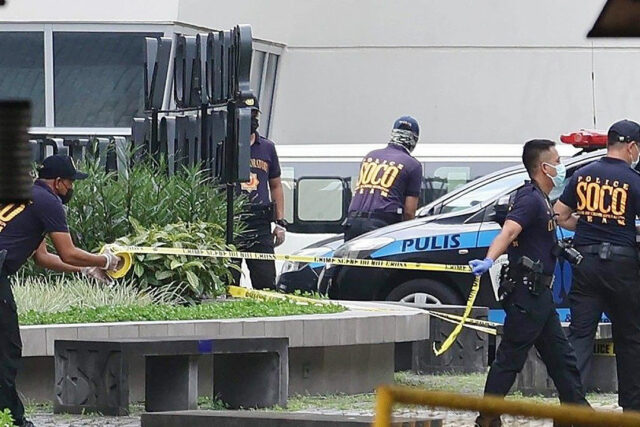

Experts say Ateneo shooting signals bigger security issue

PHILIPPINE STAR/ MICHAEL VARCAS

By Kyle Aristophere T. Atienza and John Victor D. Ordoñez, Reporters

SUNDAY’S deadly shooting in one of the Philippines’ biggest universities could signal a bigger security issue and highlights the failure of the country’s justice system, according to political analysts.

The shooting, where at least three people died, “unmasked the hidden insecurity of the middle class that was not obvious before,” said Jairus D. Espiritu, a sociologist at the University of the Philippines.

“The killing of the former mayor right at the heart of one of the most exclusive schools in the country only showed that even the middle and upper-middle class are not safe,” he said, noting that most victims in the government’s drug war were poor.

The mayor’s assistant and a university guard also got killed.

The suspect, who is a licensed doctor from a city in southern Philippines, had accused the lady mayor of being a drug lord. He was not in police custody.

Police recovered two handguns and a silencer allegedly used by the suspect, whom police said had a long history of legal disputes with the mayor.

The suspect was out on bail for a cyber-libel charge. “This looks to be a determined assassin,” police Brigadier General Remus B. Medina, director of the Quezon City Police District who described the incident as “isolated,” told reporters on Monday.

Experts said the shooting showed the country’s culture of impunity made worse by ex-President Rodrigo R. Duterte, who had justified the killings in his anti-illegal drug campaign.

“This person would not have been emboldened to do this if he did not have a massive personal grievance based on his local context or if he did not believe that he’s doing this as part of a larger political project,” said Hansley A. Juliano, a former political science professor studying at Nagoya University’s Graduate School of International Development in Japan.

The gunman would also not have traveled from Basilan province to the Philippine capital “if he was not enabled along the way,” he added. “This was a vendetta at the local level, and this is not a new thing in the political scene in southern Philippines.”

Despite relaxed gun rules, school shootings are uncommon in the Philippines. But killings of politicians are not new in the country, especially during election season.

“The local spat was given symbolic cover because clearly, the suspect is treating his perceived political opponents as members of the partisan opposition against his political idols, such as the new President and his predecessor,” Mr. Juliano said.

He added that authorities should examine how the shooter had managed to bring this vendetta in public, on the eve of Philippine President Ferdinand R. Marcos, Jr.’s first address to Congress, for which a gun ban was enforced.

“This kind of random assassinations does pop up in many authoritarian contexts,” Mr. Juliano said, noting that the incident is no different from killings in the drug war.

Joy Aceron, convenor of transparency and accountability watchdog G-Watch, said the incident should prompt the public to push for policy engagements on justice system reform, accountability and peace.

“We should have a better prospect of improving the condition of our country to the point that random killings will no longer be a threat and impunity will no longer rule,” she said.

Mr. Medina said the shooting is unlikely to inspire future incidents. “This is just an isolated case,” he told the ABS-CBN News Channel. “It should not alarm the public.”

Mr. Medina said the gunman had entered the campus through GrabTaxi.

Quirino G. Esguerra, a lawyer for the late mayor’s family, called the illegal drug allegations against her “a big lie.” She said the suspect’s medical clinic in Lamitan City, Basilan province had been shuttered for operating without a permit.

COVID infections rose by 33% in past week, Health authorities say

PHILIPPINE STAR/EDD GUMBAN
EXTENSIVE vaccination against Covid-19 continues including giving first and second doses of booster shots in some malls and hospitals in Manila. — PHILIPPINE STAR/ EDD GUMBAN

CORONAVIRUS infections in the Philippines rose by 33% to 19,536 in the past week, according to the Department of Health (DoH).

The average daily cases hit 2,791 on July 18 to 24, it said in a bulletin on Monday. Of the new infections, 56 were severe and critical.

DoH said 666 or 9% of coronavirus disease 2019 (COVID-19) patients in hospitals were in severe and critical condition. It added that 578 or 21.7% of 2,664 intensive care unit (ICU) beds for COVID-19 patients had been occupied as of Sunday.

“These case increases may translate to a spike in total and ICU admissions in October if compliance with minimum public health standard continues to decline and booster rates remain low,” DoH said in a separate statement. — Norman P. Aquino

Taxes bring minimum price for pack of cigarettes to P82.49

BW FILE PHOTO

THE floor price for the cheapest 20-stick pack of cigarettes will be P82.49 according to a tax calculation performed by the Philippine Tobacco Institute (PTI), an industry association.

The PTI, in a statement, was citing a June memorandum issued by the Bureau of Internal revenue (BIR), and computed that under this tax regime, the bulk of the final retail price will consist of excise and value-added taxes.

In Memorandum Circular No. 79-2022, the BIR provided a breakdown of the taxes on the cheapest pretax cigarettes on a per-pack basis. Apart from the P18.65 net cost of the cheapest cigarettes, excise tax adds P55 and a value-added tax P8.84, the PTI said.

The PTI said tobacco makers have to deal with competition from smuggled cigarettes, and made clear that compliant manufacturers have to follow the tax rules and sell at a certain price.

“It is estimated that P26 billion is lost in illicit tobacco trade annually. According to a Euromonitor report, six out of 10 cigarettes sold in Mindanao are illegal,” it said.

In its statement, the PTI billed the taxes as a clear indicator of which cigarettes are smuggled or noncompliant, characterizing the tax scheme as designed “To fight smuggling and selling of illegal cigarettes.”

The memorandum lists registered cigarette, tobacco, and vapor product brands that may be legally sold in the country or exported.

“The products must comply also with the requirement on graphic health warning and the affixing of BIR Tax Stamps, except for vapor products where Internal Revenue Stamps Integrated System (IRSIS) stamps are not yet available in the system,” the BIR said.

Graphic health warnings should contain “text in Tagalog in front and English at the back; and the Tarsier or Vinta design tax stamps required as proof of tax payment,” the PTI noted.

Violators are liable for fines of P200,000 at minimum and up to five years’ imprisonment for breaching the graphic health warning rules, and a minimum of P1 million and up to eight years of imprisonment for violations on tax stamps.

“Any product not included in the list, no BIR Tax Stamp, absence of the mandated graphic health warning and product which is lower than the floor/ minimum price shall be considered as unauthorized/ illicit subject to seizure/apprehension,” the BIR said.

In the three months to March, the Bureau of Customs reported that cigarettes valued at P132.56 were seized. — Diego Gabriel C. Robles

Electronics industry says RCEP needed to ensure competitiveness

REUTERS

THE electronics industry expressed confidence in the industry’s competitiveness, but urged the Senate to ratify the Regional Comprehensive Economic Partnership (RCEP) trade agreement to enhance its prospects.

Danilo C. Lachica, president of Semiconductor and Electronics Industries in the Philippines Foundation, Inc., said during BusinessWorld Live on One News Channel that the trade deal is good for the electronics sector since the deal will make its exports competitive.

“RCEP is favorable to us because… we have top countries that compete (in supplying) electronics products. If we are not part of RCEP, then… compared to those countries who are participating in RCEP, our exports, with tariffs and everything, will be more expensive,” Mr. Lachica said.

Mr. Lachica added that the electronics industry’s competitive advantage lies in its work force.

“The biggest asset we have in the Philippines is the productivity of our labor. If we can just rationalize holidays and address that, then we will continue to be advantageous and competitive with labor,” Mr. Lachica said.

The RCEP, which started coming into force in various jurisdictions on Jan. 1, involves Australia, China, Japan, South Korea, New Zealand and the 10 members of the Association of Southeast Asian Nations (ASEAN). It is projected as the world’s largest trade deal, accounting for about 30% of global gross domestic product.   

The Philippines has yet to finalize its participation in the trade deal after the Senate was unable to give its concurrence in the previous Congress due to concerns over the lack of safeguards for the agriculture sector.

Senate concurrence is needed before the country can deposit its instrument of ratification to the ASEAN Secretary General. President Ferdinand R. Marcos, Jr. also needs to endorse the trade deal to the Senate.

Mr. Lachica urged the government to review the rationalization of incentives under Republic Act No. 11534 or the Corporate Recovery and Tax Incentives for Enterprises (CREATE) Act, citing the need to compensate for the Philippines’ high operating costs.

“The thing is power and logistics are still big handicaps. We are hoping that the operating costs can be significantly reduced. That’s really the premise for requesting a review of the incentives because at least, we have something to offset the high operating cost to give the multinationals the rationale and the reason to locate in the Philippines,” Mr. Lachica said.

“We have observed about $3.2 billion of capital flight and we hope that the situation does not get worse. We are at a disadvantage compared to our ASEAN neighbors. They have more generous incentives,” he added. — Revin Mikhael D. Ochave

BPO employees insist on feasibility of 100% work-from-home arrangements

BW FILE PHOTO

CALL CENTER workers said 100% work-from-home (WFH) arrangements are workable following a government ruling setting limits on hybrid work in the Information Technology and Business Process Management (IT-BPM), insisting that companies should be allowed to adopt flexible work arrangements for safety reasons.

“We assert that a 100% permanent WFH not only has a legal basis but a moral one, due to the increasing number of coronavirus disease 2019 (COVID-19) cases,” Alliance of Call Center Workers Co-Convenor Emman D. David said in a mobile phone message.

The IT-BPM industry, also known as the business process outsourcing (BPO) sector, is required by tax law to conduct 100% of its work within the premises of economic zones if it is to enjoy tax incentives, though this rule was relaxed during the pandemic.

The Fiscal Incentives Review Board (FIRB) issued Resolution No. 017-22, dated June 21, temporarily authorizing registered IT-BPM firms to operate on a 70% onsite and 30% WFH (70:30) basis until Sept. 12 without affecting their fiscal incentives, which are governed by Republic Act No. 11534 or the Corporate Recovery and Tax Incentives for Enterprises (CREATE) law.

“As a temporary measure under Rule 23 of the CREATE Act implementing rules and regulations, registered business enterprises (RBEs) of the IT-BPM sector may be allowed by their respective investment promotion agencies to continue implementing WFH arrangements without adversely affecting their fiscal incentives under the CREATE Act from April 1, 2022 until Sept. 12, 2022 only,” according to the resolution.

At the height of the pandemic, the FIRB issued Resolution No. 19-21, which had allowed registered IT-BPM firms to offer 90% WFH and 10% onsite (90:10) work arrangements while still enjoying tax incentives. This resolution expired on April 1.

“Restoring the previous 90% work-from-home setup beyond Sept. 12 would also mitigate the impact of high inflation and ease the burden carried by our public transport system. We are reaching out to pertinent government agencies regarding this and we hope they can grant us a dialogue,” Mr. David said.

In a separate statement, PEZA Officer-in-Charge Director General Tereso O. Panga said that the agency will continue to partner with the industry to make hybrid work arrangements more permanent.  

“Rest assured that we will continue to work with our respective stakeholders and partner agencies to come up with a win-win strategy that will institutionalize the implementation of hybrid work arrangements as we promote a competitive investment climate in support of our economic zone investors and the continued revival of the economy,” Mr. Panga said. — Revin Mikhael D. Ochave

More sanctions on Russia seen bringing crude to $200 per barrel in worst case

REUTERS

ADDITIONAL sanctions on Russia if it escalates the Ukraine war could lead to higher pump prices paid by consumers in Asia, with the crude oil price benchmark for the region possibly rising as high as $200 per barrel, the Asian Development Bank (ADB) said.

The projection was contained in a report, the Asian Development Outlook 2022 Supplement.

The bank said the main driver for prices will be the supply-demand gap of about 3.5 to 7 million barrels a day, as suppliers fall short of their targets amid supply chain disruptions, leveraged positions, and rising costs, the ADB said.

Rizal Commercial Banking Corp. (RCBC) Chief Economist Michael L. Ricafort said $200 crude is likely in the event of “further sanctions on Russia, and if Russia retaliates using oil (and) energy supplies as leverage.”

“That’s beyond our control. Rich countries can do that anytime in anyway they want. It›s really possible given that they are taking the economic approach to stop the war,” said John Paolo R. Rivera, an economist at the Asian Institute of Management.

Oil prices peaked at $140 per barrel ($180 in today’s money) in June 2008, absent of any geopolitical issues, the ADB added.

The Philippines is highly dependent on oil imports, making its economy sensitive to global oil price swings.

“While I believe we have supply, we might not be able to manage prices as we have seen in previous months,” Mr. Rivera said in a Viber message.

The ADB said its scenarios for developing Asia include, on the optimistic end, a short-term shock in the remaining months of the year, in which gross domestic product growth is unaffected and inflation hits 5.1% before easing to 2.4% in 2023.

Last week, the ADB downgraded its 2022 growth forecast for developing Asia to 4.6% from the 5.2% projection in April.

It also raised its inflation forecast for this year to 4.2% and next year to 3.5%.

“The more plausible scenario is the war escalating in conjunction with a $200 per barrel price shock (which) will set off significant secondary effects. One possibility is an increase in inflation expectations that requires additional monetary policy tightening, which will also result in falling consumer confidence and business sentiment,” ADB said.

In such a case, the region will post downgraded growth of 3.2% in 2022 and 4.5% in 2023. The latter is lower than the 5.2% forecast for that year.

At the same time, inflation will increase to 5.8% and 5.3% in 2022 and 2023 respectively.

The severe scenario involves global financial turmoil in 2023 driven by expectations of heightened inflation and monetary policy tightening, with developing Asia growing by only 2.2% and several economies contracting.

Nonetheless, RCBC’s Mr. Ricafort said that global oil prices have already declined to their lowest levels in about four months, with Nymex crude oil falling to $95 from its $130 peak during the Russia-Ukraine conflict.

“Some COVID-19 lockdowns in China, which is the world’s second largest economy, also led to the recent declines in the prices of global crude oil and other major global commodities,” he said in a Viber message.

While the ADB projects elevated oil prices relative to prices last year, the possibility of $200 per barrel remains low after the European Union decided to phase out Russian oil imports gradually.

“Doing this rather than abruptly ending imports will allow for an orderly transition to alternative supplies and keep prices more stable and affordable for consumers,” the ADB said.

“Further reduction of reliance on imported crude oil (and) petroleum products would (be) among the structural solutions, by increasing the shift to more renewable power sources such as solar, wind, hydro, (and) geothermal, as well as accelerating the shift to electric vehicles,” Mr. Ricafort said.

“Conservation measures would also help reduce demand for imported crude oil (and) petroleum products,” he added.

The Philippine government’s economic assumptions are for Dubai crude — the price benchmark for Asia — to average $90-$110 per barrel this year, $80-100 per barrel in 2023, and $70-90 per barrel from 2024 to 2028. — Diego Gabriel C. Robles

PhilMech to provide P5B worth of equipment to rice farmers

PHILSTAR FILE PHOTO

THE Philippine Center for Postharvest Development and Mechanization (PhilMech) said it expects to provide P5 billion worth of equipment to rice farmers in the remaining months of the year.

“PhilMech will provide rice processing and drying equipment to more qualified farmers’ cooperatives and associations (FCAs) and local government units (LGUs), and the acquisition of the processing and drying facilities will be included in the P5-billion allocation,” PhilMech Director Dionisio G. Alvindia said in a virtual briefing.

“PhilMech will also sustain the distribution of farm machines from crop establishment to harvesting,” he added.

In June, the agency began the procurement process for farm machinery covered by the P5-billion allocation for 2022. These modernization initiatives are funded by rice import tariffs channelled into the Rice Competitiveness Enhancement Fund.

To date, the agency has delivered over 20,000 units of farm machinery worth P15 billion between 2019 and 2021. — Luisa Maria Jacinta C. Jocson

Cross-border exchange of tax-related information

With the continuing improvement of information and technology, it is becoming easier and easier for taxpayers to transact business on a global scale. While this situation provides a number of opportunities, issues with tax administration appear to be an inevitable consequence. One of the main issues is the risk the taxpayer will shift revenue to a low-tax country.

Thus, in an effort to deter tax fraud and evasion, the various tax jurisdictions have resorted to exchanging information. The Bureau of Internal Revenue (BIR) issued Revenue Regulation (RR) 11–2022. It prescribes the guidelines for the spontaneous exchange of taxpayer specific rulings between the Philippines and other countries to ensure the timely exchange of information.

The spontaneous exchange of information provides tax administrators access to timely information on rulings that have been granted to a foreign related party or a permanent establishment of their resident taxpayer, which can be used in conducting risk assessments.

Information subject to exchange include rulings related to preferential regime; cross-border unilateral Advance Pricing Arrangements (APAs) and any other cross-border unilateral tax ruling covering transfer pricing or the application of transfer pricing principles; cross-border rulings giving a unilateral downward adjustment to the taxpayer’s taxable profits in the country giving the ruling; Permanent Establishment (PE) rulings; and Related party conduit rulings.

How will the above spontaneous exchange of information affect Philippine taxpayers?

In RR 11-2022, the BIR mentioned the following:

• If the past ruling does not contain sufficient information to enable identification of the relevant countries with which the information needs to be exchanged, the BIR may obtain information from the domestic withholding agent or from a representative in the Philippines. These past rulings pertain only to PE rulings or rulings concerning the existence or absence of a PE of a foreign enterprise in the Philippines that were issued either:

a. On or after Jan. 1, 2015 but before Sept. 1, 2017; or

b. On or after Jan. 1, 2012 but before Jan. 1, 2015, provided they were still in effect as of Jan. 1, 2015.

• With regard to future rulings, the BIR may require the amendment of the ruling process, and if necessary, the amendment of the BIR Forms that must be submitted by the taxpayer when requesting a confirmatory ruling, and the inclusion of transfer pricing documentation as part of the documentary requirements among others.

• Also, for those rulings exchanged with the BIR, if it is established, upon evaluation, that the ruling will aid the tax examiners in their tax investigation, a copy thereof shall be immediately forwarded to the Revenue District Office having jurisdiction over the domestic taxpayer.

Hence, at the very least, a Philippine taxpayer may be asked for information by the BIR; there could also be changes in the taxpayer’s submission of request for BIR rulings, and a Philippine taxpayer may also be affected by the exchange of information during a BIR audit investigation.

It will also be noted above that, basically, the covered entities of the exchange of information are the related parties.

WHAT SHOULD THE PHILIPPINE TAXPAYERS DO THEN?
The following should be considered by Philippine taxpayers:

1.  Ensure that the Philippine taxpayer is dealing with its foreign related parties on an arm’s length basis.

According to the Organization for Economic Cooperation and Development (OECD), arm’s length means that a transaction between related entities reflects the conditions and remuneration set in comparable transactions between unrelated entities. Thus, in transacting business with foreign related parties, transfer pricing analysis must be considered to verify whether the transactions with related entities comply with the arm’s length principle. The pricing of the goods or services must be assessed, to ensure that this is comparable to the pricing of independent entities in more or less similar conditions and circumstances.

2. Document the reasonableness of the transaction.

The issuances of the BIR on transfer pricing detail the requirements for the submission of transfer pricing documentation (TPD). The authorities have given taxpayers certain guidelines to follow in preparing TPD in compliance with transfer pricing rules. The TPD will serve as the taxpayer’s proof that its transactions with related parties are not arbitrarily priced, and that there is no malicious shifting of revenue and expenses among the related parties.

The above actions would be helpful in a taxpayer’s preparations for possible application for a tax ruling with the BIR in the future. At any rate, even without thinking about a possible application for a tax ruling in the future, a taxpayer is required to ensure that its transactions with related parties are reasonable and not carried in a manner leading to tax evasion.

As we know, cross-border transactions are growing rapidly as technology has been making the world smaller. The tax authorities have also been adapting to this. The exchange of information is part of the process of addressing possible gaps in the tax system. As taxpayers, in turn, we should also take care to ensure that we comply with international tax principles and best practices.

Let’s Talk Tax is a weekly newspaper column of P&A Grant Thornton that aims to keep the public informed of various developments in taxation. This article is not intended to be a substitute for competent professional advice.


Maricel P. Katigbak is a senior manager of the Tax Advisory & Compliance division of P&A Grant Thornton, the Philippine member firm of Grant Thornton International Ltd.

pagrantthornton@ph.gt.com

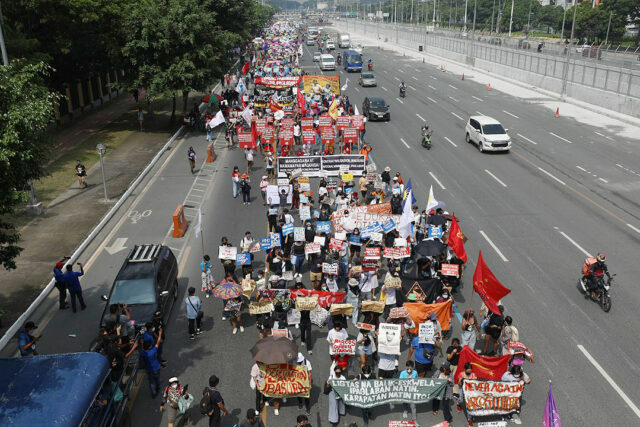
Activists, human rights campaigners protest on Marcos’ first SONA 

ACTIVISTS and campaigners for various sectors march along Commonwealth Avenue in Quezon City on July 25, 2022 ahead of President Ferdinand R. Marcos, Jr.’s first State of the Nation Address. — PHILIPPINE STAR/ RUSSELL PALMA

HUMAN rights campaigners and progressive groups on Monday held protests before President Ferdinand R. Marcos, Jr.s first address to Congress, calling attention to accountability and pressing economic issues.   

An estimated 5,000 protesters joined the multi-sectoral march along Commonwealth Avenue, according to the Quezon City Police Districts estimate.  

Samahan ng Ex-Detainees Laban sa Detensyon (SELDA), a group for Martial Law victims and survivors, said it joined hundreds of former political prisoners in seeking accountability for the human rights violations during the regime of the late dictator Ferdinand E. Marcos Sr., father of the President.  

“Marcos Jr. cannot claim that he is innocent and is off the hook from being liable for the violations inflicted upon us by his fathers bloody regime,” SELDA said in a statement. 

More than 70,000 people were jailed, about 34,000 were tortured and more than 3,000 people died under martial rule, according to Amnesty International. 

The group also slammed the anti-graft court Sandiganbayan’s recent decision allowing the Marcos family to present evidence in an ill-gotten wealth case.  

“We are deeply concerned that this move is an absolution of the cases of corruption and ill-gotten wealth of the Marcoses,” said Danilo dela Fuente, SELDA’S vice chairperson. 

“We fear that this could be the signal for the halt in the recovery of the stolen wealth of the Marcos family, which are rightfully owned by the Filipino people.” 

The Presidential Commission on Good Government filed the ill-gotten wealth case in 1987, accusing business associates of the elder Mr. Marcos and his wife Imelda of acting as their dummies to acquire ill-gotten wealth using state funds.  

In 2003, the Supreme Court awarded the Philippine government $658 million from the frozen Swiss bank deposits of the former president.  

The Philippines Highest Court ruled that only about $304,000 of the Marcos familys income was lawful since they did not file any statement of assets and liabilities required by law.  

The group said it will continue to seek accountability and reparations from the President for victims of human rights violations.  

Meanwhile, progressive groups under the Bagong Alyansang Makabayan (Bayan) coalition marched along Commonwealth Avenue as it called for Mr. Marcos to address rising prices of commodities, ensure environmental protection, and prioritize human rights violations.  

Gabriela Women’s Party-list also held a protest urging the President to increase wages and to present concrete economic measures to the Filipino people.  

The group said Mr. Marcos should employ measures to boost local food production to combat the hike in basic goods.   

“No revisionism or lofty narratives can cover up empty stomachs and escalating prices,Gabriela Party-list Rep. Arlene D. Brosas said in a statement. John Victor D. Ordoñez 

Sustained smuggling stifles rice tariff law benefits

DA

CONTINUED smuggling operations undermine the goals of the rice tariff law of modernizing Philippine agriculture, improving farmersincome and reducing the retail price of the staple food, said a senator on Monday.  

(T)he problem here is that it is not going down fast enough because the issue of smuggling remains prevalent,Senator Mary Grace S. Poe-Llamanzares, presumptive chair of the Economic Affairs Committee at the upper chamber, said in Filipino.  

The Rice Tariffication Law under Republic Act 11203, deregulated rice imports. It allows private parties to import with fewer restrictions with a tariff of 35% on grain brought in from Southeast Asia.  

The tariff collection supports the Rice Competitiveness Enhancement Fund to the extent of P10 billion a year.    

Various sectors have been calling for an amendment or repeal of the law. 

Ms. Poe, however, said smuggling is the more pressing issue that has to be addressed.   

Now that the President himself is sitting there in the Department of Agriculture, I hope those who try to smuggle or those who have already smuggled will be afraid. Its the same people doing the same things until today,Ms. Poe said.  

Senator Maria Imelda ImeeR. Marcos urged her brother, President Ferdinand BongbongR. Marcos, Jr. who has also designated himself as concurrent Agriculture secretary, to fiercely go after smugglers of agricultural goods.   

As a super sister, I want Bongbong to be angry. I want him to go crazy and name all the agricultural smugglers who are destroying our local farming,she told the media in Filipino during an ambush interview on Monday.  

Hopefully, he will scare and file cases against all of those in the government that are well-known to be corrupt in the BoC (Bureau of Customs), BIR (Bureau of Internal Revenue) and other agencies,she added.  

A report by the Senate Committee of the Whole in the last Congress indicated that around P667.5 million worth of agri-fishery products were technically smuggledinto the country from 2019 to 2022. It also listed 22 government officials and personalities allegedly involved in the illegal operations. Alyssa Nicole O. Tan 

Taraka local gov’t-funded irrigation, household water supply project nears completion

OFFICIALS of the Taraka local government, Mindanao Development Authority, and the Development Bank of the Philippines lead the inauguration of the partially operational solar-powered irrigation system on Aug. 10, 2021. — TARAKA MUNICIPAL GOV’T

A PIONEERING solar-powered irrigation and water supply project in Taraka, a small agricultural town in southern Philippines, nears completion with farmers of 700 hectares of land and over 27,000 residents seen to benefit from the infrastructure, according to the Mindanao Development Authority (MinDA).   

Four of the six irrigation systems are already operational while the water supply system is 60% done, MinDA said in an update posted on Monday following a site visit last week.  

The project is the first local government-funded undertaking under MinDAs water supply program aimed at assisting unserved and underserved municipalities establish sources of water for drinking and agriculture.   

State-owned Development Bank of the Philippines (DBP), a partner in the MinDAWater program, provided a P115-million loan to the Taraka municipal government.   

DBP and MinDA signed a partnership agreement in 2019 to support proposed ventures that will bring economic development in Mindanao, especially the Bangsamoro region.    

Launched in January 2021, the project had a formal inauguration in August after three of the irrigation systems were completed.  

The solar-powered irrigation infrastructure has an automatic system for water extraction and regulation to avoid flooding.  

The irrigated farmlands are eyed for the production of high-quality rice, to be branded Premium Maranao Rice.    

Other government agencies assisting the program include the Philippine Rice Research Institute, the Bangsamoro regions Ministry of Agriculture, the Department of Agricultures Northern Mindanao office, and the Philippine Center for Postharvest Development and Mechanization. MSJ