Home Blog Page 5658

Injured Ramos ruled out of the Asia Cup campaign in Indonesia

DWIGHT RAMOS — FIBA

ALREADY burdened with manpower woes, Gilas Pilipinas took another heavy blow as Dwight Ramos, one of its key players, is sitting out the International Basketball Federation (FIBA) Asia Cup campaign in Indonesia due to injury.

Mr. Ramos, according to the Samahang Basketbol ng Pilipinas (SBP), is suffering from “medial tibial stress syndrome” or shin splints, which forced him out of action in the July 12-24 Continental meet altogether.

“(Mr.) Ramos has been dealing with pain in his left leg for the past week but it has become too much to overcome as he could not join the team for practice anymore,” the SBP said on Sunday.

Mr. Ramos, who produced 21 points, five rebounds, two assists and four steals in Gilas’ 79-63 rout of India last Sunday in the FIBA World Cup (WC) Asian Qualifiers third window, joined Ange Kouame (ACL tear) and Dave Ildefonso (knee) in sick bay.

Reserve Rhenz Abando, pending clearance from FIBA Asia, is being eyed to take Mr. Ramos’ spot and link up with skipper Kiefer Ravena, Poy Erram, Thirdy Ravena, Ray Parks, RJ Abarrientos, SJ Belangel, William Navarro, Carl Tamayo, Francis Lopez, Geo Chiu and Kevin Quiambao.

“We will definitely miss Dwight (Ramos) who’s one of our starters,” said Gilas program director Chot Reyes, who is tasked to call the shots for the youth-laden five.

“But that’s the value of having a pool and the reason why Rhenz (Abando) is making the trip with the team.”

Gilas is set to launch its bid in Group D on Wednesday against Lebanon before facing off with old rivals from the recent WC Qualifiers in India and New Zealand on Friday and Sunday, respectively.

Mr. Reyes’ wards need to top the group to gain outright entry into the quarterfinals or at least finish second or third for a chance to advance via the qualification to the quarterfinal stage. — Olmin Leyba

MPTC yet to feel impact of high fuel prices on vehicle volume

TOLL road developer and operator Metro Pacific Tollways Corp. (MPTC) has yet to feel the impact of rising fuel prices on the vehicle traffic volume on its road network in the country, its chief financial officer said.

“We haven’t felt the impact of the fuel price increases. For the first half, we have already exceeded the 2019 traffic volumes, so pre-pandemic,” MPTC Chief Finance Officer Christopher Daniel C. Lizo told reporters during a gathering in Cavite last week.

“In total, across the network, I think we are maybe 5-6% above the 2019 traffic volumes,” he said, referring to the traffic volume seen in June. “That’s excluding the new roads that opened.”

On its website, MPTC said it handles 700,000 vehicles per day on average during the pandemic and close to a million vehicles per day pre-pandemic.

The company’s toll roads include North Luzon Expressway, Subic–Clark–Tarlac Expressway, Manila–Cavite Expressway, Cavite–Laguna Expressway,  and Cebu–Cordova Link Expressway.

The company saw a slowdown in traffic in the first five days of July, Mr. Lizo said.

“Maybe by 6% compared to June. It’s also a function of seasonality. Traffic peaks in the second quarter, summer. Kapag tag-ulan na, bumababa talaga yan. (In the rainy season, traffic falls.)”

MPCALA Holdings, Inc., a subsidiary of MPTC, is eyeing the operationalization of its upcoming interchange, the Silang (Aguinaldo) Interchange, in the latter part of the year.

“This will extend CALAX’s operational sections from Mamplasan, Laguna, to Aguinaldo Highway in Silang, Cavite,” the company said in an e-mailed statement.

“As of today, the 3.9-kilometer 2×2 lane CALAX subsection reaches 56% of completion. Part of the ongoing works includes drainage and bridge constructions, excavation and roadway earthworks, and installation of fence and coco net,” it added.

Raul L. Ignacio, MPCALA Holdings president and general manager, said the Silang (Aguinaldo) Interchange is expected to help decongest the busiest highway in Cavite, the 41-kilometer Emilio Aguinaldo Highway. 

“Motorists from Manila going to the famous tourist destinations of Silang and Tagaytay, Cavite will surely benefit from this upcoming project as it offers convenience and shorter travel time.”

The 45-kilometer CALAX project has eight subsections: Kawit to Open Canal (subsection 1), Open Canal to Governor’s Drive (subsection 2), Governor’s Drive to Silang (subsection 3), Silang to Silang East (subsection 4), Silang East to Santa Rosa (subsection 5), and Santa Rosa to Mamplasan (subsections 6, 7, & 8).

Subsections 6 to 8 started operations in 2019 and CALAX Laguna segment interchanges, which are part of the subsections 6 to 8, opened the following year. These interchanges are the Laguna Boulevard Interchange and the Laguna Technopark Interchange.

Last year, CALAX Subsection 5, which connects Silang East to Sta. Rosa-Tagaytay Road Interchange, was inaugurated, extending the expressway’s operating sections from 10 to 14.24 kilometers.

Full completion of the CALAX project is expected in 2023. Once fully operational, the project is expected to cut travel time between the CAVITEX and SLEX to 45 minutes from the current 2.5 hours.

MPTC is the tollways unit of Metro Pacific Investments Corp., one of three key Philippine units of Hong Kong-based First Pacific Co. Ltd., the others being Philex Mining Corp. and PLDT Inc.

Hastings Holdings, Inc., a unit of PLDT Beneficial Trust Fund subsidiary MediaQuest Holdings, Inc., has a majority stake in BusinessWorld through the Philippine Star Group, which it controls. — Arjay L. Balinbin

For EV and ever

Shell officials pose at the Shell Recharge bay next to an all-electric Jaguar I-Pace. — PHOTO BY KAP MACEDA AGUILA

Pilipinas Shell unveils first electric vehicle charging facility, rolls out carbon offset program

IF ANYONE asks about the feasibility of electric vehicles in the country, you can say that it’s surely getting better by the day. The most obvious pain point — the enduring issue of range — is being addressed on multiple fronts through better battery technology and energy recuperation at the OEM end, while the dearth of charging infrastructure is slowly being solved as well.

While the Philippines is admittedly still at the infancy stage of mainstream EV adoption, progress is happening from more favorable legislation and policies, to the aforementioned steady establishment of charging facilities.

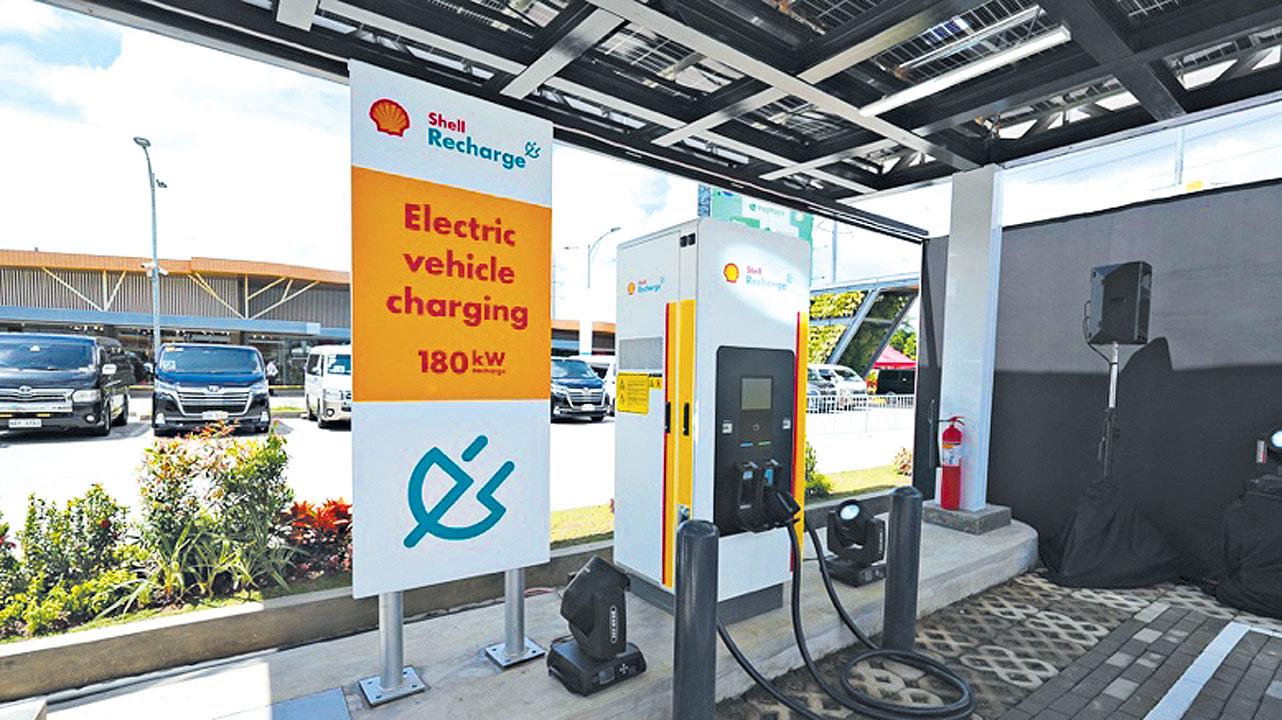
By all indications, last Thursday was a big win for the EV sector, as Pilipinas Shell, which has a network of 1,100 “mobility stations” in the country, made a historic step of introducing its very first electric vehicle charging facility here. Located within the sprawl of Shell Mamplasan on the northbound lane of the South Luzon Expressway (or SLEx), a high-power Titan 180kWh 300A charger with CCS2 connectors will be able to service up to two compatible electric vehicles simultaneously. The DC charger is, according to Shell, the most powerful of its kind, and can fully charge a vehicle from low battery status to “optimal battery charge” in as little as 30 minutes. For the service, customers are charged P65 per minute. Now if you multiply that by 30, then that’s P1,950 to get the full range of your EV — surely way less than topping up your conventional internal-combustion-engine-powered vehicle with fossil fuel.

Branded as Shell Recharge, the service will gradually be introduced in more locations over the next 12 months — and beyond. In an exclusive interview with “Velocity,” Pilipinas Shell Vice-President and General Manager for Mobility Randy Del Valle revealed that up to eight stations may feature the service by the end of the year.

Aside from Shell Recharge, Pilipinas Shell presented another program in line with its vision of “decarbonizing mobility.” Now available for retail customers here is the brand’s so-called Nature-based Solutions (NBS) Carbon Offset Service. In 2020, Shell became “the first energy company in the Philippines to offer the (service) to its B2B fleet customers.” Now, everyday consumers can get to make up for their carbon emissions from ICE-powered vehicles.

“By being the first Shell market in Asia to offer this particular service to everyday customers, Pilipinas Shell underscores its commitment to continue powering progress to achieve a more sustainable future,” said Pilipinas Shell Country Head Lorelie Quiambao-Osial. “These two new low-emission energy solutions encapsulate what Pilipinas Shell means when we say sustainability. It’s about providing energy in a responsible manner to our consumers so that we can minimize the impact we make on the environment while achieving a lower-carbon future,” she added.

Continued Mr. Del Valle to this writer: “The NBS Carbon Offset Service is (a result of us noticing that) customers here in the Philippines really want to make sure that they are actually net zero. This gives everyone an opportunity to be so. Every time our customers gas up at Shell, we can offset their fuel consumption.”

What does this all mean? “Because fuel comes from oil, there’s some carbon that is actually used to develop the fuel. So, for you to be net zero, we’re giving you an offset that if you buy credits, you can have that carbon offset by helping plant forests around the world — equivalent to the fuel you’ve consumed.” This target of negating one’s carbon footprint is achieved, of course, by “investing” in nature’s carbon sinks such as forests. The total number of liters purchased with carbon offsets by customers are then assigned the equivalent carbon credits from Shell’s “independently verified global portfolio of Shell NBS afforestation, reforestation, and conservation projects.” These credits are then retired by Shell on behalf of the customer. The voluntary contribution of P2.50 per liter of fuel can be made at participating Shell stations.

“There are a lot of forests around the world that we support. There are various locations in South America, and here in Asia. And then for the Philippines, we’re continuing to explore some locations where we can do this as well,” he added.

In tandem with Shell Recharge, this carbon offset drives home the company’s push to decarbonize mobility “by helping customers in avoiding, reducing, and compensating for carbon emissions, as well as its transformation toward becoming the mobility destination of choice for motorists.”

“Shell is rapidly becoming the Philippines’ leading mobility company and this launch is a testament to the range of its offer to motorists,” said Shell Mobility Global Executive Vice-President Istvan Kapitany. “The NBS Carbon Offset Service and Shell’s first EV charger in the country are among the initiatives to reduce carbon emissions and to cater to a growing number of customers whose needs are changing fast… We are making sure that Shell sites will become the go-to place for all customers, whether they drive traditional or EV, thanks to an integrated offer of fuel, EV, and convenience retail. They will be mobility destinations for everyone.”

Farm industry calls for more imports of raw materials for animal feed

REUTERS

By Luisa Maria Jacinta C. Jocson, Reporter

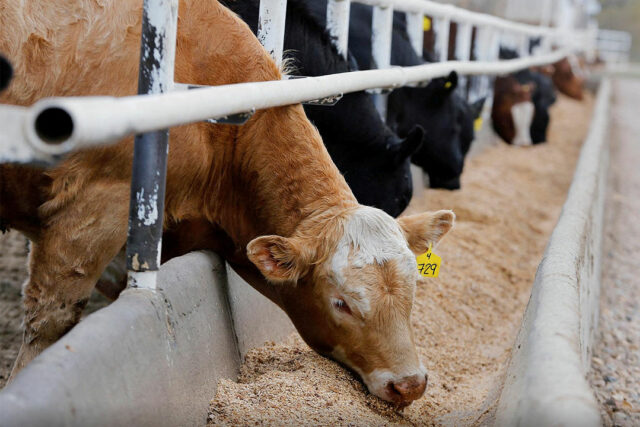
FARMERS called for increased imports of the raw materials used in animal feed, citing the need to provide relief to growers suffering from rising input prices in the wake of the Russia-Ukraine war and the logistics disruptions caused by the pandemic.

“The priority should be the ease of importing ingredients, not finished products. (That way,) we can keep the livelihoods here and have the by-products. As of the moment, I believe there is no need to import chicken. Too much importing will discourage poultry growers who are… taking on the extra challenges due to the Russia-Ukraine war and other global disruptions,” Feedmix Specialist II, Inc. Vice-President Norberto O. Chingcuanco said in a Viber message.

He added that the input costs have been rising due to the cost of soy and other proteins used in animal feed, as well as wheat.

“There are weather and disease related problems, in addition to the rising cost of feed. Then there is uncertainty over imports which discourages raisers from investing and rehabilitating or expanding their facilities. There could have also been a shift in demand from pork to chicken as a result of the high prices of pork,” Federation of Free Farmers National Chairman Raul Q. Montemayor added in a Viber message.

The price of whole chicken in Metro Manila markets increased by P25 from a month earlier to P200 per kilogram in June, according to the Department of Agriculture (DA).

Rising input costs have been an industry problem even before the onset of the pandemic and the crisis in Europe, according to United Broiler Raisers Association President Elias Jose M. Inciong.

“Even before the Ukraine war, prices of corn and soy already went up. In the case of local corn especially, corn farmers lost confidence because a large portion of their market, which was the hog industry, disappeared because of African Swine Fever,” he said.

Corn prices have risen to P22-P23 per kilogram from P14-P16 per kilogram in 2021, according to Mr. Inciong.

Soy likewise increased to P34-P36 per kilogram this year from P24-P26 per kilogram last year.

“This has impacted the performance of the broiler industry, whether terminal broiler farms or breeders. Right now, the day-old chicks that used to cost P28-P30 per kilogram now cost P38 pesos,” he said.

Due to poor production by the poultry sector, Mr. Inciong said that undersized chickens have proliferated and are now finding their way into the markets to meet demand.

“In the normal course of things, chicken below 1 kilogram is not sold. It’s too small. But now it can be sold. Because it is in short supply, even the poor-quality (birds) will have buyers because they want to continue production,” he said.

Fast food chains like Jollibee and McDonald’s have reported supply problems, particularly in procuring chicken that passes their quality standards.

Mr. Inciong said, “They won’t buy the runt chickens of course.”

In order to augment supply and solve the shortage for the long term, Mr. Inciong said that the government must look into policy reforms while consulting producers.

“This is the culmination of almost two and a half decades of the neglect of the agriculture sector. Every one of us will be paying for the price of wrong policies and false narratives,” he said.

“The more important step is for the government to interface with the frontliners and producers, because there are details in every industry that (the President) needs to know. They will be the first one to say what needs to be done,” he added.

President Ferdinand R. Marcos, Jr., who is also the Agriculture Secretary, said that the government might consider additional imports of chicken and pork to meet the growing demand and temper rising prices.

“With the African Swine Fever still affecting the pork industry and a shortage in feed posing a problem for the broiler industry, the Department of Agriculture (DA) may still look into importing minimal volumes of pork and chicken,” he said in a virtual briefing on Tuesday.

“Production is not sufficient. Our production is not sufficient in rice, corn, livestock and fisheries. That is why I made agriculture the highest priority of what we are doing because you cannot build a strong economy if you don’t have the foundation of a robust agricultural sector which assures food supply even in emergencies,” he added.

The DA, through the Bureau of Animal Industry (BAI), also announced that it has taken steps to increase production and stabilize supply and market prices.

“Among the measures being undertaken is allowing inter-island movement from mainland Luzon of day-old chicks, hatching eggs and ready-to-lay pullets. For day-old chicks and hatching eggs, movement is allowed provided they tested negative for 28 days from the date of sample collection. For ready-to-lay pullets, movement is allowed provided they tested negative 14 days from the date of sample collection,” it said.

The BAI has issued special import permits for vaccines in order to address poultry diseases such as Infectious Body Hepatitis.

CTA affirms partial refund for Deutsche Knowledge

THE Court of Tax Appeals (CTA) affirmed its division ruling partially granting Deutsche Knowledge Services Pte. Ltd.’s (DKSPL) claim for a refund worth P990,730.56 representing its excess input value-added tax (VAT) traced to zero-rated sales for the first quarter of 2007.

In a 23-page decision on July 1 and made public on July 6, The CTA full court said DKSPL was able to sufficiently prove that its clients were foreign corporations not engaged in trade or business in the Philippines.

The court noted the company presented certificates of non-registration from the Securities and Exchange Commission (SEC), which the court deemed competent evidence to prove its clients were foreign entities.

“This court finds no compelling reason to reverse or modify the findings of the court a quo in the assailed decision and resolution,” according to the ruling written by CTA Associate Justice Erlinda P. Uy.

The CTA Second Division earlier ruled DKSPL successfully substantiated P990,730.56 out of the original P12,549,446.30 claim.

“The commissioner of internal revenue (CIR) did not indicate any reversible error made by the Court in Division in its appreciation of the subject Certificates, nor did he disprove DKSPL’s justifications for the said disparities,” said the tribunal.

The CIR, the petitioner, argued that the CTA Second Division made an error in giving weight to the SEC certifications of non-registration.

The CTA full court also rejected DKSPL’s appeal to refund its original claim of P12,549,446, as the court upheld its division ruling.

DKSPL provides its clients with corporate finance advisory services, research and development services, and logistics services among others. The company is also a subsidiary of Deutsche Bank Group in Singapore.

The CIR has the authority to act upon and approve claims for refund or tax credit in accordance with the country’s tax code.

Under the country’s tax code, a transaction should be treated as zero-rated VAT if the following conditions are met: services must be performed outside the Philippines, the recipient of services is doing business outside the country, service offered must be other than processing, manufacturing or repacking of goods and paid in acceptable foreign currency accounted for in the laws of the local bank. — John Victor D. Ordoñez

Paris Haute Couture Shows: Juana Martin brings Andalusian style; Viktor & Rolf retools the suit; Chanel goes casual; and Dior takes a folksy turn

GIAMBATTISTA VALLI — JONAS GUSTAVSSON/SIPA USA VIA REUTERS

PARIS —  Spanish designer Juana Martin took to a gravely runway in a Paris school yard Thursday for her haute couture debut in the French capital, sending out a collection that drew on flamenco references while recasting traditional styles. (Watch the show here: (8) Juana Martín Fall Winter 2022/23 Full Show Andalucía — Haute Couture collection — YouTube.

Actress Rossy de Palma opened the show, which paid hommage to Spain’s Andalusia region, wearing a long, ivory overcoat covered with white beadwork.

She wound around the garden at a snail’s pace to the traditional singing and guitar strumming of live performers, including singer Israel Fernandez, halting to greet them with a dramatic twist of her hand — flamenco style.

With the other looks that followed, Ms. Martin played with volumes, tossing bolero jackets over long, black skirts made from piles of ruffles, and a short, bouncy tutu so full it turned upwards. An all-ivory look paired fitted shorts with a wide puffed jacket that had short cape sleeves.

Some models wore prominent silver rose earrings, a pattern that also appeared engraved on a leather dress with matching gloves.

Ms. Martin is the third Spaniard to take part in France’s official haute couture schedule, following Cristobal Balenciaga and Paco Rabanne — and she is the first Spanish and Gitana woman to do so.

“It is not only historic for me but also for the fashion industry in Spain,” said Ms. Martin, speaking through an interpreter. She said she would like to continue showing her haute couture line in Paris. “I have a lot of stories to tell and I’d like to do it here,” she said.

Thursday was the closing day of haute couture shows in Paris this season.

VIKTOR & ROLF
Viktor & Rolf focused on suits for the label’ s haute couture runway show in Paris on Wednesday, showing a collection of them in outrageous proportions before reshaping them into feminine silhouettes.

Transformation was the point of the Dutch design duo Viktor Horsting and Rolf Snoeren, whose eponymous label belongs to Italian fashion group OTB.

“We wanted something rigorous, something rigid, so we looked to men’s tailoring,” Mr. Snoeren said in an interview. “We didn’t just want to show an extreme silhouette, of course. We wanted a new silhouette.”

The show opened with age-old classic pinstriped, navy blue and white suits. The first jacket was slightly cropped and paired with pleated trousers, the next one double-breasted.

Then proportions changed, with jacket shoulders splaying out to the sides like shells floating around the models’ bodies. Some shoulders were bare, while other looks had collars up to the chin.

Models stomped down the runway in chunky platform heels to pulsating techno music in shimmery tuxedo jackets and trench coats and crisp, striped men’s shirts.

Halfway through the show, the music stopped and the designers attended to a lone model onstage, pulling out wiring from her jacket, gently replacing her heels with flats and turning up the extra fabric that became an upright ruffle.

“It’s important for us to show the power of transformation,” said Mr. Horsting.

ELIE SAAB
Men swept down Elie Saab’s haute couture runway on Wednesday in voluminous capes teeming with feathers and glittering beadwork — adding extra flash and new energy to the Lebanese designer’s lineup of signature, red carpet-ready dresses for women. (See the show here: ELIE SAAB Haute Couture Autumn/Winter 2022-2023 Collection ).

“People who come to us for this type of style, they want to be spectacular — it’s the same for men and women,” Mr. Saab said in an interview after the show, as guests swarmed around to greet him. “We have a lot of demand from clients, but this is the first time we’ve shown it on the runway.”

The designer strutted out his men’s looks fast on the heels of the wide-skirted dress that opened the show. The first male model entered in a sweeping cape adorned with long red and black feathers that curled up at the ends, arranged in a stark zig-zag pattern.

Other male models followed with embellished coats and capes thrown over black or gold suits, sprinkled into the collection of the label’s distinct, feminine styles.

For women, there were sheer, fitted dresses dripping with lace and glittering beadwork while long, floor-sweeping ballgowns had puffs of ostrich feathers augmenting the shoulders. Embellishments ran down to the fingertips, applied to sheer, skin-colored gloves.

One particularly striking men’s coat had a stylized python pattern, delineated in beadwork, both grand and reptilian.

Known for intricate craftsmanship, haute couture houses are increasingly catering to men.

In a high profile example, Balenciaga designer Demna Gvasalia introduced made-to-measure pieces for men and women last year when he resumed the Kering-owned label’s couture line for the first time in over half a century.

ARMANI
Giorgio Armani welcomed guests to Paris for his haute couture show Tuesday in a minimalist, intimate setting, showcasing a polished collection drenched in rhinestones, sequins and glitter. (Watch the show here: Privé — Haute Couture Fashion Show | Giorgio Armani

The Italian designer, whose creations are worn by royalty and Hollywood stars, sent out models in tiered black tulle dresses, elegant jackets with added sheen and sheer tops with flower details.

Models in floral-printed jackets and blue jodhpur-style pants cut from iridescent fabrics strutted down the runway, while others showed off puffy tops or jackets, covered in pink tulle ribbon bows by the dozens.

An awards ceremony is never far off, and Armani offered a selection of glamorous dresses, slender or voluminous, silky or velvety, strapless or covered in sequins, in colors ranging from Barbie pink to deep blue.

At the end of the show, Mr. Armani, almost 88, barely emerged from the darkness for his customary bow.

Paris Fashion Week is a prestigious showcase for a select group of fashion houses whose clothes are meticulously hand-sewn by highly skilled artisans. While haute couture accounts for a small proportion of sales for luxury brands, it is a major marketing driver for the industry.

CHANEL
Chanel creative director Virginie Viard opted for a low-key rendition of haute couture for the French fashion house’s fall-winter runway show on Tuesday, sending out a mix of long, full-skirted dresses and tweed ensembles with slightly relaxed fits. (Watch the show here: Fall-Winter 2022/23 Haute Couture Show | CHANEL ).

The label took to a horse arena on the outskirts of Paris, building a set that played with optical effects, with geometric patterns running at a slant while large silver globes hung from the ceiling.

The show opened with a projection of Pharrell Williams playing a drum set, with grinding electronic music in the background.

When the soundtrack suddenly switching to soothing vocals, out came a wavy-haired model in a lime green skirt and jacket kicking off the fashion line-up. Others followed, zig-zagging across the floor, in beige, pale pinks, and all-black looks.

Jackets were paired with loose trousers or skirts that swished around the ankles, with pockets and rows of buttons punctuating the house’s signature tweeds, in various patterns, including stripes.

Low heels and floppy hats added to the casual flavor of the lineup, shimmery embellishments kept to a minimal.

Closing the show, even the traditional bride in an all-white wedding dress looked relaxed, her hands thrust in front pockets. A simple white bow placed on her head, the tails of the ribbon left streaming down behind.

GIAMBATTISTA VALLI
Giambattista Valli went full throttle for his namesake label’s Paris fashion show Monday night, marking 10 years on the official French haute couture calendar by sending mountains of tulle and billowing trains for a spin under bright lights, and the gaze of cheering fans. (Watch the show here: Haute Couture 23 — Giambattista Valli | Haute Couture).

Models drifted out from a wall of shiny, party balloons — pink flamingos squeezed against rainbow ponies — wearing wide cat-eyed sunglasses and teased-out hair extensions. They lifted their skirts as they crisscrossed the runway and rounded the mirrored columns while a robot camera rolled back and forth.

Silhouettes were ample and varied, with volumes that shifted. Sleeves puffed out from the shoulders, and skirts were cast wide, built in tiers like layered cakes, or fitted, then suddenly splayed out at the bottom in a burst of yellow, pink or turquoise.

In a nod to his signature topiary dresses, Mr. Valli sent out a shimmery, silver sequined body suit with rings of white ostrich feathers around the legs.

“It’s like the generosity of the hug. It’s a hug of flowers, a hug of feathers, a hug of tulle. There are all these bouquets that hug you; it’s this kind of pleasure to share happy times together,” Mr. Valli told Reuters.

The collection was about living in the moment, he explained. “I don’t look too much in the future, or too much in the past,” he said. “I think this is the big lesson from the past couple of years.”

Popular with socialites and known for serving the red carpet set, the label has financial backing from the Pinault family holding Groupe Artemis. It broadened its consumer base with an H&M collaboration in 2019.

DIOR
Dior designer Maria Grazia Chiuri set aside the shimmery jacquards and coatings of sequins — standard fare at Paris fashion shows — and homed in on craftsmanship of the needle-and-thread variety, applying elaborate, folksy-flavored flower embroideries to her haute couture lineup for the fall-winter season. (Watch the show here: Autumn-Winter 2022-2023 Haute Couture Show — DÉFILÉS HAUTE COUTURE — Women’s Fashion | DIOR ).

“It’s really a project that has inside this idea that art and artisan are at the same level,” Ms. Chiuri told Reuters.

Models swept down the runway Monday in loose braids and patchwork opera coats, trim jackets and long dresses with billowing sleeves. The garments served as blank canvasses of sorts, in soft, neutral colors — beige wool gabardines, cotton canvas and black velvet — for the stylized floral embroideries that trickled down shoulders and wound around skirts, rising up from the hemlines.

Ukrainian artist Olesia Trofymenko filled the show venue in the garden of the Rodin Museum with artwork, towering photographic images of landscapes overlaid with embroidered flowers, outlining the shapes of people who might have been there. The French fashion house, one of the labels owned by LVMH, will leave the exhibit open to the public, in keeping with a tradition it started with a Judy Chicago display in 2020.

The artwork and the fashion carried an underlying theme — the tree of life, a universal symbol interpreted in different styles across cultures. Ms. Chiuri described the notion as carrying a mystical quality that people can turn to “in difficult times.”

The patterns had a slightly retro flair. Ms. Chiuri considered local traditions and how flower patterns are interpreted around the world.

“I think all these dresses have some aspect in common. Very often they are in embroidery, very often they are ornamented with flowers. There really is a connection with life,” she said. — Reuters

‘Meeting the needs of today while preparing for the future’

Pilipinas Shell President and CEO Lorelie Quiambao-Osial speaks ahead of the unveiling of the Shell Recharge facility in the company’s Mamplasan station. — PHOTO BY KAP MACEDA AGUILA

We talk to Pilipinas Shell’s Lorelie Quiambao-Osial about what’s ahead

Interview by Kap Maceda Aguila

VELOCITY: This is a momentous occasion, in terms of the electrification of mobility in the Philippines. This is big because Shell is a large company and now it is entering this space with this kind of commitment. What sort of mobility developments in the country did Shell see which made the company confident that Shell Recharge is a concept whose time has come here?

LORELIE QUIAMBAO-OSIAL: There are two things for me. One, we did say when the launch or “refresh” and “refocus” strategy that people want to be wanting a market leader in this space. The other thing is customers, and at Shell the customer is always a part of what we do, looking at how we elevate the customer experience for today — and also for the future. It’s also enabling and empowering our customers to make choices that prepare them for a more sustainable future. So with that, I think it’s always a chicken-and-egg situation. But if it’s just always chicken and egg, nothing will run. So, I think we place our money where our mouth is in terms of being a leader in the industry on this one, and this is where we are today.

Would you consider this equal parts leap of faith and a sign of the times? What are the plans for Recharge moving forward? What’s the rollout going to be like?

We believe in the country, and we believe in Filipinos. And we are here to partner with our customers, motorists, passengers, cyclists, and even pedestrians. So, what’s next for Shell? As I said earlier, it’s meeting the needs of today and preparing for the future. So, we’ve launched our Shell Recharge today, and we are looking at setting up more Recharge stations or sites in the next 12 months, but we’re also listening to the market. We are looking at the learnings from other countries and bringing them here. We’re just looking at the right positioning, strategy, and designs that will be applicable and will fit the Philippine market as well.

Mr. Istvan Kapitany (Executive Vice-President for Shell Mobility) said that the carbon offset and Recharge are just two of the sustainability solutions or efforts of Shell worldwide. Are we going to see some, if not all, of those in the near future? For instance, are biofuels something that Pilipinas Shell is also looking at making available to customers?

If you look at our “powering progress” strategy, that has four pillars: Improving stakeholder value, net-zero emissions, powering lives, and respecting nature. So, we are looking at all of that globally. We aim to be an energy company with net-zero emissions by 2050 (while being) at pace with society. Here in the Philippines, we will be at pace with Philippine society as well — and we’re looking at all of those pillars in terms of what will be applicable to the Philippines. So, we continue to look for opportunities in the country and continue to provide those opportunities when possible and when it is the right time… We will continue to make those decisions moving forward. It’s an evolving world, and we are an evolving company and innovative company, and I am excited to be working in Shell. I have a great team, a great group of people working in the company that makes these things possible.

More than just a pretty face

BINIBINING Pilipinas candidates wearing Dia Ali swimwear by Justine Aliman.

THE 40 ladies from all over the Philippines competing for the chance to win the four international pageant crowns offered by Binibining Pilipinas: Miss International, Miss Grand International, Miss Intercontinental, and Miss Globe, have more to offer than their beauty. Alongside swimsuit and costume competitions, part of the pageant involves their participation in civic activities.

During a press presentation on July 5, the candidates wore outfits from official partner Shein and swimsuits by Justine Aliman. Candidates came from all corners of the country, from Davao del Sur to Tanjay, Negros Oriental. Among the activities lined up before the Grand Coronation Night on July 31 are a national costumes show on July 16 and the Parade of Beauties on July 23. The Grand Coronation Night will be held at the Smart Araneta Coliseum and will be broadcast live on TV5, A27, The Kapamilya Channel, Metro Channel, iWantTFC and the Bb. Pilipinas official YouTube channel.

The pageant is organized annually by the Binibining Pilipinas Charities, Inc. (BPCI), under the Araneta Group of Companies. For many years, the Bb. Pilipinas pageants determined the candidate to be sent to three of the four major beauty pageants: Miss Universe, Miss World, and Miss International (Miss Earth, by Carousel Productions, is the fourth major beauty pageant). In 2011, the franchise for Miss World changed hands and the search for Miss World in the country was rebranded as Miss World Philippines. Under new management, actress Megan Young went on to win as the country’s first Miss World in 2013. In 2019, the franchise for Miss Universe also changed hands, and Filipinas hoping to compete in Miss Universe would now be selected through Miss Universe Philippines, with 2011 Miss Universe 3rd Runner-Up Shamcey Supsup-Lee serving as National Director. BPCI still holds the franchise for Miss International, which was the pageant that BPCI Chair Stella Marquez Araneta won as Miss Colombia in 1960. Mrs. Araneta is the spouse of Araneta Group chair Jorge Araneta.

“I think what you want to know is how we are preparing the girls to be ready for those international pageants,” said BPCI Head Gines Enriquez to BusinessWorld after the press presentation in Novotel at the Araneta Center. “I think you’ve witnessed the impact of what we did today. That itself is a reflection of how relevant we still are in the pageant industry.

“What I also want to tell you is that thanks to Bb. Pilipinas, we are keeping the pageant industry alive. It’s not about the franchise, or this, or that. This is about giving that hope and happiness to the pageant fans. If we don’t upgrade, if we don’t show something nice, and if we allow ourselves to wallow in mediocrity, we will not have a nice pageant; we will not have a lot of participation or involvement with the fans, sponsors, and so many other things,” he said.

Mr. Enriquez declined to identify the judges for the Grand Coronation Night, as well as the preparations and processes the girls go through. “That’s one thing I cannot fully disclose to you. That is the Bb. Pilipinas secret sauce,” he said.

“The answer is very simple. They have to be presentable, Filipina, intelligent, beautiful. The rest: that’s our secret sauce.”

During the swimsuit runway show, the names, short profiles, and advocacies of the candidates were announced. Of the 40, some were already crowd favorites: Elda Louise Aznar of Davao del Sur, Chelsea Fernandez of Tacloban, Annalena Lakrini of Bataan, and Jashmin-Lyn Dimaculangan of Albay (among others) received loud cheers from the audience. The 40 candidates’ causes varied from autism awareness to fighting misinformation.

“The pageant industry and the pageant participants [have] evolved,” said Mr. Enriquez as he discussed the importance of promoting the candidates’ causes. “This is part of the transformative process that they all go through. To be relevant, you have to be more than just a pretty face. You have to support and believe in something, to be able for you to be interesting.” — Joseph L. Garcia


The Candidates for Bb. Pilipinas 2022

1. Stacey Daniella B. Gabriel
2. Krizzia Lynn O. Moreno
3. Diana Pinto
4. Jane Darren Genobisa
5. Karen Laurrie Mendoza
6. Elda Louise Aznar
7. Graciella Sheine Lehmann
8. Nicole Budolj
9. Natasha Ellema Jung
10.Fatima Kate Bisan
11. Esel Mae P. Pabillaran
12. Leslie B. Avila
13. Patricia Ann Tan
14. Joanna Day
15. Nyca Mae O. Bernardo
16. Jeriza B. Uy
17. Chelsea Fernandez
18. Ma. Isabela David
19. Ira Patricia Malaluan
20. Joanna Marie Rabe
21. Gracia Elizabetta Mendoza
22. Joanna Ricci Alajar
23. Nicole Borromeo
24. Patricia Samantha Go
25. Annalena Lakrini
26. Cyrille D. Payumo
27. Jessica Rose McEwen
28. Gabrielle Basiano
29. Mariella V. Esguerra
30. Jashmin-Lyn Dimaculangan
31. Yllana Marie S. Aduana
32. Anna Carres De Mesa
33. Mary Justinne Punsalang
34 Christine Juliane Opiaza
35. Diana Mackey
36. Jannine Navarro
37. Eiffel Janell Rosalita
38. Ethel Abellanosa
39. Jasmine Omay
40. Roberta Angela Tamondong

Southwest monsoon inflicts P14.6M worth of farm damage

PHILIPPINE STAR/ MICHAEL VARCAS

AGRICULTURAL damage resulting from the southwest monsoon, or habagat, was estimated at P14.6 million, the Department of Agriculture (DA) said.

Losses were mainly reported in Ifugao province, affecting 684 farmers, with the volume of lost production at 728 metric tons across 198 hectares of agricultural land. 

The affected commodities were high-value crops and rice. Damage to high-value crops was P10.1 million across 78 hectares and rice at P4.5 million across 120 hectares.

The DA said it will provide assistance to affected farmers and fisherfolk, including rice, corn and assorted vegetable seed; and drugs and biologics for livestock and poultry growers.

It will also tap funds from the Agricultural Credit Policy Council, the Philippine Crop Insurance Corp., and the Quick Response Fund.

The DA said its regional offices will continue assessing damage and losses. — Luisa Maria Jacinta C. Jocson

Treasury bills, bonds seen to fetch higher rates

BW FILE PHOTO

RATES of government securities on offer this week are expected to climb further as investors expect the Bangko Sentral ng Pilipinas (BSP) to hike borrowing costs aggressively next month amid rising inflation.

The Bureau of the Treasury (BTr) will offer P15 billion in Treasury bills (T-bills) on Monday, made up of P5 billion each in 91-, 182-, and 364-day debt papers.

On Tuesday, the BTr will auction off P35 billion in 10-year Treasury bonds (T-bonds) with a remaining life of six years and six months.

Traders said yields on the government debt on offer this week are expected to climb after BSP Governor Felipe M. Medalla said the central bank is prepared to move aggressively amid growing risks to the inflation outlook.

“Treasury bills will likely climb even higher by 10-15 bps (basis points) more this week. The seven-year reissue will likely range from 6.75% to 7%. The BSP governor signaled that a 50-bp rate hike is already a possibility, so yields of government securities will be pressured higher, especially on the short end sector of the curve,” the first trader said.

The second trader likewise said yields will climb as the market anticipates a 50-bp hike from the BSP at its meeting on Aug. 18. The trader expects T-bill rates to rise by 5-15 bps and the yields on the reissued bonds to range from 6.7% to 7%.

Rizal Commercial Banking Corp. Chief Economist Michael L. Ricafort said yields on the T-bills to be auctioned off on Monday could rise slightly and track secondary market movements.

Mr. Ricafort said secondary market yields on T-bills climbed on Mr. Medalla’s hawkish signals amid rising inflation and the peso’s decline against the dollar.

Mr. Medalla last week said the BSP is prepared to raise its policy rate by 50 bps at their Aug. 18 meeting to keep inflation in check after the peso on Thursday breached the P56 level against the dollar to move closer to its record low.

He said the US central bank’s hawkish stance has placed “strong depreciation pressures” on global currencies such as the peso, which adds to inflation risks.

The peso closed at P56.06 versus the dollar on Thursday, down by 39 centavos or 0.7% from the previous day, data from the Bankers Association of the Philippines showed.

This is the peso’s worst finish since Sept. 27, 2005’s P56.30 a dollar and just 39 centavos away from the record low of P56.45 on Oct. 14, 2004.

The Monetary Board has raised benchmark interest rates by a total of 50 bps so far this year via 25-bp hikes at its May 19 and June 23 meetings, bringing the policy rate to 2.5%.

Mr. Medalla last week said the BSP may hike rates by at least 100 bps more this year, after inflation reached 6.1% in June, the fastest in nearly four years.

The June headline print brought inflation in the first half to an average of 4.4%, above the central bank’s 2–4% target but still lower than its 5% forecast for this year.

At the secondary market on Friday, the 91-, 182-, and 364-day T-bills were quoted at 1.8515%, 2.3971%, and 2.6928%, respectively, based on the PHP Bloomberg Valuation Reference Rates published on the Philippine Dealing System’s website.

Meanwhile, the 10-year bond fetched a yield of 6.9239%, while the seven-year tenor, the benchmark closest to the remaining life of the bonds to be offered on Tuesday, was quoted at 6.4363%.

Last week, the BTr fully awarded its offer of T-bills, raising P15 billion as planned from total bids of P32.76 billion.

Broken down, the Treasury raised P5 billion as programmed from its offer of 91-day securities as the tenor attracted P18.67 billion in bids. The average rate of the tenor climbed by 5.3 bps to 1.908 from the 1.855% fetched at the previous auction. Accepted rates ranged from 1.725% to 1.95%.

The BTr also borrowed P5 billion as planned from the 182-day debt papers, with total tenders reaching P6.38 billion. The tenor’s average rate went up by 20.8 bps to 2.608% from the 2.4% fetched for a partial award previously, with the government accepting offers ranging from 2.428% to 2.85%.

Lastly, the government fully awarded P5 billion in 364-day debt papers, with bids reaching P7.71 billion. The average rate of the one-year tenor climbed by 18.1 bps to 2.811% from the 2.63% seen at the previous auction, with the yields on the awarded bids at the 2.6-2.924​​% band.

On the other hand, the reissued 10-year papers to be offered on Tuesday were last auctioned off on Feb. 18, 2020, where the BTr made a full P30-billion award of the bonds at an average rate of 4.409%.

The Treasury wants to raise P200 billion from the domestic market in July, or P60 billion through T-bills and P140 billion via T-bonds.

The government borrows from local and external sources to help fund a budget deficit capped at 7.6% of gross domestic product this year. — Diego Gabriel C. Robles

Freshworks targets PHL market in regional expansion

SOFTWARE firm Freshworks is targeting to expand in the Philippines as part of widening its customer base in Southeast Asia.

Simon Ma, Freshworks director and regional manager of sales for ASEAN markets, said that the company has “aggressive expansion plans” aimed at the Philippines and across Southeast Asia.

“You’ll probably hear from us in the next six months or one year, we have aggressive expansion plans in Southeast Asia, (and) in the Philippines itself,” Mr. Ma said on the sidelines of the recent Freshworks’ Global Jam event in Pasay City last week.

“The Philippines is one of the key markets. Freshworks’ Southeast Asia headquarters is in Singapore. We realize (that) with the pandemic and the difference in culture and disparity in the way business operates across different countries, it is very crucial for us to have people in the country and feet on the ground,” he added. 

According to Mr. Ma, the planned investment of Freshworks seeks to help prospective customers who wish to try the company’s services and to establish a local ecosystem.

“The areas of investment is first, centered around helping our customers be successful and also the prospective customers that want to try out Freshworks, we need to make sure that we are able to go to them and deliver that,” Mr. Ma said.

“The second part that is very important in all Southeast Asia markets is the partner ecosystem. We need to have an ecosystem of local partners that can also service the existing customers and provide other services as well,” Mr. Ma said.

Further, Mr. Ma said that the company already has partners in the Philippines, and is planning to sustain the buildup of its ecosystem in the country.

He added that the Philippines is ranked high in the company’s priority list in terms of markets that it wants to go after.

“We already have partners in the Philippines and we are continuing to build up that ecosystem. We have a big target market. We address across all industries,” Mr. Ma said.

“We also target small customers to large enterprises. We do not have a hard target in terms of number, but we definitely want to be able to reach as much customers and bring as much value as we can,” he added.

Freshworks is a software firm that provides solutions that allow businesses to have fast and easy engagements with their customers and employees using software-as-a-service platforms. The company currently has over 50,000 customers across the world.

Some of its products include customer service solutions Freshdesk; sales automation solutions Freshsales; marketing automation solutions Freshmarketer; IT service management solutions Freshservice; HR management solutions Freshteam; and engagement solutions Freshchat. — Revin Mikhael D. Ochave

Peso may weaken further vs dollar

BW FILE PHOTO

THE PESO may continue to weaken versus the greenback this week on safe-haven demand due to fears of a global economic slowdown and expectations of further aggressive action from the US central bank.

The local unit finished at P55.92 per dollar on Friday, rebounding by 14 centavos from its P56.06 close on Thursday, data from the Bankers Association of the Philippines showed.

Still, the local unit weakened by 83 centavos from its July 1 close of P55.09 per dollar.

The peso opened Friday’s session at P55.90 against the dollar. Its intraday best was at P55.845 while its weakest showing for the day was at P56.13 versus the greenback.

Dollars exchanged declined to $1.07 billion on Friday from $1.11 billion on Thursday.

The peso strengthened versus the dollar on Friday after hawkish signals from the Bangko Sentral ng Pilipinas (BSP) chief, Rizal Commercial Banking Corp. (RCBC) Chief Economist Michael L. Ricafort said in an e-mail.

BSP Governor Felipe M. Medalla last week said the central bank is prepared to raise its policy rate by 50 basis points (bps) at their Aug. 18 meeting to keep inflation in check after the peso on Thursday breached the P56 level against the dollar to move closer to its record low.

He said the US Federal Reserve’s hawkish stance has placed “strong depreciation pressures” on global currencies such as the peso, which adds to inflation risks. The Fed last month raised its benchmark rates by 75 bps and the market is pricing in another hike of the same magnitude at its July 26-27 review.

The Monetary Board has raised benchmark interest rates by a total of 50 bps so far this year via 25-bp hikes at its May 19 and June 23 meetings, bringing the policy rate to 2.5%. Mr. Medalla also said last week that the BSP may hike rates by at least 100 bps more this year.

For this week, the dollar will continue to be supported by safe-haven demand amid fears of a global slowdown and more aggressive hikes from the Fed, UnionBank of the Philippines, Inc. Chief Economist Ruben Carlo O. Asuncion said in an e-mail.

Still, the BSP’s signals of a 50-bp hike next month could provide support for the peso, Mr. Asuncion said.

RCBC’s Mr. Ricafort said the market will continue to monitor policy signals from both the Fed and the BSP and their implication on interest rate differentials, which could affect the peso.

He said investors are awaiting the release of latest US inflation data and the Fed’s Beige Book on July 13, as this could give some hints on the US central bank’s future policy path.

Mr. Ricafort sees the peso moving within P55.60 to P56.10 per dollar this week, while Mr. Asuncion expects the local unit to trade at the P55.55 to P56.50 levels. — Keisha B. Ta-asan