Home Blog Page 5655

Taiwan accuses China of ‘tricks’ with military footage of islands

REUTERS

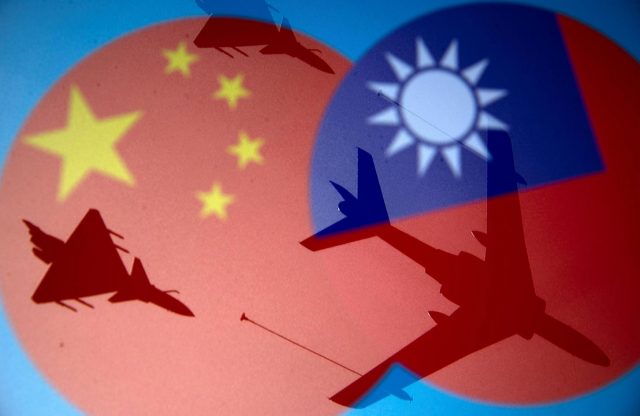
TAIPEI — Taiwan accused China of exaggeration on Tuesday after the Chinese military published footage of the strategically located Penghu islands, where there is a major Taiwanese air base, saying it was not true Chinese forces had come near the islands.

China, which claims Taiwan as its territory, has carried out military exercises around the island this month after a visit by US House of Representatives Speaker Nancy Pelosi, who was followed by five US lawmakers on Sunday and Monday.

The Chinese military unit responsible for the area adjacent to Taiwan, the People’s Liberation Army’s Eastern Theatre Command, released on Monday video of the Penghu islands, apparently taken by a Chinese air force aircraft.

Taiwan Air Force Vice Chief of Staff for Operations Tung Pei-lun told reporters in Taipei that this was Chinese information warfare, though he said he had no comment on who had taken the video.

“China used the exaggerated tricks of cognitive warfare to show how close it was to Penghu — which is not true,” Tung said.

Taiwan’s Defense Ministry on Monday, in an update of Chinese air force activity near Taiwan, showed on a map that the closest Chinese aircraft to Penghu that day were four J-16 fighters.

The fighters crossed the Taiwan Strait median line — normally an unofficial barrier between the two sides — but stayed closer to the Chinese coast than Penghu, the map showed.

Tung said that Taiwan had a real-time “grasp” of what was going on in the skies, and that Chinese aircraft have been operating to the north and southwest of Taiwan and across the median line.

Penghu, a summer tourist destination for its beaches, is close to Taiwan’s southwestern coast, unlike the Taiwan-controlled Kinmen and Matsu islands, which are right next to the Chinese coast.

Taiwan’s armed forces are well-equipped but dwarfed by China’s. The island’s president, Tsai Ing-wen, has been overseeing a modernization program and has made increasing defense spending a priority.

Defense Ministry spokesman Sun Li-fang said next year’s proposed defense budget had been submitted to the Cabinet for approval.

It is based on the “assessment of the enemy threat,” military development needs, and Taiwan’s overall financial resources, he said, without giving details. — Reuters

Indonesia at ‘pinnacle of global leadership’ — Jokowi

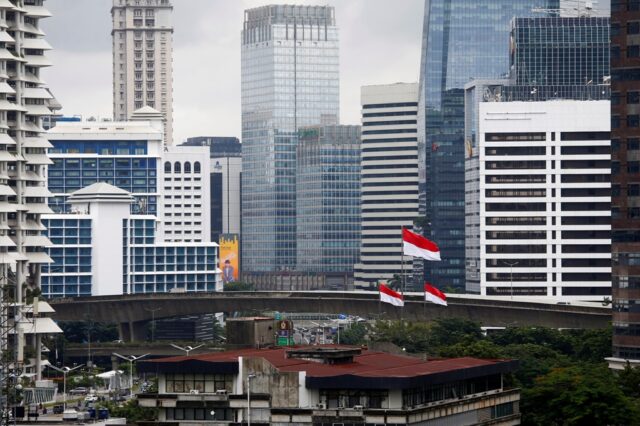
INDONESIAN national flags fly at a business district in Jakarta, Indonesia, Feb. 5, 2021. — REUTERS

JAKARTA — Indonesian President Joko Widodo on Tuesday hailed his country’s growing stature on the global stage and reiterated calls for the Southeast Asian nation to be a “bridge of peace” between Russia and Ukraine.

“In 2022, we hold the presidency of the G20, an international forum made up of the world’s largest economies. Next year, we will assume the chairmanship of ASEAN,” he said in an annual state of the nation speech a day before Indonesia celebrates 77 years of independence.

“It indicates that we [are at the] pinnacle of global leadership,” he added.

As head of the G20 this year Jokowi, as the president is known, has taken an increasingly active role in foreign affairs.

In late June he travelled to Kyiv and Moscow to meet with his Ukrainian and Russian counterparts, Volodymyr Zelensky and Vladimir Putin, as part of diplomatic efforts to find a peaceful solution to the war and ease the global food crisis. He was the first Asian leader to do so.

Indonesia, he said, “has been accepted as a diplomatic bridge” between the two nations.

In the televised national address Jokowi also noted the country’s economic fundamentals remain strong amid a volatile global economy, with inflation at 4.9% and economic growth reaching 5.4% in the second quarter of 2022.

As the pandemic eases, relatively low case numbers this year have allowed Jokowi to refocus on his priorities, including economic growth and infrastructure development in Southeast Asia’s largest economy.

The parliament passed legislation earlier this year on relocating the country’s capital to Indonesian Borneo, a cornerstone of the president’s agenda.

Jokowi, who donned a traditional outfit from Bangka Belitung islands off Sumatra, the color of which his private secretary said represented a “green future,” was elected in 2014 and will finish his second and final term in 2024. — Reuters

Singapore’s next PM signals rich may have to pay more taxes

A VIEW of the city skyline in Singapore, Dec. 31, 2020 — REUTERS

Singapore’s next prime minister signaled that the wealthy may face more taxes as the government seeks more inclusive growth in the city-state and looks for ways to shield the most vulnerable groups from the impact of high inflation.

While the country’s income inequality based on the Gini coefficient has been narrowing, the government probably needs to “lean some more in the direction of more inclusive growth,” Lawrence Wong, 49, the country’s deputy prime minister, said in an interview with Bloomberg News Editor-in-Chief John Micklethwait on Monday. He was referring to an index developed by Italian statistician Corrado Gini in 1912.

“Everybody pays some form of taxes but certainly the ones with greater means — the rich and the higher-income — will have to pay more,” Mr. Wong, who’s also the finance minister, said, reiterating a message he has communicated before. “It’s not only done through the taxation system, but we also can do it through transfers and spending and make sure that spending is targeted at the lower-income and those with greater needs.”

His comments follow an assurance from Prime Minister Lee Hsien Loong last week that the government is prepared to do more to help lower-income households deal with price gains hovering at a 14-year high. The city-state, which earlier raised taxes on its wealthiest 1% and imposed other levies, needs more cash to sustain its inflation fight given an expected budget shortfall of $3 billion, or 0.5% of gross domestic product, this fiscal year.

Inflation is expected to peak by the end of the year before easing, Mr. Wong said, adding that the government will provide more assistance should prices rise further. The country’s consumer prices rose 6.7% in June, the quickest pace since mid-2008, while the core measure gained 4.4%.

“But the big uncertainty is what is the extent of the easing and where will the new inflation rate stabilize at,” said Mr. Wong, who expects inflation to settle at a higher rate especially considering the geopolitical environment, supply issues, and spending on the green economy transition. “We have to prepare for that new equilibrium where inflation is concerned.”

Singapore’s central bank has already tightened monetary policy four times since last year to tame inflation, while the government has targeted measures, including unveiling a S$1.5-billion ($1.1 billion) package in June, at the most vulnerable to blunt the impact of supply-driven price shocks.

Mr. Wong said the government intends to stick with its plan to raise the consumption tax next year to 8% from 7%, while clarifying that there are built-in buffers to protect the lower-income households from the increase.

“That’s the system we have but we’re continuing to see how it can be enhanced, how it can be improved and how can it be fit for purpose, increasingly in a world that’s going to be more uncertain and where there will be more forces that will stretch incomes and wealth apart,” Mr. Wong said.

In the same interview, Mr. Wong talked about rising geopolitical risks and the importance of a multilateral rules-based trading system to support global growth.

GROWTH RISKS

Mr. Wong was named the leader of the so-called fourth generation, or 4G, team in mid-April, making him the heir-apparent to Lee. The economy he’s poised to inherit is grappling with slowing growth on top of elevated prices.

“It’s not just an inflation risk and, in fact, the growth risks are starting to increase as well for next year and that’s what we’re watching carefully, too,” the deputy prime minister said.

Singapore last week trimmed its full-year economic growth projection to a range of 3%-4% from 3%-5% seen previously, citing significant downside risks to the global economy including the war in Ukraine and financial instability owing to tighter monetary policies in advanced economies.  — Bloomberg

H&M returns to Alibaba’s Tmall, 16 months after Xinjiang controversy

SHANGHAI — Swedish fashion giant H&M’s official store on Alibaba’s Tmall e-commerce platform has re-opened, 16 months after the Chinese site took it down following the brand’s criticisms of human rights abuses in Xinjiang.

The re-opening was first noticed by Chinese netizens and confirmed by a Reuters search of the platform on Tuesday.

It was not clear what prompted the re-opening and H&M and Alibaba did not immediately respond to Reuters’ requests for comment.

Tmall and many other Chinese platforms and apps scrubbed references to the fashion brand when it was revealed that H&M had pledged not to source cotton from China’s far western Xinjiang region, citing concerns about human rights abuses there.

UN experts and rights groups estimate over a million people, mainly Uyghurs and other Muslim minorities, have been detained in recent years in a vast system of camps in Xinjiang. China denies all accusations of abuse.

H&M, the world’s second-biggest fast-fashion retailer, first opened on Tmall in March 2018.

It was one of many Western brands caught up in the Xinjiang cotton controversy in March last year and was disproportionately impacted as one of the first to be targeted by netizens on Chinese social media.

While other brands such as Nike, Adidas, Burberry and Converse saw celebrity ambassadors sever ties over their public commitments not to use Xinjiang cotton, H&M was the only brand to see its online identity in China removed to such an extent.

Since March 2021, H&M has only been able to sell online in China via its own website and a mini-programme on WeChat, but has not been available or searchable on major third-party platforms such as Tmall or JD.com.

In June, H&M closed its flagship bricks-and-mortar store in Shanghai, hurt by the consumer backlash to the Xinjiang cotton controversy as well as lockdowns in China’s commercial capital.

H&M entered China in 2007 with the opening of that three-storey flagship store and rapidly expanded. It had more than 500 stores in mainland China early last year but its website currently only lists 375. — Reuters

Closer economic ties with Taiwan: Aquaculture

HANSON LU-UNSPLASH

Another sector in which closer ties between the Philippines and Taiwan will greatly benefit our attaining food security is that of aquaculture in which, with the appropriate investments from both the public and private sectors, our country can literally leapfrog into high-technology production of fish products for our growing population. This is especially important because fish and other aquaculture products constitute a major component of the Filipino diet.

As reported by Paula Arab, like elsewhere in the Taiwanese economy, high-tech is playing an emerging and key role in the country’s fisheries, particularly in the aquaculture sector. This island country is already showcasing aquaculture practices that integrate collaboration with smart industries such as biological technology, artificial intelligence and the Internet of Things (IoT).

At a glance, Taiwan’s aquaculture industry can be described as follows:

  • 28% of the country’s fish production comes from aquaculture.
  • 42,000 hectares of aquaculture
  • Taiwan’s aquaculture history dates back 300 years
  • Taiwan’s marine aquaculture is divided into three categories: shallow sea culture, marine cage culture, and salt water pond culture.
  • Grouper has become the most important aquaculture species today, after the Fisheries Research Institute (FRI) successfully established the technology of its artificial propagation in 1982.
  • Tilapia is another one of the country’s most important aquaculture species. The FRI has introduced various tilapia species and developed hybrids for aquaculture, such as red tilapia, monosex tilapia, and seawater tilapia.

The most recent initiative to profit from advanced aquaculture technology from Taiwan is a proposal from an entrepreneur from Cavite to establish an aquaculture training center in Maragondon, Cavite.

Maragondon is just 66 kilometers from Manila via the R1-Antero Soriano Highway, or barely a two-hour drive away from the National Capital Region (NCR). The Philippine Naval Station at Ternate, Cavite, has identified the strategic site of Maragondon for development as an aquaculture training center to enhance the opportunities for aquaculture training within the Cavite-Batangas-Mindoro-Bataan areas. The biggest market for aquaculture products, Metro Manila, is just around the corner. Once the bridge connecting Cavite to Bataan, passing through Corregidor, is constructed, the market will be even further expanded to include the emerging metropolis of Central Luzon.

A group of Filipino entrepreneurs, led by Guillermo Choa and Arsenio Barcelona, are eyeing a partnership with Taiwan technology institutions through the Taipei Economic and Cultural Office with its counterpart, the Manila Economic and Cultural Office (TECO-MECO) to put up a training center of aquaculture and hatchery technology transfers.

Mr. Choa is willing to support the establishment of this center by leasing land in Maragondon that can be used for 30 years under a usufruct agreement, and funding a training facility for Filipino aquaculturists, aquaculture science students and teachers. This center can be located within an area with more than 1,000 hectares. Mr. Choa is willing to negotiate with private Taiwanese aquaculture entrepreneurs and the Taiwan Aquaculture Research Institute to develop the aquaculture industry in Maragondon, which, as described above, is ideally located to serve the huge market for aquaculture products of populous Metro Manila and Central Luzon.

The private business sector led by Mr. Choa will provide the funding for the Training Center Building, composed of two lecture rooms with audio-video facilities. Each room will have a capacity for 30 persons. There will be a movable partition between the two rooms so that they can be expanded into one big lecture hall for 100. There will be residential facilities for management and maintenance staff. Ten hectares will be available for aquaculture ponds for finfish and shrimps, an Algae and Seaweeds Research Institute, and a future building to house a full-blown School of Aquaculture.

The Cavite Aquaculture Center will take care of developing training syllabi and hands-on mentoring modules for trainees, which can eventually be shared with aquaculture training centers in state colleges and universities as well as local government units in coastal municipalities. People trained in these aquaculture centers can become mentors who will train others equipped with an “agribusiness sense,” enabling them to manage aquaculture farms all over the country efficiently and, more importantly, profitably.

Government policies and support should provide the necessary infrastructure for aquaculture zones that have the environmental conditions that can protect the quality of the land and water resources within each area. Government regulations should be strictly implemented but should be investor friendly.

What President Ferdinand Marcos, Jr. promised farmers in his SONA should also be made available to the fishing or aquaculture industry because fisherfolk are also among the poorest Filipinos. Road networks, electricity, manpower development, aquaculture inputs suppliers’ support, processing technology transfer, cold chain, distribution and marketing channels should be included in the industry roadmap.

If we are able to produce more than what can be sold to the domestic consumers, China and Japan are big markets nearby. This prospect for exporting aquaculture products to China and Japan should be another reason we should ratify the Regional Comprehensive Economic Partnership (RCEP) as soon as possible.

The Maragondon project should be replicated in other provinces and municipalities that are rich in aquaculture resources such as Pangasinan, Iloilo, Negros Occidental, San Jose (Mindoro Occidental), General Santos, and many others. Local government officials, in tandem with private entrepreneurs like Mr. Choa and Mr. Barcelona, should reach out to Taiwanese officials who are more than willing to transfer both capital and technology to the Philippines to help us achieve food security.

In their Southbound policy, it is obvious that the Philippines is the very first country that they will consider to help. It is also providential that historically native Taiwanese culture and our own have very many things in common. It is about time that we take very seriously the many lessons we can learn from the most successful East Asian economy to achieve agro-industrial excellence.


BERNARDO M. VILLEGAS has a Ph.D. in Economics from Harvard, is professor emeritus at the University of Asia and the Pacific, and a visiting professor at the IESE Business School in Barcelona, Spain. He was a member of the 1986 Constitutional Commission.
bernardo.villegas@uap.asia

Revitalizing the Fourth Estate of our democracy

PHILIPPINE STAR/ MIGUEL DE GUZMAN

When the Duterte administration, through the House of Representatives, shut down network giant ABS-CBN by denying the extension of its franchise, there was a palpable sense of gloom and foreboding among many Filipinos.

The shutdown happened just a few weeks after the first announcement of lockdowns due to the COVID-19 pandemic. Given how ABS-CBN had been generally critical of the Duterte administration’s pandemic response and of its war against drugs, the denial of the franchise was seen as an assault on press freedom and a successful attempt by President Rodrigo Duterte to silence his critics.

To the shock of millions, the final blow was delivered on May 4, 2020, just a day after the global commemoration of World Press Freedom Day.

With the shutdown, some 12 local TV Patrol newscasts delivering news in the dialects were also forced to close down. Thus, there ensued an information gap for Filipinos living in far-flung rural areas — numbering around 3 million — who relied solely on ABS-CBN in obtaining the news. Kapisanan ng mga Brodkaster sa Pilipinas Chair Ruperto Nicdao said millions of Filipinos simply “tuned out of television” when ABS-CBN was forced off the air.

This became especially crucial during calamities — no other television and radio network had the same reach and influence, and internet infrastructure was, and still is, not adequate, if not totally absent, to provide the needed information.

This has been the state of things for the past 27 months.

Thus, if we are to go by reports that ABS-CBN has joined forces with TV5, we have reason to be hopeful that what was missed by the public, and even the broadcast industry’s ecosystem, may soon regenerate into the next dominant channel for news and entertainment.

In an investment deal announced last week, the Lopez-owned ABS-CBN acquired a 34.99% stake in TV5 and has the option of acquiring up to 49.92% in the future. Tycoon Manuel Pangilinan’s MediaQuest will remain as majority owner.

Proceeds from the sale of shares, amounting to P2.16 billion, will fund TV5’s capital expenditure and operating expense in enhancing its content and programming.

Also included in the investment deal is the Pangilinan’s Cignal Cable Corp.’s acquisition of 38.88% of the Lopezes’ Sky Cable Corp.

Rep. Gus Tambunting, chairperson of the House Committee on Legislative Franchise, said in a recent interview with Radyo ng Bayan that the agreement is actually a simple business venture wherein a legitimate TV network, with a channel and franchise, has partnered with a former television network which is known to provide good and popular content.

“From a business point of view,” he said, “it seems very sensible to give space to the former leading network. This can be a very good business venture. One has the airspace, the other carries the content.”

At least two advocacy groups have also issued statements regarding the deal between the two networks. CitizenWatch says it will ultimately redound to the benefit of the Filipino people and will elevate the quality of Philippine entertainment and public service.

Meanwhile, according to Bantay Konsyumer, Kalsada, Kuryente (BK3), the merger is an opportunity to create a new and credible brand of public service that would deliver not just entertainment but would, hopefully, become a developmental medium of education and good values, freely accessible to Filipinos wherever they may be in the archipelago.

BK3 adds: “The merged creative and production pools of both networks also make us hopeful of higher quality programming that entertains, yes, but also educates and encourages critical thinking among viewers, especially the young.”

The deal between ABS-CBN News and TV5 is an encouraging development for Filipinos, who will again have access to quality information and programs. More importantly, the agreement tempers the “chilling effect” that was created by what many observers saw as a whimsical and vengeful act of the past administration when it shut down ABS-CBN more than two years ago.

The media is called “The Fourth Estate” for a reason. It has a unique and specific function in a democratic society. Its practitioners, schooled in the rigors of journalism and imbued with a sense of public service over personal gain or glory, perform a valuable good in holding public officials — servants of the people — accountable for their words and actions.

When these public officials feel slighted by criticism and then retaliate by bringing about the closure of a media organization, that is never good for a democracy. When people and organizations fear something bad will happen to them when they speak out, that distorts the very essence of a free society.

Democracy thrives in assent and dissent, in the free exchange of views and the civilized recognition of each one’s inherent freedom of expression. The return to free television of ABS-CBN’s known brand of professional and intrepid reporting and commentary, makes us just a bit more confident of better, or at least more reasonable, times ahead.

For now, the chill and foreboding have been replaced by hope.


Victor Andres “Dindo” C. Manhit is the president of the Stratbase ADR Institute.

Probing proby

DANIE FRANCO-UNSPLASH

One of the more common types of employment is probationary or proby in HR lingo. Unless it is prohibited, as in the case of fixed-term or project employment, employees almost always undergo probationary employment. It is very rare that employers engage employees as a regular at the outset.

Article 296 of the Labor Code is straightforward on the requirements – first, the employee must be apprised of the regularization standards at the time of his/her engagement; and second, the probationary employment must not exceed six months. From these, however, arise several issues.

WHAT TO COMMUNICATE

What exactly are the regularization standards? Ideally, and for the avoidance of doubt, the employee must be apprised of the metrics and key performance indicators and be informed explicitly that these are the standards for regularization.

It was ruled though in Enchanted Kingdom v. Verzo (December 2015) that a provision in the employment contract indicating the employee’s duties and responsibilities and his job description, is sufficient compliance. The High Court has, in fact, adopted a liberal approach in some cases when it declared that there is no need to apprise the employee of the standards for regularization if the job is self-descriptive, like maid, cook, driver, or messenger (Robinson’s Galleria v. Ranchez, January 2011). Indeed, “the rule on notifying a probationary employee of the standards of regularization should not be used to exculpate an employee who acted in a manner contrary to basic knowledge and common sense in regard to which there was no need to spell out a policy or standard to be met.” (Enchanted, supra).

However, the mere fact that the employer informed the employee that his/her performance would be evaluated on the 3rd  and 5th months of his/her probationary employment, when it was not shown that he/she was actually informed of the regularization standards, is not sufficient compliance (Aliling v. Feliciano, et al., April 2012).

WHEN TO COMMUNICATE

Ideally the communication should be made at the precise time of engagement, i.e., when the employee signed the contract or on the first day of work. However, in Echanted (supra) the Court held that this is not an ironclad rule.

“The true test of compliance is one of reasonableness. As long as the employee is given a reasonable time and opportunity to be made fully aware of what is expected of him during the early phases of the probationary period, the requirement has been satisfied.”

In the said case, a total of 14 days had lapsed when the employee officially received the letter containing what he already knew — that he was still a probationary employee. See also Cambil v. KPMB, Inc. (April 2022).

HOW TO COMMUNICATE

Viernes, et al. v. NLRC (April 2003), A.M. Oreta & Co., Inc. v. NLRC, et al. (August 1989) and Karen Jaso v. Metrobank & Trust Co., et al. (May 2021) are the authorities supporting the doctrine that it is not mandatory that the probationary employee should be apprised of his status as such and the regularization standards, in his employment contract or appointment letter.

If there is evidence to show compliance with the notification, and as long as the notification is done, as a general rule, at the time of engagement, the employee may qualify as a probationary employee. This may be done through some other means.

MORE THAN 6 MONTHS

The probationary period may go beyond six months as:

1.) when the parties may agree otherwise in the employment contract and there is basis for such agreement, such as when the nature of the work to be performed requires a longer period (Buiser, et al. vs. Leogardo, et al., July 1984);

2.) when there is valid extension of the period prior to the lapse of the six-month period (Mariwasa Manufacturing, Inc. v. Leogardo a, January 1989); and,

3.) in the case of teachers in private and public schools, where the period is three years.

COMPUTATION OF PERIOD

In Cebu Royal v. Deputy Minister of Labor (August 1987), CALS Poultry Supply Corp., et al. v. Alfredo Roco, et al. (July 2002), and Radin C. Alcira v. NLRC, et al. (June 2004), the computation of the six months was reckoned from the date of appointment up to the same calendar date of the 6th month following.

However, the Court reversed itself in Mitsubishi Motors Phil. Corp. v. Chrysler Phil. Labor Union, et al. (June 2004) where Article 13 of the Civil Code was used, thus, the probationary period of six months consists of 180 days. The Court in 2021 reverted to the doctrine in Cebu Royal, CALS, and Alcira in Karen Jaso (supra).

There are other issues surrounding probationary employment — e.g., successive probations, training period considered as probationary, probationary in fixed-term or project employment, etc. — but, due to space constraints, the same are not discussed here.


This article is for informational and educational purposes only. It is not offered and does not constitute legal advice or legal opinion.

Neptali B. Salvanera is a partner of the Labor and Employment Department (LED) of the Angara Abello Concepcion Regala & Cruz Law Offices or ACCRALAW.
(632) 8830-8000
nbsalvanera@accralaw.com


Why did Trump take classified documents in the first place?

SHARON MCCUTCHEON-UNSPLASH

We now know that the reason the Federal Bureau of Investigation (FBI) searched Donald Trump’s Palm Beach residence last week is because the 45th  president of the United States of America is under investigation for pocketing classified documents related to nuclear weapons and possibly violating the Espionage Act. For good measure, he may have also lied to federal officials about the documents and obstructed justice.

Much of the drumbeating that followed news of the FBI search focused on investigators’ motives for executing a search warrant at Mar-a-Lago. That’s largely because Trump seized the public relations high ground in the wake of the search, filling a communications vacuum the Justice department helped create by not providing more immediate clarity about its investigation.

Trump is not sophisticated or particularly bright, but messaging is one of his superpowers. No sooner had he characterized the FBI search as a politically motivated hit worthy of “broken, Third-World Countries” than his GOP apologists and Fox News enablers went to work repeating the same lies and talking points. Possible FBI malfeasance became a centerpiece of the debate about the search. Even well-intentioned observers stroked their chins quizzically. “Hmm” they allowed, “maybe the FBI has gone off the rails.”

But a few turns of the news cycle and one press briefing from Attorney General Merrick Garland have properly refocused attention on the suspected perpetrator — Trump — and dimmed some of the histrionics aimed at the FBI. Keep worrying about FBI overreach if you’d like, but more pressing answers are needed for why Trump absconded with the documents in the first place.

I think there are three likely reasons Trump wanted to keep all that top-secret paperwork and classified paraphernalia to himself — even if we still don’t know exactly what he had stashed in his safe, closets, and socks at Mar-a-Lago.

Reason One seems relatively harmless. Trump is a seven-year-old grown old, and he liked some of the cool doodads you get your hands on as president. He reportedly wanted to keep an Air Force One model displaying a bespoke paint job he had commissioned for the presidential jet and resented restrictions against hanging on to such stuff. Among the disputed documents at Mar-a-Lago was a meteorological map of Hurricane Dorian that he had infamously marked up with a black Sharpie. Who knows why that map was so important to him? Who cares?

The second and third reasons aren’t harmless at all. They’re deeply damaging and troubling.

So, Reason Two: Money. Unfettered greed has motivated Trump his entire life. He didn’t get into the casino business to beautify Atlantic City. He didn’t propose a mega-development on Manhattan’s West Side because it would have made New York more livable. He didn’t start Trump University to educate students, and he didn’t host The Apprentice to tutor entrepreneurs. He didn’t originally run for president to revitalize democracy. Money, money, money.

Other graduates of the Trump administration have cashed in in ways that should raise national security concerns. Former White House adviser Jared Kushner (Trump’s son-in-law) and former Treasury Secretary Steven Mnuchin have received billions of dollars from Saudi Arabia to seed their nascent money-management firms. Those deals still look like influence peddling, but to Trump they undoubtedly looked like huge and enviable paydays. It had to occur to him that if hangers-on such as Kushner and Mnuchin could rake in billions because of their proximity to him, he could sell himself — or, possibly, state secrets — for even higher prices.

Recall that Trump’s businesses have been in difficult straits. When Trump left the White House, his operations were saddled with about $1 billion in debt, $900 million of which comes due relatively soon. He personally guaranteed repayment of about $421 million of that debt. And his businesses — concentrated in urban real estate and leisure — were pummeled by the economic downturn that accompanied the COVID-19 pandemic. Trump and his firm, the Trump Organization, also face civil and criminal fraud investigations in New York that could put him out of business.

That’s a lot of financial pressure, especially for someone already prone to be a money-grubber. It should also raise alarms for any rational observer concerned that Trump might have been inspired to use the powers and access to records that his presidency provided to rake in lucre by peddling classified information after he left the White House. Perhaps that won’t prove to be the case — and I hope it doesn’t — but extreme vigilance around that particular problem would be well advised.

Reason Three: Reputational damage. Trump reportedly held on to letters he exchanged with North Korea’s dictator, Kim Jong Un. Perhaps vanity inspired that move because Trump has referred to such correspondence as “love letters.” But what other communications are contained in the documents Trump kept? Anything with Russian President Vladimir Putin or Chinese President Xi Jinping? How about documents pertaining to Trump’s phone calls with Ukrainian President Volodymyr Zelenskiy from that time when Trump was trying to strong-arm Zelenskiy into digging up dirt on his political opponent, Joe Biden. Those communications led to the first of Trump’s two impeachment proceedings.

Again, maybe there’s nothing of this sort, either, in the documents Trump kept. But it’s not unreasonable to worry that his communications with foreign leaders — and anything disreputable or possibly illegal that took place in connection with those — could have been something he felt compelled to hide.

The frenetic pace at which Trump has seeded the ground with lies in the wake of the Mar-a-Lago search certainly suggests that he has something to hide and that he’s worried about the investigation. After all, he has claimed, without even a hint of fact, that the FBI planted evidence at Mar-a-Lago. Trump also claimed that he wasn’t the first president to lift classified information and said former President Barack Obama kept 33 million pages of documents, “much of them classified.” The National Archives controls all of Obama’s papers and swiftly debunked that howler.

Trump and his allies have also asserted that Trump had the power to declassify all of the documents in his possession as president and that he declassified the contested documents held at Mar-a-Lago. No harm, no foul. But as Barbara McQuade, a professor at University of Michigan Law School and a former federal prosecutor, has pointed out, that distinction doesn’t matter.

“Classification is irrelevant,” McQuade noted on Twitter. “Government documents that pertain to the national defense may not be withheld from the government upon request for return. The obstruction charge in the warrant suggests Trump tried to conceal what he had.”

Trump has also flexed his muscles more directly. The New York Times reported that he had an intermediary warn Garland before his press conference last week that people were enraged by the FBI’s search of Mar-a-Lago. Armed Trump supporters have since marched outside the FBI’s offices in Phoenix. One gunman who stormed an FBI office in Cincinnati last Thursday was shot and killed. The federal judge who approved the FBI’s search warrant for Mar-a-Lago has been subjected to antisemitic attacks and threats online. Some of those attacks were also directed at his synagogue.

Sorting out this investigation before the violence escalates further should be a priority for law enforcement, but it has to be sorted out. Soft-peddling an examination of whether a former president stole state secrets and what he wanted to do with them — especially if it involved espionage — because of violence or threats of violence only plays into Trump’s hands.

Bloomberg Opinion

BusinessWorld One-on-One: “Digital Transformation in the Insurance Sector”

In line with BusinessWorld’s 35th-anniversary celebration this year with the theme “Forward Faster”, the country’s most trusted business newspaper and multimedia content provider will be holding a BusinessWorld One-on-One series featuring some of the country’s topnotch thought leaders who will share with BusinessWorld Editor-in-Chief Wilfredo G. Reyes their expert insights about “Innovations Reshaping the Future of Key Industries”.

Listen to Subra Ramakrishnan, chief business transformation officer of Sun Life Philippines, who will talk about “Digital Transformation in the Insurance Sector” on #BUSINESSWORLDONEONONE this August 16 at 11 a.m. on BusinessWorld’s and The Philippine STAR’s Facebook pages.

#BUSINESSWORLDONEONONE is supported by Asia Society – Philippines, British Chamber of Commerce of the Philippines, Bank Marketing Association of the Philippines, European Chamber of Commerce of the Philippines, Financial Executive Institute of the Philippines, Management Association of the Philippines, Makati Business Club, Philippine Chamber of Commerce and Industry, Philippine Franchise Association, People Management Association of the Philippines, and The Philippine STAR.

Soft skills courses gaining popularity on LinkedIn

UNSPLASH

Southeast Asian learners on Linked In, a professional networking platform, want to improve their speaking and critical thinking skills, based on data collected between June 1, 2021, and June 30, 2022, which showed that six of the top 10 popular courses offered by LinkedIn Learning, LinkedIn’s educational arm, are related to those two soft skills.

“The most popular LinkedIn Learning courses shed light on the priorities of SEA professionals and all who are looking to dip their toes in the job market,” said Frank Koo, LinkedIn’s head of talent solutions for the Asia Pacific, in an Aug. 15 press statement.

“Speaking Confidently and Effectively” ranked second while “Critical Thinking for Better Judgment and Decision Making” ranked sixth in Southeast Asia (SEA). 

“Excel Essential Training (Office 365/Microsoft 365)” was the most attended.

Filipino learners were among the 7.3 million worldwide who enrolled on LinkedIn Learning during the said period. The number of learners was almost double that of the preceding year.

Learners in Southeast Asia spent over 2.6 million hours on LinkedIn Learning in the past year, or 18.4% higher than the previous year. 

Mr. Koo said that the growing skills gap in the fast-evolving job market, coupled with the digital transformation accelerating businesses, means individuals and enterprises who build their competencies in soft and hard skills will gain a competitive edge.  

“SEA, including the Philippines, is moving towards a skills-based economy, along with the rest of the world, and we will see a diverse range of in-demand skills emerge for the future of work,” he said.

LinkedIn noted in its 2021 Future of Skills report that skills for a particular job in the Philippines have changed by 28% on average since 2015, with the pandemic accelerating this pace of change. The platform said the change could be 41% to 48% by 2025, and that “there will also likely be three new skills required for a job then.” 

LinkedIn Learning offers over 18,000 sessions. It is giving free access to its most popular courses until Aug. 31. — Patricia B. Mirasol


Most popular courses on LinkedIn Learning 

Here are the most popular courses on LinkedIn Learning in Southeast Asia from July 1, 2021, to June 30, 2022, ranked in descending order:

  1. Excel Essential Training (Office 365/Microsoft 365)
  2. Speaking Confidently and Effectively
  3. Project Management Foundations
  4. Communicating with Confidence
  5. Strategic Thinking
  6. Critical Thinking for Better Judgment and Decision-Making
  7. Excel: VLOOKUP and XLOOKUP for Beginners
  8. Digital Marketing Foundations
  9. Critical Thinking
  10. Communication Foundations

UN can facilitate IAEA power plant visit, but Russia puts conditions

REUTERS

 – The United Nations has the logistics and security capacity to support a visit by International Atomic Energy Agency (IAEA) inspectors to Ukraine’s Zaporizhzhia Nuclear Power Plant, a spokesman said, but a Russia diplomat imposed conditions, saying routing any mission through Ukraine’s capital was too dangerous.

U.N. spokesman Stephane Dujarric, speaking on Monday, also said: “The U.N. Secretariat has no authority to block or cancel any IAEA activities.”

Dujarric was responding to an accusation by Russia that U.N. security had blocked a visit by IAEA inspectors to Europe’s largest nuclear power plant, which Russia seized in March following its invasion of Ukraine on Feb. 24.

He said that “in close contact with the IAEA, the U.N. Secretariat has assessed that it has in Ukraine the logistics and security capacity to be able to support any IAEA mission to the Zaporizhzhia Nuclear Power Plant from Kyiv.”

But he said both Russia and Ukraine have to agree. Both countries have said they want IAEA inspectors to visit. IAEA chief Rafael Grossi has said he was ready to lead a mission and called on Russia and Ukraine to cooperate.

In Moscow, Russian news agencies quoted a senior diplomat as saying that no such mission could pass through Kyiv, the Ukrainian capital, as proposed by the United Nations.

“Imagine what it means to pass through Kyiv — it means they get to the nuclear plant through the front line,” RIA news agency quoted Igor Vishnevetsky, deputy head of the foreign ministry’s nuclear proliferation and arms control department, as telling journalists.

“This is a huge risk, given that Ukraine’s armed forces are not all made up in the same way,” he was quoted as saying.

Russia describes its actions in Ukraine as a “special military operation” and accuses Kyiv’s military — and much of its political structures — as being beholden to nationalists and Nazis.”

Tass news agency quoted Vishnevetsky as saying that any such mission had no mandate to address the “demilitarization” of the plant as demanded by Kyiv as it could only deal with “fulfillment of IAEA guarantees.”

U.N. Secretary-General Antonio Guterres on Thursday called for an end to military activity around the Zaporizhzhia nuclear power complex as Moscow and Kyiv blamed each other for shelling of the area. Read full story

Guterres spoke with RussiaDefense Minister Sergei Shoigu on Monday about the conditions for the safe operations of the Zaporizhzhia, the United Nations and Russia said. – Reuters

Inflation, labor shortages to delay recovery in business travel spending -industry forecast

STOCK PHOTO

A recovery in global business travel spending to pre-pandemic levels is likely to be delayed by 18 months to 2026 because of factors like persistent inflation, high energy prices, labor shortages and lockdowns in China, a new industry forecast shows.

The Global Business Travel Association (GBTA) said business travel spending rebounded by 5.5% to $697 billion in 2021 with North America leading the recovery, but remained well short of 2019 levels of $1.4 trillion.

The recovery outlook is more pessimistic than GBTA’s last forecast issued a year ago, when it expected a full rebound to 2019 levels by 2024.

Environmental sustainability considerations and the regional impact of the war in Ukraine are also weighing on travel demand, the forecast said.

“The factors impacting many industries around the world are also anticipated to impact global business travel recovery into 2025,” GBTA CEO Suzanne Neufang said in a statement. “The forecasted result is we’ll get close, but we won’t reach and exceed 2019’s pre-pandemic levels until 2026.”

Global Business Travel Group Inc., owner of the world’s largest corporate travel agency American Express Global Business Travel, said last week that revenues this year were expected to average around 65% of 2019 levels, though that did not include the impact of a possible recession.

Airlines and hotels have been relying on strong leisure demand to help fill the gap left by the decline in corporate travel during the pandemic. – Reuters