Home Blog Page 5640

August FDI net inflows drop to $797 million

US dollar banknotes are seen in this photo illustration taken Feb. 12, 2018. — REUTERS

PHILIPPINE NET INFLOWS of foreign direct investments (FDI) declined in August as higher interest rates and a looming global economic slowdown hurt investor confidence.

Data released by the Bangko Sentral ng Pilipinas (BSP) on Thursday showed FDI net inflows fell by 19.2% to $797 million from $987 million a year earlier.

Month on month, FDI net inflows were 73.3% higher than $460 million in July.

Net Foreign Direct Investment (August 2022)Despite the decline, August saw the biggest monthly FDI inflow since the $989 million in April.

“The slowdown in FDI may be attributed to concerns over weakening global growth prospects, particularly with the moderating demand and policy tightening in major economies,” the BSP said in a statement on Thursday. 

The global economy is facing an increasingly gloomy outlook due to persistent inflation that has triggered tightening of global financial conditions, the ongoing Russia-Ukraine war, and a slowdown in China.

“The worldwide inflation, the war in Ukraine and Russia, the continued increase in the prices of oil and oil products and the recession in the US and Europe led to the tightening of policy,” Colegio de San Juan de Letran Graduate School Dean Emmanuel J. Lopez said. “This naturally prohibits the outpouring of funds coming from foreign sources which will give rise to an economic slowdown.”

Inflation rose to 6.3% in August, marking the fifth consecutive month that went above the BSP’s 2-4% target, as prices of food and utilities continued to surge.

Like many central banks, the BSP has tightened policy to tame inflation. In August, the BSP increased its policy rate by 50 basis points (bps) to 3.75%.

Rizal Commercial Banking Corp. Chief Economist Michael L. Ricafort said FDIs might have been weighed down by faster inflation, a weaker peso, and the rise in US and Philippine interest rates. Higher borrowing costs usually hurt new investments, he added.

Mr. Ricafort said net FDI inflows still hit a four-month high in August, as investor confidence rose after the economic team assumed office and the continued reopening of the economy.

BSP data showed all major FDI components posted lower net inflows, particularly non-residents’ net investments in debt instruments of their local affiliates.

Nonresidents’ net investment in debt instruments, consisting mainly of inter-company borrowings between foreign direct investors and their units in the country, fell by 15.3% year on year to $600 million in August.

Investments in equity and investment fund shares dropped by 29.1% year on year to $197 million.

At the same time, nonresidents’ net investments in equity capital (other than reinvestment of earnings) slumped by 60.7% to $31 million.

This was mainly due to the 38.7% decrease in equity capital placements to $80 million. However, equity capital withdrawals also slipped by 3.2% to $48 million.

The equity placements were mainly from Japan and the United States. Investments were placed mostly in manufacturing, real estate, and information and communication industries.

Reinvestment of earnings also contracted by 16.4% to $166 million year on year in August.

For the first eight months, total FDI net inflows dropped by 13% to $5.9 billion from $6.8 billion a year earlier.

Foreign investments in debt instruments also slid by 13% year on year to $4.16 billion.

Investments in equity and investment fund shares declined by 13% to $1.74 billion.

Net foreign investments in equity capital shrank by 17.1% to $907 million. Equity capital placements fell by 23.2% to $1.06 billion, while withdrawals declined by 46.8% to $150 million.

Most of these placements were from Japan, the United States, Singapore and Malaysia.

Reinvestment of earnings slipped by 8% to $836 million in the first eight months.

“On the bright side, however, as we see and expect the economy to normalize and get back to its pre-pandemic level, we can expect the economy to gain momentum as we see the FDI to return to the country and net inflows go back to their positive stance,” Mr. Lopez said.

He expects bigger FDI net inflows in the first quarter of 2023.

Mr. Ricafort said FDIs might pick up in the next few months, as investment commitments materialize after President Ferdinand R. Marcos, Jr.’s recent visits to the United States, Singapore and Indonesia.

The central bank projects FDI net inflows to reach $10.5 billion this year and $12.5 billion in 2023.

MARCOS WOOS INVESTORS
Meanwhile, Mr. Marcos wooed Cambodian companies to invest in the Philippines, particularly the manufacturing sector.

At a roundtable discussion with Cambodia’s business leaders, he said the Philippines highly needs “capital-intensive” investments because the government seeks to increase the share of manufacturing in economic output.

“Right now, [the economy] is very, very much skewed to the service sector,” he said, based on a press release from his office. “We are trying to build up the manufacturing side of the economy and that is why capital-intensive investment will be very, very important for us to be able to do that.”

Mr. Marcos also touted the Philippine economy’s recovery from the pandemic.

“It looks like the route that we have taken is taking the economy in the right direction… I think the Philippine economy, the important elements are in place and you can feel that our economy is trying to grow but is really being pummeled by the forces outside, of which we have no control,” he said.

The Philippine economy grew faster than expected at 7.6% in the third quarter, driven by expansion in services and industry, the statistics agency reported on Thursday. — Keisha B. Ta-asan and Kyle Aristophere T. Atienza

To ‘meat’ a need to feed

The Entrepreneur Of The Year Philippines 2022 has concluded its search for the country’s most undaunted and unstoppable entrepreneurs. Entrepreneur Of The Year Philippines is a program of the SGV Foundation, Inc., with the participation of co-presenters the Asian Institute of Management, the Department of Trade and Industry, the Philippine Business for Social Progress, and the Philippine Stock Exchange. In the next few weeks, BusinessWorld will feature each finalist for the Entrepreneur Of The Year Philippines 2022.


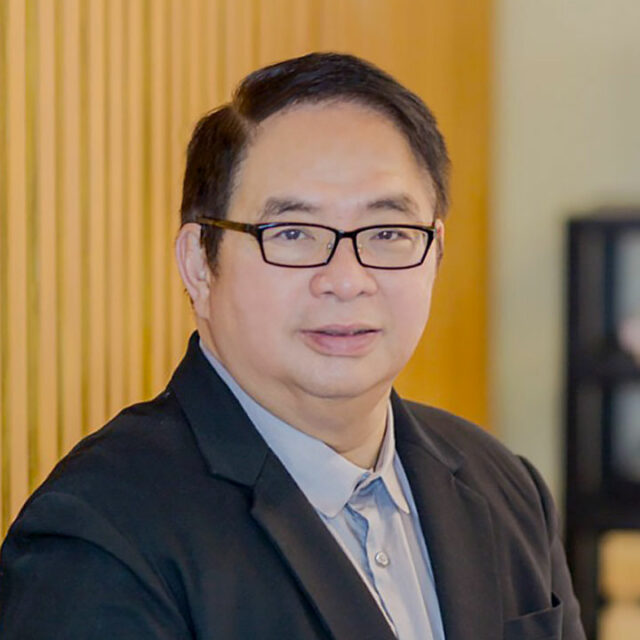
Dr. Robert Lo
Founder and Chief Executive Officer
RDF Feed, Livestock & Foods, Inc.

INSPIRED by a personal commitment to produce high-quality food for the nation, Robert Lo grew his business from a single poultry farm into a major agri-food enterprise.

Today, RDF Feed, Livestock & Foods, Inc. (RDF) manages a variety of modern poultry and swine farms in Pampanga and Tarlac, equipped with industrial facilities that include a feed mill, a slaughterhouse, and meat-cutting and meat-processing plants. As part of its ecosystem, RDF owns and operates a meat shop chain to provide maximum value.

Mr. Lo, a veterinarian, first experienced the entrepreneur’s life in a small department store owned and run by his parents. After experiencing a setback in his educational aspirations in 1984, which he later saw as a blessing in disguise, Mr. Lo founded RDF in 1988. He started as a poultry contract grower for giant integrators but seized the opportunity to expand after recognizing what he needed: housing, management and labor. By 1991, he had opened two more poultry farms in Pampanga and stopped being a contract grower.

His entrepreneurial journey faced challenges, such as calamities and animal-related pandemics. The eruption of Mt. Pinatubo in 1991 destroyed his poultry farms. The rampant smuggling of chicken leg quarters during the Asian financial crisis in 1997 resulted in P10 million in losses for RDF, while several other poultry businesses were shuttered. Disaster struck once more when Typhoon Reming caused lahar flow to increase, wiping out one of his farms.

One of Mr. Lo’s biggest challenges was dealing with substandard feeds from various suppliers. Using his background in animal nutrition as a veterinary medicine graduate, he formulated his own high-quality feeds.

Realizing that he couldn’t depend on a single product for growth, Mr. Lo opened a piggery business in 2001. However, two farms were wiped out after being hit by African Swine Fever (ASF). With the help of a veterinary molecular epidemiologist and by strategically compartmentalizing his farms, Mr. Lo said the farms now operate at normal capacity without waiting for a vaccine. His investment in a laboratory for testing and in stricter vicinity controls also prepared the company for any other potential strains.

Mr. Lo sought to make the company’s food products more accessible to bigger markets by transforming his business into a vertically integrated enterprise. While selling livestock through middlemen is a common practice in the industry, he instead opened his own meat shop in 2005 to distribute his company’s products.

Fresh Options Meatshop, which began inside an Angeles City supermarket, has now grown to more than 180 branches with a chain of standalone stores and a presence in local supermarkets. When the coronavirus pandemic struck in 2020, RDF quickly pivoted online, allowing it to continue providing customers with quality meats.

When faced with poor chicken sales, Mr. Lo produced value-added chicken products such as embutido, nuggets and tocino. To address inventory buildup, he added distribution channels in the form of two restaurants. Roberto’s is a Western-inspired restaurant in San Fernando, Pampanga. Hot Kitchen by Fresh Options, which provides home-cooked, ready-to-heat and ready-to-cook products, has branches in Quezon City, Mandaluyong and Taguig.

Mr. Lo champions quality and initiates various programs to support the company mission of product excellence, process efficiency, professionalism and social commitment.

One such program is the RDF University, which offers internal programs geared toward leadership development. The company also provides free education to selected employees in various institutions, such as the University of Makati, TESDA for NCII certification and the Department of Education’s Alternative Learning System for junior high school education. Mr. Lo is also a member of the Pampanga Chamber of Commerce, where he mentors small business owners in improving their own operations.

RDF also has various environmental, social and governance practices. Its state-of-the-art farms are accredited by the Bureau of Animal Industry for Animal Welfare and Good Animal Husbandry Practice, signifying how these farms have met the strictest requirements for animal welfare and food safety.

In its piggeries, RDF uses smart climate-controlled housing, a three-week batch program for pig flow and artificial insemination. Its poultry operations adopted a new approach toward brooding by elevating the energy level of its own feeds instead of using artificial heaters. Its use of customized chicken cage systems resulted in more efficient manure collection, helping control fly infestations in the community where the farms are located.

In his three decades of experience, Mr. Lo said he has never been afraid of failure. Instead, he noted that setbacks are lessons to learn from. Before RDF, he had other businesses that failed, such as a quail farm, a small animal clinic and Robbie’s Deli in a Hurry, a food-from-the-wall concept business that unfortunately closed after only a year.

He learned from these failures and now applies data science to gather consumer insights before developing new products. RDF’s plans for future growth involve using AI to help collect data faster and more easily, as well as more effectively analyze consumer behavior and identify trends.

Despite the scale of his business, its many moving parts and the many challenges he faced, Mr. Lo said he sees the value of the work he does to sustain food security as well as support local communities and improve the quality of the agriculture sector. This is why he emphasizes to young people: “Enjoy what you are doing so that you can stay productive and motivated even in the face of difficulties.”

The media sponsors of the Entrepreneur of the Year Philippines 2022 are BusinessWorld and the ABS-CBN News Channel. Gold Sponsors are SteelAsia Manufacturing Corp., Uratex, and Navegar. Silver Sponsors are Intellicare, OneWorld Alliance Logistics Corp., and Regan Industrial Sales, Inc. Banquet Sponsors are Uratex and MerryMart Consumer Corp.

The winners of the Entrepreneur Of The Year Philippines 2022 will be announced on Nov. 21 in an awards banquet at the Grand Hyatt Manila. The Entrepreneur Of The Year Philippines will represent the country in the World Entrepreneur Of The Year 2023 in Monte Carlo, Monaco in June 2023. The Entrepreneur Of The Year program is produced globally by Ernst & Young (EY).

LRMC arbitration seen to dent on gov’t plan for railways PPP

By Arjay L. Balinbin, Senior Reporter

LIGHT Rail Manila Corp. (LRMC), the private operator of Light Rail Transit Line 1 (LRT-1), is hopeful that the arbitration case it filed against the Transportation department and the Light Rail Transit Authority (LRTA) will be resolved soon, as the company bleeds despite the easing of mobility restrictions.

A resolution to the arbitration case concerning compensation claims and fare adjustments is crucial, especially if the government intends to offer its railways for public-private partnerships (PPPs), LRMC President and Chief Executive Officer Juan F. Alfonso told BusinessWorld on Wednesday.

“The new administration has been making it very public that they want to push for PPPs; but when you market yourself for a PPP project, the first thing that potential investors will look at are arbitration cases with the government,” he noted.

“I think they are aware of that. I think you can telegraph the way they are going to move based on that. They would like to have as many cases (as possible) behind them,” the LRMC chief added.

LRMC hopes to recover around P2.67 billion in compensation claims and costs resulting from delays in the implementation of fare adjustments for 2016, 2018, and 2020.

The company recently filed a request for arbitration against the Department of Transportation (DoTr) and the LRTA, the grantors under the 32-year concession agreement for LRT-1.

LRMC reported on Wednesday that it incurred a core net loss of P494 million for the January-to-September period “due to the start of amortization of concession assets and borrowing costs.”

“Our ridership level is just starting to recover,” Mr. Alfonso said.

LRT-1’s average daily rider count rose 76% to 203,914 compared with 116,021 in 2021 with the allowed operating capacity lifted to 70% in November that year and further to 100% in March 2022.

“To recover, there are two things that we have to address. We have to recover the volume and then [increase the] ticket price,” Mr. Alfonso said.

“There’s a necessity to increase” the ticket price, he added, noting that other modes of transportation have been allowed to raise their fares due to rising fuel costs.

The existing boarding fare for LRT-1 is P11, while the distance fare is P1 per kilometer, LRMC Spokesperson Jacqueline S. Gorospe said in a phone message.

Sought for comment, LRTA Administrator Hernando T. Cabrera said that proposals of fare adjustment are an annual exercise on the part of the public transport operator.

The fare increase will be uniform across all rail systems, he said during a briefing on Thursday.

Mr. Cabrera also noted that LRMC is requesting to implement a “boarding fare of P16.46 and a distance fare of P1.50 for 2022.”

The petition “will go through a long process,” he said when asked about the release of the resolution.

On the arbitration case, he said: “The DoTr is being represented by the Office of the Solicitor General and the LRTA is being represented by the Office of the Government Corporate Counsel.”

“A preliminary hearing has been conducted,” Mr. Cabrera added.

Transport Secretary Jaime J. Bautista said in a statement on Wednesday that “LRT-1, LRT-2, and MRT-3 (Metro Rail Transit Line 3) continue to be subsidized by government to keep fare levels affordable.”

“We are looking at partnering with private rail operators for MRT 3’s operations and maintenance – under the same scheme with LRT 1 – with the rail line’s assets remaining government-owned,” he added.

LRMC is the joint venture of Ayala Corp., Metro Pacific Light Rail Corp., and Macquarie Infrastructure Holdings (Philippines) Pte. Ltd.

Metro Pacific Investments Corp. is one of three Philippine subsidiaries of Hong Kong’s First Pacific Co. Ltd., the others being PLDT, Inc. and Philex Mining Corp. Hastings Holdings, Inc., a unit of PLDT Beneficial Trust Fund subsidiary MediaQuest Holdings, Inc., maintains interest in BusinessWorld through the Philippine Star Group, which it controls.

JG Summit income hits P6.5B as economy improves

JG SUMMIT Holdings, Inc.’s nine-month core net income reached P6.5 billion, more than 10 times the P600 million posted in the same period last year, as the Gokongweis’ consumer-facing businesses improved.

“Our core businesses in food, airline, real estate and banking continue to benefit from the sustained strong demand brought about by the increase in economic activity and mobility,” JG Summit President and Chief Executive Officer Lance Y. Gokongwei said in a stock market disclosure on Thursday.

He added that the listed holding firm’s petrochemical business suffered due to a “weaker export demand.”

From January to September, consolidated revenues amounted to P224.8 billion, a surge of 34% versus the level in the previous year.

In the third quarter, the firm’s consolidated net loss narrowed to P859 million from the P2.4-billion loss a year earlier. The improvement comes after its topline rose by 46% to P73.7 billion despite being tempered by the shutdown of its petrochemical plants from May to August.

“We have implemented strategies from gradual pricing actions and cost management initiatives to cushion the impact on our bottom line and margins,” Mr. Gokongwei said.

He added that while the firm anticipates finishing the year stronger with its topline maintaining its momentum into the fourth quarter, “our stance on margin recovery remains cautious.”

At the beginning of the third quarter, JG Summit recognized a P3.2-billion portfolio management gain after it sold its partial 3.2% stake in Manila Electric Co.

For its nine-month revenues, the firm’s petrochemical business recognized a 4% fall to P26.2 billion due to lower polymer sales.

JG Summit Olefins Corp. (JGSOC) was able to cushion the lower polymer sales through sales from its aromatics, butadiene, and liquefied petroleum gas trading.

JGSOC, due to higher interest and foreign exchange losses, posted a net loss of P9 billion during the nine-month period.

Meanwhile, JG Summit’s banking segment registered an 11% revenue growth to P7.7 billion from January to September.

“This was on the back of strong loan expansion and higher fee income from its fast-growing credit card and merchant acquiring business,” the company said.

Robinsons Bank Corp. also posted higher net interest income at P5.8 billion, up by 17% on rising global interest rates and faster growth in higher-yielding loans.

In a separate disclosure, JG Summit said its board of directors approved a proposed infusion of P5 billion into JGSOC. It said the additional capital is intended “primarily to pay off its outstanding obligations resulting from its expansion projects and to cover uncertainty of the petrochemical industry.”

The capital hike will be through a cash purchase of shares of stock, with JG Summit subscribing to additional JGSOC shares, which will be issued out of existing unissued shares.

JGSOC maintains a naphtha cracker plant and related facilities to produce polymer-grade ethylene, polymer-grade propylene, pyrolysis gasoline, mixed C4, pyrolysis fuel oil, and other products and their by-products.

On Thursday, JG Summit shares fell 4.18% or P1.90 to close at P43.60 each.

Nickel Asia posts 12% profit rise to nearly P7B 

LISTED mining firm Nickel Asia Corp. posted a 12% increase in its nine-month attributable net income to P6.90 billion on the back of higher ore prices.

In a stock exchange disclosure on Thursday, the mining firm said revenues increased by 2% to P21.51 billion from P21.03 billion due to favorable exchange rates and higher nickel ore prices. Earnings before interest, tax, depreciation and amortization (EBITDA) reached P11.10 billion, slightly higher than P11.01 billion last year.

“Despite the challenges in our mining operations due to adverse weather conditions at our mine sites, the favorable London Metal Exchange nickel price and strong US dollar helped drive revenues up by 2% from the prior year,” Nickel Asia President and Chief Executive Officer Martin Antonio G. Zamora said.

Ore sales volume from five operating mines declined 14% during the period to a combined 12.44 million wet metric tons (WMT) from 14.44 million WMT last year.

“The drop in sales volume was almost in direct proportion to unrealized workable days caused by unfavorable weather that adversely affected the company’s mining operations during the period,” Nickel Asia said.

For the nine-month period, Nickel Asia said that the weighted average nickel ore sales price increased by 5% to $29.46 per WMT compared to $28.05 per WMT.

“The company realized P54.22 per US dollar from these nickel ore sales, a 10% increase from P49.17 last year,” the firm said.

Broken down, Nickel Asia exported 6.68 million WMT of saprolite and limonite ore at an average price of $38.87 per WMT for the period, lower than the 8.72 million WMT at $38.88 per WMT last year.

The company also sent 5.76 million WMT of limonite ore to its Coral Bay and Taganito high-pressure acid leach (HPAL) plants, which had an average price of $11.66 per pound of payable nickel, higher than the 5.72 million WMT at $8.20 per pound last year.

The nine-month average price of the deliveries to the HPAL plants was also higher at $18.55 versus $11.54 in 2021.

Separately, Nickel Asia’s renewable energy unit Emerging Power, Inc. (EPI) posted a 60% improvement in revenues to P393.67 million, while its EBITDA also climbed by 51% to P239.50 million.

EPI’s improved performance came from a 56% year-on-year increase in the generation capacity of its operating arm Jobin-SQM, Inc. (JSI) to 79,022 megawatt-hours (MWh) after the completion of its 38-MW expansion in June, bringing its total capacity to 100 MW.

Power sales of JSI’s Sta. Rita plant had an average realized tariff of P4.98 per kilowatt-hour. Of the plant’s power generation, 70% was sold to retail electricity suppliers via power supply agreements while 30% was sold to the Wholesale Electricity Spot Market.

“JSI logged a net income of P72.83 million, allowing EPI to trim its losses to P133 million from the same period last year, a 53% reduction thanks to higher economies of scale and improved market conditions,” Nickel Asia said.

It said that the construction of EPI’s additional 68 MW in Subic is expected to go online by the last quarter of 2023.

Recently, EPI entered into a joint venture agreement with Shell Overseas Investments B.V. for the creation of a platform to own, operate, and maintain utility-scale onshore solar and wind power generation projects and battery energy storages in the country.

The venture, with equity ownership of 60% EPI and 40% Shell via a newly formed company Greenlight Renewables Holdings, Inc., targets to have an aggregate operating capacity of 1,000 MW by 2028.

According to Nickel Asia, the joint venture is also an avenue to explore synergies with retail electricity supplier Shell Energy Philippines, Inc. in a bid to provide integrated value to customers.

Meanwhile, Nickel Asia said in a separate disclosure that its board of directors approved to guarantee the P2-billion loan facility to be obtained by EPI.

The mining firm disclosed that EPI would get the loan from Security Bank Corp.

“The proceeds of the loan will be used to finance the Phase 4A, 68-MW Subic solar power plant expansion of EPI’s solar power subsidiary, JSI,” Nickel Asia said.

Nickel Asia also mentioned that its board approved the renewal of promissory notes issued by JSI amounting to P1.095 billion. The notes were for Nickel Asia’s advances used by JSI for Phase 3B of its solar power plant expansion project last year.

On Thursday, shares of Nickel Asia rose 17 centavos or 3.28% to end at P5.36 apiece. — Revin Mikhael Ochave

Converge income rises 11% to P2B as revenues climb

LISTED fiber internet service provider Converge ICT Solutions, Inc. announced on Thursday an 11% increase in its third-quarter net income to P2.16 billion from P1.95 billion in the same period a year earlier despite economic challenges.

Matthias Vukovich, chief financial office advisor at Converge, also said that the company has revised its capital expenditure guidance for the year to P21-23 billion from the P25 billion set previously.

Total revenues for the third quarter rose 20% to P8.43 billion from P7.05 billion in 2021. This was driven by the revenue growth in the company’s residential and enterprise businesses.

The cost of services for the quarter increased 26% to P3.32 billion from P2.64 billion previously.

“Despite the macroeconomic pressures experienced throughout the year, Converge has continued to achieve solid financial growth. This was driven mainly by the growth in our subscriber base,” Converge President Maria Grace Y. Uy said during a briefing.

For the nine months that ended Sept. 30, Converge saw its net income grow 17% to P6.11 billion from P5.2 billion in 2021.

Revenues for the period went up 30% to P24.48 billion from P18.83 billion previously, while the cost of services increased 29% to P9.65 billion from P7.46 billion in the same period last year.

“Our fiber digital highway is now running around 600,000 kilometers, reaching our northernmost provinces in the Ilocos and Cordillera regions up to Palawan and the Bicol region, and the major islands in the Visayas and key cities in Mindanao. And it’s not yet over. Our mission is to reach the underserved areas in the country with our world-class fiber infrastructure,” Converge Chief Executive Officer Dennis Anthony H. Uy said.

The company achieved earnings before interests, taxes, depreciation, and amortization (EBITDA) of P14.4 billion in the first nine months of the year, 39% higher than the previous year.

“As a result, the company’s consolidated EBITDA margin reached an all-time high of 59.0% during the nine-month period,” Converge noted. — Arjay L. Balinbin

8990 Holdings’ profit up 34% on eased mobility

8990 HOLDINGS, INC. posted 34.1% higher attributable net income to P2.65 billion in the third quarter from P1.97 billion last year on eased mobility restrictions.

For the quarter, the company’s topline reached P6.98 billion, up by 30.7% from P5.34 billion in the same period a year ago.

Real estate sales contributed P6.92 billion, 29.8% higher than P5.34 billion last year. Rental income was 68.5% lower at P1.33 million from P4.21 million a year ago.

“The outstanding results for the third quarter also significantly boosted the calendar-year results of the country’s leading affordable developer by double digits,” the company said.

For the nine-month period, the company’s attributable net income rose by 15.9% to P6.29 billion from P5.43 billion last year.

From January to September, 8990 Holdings’ topline totaled P17.03 billion, up by 10.9% from P15.31 billion in 2021.

Real estate sales contributed P16.88 billion, 10.6% higher than P15.27 billion a year ago, while rental income’s share was 97.2% lower at P2.4 billion from P84.75 billion.

8990 Holding’s vertical projects contributed 59% to revenues, while horizontal projects made up 41% of the total.

As of September, the company delivered 8,882 additional homes — 56% in Luzon, 23% in the Visayas and 22% in Mindanao.

The company said it has 704.66 hectares of land holdings with a potential sale value of P155 billion.

On Thursday, shares in 8990 Holdings climbed by 90 centavos or 9.57% P10.30 apiece. — Justine Irish D. Tabile

Robinsons Land’s REIT reports 67% profit growth

RL Commercial REIT, Inc. (RCR) registered a 67.2% rise in third-quarter attributable net income to P1.14 billion after completing new acquisitions, it said on Thursday.

In a regulatory filing, the real estate investment trust (REIT) of Robinsons Land Corp. said revenues for the period doubled to P1.45 billion from P718.23 million a year ago.

Rental income accounted for the bulk of revenue as it increased more than twice to P1.19 billion from P585.55 million a year ago.

During the quarter, Robinsons Cyberscape Gamma was transferred to RCR through an asset-for-share swap. The move allowed revenues from the development to be accrued to RCR.

Earlier this year, RCR added Robinsons Cybergate Bacolod to its portfolio, also from its listing sponsor, Robinsons Land.

“The infusion of two accretive assets shows our unrelenting commitment to continuously grow RCR,” said Jericho P. Go, president and chief executive officer of RCR, in a press release.

For the nine-month period, RCR’s attributable net income increased by almost five times to P3.13 billion from P633.79 million last year.

Revenues from January to September stood at P1.45 billion, more than double the P718.23 million posted a year ago.

Rental income was the largest year-to-date contributor with P1.19 billion, up by 103.8% from P585.55 billion.

RCR shares rose 0.79% or P0.04 to close at P5.13 each on Thursday. — Justine Irish D. Tabile

Women of Pinoy Rock come together

SIX women in Pinoy Rock are coming together for a one-night concert titled TANAW on Nov. 26 at The Theatre at Solaire.

TANAW will feature five Filipino singer-songwriters who used to be the lead vocalists of top local bands: Acel Bisa, the former vocalist of Moonstar88; Aia de Leon who was the lead vocalist and guitarist of Imago; Barbie Almalbis, who was the lead vocalist of Hungry Young Poets and Barbie’s Cradle; and Kitchie Nadal and Lougee Basabas, both of whom were lead vocalists of the band Mojofly — Ms. Nadal from 1998 to 2003, and Ms. Basabas from 2003 to 2007, then again from 2015 to the present. Also performing is Hannah Romawac of sessiOnroad. The concert marks the first time that the six will be performing together in a concert.

The idea for the concert started over lunch. The singers were catching up for the first time since the start of the coronavirus pandemic lockdowns.

“It’s been a while since we last saw each other in gigs,” Ms. De Leon said during a press conference at The Theater at Solaire in Parañaque City. “We were just talking about music and life. And we posted a photo of [the lunch] online,” Ms. Almalbis added.

The lunch opened the opportunity to collaborate and perform in a concert.

The show’s title, TANAW, the musicians said, has a dual meaning — both reminiscing and looking ahead.

“At this stage in our careers, ang dami na naming pinagdaan at ang dami ng to be grateful for (we have been through a lot and there are many things to be grateful for),” Ms. Almalbis said of the concert’s title.

Meanwhile, Kitchie Nadal, who is in Spain, will be coming home in time for the concert.

“The girls have been very encouraging. They know it will not be very easy for me to say ‘yes’ since I’ll be coming all the way from Spain. However, it would be a good time for me to break a routine and be with people who are like-minded and I could really learn from,” Ms. Nadal said in a video shown at the press conference, adding that the audience is to expect “nostalgic songs and a new single.”

It is never a bore to play the same song over again, said the singers.

“It’s still always so much fun and there is always room to play with the arrangement,” Ms. Almalbis said. To which Hannah Romawac added: “You never play it the same way.”

The event is produced by GNN Entertainment and co-presented by The Theatre at Solaire. Tickets to TANAW are available via TicketWorld (https://premier.ticketworld.com.ph/shows/Show.aspx?sh=TANAW22). Ticket prices range from P1,300 to P4,600. — Michelle Anne P. Soliman

AREIT records 69% profit growth to P814M

AYALA-LED AREIT, Inc. reported a 69.2% rise in third-quarter net income to P814.21 million due to higher contributions from its asset infusions last year.

In a stock exchange disclosure on Thursday, the real estate investment trust (REIT) said revenues during the quarter grew 69.3% to P1.19 billion.

Rental income was the biggest contributor with P896.57 million, up by 69.7% from P528.46 million.

During the nine-month period, AREIT’s net income climbed by 35.8% to P2.4 billion, which it attributed to contributions from assets acquired in 2021.

Its revenues from January to September increased by 67.9% to P3.56 billion. The company’s rental income surged 65.4% to P2.64 billion.

AREIT said that as of September, its portfolio’s average occupancy rate was 97%, while the rental collection rate was at 98%.

In June, the company filed a deed of exchange for the infusion of Ayala Land, Inc.’s six Cebu-based office buildings.

“It is awaiting regulatory approvals for this second property-for-share swap with its sponsor — [Ayala Land], within the year,” the company said.

If realized, the move will increase AREIT’s total gross leasable area to 673,000 square meters and its assets under management to P64 billion.

“[This is] a 113% increase since its initial public offering with a target to double in size within two years,” the company said.

On the stock exchange on Thursday, shares in AREIT climbed by 10 centavos or 0.32% to P31.80 apiece. — Justine Irish D. Tabile

Kurt Cobain’s smashed guitar, Lennon’s glasses hit auction block

NIRVANA lead vocalist Kurt Cobain’s smashed guitar — JULIENSAUCTIONS.COM

NEW YORK — A Kurt Cobain smashed guitar is expected to fetch top dollar at Julien’s Auction’s annual Icons & Idols: Rock ‘N’ Roll Auction in New York.

The taped-up instrument is considered by some a piece of rock and roll history and estimated to be worth $200,000 to $400,000.

“This guitar was actually smashed in Williamsport, Pennsylvania, 1989,” said executive director of Julien’s Auctions, Martin Nolan. “He’s actually written on the guitar.”

Over 1,500 lots are included that features items from Beyonce, Prince, and Carrie Underwood.

Glasses worn by John Lennon are estimated to sell for over $80,000.

“You sort of identified John Lennon as wearing those type of round granny glasses, as he called them himself. And their photo match to a photograph taken by Ian McKellen for the book The Lives of John Lennon — it comes with that book as well.”

Mr. Nolan said since the pandemic there has been a surge in people wanting to own iconic items.

“People are sort of taking their money out of sort of intangible items or even real estate items that they have in their investment portfolio and choosing to own something cool, something that they can relate to.”

The sale will take place live at the Hard Rock Café in New York City’s Times Square and online from Nov. 11-13. — Reuters

Maersk to increase warehousing footprint in PHL  

SHIPPING FIRM A.P. Moller-Maersk is set to expand its warehousing footprint in the Philippines after the groundbreaking of a new warehouse in Laguna.

The company said in a statement on Thursday that the construction of its new 100,000-square-meter warehouse in Calamba is expected to be finished by the end of 2023.

According to Maersk, the facility will be operated by its newly created omnichannel-fulfillment team after it acquired contract logistics firm LF Logistics.

“The total area is equivalent to almost three times of LF Logistics’ current multi-service distribution center in the province of Rizal and will enhance the overall warehouse and distribution footprint further in the Philippines,” the firm said.

Maersk said that the facility will have a 75,000-pallet storage capacity with distribution center technologies such as pallet shuttles, automated sortation, put-to-light, yard management systems, and track-and-trace capabilities.

The firm added that the facility is primed to meet the needs of retail, pharmaceutical, and e-commerce customers.

“The facility will integrate LF Logistics’ key service offerings into Maersk’s product portfolios, including value-added services, distribution services, order management, and end-to-end e-commerce,” it added.

Maersk said that the build-to-specification agreement has been signed with local developer Precos, Inc., which is a unit of Solid Group, Inc., guaranteeing a 15-year lease.

“Maersk’s strategic ambition is to connect and simplify our customers’ supply chains. With combining LF Logistics’ strength in the Philippines and strong expertise in our omnichannel-fulfillment operations, we will extend the scope of our logistics offerings closer to the end-consumers. Expanding the warehousing footprint and omnichannel-fulfillment competence is crucial to our strategic growth,” Maersk Indonesia and Philippines Area Managing Director Erry Hardianto said.

With the acquisition of LF Logistics, Maersk currently operates 96 warehouses in the Philippines.

“Building this mega facility in South Luzon enables us to provide a more agile, resilient, and more flexible end-to-end supply chain, complementing the infrastructure and network we have built and sustained over the past two decades in the Philippines. This project will also help create 800 job opportunities for the surrounding communities, aligned with our corporate social responsibility,” LF Logistics Senior Vice President and Head of Country and Business Development Jocelyn O. Ramos said. — Revin Mikhael D. Ochave