Home Blog Page 5638

New Zealand industries struggle to find workers

REUTERS

WELLINGTON — New Zealand video game developer PikPok found a solution to prolonged difficulty in finding experienced workers: Colombia.

The company, which is behind such mobile game apps as Clusterduck and Into the Dead, bought a studio in Medellin, Colombia, in February, increasing its staff of 180 by 35.

“It’s incredibly difficult to get to people with experience,” said Mario Wynands, managing director of PikPok. “By acquiring the studio in Colombia, that’s given us the opportunity to recruit talent from Latin America and scale up that way.”

Other industries do not have that solution. Businesses from farms to retirement villages and hotels are scrambling to find workers — and competitively pushing up wages as they do, increasing the central bank’s challenge in fighting inflation.

In many cases, activity is simply disrupted by a lack of people — exacerbated by suspension of immigration in the pandemic and, now, the slowness of its revival.

The unemployment rate was just 3.3% in the second quarter. Wages in the quarter were 3.4% higher than a year earlier, rising at the fastest rate in 14 years.

The aged-care sector had only 78% of the 5,000 registered nurses it needs, said Rhonda Sheriff, co-owner of Chatswood Retirement Village and clinical advisor to the NZ Aged Care Association.

As a result, there are aged-care beds throughout the country that cannot be used, she said. Her solution is higher pay.

The government should pay nurses in aged care as much as it paid those in public hospitals, she said.

The meat processing sector has been raising concerns about labor shortages for months. According to the Meat Industry Association, the sector has 23,000 staff but needs 25,000. At peak times, not all carcasses can be processed on time, and plants could not run at capacity, it said.

Willie Wiese, general manager manufacturing at red meat cooperative Alliance, said this year his staff had gone to help in processing plants because of the shortages.

New Zealand’s nursing and agricultural industries have long relied on immigrant labor, the supply of which dried up when the country closed its borders during the pandemic.

In 2021, the government said it was simplifying immigration, but it also made changes that raised barriers to low-wage migrants. The immigration minister at the time said this was to help transition the country to a higher-wage, higher-skill economy.

Borders were reopened partially in February and fully this week, but New Zealanders are also leaving for other countries, especially Australia.

Mr. Wynands and Ms. Sheriff both said they were losing staff to overseas employers offering higher pay.

Economists do not expect to see net immigration until next year, because recruiting foreign workers, getting visas for them and moving them into the country takes time. That leaves challenges for now.

Dairy farmer Richard McIntyre, the spokesman for lobby group Federated Farmers, said his industry had been short staffed for a year. Farmers had to work longer hours, and some jobs, such as pasture management, were being missed.

“The real difficulty is if I attract someone on to my farm, there are only so many people and I’m really just taking a staffer off someone else and that creates a problem for them,” he said. “There’s just this fundamental shortage of people.” — Reuters

Entertainment News (08/05/22)

New single by Stela Cole

EMERGING singer/songwriter Stela Cole has released a new single, “Rhapsody In Pink,” a gritty track about knowing your self-worth. A pop and hip-hop interpolation of George Gershwin’s “Rhapsody In Blue,” the track includes bursts of horns, steady claps, and bass-heavy beats. This is Cole’s latest single since performing on NBC’s American Song Contest earlier this year and breaking the show’s season record for week 1 streaming with break-up single “DIY,” co-written by Tele. Cole has released two EPs (Throwing Up Butterflies in 2018, Woman Of The Hour in 2020) and a string of independent releases including hit single “I Shot Cupid,” “You F O,” and the “Love Like Mine.”

Ang Huling El Bimbo to hold auditions

THE HIT musical Ang Huling El Bimbo (AHEB) will return onstage in 2023 at Newport World Resorts. Full House Theater Company (FHTC), Newport World Resorts’ production arm, has announced an open casting call for lead and ensemble roles. Interested parties can submit a three-minute audition video to aheb2023@gmail.com singing a track from the musical, along with their CV, a scanned copy of their vaccination card, and a half-body photo. Deadline of submissions is on Aug. 20, 5 p.m. Selected actors will be notified for an in-person audition. The production is looking to cast new male and female actors to play various principal and ensemble roles, including the lead characters of Joy, Hector, Emman, and Anthony.  For the older characters, aspirants must be 35 to 45 years old. Their vocal range must be in tenor with strong top notes (old Emman and Hector), high baritone or tenor with strong mid-tones (old Anthony), and alto with strong low tones (old Joy). Dancing skills are not required.  For the younger characters, the actors must be 23 to 30 years old, whose vocal range falls under tenor with strong top notes (young Hector and Andre), tenor with strong mid-tones (young Anthony), baritone strong mid and top notes (young Emman), and alto with strong top notes (young Joy). Young Anthony must have good comic timing. Basic dancing skills are required for these roles. A child actress aged 8 to 12 years old with singing talent and acting background is needed to fill the role of Ligaya. Ensemble roles are also open for both males and females aged 20 to 35 years old with good singing and dancing skills. AHEB the musical follows the trials and triumphs of four friends, set to the music of one of the most iconic 1990s OPM bands.

Tala Gil releases new single

EXPECT a sweeter blend of pop on Tala Gil’s latest single, “cherry soda,” under Universal Records Philippines. Tala Gil describes her first 2022 release as “a fun attempt at bubblegum pop,” and the lovechild of two of her chart-topping singles, “nothing personal” and “ain’t leavin’ without you.” “Cherry Soda” is available to stream on all digital music streaming platforms.

EIC on the Movie explores Northern Spain

SPAIN’s northern coast, its rich history and thriving gastronomic society are explored in the new season of EIC on the Move, premiering Aug. 7 at 7:30 p.m. on Metro Channel. Metro Society editor-in-chief and EIC on the Move host Raul Manzano starts his exploration in Galicia, then Santander, the Basque Country, and the city of Bilbao and the resort town of San Sebastian. EIC on the Move airs every Sunday beginning Aug. 7, 7:30 p.m. on Metro Channel. It is also available on Sky Cable channel 52 (SD) and channel 174 (HD), Cignal channel 69, and GSAT channel 70.

Wish Ko Lang celebrates 20 years

THIS August, Saturday afternoon show Wish Ko Lang — hosted by GMA News and Public Affairs mainstay Vicky Morales — celebrates 20 years of granting wishes with cinematic anniversary episodes and its biggest presents to date. For two decades, the award-winning GMA Public Affairs program has made life-changing memories for Filipinos here and abroad by fulfilling wishes via mailed letters. This August, Morales will give the show’s biggest gifts to deserving Filipinos, including a Wish Ko Lang financial assistance amounting to P100,000. The program is also giving away “Instant Wish” packages through its official Facebook page, including home business packages, gadgets, and cash assistance, among others. Shot in high-def C700 cameras, the month-long special features some of the country’s best actors led by Sid Lucero, Bianca Umali, Tessie Tomas, and Claudine Barretto. The anniversary is made extra special with the release of the program’s original soundtrack, to be recorded by Hannah Precillas, Anthony Rosaldo, Jessica Villarubin, and Ysabel Ortega. Wish Ko Lang’s anniversary episodes will begin airing on Aug. 6, 4 p.m., on GMA Network with live streaming on GMA Public Affairs social media accounts. Viewers abroad can watch it as well via GMA Pinoy TV.

Samat LNG seeks DoE nod

SAMAT LNG Corp. sought approval from the Department of Energy (DoE) to proceed with the development and construction of a liquefied natural gas (LNG) terminal in Mariveles, Bataan.

Rino E. Abad, director of the DoE’s Oil Industry Management Bureau confirmed to BusinessWorld by phone that Samat LNG had applied for a notice to proceed (NTP) with the department.

Mr. Abad said that the company’s application is still awaiting the approval of Energy Secretary Raphael P.M. Lotilla.

On its website, Samat LNG said it “is seeking the necessary regulatory approvals and investment incentives which will enable it to proceed with the development and construction of the Mariveles LNG Terminal together with the marine jetty.”

Samat LNG said that the Mariveles LNG terminal is designed to handle approximately 200,000 to 400,000 tons of LNG per year and will be the first small-scale LNG terminal in the Philippines.

The company was established in 2020 to develop, own and operate LNG import terminals together with the receiving, storage, distribution and wholesale marketing of LNG in the Philippines. — Ashley Erika O. Jose

Gig economy poised to take off

THE Philippine Digital Workforce Competitiveness Bill is now a law! The Digital Workforce Competitiveness Act or Republic Act No. 11927 lapsed into law last July 30. This enables the establishment of the Inter-Agency Council for Development and Competitiveness of Philippine Digital Workforce that will lead the promotion, development, and enhancement of the competitiveness of Filipinos in digital technology and innovations.

The new law also authorizes the government to enter public-private partnerships with industry experts, IT-BPO associations, private companies, and other stakeholders to plan and implement training, skills development, and certification programs for digital careers. It also mandates local government units to formulate local policies that support and promote the growth and development of digital technology as well as digital careers and innovations in their respective communities.

This law augurs well with the already accelerating growth of the gig economy in the Philippines. Before the pandemic in 2019, the Philippines was already the fifth-largest supplier of online labor in the world, behind India, Bangladesh, Pakistan, and the US, according to the Oxford Internet Institute. Those in the creative and multimedia segment make up the largest group, comprising 37.4% of online Filipino workers, further to the study. The other types of work categories are clerical and data entry, professional services, sales and marketing support, software development and technology, and writing and translation, which are all digital technology enabled.

What is exactly the gig economy? In the seminal book The Gig Economy: A Critical Introduction published in 2020, authors Jamie Woodcock and Mark Graham defines the gig economy as referring to labor markets that are characterized by independent contracting that happens through, via, and on digital platforms. This includes online freelancing work, delivery work, taxi work, and microwork — all enabled by digital technology.

One obvious driver of the gig economy was the pandemic. In 2020 at the height of COVID-19, organizations shifted to digital as commerce, work, and school were conducted remotely. As of February 2022, the internet speed improved by 105.5% (18.68 Mbps) and 115.9% (46.44 Mbps) for mobile internet and fixed broadband, respectively, according to the latest We Are Social report.

But the effect of the pandemic was closure and slowdown of businesses, resulting in the rise of unemployment as well as under employment in the country. In October 2020, the Philippine Statistics Authority reported that of the 43.65 million economically active population 15 years old and over, 3.81 million were unemployed, which placed the country’s unemployment rate to 8.7%. Underemployment, on the other hand, was registered at 14.4% of the total employed persons or 5.75 million Filipinos.

This is complemented by the young labor force in the country, with a median age of 26 years, that desire flexibility and increased pay. Millennials and Gen Z workers want to work from home or part-time to enjoy traveling anytime, or simply just to stay with family. Gig economy workers can work at their own pace, their own time and in their preferred locations.

All these bode well for the future of the gig economy in the Philippines, considering the country’s two core competencies that cannot be replicated by any country: its people’s natural creativity and natural hospitality. In my previous articles, I argued that because of these two factors, our country has been the top exporter of either workers for overseas jobs or talents for business process outsourcing, or jobs where the Filipino’s creative talents stand out — photo editing, writing, artwork, etc. and customer service — and for call center and virtual assistant work.

The gig economy is poised to take off and will just be bigger in the future. Our government, human resource practitioners, and labor groups will have to evaluate and assess their role in hastening this growth.


Reynaldo C. Lugtu, Jr. is the founder and CEO of Hungry Workhorse Consulting, a digital and culture transformation consulting firm. He is a fellow at the US-based Institute for Digital Transformation. He teaches strategic management in the MBA Program of De La Salle University. The author may be e-mailed at rey.lugtu@hungryworkhorse.com

When to discontinue an employee training program

We have a very tight budget for training with the business not earning much. We have found it necessary to stop organizing seminars as we aren’t seeing a good return on investment (RoI). Is this wise? — Lady Bug.

If the issue is purely RoI, then why stop training? Why don’t you investigate why employee training programs are not meeting your organizational expectations? There are many possible reasons. You should be the first person to find out, with your conclusions based on verifiable facts, not biased opinions.

Henry Ford was right in saying: “Don’t find fault, find the remedy.” That means we should not point an accusing finger at anyone, including the resource speaker, the training manager, the workers who participated in those programs or even the management that approved such programs.

Instead, we should focus on the training method, the equipment used, the training room, the course design, even the dates chosen for training, among others. A better approach is to understand all possible issues, including those that are invisible from the comforts of your air-conditioned room.

British billionaire and entrepreneur Richard Branson tells us the best way to succeed in business is through employee training. “Train your employees well enough so they can leave, treat them well enough so they don’t want to,” he said. That is the kind of management star power that believes in training, which cannot be ignored.

ZERO-COST TRAINING PROGRAMS
A training program need not be expensive. In fact, you don’t have to spend money if you know what to do. There are many options for improving your employees’ knowledge, attitude, skills and habits. Management needs only to exercise a little creativity. These approaches might be useful:

One, line management mentoring. This can only succeed with the active help of line leaders, supervisors and managers. After all, mentoring the workers is related to the performance appraisals of both the mentor and mentee. No line manager can refuse to mentor workers as it is a primary management responsibility.

Two, off-the-job training. Off-the-job training is a temporary transfer to another unit, section or department to understand a job process related to the work they’re doing in their original posting.

Three, secondment to affiliate companies. This option is unknown to many organizations and yet effective for improving not only individual worker performances but also the relationship between two group companies, or even between a supplier and a client. It’s a temporary assignment of six months at most, or as soon as the seconded worker is ready to return to the original job.

Last, free online courses for everyone. Many free online courses are available, on a variety of topics, by Coursera or other organizations. The challenge is to convince workers to do it during their free time.

EMPLOYEE MOTIVATION
For many people, training is an important aspect of their work life. Psychology tells us that ability and motivation produces superior employee performance. But how can ability improve without training? For the workers who are not receiving above-average pay and perks, training should be considered the best available reward.

That is, if you follow the advice of Richard Branson and treat the workers well. Good treatment offers them no pretext to leave for another employer. When I say being treated well, it means being fair and humane, an aspect of management that cannot be ignored.

How does one treat people well enough so they don’t want to leave? The answer lies in the concept of intrinsic reward. To discover what drives people, you and every line executive must strive to talk to the workers casually at opportune times. Your discussions could include the following questions:

How can I help you achieve your career goals in this organization? What are your challenges, or at least those that are within our control to solve? What would you like us to do? Find out how your direct reports respond. Their answers might surprise you.

One last thing: Proactive communication involves countless hours of face-to-face, back-and-forth meetings, either in person or online, in which managers must do more listening than talking.


Consult with Rey Elbo on Facebook, LinkedIn or Twitter or send your questions to elbonomics@gmail.com or via https://reyelbo.com

Ball of confusion

A STILL from ‘Katips: The Movie’ directed by Vince Tañada as shared by Renz Saavedra on his Facebook on July 28, 2022. — FACEBOOK/CHRISTIANRENZSAAVEDRA

By Menchu Aquino Sarmiento

Movie Review
Katips
Directed by Vince Tañada

KATIPS, the movie version of the 2016 ALIW-award winning stage play, written and directed by Atty. Vince Tañada, has brought home a bucket-load of FAMAS gold.

The film has unexpectedly discombobulating messages beyond its hippy dippy depictions of grim and determined activists from the First Quarter Storm onwards. These tibak (activists) are not your typical maong (jeans) and T-shirt types, but more like fugitive cosplayers from Soul Train or the musical Hair, with uncharacteristic Afro-do’s, flimsy embroidered kurtas and flowing paisley headbands at rallies. One even turns up at Mendiola in a full equestrienne outfit — white jodhpurs, knee-high riding boots and a snappy crop — as though she came straight from the Manila Polo Club. The Katips tibak are so pakuwela (gimmicky) and pa-cute, that they even have a special secret handshake which involves pompyang (cymbals) Three Musketeers style, then the hand over the heart bit, like any good scout.

Listen closely to the dialogue though, and you are in for some eye-popping, shoulder-shrugging, double takes. These are alarming and perplexing in a film that claims to counter the proliferation of historical distortions about the period from the First Quarter Storm, through Marcos Martial Law all the way till the aftermath of EDSA People Power I.

For example, Ka Panyong (Vince Tañada) further misleads the Fil-Am Broadway actress Lara (Nicole Laurel) when she apologizes for not being that well-informed about the Philippine political situation. Lara’s father, Prof. Quimpo, had just been abducted from a Mendiola rally, then murdered by Metrocom Lt. Sales (Mon Confiado) and his men. Ka Panyong explains the Philippine political problem to her, as the United States’ perpetually borrowing money from the Philippines then squirreling it away overseas. One wonders if half a century ago, Ka Panyong had insider information on Yamashita’s Treasure the Tallano gold. As the editor of a radical newspaper that is strikingly similar to the Philippine Collegian, he surely knows better. PCGG records show how Marcos Sr. and his cronies misappropriated gazillions in US loans and grants. This clunker is somewhat mitigated by being followed with a spoken word elegy about the usual Philippine motherland travails — poverty, injustice, etc., which all happen to be true for a change  —rendered by Ka Panyong and Aleta (Adelle Ibarrientos) while Lara accompanies them on the piano.

The expected kilig factor love teams are interspersed throughout the film. Another troubling untruth here is the mislabeling of Aleta’s missing lover Ben as a member of a “sparrow unit.” Ben and Aleta are reunited when the villainous Lt. Sales abducts Aleta and imprisons her in a safe house. However, Ben is not a prisoner himself, but is actually Lt. Sales’ good buddy, so clearly not a sparrow. The Encyclopedia Britannica entry on the NPA’s Alex Boncayao Brigade (ABB) hitmen explains they were then called “sparrow units” for their swift assassinations, and their ability to often elude arrest. The Washington Post said these “sparrow units” were named after the sparrow bird because of their “smallness and quick moves.” Thus the correct term for Ben is not sparrow but DPA for Deep Penetration Agent, hence his friendship with Lt. Sales. Ben even looks on approvingly while Aleta is gang-raped, tortured then executed by Sales and his men. When I asked about this mischievous misidentification which was clearly intended to disparage the ABB sparrows and draw attention away from nefarious DPA, Tañada again claims the distortion was: “for literary purposes. Sparrow unit was specifically mentioned to insinuate negotiation and collaboration with the Metrocom to show how cunning the Marcos men were.” That’s quite a stretch, really.

But the truly hair-raising zinger comes when, after EDSA People Power I, Ka Panyong is incarnated as Tatang who is writing a historical novel about Marcos’ Martial Law while comfortably ensconced somewhere in the Bantayog ng mga Bayani Martial Law Museum. In voice-over, Tatang falsely intones: lahat ng diktador ay may malagim na katapusan (all dictators have a dark end). That is clearly untrue. When the stage version of Katips was mounted in 2016, then presidential frontrunner Rodrigo Duterte had already promised he would have the late dictator Ferdinand E. Marcos’ remains interred with full honors at the Libingan Ng Mga Bayani. Even during his years in exile, Ferdinand Sr. and Imelda Marcos did not suffer any significant material deprivation, as reported in https://www.hawaiinewsnow.com/2019/06/05/chapter-iii-exile/:

“Although Imelda Marcos complained that living in exile was like a prison sentence, she still enjoyed the same lifestyle which she had in the Philippines. She and her husband hosted extravagant dinners and weekly Sunday afternoon parties, catered by some of the most expensive restaurants in Honolulu. When she wasn’t entertaining her party guests, some of whom would fly in from different parts of the world just to attend, Imelda Marcos was shopping at designer dress shops in town… In September 1988, the couple celebrated Ferdinand Marcos’ 71st birthday with a six-hour party at the Blaisdell Center in downtown Honolulu. The 2,000 guests who attended the event were among some of Hawaii’s top entertainers, and loyal supporters still referred to them as the president and the first lady.”

Unlike the thousands who were tortured to death, summarily executed or who were just never found, Ferdinand E. Marcos, Sr. did not meet a dark painful end, but died at the age of 72, while continuing to get the best medical care in a top-notch Hawaiian hospital. Nonetheless, when I asked Tañada through his publicist about this clear untruth uttered by the Katips protagonist, Tatang, a.k.a. Ka Panyong, he again said that line was just a “literary device” in relation to the Marcos Martial Law novel Tatang is working on, and is meant to be a deterrent to future dictators. Some deterrent. Junior is back in the Palace now; Super Ate is in the senate and a newbie Congressman son is a Deputy Speaker of the House. The family continued to amass political power and wealth as soon as they were allowed to return in 1992, by their relative President Fidel V. Ramos, while the thousands of surviving Marcos Martial Law victims are gradually dying off, without getting justice or adequate reparations. There is Archimedes Trajano, for one.

Perhaps even more disturbing than such confusing statements scattered throughout the film, were the things it doesn’t say. The name of Ferdinand E. Marcos, Sr. (FEM) is rarely heard said out loud in Katips. Usually, FEM is warily alluded to as ang Apo, like a blind item in a gossip column. Through his publicist, Tañada clarified: “Although most of the dialogues referred Marcos as Apo, Marcos was mentioned in some of the song lyrics, to wit — ‘Mga traydor na tauhan ni Marcos,’ ‘Bakit naman kapit tuko si Marcos’ in ‘First Quarter Storm’; ‘Medalya ni Marcos ay pulos kasinungalingan,’ ‘Sapatos ni Imelda aking pag-iinitan,’ in ‘Subersibo’ (Note: Imelda Marcos’s shoe fetish was only revealed after the EDSA People Power Revolution in 1986, and not during the early years of Marcos Martial Law.); ‘Kay Marcos ako’y loyalista’ in ‘Love si Apo na Masugid’; ‘’Wag lang siyang kakantiin, makakatikim si Marcos sa akin’ in ‘Salising Landasin.’”

Again, Tañada cites “literary device” as his reason: “Marcos was referred as Apo in order to show that Tatang was writing a literary novel. Songs mentioned ‘Marcos’ to provide a literary device that Music is a universal language and most of the times bare truth (sic) than the spoken lines.”

Raissa Espinosa Robles, the author of Marcos Martial Law: Never Again, has stressed how important it is to always name Ferdinand E. Marcos, Sr. as the lead author and implementer of Proclamation 1081 which placed the entire Philippines under martial law from 1972 to 1981. Marcos lifted martial law in 1981 before the visit of the popular Pope John Paul II, but it was only on paper, as he effectively continued to wield all his authoritarian powers. Robles believes we owe it to the thousands of Filipinos martyred and persecuted then, to at least keep on calling out the one who was responsible: Marcos’ owns martial law, from the human rights abuses and including the dire economic fallout that plunged the Philippines from being a promising young nation to the sick man of Asia, who always seems to be in relapse.

Incongruously and disturbingly, the name Marcos does appear visually as vivid playfully floating colorful graphics bannering Marcos’ infrastructure achievements in Lou Veloso’s long Metro Aide dance number. It is an homage to Aling Otik’s Metro Aide dance in Ishmael Bernal’s film Tisoy (Nonoy Marcelo who created Tisoy had also made a cartoon animation of Philippine History for Senator Imee Marcos). It actually reinforces the Marcos apologists’ claim that all that infrastructure proves that Marcos Martial Law was a real golden age. Hmmm…

A similarly unseemly gingerliness in IDing the bad guys applies to calling the dreaded Metrocom by its name. In Katips, they are coyly referred to as the Metropol or even as the Guardia Civil. Again Tañada cites Tatang’s literary aspirations: “Guardia Civil was mentioned metaphorically after Panyong described themselves as Modern Day Katipuneros who represented Bonifacio, Rizal, Jacinto, Tandang Sora, etc. Metrocom was changed to Metropol to show (sic) literary aspect to Tatang’s novel.”

So, it seems it’s still not safe, after nearly half a century’s distance, to use the powerful’s real names and literally call them out. As the late numero uno Marites ng Bayan, Inday Badiday might say: “Careful, careful…” Rumor-mongering was a crime under Marcos Martial Law.


URC backs plastic neutrality

GOKONGWEI-LED Universal Robina Corp. (URC) launched a program that will collect, recover and divert plastic trash as part of its long-term goal of achieving plastic neutrality.

“We are aiming to make lasting, concrete changes on an institutional level, in a way that affects all operations and demonstrates our resolve as a world-class manufacturer,” URC President and Chief Executive Officer Irwin C. Lee said in a press release on Thursday.

Through its “Juan Goal for Plastic” program, URC hopes to be an active participant in converting post-consumer waste into something useful and in its consumers’ collect-and-recycle activities.

A number of plastic collection locations have been established nationwide for the program, with more sites set to open this year.

The program allows consumers to exchange their plastic waste for cash, in the said sites, matching weight for “environmental points” that can be used to redeem URC products or school supplies.

The company joined long-term collaborative projects on waste management that cover community engagement and linking with local recyclers to reach more people.

It has one site in its La Carlota sugar mill in Negros Occidental which is in partnership with the city of La Carlota, Brgy. Roberto Salas Benedicto and its Sangguniang Kabataan.

Another site is in the company’s plant in Bagong Ilog which is in partnership with the local government of Pasig and Basic Environmental System & Technologies, Inc.

General Mariano Alvarez (GMA), Cavite also has one which is in partnership with the local government. There are also sites in some Robinsons Malls.

“With our current systems, plastic waste will be segregated and given new life that supports a true circular economy,” said Mr. Lee. — Justine Irish D. Tabile

How PSEi member stocks performed — August 4, 2022

Here’s a quick glance at how PSEi stocks fared on Thursday, August 4, 2022.


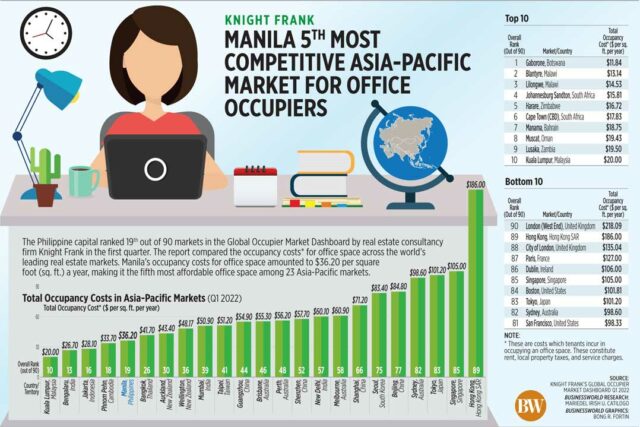
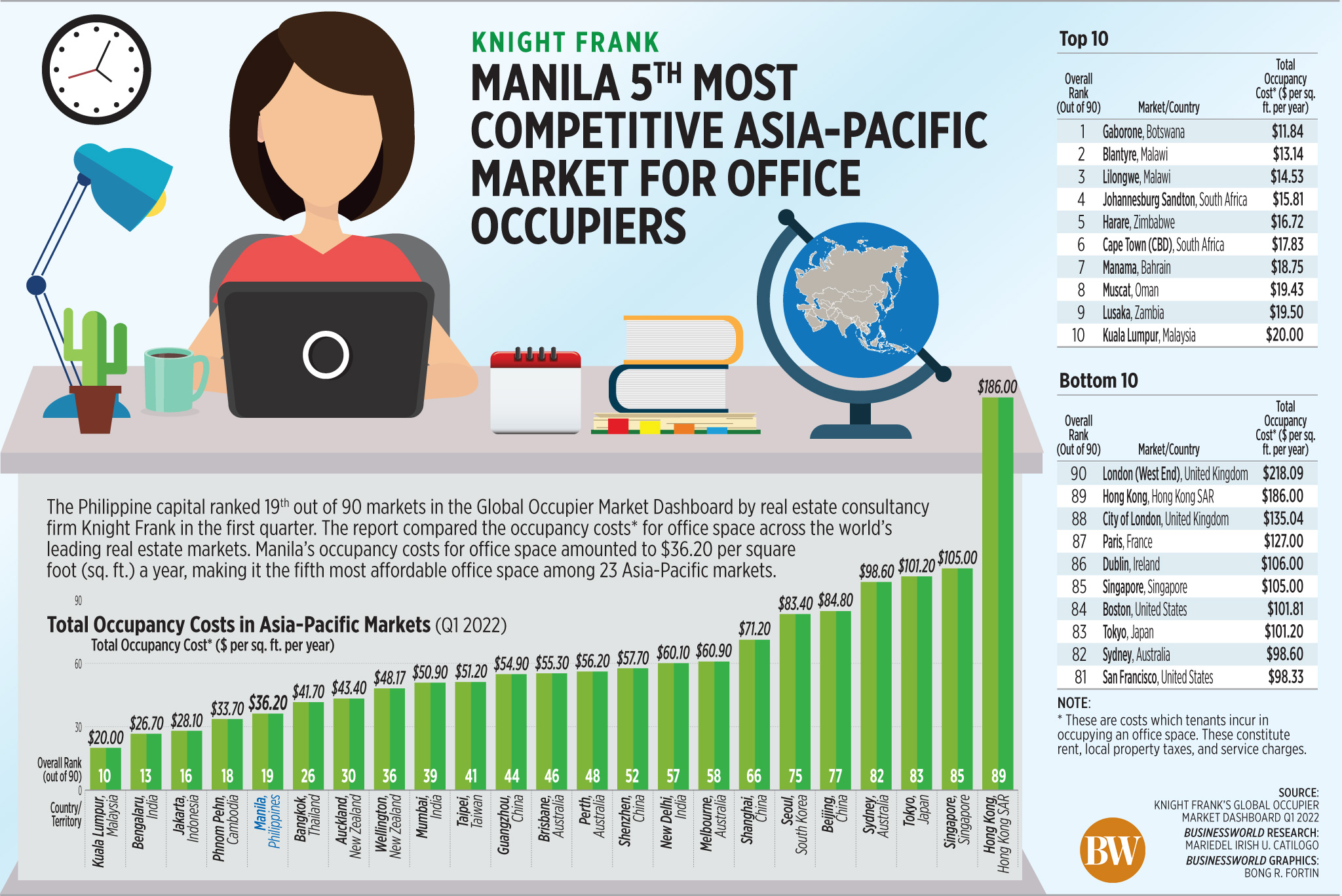
Manila 5th most competitive Asia-Pacific market for office occupiers

The Philippine capital ranked 19th out of 90 markets in the Global Occupier Market Dashboard by real estate consultancy firm Knight Frank in the first quarter. The report compared the occupancy costs* for office space across the world’s leading real estate markets. Manila’s occupancy costs for office space amounted to $36.20 per square foot (sq. ft.) a year, making it the fifth most affordable office space among 23 Asia-Pacific markets.

Manila 5<sup>th</sup> most competitive Asia-Pacific market for office occupiers

Stocks extend rally as investors pick up bargains

BW FILE PHOTO

PHILIPPINE SHARES extended their rally on Thursday on bargain hunting and ahead of the release of July inflation data.

The 30-member Philippine Stock Exchange index (PSEi) rose by 53.03 points or 0.82% to close at 6,483.11 on Thursday, while the broader all shares index increased by 24.93 points or 0.72% to 3,461.76.

“Philippine shares [were] bought as investors picked up heavily beaten stocks ahead of the latest CPI (consumer price index) print [on Friday] and with the rising US-China tensions at the backseat,” Regina Capital Development Corp. Head of Sales Luis A. Limlingan said in a Viber message.

“The local bourse rallied once again, up by 53.03 points [or] 0.82%, to 6,483.11 as foreigners continued to bargain hunt, registering a net buying of P315.55 [million],” Philstocks Financial, Inc. Research Analyst Claire T. Alviar said in a Viber message.

“Stocks in the US gained overnight as the view on the US economy improved following the strong ISM (Institute for Supply Management) non-manufacturing PMI (Purchasing Managers’ Index),” Ms. Alviar added.

The US service sector unexpectedly recovered in July, with strong new orders, supporting the view that the economy is not in recession despite the weak output in the first half of the year, Reuters reported.

The ISM’s non-manufacturing PMI ended three consecutive months of decline with a reading of 56.7 last month from 55.3 in June. A figure above 50 points to an expansion in the services sector that accounts for more than two-thirds of US economic activity.

Back home, all sectoral indices ended in the green on Thursday. Services climbed by 22.40 points or 1.33% to 1,699.92; industrials went up by 101.94 points or 1.07% to 9,609.50; property rose by 24.53 points or 0.85% to 2,908.24; financials increased by 11.39 points or 0.75% to 1,524.74; holding firms added 17.97 points or 0.29% to end at 6,155.58; and mining and oil gained 20.47 points or 0.17% to 11,609.09.

Value turnover went down to P5.84 billion on Thursday with 591.26 million shares changing hands from P6.52 billion with 502.37 million issues seen on Wednesday.

Advancers outnumbered decliners, 98 versus 78, while 49 names closed unchanged.

Net foreign buying went down to P315.55 million on Thursday from the P726.48 million seen the previous trading day.

“I think that overall market sentiment is slowly turning bullish as investors saw foreign flows coming in the PSEi,” Mercantile Securities Corp. Head Trader Jeff Radley C. See said in a Viber message.

Mr. See placed the PSEi’s support between 6,200 and 6,350 and resistance at 6,500-6,800, while Philstocks’ Ms. Alviar put support at 6,100-6,150 and resistance at 6,400. — Justine Irish D. Tabile with Reuters

Peso rebounds vs dollar on lower oil prices, PHL stocks’ 3-day rally

BW FILE PHOTO

THE PESO rebounded against the dollar on Thursday as global oil prices declined and on positive market sentiment as the country’s benchmark stock index rose for the third straight day.

The local unit closed at P55.60 per dollar on Thursday, gaining 14 centavos from its P55.74 finish on Wednesday, based on Bankers Association of the Philippines data.

The peso opened Thursday’s session at P55.68 versus the dollar. Its weakest showing was at P55.775, while its intraday best was at P55.58 against the greenback.

Dollars exchanged went up to $986.6 million on Thursday from $922.1 million on Wednesday.

The peso strengthened as global oil prices declined to multi-month lows, Rizal Commercial Banking Corp. Chief Economist Michael L. Ricafort said in a Viber message. 

Fuel prices dropped to their weakest levels since February, or when the Russia-Ukraine war started, after US data showed crude and gasoline stockpiles unexpectedly surged last week.

Additionally, the Organization of the Petroleum Exporting Countries (OPEC) and allies including Russia agreed to raise its oil output target by 100,000 barrels per day, equal to about 0.1% of global oil demand.

The peso also rose following gains in the local stock market, Mr. Ricafort said.

The bellwether Philippine Stock Exchange index (PSEi) rose by 53.03 points or 0.82% to close at 6,483.11 on Thursday. The broader all shares index also increased by 24.93 points or 0.73% to 3,461.76.

“The peso and PSEi also gained after generally better corporate earnings or results, as well as the recent net foreign buying at the local stock market for the third straight day,” Mr. Ricafort said.

“The peso strengthened ahead of a potentially stronger Philippine inflation report [on Friday],” a trader added in an e-mail.

A BusinessWorld poll of 14 economists last week yielded a median estimate of 6.2% for July headline inflation, within the Bangko Sentral ng Pilipinas’ forecast of 5.6% to 6.4% for the month.

If realized, this would be a tad faster than the 6.1% reading in June, which was already a near four-year high, as well as the 3.7% posted in July last year.

For Friday, the trader said the peso might depreciate anew ahead of the release of latest US jobs data over the weekend.

Both the trader and Mr. Ricafort expect the peso to move within P55.50 to P55.70 per dollar on Friday. — K.B. Ta-asan

FTA signing with South Korea expected by November — DTI

REUTERS

A FREE trade agreement (FTA) between the Philippines and South Korea is expected to be signed by November, according to the Department of Trade and Industry (DTI).

“The feedback that I got from the team that is working on (the FTA) is that the target date for signing is November this year,” Trade Secretary Alfredo E. Pascual told reporters on the sidelines of the Israel Chamber of Commerce of the Philippines’ 26th General Membership Meeting in Makati City late Wednesday.

The Philippines and South Korea began FTA negotiations in June 2019 and concluded in October 2021.

Once in force, the FTA is expected to generate more investment and jobs, alongside expanded trade.

Some of the Philippine products covered by the FTA are banana, pineapple, and other tropical fruit. South Korean products that will enjoy free-trade privileges include vehicles and auto parts.

In October, the DTI announced that Philippine banana exports to South Korea will be charged zero duties in five years while processed pineapple exports will be duty-free in seven years.

It added that the tariffs on some South Korean automotive parts will be eliminated in five years.

Mr. Pascual said it is also possible to elevate the investment promotion and protection agreement (IPPA) between the Philippines and Israel into an FTA.

“Everything is possible. I hope we can build up the trade between the two countries,” Mr. Pascual said.

The Philippines and Israel signed their IPPA on June 7.

“Israeli investors and businesses may continue to find the Philippines a suitable destination for investments a source of a talented (workers); and an enabling environment with a robust regime for strategic trade management and intellectual property and data protection,” Mr. Pascual said.

Mr. Pascual said he hopes to start FTA negotiations with other countries like the US.

“We don’t have an FTA with the US yet; we don’t have an FTA with the European Union yet,” Mr. Pascual said.

He also confirmed that the renewal of Philippine participation in the US Generalized System of Preferences (GSP) is under negotiation.  

“We have a team already talking to the US counterparts on that,” Mr. Pascual said.

Eligibility for the GSP expired at the end of 2020. The GSP program permitted duty-free entry of more than 5,000 Philippine products into the US, such as electronics and agricultural products. 

Separately, Mr. Pascual confirmed that the DTI is currently reviewing the suggested retail price (SRP) list for school supplies.

He said that the DTI is aiming to release the SRP before the start of five-days-a-week in-person classes by November. The formal start of the 2022-2023 school year is Aug. 22.

“I saw the SRP, the range is very wide. It should include specifications (of various products). It does not indicate the type of notebook or how many leaves,” Mr. Pascual said. — Revin Mikhael D. Ochave