Home Blog Page 5622

PHL’s flora and fauna, festivities take center stage at anello’s grand bag exhibit

Present during the ribbon cutting of the exhibit are anello Director Marnie Chua, anello Creative Director Hiroshi Takemoto, Rozelle Reig of GK College, anello Brand Director Meiko Hamasu and GK College’s Fine Arts Department Dean and multi-awarded Filipino fine artist, Professor Aladin Antiqueño.

Japanese brand collaborates with local art school, Pinoy artists for first-ever bag painting competition

Japanese backpack brand anello put the spotlight on the Philippines’ colorful festivities and diverse flora and fauna at the culminating activity of the brand’s 5th anniversary on Friday, July 29, 2022 at the @Tokyo Store PH in Uptown Mall BGC.

Wrapping up the brand’s first-ever bag painting competition is the grand Fine Art Bag Exhibit featuring over 50 delicately and intricately anello bags designed by our very own local artists.  This exhibit housed at the flagship store will run until July 31, 2022.

Making a lasting partnership with Global Knowledge College

Marking its fifth year in the Philippines, anello collaborated with Global Knowledge College and various Filipino artists for the Paint-Your-Bag Contest. Each unique, hand-painted anello bag showcased the beauty of the Philippine heritage and biodiversity and highlighted Pinoy artists’ ingenuity and creativity.

Global Knowledge College is one of the country’s premier art schools. It is recognized nationwide for being one of the best in the field of realism and traditional painting. The school provided the 2-Year Fine Arts Degree scholarship grant to the competition’s winners as well as training discount vouchers at GK College of Fine Arts.

During the three-leg Paint-Your-Bag Contest, GK College’s Fine Arts Department Dean and multi-awarded Filipino fine artist, Professor Aladin Antiqueño shared a lot of insights to the participants. He was also one of the judges along with the representatives of GK College’s Fine Arts Department, United Fine Artists of the Philippines, Philippine Art Restorers Society of the Philippines and Asia, and anello’s Creative Director Mr. Hiroshi Takemoto who chose the winners at the culminating event.

Celebrating the talent and skills of Filipino artists

More than it being a competition, Paint-Your-Bag was a celebration of the talent and skills of Filipino artists.

Santiago Balase emerged as a winner with his “Ugnayan” bag design concept. Meanwhile, “Kurales” of Oliver P. Ornido Kurales and “Look and Listen” of Albert Cabagay were selected as the runners up for the bag painting contest.

A total of 55 artists, joined the three-leg competition. Each of them wowed the crowd with their talent and skills as they showed various perspectives of the country’s festivals and local flora and fauna.

Check out anello’s grand bag exhibit!

Truly, anello’s fifth anniversary is the best of both worlds!

Get ready to be amazed by the richness of Filipino culture and the versatility and quality of Japanese-made bags at the grand Fine Art Bag Exhibit. Head to the @Tokyo Store PH in Uptown Mall in BGC. And see for yourself the creativity that Filipino artists have showcased at the competition.

This is also your chance to cop one of these unique, hand-painted bags. For every purchase of these limited-edition bags, you can get a chance to help the artist, GK students, as well as the selected local charities since the proceeds of Paint-Your-Bag will be donated to them.

What are you waiting for? Celebrate anello through art by dropping by the @Tokyo Store PH in Uptown Mall, BGC on July 29-31!


Spotlight is BusinessWorld’s sponsored section that allows advertisers to amplify their brand and connect with BusinessWorld’s audience by enabling them to publish their stories directly on the BusinessWorld Web site. For more information, send an email to online@bworldonline.com.

Join us on Viber to get more updates from BusinessWorld: https://bit.ly/3hv6bLA.

Keifer Ravena’s PBA comeback not in next two conferences

KIEFER RAVENA — B LEAGUE

Kiefer Ravena’s PBA comeback won’t be happening in the ongoing Season 47 hostilities.

Mr. Ravena signed a fresh contract with Japanese club Shiga Lakes for the B. League’s 2022-23 B. League season, ending hopes of his return to the NLEX Road Warriors’ fold in the PBA’s next two conferences.

With blessing from the PBA and his mother club NLEX, played for Shiga last year and averaged 13.16 points, 5.84 assists, 2.41 rebounds and 1.48 steals in 56 outings.

After his first season in Japan, he returned home to reunite with the Road Warriors in the ongoing Philippine Cup but failed to strike a deal with the team. Ravena proposed to play one conference but NLEX wanted him for a full year.

PBA commissioner Willie Marcial said won’t stand in the way of Mr. Ravena’s extended Japan stint. However, he stressed the 28-year-old Mr. Ravena will have to abide by the league’s policy on returning players from leagues overseas.

“Based sa policy kailangang makabalik siya within two years. Kapag hindi siya nakabalik within that period, waiting siya for the next three years bago siya makabalik sa PBA,” Mr. Marcial told The STAR.

According to Mr. Marcial, Mr. Ravena has until September of next year to go back to the PBA without having to go through the extra three-year “waiting” period.

Ravena’s status is similar to that of Bobby Ray Parks, who inked a renewal with Nagoya for the next two seasons.

The PBA is also enforcing a policy on eligible college graduates who decide not to apply for the draft and play overseas first.

Mr. Marcial said these players must enter their names within three years of their draft eligibility. Otherwise, they face an additional two-year wait.

This rule applies to Mr. Ravena’s brother Thirdy and La Salle’s Justin Baltazar, who are both in the B. League. — Olmin Leyba

More Chinese women delay or give up on having babies after zero-COVID ordeal

STOCK PHOTO | Image by Chu Viết Đôn from Pixabay

 – Seeing Chinese authorities exercise extraordinary powers during a stringent COVID-19 lockdown in Shanghai earlier this year altered Claire Jiang’s life plans: she no longer wants to have babies in China.

During the April-May lockdown, the hashtag “we are the last generation” briefly went viral on Chinese social media before being censored.

The phrase echoed the response of a man who was visited by authorities in hazmat suits threatening to punish his family for three generations for non-compliance with COVID rules.

“That really resonated,” said Jiang, who internalized the man’s remark as her own answer to the motherhood question.

“I definitely don’t want my children to have to carry the uncertainty of living in a country where the government can just come to your door and do whatever they want,” said the 30-year-old, who works in the media industry.

Studies have shown that pandemics and economic uncertainty historically weigh on birth rates around the world.

But, particular to China, its uncompromising “zeroCOVID” policy of promptly stamping out any outbreaks with strict controls on people’s lives may have caused profound damage on their desire to have children, demographers say.

Accounts of people losing income or not having access to healthcare or food, or of authorities forcefully entering homes to take people to quarantine centers, including elderly and children, abounded during lockdowns in Shanghai and elsewhere.

Demographers say people’s feelings of losing control over their lives from events like those can have major consequences on parenthood goals.

“China is obviously big government and small family,” said prominent Chinese demographer Yi Fuxian. “China’s zeroCOVID policy has led to a zero economy, zero marriages, zero fertility.”

China’s National Health Commission and its Family Planning Commission did not immediately respond to requests for comment.

Chinese authorities have repeatedly said zeroCOVID is necessary to save lives, pointing to the millions of deaths around the world compared to only 5,226 officially reported in China since the start of the pandemic.


BAD SIGNS

A July United Nations report predicts China’s population of 1.4 billion may start to decline as early as next year, when India will overtake it as the world’s most populous country.

UN experts now see China’s population shrinking by 109 million by 2050, more than triple the decline of their previous forecast in 2019.

A separate UN China report said the pandemic had a long-term impact on first births, with women citing financial insecurity, unsubstantiated worries about COVID vaccines affecting fetuses, along with difficulties in carrying a pregnancy and taking care of an infant under heavy restrictions.

“Couples that may have been thinking about having a child in the next year, definitely postponed those. Couples that really weren’t sure, have postponed indefinitely,” said Justine Coulson, the UN Population Fund Representative to China.

New births are set to fall to record lows this year, demographers say, dropping below 10 million from last year’s 10.6 million babies – which were already 11.5% lower than in 2020.

Official 2022 population data is not expected until early next year, but some places in China have published worrying statistics in recent weeks.

Screening for birth defects – a reliable proxy for birthrates – in China’s third most populous province Henan fell 9.5% year-on-year in the first six months.

Cities elsewhere reported double-digit drops in new birth certificates. Jiaozhou, a city of 1 million in Shandong province, saw a 26% drop in the first six months. Hukou, in Jiangxi province, saw a 42% dive.

Corporate earnings statements also provide some hints: formula maker Ausnutria Dairy, diaper producer Aiyingshi and Goodbaby 1086.HK, which makes cribs and strollers, are among firms citing China’s falling births as factors leading to losses in the first half of the year.

None of those figures reflect the impact lockdowns such as those in Shanghai and elsewhere had earlier this year.

But demographers say they do offer a glimpse into how COVID-19 restrictions in 2020 and 2021 affected births and expect 2022 to be worse.

Demographer Yi collated data on infants tuberculosis vaccines, marriage registrations and searches for maternity and baby products on Baidu, China’s main search engine. He estimates COVID will result in 1 million fewer births in 2021 and 2022 combined, and 2023 could be even worse.


ROOT CAUSES

China, which imposed a one-child policy from 1980 to 2015, has officially acknowledged it is on the brink of a demographic downturn.

Its fertility rate of 1.16 in 2021 was below the 2.1 OECD standard for a stable population and among the lowest in the world.

Over the past year or so, authorities have introduced measures such as tax deductions, longer maternity leave, enhanced medical insurance, housing subsidies, extra money for a third child and a crackdown on expensive private tutoring. Read full story

Still, the desire for Chinese women to have children is the lowest in the world, a survey published in February by think-tank YuWa Population Research showed.

Demographers say measures taken so far are not enough. They cite high education costs, low wages and notoriously long working hours as issues that still need to be addressed, along with COVID policies and economic growth concerns.

A key root cause of low birth rates, according to Peter McDonald, professor of demography at University of Melbourne, is gender inequality, where China is ranked 102nd out of 146 countries by the World Economic Forum.

Jiahui Wu, a 25-year-old financial analyst, said society’s standards for a good mother were strict.

“It seems much easier to be a good father,” she said. “I prefer to have a good career.” – Reuters

Rating agencies expect US spending bill to cut inflation, deficit over time

 – A sweeping bill passed by the US Senate on Sunday and intended to fight climate change, lower drug prices and raise some corporate taxes, will bring down inflation over the medium to long term and cut the deficit, rating agencies Moody’s Investors service and Fitch Ratings told Reuters on Monday.

The legislation, known as the Inflation Reduction Act, however, will not bring down inflation “this coming year or next year,” said Madhavi Bokil, senior vice president at Moody’s Investors Service.

Charles Seville, senior director and Americas sovereigns co-head at Fitch, said that the legislation was disinflationary “but for all the rebranding of the legislation, the impacts on inflation are relatively small and will only really start to compound over the medium and long term as these provisions take effect.”

“We do think that this act will have an impact (of cutting inflation) as it increases productivity,” Bokil said, adding her horizon was two to three years.

The Senate on Sunday passed the $430 billion bill, a major victory for President Joe Biden, sending the measure to the House of Representatives for a vote, likely Friday. They are expected to pass it and send it to the White House for Biden’s signature. Read full story

Republicans, arguing that the bill will not address inflation, have denounced it as a job-killing, left-wing spending wish list that could undermine growth when the economy is in danger of falling into recession.

Ms. Bokil said in the immediate short-term future, inflation was going to be tackled by the Federal Reserve as it raises rates.

Inflation expectations are a key dynamic being closely watched by Fed policymakers as they aggressively raise interest rates to contain price pressures running at four-decade highs. Read full story

While the short-term impact of the legislation on inflation will be modest, the bill still has the potential to bring down inflation expectations, Wendy Edelberg, a senior fellow in economic studies at Washington think tank the Brookings Institution, told Reuters in an email on Monday.

Senate Democrats also said the act will cause a deficit reduction of $300 billion over the next decade while the U.S. Congressional Budget Office said the bill would decrease the federal deficit by a net $101.5 billion over that period. The CBO estimated in May that the 2022 federal budget deficit would be $1.036 trillion.

Asked about how the legislation would impact the budget deficit, Bokil said: “The savings from the Medicare side as well as the tax changes will more than offset the extra cost.”

Mr. Seville also said that the bill will reduce deficits and help contain rising healthcare costs.

The legislation aims to reduce prescription drug costs by allowing Medicare, the government-run healthcare plan for the elderly and disabled, to negotiate prices on a limited number of drugsRead full story

Ms. Edelberg also said the bill will lead to “greater corporate tax revenue than we otherwise would see”, which will offset the cost and control the deficit.

Moody’s said that the spending bill was complementary to another bill recently passed by Congress, which aimed to subsidize the U.S. semiconductor industry and boost efforts to make the United States more competitive with China.

“They move in the same direction, so the Chips Act will also help with alleviating some of the supply chain issues,” Bokil added. – Reuters

Ukraine, Russia trade blame for nuclear plant shelling amid global alarm

UKRAINE and Russian flags are seen through broken glass in this illustration taken March 1, 2022. — REUTERS

 – Kyiv and Moscow traded blame on Monday for the weekend shelling of Ukraine‘s Zaporizhzhia nuclear complex amid international alarm that their battle for control of the plant could trigger catastrophe.

Calling any attack on a nuclear plant “suicidal”, United Nations chief Antonio Guterres demanded U.N. nuclear inspectors be given access to Zaporizhzhia, the largest complex of its kind in Europe.

Russia‘s invading forces seized the southern Ukrainian region containing Zaporizhzhia in March, when the site was struck without damage to its reactors. The area, including the city of Kherson, is now the target of a Ukrainian counter-offensive. Read full story

Ukraine appealed for the area around the complex to be demilitarized and for the International Atomic Energy Agency, the U.N.’s nuclear watchdog, to be let in. Russia said it too favored an IAEA visit, which it accused Ukraine of blocking while trying to “take Europe hostage” by shelling the plantRead full story

Ukraine blamed Russia for weekend attacks around the complex, which is still being run by Ukrainian technicians. It said three radiation sensors were damaged and two workers injured by shrapnel.

As of Monday morning, the plant appeared to still be running, said Petro Kotin, head of Ukraine‘s state nuclear power company Energoatom. He said 500 Russian soldiers and 50 pieces of heavy machinery, including tanks, trucks and armored infantry vehicles were at the site. Read full story

The Ukrainian staff at the plant had nowhere to shelter, he added.

Reuters could not independently verify either side’s account.

Mr. Kotin called for peacekeepers to run the Zaporizhzhia site, flagging the risk of shells hitting its six containers of highly radioactive spent nuclear fuel. In an evening video shared online, Ukrainian President Volodymyr Zelenskiy called for new Western sanctions on Russia‘s nuclear industry “for creating the threat of a nuclear disaster.”

Dr. Mark Wenman, a nuclear expert at Imperial College London, played down the risk of a major incident, saying the Zaporizhzhia reactors were relatively robust and the spent fuel well protected.

“Although it may seem worrying, and any fighting on a nuclear site would be illegal …the likelihood of a serious nuclear release is still small,” he said in a statement.


WORKING UNDER ‘RUSSIAN GUNS’

Yevhenii Tsymbaliuk, Ukraine‘s ambassador to the IAEA, said Zaporizhzhia staff were “working under the barrels of Russian guns”. Read full story

Meanwhile, Russia‘s defense ministry said Ukrainian attacks had damaged power lines servicing the plant and forced it to reduce output by two of its six reactors to “prevent disruption”. Read full story

The U.N.’s Guterres said IAEA personnel needed access to “create conditions for stabilization”.

“Any attack (on) a nuclear plant is a suicidal thing,” he told a news conference in Japan, where he attended the Hiroshima Peace Memorial Ceremony on Saturday to commemorate the 77th anniversary of the world’s first atomic bombing.

The world’s worst civil nuclear disaster occurred in 1986 when a reactor at the Chornobyl complex in northwest Ukraine exploded. Soon after this year’s Feb. 24 invasion, Russian troops occupied that site, withdrawing in late March.

Ukraine has said it is planning to conduct a major counter-offensive around Kherson and that it has already retaken dozens of villages.

Its forces are also fighting to retake areas near Kharkiv in the north, where Russian forces launched artillery strikes on Monday, Ukraine‘s general staff said.

In Ukraine‘s Donetsk region, where pro-Moscow separatists seized territory after the Kremlin annexed Crimea to the south in 2014, Russia was “using all available fire power…to try and inflict maximum losses on Ukrainian units to prevent them from reinforcing other areas,” the general staff added.

Stepping up its fiscal aid and military spending on Ukraine, Washington announced it will send $4.5 billion in budgetary support and $1 billion in weapons, including long-range rocket munitions and armored medical transport vehicles. Overall, the United States has contributed more than $18 billion to Ukraine this year. Read full story

Russia‘s foreign ministry meanwhile told the United States it was suspending inspection activities under their START nuclear arms control treaty, though it said Moscow remained committed to the treaty’s provisions.


GRAIN EXPORTS PICK UP

Adding weight to a rare diplomatic success since the war began, a deal to unblock Ukraine‘s food exports and ease global shortages gathered pace as two grain ships carrying almost 59,000 tons of corn and soybeans sailed out of Ukrainian Black Sea ports.

That raised the total to 12 since the first vessel left a week ago. Read full story

The July 22 grain export pact, brokered by Turkey and the United Nations, was further underpinned as the parties issued procedures for merchant ships carrying Ukrainian grain, including a 10-nautical-mile military exclusion zone, according to a document seen by Reuters. Read full story

Before the invasion, Russia and Ukraine together accounted for nearly a third of global wheat exports.

Russia says it is waging a “special military operation” in Ukraine to rid it of nationalists and protect Russian-speaking communities. Ukraine and the West describe Russia‘s actions as an unprovoked war of aggression.

The conflict has displaced millions, killed thousands of civilians and left cities, towns and villages in ruins. – Reuters

US okays first Boeing 787 Dreamliner delivery since ’21 -sources

YASSINE KHALFALLI-UNSPLASH

 – The US government on Monday approved the first Boeing Dreamliner for delivery since 2021, clearing the way for American Airlines to take possession, people briefed on the matter told Reuters.

American Airlines said it expects to receive its first Boeing 787 delivery of the year as early as Wednesday and that the plane will enter commercial service in the coming weeks. The plane is its first 787 delivery since April 2021.

Earlier on Monday, the Federal Aviation Administration (FAA) said it expected Boeing to resume deliveries of its 787 in coming days after the manufacturer made inspection and retrofit changes needed to meet certification standards.

Boeing halted deliveries in May 2021 after the FAA raised concerns about its proposed inspection method. In September 2020, the FAA said it was investigating manufacturing flaws in some 787 jetliners.

American Airlines said on a July earnings call it expects to receive nine 787s this year, including two in early August. It has 42 on order, excluding the plane it expects to receive this week.

Boeing said it continues “to work transparently with the FAA and our customers towards resuming 787 deliveries.”

Last month, the FAA approved Boeing‘s plan for specific inspections to verify the airplane meets requirements and that all retrofit work has been completed.

Boeing has about 120 787s awaiting delivery. The FAA said it “will inspect each aircraft before an airworthiness certificate is issued and cleared for delivery.” Typically the FAA delegates airplane ticketing authority to the manufacturer but in some instances like the 737 MAX it has retained responsibility for approving each new airplane.

In the aftermath of two fatal 737 MAX crashes in 2018 and 2019, the FAA pledged to more closely scrutinize Boeing and delegate fewer responsibilities to Boeing for aircraft certification.

On Thursday, Acting FAA Administrator Billy Nolen met with FAA safety inspectors in South Carolina as the agency mulled whether to allow Boeing to resume 787 deliveries.

Before Boeing suspended production, the FAA had previously issued two airworthiness directives to address production issues for in-service airplanes. It identified a new issue in July 2021.

The plane maker had resumed deliveries in March 2021 after a five-month hiatus before halting them again. The FAA said earlier it wanted Boeing to ensure it “has a robust plan for the re-work that it must perform on a large volume of new 787s in storage” and that “Boeing’s delivery processes are stable.”

In January, Boeing disclosed a $3.5 billion charge due to 787 delivery delays and customer concessions, and another $1 billion in abnormal production costs stemming from production flaws and related repairs and inspections. – Reuters

Factory output up 2.4% in June

The factory output steadily grew in June, the Philippine Statistics Authority (PSA) reported on Tuesday.

The preliminary results of the Monthly Integrated Survey of Selected Industries by the PSA showed that the manufacturing output, as measured by the volume of production index, grew by 2.4% year-on-year in June.

This was higher than the revised 0.9% in May and significantly lower than 448.8% last year.

It was the second straight month of growth after the revised 0.2% decline in April.

The manufacturing output averaged 29.7% in the first half of the year.

Thirteen industry divisions contributed to the VoPI growth in June, led by machinery and equipment except electrical (45.3% from 52.1% in May), followed by fabricated metal products, except machinery and equipment (31.4% from 30.7%), and wood, bamboo, cane, rattan articles, and related products (31% from 24.7%).

In comparison, the country’s manufacturing purchasing managers’ index (PMI) in June was registered at 53.8, easing from 54.1 reading in May. A reading of the PMI above 50 establishes an improvement in the business conditions from the previous month.

The capital utilization averaged 71.1% in June, higher than May’s 70.9%. Out of the 22 sectors, 20 industry divisions have reached an average capacity utilization rate of at least 60%. — KAB

June trade deficit widens to record $5.8 billion

The country’s merchandise trade deficit hit another record in June despite slowdowns in annual growth of imports and exports, the Philippine Statistics Authority (PSA) reported on Tuesday.

Preliminary data from the statistics agency showed imports grew by 26% annually to $12.487 billion in June. This was slower than the revised 30.2% in May and 42.4% in June 2021.

The year-on-year increase of imports eased to its lowest in three months, or since the 23.4% in March.

June marked the 17th straight month of imports growth.

Meanwhile, exports inched up by 1% year on year to $6.644 billion in June, slower than the revised 6.4% in May and 18.9% in June last year.

It was the lowest annual growth in 16 months, or since the 1.4% contraction in February 2021.

This brought the balance of trade in goods — the difference between exports and imports — at a record monthly deficit of $5.843 billion in June.

It was wider than the $3.331-billion gap in the same month last year and the revised $5.556-billion deficit in May.

Meanwhile, total trade — the sum of exports and imports — rose by 16.1% to $19.131 billion. The pace of growth was lower than the revised 20.8% in May, and 32% in June a year ago.

In the first six months of 2022, imports grew by 26.7% year on year to $68.320 billion. The growth rate was well-above the economic managers’ upwardly revised 18% target for this year.

Exports likewise rose by 7.1% to $38.527 billion, slightly above the 7% growth target set by the interagency Development Budget Coordination Committee (DBCC) for the year.

Year to date, the trade balance ballooned to a $29.793-billion deficit from $17.953-billion trade gap a year ago.

According to the PSA, import figures for 2021 with reference months June to December except for November and 2022 figures for January to May were revised due to exclusion of duplicate transactions identified by the Bureau of Customs.

It added that these transactions came from the withdrawal of manufactured goods from the freeport zone area. — AMPY

Pop music and Grease star Olivia Newton-John, 73

Olivia Newton-John in Grease (1978).

SINGER Olivia Newton-John, who soared to the top of the world’s pop music charts in the 1970s and 1980s with such tunes as “I Honestly Love You” and “Physical” and starred in the hit movie musical Grease, died on Monday at age 73 at her home in Southern California.

The death of the British-born, Australian-raised performer was announced on her Instagram account, saying she “passed away peacefully” at her ranch home “surrounded by family and friends.”

Ms. Newton-John, a four-time Grammy winner, had disclosed in 2017 that a recurrence of breast cancer had metastasized and spread to her lower back, forcing her to cancel performances. Twenty-five years earlier Newton-John had undergone a partial mastectomy, leading her to become an advocate for breast cancer research and other health issues and to establish a cancer treatment-research facility in Australia.

The entertainer began performing as a child and became a global superstar after moving to the United States. She was blond, blue-eyed, and brimming with wholesomeness when she had her first hit in 1971 with “If Not for You” —  a Bob Dylan song that also had been recorded by George Harrison.

It would be followed in the next few years by “Let Me Be There,” which won her a Grammy for best female country vocal performance, “If You Love Me (Let Me Know),” and two No. 1 songs, “Have You Never Been Mellow” and “I Honestly Love You.” The latter song won Grammys for best female pop performance and record of the year.

Ms. Newton-John also clinched the Country Music Association’s female singer of the year title in 1974, edging out such homegrown American stars as Loretta Lynn and Dolly Parton. The unlikely success of an Australian performing country-flavored pop songs bothered many Nashville purists at the time.

Critics did not always care for Newton-John’s work, often finding her style frothy and overly commercial. The New York Times once described her voice as “nearly colorless.”

MOVIE STARDOM WITH GREASE
But the criticism did not hurt Ms. Newton-John’s sales, and she cemented her acclaim by co-starring with John Travolta in Grease, the 1978 film that would become one of the most popular musicals in Hollywood history.

In the film, set in the 1950s, Ms. Newton-John’s prim character, Sandy, has a summer fling with Danny, the “greaser” portrayed by Mr. Travolta, but the relationship falls apart over cultural differences. In the end they reconcile as their roles reverse, with Danny cleaning up his act, and Sandy making a striking appearance in a tight, black leather outfit.

Mr. Travolta, 68, addressed a tribute to his co-star on Instagram, saying her “impact was incredible.”

“My dearest Olivia, you made all of our lives so much better,” the actor wrote. “I love you so much. We will see you down the road and we will all be together again. Yours from the first moment I saw you and forever! your Danny, your John!”

The film’s producer, Allan Carr, had sought Ms. Newton-John for the female lead after being impressed by her at a dinner party, and Mr. Travolta also urged her to take the part.

The singer was initially reluctant because of her negative experience in the awkwardly titled 1970 British film flop Toomorrow and worried about hurting her recording career. She also was concerned about doing an American accent, so the part was rewritten to make Sandy an Australian.

The film, based on the 1972 Broadway hit musical of the same name, was a major critical and commercial success, and its soundtrack generated a string of hits, including the title song, Newton-John’s “Hopelessly Devoted to You,” “Summer Nights,” and her bouncy duet with Travolta, “You’re the One That I Want.”

“I’m grateful for Grease,” she told the Detroit News in 2016. “The movie and the songs are still so loved.”

Her next musical film, Xanadu in 1980, was a bust but did give Newton-John more hits in the title song and “Magic,” which reached No. 1.

In 1981 Newton-John scored her biggest hit single, “Physical.” The song’s accompanying video featured her in work-out clothes and a headband, which fueled a fashion trend. Its sex-infused lyrics (“there’s nothing left to talk about unless it’s horizontally, let’s get physical”) eroded her good-girl image and led some radio stations to ban it.

Newton-John’s career cooled off after “Physical” but in 2015 she had another No. 1 hit on the dance charts —  “You Have to Believe,” a revamped version of “Magic” performed with her only child, Chloe Lattanzi.

She would make another movie with Travolta, Two of a Kind in 1983, and they recorded an album of Christmas songs in 2012.

Ms. Newton-John, whose sister died of brain cancer, became an advocate after her first bout with breast cancer, and she founded the Olivia Newton-John Cancer Wellness and Research Center in her hometown of Melbourne. She also marketed what was known as the Olivia Breast Self-Exam Kit.

Ms. Newton-John, whose grandfather was German-born, Nobel Prize-winning physicist Max Born, finished fourth in the 1974 Eurovision Song Contest, representing the United Kingdom.

Her first marriage, to Xanadu actor Matt Lattanzi, ended in divorce in 1995, and in 2008 she married businessman John Easterling. — Reuters

Philippines Q2 GDP grows 7.4% year on year

STOCK PHOTO | Image Dmitry Berdnyk from Unsplash

MANILA – The Philippine economy expanded less than expected in the second quarter, but at pace still in line with the official 2022 growth target, giving the central bank leeway to further tighten monetary policy to curb red-hot inflation.

The Southeast Asian country’s gross domestic product was 7.4% higher in the June quarter than a year earlier, growing more slowly than the downwardly revised 8.2% annual rate seen in the previous quarter and the median 8.6% forecast in a Reuters poll.

It was the slowest growth in three quarters but the second-fastest so far in Asia for the second quarter, Economic Planning Secretary Arsenio Balisacan said.

The Bangko Sentral ng Pilipinas (BSP) has flagged the possibility of raising key interest rates further by 50 basis points at its Aug. 18 policy meeting, confident the economy can withstand a less accommodative policy.

It has raised interest rates by a total 125 basis points since the start of the year to tame inflation, which soared to its fastest pace in nearly four years in July.

Mr. Balisacan attributed the second-quarter growth rate to strong construction and household consumption, among other factors.

He said the country’s economic recovery remained strong, with the second-quarter performance in line with this year’s growth target for full-year GDP of 6.5% to 7.5%.

The administration of President Ferdinand Marcos, whose six-year term began on June 30, is further targeting growth in full-year GDP of 6.5%-8.0% annually from 2023 to 2028.

Marcos, who is concurrent agriculture secretary, has vowed to turn the long-neglected farm sector into an engine of growth and to focus on fiscal management and infrastructure upgrades to sustain the economy’s rebound from the pandemic. — Reuters

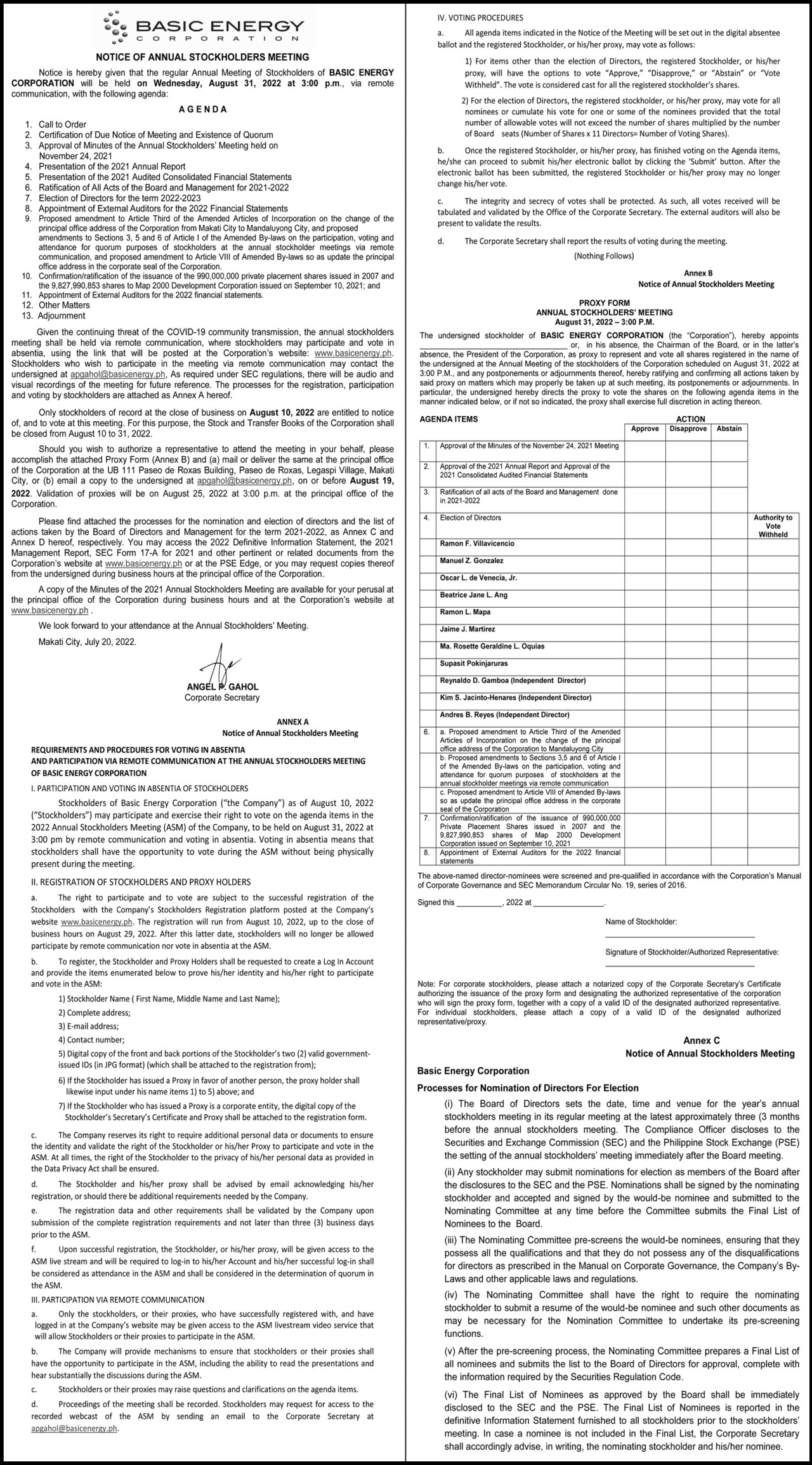
Basic Energy Corporation to conduct annual stockholders’ meeting via remote communication on August 31

Click to enlarge.
Click to enlarge.


Spotlight is BusinessWorld’s sponsored section that allows advertisers to amplify their brand and connect with BusinessWorld’s audience by enabling them to publish their stories directly on the BusinessWorld Web site. For more information, send an email to online@bworldonline.com.

Join us on Viber to get more updates from BusinessWorld: https://bit.ly/3hv6bLA.

YCH Group: Serving world-class customers for more than 60 years

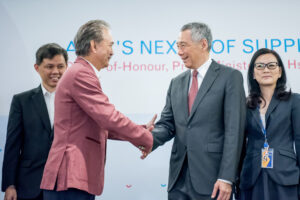
YCH Group, Asia’s leading supply chain and logistics provider has been in the business, serving world-class customers for more than sixty years. Supply Chain City© (SCC), YCH’s flagship facility in Singapore, was officially launched on Sept. 22, 2017 by Prime Minister of Singapore Lee Hsien Loong. Serving as Asia’s nexus for supply chain excellence, SCC is strategically located in the heart of Jurong Innovation District, with more than $200 million in building investment and covering more than 6.5 hectares of land. It features the world’s first patented Fusionaris® — a fusion between conventional and digital warehousing capabilities made up of Automated Storage and Retrieval System (ASRS) and Ramp up Integrated Solution and manual warehousing facilities. Standing at 50m in height, the ASRS is the tallest in Southeast Asia, designed for scalability and operations around the clock, 24/7 for 365 days.


A key focus of SCC is to add fresh impetus to the industry in terms of innovation and collaboration and to refine the standards of supply chain excellence through its one-of-a-kind LEARN™ ecosystem. The five elements of the LEARN™ ecosystem are Living Supply Chain, Experiential Workplace Learning, Asia’s Network of Supply Chain Thought Leaders, Reinvent Tomorrow, and Nurturing Disruptive Innovators.

The SuperPort™ vision emerged to strengthen logistics and supply chain connectivity in the Asia-Pacific region through technology and innovative solutions. Originated from the ASEAN Business Advisory Council (ASEAN-BAC)’s Smart Growth Connect (SGConnect™) project in 2018, the member states hope to enable cities to grow without growing pains. The launch of the ASEAN Smart Logistics Network (ASLN) in November 2022 further strengthened this project. The ASLN supports the ASEAN Connectivity Master Plan 2025 as a collaborative platform with a shared goal of developing smart and sustainable advancements based on smart logistics infrastructure.

SuperPort™ will be a first-of-its-kind, multi-modal logistics hub that integrates a dry port with an advanced supply chain nerve center that focuses on four key pillars: connectivity, sustainability, scalability, and agility. It will encapsulate the features of SCC and its LEARN™ ecosystem; a Supply Chain and Logistics Academy will be established to equip local workers with the necessary skills to face Industry 4.0 using the Experiential Workplace Learning methodology.

With the growing emphasis on sustainability and green supply chains, YCH Group looks forward to replicating this SuperPort™ project in all ten ASEAN member states in the coming future.


Spotlight is BusinessWorld’s sponsored section that allows advertisers to amplify their brand and connect with BusinessWorld’s audience by enabling them to publish their stories directly on the BusinessWorld Web site. For more information, send an email to online@bworldonline.com.

Join us on Viber to get more updates from BusinessWorld: https://bit.ly/3hv6bLA.