Home Blog Page 5620

NCAA Volleyball Finals: CSB Lady Blazers too good for Arellano U Lady Chiefs

COLLEGE of St. Benilde Lady Blazers. — SYNERGY/GMA NETWORK, INC.

25-21, 25-11, 25-10

COLLEGE of St. Benilde (CSB) coach Jerry Yee knew his team would come in a little rusty going into the opener of their NCAA Season 97 Volleyball title showdown with Arellano University (AU) after an 11-day hiatus.

But the soft-spoken coach was also aware that when the Lady Blazers get going, nothing, not even the reigning three-peat champions like the Lady Chiefs, could stop them.

Overcoming opening-set sluggishness, CSB showed little mercy in its 25-21, 25-11, 25-10 decimation of a listless AU side yesterday to move on the cusp of sweeping its way to its second league crown at the Filoil EcoOil Arena.

“In the first set we have problems with our game speed, my players had a hard time catching up,” said Mr. Yee, whose charges swept the elimination round in nine games to barge straight into the best-of-three finale.

“But I reminded them of what we should do and I’m glad they responded,” he added.

It was a devastatingly impressive victory for CSB, which could complete a historic sweep if it could repeat over AU, which survived Jose Rizal in the final game of the stepladder semis Sunday, in Game Two tomorrow.

Or the Lady Chiefs could miraculously summon supernatural grit and force a decider on Sunday for a chance at a potential four-peat feat.

But that would be highly unlikely considering CSB has been too good to be true especially on this one for the one-sided triumph that may have broken the will of AU.

Mr. Yee didn’t even call a single time out while counterpart, Obet Javier, stood up for most part of opener, barked instructions and pleaded for his wards to plod on.

The Lady Chiefs never did.

Jhasmin Gayle Pascual presided over the carnage with a match-high 17 points while Michelle Gamit, skipper Francis Mycah Go and Jade Gentapa joined the execution with 11, eight and seven hits, respectively.

Mr. Yee also had the luxury of playing two setters in Cloanne Sophia Mondonedo and Chenae Basarte, who split time and were equally efficient and effective in dishing out excellent set after excellent set that fuelled its relentlessly powerful attacking game.

“It’s the coach’s job to make the games boring and one-sided because if we allow it to be exciting, that’s my fault if we lose,” said Mr. Yee. — Joey Villar

Dollar debts of Globe and SMC ‘sufficiently’ hedged: CreditSights

JCOMP-FREEPIK

By Arjay L. Balinbin, Senior Reporter

GLOBE Telecom, Inc. and San Miguel Corp. (SMC) — on a standalone basis — have sufficiently hedged their US dollar (USD) debts, according to financial research firm CreditSights, Inc.

PLDT, Inc. has substantially hedged its 2031 USD bond, although all of its hedges are currently “out of the money.”

CreditSights noted that many companies fell into distress during the Asian financial crisis in 1997 “due to severe currency risks, which were largely unhedged.”

“The currencies of India, Indonesia and the Philippines have depreciated sharply against the USD in the last 1-1.5 months,” the research firm said in its latest currency risk exposure report on the corporations it covers in the region. Local currencies’ weakness was attributed primarily to the faster pace of US Fed rate hikes as compared to the Asian benchmark rates.

“The Philippine companies… have not fallen into distress due to foreign exchange problems, since these companies are owned and supported by large, long-standing conglomerates.”

According to CreditSights, Globe, whose revenues and costs are mostly in Philippine peso (PHP), has hedged 96% of its $1.1-billion debt with “cross currency swaps and call spread options.”

“A 0.9% depreciation in USD/PHP would reduce profit before tax by P1.3 billion,” it noted.

This means that the company has derivatives in place that “mitigate the risk of their dollar-denominated debts bloating in peso terms due to the latter’s depreciation,” Philstocks Financial, Inc. Senior Research Analyst Japhet Louis O. Tantiangco said in a Viber message.

“The derivatives have pre-arranged conditions which allow their holders to have access of the foreign currency at rates more favorable than what’s going on in the market right now,” he added.

Meanwhile, diversified conglomerate SMC, whose 74% of revenues are in PHP and a substantial portion of costs are in USD, has hedged 88% of its $500-millon bond with cross currency swaps and call spread options.

“A 1% depreciation in USD/PHP would reduce profit before tax by P5 billion,” CreditSights said.

“However, SMC’s USD debt issuing subsidiaries Petron and SMC Global Power have significantly inadequate USD debt hedging measures in place,”  the financial research firm also said.

Oil and gas company Petron, whose 13% of revenues and 53% of costs are in USD, has hedged 4% of its $2.2-billion debt with cross currency swaps and call spread options in the range of P47 to P57.

“A 1% depreciation in USD/PHP would reduce profit before tax by P790 million.”

SMC Global Power Holdings Corp., a power generation company whose revenues are mostly in PHP and costs are mostly in USD, has hedged 3% of its $5.7-billion debt with call spread options in the range of P52.95 to P56.15.

CreditSights said a 1% depreciation in USD/PHP would reduce profit before tax by P2.1 billion.

Meanwhile, PLDT, whose revenues and costs are mostly in PHP, has hedged 50% of its $820-million debt with cross currency swaps and call spread options in the range of P48.64 to P55.28.

“Of which, it hedged 97% of its $300-million 2031 bond in the range of P49.61 to P55.28, but its $300-million 2050 bond is fully unhedged,” the research firm noted.

“We have market perform recommendations on… PLDT… (and) outperform recommendations on SMC and Globe Telecom,” it added.

Finance website Investopedia defines market perform as a “neutral assessment of a stock and is neither strongly positive nor negative.”

“If, however, the stock has gone through a period of market underperformance, it is an indication that the stock is expected to improve its performance relative to market averages.”

Meanwhile, outperform means “the company will produce a better rate of return than similar companies, but the stock may not be the best performer in the index.”

CreditSights said its report is for informational purposes only. “Neither the information contained in this report, nor any opinion expressed therein is intended as an offer or solicitation with respect to the purchase or sale of any security or as personalized investment advice.”

Hastings Holdings, Inc., a unit of PLDT Beneficial Trust Fund subsidiary MediaQuest Holdings, Inc., has a majority stake in BusinessWorld through the Philippine Star Group, which it controls.

Gilas Pilipinas game plan in place for the next window

WHAT doesn’t kill you only makes you stronger.

Friedrich Nietzche’s words ring true for the young guns of Gilas Pilipinas, who expect to come out of their failed campaign in the FIBA Asia Cup better and wiser.

The youth-laden crew sustained a 102-81 loss to hot-shooting Japan Tuesday night at the Istora Senayan in Jakarta, missing out on a quarterfinal ticket. This marked the first time the Filipinos did not reach at least the Last-8 of the Continental meet since 2007. It was also their first loss to the Akatsuki Five in 12 years.

“Obviously, the result is not what we wanted. We’re very sorry that we’ve disappointed a lot of our countrymen, our fellow Filipinos,” said Gilas coach Chot Reyes.”

The veteran coach noted that none of the 12 players in this group had played in the FIBA Asia Cup before.

“We brought a very young team here and the experience and exposure to the kind of intensity and level of play here at the Asian Cup is just going to make them better,” said Mr. Reyes, who once led Gilas to the silver of the FIBA Asia Cup in 2013 en route to a trip to the following year’s FIBA World Cup.

Skipper Kiefer Ravena took the blame for his failure to lead the squad to success.

“I felt like I let the team down, not being the leader they expected. Maraming shortcomings,” said the Japan B. League vet.

“I’m still learning, this being my first time. Not here to make any excuses but I told them this is for the long haul. Whether we play in Japan, PBA, Korea or wherever, this is something we have to really embrace and take into heart, everything that happens here will make us better.”

Gilas will have just a little over a month to regroup with the second round of the FIBA World Cup Asian Qualifiers tipping off next month. The Filipino dribblers open their Group E campaign on Aug. 25 on the road against Lebanon, which handed them a 95-80 beating in the Asia Cup group stage. They host Saudi Arabia four days later.

“We already have a plan in place for the next window,” said Mr. Reyes, maintaining that the Gilas plan actually goes all the way to the global hoopfest in August 2023.

“We’re operating under very difficult circumstances and a lot of restrictions but we’re making do with what we have. In the end, that’s all we can do, take what’s in front of us and just continue plugging away and hopefully, we continue to develop and get better for next year.” — Olmin Leyba

BoI approves P2-billion solar power plant project in Naga

THE BOARD of Investments (BoI) has approved the registration application of PAVI Green Renewable Energy, Inc. for its P2-billion solar power plant project in Naga City, Camariñes Sur which is seen to help address the power demand in Luzon.

In a statement on Wednesday, the BoI said that the project is expected to begin commercial operations by February 2024.

“On the economic aspect, the project will generate 554 jobs during its construction and 21 jobs during its commercial operations. Homing in on innovative ways, the project will use the latest technology in the market through the use of monocrystalline solar panels and string inverters,” the BoI said.

“The project will contribute to the required capacity addition of 73,868 megawatts (MW) that is needed to meet the National Renewable Energy Program target of 81,485 MW for the total installed capacity by 2040 under the Clean Energy Scenario,” it added.

The solar power plant project was approved under Tier 1 based on the 2020 Investments Priorities Plan Listing “Special Laws” (Renewable Energy Act of 2008) of the 2022 Strategic Investment Priority Plan.

According to the BoI, the power demand in Luzon will continue to climb due to the country’s sustained economic growth.

“In 2020, based on the data from the Department of Energy, Luzon contributed 67.9% share of the total installed capacity. Further, in terms of power generation and consumption, Luzon recorded 71.2% and 72.2%, respectively,” the BoI said.

Meanwhile, the BoI said that the solar power plant project also helps the country’s objective of pursuing green projects, as it will release less greenhouse gas emissions into the atmosphere.

“As the Philippines is heading towards a greener and modern economy, projects like this one are consequential for the attainment of the economic goals of the country,” BoI Managing Head Ceferino S. Rodolfo said.

“Also, the solar power plant project of PAVI Green will play a crucial role in building up the capacity needed to sustain electricity demand in Luzon, ensuring an unhampered supply of power to consumers,” he added. — Revin Mikhael D. Ochave

Clash of the titans as Cignal HD Spikers collides with Creamline Cool Smashers

UNBEATEN Cignal HD Spikers. — PVL

CIGNAL and Creamline stake their unbeaten slates as they tangle when the Premier Volleyball League Invitational Conference goes out of town at the Sta. Rosa Sports Complex in Laguna today.

The HD Spikers have roared to a mighty 3-0 start while the Cool Smashers hurdled their first two assignments.

But after their 5:30 p.m. showdown, only one will remain unscathed and on top.

It was a long-anticipated match between the league’s top teams as the two were supposed to meet in the Open Conference finals early this year after sweeping their respective groups.

But some ill twists of fate denied the much-anticipated duel from ever materializing.

Now they have a chance to prove which team is superior.

“Cignal is one of the strongest teams in the conference, that’s why we must prepare,”said Creamline coach Sherwin Meneses.

The Cool Smashers have been drawing strength from version of the Fantastic Four of skipper Alyssa Valdez, setter Jia de Guzman and the power-hitting duo of Tots Carlos and Jema Galanza.

That is why Cignal mentor Shaq delos Santos has constantly pleaded to his charges to keep their laser-like focus to the game.

“I don’t consider our team as one of the strongest. But we have to stay focused on every game. Despite our victories, there’s still a lot to improve in our system, it’s a process,” said Mr. Delos Santos.

Ces Molina has been the most consistent of all as she averaged around 18 points a game.

Setter Gel Cayuna is expected to be activated again after she was rested in Cignal’s 25-23, 25-16, 25-18 demolition of Chery Tiggo Saturday.

Ayel Estranero effectively filled the void in Ms. Cayuna’s absence.

Meanwhile, Petro Gazz (0-3) and Chery Tiggo (0-3) collide at 2:30 p.m. in a match between the league’s winless squads. — Joey Villar

Alternergy project secures P600-M funding from DBP

RENEWABLE ENERGY company Alternergy Holdings Corp. said a mini hydropower project it is co-developing has received approval for P600-million funding support from the Development Bank of the Philippines (DBP).

In a media release on Wednesday, Alternergy said its 4.6-megawatt (MW) Dupinga mini hydropower project, has been backed by DBP’s program that aims to help access to electricity services by financing utility-scale power generation projects.

“We are pleased to receive DBP’s approval of financing as it speaks confidence in our Dupinga Project and our commitment to harnessing renewable energy,” Dupinga Mini Hydro Corp.’s (DMHC) President and Chief Executive Officer Eduardo M. Miranda said.

The run-of-river hydropower project in Gabaldon, Nueva Ecija is being developed by DMHC, a partnership between Alternergy, led by former Energy secretary Vicente S. Pérez, Jr., and Markham Resources Corp., a renewable energy company led by Francisco Tiu Laurel of the Frabelle group of companies.

Mr. Miranda noted that the loan will be a big help as hydropower projects need numerous permits and clearance during their pre-development stage.

“We were one of the few energy projects that commenced construction at the height of the COVID-19 pandemic. The DBP loan will provide strong support to the ongoing construction of the Dupinga Project as we target completion by early 2024,” he added.

The project was awarded a hydropower service contract by the Department of Energy in 2010. The right to further develop the project and utilize the hydro resource was transferred to DMHC in 2017 upon approval by the department.

“DMHC proceeded to conduct extensive technical studies, public consultations, and secured permits,” Alternergy said in the media release.

The project ensures the protection of the ancestral domain and the development of the indigenous people’s community through a memorandum of agreement entered with the Katutubong Dumagat of Central Luzon and the Dupinga project’s Kaagapay ng Komunidad corporate social responsibility program.

DMHC signified its commitment by maintaining the Dupinga watershed, providing local employment — 36 out of 74 workers of the project are from Katutubong Dumagat — and assistance during times of need and emergencies.

Alternergy is a renewable energy holding company with a portfolio of project companies engaged in different projects, particularly wind, run-of-river hydro, solar farm and commercial rooftop, battery storage, and offshore wind projects.

The company has developed 67 MW of operating assets in wind and solar energy and an additional 62 MW of hydro and solar projects under construction.

Alternergy aims to develop up to 1,245 MW of additional wind, offshore wind, solar, and run-of-river hydro projects in the next five years. — Justine Irish D. Tabile

UAAP, NCAA in collegiate preseason tournament

UP Figthing Maroons’ Z. Lucero. — UAAP

UAAP king University of the Philippines and NCAA runner-up Mapua University take centerstage in an explosive duel to banner the return of Filoil EcoOil Preseason Cup for the first time amid the pandemic starting this Saturday.

The Fighting Maroons and the Cardinals meet at 1 p.m. to get the ball rolling in the rousing comeback of the premier collegiate preseason tourney featuring a triple-header at the Filoil EcoOil Centre in San Juan.

UP, coming off a historic run in the UAAP Season 84 two months ago when it trampled the Ateneo dynasty to end its 36-year title drought, is seen as the heavy favorite in the 17-team Filoil cast pitting UAAP and NCAA representatives.

Following suit in the opener are UAAP semifinalists La Salle and Far Eastern U at 3 p.m. before the Adamson-College of St. Benilde duel at 5 p.m.

UP and Mapua lead Group A with Adamson, University of Perpetual Help System Dalta, College of St. Benilde, National U, Arellano, University of the East, and Emilio Aguinaldo College.

Back-to-back NCAA champion Letran, meanwhile, paces Group B with runner-up San Beda, La Salle, FEU, San Sebastian, University of Santo Tomas, Lyceum, and Jose Rizal University.

All teams will figure in single-round robin format within their pools with the top four teams qualifying in the knockout playoffs until the finale on August 27.

Games will be available on Filoil EcoOil Sports’ Facebook page as UAAP and NCAA teams gear up for the full-swing return of their respective mother leagues after a compressed season this year. — John Bryan Ulanday

Doing good

400 volunteers put together 16,000 meal packs for the poorest of the poor

WHEN it comes to dining, not everything has to be fine, casual, or fast. Sometimes meal packs pack the most satisfaction, both nutritionally and spiritually.

When International Care Ministries (ICM), in partnership with Rise Against Hunger Philippines, held a meal-packing event on July 14 at the Conrad Manila, 400 volunteers put together 16,000 meal packs. Stef Juan, PR Manager for International Care Ministries – Manila told BusinessWorld that they managed to garner 500 sign-ups for the event, but had to turn people away due to the sheer number of people who volunteered.

The meal packs consist of fortified rice mixed with textured vegetable protein and dehydrated vegetables, with four flavoring packs that will transform these into beef congee, chicken arrozcaldo (rice soup), ginataan (coconut milk porridge), and champorrado (chocolate-flavored porridge).

The posh venue for the event was explained by the fact that the Hilton Hotel group (under which Conrad Manila belongs) has a partnership with Rise Against Hunger. The group’s Hilton Effect Foundation is also a donor of the non-profit organization.

Jomar Fleras, Executive Director of Rise Against Hunger Philippines, explained the nutritional content of the meal packs. Each meal pack costs P100, and is able to feed either six adults or 12 children. “Soy contains more protein than meat,” said Mr. Fleras. Each meal pack also includes a packet of micro-nutrient powder, with 23 nutrients including Vitamins A, B, and C. “When we add the micro-nutrient powder, it assumes that the rest of the meals of the children will be sub-standard already.”

By this, Mr. Fleras means that while the food they might eat outside the program may not satisfy their required nutritional needs, the nutritional content of the meal packs will still help them reach their required nutrient intake. “We check their weight and their overall health,” said Ms. Juan, and this is done before and after the program.

These meal packs are distributed by ICM during its Transform program, which aims to change communities of the ultra-poor (individuals living on $0.50 a day, or about P25). While ICM serves the entire country, the 16,000 meals packed during the event will go to communities in Visayas and Mindanao. The Transform programs are held once a week for four months.

The meals are just a small part of ICM’s programs. Founded in 1992, the faith-based organization uses research and data for their poverty alleviation programs. “We’re faith based. Sometimes, faith-based organizations are ‘by feel,’” said Ms. Juan. “We do have that — but it’s tempered by research.”

Participants in their Transform program are given surveys prior to joining and after, which then helps the organization gauge their real needs, from concerns about health, hunger, clothing, sanitation, to other pressing matters. “Our approach is very business-like, data-driven; instead of more emotional and passionate,” she told BusinessWorld during an interview. “We also have passion — don’t get me wrong,” she said.

In 2018, their research was published in The Economist and the New York Times. They have helped cure 8,075 children of malnutrition, have supported 12,129 high-risk pregnancies, and helped treat 316,297 people for parasites in 2014-2021, according to their annual report. In the same report, their research yields the toll of living on or below $0.50 a day. In their communities (in Palawan, Kalibo, Iloilo, Bacolod, Dumaguete, Cebu, Bohol, Tacloban, Dipolog, Koronadal, General Santos, and Davao), 64% live in “cramped, unsafe homes” while 79% reported leaks in their homes; 65% do not have furniture, and 29% do not have electricity. Finally, 15% of these households have had a child die.

The Transform program uses community-based pastors to seek out the ultra-poor in these places. They are then given skills and financial literacy training, and healthcare support. The food packs, according to Ms. Juan, will be given during these training sessions, as well as during counselling sessions from the trauma caused by Typhoon Odette late last year.

ICM’s annual report said that they have seen a 16% increase in family life satisfaction in their communities, a 25% increase in the communities’ social safety net, and a 107% increase in income.

Ms. Juan however, has somewhat better metrics. She talks about a community of women who formed a savings group (one of the segments of Transform, which urges participants to save, then invest in a community business) together after their training. They were able to open their own business making bags, which are now ready for export (according to Ms. Juan, the savings group is now collectively worth P9 million). Other communities have learned how to make soap, figurines, or have invested in livestock and agriculture. “Our goal is that eventually, the community we leave behind will be able to continue the Transform program without us.”

“We look at their kids. Are they doing well in school?” she said, still in response to a question about how ICM knows its programs work. While their parents have usually not even finished their elementary schooling, some of their children are going off to college. “They have bigger dreams.”

To learn more about International Care Ministries, visit https://www.caremin.com. —   Joseph L. Garcia

Citicore secures 1-MW contract with JE Hydro and Bio Energy

CITICORE Renewable Energy Co. (CREC) secured a 1-megawatt long-term power supply contract with water management solutions provider JE Hydro and Bio Energy Corp. (JEHBEC).

The deal with CREC’s retail supply arm, Citicore Energy Solutions, Inc., was signed under the government’s Green Energy Option Program which allows end users to source their electricity needs from preferred renewable energy sources.

“Our shared vision in delivering more sustainable basic utilities to the Filipino people will help empower more communities and address the gaps in the water and energy supply situation across the country,” said Citicore Energy REIT Corp.’s (CREIT) President and Chief Executive Officer Oliver Y. Tan.

CREIT is a listed company whose market listing was sponsored by CREC.

Through the contract, CREC was assigned by JEHBEC to supply its power needs as the bulk water provider of Metropolitan Cebu Water District.

The power requirement will be supplied by CREC’s Solar Toledo, which is said to be the largest solar plant in the Visayas located in Toledo City, Cebu and one of the 10 solar facilities operated by CREC.

“From the design stage of our facilities, we already integrate resource conservation and environmental stewardship in developing studies and solutions for sustainable water systems. We further ensure our sustainability efforts by incorporating RE in our operations,” JEHBEC Chairman Joffrey E. Hapitan said.

Mr. Tan said that CREC’s continued expansion and diversification of its customer base is consistent with its long-term plan to increase renewable energy usage in the country and its goal of a net zero carbon future.

The company plans to grow its current capacity by five times to 1.5 gigawatts in the next five years through a steady pipeline of renewable energy sources available for offtake agreements with existing and new customers.

“CREC’s larger capacity and wider customer base will also augur well for CREIT, as most of these assets are programmed to be infused into the REIT [company] in the next five years, supporting a sustainable and growing revenue base,” added Mr. Tan.

At the stock market on Wednesday, CREIT’s shares increased by P0.01 or 0.42% to close at P2.38 apiece. — Justine Irish D. Tabile

Digital risks may weigh on PHL banks’ credit ratings — Fitch

PHILIPPINE BANKS’ credit ratings, as well as those of lenders in the region, could face pressure from rising risks of cyberattacks due to an increase in digitalization in the sector, Fitch Ratings said.

A Fitch report on Asia-Pacific (APAC) banks’ technological risks published last month said increased digitalization in the sector due to the coronavirus disease 2019 (COVID-19) pandemic increases the risk of cyberattacks that could cause reputational damage and affect their viability ratings. The report was written by Fitch Asia-Pacific Financial Institutions Director Willie Tanoto and Associate Director Priscilla Tjitra.

“Banks across APAC have been digitalizing their service offerings at varying paces and the imperative to do so was accelerated during the COVID-19 pandemic when service channels overwhelmingly moved online. Faster adoption of digital banking presents new business opportunities and banks that managed the transition well have reinforced their business profiles compared with competitors,” Fitch said.

“However, increased digitalization also amplifies the technology-related operational risks that banks face, and can expose them to reputational damage that weighs on their franchises. Cases of technological failure in APAC since 2016 have shown the potential to transform into wider financial risks that have an adverse impact on bank ratings,” it said.

Fitch said while specific incidents of technological failures have not had an immediate impact on its ratings of banks in the region, this could change if these incidents and vulnerabilities recur or persist, as this could show a weakness in lenders’ risk management. 

“Technological failure events could have varying impact on banks according to the frequency and the severity of the incidents,” Ms. Tjitra said in a virtual interview with BusinessWorld.

“Direct impact on banks could arise from monetary compensations to customers or fines imposed by the regulators, while indirect costs could come from reputational damage. All of these could influence our assessment of a bank’s ratings,” she added.

Fitch Asia-Pacific Financial Institutions Director Tamma Febrian said in the same interview that the technological risks faced by Philippine banks are the same as those seen by other banks in the region.

“Externally, they are exposed to hacking incidents, phishing scams and ransomware, among others. Internally, some also have had a fair share of experience in dealing with system failures in the past, partly because they had to grapple with systems that are very outdated and not as scalable for use in the increasingly digital world,” Mr. Febrian said.

He said Philippine banks still need to improve the readiness and sophistication of their systems to combat the risks that come with increasing digitalization in the country.

INVESTMENTS IN TECHNOLOGY LAGGING
Mr. Febrian noted that lenders in the Philippines could face heightened risks as they are “a bit lagging” in terms of technology investments and only began to ramp up spending when the pandemic hit, compared with banks in countries like Singapore that have been doing it 10 or more years ago.

“But I think the banks are aware of these risks and shortcomings, and are taking appropriate actions to address them,” he said.

“BSP (Bangko Sentral ng Pilipinas) is similarly as invested in ensuring that cyber risks are being properly controlled and mitigated within the banking system, as evident, for example, from the latest requirement that asks banks to implement an automated and real time fraud-monitoring system,” Mr. Febrian added.

Ms. Tjitra said in emerging markets like the Philippines, rules on cyberattacks on banks are less strict compared with those in advanced economies.

“In terms of the regulatory implications, we noted that the rules and the supervisory actions taken in relation to banks’ tech operational issues in developed markets are more stringent than in emerging markets, including the Philippines, which are typically still evolving,” Ms. Tjitra said.

The analysts and the report cited recent cases of cyberattacks involving lenders in the Philippines, including a 2021 hacking incident involving BDO Unibank, Inc. and UnionBank of the Philippines, Inc., as well as the Bangladesh Bank heist in 2016 that involved Rizal Commercial Banking Corp. (RCBC). Bank of the Philippine Islands in 2019 also experienced some disruptions to its services due to issues encountered while upgrading its core banking system.

BDO and UnionBank faced sanctions from the BSP due to the 2021 online fraud incident where hackers stole about P1.2 million from more than 700 BDO clients. BDO also reimbursed affected clients.

Meanwhile, RCBC had to pay a P1-billion fine for lapses that enabled the cybercriminals to allegedly run off with $81 million from the account of Bangladesh Bank at the Federal Reserve Bank of New York and their transfer to four accounts registered under fictitious names at RCBC’s Jupiter Street branch in Makati City. The amount is the biggest ever monetary penalty imposed by the BSP on a lender.

The Fitch report also mentioned an incident experienced by banks in Southeast Asia, including those in the Philippines, in March 2020, where over 200 thousand credit card details were leaked. —  Keisha B. Ta-asan

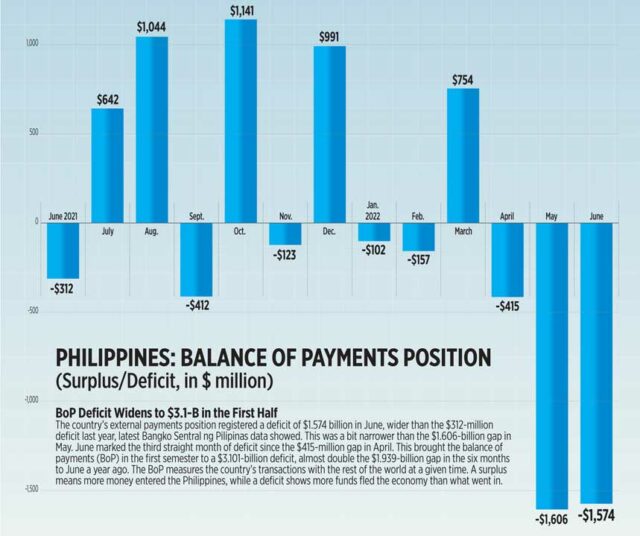
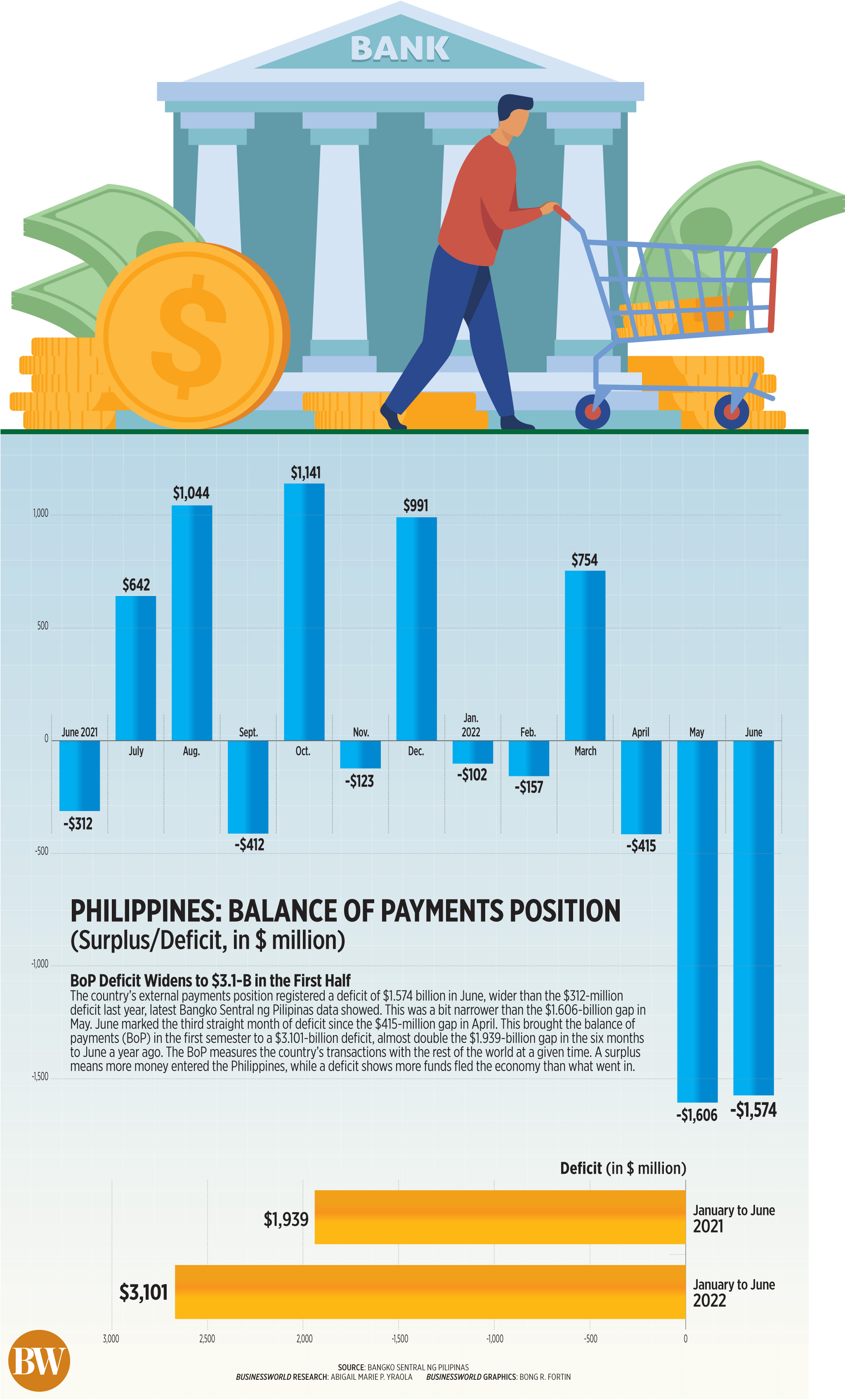
Philippines: Balance of payments position

THE PHILIPPINES’ balance of payments (BoP) position remained in a deficit for a third straight month in June, as more dollars flowed out of the country to pay for the government’s foreign debt. Read the full story.

Philippines: Balance of payments position

Asian Games rescheduled for next year in Hangzhou, China

A PIECE of good news greeted the Filipino athletes after learning that the Asian Games have been rescheduled from Sept. 23 to Oct. 8 in Hangzhou, China next year, or more than a year of its original date.

The Olympic Council of Asia on Tuesday confirmed the development after months of discussions with organizing Chinese Olympic Committee.

The quadrennial event was originally set Sept. 10-25 but was moved due to the coronavirus disease 2019 (COVID-19) pandemic.

“Yes it will push through next year and we are all excited because it was postponed,” Philippine Olympic Committee president Abraham Tolentino yesterday told The STAR.

The Tagaytay City Mayor said the games will still have 40 events and more than 480 gold medals at stake.

“No changes in the events, only there will be new athletes,” said Mr. Tolentino.

The country is confident it could improve on its four-gold, two-silver and 15-bronze haul for a 19th place finish in the last edition of the Asian Games in Jakarta, Indonesia four years ago.

The optimism comes from the country’s slew of world-class athletes like Tokyo Olympics gold medalist Hidilyn Diaz and a group of young promising lifters, world champion gymnast Caloy Yulo, the boxers, pole-vaulter EJ Obiena, and Asian Games skateboarding gold winner Margie Didal. — Joey Villar