Home Blog Page 5578

PHL factory activity slows in July

A worker operates the die attach machine at a semiconductor manufacturing plant in Manila, Dec. 10, 2008. — REUTERS

THE PHILIPPINES’ manufacturing sector slowed in July as production and new orders declined, signaling weaker global demand, S&P Global said on Monday.

The S&P Global Philippines Manufacturing Purchasing Managers’ Index (PMI) reading stood at 50.8 in July, lower than the 53.8 reading in June.

While the PMI remained in expansion territory in July, the reading was the lowest in six months. Excluding the flat reading in January, S&P Global said the July PMI was the weakest in 11 months.
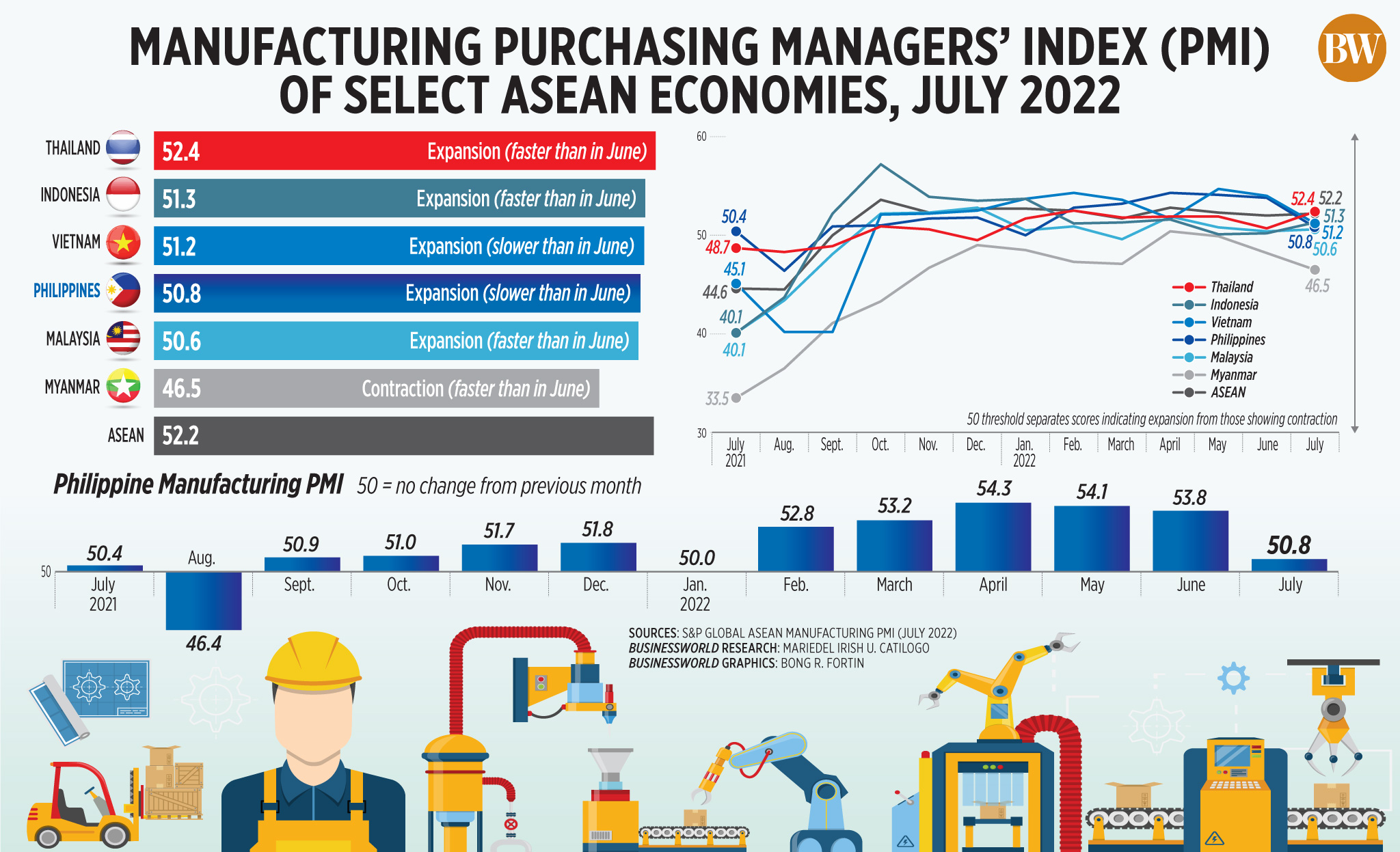
Manufacturing Purchasing Managers’ Index (PMI) of select ASEAN economies, July 2022

A PMI reading above 50 denotes improvement in operating conditions compared with the preceding month, while a reading below 50 signals deterioration.

“Data from the latest PMI survey indicated a loss in growth momentum at goods producers in the Philippines. Renewed contractions in output and new orders, albeit only mild, were recorded in July. The headline figure slipped to 50.8 in July to signal the slowest expansion since January,” Maryam Baluch, economist at S&P Global Market Intelligence, said in a statement.

The headline PMI measures manufacturing conditions through the weighted average of five indices: new orders (30%), output (25%), employment (20%), suppliers’ delivery times (15%) and stocks of purchases (10%).

S&P Global said last month’s contraction in output and new orders was the first since January. “The rates of reduction were modest but signified a visible change from the strong expansions seen in June, amid challenging demand conditions,” it said.

Firms also reported weaker demand from foreign clients in July.

“While the pace of decrease was the softest in the current five-month sequence of contraction, global uncertainties and the ongoing impact of the pandemic continued to weigh on export demand,” S&P Global said.

Manufacturers’ buying activity was muted in July, as they had less business requirements and prices of materials rose.

Despite the slowdown, S&P Global said Philippine firms added more workers for a third month in a row in July. The additional workers helped companies to clear their existing backlogs at a faster pace.

S&P Global said data showed a further deterioration in vendor performance, as “lead times lengthened to the greatest extent in four months” due to logistical problems, shipment delays and port congestion.

The manufacturing sector also faced pressure as inflation continued to rise in July, pushing average cost burdens sharply higher.

“Overall, muted growth across the Filipino manufacturing sector, adds caution to the air as inflationary pressures continue to heat up,” Ms. Baluch said.

Inflation likely accelerated by 5.6-6.4% in July amid higher food prices, transport fares and the peso’s depreciation against the US dollar, the Bangko Sentral ng Pilipinas (BSP) said on Friday.

“July PMI is showing the impact of inflationary pressures. Production levels have fallen and output has dropped together with new orders,” UnionBank of the Philippines, Inc. Chief Economist Ruben Carlo O. Asuncion said in a Viber message.

ING Bank N.V. Manila Senior Economist Nicholas Antonio T. Mapa said that manufacturing firms cited higher costs and softer demand from foreign markets, reflecting the impact of the Russia-Ukraine war and the China lockdowns.

“One good development was the firms continued to increase workforce requirements to clear out backlogs and with confidence remaining upbeat despite the near-term headwinds,” Mr. Mapa said in an e-mail.

Amid signs of weakening demand, S&P Global noted that Philippine firms’ outlook for the next 12 months rose to a seven-month high in July.

“Firms stated that stronger expectations were underpinned by hopes of greater customer demand. That said, sentiment was weaker than the series average,” it said.

ASEAN
The Philippines’ PMI reading in July lagged behind Thailand (52.4), Indonesia (51.3) and Vietnam (51.2), and was below the Association of Southeast Asian Nations (ASEAN) average of 52.2. It was only better than Malaysia’s 50.6 and Myanmar’s 46.5.

“The latest PMI data indicated further growth in the ASEAN manufacturing sector, with the latest figure improving from June’s three-month low,” S&P Global’s Ms. Baluch said.

Improved demand and easing mobility restrictions boosted production and sale volume in the region.

“Additionally, price pressures remain persistently high, despite easing marginally on the month. In response, central banks around the region are likely to exercise tighter monetary policies,” Ms. Baluch said.

“This could potentially impact growth momentum and demand in the coming months, which continues to find its bearing as the COVID-19 (coronavirus disease 2019) shocks subside,” she added.

In a separate note, Capital Economics said most manufacturing PMIs for July dropped “amid further signs that global demand is weakening.”

“With global growth set to slow further and domestic interest rates set to continue rising, the region’s industrial sectors face a tough year ahead… One common factor from the July PMIs was once again the weakness of the new export orders component, which was below 50 in five of the seven countries,” Capital Economics said. — K.B.Ta-asan


Philippine esports can be a game changer, experts say

AN ESPORTS PLAYER competes at the International Dota 2 World Championships, Mercedes-Benz Arena, Shanghai, China, Aug. 25, 2019. — REUTERS

By John Victor D. Ordoñez, Reporter

TWENTY-THREE-YEAR-OLD Kendrick L. Cheah, one of the top Super Smash Bros. Ultimate players in the Philippines, has shown that video games aren’t just a child’s pastime anymore.

Having won the fighting game tournament REV Major in 2018 as PSI Force, the road to becoming a top-ranked electronic sports (esports) player was not a walk in the park.

“I wasn’t sponsored by a team,” Mr. Cheah said in a Facebook Messenger chat. “I had to solely rely on leftover allowances from my mom, as well as the cash prizes I won in previous tournaments to attend upcoming gatherings, tournaments and events.”

Transportation costs to venues were expensive especially when one gets stuck in Manila’s notorious traffic jams.

Money wasn’t easy until a professional esports team sponsored him, but he continues to worry about his team’s finances.

That playing video games competitively could be a salaried profession was nonsense a few years ago. Now, professional gamers make a decent living and turn into millionaires on some occasions.

Salaried pro gamers in the United States earn as much as $60,000 yearly, while tournament prize money can go as high as $50,000, according to Esports Grizzly. Video game streamers earn as much as $2,000 a month.

TNC Predator, a Philippine-based esports team known for their high placings at international Dota 2 tournaments, has won $4.6 million since it started in 2013, according to esports portal GosuGamers.

Several local groups have sought more government support for the Philippine esports industry, including seeing it as a legitimate creative sector and sport.

At a House of Representatives hearing in March, the Philippine Esports Organization proposed an economic zone that will house a studio where esports events can be broadcasted and boot camp facilities where local esports athletes can train.

The group also cited the need to improve internet infrastructure, build more airports for easier foreign participation, as well as incentives for esports organizations.

“The Philippines is a third-world country making a first-world innovation like esports work,” Kenneth Ian G. Alog, associate project coordinator at AcadArena Technologies, Inc., an esports tournament operator that also offers scholarships to players, said in an e-mailed reply to questions. “However, there are many infrastructure improvements that need to happen.” 

“One example is minimum wage,” he said. “Unless it improves to a level that Filipinos do not find microtransactions in games or even reliable data an absolute luxury, then video games cannot be fully part of their lifestyle and the market cannot grow to a certain size for it to be viable for certain companies to open shop.”

The Department of Education (DepEd) also plans to integrate esports in the curriculum through game-based learning and physical education, according to a Powerpoint presentation shown at the House hearing.

Skills that could be learned include adaptive, creative and critical thinking, problem solving, new media literacy and self-management, among other things.

AcadArena’s support programs include scholarships and aid for esports athletes with a tuition coverage of as much as P25,000, a creator grant for streamers including tuition coverage of as much as P30,000 and an Axie Infinity scholarship grant, giving awardees a play-ready team, training and an eventual payout.

The Philippine video gaming industry is the 25th largest market in the world by revenue, with earnings of more than $572 million, according to Pangasinan Rep. Christopher V.P. de Venecia, who had sought an inquiry into the state of the sector.

Almost half of the country’s more than 110 million people play video games. Local game developers are also recognized globally.

The esports sector offers opportunities to generate revenues through creative avenues, namely streaming, shoutcasting and content creation, the congressman said in House Resolution No. 2394.

Despite the success of Filipino esports athletes in the country, the support structure is not enough. Teams, for example, have difficulty traveling overseas for international tournaments due to visa issues.

Filipino esports teams have won medals at international competitions, including the Southeast Asian and Asian games.

At the recent Southeast Asian games, Philippine Team Sibol won silver medals at the League of Legends and Crossfire events, while the Mobile Legends: Bang Bang team, consisting of players from gaming organization Blacklist International, brought home a gold medal.

GrindSky Eris, a Philippine all-female team, also claimed a gold medal at the mobile League of Legends: Wild Rift event.

Esports games fall under six major categories: fighting games (Tekken, Marvel vs. Capcom, Super Smash Bros.), real-time strategy (StarCraft II, Warcraft III), first-person shooters (Counter Strike: Global Offensive, Valorant, Apex Legends), multiplayer online battle arenas (Defense of the Ancients 2, Dota 2, League of Legends, Mobile Legends: Bang Bang), sports games (NBA 2K, FIFA Online) and digital card games (Hearthstone, Pokémon TCG).

‘VIABLE CAREER’
In the Philippines, the most popular is Mobile Legends: Bang Bang, probably because it can be played on smartphones. Other popular games are Valorant, Call of Duty: Mobile, League of Legends and Dota 2.

An esports player can be a professional video game player who competes for money or a streamer who seeks an online audience, Jose M. Alberto, a program coordinator at AcadArena, said in an e-mail.

At the height of the global coronavirus pandemic and booming cryptocurrency market, graphics cards used in more demanding video games and cypto-mining became harder to come by. Prices rose more than three times, with many retailers becoming the scalpers themselves.

“The demand was high and the supplies were almost nonexistent, especially since people needed their own PCs to work from home,” Sidney L. Mangaoang, who owns a custom PC building business, said in a Facebook Messenger chat.

Prices in most markets overseas have since fallen below manufacturers’ suggested retail prices -— after almost two years — in line with the cryptocurrency crash.

The crash has forced miners to sell their high-end graphics cards in the used market, causing prices both in the second-hand and retail markets to fall since the start of the year.

This may not matter much for a number of Filipino esports players, only half of whom have access to computer games. Most players are male, 30% are female and eight of 10 play games on their mobile phones.

The Philippines has the potential and market for a thriving esports scene. Globally, the industry has also proven to be a profitable venture, given the proper infrastructure and investment.

The average salary for a pro player in the League Championship Series, the professional League of Legends tournament in the United States, was $410,000, according to consulting firm YCP Solidiance.

Franchising also plays a huge part in esports, similar to the National Basketball Association (NBA), and serves to be the primary way for teams to compete against each other.

Incidentally, NBA teams like the Golden State Warriors and Houston Rockets have invested in esports teams, namely the League of Legends teams Golden Guardians and Clutch Gaming, which has since merged with Team Dignitas.

Grammy award-winning Canadian rapper Aubrey Drake Graham became a co-owner of the esports team 100 Thieves in 2018. Athletic legend Usain Bolt this year entered the world of online gaming as co-owner of Wylde, a fledgling Irish esports group.

Franchising also generates big revenues. The cost to franchise a team in the Overwatch League ranges from $20 million to $60 million.

Top esports organizations earn more than $15 million a year, with earnings mainly coming from merchandise sales, franchising and sponsorships, according to Forbes magazine.

Had the global pandemic not happened, investments from companies like Mastercard, Inc., Coca-Cola Co., Bayerische Motoren Werke AG and Nike, Inc. would have hit about $1.1 billion in 2020, with $822.4 million of that coming from media rights, advertising and sponsorships, according to YCP Solidiance.

Goldman Sachs expects $2.92 billion in revenue for the esports industry this year.

“Seeing as there’s passion and support, I do think esports has the potential to grow here in the Philippines,” said Mr. Cheah, the professional video game player. “Esports is a viable career as long as you know how to back yourself up should something happen. Passion, community and support are what will help the local esports scene.” — with Tobias Jared Tomas

BoC exceeds July collection target by 39%

BW FILE PHOTO

THE BUREAU of Customs (BoC) on Monday said it exceeded its July collection target by 39%, mainly due to increased imports and improved valuations.

In a statement, BoC said the July collection reached P84.43 billion, surpassing its monthly target of P60.78 billion. This was also a record monthly collection for the bureau.

“The collection includes additional revenues from the Tax Expenditure Fund (TEF) collection of P1.128 billion and Post Clearance Audit Group (PCAG) collection of P527.65 million in the same month,” Customs said.

In the first seven months of the year, the BoC collected P481.14 billion, surpassing its P388.6 billion target by 24%. This includes the TEF collection of P2.57 billion, and PCAG’s P1.37 billion.

The seven-month collection was also 34% higher than the P358.92 billion logged in January to July 2021.

BoC Commissioner Yogi Filemon L. Ruiz attributed the strong performance to improved valuation and digitalization of Customs systems.

He also noted import volumes have gone up as the economy gradually reopens. Import values have also improved due to the higher global prices of oil and other commodities.

Mr. Ruiz also noted the “intensified collection efforts of all districts which prevent revenue leakages” helped the BoC exceed its targets.

The BoC is tasked to collect P733 billion this year, 8% higher than the initial goal of P679.23 billion.

Rising rates put more pressure on consumers, SMEs — Fitch

BW FILE PHOTO

RISING INTEREST RATES will put more pressure on consumers and small businesses in the Philippines, as many are still recovering from the economic shock brought by the coronavirus pandemic, Fitch Ratings said.

In a report “Impact of Rising Interest Rates on APAC Banks,” Fitch Ratings said conglomerate-owned corporate borrowers will have stronger financial buffers to handle the expected rise in interest payments.

“We believe there are lingering impairment risks among consumer and SME (small and medium enterprise) borrowers whose finances have yet to recover from 2020’s severe shock,” it said, referring to the impact of pandemic-related lockdowns on many consumers and businesses.

Fitch Ratings noted that Philippine banks saw the biggest increase in nonperforming loan ratios among major Southeast Asian economies in the last two years, mainly due to higher delinquencies in consumer loans and the early end of loan forebearance.

The Bangko Sentral ng Pilipinas (BSP) last month raised its benchmark interest rates by 75 basis points (bps) in a surprise off-cycle move, as it sought to contain broadening inflationary pressures. It has raised rates by 125 bps since May.

The key overnight borrowing rate is now at 3.25%. The rates for overnight deposit and lending facilities were also hiked by 75 bps to 2.75% and 3.75%, respectively.

Rising interest rates will have a “mildly favorable” net revenue impact on Philippine banks, and “moderate” impact on asset quality, Fitch Ratings said.

It said adjustments in the policy reverse repo rate “have not historically been fully passed through to bank lending rates.”

“The conglomerate-dominated business landscape gives corporates considerable bargaining power, and competition for high-quality assets often means that banks are hesitant to raise rates quickly. Therefore, we expect lending spreads to widen only moderately,” it added.

The Philippines has one of the most liquid banking systems in Asia-Pacific, Fitch Ratings said. It noted that the high proportion of “rate-insensitive CASA (current account/saving account) deposits” allows Philippine banks to better manage deposit costs.

Fitch Ratings said it expects the policy rate to reach 4% by the end of 2023. — KBT

Petron profit doubles to P7.7B on steady sales rise

PETRON.COM

PETRON Corp. reported a net income of P7.7 billion in the first semester, or about double the P3.87 billion earned in the same period last year, as the company maintained steady sales growth.

In a disclosure to the stock exchange, the company said year-to-date sales in the Philippines and Malaysia, including its trading subsidiary in Singapore, increased 34% to 51.4 million barrels from 38.5 million in the same period last year.

Petron, the country’s largest refining company, attributed the increase in commercial sales to easing pandemic restrictions as aviation and travel rebounded from the pandemic’s impact.

“Our post-pandemic transition has so far been marked by steady growth particularly in segments where we suffered major setbacks earlier during this crisis,” Petron President and Chief Executive Officer Ramon S. Ang said in a press release.

The company has yet to disclose its profit and revenue figures for the second quarter.

In the first half, sales of lubricant products, Jet-A1 aviation fuel, liquefied petroleum gas, and petrochemicals showed strong growth compared with 2021, Petron said.

It added that the group’s retail business registered an uptick of nearly 30% “fueled by the strong sales of its premium gasoline and diesel fuels.”

Consolidated revenues for the first half jumped to P398.5 billion, or more than double the P174.1 billion recorded in the same period last year, because of a sustained increase in sales and volume prices. Dubai crude averaged $102 per barrel from January to June due to supply concerns.

“We move forward with hope and optimism as we roll out projects that will not only yield optimal returns for the company but more importantly, lead towards greater sustainability and create economic opportunities for more sectors,” Mr. Ang said.

Petron, which is also a leading player in the Malaysian market, has a combined refining capacity of 268,000 barrels a day. The company operates about 40 terminals in the region and has around 2,800 service stations where it sells gasoline and diesel. — Ashley Erika O. Jose

Artists and music fans collaborate on songs

MUSIC artists BINI, Shanti Dope, and Adie — SCREENSHOTS FROM YOUTUBE.COM/COKESTUDIOPH

THIS year, six Filipino artists each co-wrote and produced a song with a music fan on the sixth season of Coke Studio Philippines, with the results out in the Fan Collaborated Coke Studio EP.

Coke Studios was inspired from the function of a music studio, where artists produce music.

“Through Coke Studio Philippines, we have been uplifting lives and empowering the local music scene by reuniting music artists and their fans to create one music, one sound,” said Cesar Gangoso, Frontline Marketing Director, East Region, Coca-Cola ASEAN and South Pacific, at an online press launch on July 20.

“We are proud to say that since it was launched in 2017, we have been able to establish Coke Studio as one of the biggest music platforms where diversity, fusion, and unity of artists, producers, and fans are at its core,” he said.

“One of the things fans always request is to collaborate with their favorite music artists,” Mr. Gangoso said of this year’s concept. “We want to involve music fans and we want to make the process of creation accessible to music fans.”

This season’s Coke Studio artists are hip-hop artist and rapper Shanti Dope, singers and social media influencers Arthur Nery and Adie, pop rock band The Juans, all-girl pop group BINI, and singer and rapper KZ Tandingan.

In June, these artists’ fans were invited to write, produce, and remix songs through the Coke Fan Fusion challenges. Through social media, fans submitted their entries for a chance to co-create the final song with their favorite artists. The six singles and the episodes on the creation of the songs are being released weekly until Aug. 30.

DIFFERENT STORIES
The songs have different themes and stories.

Shanti Dope’s song, “Day Onez,” reminisces about childhood; the Juans’ “Diskarte” is about Filipino resourcefulness, and Arthur Nery’s “Sing” talks about appreciating those who selflessly rise up for others.

BINI’s “Love Yourself” is, according to the group, about body positivity, since girl groups are expected to conform to a standard physical appearance. Adie’s “Tinatangi” speaks of expressing feelings for a loved one; and KZ Tandingan’s “Sabi-Sabi” is about being unapologetic.

“There is always something that you want to do but you don’t because people are always saying that you can’t and not doing it at all and not even trying. This is about taking that power back,” Ms. Tandingan said of her song.

The Coke Studio episodes will be available on YouTube and Spotify on the following dates: Shanti Dope’s “Day Onez” on July 23, Arthur Nery’s “Sing” on July 30, BINI’s “Love Yourself” on Aug. 6, The Juan’s “Diskarte” on Aug. 13, Adie’s “Tinatangi” on Aug. 20, and KZ’s “Sabi-Sabi” on Aug. 30.

The full episodes are available on https://www.youtube.com/c/CokeStudioPH/featured. — Michelle Anne P. Soliman

SMC power unit says losses hit P15B, seeks rate hike

SMC Global Power Holdings Corp. said on Monday that its two power plants had suffered combined losses of P15 billion, prompting the company to seek temporary relief from the energy regulator to allow it to continue supplying power.

It blamed the losses on “skyrocketing global coal prices and unilateral natural gas supply restrictions from Malampaya.”

In a media release, San Miguel Corp. (SMC) President and Chief Executive Officer Ramon S. Ang said: “We are not asking to recover all our losses, neither are we asking for a permanent increase.”

He said the conglomerate’s power unit wants to continue supplying baseload power to Manila Electric Co. (Meralco).

“What we are asking for is just a temporary and equitable relief, to allow the power facilities to survive this difficult period and continue supplying power to Meralco,” he added.

SMC Global Power said its coal power plant in Sual, Pangasinan, and natural gas-fired power plant in Ilijan, Batangas incurred the said losses from 2021 to date.

It said that to cover the losses incurred from January to May 2022, the company had sought a rate increase on its contract capacity under the power supply agreements (PSAs) to be paid for a period of six months.

The company said it is asking the Energy Regulatory Commission (ERC) for a rate increase of P0.80 per kilowatt-hour (kWh) to P5.10 per kilowatt-hour (kWh) from P4.30 per kWh for its 670-megawatt (MW) of contracted baseload capacity from the Ilijan plant.

For the Sual plant, the company an average increase of P4.00 — to P8.30 per kWh from P4.30 per kWh — for its 330-MW contracted baseload capacity.

Mr. Ang attributed last year’s losses to coal prices that reached an average of $176 per metric ton (MT).

“Apparently, coal prices were just at $60-65/MT when we entered into these PSAs. In fact, the widely held outlook at that time is that coal prices will even continue to go down because of a global shift in the energy mix,” he said.

However, coal prices continued to climb in 2021, Mr. Ang said, adding that these “have recently reached unprecedented levels, as high as $440/MT, as triggered primarily by the Russia-Ukraine conflict.”

SMC Global Power said that while the temporary and partial cost recovery relief it sought will result in a temporary increase in prices, it would also allow the power generation facilities to continue sourcing the necessary fuel for continuous operation and power supply.

It added that the net rate impact however to Meralco, assuming that this cost recovery claim is granted by the ERC, is just P0.28 per kWh over a period of six months.

Mr. Ang said that when Meralco bid out its supply requirement in 2019, the Sual and Ilijan plants proposed and adopted an escalation mechanism where the tariff price would start “very low.”

He added that the move was meant to enable consumers to immediately benefit from the competitive selection, and just escalate at a fixed annual rate of 3.5% on the fuel price component.

Mr. Ang said the company, in consideration of the difficulties the country is facing from the pandemic, had absorbed losses of P10 billion.

“Overall, the company is looking to recover from P5.2 billion in losses for the period January to May 2022,” SMC Global Power said. — A.E.O. Jose

Gov’t fully awards T-bills at mostly higher rates

BW FILE PHOTO

THE GOVERNMENT fully awarded its offer of Treasury bills (T-bills) at mostly higher rates ahead of the release of July inflation data and expectations of more hikes from the Philippine central bank.

The Bureau of the Treasury (BTr) raised P15 billion as planned from its auction of T-bills on Monday, with bids reaching P43.31 billion.

Broken down, the Treasury made a full P5-billion award of 91-day securities as the tenor attracted P24.07 billion in bids. The average rate of the tenor went down by 18.3 basis points (bps) to 2.09% from the 2.273% fetched at the previous auction. Accepted rates ranged from 2.08% to 2.1%.

The government also borrowed P5 billion as planned via the 182-day securities as tenders reached P12.94 billion. The average rate of the tenor rose by 4.6 bps to 3.188% from the 3.142% fetched at the previous auction. Accepted rates ranged from 3.125% to 3.225%.

Lastly, the BTr raised P5 billion from the 364-day debt papers as programmed, with demand for the tenor reaching P6.29 billion. The tenor’s average rate rose by 12.4 bps to 3.48% from the 3.356% fetched at the previous auction, with the government accepting offers ranging from 3.35% to 3.7%.

At the secondary market prior to Monday’s auction, the 91-, 182- and 364-day T-bills were quoted at 2.2683%, 2.8857%, and 3.2775%, respectively, based on the PHP Bloomberg Valuation Reference Rates published on the Philippine Dealing System’s website.

National Treasurer Rosalia V. de Leon said in a Viber message that the BTr made a full award of the T-bills on offer on Monday as demand remained strong even after the US Federal Reserve’s second straight 75-bp rate hike last week and expectations of another hawkish move by the Bangko Sentral ng Pilipinas (BSP) this month.

“[The] 91-day tenor declined by 18 bps as the peso … surged in last Friday’s close,” Ms. De Leon said. The local unit closed at P55.13 per dollar on Friday, gaining 69 centavos from its P55.82 finish on Thursday, based on Bankers Association of the Philippines data.

“Yields moved mixed, with demand heavily concentrated on the 91-day tenor as investors are on wait-and-see mode ahead of the July inflation data release this Friday,” the first trader said.

“Clearly, investors continue [to] demand higher rates for the six-month and one-year bills on expectations of more rate hikes from BSP,” the second trader said.

BSP Governor Felipe M. Medalla last week signaled a hike of 25 or 50 bps at their Aug. 18 meeting, although he ruled out another off-cycle increase. The central bank had raised rates by 75 bps in a surprise move on July 14 to contain sustained and broadening price pressures.

The Monetary Board has raised benchmark interest rates by a total of 125 bps so far this year as inflation remains elevated.

A BusinessWorld poll of 14 economists last week yielded a median estimate of 6.2% for July headline inflation, within the BSP’s forecast of 5.6% to 6.4% for the month.

If realized, this would be a tad faster than the 6.1% reading in June, which was already a near four-year high, as well as the 3.7% posted in July last year.

The Philippine Statistics Authority will release July inflation data on Aug. 5, Friday.

On Tuesday, the BTr will auction off P35 billion in fresh 3.5-year Treasury bonds (T-bonds).

The Treasury wants to raise P215 billion from the domestic market this month, or P75 billion through T-bills and P140 billion via T-bonds.

The government borrows from local and external sources to help fund a budget deficit capped at P1.65 trillion this year, equivalent to 7.6% of gross domestic product. — Diego Gabriel C. Robles

FAMAS-winning Katips: The Movie premieres this week

A SCENE from the musical drama Katips: The Movie — SCREENSHOT FROM FACEBOOK.COM/VTANADA

SET during Martial Law and following the struggles of student activists under the dictatorship, Katips: The Movie premieres in cinemas on Aug. 3.

The musical drama by Philstagers Films was adapted from the 2016 stage musical Katips: Ang Mga Bagong Katipunero which won Best Musical Performance at the 2016 Aliw Awards. The film was first screened for the press on Nov. 27, 2021 at Gateway Mall in Quezon City, with a second screening for the public on Dec. 3, 2021. The film, which won several FAMAS awards over the weekend, will go on wide release this week.

Written and directed by lawyer and filmmaker Vince Tañada, who also stars in the film, the film’s story follows a group of rebels, led by student leader Greg (played by Jerome Ponce), subversive writer Panyong (Mr. Tañada), and Alet (Adelle Ibarrientos), and their efforts to keep up the fight against the Marcos dictatorship even when the odds seem stacked against them.

“In the midst of uncertainty, there’s no other passion that can pull us back to freedom but the burning fire that hides within each of us. Katips is a tale of the young, in their fight for their ideals, how big can one get against a force too much bigger than yourself,” Mr. Tañada wrote in a Facebook post on Sept. 22, 2021.

Mr. Tañada is the grandson of Senator Lorenzo Tañada who staunchly opposed Martial Law under the Marcos administration.

Maraming dapat ipaglaban sa buhay, ang problema, kadalasan kapag nakikipaglaban ka, wala kang panahon o kaya wala kang kakayanan (There are many things to fight for in life, but it is often that we do not have the time or the means to) — the proper resources to fight for something you really believe in,” Mr. Tañada said in a behind-the-scenes video of the film uploaded on Philstagers Films YouTube page. “And given these resources and given this time, for me to do it now, why not? So, I did this.”

The film’s release coincides with and challenges the release of Darryl Yap’s Maid in Malacañang which is told from the perspective of the Marcoses about the 72 hours before their exile to Hawaii in 1986.

Mr. Tañada expressed that it is very important to inspire and educate audience members through film.

“It is a good opportunity to educate, inspire the youth through film,” he said in Filipino.

With music by Pipo Cifra, the film also stars Nicole Laurel, Johnrey Rivas, Joshua Bulot, Vean Olmedo, Dexter Doria, Lou Veloso, OJ Arci, Dindo Arroyo, Afi Africa, Patricia Ismael, Carla Lim, Chris Lim and Mon Confiado. An ensemble cast from Philippine Stagers Foundation also join the cast.

The film bagged seven awards at the 70th Filipino Academy of Movie Arts and Sciences Awards (FAMAS) held on July 30. It won Best Picture, Best Director and Best Actor for Vince Tañada, Best Supporting Actor for Johnrey Rivas, Best Original Song for “Manhid and Sa Gitna ng Dulo,” Best Musical Score, and Best Cinematography. — MAPS

https://www.facebook.com/vtanada/videos/893427491585688/?_rdc=1&_rdr

PLDT receives P13.2B on sale of 1,013 telecom towers

BW FILE PHOTO

PLDT, Inc. announced on Monday the second closing of a transaction involving the sale of 5,907 telecom towers and related passive telecom infrastructure for P77 billion.

“Second closing of the transaction was achieved today with the completion of the sale of 1,013 telecom towers,” PLDT said in a disclosure to the stock exchange.

The group received a corresponding cash consideration of P13.2 billion.

“This event follows the first closing attained on June 1 covering 3,012 telecom towers with a consideration of P39.2 billion having been paid to the group,” PLDT noted.

PLDT has sold 4,025 of the 5,907 telecom towers up for sale, or 68%.

It anticipates additional closings over the next few months based on the number of towers being transferred, with final closing expected by the last quarter.

To recall, PLDT announced in April that its subsidiaries, Smart Communications, Inc. and Digitel Mobile Philippines, Inc., had signed sale and purchase deals in connection with the sale of of the towers and related passive telecom infrastructure to the subsidiaries of international telecommunications infrastructure services companies edotco Group and EdgePoint.

The 5,907 towers — almost half of PLDT’s total tower portfolio — are spread across the Philippines, with 2,973 being acquired by ISOC edotco Towers, Inc., a subsidiary of edotco Group, and 2,934 towers by Comworks Infratech Corp., a subsidiary of EdgePoint.

With the cash from this transaction, the group aims to prepay P27.5 billion in debt maturing this year.

PLDT shares closed 0.06% lower at P1,655 apiece on Monday.

Hastings Holdings, Inc., a unit of PLDT Beneficial Trust Fund subsidiary MediaQuest Holdings, Inc., has a stake in BusinessWorld through the Philippine Star Group, which it control. — Arjay L. Balinbin

AUB Group’s consolidated profit surges 50% in the first semester

BW FILE PHOTO
ASIA United Bank Corp. and its subsidiaries booked a higher consolidated net income in the first semester. — BW FILE PHOTO

ASIA United Bank Corp. (AUB) and its subsidiaries saw its consolidated net income surge in the first semester amid a higher total operating income and lower loan loss provisions.

AUB Group’s consolidated net profit was at P2.9 billion in the first half of the year, rising by 50% from the P1.9 billion seen a year prior, the listed bank said in a disclosure to the stock exchange on Monday.

This translated to a return on assets of 1.8%, up from 1.2%, and a return on equity of 15.8%, improving from 11% last year.

“We remain on track with our target to return to our pre-pandemic net income performance of P4.4 billion, especially as the economy gradually reopens,” AUB President Manuel A. Gomez was quoted as saying.

“We are pleased to note that these profitability ratios are among the highest, if not the best, in the industry, as far as published reports of other publicly listed banks go,” Mr. Gomez said.

The group’s total operating income went up by 12% to P6.9 billion in the first semester from P6.1 billion a year prior on the back of higher net interest earnings and other operating income.

Net interest income climbed by 8% to P5.8 billion from P5.4 billion amid an increase in interest earnings and lower interest expense.

“Interest income from loans and receivables remained flattish at P5 billion while interest income from trading and investment securities grew 56%, year on year,” AUB said in the statement.

The bank saw an increase in its low-cost current account, savings account (CASA) deposits, which reached P222 billion as of June. Its CASA-to-total deposits ratio was at 84%, up from 71% a year prior.

“Coupled with the retirement of high-cost deposits, this drove down the group’s interest expense by 20% to P742 million from P922 million during the first half of 2021,” the lender said.

Meanwhile, the group’s non-interest income increased by 42% to P1.1 billion from P743 million, which the bank, in its statement, attributed to better trading and foreign exchange gains and higher transaction fee income.

Operating expenses were flat at P2.7 billion in the first semester, resulting in a cost-to-income ratio of 40%, down from 45% a year ago.

AUB Group set aside provisions for credit and impairment losses worth P511 million in the period, 43% lower than the P897 million seen a year prior.

This, as its asset quality improved, with its nonperforming loan ratio declining year on year to 1.8% as of June from 2%.

AUB’s total assets were at P319.7 billion at end-June, which it said ranked it among the country’s 20 biggest banks.

The bank’s shares lost 40 centavos or 0.89% to end at P44.45 each on Monday. — BVR

Actress Nichelle Nichols, Star Trek’s trail-blazing Uhura, dies at 89

ACTRESS Nichelle Nichols — UHURA.COM

NICHELLE Nichols, whose portrayal of starship communications officer Lieutenant Uhura in the 1960s sci-fi TV series Star Trek and subsequent movies broke color barriers and helped redefine roles for Black actors, has died at age 89, her family said.

Ms. Nichols, whose fans included Martin Luther King, Jr. and a young Barack Obama, “succumbed to natural causes and passed away” on Saturday night, her son, Kyle Johnson, wrote on Facebook.

“Her light however, like the ancient galaxies now being seen for the first time, will remain for us and future generations to enjoy, learn from and draw inspiration,” Mr. Johnson wrote.

The series, which became a pop culture phenomenon, shattered stereotypes common on US television at the time by casting Black and minority actors in high-profile roles on the show.

In 1968 she and Star Trek star William Shatner broke a cultural barrier when they engaged in US television’s first interracial kiss.

She had planned to quit Star Trek after one season, but Mr. King, the 1960s civil rights leader, convinced her to stay because it was so revolutionary to have a Black woman playing an important senior crew member at a time when Black people were fighting for equality in American society.

Ms. Nichols also helped break color barriers at NASA, whose leaders were Star Trek fans. After she criticized the space agency for failing to pick qualified women and minorities as astronauts, it hired Nichols in the 1970s to help in recruiting.

Her efforts helped attract, among others, the first woman US astronaut, Sally Ride; the first Black woman astronaut, Mae Jemison; and the first Black NASA chief, Charlie Bolden.

Ms. Nichols “symbolized to so many what was possible” and “inspired generations to reach for the stars,” NASA said on Twitter.

Ms. Nichols’ portrayal of the competent, level-headed Uhura also helped inspire future Black actors, including Oscar winner Whoopi Goldberg. Ms. Nichols recalled Ms. Goldberg telling her of watching Star Trek as a nine-year-old, seeing her playing Uhura, and yelling out to her mother: “Come quick! There’s a Black lady on television and she ain’t no maid!”

The original Star Trek series, tracking the adventures of the crew of the starship USS Enterprise in the 23rd century, ran for only three seasons on the NBC network from 1966 to 1969. But it became hugely popular in syndication in the 1970s, inspiring first an animated series that reunited the cast from 1973 to 1975 and then a succession of feature films and shows.

Nichols appeared in six Star Trek films ending with Star Trek VI: The Undiscovered Country in 1991.

Uhura deftly handled the starship Enterprise’s communications with allied spaceships and alien races while interacting with Captain James T. Kirk (Shatner), Vulcan first officer Mr. Spock (Leonard Nimoy) and the starship’s helmsman, Sulu (George Takei).

Takei wrote on Twitter that he and Ms. Nichols “lived long and prospered together,” describing her as trailblazing and incomparable. “(My) heart is heavy, my eyes shining like the stars you now rest among.”

Ms. Nichols’ best-known scene featured the first scripted interracial kiss on US television, although it was not a romantic one. In an episode called “Plato’s Stepchildren,” Uhura and Kirk were compelled telekinetically to smooch by aliens toying with the feeble humans. In real life, Ms. Nichols disliked Shatner, who she considered arrogant.

“She was a beautiful woman and played an admirable character that did so much for redefining social issues both here in the US and throughout the world,” Mr. Shatner said on Twitter.

She felt differently about Star Trek creator Gene Roddenberry, who cast her after she had acted in a previous show he produced. Ms. Nichols had a romance with him in the 1960s and sang a song called “Gene” at his 1991 funeral.

VISIT TO THE WHITE HOUSE
Mr. Obama, the first Black US president, who was five years old when the Star Trek series made its debut, also was a fan. Ms. Nichols visited him at the White House in 2012 and posed for a photo in the Oval Office, with the president smiling and putting his hand on her shoulder while both made a Star Trek Vulcan hand gesture meaning “live long and prosper.”

In a 2011 interview with Smithsonian magazine, Ms. Nichols recalled meeting Mr. King at a civil rights group’s fundraiser.

Ms. Nichols said she was approached by one of the event’s promoters, who told her, “There’s someone who wants to meet you and he says he’s your biggest fan, so I’m thinking of a young kid. I turn around and standing across the room, walking towards me, was Dr. Martin Luther King with this big smile on his face.”

After Ms. Nichols told Mr. King she planned to quit Star Trek, she said he implored her to stay. She said King told her: “This is a God-given opportunity to change the face of television, change the way we think. We are no longer second-class, third-class citizens. He (Mr. Roddenberry) had to do it in the 23rd century but it’s the 20th century that’s watching.’” She rescinded her resignation.

Like other Star Trek cast members, she had a hard time finding work due to typecasting after the original series ended. It was during this time when she played a foul-mouthed madam in the film Truck Turner (1974) starring Isaac Hayes. She was a recurring character on the television show Heroes in 2007.

She was born on Dec. 28, 1932 in Robbins, Illinois, trained as a singer and dancer and toured with jazz greats Duke Ellington and Lionel Hampton before her acting career took off.

Ms. Nichols, who was married twice and had one child, suffered a mild stroke in June 2015. —  Reuters