Polling and data analytics firm WR Numero Research (WRN) conducted a new survey, “Special Industry Report on FinTech in the Philippines.” According to the survey, GCash and Binance are the most trusted mobile wallet and cryptocurrency platforms, respectively. These two platforms are trusted because people feel they are easy and safe to use.
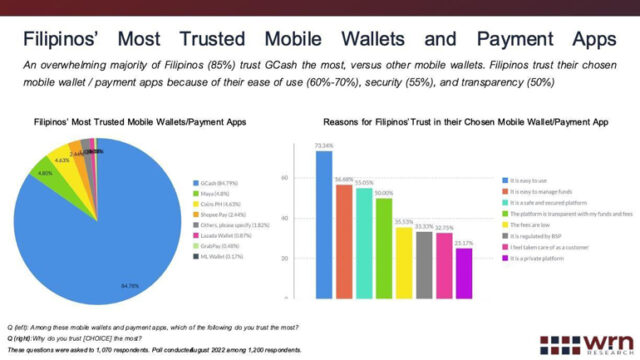
85% of the respondents of the survey answered that GCash is the most trusted mobile wallet. They pointed out the application’s ease of use (73%), security (55%), and transparency (50%) as foundations for trust.
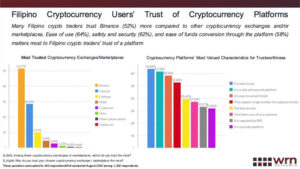
WRN also found that across cryptocurrency exchanges and marketplaces, Binance emerged as the most used and trusted platform, out of 49% of the respondents replied to be cryptocurrency users and of these users 74% were using Binance, and 52% cited Binance as the most trusted exchange.
“Cryptocurrency exchange services are fairly new compared to the other fintech services. And if the current trend of fintech adoption among Filipinos continues, we can expect that the number of Filipino cryptocurrency users is also likely to increase in the coming years,” said Cleve V. Arguelles, research fellow and managing director of WR Numero Research. “According to the survey, most Filipinos (87%) believe that cryptocurrency is beneficial to the Philippines’ economy and for that reason the government should support the industry (81%).”
Users of Binance trust the platform due to its ease of use (64%), safety and security (62%), and ease of funds conversion (58%). Eighty-five percent of the respondents who use Binance answered that the platform will contribute to the growth of the country’s economy.
WRN uses several levels of statistical intervention in its digital surveys to arrive at accurate results. The firm conducted a commissioned nationally representative digital survey of 1,200 Filipino adults between Aug. 27-29, 2022. It has a margin of error of ±4% with a 99% confidence level.
Survey responses were statistically weighted to the national profile of all Filipino adults, including those without internet access. All reputable public opinion research agencies weigh data to correct sampling issues in surveys, whether conducted online or face-to-face. The use of statistical weights ensures that the final survey data properly reflect the target population.
For data and media inquiries, please contact Cleve V. Arguelles, research fellow and managing director of WR Numero Research at +63 9998-770-572 or cleve.arguelles@wrnumero.com.
Spotlight is BusinessWorld’s sponsored section that allows advertisers to amplify their brand and connect with BusinessWorld’s audience by enabling them to publish their stories directly on the BusinessWorld Web site. For more information, send an email to online@bworldonline.com.
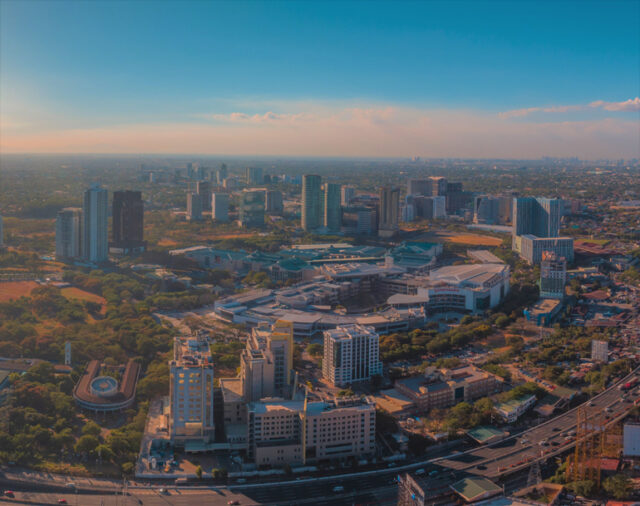
Filinvest City is the country’s first and only central business district to receive the LEEDv4 Gold for Neighborhood Plan certification.
One of the more positive impacts that the COVID-19 pandemic has left on our lives is the way it has brought to the forefront the importance of health and sustainability.
According to the Global Consumer Insights Pulse Survey published by multinational professional services firm PwC last year, half (50%) of global consumers say that they have become more eco-friendly in the past six months, with Southeast Asian and Middle Eastern consumers leading the way.
The Global Consumer Insights Pulse Survey focuses on consumer purchasing habits and behaviors, and shows how consumers have increasingly adapted to be more eco-conscious and digital in the last six months. The Philippines ranks second in this, with 74% of consumers making the change, behind Indonesia’s 86%.
The PropertyGuru Philippines Property Awards 2022 honored Filinvest Land CEO Josephine Gotianun Yap as the Real Estate Personality of the Year. She is the first woman in the country to be given this recognition.
The private sector has had a hand in leading these behavioral trends, as with the case of Filinvest Land, Inc. (FLI). Its Chief Executive Officer Josephine Gotianun Yap shared that long before it was a byword, the company has been putting environmental concerns ahead.
“Our property sustainability program is built on two important themes. First is inclusivity — bringing quality housing to as many segments of our society — as exemplified by the history of our beginnings. Second is our commitment to help protect and enrich the environment,” Ms. Gotianun Yap said while addressing the real estate industry during the recently concluded Philippine Property Awards 2022 by PropertyGuru Philippines. She was recognized as the Real Estate Personality of the Year during the event, making her the first woman to receive the award.
“Our property sustainability program is built on two important themes. First is inclusivity — bringing quality housing to as many segments of our society — as exemplified by the history of our beginnings. Second is our commitment to help protect and enrich the environment.”
She added that FLI will continue to pursue its green development thrusts as one of its long-term strategies in leading the way towards inclusivity.
This is made more significant with the fact that buildings and real estate development have an outsized effect on the environment. A study produced by the Commission for Environmental Cooperation, which evaluated the impact of North American buildings and their contribution to climate change, found that commercial and residential buildings in Canada and the United States are responsible for 20% and 40% of their primary energy consumption, respectively.
Construction and insulation of environmentally-sound buildings, which include using wood, can significantly reduce the carbon footprint of buildings. The United States Green Building Council estimates that green building, on average, currently reduces energy use by 30%, cutting carbon emission by 35%, and generates cost savings of 50% to 90%.
Recalling the origins of FLI, Ms. Gotianun Yap said that sustainability and inclusivity has always been part of the fundamentals that the company was built on. “The entry of Filinvest into property development over 50 years ago came from my parents, Andrew and Mercedes Gotianun’s desire to bring gated and secured communities to the middle class in the 70s when only the upper echelon of society enjoyed that lifestyle. In the 90s, FLI introduced our slogan ‘We build the Filipino dream’ when we brought affordable housing to the mass market,” she said.
Mira Valley, located in Havila, Rizal, is a residential subdivision blessed with natural waterways and features a wide range of nature-inspired amenities.
Today, FLI proves its commitment to creating green and sustainable developments across its residential brands namely the smart-value Futura by Filinvest, the middle-income Aspire by Filinvest, and the high-end Prestige by Filinvest. The developer carries on with offering a healthy home for Filipinos from different walks of life evidenced by its growing portfolio of over 280 ongoing projects in over 50 key areas nationwide.
Filinvest City, a 244-hectare integrated and mixed-use township of its namesake, also illustrates how the real estate developer is walking the talk. Filinvest City is the first and only central business district in the country to receive a 3-star BERDE rating from the Philippine Green Building Council. BERDE’s core framework takes into account a district’s management, use of land and ecology, energy, water, waste management, transportation, health and well-being, and community engagement — to which BERDE awarded Filinvest City with an ‘exemplary performance’ evaluation.
Filinvest City is also the first and only central business district in the country to receive the LEEDv4 Gold for Neighborhood Plan certification. This makes Filinvest City the largest central business district to gain this recognition in Southeast Asia. The US Green Building Council’s Leadership in Energy and Environmental Design or LEED is one of the world’s most credible and recognizable green building certification programs.
Northgate Cyberzone in Filinvest City, where 16 of Filinvest REIT’s 17 buildings are located, is home to the country’s largest district cooling plant that helps reduce energy and water consumption along with greenhouse gas and carbon emissions.
Filinvest REIT or FILRT, the first sustainability-themed REIT to be listed on the bourse, follows suit. Majority of FILRT’s office buildings are located in Northgate Cyberzone, an IT-BPO campus-style hub serviced by the largest district cooling plant in the country. The plant, built through the partnership between Filinvest Land and global sustainable energy company ENGIE, helps reduce power consumption by up to 40% and water consumption, greenhouse gas, and carbon emissions by up to 20%.
“Our property sustainability program paved the way for Filinvest to become one of the most trusted property developers today. We at Filinvest share one vision — to embrace green living as the better normal. We strive to constantly evolve and innovate to stay attuned to the needs and lifestyles of the markets we serve. At the heart of each endeavor is the burning passion to create sustainable, future-forward developments that enhance lives and open up opportunities for our countrymen,” said Ms. Gotianun Yap. — Bjorn Biel M. Beltran
Spotlight is BusinessWorld’s sponsored section that allows advertisers to amplify their brand and connect with BusinessWorld’s audience by enabling them to publish their stories directly on the BusinessWorld Web site. For more information, send an email to online@bworldonline.com.
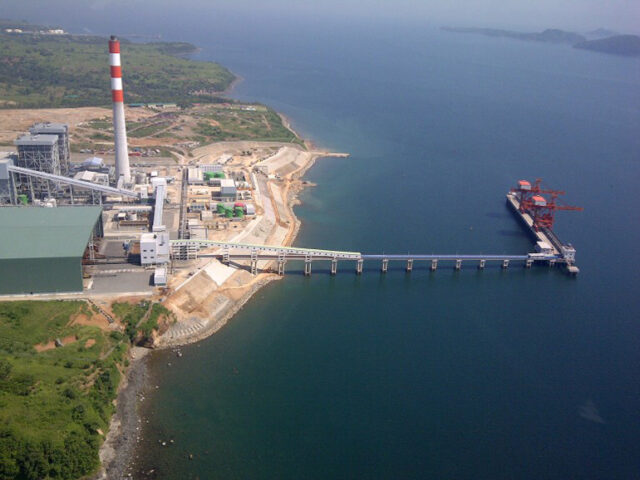
AboitizPower’s GN Power Dingnin 668MW x 2 baseload facility, located in Bataan, is in the final stages of construction.
The world is going through an energy revolution.
Amidst calls for global climate action and the transition towards more sustainable power systems, developed countries lead the efforts to curb climate change and its adverse effects on communities. However, developing nations receive the brunt of the pressure to follow suit, even as this shift cannot happen overnight for emerging economies like the Philippines.
With this in mind, Aboitiz Power Corporation is taking a pragmatic approach. While the company recognizes and supports the imperative for an energy transition in the country, initiatives toward this end should not be done at the expense of social development and economic growth.
Guided by its grand-scale vision and higher purpose of transforming energy for a better world, the company aspires to usher the Philippines into an era where there is energy abundance, zero poverty, and an environmentally sustainable society.
AboitizPower’s thermal business unit, composed of its coal and oil subsidiaries, claims its role in the Philippine energy space by building the future today by leading the energy transition and ensuring security and equity.
“Our mandate has always been to provide reliable, reasonably priced, and responsibly produced electricity to support the Philippines’ economic growth. A sensible energy mix will allow us to help power the country during this change. At the same time, we look for solutions to decarbonize more deeply,” AboitizPower President and Chief Executive Officer Manny Rubio said. “While we pursue the path toward a more sustainable Philippine energy system, our thermal assets will play a crucial role in bridging the gap between the needs of today and the better world we envision tomorrow.”
A well-managed energy shift
Data from the Department of Energy show that by the end of 2021, more than three-fourths of the country’s power came from thermal sources. Transitioning into a more sustainable energy system isn’t as easy as “turning off” all the country’s thermal assets and “turning on” as many renewable energy (RE) facilities as possible. Mr. Rubio said this narrative is over-simplistic and ignores inconvenient truths that tell a more complex energy transition story.
The goal is to ultimately transition to a net-zero emissions energy system in which most electricity is generated by renewable energy, and offsets and sequestration mitigate the remaining emissions. The Philippines can learn from the experience of its developed counterparts that went into RE too fast, too soon, and have now been forced to restart their thermal plants to meet their energy demand.
While AboitizPower has ambitious goals to further grow RE in the Philippines, the organization understands the need for a well-managed energy transformation, especially in a country with much potential for economic growth and human prosperity. Together with its partners, the company is one of the largest clean energy producers in the country today and is currently growing its RE portfolio threefold from its current capacity by 2030.
According to Mr. Rubio, AboitizPower is taking a well-calculated and long-term approach toward decarbonization.
“A decarbonized Philippines requires a well-managed shift involving supply and demand, which realistically will involve a decades-long transition to accomplish,” he stated.
Ensuring energy equity and security for today and tomorrow
AboitizPower’s Therma South, Inc. 300-MW baseload facility in Davao City
As the organization sets its eyes on the future, someone has to take care of the present.
“Whatever we do, we must move ahead and continuously focus on our customers. That’s why in all that we do, we constantly ask ourselves: How can we enhance their experience, keep costs down, and ensure reliable and responsible power delivery?” AboitizPower Thermal Business Group Chief Operating Officer Felino Bernardo said.
In particular, AboitizPower’s coal business unit is approaching the matter holistically, integrating the Environmental, Social, and Governance (ESG) framework into its operations and policies.
“We continue to improve our eco-efficiency and environmental management by leveraging new technologies and innovations,’’ said Mr. Bernardo.
The thermal group also seeks to expand its generation portfolio beyond coal and oil, having partnered in 2021 with JERA, one of the world’s largest power companies based in Japan.
Under this collaboration, both parties will explore co-firing technologies, carbon capture systems, and thermal power generation using green fuels like ammonia and hydrogen to reduce carbon dioxide emissions. Since both Japan and the Philippines rely on imported fuels due to limited domestically sourced fuel, the two companies have teamed up to look for possible alternatives, such as liquefied natural gas (LNG)-to-power projects.
According to the Department of Energy’s Philippine Energy Plan, the country’s electricity demand is estimated to grow 6.6% annually up to 2040 and twice this amount through to the year 2050, presenting AboitizPower with the opportunity to provide secure energy sources for the country.
AboitizPower’s thermal group believes the pivot to natural gas as an alternative baseload power source is the most efficient investment to help the country meet growing electricity demand. LNG also has lower emissions than coal and is an excellent complement to variable RE.
GNPower Dinginin, new kid on the block
AboitizPower’s thermal business group currently has 20 facilities under its portfolio strategically positioned across the Philippines to provide a steady and affordable power supply to homes, businesses and communities.
The latest addition to the company’s fleet, considered by far the country’s biggest in terms of installed capacity, is the 2 x 668-MW supercritical power plant operated by GNPower Dinginin (GNPD) in Mariveles, Bataan. This plant model is considered the standard for modern designs and offers greater efficiency and lower emissions than its predecessors. The project, seen to boost power supply reliability in the grid, is in the final stages of construction.
“We are truly thankful to our partners who share the same mission as ours. GNPD’s capacity allows AboitizPower to continue carrying on our vital role in the country’s power supply chain and meeting increasing power demand at a competitive cost,” Mr. Bernardo said.
Conscious efforts for a better world
The company remains undeterred by external pressures. Although the nature of its business may seem to put it in a precarious position these days, the organization believes this is not the case.
AboitizPower will continue to do what is right as it stands at the edge of the greatest transformation it will ever take in years, ensuring its massive transformative purpose grounds all its perspectives, strategies, and efforts.
“We have already come so far, but this is only the beginning for us in AboitizPower. Maximizing our thermal and renewable assets, we will continue transforming energy toward a more sustainable future,” Mr. Rubio shared. “We are confident that we can help change the country for the better by powering progress and helping build prosperity for all.”
Spotlight is BusinessWorld’s sponsored section that allows advertisers to amplify their brand and connect with BusinessWorld’s audience by enabling them to publish their stories directly on the BusinessWorld Web site. For more information, send an email to online@bworldonline.com.
The Financial Executives Institute of the Philippines (FINEX) held its FINEX annual conference called FINEX WEEK last Oct. 3 to 7, under a central theme, “Reshaping the Future with Transformational Change.” All the days of FINEX WEEK were highlighted by various conferences, including one topic of which is mentioned above, the theme of this article.
“Is your company ready? Understanding Global Investment Opportunities and Risks” as a topic covers a broad spectrum of issues, from many players, many viewpoints, and many angles, that it is quite difficult to keep the reader riveted on the theme. Outward investments? Inward investments? Inward=local risk, outward=foreign country risk, different regulatory regimes, local tax structures vs. foreign country tax structures, local corporate laws vs. foreign corporate laws, et al. There’s a plethora of permutations that can swiftly obscure the objective.
For the sake of pertinence, this article will only dwell on investments being brought into the country or being done intra-country, as these invariably improve the local economy more than an outward one. More companies have been and will continue to be involved and benefit from incoming investments than companies investing outside, typically the predominance of the ultra large companies.
Understanding the investment framework and dynamics: a singular focus on inward and local investments also presents a bit of a challenge in creating a draft which, if extensive, can fill many pages. This article then attempts to present a concise overview of the dynamics.
The players
Investors come in many shapes and forms, and at different stages of your company. Angel investors normally invest when the company needs “seed money” to get the business off the ground. This is typically equity investment which is made after a decision wherein the angel investor can take a risk, as the new company can be successful. Venture capital firms present a model where they invest at a later stage than what the angel investors take; when there is already proof of concept and there is visible positive market reaction to the product or service. Private equity firms (PE firms) come in at a much later stage, when there is a medium to long term history of revenue generating capacity and profit margin consistency. The third type of investor would be the foreign companies that go into the country and establish strong economic partnerships with local entities.
The process
Investors typically require two major documents that they need to study before making a decision to go to the negotiating table. The Information Memorandum, which must contain extensive information about the company; its operations in detail, its products, the markets it serves, its competitive advantage, the quality of its management, shareholder profiles, its historical financial performance with detailed explanations of the dips and rises in revenues and profits and debt levels among other issues, its business plans, and strategy for medium term growth. Next is the Financial Model, which must lay out the historical financial statements accompanied by medium term projections (5 to 7 years), which delineates the underlying assumptions to the model, serving as links to the numbers in the individual cells in Excel format.
Once submitted, the investor should be able to evaluate the company’s financial worth by doing a valuation. The next step is for the investor to present his valuation and the corollary terms which he will propose to accompany the financial investment. The investor will present his valuation amount and terms in a document called the Non-binding Term Sheet. This term sheet will have to go through the company’s approving authority: typically the board of directors of the company, and possibly the shareholders (should the by-laws of the company require the approval of the latter).
The ping pong, the tug of war, and gamesmanship
The road up to the presentation of the non-binding term sheet by the investor is quite straightforward. However, the road between the presentation of the non-binding term sheet until the acceptance of the terms is not so. The end game of an M and A deal (merger and acquisition) is to close the gap between the company’s expectations (the seller) and the investor’s initial offer. The aim is to close the deal, and not just to narrow it. And in all deals, this is typically the most difficult part. Experience shows that deals can be won or lost, or stalled depending on the skillful navigation of the issues that arise between the company and the investor.
This is the ping pong stage which may or may not lead to a tug-of-war between the two. The contentious issue could be in millions of pesos, or billions, or the price of the investment. It may be the number of seats in the board, it could be the dividend policy post investment, the power sharing agreement, or any major issue in the proposed shareholder agreement. Endless hours at the negotiating table, dozens or even hundreds of emails, countless phone calls, and SMS’s. Deals can be closed within a few months or could face delays for years. On and off, or worse, off and on communication, characterizes this phase. All commercial issues, and a few operational, management and shareholder issues, must be sorted out at this phase.
Finally, the handshake
But then again, it’s not over yet. Upon conclusion of the negotiations of the issues in the non-binding term sheet, the investor is required to present the Revised Term Sheet which must embody all the terms agreed upon at the negotiating table. If accepted by the company, the process moves into what is called the confirmatory Due Diligence phase, which entails making available all the books of the company: from financial, legal, tax and operations, which will be reviewed by the investor’s consultants. It’s akin to opening your company’s gut to a stranger you just met a few months ago, who now has an interest to live with you in your house, and you have to graciously accommodate.
This is another key phase of the deal: as depending on the findings of the investor’s due diligence, the Final Term Sheet could contain markedly different terms from the second or revised term sheet which was given previously. Items that could affect the tone of the final term sheet may be the need for higher provisions for the receivables, potential tax liabilities not seen during the initial evaluation, or contingent liabilities such as retirement liabilities. A few deals have been lost in this phase. There are solutions for these, though and it will take another round or two of negotiations to get a final agreement on the final term sheet. Once the final term sheet is accepted by the company, the process moves into formalization of the agreement, which will likely involve drafting of a Share Purchase Agreement (or an asset sale, depending on the final agreement, to document the investment), and a Shareholders’ Agreement, should the investment in the company be a partial stake and not full, and other relevant agreements.
The shadow called RISK
Risk is an issue that can impede, punctuate, illuminate, or enhance any initiative. Either of these at any point in the process, or all of these in certain stages of the process, can happen. Equity and debt instruments carry risks, obvious or hidden, large or small, present or contingent. It’s unavoidable; not the incurrence, but the recognition that it may happen. All investors and lenders acknowledge that it may happen, and it must be addressed, like it or not. Once evaluated, it is then priced. All risks can and must be priced (another topic altogether), for the deal to go through. There’s a technical method and there’s also the subjective way. And believe it or not, risk is the foundation of all investments and lending. Risk must first be analyzed, then understood, then accepted. Product risk, pricing risk, market risk, governance risk, government risk (emphasis supplied), supply risk, demand risk, and more. All these must be done without hesitation and without fail.
Given what has been discussed in this article, it will be meaningful to know: is your company ready for global opportunities and risks?
Spotlight is BusinessWorld’s sponsored section that allows advertisers to amplify their brand and connect with BusinessWorld’s audience by enabling them to publish their stories directly on the BusinessWorld Web site. For more information, send an email to online@bworldonline.com.
Supply chains are crucial in bringing products from the source to consumers, and such value has been further appreciated during the coronavirus pandemic when the fragility of global supply chains has been observed. As global supply chains are managing to stabilize, the need for supply chains to be more resilient and sustainable has also emerged. Supply chains, in fact, are considered “the biggest contributor to the climate change problem,” with 50% of global emissions found by a World Economic Forum report to be generated by supply chains of industries.
Learn more about this on October 12, Wednesday, at 11 a.m. in BusinessWorld Insights with the theme “Building a Strong and Sustainable Supply Chain”. Watch experts as they discuss the challenges being faced by supply chains and the opportunity for them to emerge better while growing further in the new normal. LIVE and FREE on BusinessWorld and The Philippine STAR’s Facebook pages.
This session of #BUSINESSWORLDINSIGHTS is supported by the Asia Society-Philippines, British Chamber of Commerce of the Philippines, Financial Executives Institute of the Philippines, Management Association of the Philippines, Philippine Chamber of Commerce and Industry, Philippine Franchise Association, and The Philippine STAR.
The digital realm encompasses many doors that lead to abundant opportunities for every individual and institution. But in this vast space full of possibilities also lurk cyber threats that could attack and disrupt digital operations and damage an organization. Navigating the digital world thus stipulates arming oneself with tools, strategies, and knowledge on cybersecurity.
With more people and businesses have migrated to digital since 2020 due to the global pandemic also came the surge in cyber incidents. That year, malware and ransomware attacks soared by 358% and 435%, respectively, according to The Global Risks Report 2022 of the World Economic Forum (WEF). WEF’s report also stated that “cybersecurity threats are growing” and “outpacing societies’ ability to effectively prevent or respond to them.”
As digitalization continues to expand across the world, so do cyber risks, making cybersecurity critical to be constantly enhanced.
Learn more about this on September 21, Wednesday, at 11 a.m. in BusinessWorld Insights with the theme “Improving Cybersecurity in a Digital World”. Watch experts as they discuss how businesses can ensure that as digitalization continues to expand across the world, so do cyber risks, cybersecurity is treated as a critical focus and needs to be constantly enhanced topic. LIVE and FREE on BusinessWorld and The Philippine STAR’s Facebook pages.
This session of #BUSINESSWORLDINSIGHTS is supported by the Asia Society-Philippines, British Chamber of Commerce of the Philippines, Financial Executives Institute of the Philippines, Management Association of the Philippines, Philippine Chamber of Commerce and Industry, Philippine Franchise Association, and The Philippine STAR.
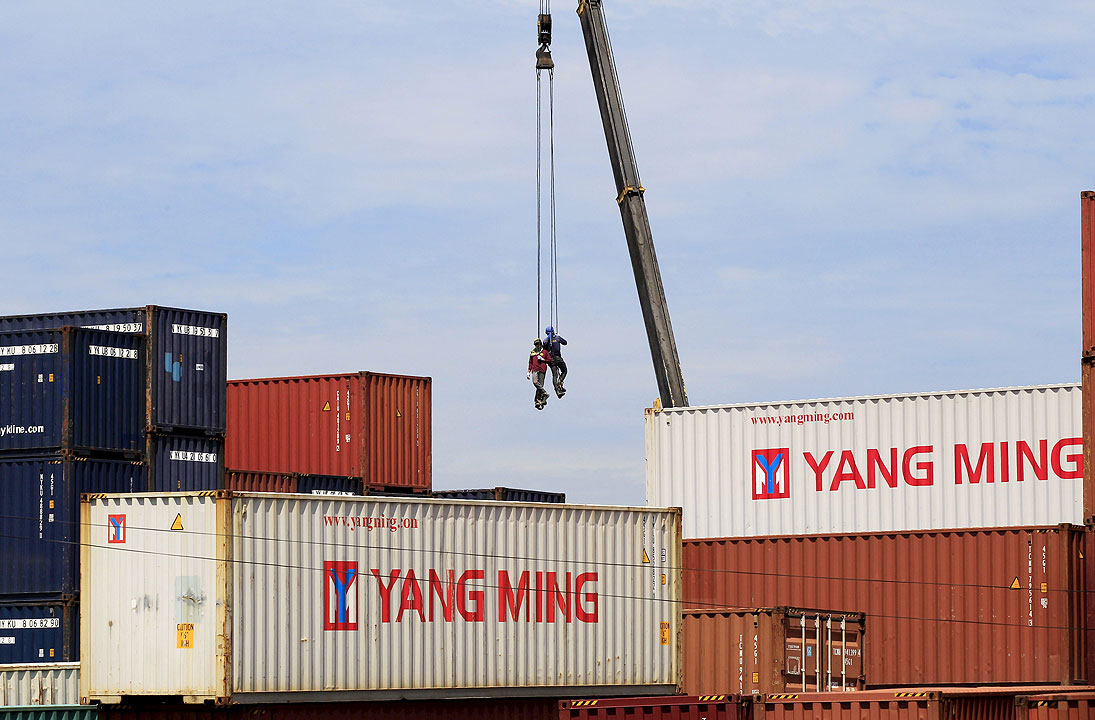
The Philippine trade deficit hit a record $6 billion in August. — REUTERS
By Lourdes O. Pilar, Researcher
THE PHILIPPINES posted its biggest single-month trade deficit on record in August as imports surged while exports slowed for a second straight month.
The value of merchandise exports shrank by 2% year on year to $6.410 billion in August, a reversal from the 18.9% growth in the same month in 2021, preliminary data from the Philippine Statistics Authority (PSA) showed.
It marked the second straight month of year-on-year contraction in exports after the revised 4.1% drop in July.
On the other hand, merchandise imports rose by 26% to $12.413 billion in August, slightly slower than the 28.3% growth in August 2021 but faster than the 22.2% in July.
August saw the fastest expansion in imports in two months or since the 26.3% growth in June. It also marked the 19th consecutive month of year-on-year growth in imports.
This brought the trade-in-goods deficit — the difference between exports and imports — to $6.003 billion in August, nearly double the $3.310-billion shortfall of the same month last year. It was also wider than the $5.989-billion gap in July.
Total trade — the sum of exports and imports — grew by 14.8% to $18.823 billion in August. This pace was faster than the 11.8% in July, but slower than the 24.4% in August 2021.
In the eight months to August, exports grew by 4.4% year on year to $51.155 billion, below the 7% growth target set by the Development Budget Coordination Committee.
Imports during the eight-month period climbed by 26% to $92.966 billion, already above the 18% full-year target.
Year to date, the trade balance ballooned to a $41.811-billion deficit, wider than the $24.77-billion trade gap in the comparable eight months last year.
DROP IN ELECTRONICS Ronilo Balbieran, economist of the University of Asia & the Pacific, said the 2% drop in exports in August was better than their forecast of a 4% contraction.
“If you are a manufacturer/exporter, it will take time for you to actually repurpose or expand your production capacity and production numbers for you to absorb this depreciation levels,” Mr. Balbieran said in an interview with One News’ BusinessWorld Live.
He noted that the ballooning deficit in August is a “definite sign” of growth in capital formation.
“More or less, we are importing a lot of construction materials, that is why materials prices are at its all-time high,” said Mr. Balbieran.
Security Bank Corp. Chief Economist Robert Dan J. Roces said the contraction in exports is still due to the “sustained drop in electronics exports given weak external demand and constrained local production.”
In August, outbound shipments of manufactured goods, which accounted for 82.6% of total exports, contracted by 0.4% year on year to $5.292 billion.
Electronic products, which made up 69% of manufactured goods and more than half of total exports that month, fell by 1.6% to $3.660 billion. Three-fourths of electronic product sales came from semiconductors, which decreased by 0.1% to $2.738 billion.
The United States, which accounted for 16.3% ($1.048 billion) of the total receipts, was the top destination of locally made products. It was followed by Japan (14.5% or $931.352 million), and China (13.1% or $839.184 million).
Philippine Exporters Confederation, Inc. President Sergio R. Ortiz-Luis, Jr. said the exports performance in August was due to the“low base effect.”
“The 2% contraction does not show significance in August export print. Slowly but surely, the export increases. The shortfall does not create a trend,” he said in a phone interview.
Mr. Ortiz-Luis also added that the peso’s weakness is helping exporters to be competitive.
“But for importers, they were affected most because most of them are into electronics and garments which comprised 60% of raw materials,” Mr. Ortiz-Luis said.
Data from the Bangko Sentral ng Pilipinas showed the Philippine peso averaged P55.7501 to a US dollar in August, a bit stronger than P55.8925 monthly average in July. As of Oct. 10, the peso returned to the record low of P59 against the greenback.
Meanwhile, the country’s orders of raw materials and intermediate goods rose by 15% to $4.924 billion in August. These accounted for close to 40% of the total August import bill.
“Import growth remained at double-digits due to still elevated global commodity prices plus buoyant import demand with continued reopening of the local economy, and as such import performance may stay robust for the rest of the year,” Mr. Roces said in an e-mail.
In August, imports of capital and consumer goods were valued at $3.349 billion (up 15.2%) and $2.151 billion (up 45.9%), respectively. Mineral fuels, lubricants and related materials increased by 75.6% to $1.931 billion from $1.099 billion last year.
China was the country’s main source of imports, with a 21.8% share ($2.706 billion) of the total bill, followed by Indonesia (10.8% or $1.346 billion) and Japan (8.1% or $1 billion).
Analysts expect better trade performance in the coming months.
“However, expect the record trade deficit to hover near current levels and continue to put pressure on the peso,” Mr. Roces said.
Mr. Balbieran said that if this higher exchange rate environment persists over the next six months, exporters should plan their production appropriately. “I can see another two to three months for exporters to actually feel that particular confidence that they will be able to export more with a higher exchange rate,” he said.
For Mr. Ortiz-Luis, trade will continue to grow in the coming months. “We expect exports to hit $100 billion at the end of the year.”
THE PHILIPPINE ECONOMY is still expected to remain one of the strongest performers in the region next year, although it may face “shocks” arising from a looming global economic slowdown, an International Monetary Fund (IMF) official said.
This as the IMF on Tuesday downgraded its global economic growth forecast to 2.7% next year, from 2.9% previously, citing the impact of “the Russian invasion of Ukraine, a cost-of-living crisis caused by persistent and broadening inflation pressures, and the slowdown in China.”
In its latest World Economic Outlook, the IMF kept the gross domestic product (GDP) growth forecast for the Philippines unchanged at 6.5% this year and 5% in 2023.
The government targets 6.5-7.5% GDP growth for this year, and 6-8% growth for 2023 to 2025.
“(The) impact of global shocks will weigh on the economy in the coming months and in 2023. GDP growth is therefore projected to slow to 5% in 2023, before picking up to about 6% in 2024. (Growth of) 5% still places the Philippines among the strong regional performers in 2023,” IMF Representative to the Philippines Ragnar Gudmundsson said in an e-mail to BusinessWorld.
The multilateral lender’s 2023 growth outlook for the Philippines is the second fastest among five Association of Southeast Asian Nations (ASEAN) member countries, after Vietnam (6.2%) and tied with Indonesia (5%).
However, the IMF lowered its ASEAN-5 forecast to 4.9% in 2023, from the 5.1% estimate given in July, “to reflect mainly less favorable external conditions, with slower growth in major trading partners such as China, the euro area, and the US.”
“The external environment is characterized by great uncertainty, and there are downside risks to our forecast linked to spillovers from Russia’s war in Ukraine, commodity price shocks, and a tightening in global financial conditions,” Mr. Gudmundsson said.
“With the risk of recession rising in countries accounting for about one-third of global output, successful multilateral cooperation is required to avoid fragmentation and economic hardship,” he said.
In its report, the IMF said the revised 2.7% global growth forecast for 2023 has a “25% probability that it could fall below 2%.” This is the weakest growth since 2001, except for the global financial crisis and the height of the coronavirus disease 2019 pandemic.
“In short, the worst is yet to come, and for many people 2023 will feel like a recession,” it added.
The IMF said it expects global inflation to rise to 8.8% this year, but ease to 6.5% in 2023 and 4.1% by 2024.
“Monetary policy could miscalculate the right stance to reduce inflation. Policy paths in the largest economies could continue to diverge, leading to further US dollar appreciation and cross-border tensions. More energy and food price shocks might cause inflation to persist for longer. Global tightening in financing conditions could trigger widespread emerging market debt distress,” it said.
In the Philippines, inflation accelerated to 6.9% in September, from 6.3% in August. It also marked the sixth straight month that inflation breached the Philippine central bank’s 2-4% target this year.
The Bangko Sentral ng Pilipinas (BSP) has raised benchmark interest rates by 225 basis points (bps) this year to tame inflation.
“Continued tightening of monetary policy in the near term can be expected to deal with second-round effects that have started emerging, including for wages and transport costs,” Mr. Gudmundsson said.
“As a commodity importer, the Philippine economy is facing a negative terms of trade shock which, combined with rising interest rates in the US and other advanced economies, is placing pressure on the peso,” he added.
The country’s trade deficit hit a record $6 billion in August.
“In this context, exchange rate flexibility remains critical as a shock absorber. If market conditions become excessively volatile and disorderly, foreign exchange intervention can help alleviate inflationary pressures and relieve some of the pressure on monetary policy,” he said.
The peso closed at P58.865 per dollar on Tuesday, gaining 13.5 centavos from its record-low finish of P59 on Monday, based on Bankers Association of the Philippines data.
So far, the local unit weakened by 15.4% or P7.865 from its P51-per-dollar finish on Dec. 31, 2021.
“Considering the current volatile global environment, decision making will need to remain nimble and data-driven,” Mr. Gudmundsson said.
He also said monetary policy can be supported through a tighter fiscal policy, while preserving essential expenditures for infrastructure, human capital, and social protection.
“Fiscal consolidation over the medium term can notably be achieved through renewed efforts to mobilize revenues domestically,” he added.
Heavy traffic is seen along the southbound lane of EDSA in Quezon City, April 18. — PHILIPPINE STAR/ MIGUEL DE GUZMAN
THE PHILIPPINE auto industry saw a 64.2% increase in sales in September, driven by strong demand for commercial vehicles.
A joint report by the Chamber of Automotive Manufacturers of the Philippines, Inc. (CAMPI) and Truck Manufacturers Association (TMA) released on Tuesday showed vehicle sales rose to 35,282 in September, from 21,4923 sold in the same month a year ago.
“The automotive industry continues its growth momentum, recording a double-digit growth of 64.2% in September driven by the increased demand for new motor vehicles,” CAMPI President Rommel R. Gutierrez said in a statement.
CAMPI-TMA said this is the seventh straight month the industry has posted double-digit annual growth.
Month on month, total vehicle sales went up by 16.9%.
In September, passenger vehicle sales jumped by 21.2% to 7,976.
Commercial vehicle sales surged by 83.1% year on year to 27,306, due to the 84.5% increase in light commercial vehicles to 22,073 and the 109% rise in sales of Asian utility vehicles (AUV) to 4,312.
There has been increased demand for commercial vehicles after the House Ways and Means Committee approved in August the fourth package of the Comprehensive Tax Reform Program which included the elimination of the excise tax exemption for pickup trucks.
Under Republic Act No. 10963 or the Tax Reform for Acceleration and Inclusion, pickup trucks are exempted from excise tax as part of efforts to assist small business owners and professionals.
For the first nine months of 2022, CAMPI-TMA members sold 248,154 units, up by 29.5% year on year.
Commercial vehicle sales jumped by 44% to 188,096 units, on the back of double-digit growth in AUVs and light commercial vehicle sales in the January to September period. Light commercial vehicle sales rose by 48% to 148,706, while AUV sales jumped by 38.8% to 32,186.
However, sales of passenger cars shrank by 1.5% to 60,058 units in the nine-month period.
“The automotive industry foresees a continued growth in the latter part of the year, benefiting from the improving economy based on the recent growth forecast of 6.5% this year – attributed to strong domestic demand and continued easing of pandemic restrictions,” Mr. Gutierrez said.
The industry is targeting to sell 336,000 units this year, 17% higher than the 268,488 units sold in 2021.
Toyota Motor Philippines Corp. accounted for half of the industry’s sales with 124,884 units in the January to September period, up 35% year on year.
Mitsubishi Motors Philippines Corp. had a 14% market share with 35,139 units sold, while Ford Motor Co. Phils. Inc. had a 6.55% market share with 16,244 units sold.
Nissan Philippines, Inc.’s market share stood at 6.48% with sales of 16,068, while Suzuki Phils, Inc. had a share of 5.83% with sales of 14,475. — R.M.D.Ochave
THE PHILIPPINES’ retirement income system is the second worst among 44 economies in Mercer-CFA Institute’s Global Pension Index released on Tuesday, due to inadequate pension for retirees.
The Philippines ranked 43rd out of 44 economies in the index, which benchmarks retirement income systems around the world, ahead only of Thailand.
The country received an overall grade of “D” as its index value slipped to 42 this year from 42.7 last year “primarily due to some minor adjustments.”
The “D” grade means that the pension system that has “some desirable features but also has major weaknesses and/or omissions that need to be addressed.” Other countries that had a “D” grade were Thailand, Argentina, India, Turkey, and Indonesia.
Based on the index, Iceland’s retirement income system is the best in the world with a score of 84.7, followed by the Netherlands (84.6) and Denmark (82). These were the only countries that had an overall grade of “A.”
Among the 10 Asia-Pacific economies in the index, Singapore had the best retirement system, followed by Hong Kong and Malaysia.
The Global Pension Index assesses retirement systems through three weighted sub-indices: adequacy, sustainability, and integrity.
In terms of integrity, the Philippines’ score dropped to 30 — the lowest among the 44 countries — from 35 last year. Integrity considers a retirement system’s regulation and governance, protection for members, and operating costs.
The Philippines scored the highest in sustainability at 52.3, although this was slightly lower than the 52.5 last year and below than the global average at 53.5. The country ranked 23rd globally in this sub-index.
Sustainability measures pension coverage, total assets, demography, public expenditure, government debt, and economic growth.
The Philippines’ score for the adequacy sub-index rose to 40.5 from 38.9 last year, and ranked 41st out of 44 countries. The adequacy sub-index measures benefits, savings, government support, and home ownership, among others.
The country’s retirement income system is comprised of a small basic pension and an earnings-related social security system.
In a report, Mercer said the Philippines’ retirement system can improve by raising the minimum level of support for the poorest individuals, and increasing coverage of employees in occupational pension schemes.
It also suggested “setting aside funds in the public system for the future, thereby reducing reliance on the pay-as-you-go system,” and introducing “non-cash-out options for retirement plan proceeds to be preserved for retirement purposes.”
Mercer said governance requirements for private pension system should also be improved.
David Knox, a senior partner at Mercer and lead author of the study, said policy makers should ensure the retirement systems are supported and well-regulated amid growing uncertainty.
“Individuals have been assuming more responsibility for their retirement savings for some time; amidst high levels of inflation, rising interest rates and greater uncertainty about economic conditions, they are doing so in an increasingly complex and volatile environment. Despite differences in social, political, historical or economic influences across geographies, many of these challenges are universal,” he was quoted as saying in a statement. — Ana Olivia A. Tirona
THE Marcos administration expects an offshore oil field northwest of Palawan island to bring “recoverable” volumes of five to six million barrels of oil in early production towards the second half of 2023.
Its optimism comes after the Department of Energy (DoE) allowed Nido Petroleum Philippines Pty. Ltd. to proceed with an on-site survey for drilling locations under Service Contract (SC) 6B in the Palawan basin by the fourth quarter of this year.
In a statement on Tuesday, President Ferdinand R. Marcos, Jr. said the plan to conduct the survey in the Cadlao oil field will encourage investors to enter the country’s oil and gas sector.
He said the go-signal to Nido Petroleum, the operator of SC 6B, paves the way for the drilling of two wells — one exploration and one appraisal — during the first quarter of next year. The appraisal well could lead to early oil production into the second half of next year, he added.
Mr. Marcos said the plan signals the Philippine government’s “intent to maximize indigenous resources and has attracted strong interest from foreign investors in the Philippine upstream oil and gas sector.”
In his statement, he described the Cadlao oil field to have last produced in the early 1990s with more than 11 million barrels.
In February 2022, the “operatorship” of the oil field was taken over by Nido Petroleum from Forum Energy Philippines Corp.
Nido Petroleum committed to funding 100% of the development costs, “which include drilling, extended well tests, and subsequent development of the said oil field,” Mr. Marcos said.
On Monday, Energy Secretary Raphael P.M. Lotilla said in a forum organized by the Economic Journalists Association of the Philippines that “to maximize the use of indigenous natural gas and oil resources, the DoE underlined to local and foreign investors the Philippines’ firm commitment to preserve investment incentives for service contractors that are provided for under PD (Presidential Decree) 87.”
PD 87 was issued to revamp petroleum legislation by introducing the service contracting system. It provides financial incentives to contractors, including tax-free importation of equipment and supplies, exemption from all taxes except income tax, income tax assumption, accelerated depreciation, free market determination of crude oil price, and easy repatriation of investments and profits.
The DoE has yet to respond to BusinessWorld’s questions regarding details of oil exploration under SC 6B.
In July, Mr. Lotilla said Mr. Marcos instructed him to prioritize addressing uncertainties regarding investment incentives in the upstream sector.
Last month, the Department of Trade and Industry (DTI) said that Australian energy firm Sacgasco Ltd. is planning more offshore oil development in the country.
It said Sacgasco, which is locally operating as Nido Petroleum, was set to get a drilling rig in 2023 to conduct an extended well test in the Cadlao field, which is under SC 6B. A successful test would lead to the redevelopment of the Cadlao oil field, it added.
The project will be followed with a plan to drill another prospect, through SC 54A, also offshore Palawan, the department said.
The DTI quoted Sacgasco as saying that the initial investments for the oil projects in SC 6B and SC 54A are about $15 million each for the drilling and testing of oil production. — Kyle Aristophere Atienza and Ashley Erika O. Jose


 “Cryptocurrency exchange services are fairly new compared to the other fintech services. And if the current trend of fintech adoption among Filipinos continues, we can expect that the number of Filipino cryptocurrency users is also likely to increase in the coming years,” said Cleve V. Arguelles, research fellow and managing director of WR Numero Research. “According to the survey, most Filipinos (87%) believe that cryptocurrency is beneficial to the Philippines’ economy and for that reason the government should support the industry (81%).”
  For data and media inquiries, please contact Cleve V. Arguelles, research fellow and managing director of WR Numero Research at +63 9998-770-572 or cleve.arguelles@wrnumero.com.