Home Blog Page 5410

Philippine court voids oil deal with China, Vietnam

BW FILE PHOTO

THE PHILIPPINE Supreme Court (SC) has voided a 2005 government deal with China and Vietnam for joint gas and oil explorations in the South China Sea.

Voting 12-2 with one abstention, the tribunal had ruled the agreement violated the Constitution for allowing foreigners to explore the country’s natural resources covering 142,886 square kilometers without full supervision from the state, it said in a statement on Tuesday.

“The court ruled that the Joint Marine Seismic Undertaking is unconstitutional for allowing wholly owned foreign corporations to participate in the exploration of the country’s natural resources without observing the safeguards provided in Section 2, Article XII of the 1987 Constitution,” it said.

The High Court had yet to upload a copy of the decision on its website.

Under the Constitution, the exploration, development and use of the country’s natural resources must be under the full control and supervision of the state.

In 2005, the Philippines under ex-President Gloria Macapagal-Arroyo entered into the deal with China and Vietnam through their state-owned oil companies.

The government earlier argued the deal was aboveboard because it only involved “pre-exploration activities,” which the court disagreed with.

The High Court said the purpose of the pact was for these companies to explore the area for petroleum and other gas resources.

“Such designation does not detract from the fact that the intent and aim of the agreement is to discover petroleum, which is tantamount to exploration,” it said.

Bayan Muna Party-list including former Congressmen Satur C. Ocampo and Teodoro A. Casiño sued the government in 2008 before the High Court, saying the deal would allow foreign oil companies to conduct large-scale explorations of natural resources intended for Filipino citizens.

In a statement, Mr. Casiño welcomed the ruling even if it took the court almost 15 years to resolve it. “The ruling is as relevant as ever considering President Ferdinand R. Marcos, Jr.’s plan to enter into a joint exploration of the West Philippine Sea with China,” he said, referring to areas of the South China Sea within the Philippines’ exclusive economic zone.

Last week, Chinese President Xi Jinping told Mr. Marcos China was ready to resume oil and gas talks with the Philippines, according to Chinese state television.

“I really hope — I would very much like, as you have suggested, Mr. President — to be able to announce that we are continuing negotiations and that we hope that these negotiations will bear fruit,” Mr. Marcos told the Chinese leader, according to a video released by the presidential palace in Manila.

“Because the pressure is upon not only China, not only the Philippines but the rest of the world to move away from the traditional fronts of power,” he added.

China claims more than 80% of the South China Sea, which is believed to contain substantial oil and gas deposits and through which billions of dollars in trade passes each year. A United Nations-backed arbitration court in July 2016 voided China’s claim to more than 80% of the sea based on a 1940s map.

China has ignored the ruling, which has failed to stop its island-building activities in areas also claimed by the Philippines, Vietnam, Brunei, Malaysia and Taiwan.

“May this be a warning to Mr. Marcos not to trifle with the constitutional provisions that reserve the exploitation of our natural resources exclusively to Filipinos and under the full supervision and control of the Philippine government,” Mr. Casiño said. — John Victor D. Ordoñez

Marcos orders DoJ to decongest jails by freeing more prisoners

PHILIPPINE STAR/ MIGUEL DE GUZMAN

PHILIPPINE President Ferdinand R. Marcos, Jr. has ordered the Department of Justice (DoJ) to release more prisoners as part of efforts to decongest the country’s jails, according to the presidential palace.

Mr. Marcos also backed a DoJ plan to transfer hardened criminals to an Alcatraz-type prison to stop them from committing more crimes while in jail.

The president said most inmates are languishing in jail because they could not afford good lawyers. “They don’t have brilliant lawyers,” he told a Cabinet meeting in Filipino, according to the palace statement. “That’s why we are in favor now to release many of them.”

“They just needed representation to set them free. So let’s continue with that,” he added.

At the meeting, Mr. Marcos cited rampant corruption inside the Bureau of Corrections, underscoring the need for inmates to be transferred to special facilities.

“The president also backed the DoJ’s plan to transfer hardened criminals to an Alcatraz-type prison, isolating them from the general population and putting a stop to their criminal activities as they were still able to direct operations while behind bars,” the palace said.

The DoJ released almost 3,000 prisoners from July to December 2022 “as an immediate step” to decongest the country’s prisons and jails.

“The DoJ also fast-tracked the processing of the release of qualified prisoners by digitalizing the systems of the Probation and Parole Administration,” the palace said, citing the agency’s accomplishment report for last year.

The Justice department is eyeing to further decongest prisons by transferring the maximum security compound in Muntinlupa City to Sablayan, Occidental Mindoro, the Presidential Communications Office (PCO) said. The DoJ is also planning to establish separate heinous crime facilities in Luzon, Visayas and Mindanao. 

Meanwhile, the palace said the Department of Education (DepEd) would seek to boost support for teachers and make learning more inclusive starting this year.

In a separate statement, DepEd said it would present a basic education report on Jan. 30 that will outline the state of basic education in the country. The report will also include updates on the K-12 curriculum.

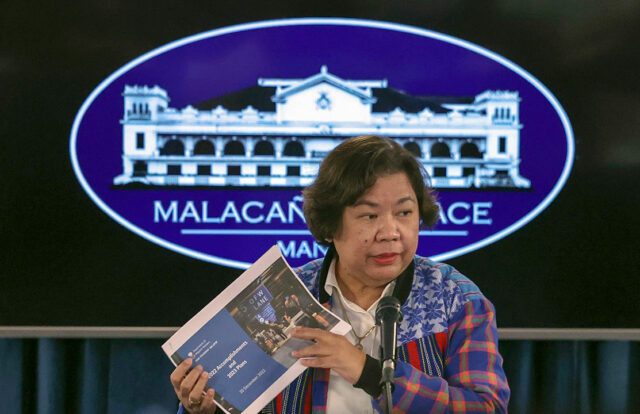
Meanwhile, Mr. Marcos has appointed Cheloy Velicaria-Garafil as PCO secretary. The office posted photos of Ms. Garafil taking her oath before the president on Instagram.

In October, Ms. Garafil was named officer-in-charge of the now defunct Office of the Press Secretary, which has since been renamed the PCO. It is in charge of coordinating the Executive branch’s messaging system.

Ms. Garafil, a former journalist, had also served as head of the Land Transportation Franchising and Regulatory Board. — K.A.T. Atienza

Gov’t looking at privatizing Manila airport

PHILIPPINE STAR/ MIGUEL DE GUZMAN

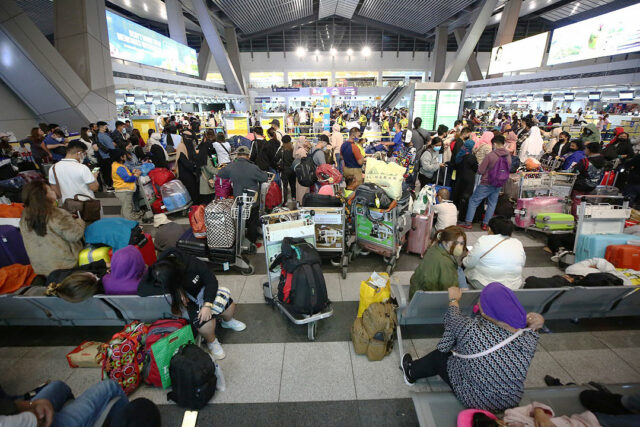
THE PHILIPPINE government is looking at privatizing Manila’s international airport, the Transportation department told congressmen probing the air traffic glitch that paralyzed the country’s airports on New Year’s Day. 

“The privatization of the Ninoy Aquino International Airport (NAIA) is being studied right now,” Transportation Secretary Jaime J. Bautista told the House of Representatives hearing on Tuesday. “We’re working with the Asian Development Bank (ADB) and Public-Private Partnership Center for a possible privatization of Manila’s international airport.” 

The terms of reference of the proposal should be ready this quarter, he said, adding that letting the private sector manage the airport could help improve its service. 

Mr. Bautista also apologized to the 65,000 passengers whose flights got canceled because of the technical glitch. 

“We sincerely apologize to all those affected by the technical glitch which disrupted hundreds of flights and inconvenienced thousands of passengers not just at NAIA but in other major local airports as well,” he said. 

Assistant Minority Leader Rep. Arlene D. Brosas said that the government should be in charge of providing public transportation services. 

“There is no guarantee that privatization of our airports would mean that services would be better, fees will not increase and true public service is given,” she said, citing how the privatization of electricity and water services had led to rate increases. 

Ms. Brosas said the Makabayan Bloc has filed a bill that seeks to establish a “clear-cut bill of rights of airline passengers.” 

The NAIA air traffic fiasco on Jan. 1 was caused by a fault in one of the air traffic management system’s circuit breakers, Civil Aviation Authority of the Philippines (CAAP) Director-General Manuel Antonio L. Tamayo told the hearing. 

“The failure of the circuit breaker could not be anticipated in spite of the many safeguards or procedures that are being done,” he said. 

Cagayan de Oro Rep. Rufus B. Rodriguez urged Mr. Tamayo to go on leave pending investigation of the glitch. Mr. Bautista said an intra-agency probe was being conducted.  

Senior Deputy Minority Leader Paul R. Daza moved for the committee to summon the suppliers and manufacturers of the air traffic management equipment at the next hearing. — Beatriz Marie D. Cruz 

More Philippine Defense officials quit 

MORE senior officials of the Defense department have quit after Jose Faustino, Jr. resigned as secretary. 

At least seven more officials who held undersecretary and assistant secretary positions submitted their resignation letters to newly installed Defense Secretary Carlito G. Galvez, Jr., agency spokesman Arsenio R. Andolong told reporters on Tuesday. 

It is customary for coterminous officials like them to resign under a new leadership, he said. 

The latest resignations came after an unexpected change of command at the military with the reappointment of General Andres C. Centino as chief of staff. 

A few hours after the ceremony, reports of alleged “destabilization moves” by AFP members circulated on messaging apps and social media platforms. 

In a statement, Mr. Faustino said he resigned as Defense chief last week after learning “only from news and social media” that a new military chief had taken oath in Malacañang — something that the presidential palace denied. 

In a separate statement, the palace said Mr. Faustino was aware of the appointment of Mr. Centino. “The president as the commander-in-chief has the sole prerogative to appoint the Armed Forces of the Philippines chief of staff,” the Presidential Communications Office said.  

The military establishment has become a “major political bloc” after a popular uprising in February 1986 toppled the late dictator Ferdinand E. Marcos, father of the current Philippine president, Arjan P. Aguirre, who teaches political science, recently told BusinessWorld

“They have learned to politicize their role that’s why they have remained to be one of the stable sources of personnel who can be appointed to important government posts,” he said. — Kyle Aristophere T. Atienza 

PHL public transport system behind by 35 years in development — senator

PHILIPPINE STAR/MICHAEL VARCAS

A SENATOR has called for increased investments in the countrys transport infrastructure and systems, saying the sectors development is behind by 35 years compared with neighbors in the southeast Asian region.   

My estimate is that were about… 35 years behind in terms of infrastructure development and transportation modernization compared to our neighbors,Senator Joseph Victor G. Ejercito said in a statement on Tuesday.  

He did not immediately provide a response when asked if he meant public or private capital outlay, or both.    

For several decades, we have not really invested much on transport the way our ASEAN (Association of Southeast Asian Nations) neighbors did,he said. We are only investing about 2% of the gross domestic product. Its supposed to be 5% for infrastructure development,he added.  

The senator said enhancing the countrys public transportation, especially railways, will boost efforts to revive the economy from the aftereffects of the COVID-19 pandemic.  

With transportation, with railway systems, more than airports, movement of people, movement of goods will be easier. That will attract, of course, foreign investments. That will make doing business easy and more convenient,he said.  

Transportation modernization and infrastructure development will cost a lot, but I think the returns to the economy will be enormous,he added.  

POWER SUPPLY
Another senator, meanwhile, called on the Department of Energy (DoE) to address the longstanding problem of thin energy reserves, which puts the delivery of supply at risk every year during the hot, dry months.   

This is a perennial problem that the DoE needs to solve immediately,Senator Sherwin T. Gatchalian said in a statement on Tuesday. It has been a tradition already that every summer, our consumers will be at risk of experiencing brownouts.  

DoE officials announced on Monday that Luzons power grid will likely experience deficient reserves for seven months this year.  

Mr. Gatchalian said the department should ensure that power source projects lined up to start this year will commence operations as scheduled.   

DoE should make sure that the 1,091MW (megawatts) of new capacity for 2023 should come online on time,he added.   

DoE Undersecretary Rowena Cristina L. Guevara on Monday said that some power plants in Luzon may experience forced outages that would reduce available capacity by 500-600 MW this year.  

The yellow alerts are anticipated to take place during the summer months of April to June as well as during the September-November period.  

Mr. Gatchalian also noted existing measures that can be tapped such as the Interruptible Load Program (ILP), which allows customers to operate their generating sets and collectively reduce electricity drawn from the grid to ration limited power supply.  

The Visayas in central Philippines, which is connected to the Luzon grid, is also likely to experience alerts for low supply.   

Mindanao in the south, with the interconnection facility still under construction, is expected to have sufficient power reserves for this year. Alyssa Nicole O. Tan

DMW, DoJ tightening watch on human trafficking within ASEAN neighbors 

PHILIPPINE STAR/KRIZ JOHN ROSALES

THE DEPARTMENT of Migrant Workers (DMW) on Tuesday said it is working closely with the Department of Justice (DoJ) to strengthen the monitoring and action against human trafficking activities within the southeast Asian region that target Filipino workers.  

“We continue to maintain a tight watch on the online illegal recruitment and trafficking of our workers to those places, especially in Myanmar, Cambodia and Laos,” Migrant Workers Secretary Maria Susana “Susan” V. Ople told a news briefing streamed live on Facebook.  

The DMW earlier provided P10,000 in cash aid to each of the workers who fell victim to an online illegal recruitment scheme allegedly run by Chinese offshore companies in Myanmar.  

Migrant Workers Undersecretary Hans J. Cacdac said in December that the DMW plans to set up more livelihood and retraining programs for jobseekers who fell victim to human trafficking schemes.  

“We are working closely with the Department of Foreign Affairs (DFA) and the office of Senator Ana Theresia N. Hontiveros-Baraquel for possible retooling programs for skilled workers and our overseas Filipino workers (OFWs) who were enticed by these fraudsters,he told BusinessWorld in a Zoom interview.  

The 12 victims were rescued in a remote area of Myanmar through a joint operation by Ms. Hontiveros’ office and the DFA.  

REGIONAL OFFICES
Meanwhile, Ms. Ople said the DMW plans to use its P 15.8 billion budget to establish 16 regional offices and to hire 1,000 new workers this year.  

She noted that the recently-built Overseas Filipino Workers (OFW) Hospital in Mabalacat, Pampanga helped over 6,000 families and provided cash assistance amounting to P21.8 million last year.  

The hospital was inaugurated in July and is intended to provide medical services exclusively for OFWs and their families. 

Mr. Cacdac has said the DMW aims to expand the medical facility this year and improve services for distressed OFWs.  

The DMW chief noted that the government has planned bilateral talks with Romania, Hungary and Portugal with the goal of establishing more labor agreements with these European countries.  

“One of our key objectives is to increase the number of deployed OFWs for this year and the good news is that there are several emerging markets,” Ms. Ople said. John Victor D. Ordoñez

Bill seeks mandatory insurance, hazard pay for journalists 

A BILL that will provide mandatory insurance benefits and hazard pay to journalists was filed in the House of Representatives, citing risks related to the job.   

During important assignments, journalists face the most dangerous situations like typhoons, disasters, floods, riots, war and conflicts, to name a few, in order to deliver the news to the public, Deputy Speaker Camille A. Villar, author of House Bill 6543, said in a statement on Monday.   

The Las Piñas City representative said the proposed law covers all permanent, temporary, contractual, and casual journalists employed by media entities in the Philippines, including freelance journalists. 

Mass media practitioners who suffer total or partial disability in line with their work shall be granted P350,000 in disability benefits.  

Death benefits are proposed at P300,000, while media personnel who are hospitalized or require medical assistance may reimburse medical costs up to P200,000.   

The media entity shall have the option of selecting the insurance company and shall be responsible for paying the insurance premiums for their journalists and employees,the bill states.   

Hazard pay, meanwhile, would be equivalent to at least 25% of the journalists gross monthly basic salary, and would not be subject to tax.   

Employers and insurance firms that fail to comply with the provisions could face fines of P300,000 to P500,000 or be imprisoned from one to six years, or both, based on the courts discretion. Beatriz Marie D. Cruz 

Solons call for suspension of water price hike in Metro Manila 

PHILSTAR

OPPOSITION lawmakers filed a joint resolution calling for the suspension of a scheduled increase in water rates in Metro Manila and surrounding areas served by two private concessionaires, citing the need to help consumers cope with inflation.  

Gabriela Party-list Rep. Arlene D. Brosas led the filing of House Joint Resolution 17, calling on both lower and upper chambers to immediately pass legislation that will defer the approved water price hikes of Maynilad Water Services, Inc. and Manila Water Services, Inc.   

The increase, approved by government regulator Metropolitan Waterworks and Sewerage System (MWSS), takes effect this month.  

The resolution was also signed by ACT Teachers Party-list Rep. France L. Castro and Kabataan Party-list Rep. Raoul Danniel A. Manuel. 

It cites the countrys record-high December inflation rate at 8.1%. 

This will only exacerbate the plight of the poor families who are struggling to make ends meet,the resolution states.  

Maynilad is the water provider for 17 cities and municipalities in the west zone of the Metropolitan Manila area, while Manila Water services 23 cities and municipalities in the east zone.  

The water service operations of MWSS was privatized in 1997. The winning concessionaires took over billions worth of government loans and a distribution system that was losing water at a rate of at least 60%. Beatriz Marie D. Cruz 

EcoWaste warns consumers vs toxic lucky charm bracelets ahead of Chinese New Year

TOXICS watchdog EcoWaste Coalition warned consumers against buying lucky charm bracelets that could contain cadmium, as these trinkets become popular with the Chinese New Year celebration set this year on Jan. 22.   

In a statement on Tuesday, the group said it has spotted high levels of cadmium in lucky charm bracelets sold at P50 to P150 in Quiapo, Manila.  

According to the group, most of the lucky charm bracelets have exceeded the 100 parts per million (ppm) limit accepted under European Union (EU) standards.  

Based on the screening results, 12 of the 15 bracelets contained rabbit-inspired ornaments with cadmium content above the 100 ppm EU limit for cadmium in jewelry: seven had over 100,000 ppm, four had 19,690 to 78,200 ppm, and one had 553 ppm,the EcoWaste Coalition said.   

Cadmium is a hazardous chemical, with its compounds being listed in the Philippine Priority Chemical list and the 10 chemicals of major public health concern of the World Health Organization (WHO), according to the group.     

We find the presence of cadmium in products marketed as charms for attracting good health, fortune and happiness very concerning as this substance is known to cause adverse health effects, including cancer,EcoWaste Coalition National Coordinator Aileen A. Lucero said.    

Consumers should be forewarned that some lucky charms, which are often sold without any labeling information, may be laden with hazardous substances like cadmium. Consumers may be exposed to cadmium through the skin or oral contact. Worst, a child may play with and accidentally ingest a cadmium-containing charm if the bracelet is broken or untied,she added.    

Citing the WHO, the EcoWaste Coalition said that cadmium has toxic effects on the kidneys, and the skeletal and respiratory systems, adding that it is classified as a human carcinogen.    

The unrestricted sale of cadmium-laden jewelries in the local market is a public health concern. We urge concerned government regulators to take action in order to protect human health,the group said. Revin Mikhael D. Ochave  

Dreaming about the World Cup: Futsal and the Palarong Pambansa

WIKIMEDIA.ORG

(Part 3)

In a well-planned physical education program at the elementary school level, children must be patiently helped to progress to the next mature version of each skill with respect to their developmental characteristics, instead of pushing them to perform the way an adult would.

As an aside, the consideration to be given to a child’s physical characteristics was especially crucial to the development of the Greatest of All Times (GOAT) football player, Lionel Messi, who reached the summit of his fabled professional success at the 2022 World Cup in Qatar, where he led the Argentinian national football team to a historic and most spectacular victory. At the age of 11, Messi was diagnosed with a rare disease called Growth Hormone Disorder (GHD). This condition impedes the body from growing as it should according to age. With the help of friends and the proactive role played by the officials of FC Barcelona (who funded the medical expenses to treat the disease), the Argentina legend fought the condition gracefully and came back strong as the unquestionable GOAT of football.

On Dec. 18, 2022, the whole world witnessed the historic victory of Argentina in FIFA World Cup 2022. Messi’s fans were left in tears as he lifted the trophy with joy and pride. Everyone knew that his fame and success did not come easy and overnight. As he once said, “I start early, stay late, day after day, year after year. It took me over 17 years to enjoy the moment of happiness where people call me their football inspiration.” Coincidentally, I first saw Messi face to face in a football match at the Camp Nou in Barcelona when he was 17 during the amazing feat — viewed by tens of millions since then — showing him agilely evade eight defenders of Club Getafe of Madrid, running straight to the goal and scoring.

In time, children eventually grow and their body systems, such as their brains and their muscles (also called hardware), mature to become more like that of adults. If they are forced to skip the pre-requisites (progressing from simple to complex), children may never achieve their optimum motor development. In Canada, for example, the Canadian Sport Centre, a chain of sports development service providers, was alarmed by the lack of basic movement skills among many of the children and youth who enter its sports programs, and has massively campaigned for the development of physical literacy.

Physical literacy is a composite of fundamental movement and motor skills that can be further reinforced through activity-specific skills, or their application in a wide variety of contexts— from sports to exercise and rhythmic activities or dance. It must always be kept in mind that learning fundamental sports skills before mastering fundamental movement skills reduces performance ability later. All these must be considered in devising the physical education curriculum, especially in our public schools which account for 90% or more of pupils at the basic education level.

In this regard, one of the leading proponents of football in the country, Kevin Goco, has suggested to me in an e-mail that the best way of promoting football in the Philippines is to encourage as many children as possible in the public schools to play futsal, a simpler version of football that can be played by fewer players in each team and in smaller spaces than an official-sized football field. It can be played on a basketball court. As in Croatia, it can be part of the curriculum in our public schools.

We can also learn from Brazil’s development model where most Brazilian children play futsal until the age of 12 to 13 years old. Once the kids reach their teens, they can either continue focusing on futsal or switch to football. Kaká, Ronaldinho, and Neymar were all examples of Brazilians who started off playing futsal and made the seamless switch to football. These three are among the most technically gifted footballers in the last 50 or so years. They attribute their development to the game of futsal.

Vice-President Sara Duterte, as Secretary of Education, will be well advised to mandate that futsal be a regular sport for girls and boys in the Palarong Pambansa. At present, it is only a regular sport for secondary school girls. (No wonder it is the National Women’s Football team that has qualified for the World Cup for women next year!) In order to have futsal as a regular sport, it first needs to be showcased and inserted into the Palarong Pambansa as a demonstration sport.

Futsal is less taxing on resources (only 12 to 15 players are needed versus a squad of 20 to 25 for football). It is also less demanding on facilities since indoor courts can be used. In addition, with the Department of Education’s rollout of a Sports Club program in their sports development agenda, there is an opportunity for the department (in cooperation with the Philippine Football Federation and some football-oriented NGOs) to roll out football and futsal sports clubs. The Sports Club program is co-curricular and should serve as a basis for developing the teams that will eventually compete in the Palarong Pambansa.

The Department of Education (DepEd) is key in the promotion of futsal. With the leadership of VP Duterte, the department can readily give futsal (and as a consequence football) a big boost by:

1.) Making futsal a demonstration sport, and eventually a regular sport, for the pupils (both boys and girls) at the elementary and high school levels during the Palarong Pambansa starting in 2023 in Marikina. This is key because once a sport is regularized in school competitions, the schools and their respective teachers are incentivized to promote and propagate the sport.

2.) Promoting the development of football and futsal sports clubs in schools through the DepEd’s Sports Club program that will be eventually rolled out by the department. Sports clubs are meant to be holistic, catering to both non-elite and elite players. The DepEd has a budget for this program and can count on the collaboration of private sector groups to implement the theory and concept of the Schools Sports Club through football and futsal.

Among the private organizations is the Parents for Education Foundation (PAREF) which has seven schools in Luzon, Visayas, and Mindanao where the School Sports Club concept has been actually implemented. The PAREF schools would just be only too willing to share their more than 40 years of experience promoting the playing of both futsal and football. In fact, one of the pupils of Southridge — a school for boys under the auspices of PAREF — at the age of 13, showed so much promise as a top football player that he was invited by FC Barcelona to transfer to their home city in order to train in the famous school called La Masia, which is the training center for future players of Barca situated in Barcelona. This person, named Sandro Reyes, who belongs to one of the prominent political families in Marinduque, has played for leading football clubs in the region of Catalunya and is now one of the midfielders in the Philippine national football team, the Azkals.

3.) Closely coordinating with the Philippine Football Federation, the Philippine Sports Commission, and the appropriate agency in the DepEd so that they do not operate as silos in the development of football. As in many other sectors of the government, more often than not these three agencies do not coordinate their respective activities and may actually at times be at cross purposes with one another. It is proposed that VP Duterte use her clout as the second most important executive in the Government to convince the heads of these three agencies to agree on a common football development agenda.

(To be continued.)


Bernardo M. Villegas has a Ph.D. in Economics from Harvard, is professor emeritus at the University of Asia and the Pacific, and a visiting professor at the IESE Business School in Barcelona, Spain. He was a member of the 1986 Constitutional Commission.

bernardo.villegas@uap.asia

Building real confidence: National interest as the best driver of foreign policy

OPS.GOV.PH

After President Ferdinand Marcos, Jr.’s trip to China last week, the question on everyone’s mind was: What now? What does this trip mean for our territorial dispute in the West Philippine Sea?

Certainly, the photos and the news reports during and after the official visit were encouraging. President Marcos Jr. met with no less than the top three government officials of China: President Xi Jinping, Premier Li Keqiang, and Chairman Li Zhansu of the Standing Committee of the National People’s Congress.

Mr. Marcos and Mr. Xi did talk about the West Philippine Sea during their bilateral meeting. They agreed to establish a direct communication mechanism between China’s Ministry of Foreign Affairs and our own Department of Foreign Affairs (DFA). This, Marcos said, would address issues and prevent possible miscommunication and incidents in the West Philippine Sea (WPS).

Mr. Marcos said it was he who proposed the creation of the direct communication mechanism, so official communication between the two countries would be elevated to a ministerial level. This is a confidence-building measure, he said, to improve the trust on both sides.

I wonder, however: Has not the line of communication been open for years, anyway, at least on the part of the Philippines? Has not our DFA, in fact, been actively engaging with China especially on the issue of the WPS, through the issuance of notes verbale and through meetings with Chinese authorities? The spokesman of the DFA, Teresita Daza, said that as of Nov. 22, 2022, the Philippines has issued 189 diplomatic protests to China and 61 of these were filed during the current Marcos administration.

But where has the confidence been, thus far?

The establishment of a so-called direct communication mechanism between the two countries, therefore, is hardly a new or significant step in Philippine-China relations, simply because it has always been there but has not been effective in preventing the latter’s aggressive action in the disputed territory. What would make it different from the existing mechanism and how can it assure us that China will even pick up when Philippine authorities call, listen to what they have to say, much less act with fairness and expediency on the issue?

The only thing that would make a difference is more fundamental than opening up communication lines that have always been there: China has to, first and foremost, acknowledge the jurisdiction of the Permanent Court of Arbitration and respect its July 2016 ruling recognizing the Philippines’ rights on the disputed territory. Without this, there will neither be confidence nor good faith in our dealings with each other.

The long-standing issues in the West Philippine Sea are not only political in nature. Yes, they have threatened our country’s territorial integrity and put to test our leaders’ resolve to fight for what is rightfully ours. But these issues also have profound economic and social repercussions, specifically as they have negatively affected the livelihood of our fishermen who depend on marine resources for their subsistence, as well as threatened the nation’s food security. Addressing both the welfare of fisherfolk communities and the food security of the larger population is a primordial responsibility of the government.

No less than the Senate, just before the previous year ended, passed an unnumbered resolution that denounced China’s continued harassment and intimidation tactics in Philippine maritime territory.

We should take comfort in the fact that numerous like-minded states — the United States, the European Union, Australia, Canada, and Japan, among others, have recognized and supported our arbitral victory against China.

The support from our strategic partners and allies is not mere political rhetoric. These states have committed to support us in many ways, among them coordinating and collaborating with civil maritime agencies and other regional institutions, in order to boost the Philippines’ capacity to protect its maritime zones and effectively respond to emerging security concerns.

Indeed, maritime security is increasingly becoming a point of cooperation among states. The Indo-Pacific region, of which the Philippines — and China, for that matter — is a part, is brewing with both traditional and non-traditional security threats. We believe the only way to navigate this increasingly complex dynamic is to push for a rule-based order that would govern states’ conduct, not only in maritime affairs, but in all other aspects, as well as to fortify partnerships with other countries with similar mindsets and objectives.

In a forum that we held on Jan. 5, called “Prioritizing the National Interest in Foreign Policy: Strengthening Alliances and Strategic Partnerships in the Indo-Pacific,” Dr. Ronald Holmes, President of Pulse Asia Research, said that in a survey held from Nov. 27 to Dec. 1, 2022, the United States still enjoys the trust of most Filipinos, with 89% of respondents picking the US, followed by Australia (79%) and Japan (78%). Just 33% of respondents cited China.

Approximately 80% of Filipinos believe that the protection of marine resources, environment, and strengthening our ability to defend and protect our seas as the top reasons why the Marcos administration should prioritize addressing the issues in the West Philippine Sea.

Further, when asked which country they thought the Marcos administration should work with to defend our territorial sovereignty, 84% of respondents chose the US, followed by Japan (52%) and Australia (25%).

This is where leadership from the top matters most.

It is up to President Marcos to keep the conversation on territorial integrity alive in the consciousness of Filipinos, primarily by staying true to his word that he would not give up a square inch of our territory to foreigners. While this, along with being “a friend to all and enemy to none,” could be viewed as a safe neutral posture, our foreign policy should be driven by one thing only: The best interests of the nation and the Filipino people.

The people are counting on your word, Mr. President.


Victor Andres “Dindo” C. Manhit is the president of the Stratbase ADR Institute.

Bangko Sentral amends regulations on financial consumer protection

ROMAIN DANCRE-UNSPLASH

The Bangko Sentral ng Pilipinas (BSP), pursuant to the rulemaking authority vested in it by the recently enacted Financial Products and Services Consumer Protection Act (Republic Act No. 11765), issued Circular No. 1160 Series of 2022 amending the financial consumer protection regulations contained in the Manual of Regulations for Banks (MORB) and Manual of Regulations for Non-Bank Financial Institutions (MORNBFI).

The circular amended and expanded the standards that the Bangko Sentral-supervised institutions (BSIs) must adhere to at all times in dealing with their clients — the financial consumers.

DISCLOSURE AND TRANSPARENCY
Under the Amended Regulations, BSIs shall now require their clients to sign a written or electronic disclosure statement as affirmation of the clients’ receipt and understanding of the statement. The disclosure statement must contain information on the type and amount of fees, charges, and interests, as well as the standard terms and conditions. The information must be provided by the BSIs to their clients during the pre-contractual stage, at the point of entering a contract, and during the term of the contract.

PROTECTION OF CLIENT INFORMATION
The Amended Regulations establish the right of the BSI’s clients to refuse the sharing of their information with a third party, and requesting the removal of their data from the BSI’s system if they wish to be excluded from receiving advertisements and other notifications, or they no longer wish to use the BSI’s services.

BSIs are required to notify their clients of the occurrence of any privacy breach that may leave their data vulnerable. BSIs are also required to provide clear policies and procedures on addressing data breaches, from the discovery of breaches or detection of security incidents, its evaluation and investigation, documentation, notification to affected clients, compensation to clients, and compliance with the reportorial requirements of regulatory bodies.

FAIR TREATMENT
The Amended Regulations recognize the right of the BSIs to select their clients but expressly prohibits discrimination against clients on the basis of race, age, financial capacity, ethnicity, origin, gender, disability, health condition, sexual orientation, religious affiliation and practice, or political affiliation.

It also enumerates the circumstances by which a term and/or condition of a BSI’s contract with its client is deemed unfair, which include, among others, the following:

1. It permits the BSI to unilaterally determine whether the contract has been breached or imposes an unreasonable penalty for a breach of the contract.

2. It amends the terms of the contract without adequate notice and/or without specifying the circumstances in which this may occur and/or does not provide a right of termination when such amendment occurs.

3. It binds the client to terms that he cannot realistically familiarize himself with before the contract is executed.

EFFECTIVE RECOURSE
The Amended Regulations now require each BSI to establish a single Financial Consumer Protection Assistance Mechanism (FCPAM) to provide free assistance to clients on their concerns about the BSI’s financial products, services and/or transactions. This shall include handling of complaints, inquiries, and requests.

The BSI should ensure that channels or platforms for submitting complaints are adapted to a client’s needs (i.e., level of literacy, accessibility) and local specifications (i.e., language or dialect). Channels used to submit complaints can include telephone, fax, e-mail, complaint/suggestion boxes, web presence, mobile phone apps, and in person. To the extent possible and employing a proportionate approach, the BSI should make available a toll-free number, free-response SMS texting, or free data for apps or live-chat to encourage access. A dedicated 24/7 customer-care telephone line, especially for fraud-related concerns, should be put in place.

The BSI’s FCPAM is a first-level recourse mechanism for clients who are dissatisfied with the financial product or service of a BSI. This means that clients are first required to report their complaints, inquiries, or requests, through the FCPAM of the concerned BSI. Clients who are dissatisfied with the BSI’s handling of their complaints, inquiries, or requests, may escalate their concerns with the Bangko Sentral Consumer Assistance Mechanism (CAM). It must be noted that reporting the concern with the BSI’s FCPAM is a condition precedent to the filing of a complaint to initiate the Bangko Sentral CAM.

PROTECTION OF CONSUMER ASSETS AGAINST FRAUD AND MISUSE
BSIs must provide necessary assistance to their clients in mitigating the risks of fraud and misuse. They must provide clear information on the actions taken on a complaint, inquiry, or request from a client involving fraudulent or unauthorized transactions.

In approving these amendments, the BSP aims to manage risks and potential harm to financial consumers, prevent unfair business practices, achieve fair and beneficial consumer outcomes, and empower financial consumers to make better and informed financial decisions.

The views and opinions expressed in this article are those of the author. This article is for general informational and educational purposes only and not offered as and does not constitute legal advice or legal opinion.


April Jane S. Sillada is an associate of the Angara Abello Concepcion Regala & Cruz Law Offices (ACCRALAW), Davao Branch.

(6382) 224-0996

assillada@accralaw.com