Home Blog Page 541

Central bank’s short-term securities fetch mixed yields, strong demand

YIELDS on the Bangko Sentral ng Pilipinas’ (BSP) short-term securities ended mixed on Friday, with the offer attracting strong demand even as the auction volume was hiked slightly.

The BSP bills fetched bids amounting to P136.913 billion, well above the P110-billion offer and the P86.339 billion in tenders for the P100 billion auctioned off the prior week. The central bank fully awarded both tenors.

Broken down, tenders for the 28-day securities reached P65.45 billion, higher than the P45 billion placed on the auction block and the P35.042 billion in bids seen for the P40-billion offer a week prior.

Banks asked for rates from 5.259% to 5.374%, narrower than the 5.25% to 5.4% band recorded previously. This caused the weighted average accepted rate of the one-month bills to go down by 2.18 basis points (bps) to 5.3337% from 5.3555%.

Meanwhile, the 56-day securities attracted bids amounting to P71.463 billion, above the P65 billion auctioned off and the P51.297 billion in demand for the P60-billion offer a week earlier.

Accepted yields were from 5.28% to 5.365%, a wider and higher range compared with the 5.265% to 5.34% margin previously. With this, the average rate of the two-month bills inched up by 0.69 bp to 5.3183% from the 5.3114% logged in the previous auction.

“BSP bills (BSPB) saw good demand,” the central bank said in a statement. “The BSP increased the total BSPB offer volume from P100 billion to P110 billion… Both tenors were oversubscribed, with bid-to-cover ratios of 1.45 times for the 28-day tenor, and 1.10 times for the 56-day tenor.”

The central bank uses the BSP securities and its term deposit facility to mop up excess liquidity in the financial system and to better guide short-term market rates towards its policy rate.

The BSP bills also contribute to improved price discovery for debt instruments while supporting monetary policy transmission, the central bank said.

The short-term securities were calibrated to not overlap with the Treasury bill and term deposit tenors also being offered weekly.

The BSP bills are considered high-quality liquid assets for the computation of banks’ liquidity coverage ratio, net stable funding ratio, and minimum liquidity ratio. They can also be traded on the secondary market.

Data from the central bank showed that around 50% of its market operations are done through its short-term securities. — Katherine K. Chan

ADB’s nuclear gamble is a dangerous climate detour

STOCK PHOTO | Image by Vectorjuice from Freepik

The Asian Development Bank (ADB) is preparing to walk back one of its most important energy commitments. In 2021, the Bank pledged not to finance nuclear power, recognizing its steep costs, unresolved waste problems, and catastrophic safety risks. Now, in its 2025 Energy Policy Review, the ADB is considering lifting that ban. This reversal risks locking Asia into decades of debt, danger, and delay at a time when the climate clock is ticking.

Nuclear’s reputation as a “clean” climate solution collapses the moment you look at the facts. It is slow, prohibitively expensive, and inherently unsafe. Globally, nuclear disasters show why these fears are justified. Fukushima in 2011 displaced over 150,000 people and left parts of Japan uninhabitable for generations. Scientists warned that such catastrophic accidents could occur every 10-20 years, given the number of reactors worldwide.

In India’s uranium mining belt of Jaduguda, Indigenous communities have lived for decades with radiation-linked cancers, congenital disorders, and poisoned lands. The uranium extracted there powers reactors hundreds of kilometers away, yet local people pay the true cost in their bodies and livelihoods.

In Tamil Nadu’s Koodankulam, fisherfolk have organized for decades against nuclear reactors that threaten their lives and the seas that sustain them. In Maharashtra’s Jaitapur, farmers and fisher communities have resisted one of the world’s largest proposed nuclear complexes, warning of ecological damage and irreversible threats to livelihoods.

The Philippines knows too well the dangers of nuclear energy. The mothballed Bataan Nuclear Power Plant left behind illegitimate debt, environmental damage, and decades of community resistance in a disaster-prone region. Yet, as the country moves to pass a legal framework for nuclear power, it brings back the fears of the residents and anti-nuclear advocates in the country about how costly it would be for the communities and the environment.

Indonesia’s plan to build out nuclear power plants in West Kalimantan threatens the region’s rich biodiversity and encroachment on Indigenous Peoples’ lands. Often viewed as a “game changer” and a thrust to energy transition, building huge infrastructure projects such as this increases the risks of reprisals, displacement, and serious health hazards to them.

Nuclear’s problems are not limited to accidents. The economics is equally dire. Projects routinely cost billions more than planned and take decades to complete. In Asia, where climate action requires rapid, decisive cuts in emissions, pouring scarce resources into projects that may deliver power only in the 2040s is reckless.

Meanwhile, renewable alternatives are already cheaper, faster, and more flexible. Solar and wind with storage can be deployed in months, not decades. They scale to communities, cut energy poverty, and build resilience against climate disasters. Every dollar directed toward nuclear is a dollar stolen from these proven solutions.

The ADB brands itself as Asia’s “climate bank.” But lifting the nuclear ban would make that claim ring hollow. Nuclear power delays and does not accelerate decarbonization. It diverts public money to a dangerous industry while exposing millions to long-term health and safety risks.

Worse, it undermines the Paris Agreement’s goal of rapid, equitable emissions reductions. Asia does not need another false solution. It needs people-centered, decentralized, and renewable energy systems that serve communities rather than sacrifice them. If ADB is serious about its climate commitments, it must resist nuclear lobbying and reaffirm its 2021 commitment.

As ADB prepares to lift its ban, it could steer financing and policy toward a risky nuclear path under the guise of technical assistance across its Developing Member Countries. Nuclear is expensive. Nuclear is dangerous. The reality of Nuclear Energy means making huge sacrifice zones where communities are left to suffer. And nuclear is a derailment of our climate future. ADB must not waste another decade (or another dollar) on this false solution.


Nazareth Del Pilar is the just transitions advocacy officer of the NGO Forum on ADB. Rayyan Hassan is the executive director of the NGO Forum on ADB.

Drones seen playing key role in rice farming digitalization

STOCK PHOTO | Image by DJI-Agras from Pixabay

THE Philippine Rice Research Institute said it is expanding its Scaling, Modern, and Adaptive Rice Technologies for Better Rice-Farming Communities (SMART Farm) to use drones to seed and fertilize rice fields.

It said the program will also deploy equipment like mechanical transplanters, drum seeders, and precision seeders to help farmers save on labor costs.

SMART Farm program leaders Dindo King M. Donayre and Mark Angelo A. Abando said the rollout will take place in the 2026 dry season.

Agriculture is facing a labor crisis due to ageing farmers, lack of interest in farming among the younger generations, and poor wages.

The Philippine Statistics Authority noted that agriculture lost around 580 thousand workers in June, second only in lost jobs to the construction industry. — Andre Christopher H. Alampay

Walking the talk

The Yangwang U8 descends from a steep sandy man-made incline at the BYD Zhengyang All-Terrain Circuit. — PHOTO BY KAP MACEDA AGUILA

BYD and its brands show their mettle in China proving ground

By Pablo Salapantan

AS EVERY wise person will tell you, if you’re looking at getting a new car, actually testing it on the road is the only way to confirm how it will perform as a daily driver. However, when it comes to more rigorous or extreme performance, we usually rely on the manufacturer’s word. In rare cases, we’re actually able to witness extreme tests or be able to drive these cars in various conditions.

Such was the case during my latest trip to China with BYD, where the brand made its cars walk the talk, so to speak.

BYD Philippines hosted a rather sizeable delegation of media and content creators for a trip to the brand’s stomping ground in China. We first made a stop at BYD’s global headquarters in Shenzhen, then flew to the simultaneously historic and modern city of Zhengzhou to experience both the Di-Space New Energy Museum, and the state-of-the-art testing ground, the BYD Zhengzhou All-Terrain Circuit located on the outskirts of the city.

When we arrived at the proving ground, we were immediately greeted by the brand-spanking-new facility, which opened just last Aug. 14.

A massive main lobby doubles as a showroom for BYD vehicles. On this floor is a coffee shop, a drive simulator area, a gift shop, and a few conference rooms. We made our way to one of the rooms to get a lowdown on the activities that we’d be partaking in. This excited us more as we were told we are the first media contingent from Asia-Pacific to tour this new facility.

SHOWCASE AT ZHENGZHOU
After being assigned to smaller groups, our first stop was the off-road showcase. During this activity, we witnessed the Yangwang (a BYD brand) U8 SUV climb a steep sandy incline. We watched in awe as the U8 made easy work of it without a hint of difficulty or strain, even with some members of our delegation aboard.

The next showcase for the U8 highlighted its very famous (and viral) Emergency Float Mode capability. With this mode on, we watched the U8 traverse deep water in a pool with people on board and, truth be told, no matter how many times they do it, one simply can’t get used to the image of seeing a massive SUV — and an electric vehicle at that — float in water without any issue. It’s a major feat, probably the most astonishing feature I’ve ever seen.

Up next for us was a track experience with the Yangwang U9 which recently gained fame by becoming the fastest production car in world — topping 496kph. That was the U9 Xtreme variant. The “garden variety” which we experienced was a more subdued version but still boasted more than 1,200hp on tap. Coming into this activity I expected to be able to properly deal with the G-force given that I race on the track from time to time. But no matter how much you try to prepare, your body will be shocked by the sheer force of instant acceleration and speed.

It boggles the mind how in this day and age 1,200hp can be somewhat considered normal, especially since the U9 is a production vehicle. I also have to commend the brand for making the U9 feel like a true hypercar. Even as the driver pushed the car hard around the track, the U9 handled it pretty well.

Next up, we sampled the mini-off-road track next to the sandy incline area. In this part, I opted to be a passenger again aboard the Fangchengbao Bao 5 model, a car of another BYD sub-brand yet to make its Philippine debut. I must say that experiencing the Bao 5 with its DMO technology is quite impressive. The instructor pointed out how easy it is to flip through the various off-road modes, and could make someone who isn’t as experienced like me comfortable off the beaten path.

Our last two activities are my highlights though. First, we were given the chance to drift a Denza (another BYD sub-brand) wagon around a “low-friction circle” that was being continuously sprayed with water. Now I’m not capable of drifting on my own, or have I ever done it, so it was very interesting to drive on a surface that purposely induced drifting. The amazing part is that the Denza AWD wagon has a Drift mode. When engaged, it actually gave me the opportunity to drift properly. With a few inputs to the throttle and steering, I felt like a pro.

Completing our track experience was a gymkhana activity. We were given a chance to drive the Seal AWD EV and Tang DM-i around a makeshift course littered with cones simulating a slalom area. I thoroughly enjoyed driving both vehicles despite their being polar opposites in form and function. Both were impressive and enjoyable.

HUMBLE BRAG
After spending a whole day immersing myself in various BYD vehicles over different surfaces, I can say that I finally get why the brand is so successful. Our whole day at this world-class facility put forward a theme of “letting the cars speak for the brand.”

There was never a moment of pandering or hard selling; we were basically asked to just experience every single product available for testing at the facility. Each time we did, everything went smoothly sans hiccups or errors. Each car at its respective areas was able to perform beyond expectations.

Unlike some Chinese brands, BYD doesn’t need to shove marketing terms and brand rhetoric down our throats to wow or awe us. It simply lets us sit in or drive its cars — the ultimate mic drop, a true humble brag.

Paris Fashion Week: Pierpaolo Piccioli debuts at Balenciaga; Hermès showcases leather brassiere tops; Beckham shows slip dresses; McCartney shows raffia dresses; LV opts for knitwear

BALENCIAGA — BALENCIAGA.COM

PARIS — Creative director Pierpaolo Piccioli held his first runway show for Balenciaga on Saturday, presenting a summer lineup that included brightly colored gowns and minimalist leather jackets, dubbed “The Heartbeat” collection.

“I don’t want to deny what has been here before me,” the Italian designer told a crowd of journalists and well-wishers after the show. He said he seeks to bring couture elements to everyday clothing like chinos and T-shirts. (Watch the show here: https://tinyurl.com/ynyabtha)

Mr. Piccioli, who previously worked at Valentino for 25 years, took the reins of the Kering-owned fashion house in July. He succeeded Demna, who moved to Gucci, as part of a broad management and design reshuffle aimed at reversing a decline in group sales.

The show opened with a sack dress — a long garment with no waist, first introduced by house founder Cristobal Balenciaga in the late 1950s.

The model also wore visor-like sunglasses that wrapped around her head, covering much of her face, topped with glittering white stones, like a crown.

Other styles included long, gathered skirts worn with cropped tops and leather jackets stripped of lapels, and even the sleeves, worn like capes.

One of the most highly anticipated debuts in a packed fashion season, the show was held at the brand headquarters — a historic 17th century building that also houses Kering’s offices. It drew crowds of celebrities including Meghan Markle, Lauren Sanchez, and Kristin Scott Thomas.

HERMÈS
Hermès designer Nadège Vanhee sent out a collection of brassiere tops, quilted silk coats, and racer-backed dresses for the French fashion house’s spring/summer runway show on Saturday. (See the show here: https://tinyurl.com/y2fah7vs)

Guests walked in from the blustery streets to find a beige set, lined with benches, the floor covered in sand and bits of broken shells.

Models marched around the space in tall riding boots, their silky ponytails swishing. They wore sandy-colored shirts, skirts and brassiere ensembles, cinched snugly with leather straps and lacework. Racerbacks revealed shoulder blades, while leather bra tops held silk fabric in place, covering the chest.

The color palette was dominated by muted beige and khaki tones, with a few touches of bright red — a leather trouser set, a handbag, and motifs on scarves.

Hermès has outperformed rival luxury groups like LVMH, Kering, and Chanel as the sector grapples with a prolonged downturn. Dozens of brands including Dior, Chanel, and Gucci have brought on new designers to try to reignite sales.

At Hermès, Ms. Vanhee, who heads womenswear designs, has held her position for over a decade.

VICTORIA BECKHAM
Victoria Beckham showed a collection of slip dresses, roomy suits, and soft leather jackets with crinkled edges for her namesake label’s spring-summer runway show, held at the 17th century Val-de-Grace abbey in Paris on Friday. (Watch the show here: https://tinyurl.com/3jrw8ad2)

Models marched under the arched corridors in sharp-toed shoes, parading dresses cut in asymmetric shapes and uneven hems, the fabric bunched together in places, some covered with a dusting of spray paint.

Trousers were low-waisted, cinched with thin belts and paired with tops that were slit open in front, while suit jackets came in boxy shapes, without lapels.

Handbags included a roomy duffle bag, a structured camera bag and one that resembled an accordion.

In written show notes, the brand described the collection as an “abstract adaptation of the coming-of-age wardrobe,” noting that Ms. Beckham had spent time reviewing photos of herself as a young adult.

DIOR
Dior creative director Jonathan Anderson unveiled a new aesthetic for women’s ready-to-wear on Wednesday, showing his take on house classics such as the bar jacket at one of the hottest tickets in a packed season of designer debuts. (Watch the show here: https://tinyurl.com/ut32b5r2)

Mr. Anderson joined the LVMH-owned label in March, and showed menswear in June. He is part of a new generation bringing change to the luxury industry, which faces a prolonged slump.

Famous for its nipped waist, Mr. Anderson’s bar jacket was loosened, with added volume at the back and paired with a pleated mini skirt that also jutted out behind.

The look set the tone for “a bold new chapter” at the brand, said Simon Longland, director of buying for the fashion department at Harrods.

“The show was a collection of contrasts — couture against everyday ease, femininity with androgyny, covered versus sheer,” he said.

The show, held in the Tuileries Gardens, started with a fast-paced film, showing images from the label’s past but styled like a black-and-white horror film.

The models then strode onto the runway. They paraded miniskirts paired with long, wool capes covering the shoulders and arms, suit jackets worn with high collars, dresses that opened in the back, and lightweight knit ensembles. Jeans were slim or ample, barrel-legged style, while coats had high collars.

STELLA MCCARTNEY
Stella McCartney showed a summer collection packed with cocktail dresses in new, feathery materials, further expanding the range of textures used by her label, known for an ecological bent. (See the show here: https://tinyurl.com/5t4dphsj)

“This collection was about coming together, bringing together handwork, craft, bringing together different innovations,” Ms. McCartney told Reuters after the show.

Models moved quickly down the runway, parading short dresses made from piles of raffia and pastel gowns in an airy plant-based feather alternative. There were also double-breasted suits with sharp shoulders, short skirts with extra flounce, and slouchy jeans.

Known for her use of alternatives to leather and fur, Ms. McCartney in January announced she would repurchase LVMH’s minority stake in her label, but would continue to advise the French luxury conglomerate on sustainability matters.

LOUIS VUITTON
Louis Vuitton womenswear designer Nicolas Ghesquière showed his spring/summer 2026 collection in a southern wing of the Louvre Museum, where models clad in flat, slipper-like shoes paraded soft knits, silky pajama-like trousers, and loose bermudas. (Watch the show here: https://tinyurl.com/4huu6wfm)

“The atmosphere I was wishing to share with you was really this serenity that you can feel when you are in the comfort of your home,” Mr. Ghesquière told journalists after the show.

Models paraded through what used to be the summer apartments of Anne of Austria, Queen of France, refitted with Art Deco seats and 19th century sculptures.

They wore knit bermudas, cardigans with deep pockets, and robe-like coats, some with chunky scarves, others baring a shoulder — or two.

Mr. Ghesquière, who has helmed women’s designs at the LVMH-owned label since 2013, is one of a handful of designers to remain in place amid a broad creative reset sweeping across the sector. — Reuters


CTA denies Ford PHL’s P203-M tax refund claim

CTA.JUDICIARY.GOV.PH

THE COURT of Tax Appeals (CTA) has denied the petition of Ford Group Philippines, Inc. seeking a refund of P202.93 million in alleged excess and unused creditable withholding taxes (CWTs) for 2020, citing the company’s failure to sufficiently prove its entitlement to the refund.

In a 26-page decision dated Oct. 1, 2025, the CTA’s Third Division, through Associate Justice Erlinda P. Manahan, ruled that while Ford filed its refund claim within the prescribed period, it failed to present adequate documents showing that the withheld taxes it sought to recover were declared as part of its 2020 income.

The company earlier asked the Bureau of Internal Revenue (BIR) to refund the alleged overpaid amount, saying it had an overpayment of P580.75 million for 2020, of which P202.93 million represented unutilized CWTs — taxes withheld by clients and other parties on its behalf that were not fully credited in its annual income tax return.

The BIR opposed the claim, arguing that Ford failed to establish a direct link between the income and the taxes withheld and did not provide proof that the taxes were remitted to the government. It added that the company’s failure to submit complete documents at the administrative level rendered its claim “pro forma,” or incomplete.

While the tax court disagreed that missing documents automatically invalidate a claim, it still found Ford’s evidence insufficient.

“Petitioner has not sufficiently proven its entitlement to the present refund claim,” the court said, noting that the burden of proof lies with the taxpayer.

The CTA said that tax refunds are a form of exemption and must therefore be substantiated with clear and complete documentation.

“Refunds need to be proven and their application raised in the right manner as required by law,” the court added, denying Ford’s petition “for lack of merit.” — Erika Mae P. Sinaking

Debt yields rise as market turns cautious

YIELDS on government securities (GS) traded in the secondary market mostly climbed last week as the market remained cautious after the US government shut down following lawmakers’ failure to pass a short-term spending plan and before the release of key economic data.

GS yields, which move opposite to prices, climbed by an average of 3.29 basis points (bps) week on week, according to the PHP Bloomberg Valuation Service Reference Rates as of Oct. 3, published on the Philippine Dealing System’s website.

Rates at the short end of the curve were mixed. The 182- and 364-day Treasury bills (T-bills) increased by 1.3 bps (to 5.1765%) and 6.55 bps (5.3262%) week on week, respectively. Meanwhile, the 91-day T-bill fell by 2.01 bps to fetch 4.9153%.

At the belly, yields on the two- three-, four-, five- and seven-year Treasury bonds (T-bonds) rose by 2.87 bps (to 5.5765%), 2.51 bps (5.6936%), 2.15 bps (5.7865%), 2.19 bps (5.8611%), and 2.05 bps (5.9533%), respectively.

At the long end of the curve, the 20- and 25-year T-bonds climbed by 9.48 bps and 9.52 bps to yield 6.4397% and 6.4386%, respectively. On the other hand, the 10-year bonds inched down by 0.4 bp to 6.0223%.

GS volume traded reached P24.28 billion on Friday, significantly lower than the P34.48 billion recorded a week earlier.

“Short-dated bonds continued to strengthen [last] week, with T-bill auctions clearing 2-6 bps lower on average. The accommodative policy stance of the BSP (Bangko Sentral ng Pilipinas) has been a key driver of this resilience, allowing the front end of the curve to outperform. In contrast, longer-dated securities remain range-bound, reflecting a market still cautious to extend duration amid global uncertainties,” Alessandra P. Araullo, chief investment officer at ATRAM Trust Corp., said in a Viber message.

“The recent US government shutdown adds another layer of complexity. The disruption has delayed the release of critical economic data, creating an information gap for the Fed as it calibrates its policy rate path. Meanwhile, furloughed workers could temporarily distort labor market dynamics, adding noise to employment data. These developments may spill over into local fixed-income markets, reinforcing a cautious stance among investors who are mindful of global policy uncertainty and its potential impact on risk sentiment. Globally, the absence of timely US economic releases due to the shutdown complicates the read on Fed policy expectations.”

A bond trader likewise said that the delay in the release of key US data due to the shutdown is affecting the market’s expectations on the US Federal Reserve’s policy path.

“In absence of the weekly jobless claims and the official US labor data, financial markets relied on the latest private payrolls report from the ADP, which posted a net loss of jobs for September. This data firmed views on the continuing weakness of the US labor market and fueled dovish policy expectations, pulling yields lower,” the trader said in an e-mail.

A bid to end the government shutdown failed again in the Senate on Friday, Reuters reported. On the shutdown’s third day, US President Donald J. Trump ramped up pressure on Democrats to end the standoff and agree to a Republican plan that would restore government funding. But that failed in a 54-44 Senate vote, short of the chamber’s 60-vote standard, ensuring that the shutdown will last until at least Monday.

The shutdown, the 15th since 1981, has suspended scientific research, financial regulation, and a wide range of other activities. Pay has been suspended for roughly  two million federal workers, though troops, airport security screeners, and others deemed “essential” must still report to work.

On Friday, the government did not release its monthly unemployment report, leaving Wall Street guessing about the health of the world’s largest economy.

A Chicago Fed report that combined private and available public data estimated the September jobless rate was 4.3%, the same as in August and evidence that a feared rapid rise in unemployment had not yet begun.

But details of the report, along with other data, pointed to sluggishness in the labor market. The ADP National Employment report on Wednesday showed private payrolls decreased by 32,000 in September, boosting expectations that the Federal Reserve would cut interest rates twice more this year.

Traders see a 25-bp cut at the Fed’s October meeting as almost certain and are pricing in an 84% probability of an additional cut in December, according to the CME Group’s FedWatch Tool.

For this week, both Ms. Araullo and the trader said the market will take its lead from the September Philippine inflation data to be released on Tuesday (Oct. 7). A BusinessWorld poll of 12 analysts yielded a median estimate of 1.9% for September inflation, within the BSP’s 1.5-2.3% forecast for the month.

If realized, inflation would have accelerated from 1.5% in August but steadied from the 1.9% clip in September 2024. This would also be the fastest print in six months or since the 2.1% in February.

“Inflation stability remains the cornerstone of the local fixed income outlook. A benign print sustains the case for another BSP rate cut in the fourth quarter, further supporting the short end and gradually improving sentiment across the curve,” Ms. Araullo said.

“Domestic players might take cue from the Philippine inflation report for September, which might provide signals on the possible policy move of the BSP in this month’s meeting. Nevertheless, both local and foreign markets will remain contingent on the resolution of the US government shutdown and the eventual resumption of official economic data releases,” the trader said.

Meanwhile, the Monetary Board will meet to review policy on Thursday (Oct. 9).

The market is divided on the BSP’s next move, with 10 of 16 analysts in a separate BusinessWorld poll expecting the central bank to pause this week due to emerging inflation risks following three consecutive cuts that brought its policy rate to 5%.

The remaining six said the BSP is likely to deliver a fourth straight 25-bp cut to support the economy amid weaker growth prospects.

Ms. Araullo added that the government’s lighter borrowing program for this quarter that has fewer scheduled T-bond auctions could ease supply pressures, making market conditions more favorable.

“[This] week’s dual-tranche reissuance by the BTr (Bureau of the Treasury), targeting P35 billion, will be a critical test of market appetite for duration. The outcome could shape sentiment toward the mid- to long-end of the curve,” she said.

The BTr is looking to raise a combined P35 billion from an offering of dual-tenor T-bonds on Tuesday, or P15 billion from reissued seven-year bonds with a remaining life of two years and six months and P20 billion via reissued 10-year debt with a remaining life of nine years and six months. — Abigail Marie P. Yraola with Reuters

Can the world handle having fewer moms?

STOCK PHOTO | Image from Freepik

By Abby McCloskey

DEMOGRAPHERS at the United Nations predict that the number of humans on Earth will begin shrinking as soon as 2080 — the culmination of a global decline in birthrates that began two generations ago. I keep thinking about what this shift means for moms.

Fewer women are having children. Those who do are having smaller families than previous generations. This trend transcends the norms of any one culture or place.

The shift away from motherhood is happening slowly — but surely. It’s a source of growing bipartisan concern. New Pew Research polling finds that over half of Americans (53%) now say fewer people choosing to have children in the future would negatively impact the United States, a six-point increase from last year.

In Foreign Affairs, social scientist and my former American Enterprise Institute colleague Nicholas Eberstadt charts the UN Population Division data, going country by county to the places where deaths are already exceeding births. Already, every major population in East Asia — in China, Japan, South Korea, and Taiwan — is shrinking. The same goes for India, Latin America, and the Caribbean. Iran and Russia have long been sub-replacement societies. Sub-Saharan Africa is the only region where the birthrate of 4.3 significantly exceeds the replacement rate of 2.1, although even there the birthrate is dropping.

There have been other times and places of falling fertility due to famine, plague, or war. But this depopulation is unique in the experience of humanity because: 1.) it appears to be what we are self-selecting into, and, 2.) it’s worldwide.

It can be argued that to the extent this shift better reflects preferences and choice, it’s a good thing. I, for one, am relieved to have three children, not 12. But politicians and academics are worried about the sociodemographic implications. After all, birthrates below replacement eventually result in human extinction.

We don’t know how this will play out over the long run. Maybe a world with fewer children means a greater level of investment in each of them. Or maybe it shrinks the share of the population interested in helping kids. Maybe technology alleviates any shortages in the workforce or the taxpayer base. Or maybe even AI can’t counteract the looming labor slump. Maybe there will be more resources for us to share, with a greater dignity and respect for life. Or maybe the whole thing will get more callous and gene-edited and selective.

But I can’t help thinking about how this will turn up the anxiety American moms already are feeling. Because declining birthrates not only mean fewer babies — declining birthrates also mean fewer moms.

I grew up in a neighborhood where each house seemed to have three or four kids, and evenings were filled with kids running around and playing games on the street. In my current neighborhood, fewer kids run around outside. Most families seem to have two children, both parents are working, and the kids are signed up for more activities. That makes life more isolating, frankly, as a mom.

There’s also more pressure on parents to keep children entertained. Children are not around other children as much socially as they used to be; even within families, there are fewer siblings. So kids look to mom and dad for playtime — or to screens.

I think of how much security and companionship I derived from having pregnant and postpartum friends walk alongside me in my own journey into motherhood. How much help I derived from a text chain of experienced moms when I had my first child. How those text chains will become smaller and smaller as fewer people opt into motherhood.

I think about all of the anxiety on mothers’ shoulders about whether they are feeding their kids the right things, whether their school is teaching children what they need to know, the significant financial investment in college, and how much that this pressure to “do parenting right” will only increase if you only have one or maybe two children.

I keep thinking about Brad Wilcox’s research. The senior fellow at the University of Virginia’s Institute for Family Studies has found that married mothers are among the happiest demographics of women; single mothers, too, find more purpose in their lives than women without children. Might declining rates of parenthood be contributing to modern society’s broader anomie?

Fewer parents around means that support for public investments — better schools, paid parental leave, more child care options — might dwindle as society focuses resources elsewhere. The same goes for community investments in playgrounds and sidewalks and parks. This, of course, would only exacerbate the decline in childrearing as prospective parents look out to a landscape that, in Tim Carney’s words, is family-unfriendly.

With this on the horizon, our generation owes it to those who come after to make the necessary structural and cultural changes to support motherhood. Because going forward, there might not be as many of us around.

BLOOMBERG OPINION

PhilRice finds silicon aids in rice crops’ typhoon resilience

PIXABAY

THE Philippine Rice Research Institute (PhilRice) said its researchers have found evidence of silicon helping improve grain yields and quality and linked it to greater resistance to typhoons in standing crops.

In a paper, “Silicon Mapping: A Potential Tool to Assess Lodging Resistance of Rice,” a team led by Jan Nico A. Lazaro concluded that silicon mitigated lodging, or the toppling of rice plants, during typhoons and heavy rains.

Rice farmers lost at least P560 million in income due to typhoons and the impact of the monsoon in July, according to the Department of Agriculture (DA), the parent agency of PhilRice.

Mr. Lazaro said silicon has been studied as a nutrient to help plants resist stress and announced plans to conduct further research in field conditions.

These findings support the conclusions arrived at by overseas researchers Dong Liqiang and Jiang Hao. Mr. Dong found that silicon in reduced nitrogen-fertilized soil improves rice yields while Mr. Jiang found that yields improved even in semi-arid regions.

PhilRice will seek to breed more resilient rice varieties optimized to exploit the silicon effect.

The PhilRice study was funded by China’s Jilin Science and Technology Development Plan Project, in collaboration with the DA’s Philippine Center for Postharvest Development and Mechanization. — Andre Christopher H. Alampay

Charging toward electric

The Mercedes-Benz GLE 400e retails for P5.79 million. — PHOTO BY JOYCE REYES-AGUILA

‘Smart and sustainable’ Mercedes-Benz GLE PHEV now in the Philippines

By Joyce Reyes-Aguila

MERCEDES-BENZ PHILIPPINES recently revealed its latest plug-in hybrid offering, the GLE 400e. Equipped with a 2.0-liter turbocharged engine supplemented by an electric motor, the plug-in hybrid electric vehicle (PHEV) delivers 252hp and 400Nm of torque.

Mercedes-Benz Philippines General Manager Maricar Parco said in a speech during the product’s recent reveal that the SUV offers “the best of both worlds: quiet, low-emission electric driving for the daily commute, paired with our range of traditional gas engine for longer trips. It’s a smart, sustainable solution that meets the needs of today’s modern driver without sacrificing the performance, safety, luxury that define Mercedes-Benz.”

The GLE 400e has an all-electric range of over 100km — and accepts a maximum alternating current (AC) charge of up to 11kW. Meanwhile, the German marque’s 4matic all-wheel-drive system promises improved traction across diverse road conditions.

In an exclusive interview with “Velocity,” Ms. Parco explained that the GLE 400e aligns with the vision of the brand and local distributor Inchcape Philippines (through IC Star Automotive, Inc.) “for the future of sustainable luxury mobility. We are continually introducing several variants of plug-in hybrid vehicles… to grow electrification. That is still the direction: that we continue to grow electrified vehicles.”

She added that PHEVs “have seen a better response,” based on the reception toward the brand’s previously launched vehicles. “The E-Class is currently sold out, as well as our GLC 350e. I’m quite confident that the GLE PHEV will also have the same response. At this point, I feel that plug-in hybrid (vehicles) will have faster growth than pure electric (ones) only because it is really a step forward to full electrification. As you know, our market does not have the infrastructure to support full electrification just yet (particularly) outside of Metro Manila.

“But still, we want to go out on weekend drives with family and all that. (The trend is) still toward new energy but plug-in hybrids will certainly have faster growth than other electrified vehicles as I see it in the short term.”

The executive added that the Mercedes-Benz EQ line of electric vehicles accounts for about 10% of its products sold, while 90% still feature the traditional internal combustion engine.

“It’s too early to tell, but if you look at industry figures, you really see that the new energy vehicle (market) is growing significantly,” Ms. Parco stated. According to “Driver of Change,” Inchcape’s global study on consumer sentiment toward consumer readiness for new energy vehicles (NEVs) and personal mobility, 82% of car buyers in the Philippines plan to purchase an NEV for purely environmental reasons — the highest number in Asia-Pacific.

“People want cleaner options but also seek answers on cost, charging, and long-time support,” Inchcape Philippines Country Head Alex Yap told guests at the vehicle’s launch. “This shift shows that demand for car ownership is rising and (customers are more open to) electrified vehicles as solutions that are practical and accessible. Inchcape’s role is to make that choice seamless and empowering for Filipinos. Together with Mercedes-Benz, we are taking another step toward sustainable, future-ready mobility. The Mercedes-Benz GLE plug-in hybrid shows how performance and responsibility can move forward together.”

The GLE 400e is priced at P5.79 million. It gets AMG Line touches such as a diamond grille with Mercedes-Benz pattern in chrome, 21-inch AMG multi-spoke light-alloy wheels, and multi-beam LED headlamps for maximum visibility. Safety features include the brand’s Pre-Safe proactive system that prepares occupants in the event of a collision and Active Brake Assist to prevent or mitigate accidents by monitoring surrounding traffic and automatically intervening when necessary.

Interior features include a Burmester surround sound system, an MBUX multimedia system with widescreen cockpit display, Artico man-made leather upholstery and Microcit microfiber, and electrically adjustable front and rear sets with memory function for the driver and front passenger for a more personalized experience.

Looking for the next Human Nature, Rags2Riches

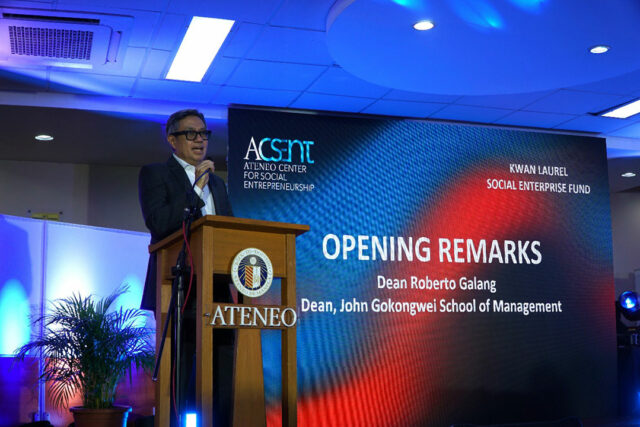
Ateneo holds social entrepreneurship grant challenge

THE ATENEO Center for Social Entrepreneurship (ACSEnt), with the support of the Kwan Laurel Social Enterprise Fund (KLSEF) will hold a social entrepreneurship grant challenge. Open to senior and postgraduate Ateneo de Manila University students, the grant, once announced next April, will award up to P1 million each to three groups to start their own social enterprise.

The phrase has been bounced around recently to mean anything from actual businesses that help communities to corporate social responsibility projects. While Ana Marina Tan, director for ACSEnt said that there is no globally accepted definition of what a social enterprise is, at its core: “It’s social mission before profit. It’s a business that is created to address a specific social problem or issue,” she said in an interview with BusinessWorld at the project’s launch at the John Gokongwei School of Management (JGSOM).

Arkel Suaco Mendoza, assistant director for ACSent said, “We really want to get the next Human Nature, or the next Rags2Riches.” Human Nature helps rural low-income communities and produces cosmetics; Rags2Riches helps women in urban communities and produces bags and accessories using fabric scraps.

“In our world, we really don’t want to be profit-driven, but we really want to have a triple bottom-line: people, profit, and place,” said Mr. Mendoza.

Entries are accepted through the ACSent Office until Nov. 5. Accepted entries (up to 10) with groups of two to four people will gain access to ACSent’s mentorship program, which includes financial planning, operations, business planning, permits; among other subjects.

“We really want people who have the heart to do social enterprise,” he said. In a mix of English and Filipino, he added, “We have a lack of businesses that would spark social change.”

Quoting Robby Galang, dean of the John Gokongwei School of Management, Mr. Mendoza said, “Imbis na nakawin ng gobyerno ang pera natin, magtulungtulongan na lang tayo (instead of having the government steal our money, let’s just help each other) to actually create change and create businesses that will be better for the future.”

Ms. Tan had an answer on why such a grant should come from the Ateneo: “You know how Ateneo teaches you to be ‘Men and Women for Others?’ A lot of that is tied with how social enterprises work. It’s a business that’s making a difference.”

While this initial grant will be awarded to Ateneo students first, Ms. Tan says, “Ideally, the big dream is to have more support so we can do it with other schools as well.

“That’s the ideal world that we want to live in: where people are governed not just by profit maximization, but the need to create businesses that earn money — it’s not bad to earn money — but whatever they do with that earned money is really towards helping more people and doing no harm to the planet.”

For inquiries, contact the ACSEnt at 8426-6001 ext 4851-52. — JL Garcia

SEC eyes wider REIT asset definition to attract more listings

SEC.GOV.PH

THE Securities and Exchange Commission (SEC) is drafting amendments to the real estate investment trust (REIT) rules to expand and clarify what qualifies as income-generating assets, allowing more companies, including those in the power, infrastructure, and telecommunications sectors, to list under the framework.

“Well, it’s a work in progress. In fact, I was just talking to one of the participants following up. Because we have our own ideas on how to liberalize the REIT Rules,” SEC Chairperson Francisco Ed. Lim told reporters on Wednesday last week.

Mr. Lim said that among the proposed amendments is the enumeration of asset types to avoid confusion and disputes over what constitutes an income-generating property.

“For example, we will define what the income-generating assets are. We will enumerate them in order to minimize issues — what is really an income-generating asset. For example, the electric towers attached to the ground — that’s income-generating. That can be a REIT-able asset,” he said.

“The toll roads — although the company is not the owner, but it has a real right to operate the highway in that long piece of land — that’s a REIT-able asset,” he added.

Power plants and cell towers are other examples cited by the SEC as qualifying assets.

“For example, power plants and cell towers can be characterized as REITs because, under the law, they are considered immovable properties. Real estate assets are immovable properties; therefore, by definition, under the Civil Code, they are real property,” Mr. Lim said.

“Therefore, if they generate income on a regular basis, that’s a REIT-able asset,” he added.

Republic Act No. 9856, or the REIT Act of 2009, provides tax incentives to REITs, which are companies that invest in income-producing properties. REITs allow investors to participate directly in completed, revenue-generating projects.

Under the REIT framework, at least 75% of a REIT’s deposited property must consist of income-generating real estate, including those held under freehold or leasehold arrangements.

The SEC said the broader interpretation aims to encourage more companies to list their income-generating properties, offering greater investment and growth opportunities in the sector.

“We are expanding the definition so that more companies will be able to list,” Mr. Lim said.

In July, the SEC chair said the commission was planning to revise REIT rules to bolster the Philippine capital market by widening the range of eligible assets, extending the reinvestment period, and encouraging broader participation. — Alexandria Grace C. Magno