Home Blog Page 5400

SteelAsia, Chinese group to build P108-billion integrated facility

STEELASIA Manufacturing Corp. said it entered into an agreement with a Chinese steelmaker to construct a P108-billion integrated steel facility at a location yet to be decided.

In a statement over the weekend, SteelAsia said that the facility will produce three million tons of liquid steel for construction, automobile, appliance, and shipbuilding applications.

The deal between SteelAsia and Baowu Group was a product of the three-day visit of President Ferdinand R. Marcos, Jr. to China in early January.

SteelAsia Chairman and Chief Executive Officer Benjamin O. Yao and Baowu Group Zhongnan Iron and Steel Co. Senior Vice-President Li Huaidong signed the deal.

Baowu was formed from the merger of the BaoSteel Group and Wuhan Iron and Steel in 2016. 

“This project will spawn new industries and wean the country from its perennial dependence on imports. It will generate about 2,000 jobs, including for professionals who in the past have had to work abroad and leave their families,” Mr. Yao said.

Baowu will send a team to the Philippines next month to jointly explore with SteelAsia possible locations for the plant.

SteelAsia operates six manufacturing plants in five locations: Bulacan, Batangas, Cebu, Davao, and Misamis Oriental.

The company is scheduled to open a seventh plant this year, in Compostela, Cebu. The new plant will increase its annual capacity to 3 million metric tons (MT) from 2 million MT. — Revin Mikhael D. Ochave

Maharlika fund billed as means of addressing power, food security

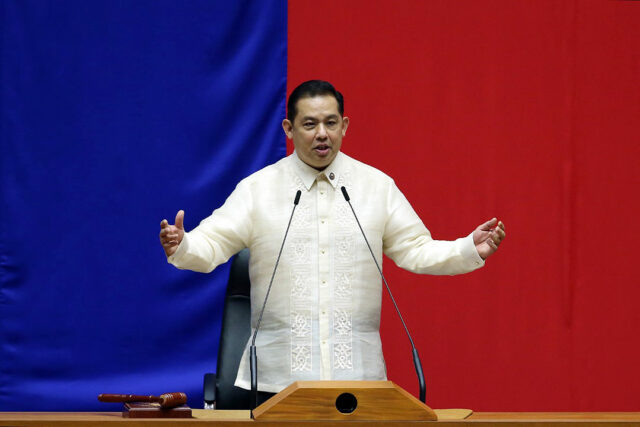
House Speaker Ferdinand Martin G. Romualdez — PHILIPPINE STAR/KRIZ JOHN ROSALES

By Beatriz Marie D. Cruz

SPEAKER Ferdinand Martin G. Romualdez said on Sunday that the Maharlika Investment Fund (MIF) bill will help address rising electricity and fuel prices.

“Filipinos cannot wait. We have to bring down the cost of electricity, the cost of power, the cost of oil,” Mr. Romualdez told Manila-based reporters at Zurich, Switzerland.

Mr. Romualdez was at the World Economic Forum in Davos last week, where President Ferdinand R. Marcos, Jr. had sought to attract interest in Maharlika from potential investors.

The bill has generated backlash because of the proposed sources of the fund’s capital. The bill had originally designated the two major government pension funds as suppliers of capital to the fund, but these provisions were withdrawn, at one point leaving the Bangko Sentral ng Pilipinas (BSP) as the main funder from its own profits.

Albay Rep. Jose Ma. Clemente S. Salceda, who chairs the House ways and means committee, said in an interview with ANC that the latest version of the bill has removed the BSP as a funder.

Michael Henry LI. Yusingo, a lawyer and policy analyst, said that the House version of the bill endorsed to the Senate cannot be revised.

“The House can withdraw that, revise it by repeating the process, and then endorse the revised bill to the Senate. Alternatively, a senator can file his own bill incorporating those revisions,” Mr. Yusingco said via chat.

The current MIF bill proposes government-owned and -controlled corporations (GOCCs) as funders, which Albay Rep. Edcel C. Lagman said could crowd out some basic services funded from GOCC profits.

“It must be recalled that dividends from GOCCs have been used for budgetary support. These dividends must not be parked in long-term contingent investments as they are urgently needed for immediate utilization to address the requirements of basic services like education, health, employment, food security and infrastructure,” Mr. Lagman said in a statement.

Percival K. Peña-Reyes, director of the Ateneo Center for Economic Research and Development, said by phone, “Those who are tasked to manage (the fund) are incentivized but if they lose, who foots the bill?”

IBON Foundation Executive Director Jose Enrique A. Africa said in a Viber message, “The worst-case scenario would be the fund attracting dubious private investors who perceive the fund as having political advantages from being so eagerly pushed by high government officials predisposed to self-interested interventions.”

“You do not have to gamble this much (and) take on such a huge risk,” Mr. Peña Reyes said, citing foreign direct investment (FDI) channeled into exports as an alternative.

“That’s what our neighbors in ASEAN are doing. They are able to export more because they are able to attract more FDI. And we have the potential also to do that, if only we had the political will,” Mr. Peña-Reyes said.

Mr. Africa added, “The haste with which it is evolving to adapt to public criticism is actually a little suspicious and raises the question (asking) why the administration is in such a hurry to create a Maharlika fund in whatever form.”

Senator Juan Miguel F. Zubiri told DWIZ radio on Saturday that a counterpart measure has been filed in the Senate by Sen. Mark A. Villar, chairman of the Senate Banks, Financial Institutions and Currencies committee.

Sen. Sherwin T. Gatchalian, who chairs the Senate ways and means committee, told DZBB on Sunday that funding sources remain the Maharlika bill’s main sticking point.

“My main concern is where the funds for the Maharlika Investment Fund will come from,” Mr. Gatchalian, told DZBB on Sunday.

“There should be substantial funding for the investment fund in order to have a large return.”

Mr. Romualdez called on the Senate to work out all their concerns on the bill.

“For all those senators who may have contrary thoughts, just read the bill and deliberate it in the Senate and let’s take it from there,” he said.

DPWH seeking China grants for Visayas, Mindanao bridges

DPWH

By Arjay L. Balinbin, Senior Reporter

THE Department of Public Works and Highways (DPWH) is hoping to obtain “grant assistance” from the Chinese government for bridges in the Visayas and Mindanao.

“I have had active discussions with them,” DPWH Secretary Manuel M. Bonoan told BusinessWorld on Friday on the sidelines of the ceremonial opening of the Binondo-Intramuros Bridge linear park and pedestrian stairs project.

He said that the grants being proposed will be for bridges outside the capital region. The Chinese government has provided various grants for projects in the capital, including $75 million for the Binondo-Intramuros Bridge and the Estrella-Pantaleon Bridge during the previous administration.

“We are trying to get some more grant assistance for other bridges like in Bohol and Mindanao,” Mr. Bonoan said.

He added that one of the bridges being proposed for a Chinese grant is the one connecting Panglao Island and Tagbilaran City in Bohol to ease access to a top tourist destination.

“There is an existing bridge that we built, so we are going to request a more permanent structure that will connect Panglao island and Tagbilaran,” Mr. Bonoan said.

The project is expected to cut travel time from Tagbilaran City seaport to Panglao Island to 15 minutes from 45 minutes during peak periods.

The Philippines and China have a current agreement for the China Aid Localized Project for Davao River Bridge or Bucana Bridge, a coastal road intended to provide an alternate route to the Pan-Philippine Highway in southern Davao City, which has been experiencing heavy road congestion.

During the recent visit of President Ferdinand R. Marcos, Jr. to Beijing, the two governments signed an updated memorandum of understanding on the Belt and Road Initiative and the framework agreement on bridges crossing the Pasig-Marikina River and the Manggahan Floodway Bridges Construction Project.

Chinese President Xi Jinping and Mr. Marcos also discussed loan agreements for Philippine infrastructure development.

“Both sides will further strengthen infrastructure cooperation with big projects such as the Davao-Samal Island Bridge. Both sides will explore means to further strengthen cooperation, at the locations to be mutually agreed, with the purpose of promoting innovative economic development and maintaining stability in production and supply chains,” they said in a joint statement on Jan. 5.

According to the Finance department, the cumulative loan commitments with China for ongoing Philippine projects now stand at $1.06 billion after the recent signing of loan agreements worth $201.8 million.

DBM considering ‘green’ standards for gov’t procurement

BW FILE PHOTO

THE Procurement Service (PS) of the Department of Budget and Management (DBM) is planning to impose a green public procurement (GPP) standard to ensure that the government spends in a sustainable manner.

“The establishment of an inter-agency technical specifications review committee is one of the reform initiatives we spearheaded to take government procurement to a sustainable track,” PS Executive Director Dennis S. Santiago said in a statement.

The committee will be formed to implement GPP and assess, review and evaluate the sustainability of common-use supplies and equipment technical specifications.

The specifications will need to comply with Philippine and international standards, as well as address environmental, social and economic aspects of government purchasing.

“Under a GPP regime, the government shall procure goods and services with reduced environmental impact throughout their life cycle,” the DBM said.

Budget Secretary Amenah F. Pangandaman said that integrating “green choices in public procurement puts the Philippines closer to its ultimate goal of ensuring sustainable management and use of natural resources by 2030.”

“GPP provides the opportunity for government agencies to infuse environmentally-friendly parameters and requirements in the products that we procure, and in the process avoid the use of toxic substances; prioritize alternative green materials; reduce energy and water consumption during use; and recycle at the end of the useful life of the product,” Mr. Santiago added.

Apart from the PS, the committee will also include the departments of Environment and Natural Resources, Trade and Industry, Science and Technology, Information and Communications Technology; and Energy. — Luisa Maria Jacinta C. Jocson

Pushback to ‘holiday economics’ centers on disadvantages for no-work, no-pay employees

BOHOL TOURISM OFFICE

PROPOSALS to enact a “holiday economics” measure will help prop up tourism as a pillar of the recovery, analysts said, but such a policy could be negative for employees who are not paid on days they do not work.

Percival K. Peña-Reyes, director of the Ateneo Center for Economic Research and Development, said that the proposed measure will provide a boost for the ongoing recovery from the COVID-19 pandemic.

“The (possible) endemicity of COVID is going to help ease the mobility restrictions we had and that would welcome development especially for (the tourism sector), since we would have more tourists come in,” Mr. Peña-Reyes said by phone.

The practice of so-called “holiday economics” seeks to create long weekends, moving national holidays closer to Saturday or Sunday if necessary in order to stimulate travel and help tourism drive the recovery.

Mr. Peña-Reyes added that developing the industry will in turn attract more foreign visitors, creating a knock-on effect for exchange rates.

“We have a limited domestic market, so it would be very beneficial for us to get more revenue from outside,” he said.

Last week, House Assistant Minority Leader Arlene D. Brosas said that day laborers will earn less under such an arrangement.

“This will be a problem for workers who only receive their salaries on a daily basis because that would mean a deduction from their salary,” Ms. Brosas said.

Lawrence B. Dacuycuy, an economics professor at De La Salle University, said holiday economics can be billed as a “strategic move to promote spending and improve (worker’s) well-being.”

Mr. Dacuycuy called for creative and flexible ways to galvanize the economy. “We have to find ways to… outplace inflation in terms of economic growth,” he said via e-mail.

Mr. Peña-Reyes acknowledged the disadvantages to workers that are not in regular employment. “It would not be such a problem if you are formally employed because you are paid anyway (regardless of holidays). But those who might be in more precarious employment situations, (that would mean) no work, no pay for them,” he said.

Deputy Minority Leader France L. Castro added that moving the commemoration of a holiday from its actual date risks eroding the spirit of the holiday.

“We must value the actual date of a particular event in our history (and take this as an opportunity to) reflect the significance of those dates,” Ms. Castro of ACT Teacher’s Party-list said.

Mr. Dacuycuy countered that “If we’re able to instill patriotic or essential values in each of us, it really does not matter when a particular historical event or person is celebrated.”

“Of course, some of us focus on the special meaning of such events, while others would like a paid day off,” he added.

Mr. Dacuycuy said that “institutions need to undertake studies that will formally assess the contribution of such a measure to economic output.” — Beatriz Marie D. Cruz

PHL-Israel trade not seen sufficiently developed to warrant FTA

REUTERS

THE PHILIPPINES and Israel have not yet reached the point in their trade relationship that warrants a free trade agreement (FTA), Ilan Fluss, Israel’s ambassador to the Philippines, said.

“(An FTA is) always interesting, but you need to have a certain level of trade between the countries in a variety of areas to make it interesting for both countries. I think we’re not there yet,” Mr. Fluss said on the sidelines of an event organized by Digital Pilipinas in Makati City last week.

Mr. Fluss said the Philippines and Israel are set to convene a joint economic commission (JEC) meeting in the second quarter of 2023 to discuss more business and investment collaboration.

“This will be an opportunity for the two governments to sit down and discuss how (we can introduce) more tools to do more business together,” Mr. Fluss said.

In June, the Philippines and Israel signed a memorandum of understanding creating the JEC.

According to Mr. Fluss, interest in investment and collaboration centers on agricultural technology, digitalization, water management, financial technology, and cybersecurity.

“Israeli companies are here (and) seeing a lot of interest. We’re trying to get more Philippine companies to come to Israel, to identify opportunities in Israel, because the two economies complement each other,” Mr. Fluss said.

“The Philippines is a vast island country (with) a lot of challenges (and) needs. Israel is a small country, but has a lot of technology and best practices that it can share with the Philippines. I think that it just makes sense to work together,” he added.

Mr. Fluss said that the investment promotion and protection agreement (IPPA) signed by the Philippines and Israel in June 2022 has yet to be ratified by Israel’s parliament, which was newly elected in November.

“The Philippines went into elections. And then in Israel… we also went into elections. We need to ratify this agreement. Our parliament is convening again. So hopefully this will be ratified,” Mr. Fluss said.

The Department of Trade and Industry has said that the IPPA provides opportunities to tap investment in life sciences and healthcare, water technology, high technology and semiconductors, cybersecurity, financial technology, and defense.

Bilateral trade in goods between the Philippines and Israel was $323 million in 2021, higher than 2020 levels but lower than the pre-pandemic total of $338 million in 2019.  — Revin Mikhael D. Ochave

Digital government: Creating real connections

(First of two parts)

As people increasingly look to the government to defend their lives and means of subsistence during times of crises, most recently under the pandemic, public policy and the provision of services are now under unprecedented pressure. There is widespread demand among citizens for more digitally enabled public services, and many of them want more control over how these services are provided. However, a sizable portion of the populace lacks the ability or resources to use digital services.

To better understand how people’s lives are changing in the connected world, EY launched a new research study with over 12,000 working-age respondents called Connected Citizens. This global study looked at what these respondents value, their top concerns, and how they feel about the impact of technology. The study then aimed to examine their expectations of the function of the government, the provision of public services, and the nature of the interaction between those in power and those under it.

TECHNOLOGY IN A MORE PERVASIVE ROLE
The increased use of technology in daily life has been one of the most noticeable changes catalyzed by the pandemic. It changed how people work, play, shop, study, and socialize in mere months. According to the study, a majority anticipate using technology even more in the future than they would have otherwise. As much as 64% of the respondents anticipate that the pandemic will result in an increase in the use of technology.

Although governments worldwide have sped up the process of digitalizing many public services, many still fall behind private sector offerings like online banking and shopping in terms of anticipated gains in service delivery (although healthcare services are viewed more positively). Over half of the people globally (53%) believe that governments and public services have used digital technology to successfully combat the pandemic. This shows that governments still need to make progress in their digital transformation before they can live up to the expectations of the citizens they serve.

We are seeing similar trends in the Philippines, where the government is increasingly focused on implementing and sustaining digital transformation strategies to bring about a true e-government that would strengthen connections with citizens by using digital and technology to achieve economic transformation and more efficient delivery of services to citizens. However, both government and stakeholders alike need to understand the deeper issues around technology in order to truly make the most of it.

BROADER CONCERNS REGARDING TECHNOLOGY IMPACT
Despite the prevalence of technology, the study found complex attitudes towards it. Most respondents (72%) believe it improves life and will be necessary in the future to help address ever-more complicated challenges. However, there are concerns about its broader effects.

Growing socioeconomic inequality.

The most disadvantaged people frequently lack the resources to access new technology and the digital literacy skills necessary to use it. Another issue is the use of algorithms for decision-making, which some believe may be biased. Nearly a third of people worldwide (32%) believe that not all segments of society will equally benefit from technology. And 34% believe that people who are already wealthy and powerful gain more influence as a result of technology.

Diminished human interaction.

Concerns have been raised about how using communication technology can affect social cohesion, with 32% believing that technology will cause people to feel less connected to their community. Some of the most vulnerable groups may experience increased isolation in a more virtualized society where there is less physical interaction.

Digital security and personal privacy.

The quantity and variety of data produced and the rate at which it is gathered will grow as more people and devices are linked. This creates public anxiety over personal privacy and a lack of choice over how data is used. More than 4 out of 10 people oppose the sharing of data with both the government and the business sector, while 72% oppose government selling their personal information to the private sector.

Additionally, governments can do more to explain the advantages of data sharing and reassure the public that it will be used responsibly. The study reveals some support for data use when people are aware of the use case, and if it presents advantages for them personally or for society as a whole. This is especially true when it comes to matters of public health. For instance, 52% of people worldwide favor utilizing personal data to track and prevent disease, while 47% support using it to set priorities for healthcare.

Building trust in government institutions will be crucial in increasing the effectiveness and efficiency of government operations as well as utilizing public efforts to help design and provide better services. The study shows that citizens are willing to participate more in the delivery of public services in the future, with more than a third identifying more performance transparency as one of their top priorities to improve public service quality. Additionally, 42% said they would like to have a greater say in how public services are delivered in their community.

THE SEVEN CITIZEN PERSONAS
With the study showing how complicated global citizen beliefs, values, needs, and behaviors are, understanding these identities can assist governments in forging more reliable ties with their constituents. It identified seven different citizen personas through survey data analysis: Diligent Strivers, Capable Achievers, Privacy Defenders, Aspirational Technophiles, Tech Skeptics, Struggling Providers, and Passive Outsiders.

Diligent Strivers are young proactive self-improvers keen to advance in life. They expect seamless digital government services to help them achieve their aims, are comfortable sharing their data with governments, and strongly believe in equal opportunities.

Capable Achievers have an older age profile and are independent, successful and satisfied with their life. Pragmatic technophiles who embrace digital innovation, they trust governments to use their data appropriately but worry about it getting into the wrong hands.

Privacy Defenders tend to be older, independent and comfortably off. They value technology and the benefits it provides them, but are extremely cautious when it comes to sharing their personal data with governments or private companies.

Aspirational Technophiles are younger, well-educated city-dwellers. Motivated by success and new opportunities, they incorporate technology and data into every facet of their lives. They are excited by the potential for new digital innovations to empower people and improve society.

 Tech Skeptics are older, on lower incomes and relatively dissatisfied with their lives. Distrustful of governments and skeptical about the benefits of technology, they tend to be opposed to data sharing, even with a clear purpose.

Struggling Providers are younger and tend to be in low paying, less secure work. They are above-average users of welfare services and are ambivalent toward technology, lacking the access and skills for it to significantly impact their lives.

 Passive Outsiders have lower levels of income and education. Detached from the connected world around them and generally reluctant to embrace change, they are relatively ambivalent on data sharing but tend to feel the risks outweigh the benefits.

 The attitudes each persona has toward technology and their level of access and comfort with digital services are significant. Despite being representative of the online population, the survey participants vary in their comfort level while utilizing new technologies on their own. This indicates that governments should shift away from a one-size-fits-all approach towards service delivery and increase the level of personalization to improve public policy design, deliver more efficient and effective public services, and deepen the relationship between government and citizens.

For instance, Struggling Providers, who would require the most assistance, would likely be unable to utilize services and miss opportunities if some services can only be accessed through digital channels. This leads to a worsening of the structural inequality they already experience.

We have seen this ourselves during the pandemic particularly in the education sector where students were given the option to participate in online classes, yet a significant percentage did not have access to devices or the internet and had to resort to analog options such as printed learning modules.

 In the second part of this article, we discuss four key areas government can focus on to better engage with the public: inclusive digitization, responsible data use, innovative and agile policymaking, and public participation and engagement.

This article is for general information only and is not a substitute for professional advice where the facts and circumstances warrant. The views and opinions expressed above are those of the author and do not necessarily represent the views of SGV & Co.


Marie Stephanie C. Tan-Hamed is a strategy and transactions partner, EY Parthenon partner and PH Government and Public Sector leader of SGV & Co.


Experts: New security adviser indicates strong military lobby

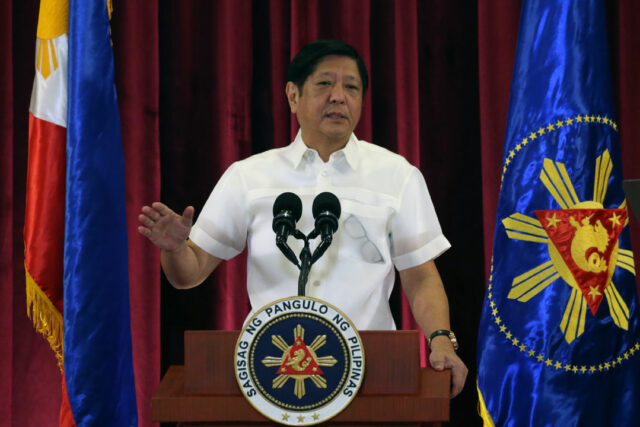
PRESIDENT Ferdinand “Bongbong” R. Marcos Jr. — PHILIPPINE STAR/KRIZ JOHN ROSALES

By Kyle Aristophere T. Atienza, Reporter

ANALYSTS on Sunday said the appointment of an ex-military general and former Duterte Cabinet member to the National Security Council under President Ferdinand R. Marcos, Jr. showed a strong military lobby in the government.

“The military bloc obviously is really interested to keep its hold or control over important Cabinet positions that are concerned with defense and security,” Arjan P. Aguirre, who teaches political science at the Ateneo University, said in a Facebook Messenger chat.

“The national security adviser post is one of those key positions that for them should be held by a person whose interests are aligned with the short- and long-term agenda of the military bloc opting to operate in a particular administration,” he added.

Earlier this month, Mr. Marcos appointed Eduardo M. Año, a retired general of the Philippine Army, as his national security adviser, replacing Clarita A. Carlos, a political scientist and retired University of the Philippines professor.

The appointment of Mr. Año, who also served as Interior secretary under former President Rodrigo R. Duterte, “tells us of how effective the military bloc has been these past years in aligning themselves with the ruling coalition and making themselves useful in the defense and security Cabinet portfolios,” Mr. Aguirre said.

Mr. Año as head of the National Security Council will advise the President on security and foreign policy issues.

Ms. Carlos has said forces who wanted her out of the government had been besmirching her reputation since she got appointed — a claim that Mr. Marcos denied on Saturday.

“She felt that there were people who were moving against her in government,” he told reporters. “I kept telling her, I don’t really think so.”

“I guess she just found it too much. She didn’t enjoy her time in government which, you know, if we think about it, it’s not really surprising because that’s not her natural habitat,” the president said. “Her natural habitat is the academe. And so now, she will be in a think tank, which is perfect for her.”

Ms. Carlos, 76, is reportedly headed to the policy and budget research department of the House of Representatives.

During her stint at the council, she vowed to veer away from the US concept of national security, which she said has a military bias. She said national security should also focus on the “economic life” of Filipinos.

The previous government had been criticized for using militarist solutions to national problems, including the global coronavirus pandemic.

“Whatever motivated this change was either politics or a loss of confidence,” Kiefer Zachary Hipe, a military historian, said in a Messenger chat.

“What this says about our security sector depends on the genuine reason for these changes,” he said. “If it was competency-based, then we can assume that they are trying to align the sector to the ever-growing developments in the region.”

“If it was politics, then it shows that opportunism heavily thrives in the defense and security sector.”

Mr. Hipe said the military has kept its strong influence on the government even after the ouster of a military-backed dictatorship in the mid-1980s and restoration of democracy.

“[People Power] showed that military-supported changes have weight,” he said. “But the military remains subservient to political patronage.”

Chester B. Cabalza , a national security expert, doubts Ms. Carlos was removed from the post because she didn’t come from the military.

Mr. Cabalza said she had overseen for years the academic training of future top officers of the Armed Forces and select government bureaucrats, noting that she served as president of the National Defense College of the Philippines from 1998 to 2001.

“Therefore, she has been part of the wider defense and security sector.”

Last week, Ms. Carlos said she felt Mr. Marcos “made a difficult decision in letting me go.” “That’s how I read the situation. I should know if I have lost his confidence,” she told ABS-CBN News.

“Regardless of the complexity of internal and external security threats on the ground, the adviser must be skillful in commanding the giants in the military based on field experience,” Mr. Cabalza said.

Food security, insurgency and external defense issues remain the top security threats confronting the country.

The South China Sea dispute is among the Philippines’ external security concerns. On Saturday, the Philippine Coast Guard (PCG) said the Chinese Coast Guard on Jan. 9 drove away a Filipino fishing vessel at the Second Thomas Shoal, which is within the Philippines’ exclusive economic zone.

This was days after Mr. Marcos met with Chinese President Xi Jin Ping in China, where the latter vowed to find a solution to avoid tensions in the disputed waterway.

“The national security adviser should be a thinker and doer at the same time,” Mr. Cabalza said. “He should provide more solutions to complex problems in our national, regional and global security.”

Congress to tackle top bills as sessions resume

PHILSTAR

THE PHILIPPINE Congress resumes sessions on Monday after a month-long holiday break, with lawmakers vowing to work double time in passing priority bills of the Marcos government.

Bills that seek to hasten the country’s digital transformation such as the proposed E-Governance Act will top the list of priorities of the House of Representatives, Speaker Ferdinand Martin G. Romualdez said in a statement on Sunday.

“We will expedite the passage of these measures to implement the pronouncements of President Ferdinand R. Marcos, Jr. in Davos, Switzerland on his desire for the country to catch up with other nations in digital evolution,” he said.

House priorities this year also include 11 other measures that the Executive and Legislative branches had agreed on in October during a meeting of the Legislative-Executive Development Advisory Council (LEDAC), Mr. Romualdez said.

These were among those mentioned by Mr. Marcos in his first state of the nation address (SONA) in July.

“These measures are components of the President’s agenda for prosperity, which we fully support,” Mr. Romualdez said.

Senate Minority Floor Leader Aquilino Martin “Koko” D. Pimentel III said about half of 20 pending committee reports in the Senate have been acted on.

“We have unfinished and new business which we can tackle in plenary of about only 10 committee reports,” he said in a Viber message.

The senator said the Senate should prioritize measures that seek to boost farm output and address military concerns about their ranks and promotions.

Apart from the E-Governance bill, the House would also work on an enabling law for the natural gas industry and changes to the Electric Power Industry Reform Act, Mr. Romualdez said.

Also topping House priorities are bills on pensions, land use, defense, government rightsizing, budget modernization and a proposed Department of Water Resources.

Setting up the Negros Island Region, magna carta for Filipino seamen and a proposal to establish regional specialty hospitals would also be prioritized, he added.

The House approved 19 priority bills during its first five months. Two of them, the SIM Registration Act and postponement of village and youth council elections, have been signed into law.

Before Congress went on a break last month, it passed on final reading the Maharlika Investment Fund bill, which Mr. Marcos pitched at the World Economic Forum in Davos, Switzerland last week. — Beatriz Marie D. Cruz with Alyssa Nicole O. Tan and JVDO

Philippine labor groups, employers to discuss workers’ rights with ILO

REUTERS

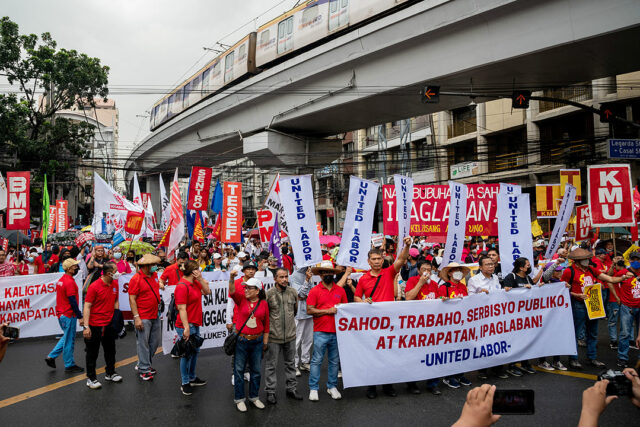
PHILIPPINE labor groups and employers are set to meet with a team from the International Labour Organization (ILO) in Manila this week to discuss cases of harassment and violence against trade unions.

In a statement last week, the Leaders Forum said it would push the rule of law and justice at the three-day meeting that will start on Jan. 23.

“Respect for labor rights as guaranteed by the Philippine Constitution, national labor laws and ILO conventions is indispensable for investments and economic growth,” it said.

ILO Bureau of Worker’s Activities Director Maria Helena André has said the Philippine government should uphold the law since rights violations would deter investments and economic activity.

The ILO high-level tripartite mission to the Philippines will look into the killings of trade unionists and other violations of workers’ rights.

The Leaders Forum includes the  Employers Confederation of the Philippines, Philippine Chamber of Commerce and Industry, Trade Union Congress of the Philippines and the Federation of Free Workers.

Justice Secretary Jesus Crispin C. Remulla has said the state does not sanction attacks, harassment or intimidation of activists and unionists.

He said an inter-agency task force on extralegal killings had investigated at least 17,000 police officers.

The Philippines has accepted 200 recommendations from member-states of the United Nations Human Rights Council, including investigating extralegal killings and protecting journalists and activists.

The UN Human Rights Committee has said the Philippines should comply with international human rights mechanisms.

Human rights abuses continued in the first six months of President Ferdinand R. Marcos, Jr.’s rule, Human Rights Watch said this month.

The Philippine Commission on Human Rights has said the government of ex-President Rodrigo R. Duterte had encouraged a culture of impunity by hindering independent inquiries and failing to prosecute erring cops involved in the government’s anti-illegal drug campaign.

Meanwhile, Jose “Sonny” G. Matula, a labor lawyer and president of the Federation of Free Workers, said government agents did not do enough to ensure the prosecution of 17 police officers in the murder of an activist.

This was after government prosecutors dismissed the murder complaint for lack of evidence.

“We are disappointed with the dismissal,” he said in a Viber message. “It appears that the authorities did not help the private complainant in gathering enough evidence.”

Mr. Matula said labor groups would bring up the murder of nine activists during a series of police raids in March 2021 with the ILO. — John Victor D. Ordoñez

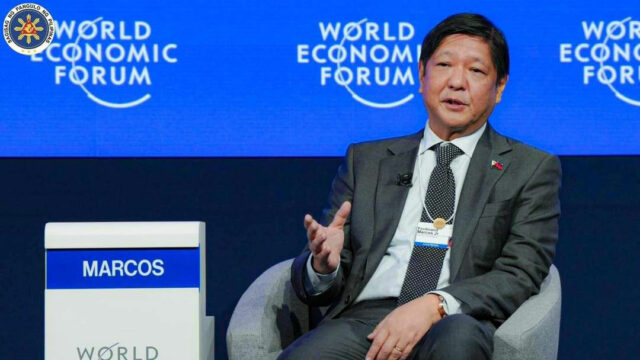
Marcos claims PHL tagged as part of Asia’s ‘VIP Club’ in WEF

PRESIDENT R. Marcos, Jr. in World Economic Forum (WEF) — OPS PHOTO

PRESIDENT Ferdinand R. Marcos, Jr. at the weekend touted that global business and political leaders have tagged the Philippines as part of a so-called VIP Clubof Asia due to its economic performance, which the government hopes would translate to more foreign investments. 

The Philippines’ participation in the World Economic Forum (WEF) in Davos, Switzerland last week served as an excellent platform to showcase the Philippine economys strong performance,Mr. Marcos was quoted as saying in a press release by the Presidential Communications Office (PCO). 

Its good that we came here (in Davos, Switzerland) because by coming here, we have been included in what they call the VIP Club,he said in Filipino. The VIP Club is composed of Vietnam, Indonesia, and the Philippines. 

They said these countries have the best economy in Asia.” 

Think tank Ibon Foundation, however, expressed dismay at the Palaces bullish claims about the Philippine economy, saying facts show that last year was a tough one for poor and middle-class Filipinos. 

The Philippines faces growth risks from elevated inflation, rising borrowing costs and a global recession. The World Bank expects the economy to slow to 5.4% this year from an estimated 7.2% last year. 

The government has lowered its growth target this year to 6% to 7% from 6.5%-7.5%. Inflation hit 8.1% in December, the fastest since November 2008. 

The economic managers have failed to meet their growth targets for five years now with only eleventh-hour estimates coming anywhere close,IBON said. If their usual overestimates are any guide and generously ignoring how wildly growth was in 2020 it is more likely that growth this year will be around 5% or even less.” 

IBON maintained that the relatively rapid growth last year is a misleading indicator of the economys trajectory,noting that it was just a rebound from reopening and there was a statistical boost from being measured against the low base of an economy pressed down by lockdowns.”  

Leonardo A. Lanzona, who teaches economics at the Ateneo, also noted that the WEF organized by a foundation advocating for public-private cooperation — “is perceived as an elitist group.”  

“The WEF is a collection of super rich entities formed to avoid taxes. In the face of prevailing gut problems, persistent inequality and rising poverty, the active participation of the Philippine government only crystallizes the anti-poor character of the policies advocated by this administration,Mr. Lanzona said in a Facebook Messenger chat.

The poor farmer has more to contribute to the countrys development than all the tycoons who were part of this delegation,he said.  

The President met with global leaders at the Davos conference, with several foreign investors expressing intent to explore business opportunities in the Philippines,the PCO said in the media release.  

Earlier, the Palace said Mr. Marcos had secured commitments from at least two foreign companies during his Switzerland trip.   

But investment analysts were unimpressed, saying the supposed commitments were insignificant and could be had without a foreign trip.

Mr. Marcos met with WEF Founder and Chairman Emeritus Klaus Schwab and discussed partnerships and collaboration to help the Philippines sustain equitable and inclusive growth and provide a better quality of life for Filipinos,the PCO said in the Sunday release.  

It added that the Philippine leader also had the opportunity to exchange views with World Trade Organization Director-General Ngozi Okonjo-Iweala, World Bank Managing Director for Operations Axel Van Trotsenburg, International Monetary Fund Managing Director Kristalina Georgieva, and former United Kingdom Prime Minister Tony Blair.

Mr. Marcos, 65, arrived in Switzerland on Jan. 15 and returned to the Philippines on Saturday.

In his arrival speech, the President said his WEF engagement gave the Philippines a chance to inform various sectors that the country is leading economic recovery and performance not only in the Asia-Pacific but also in the whole world. 

Mr. Marcosclaim has been backed by House legislator Jose Maria Clemente S. Salceda, who said in a Sunday statement that absolutely there will be no recession for the Philippines in 2023.”  

We will be in positive growth territory regardless of what happens for the rest of the world,he claimed. We have removed restrictions on so many key sectors public services, the retail trade sector, the energy sector that the country will offset global recessionary forces.”  

Last week, the Palace said New York-based investment firm Morgan Stanley & Co. LLC would set up an office in Manila to support the governments development agenda. 

It added that Emirati logistics company DP World, which is already operating in the Philippines, seeks to set up an industrial park in Clarkfield, Pampanga province north of the Philippine capital.

Terry L. Ridon, a public investment analyst, told BusinessWorld at the time that Morgan Stanleys commitment does not constitute a commitment to undertake foreign direct investment in the Philippines.  

DP World, the logistics company, is already well-established in the country, operating ports in Manila and Batangas province,he added. Kyle Aristophere T. Atienza 

Lawmaker calls for rationalization of air transport by expanding Clark flights 

Clark International Airport
STOCK PHOTO | Image by BCDA.GOV.PH

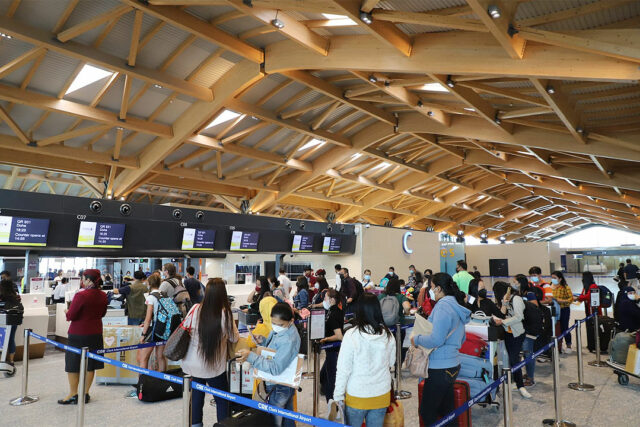
A LAWMAKER called on transport authorities to maximize the recently upgraded Clark International Airport as an alternative facility to the main gateway in Manila, which is being pushed for privatization in the aftermath of the Jan. 1 air traffic fiasco that affected more than 65,000 passengers.     

House Minority Leader Marcelino C. Libanan said 50% of all flights in and out of the congested Ninoy Aquino International Airport (NAIA) could be transferred to the privately-managed Clark airport, which has a new terminal building that can accommodate up to eight million passengers annually.    

The Clark airport, located within a former American military air base in Pampanga, is about 115 kilometers north of NAIA.   

Mr. Libanan noted that Clark is more accessible now to and from the capital with the construction of toll roads.  

He added that privatizing NAIA would only be a temporary solution to the congestion problem.   

NAIAs problem is lack of land for expansion. No new parallel runway can be built there because the area around the airport is already highly urbanized,he said in a statement on Sunday.   

On Sunday, flights at the NAIA were briefly suspended for the replacement of a blowing/cooling fan for its second uninterruptible power supply, according to the Civil Aviation Authority of the Philippines (CAAP).   

Nine flights for departure were affected while 38 waited for clearance delivery after a short outage as part of maintenance activity, CAAP said. Beatriz Marie D. Cruz 

ADVERTISEMENT
ADVERTISEMENT