Home Blog Page 538

US plans to delay retirement of many more coal power plants to feed AI boom

PEXELS-PIXABAY

NEW YORK – The administration of US President Donald Trump expects most of the nation’s coal-fired power plants to delay retirement to help deliver the vast amount of electricity needed to fuel artificial intelligence, Energy Secretary Chris Wright told Reuters on Thursday.

Keeping those often half-century-old coal plants running is part of a broader strategy to increase the country’s power output that will also include boosting nuclear energy and allowing backup power plants to operate around the clock.

The administration has made expanding energy production a top priority while rejecting concerns about climate change, which Trump told the United Nations this week amounted to a global “con job.”

“Energy sobriety has returned to Washington, D.C. Our focus is on Americans and the price of utility and avoiding blackouts,” Wright said at a Reuters Newsmaker event. “We’ve got to stop existing firm capacity from retirement.”

The government had been in discussions with many utilities nationwide and expects the majority of the several dozen US coal plants nearing retirement to delay closure, he said.

“I would say the majority of that coal capacity will stay online,” he added.

The administration is also prepared to use its emergency powers to extend the life of coal-fired plants, he said.

Last month, Wright extended his emergency order to keep a Michigan coal plant running, even though the plant’s operator had been planning to shut permanently for economic reasons.

The Energy Department also ordered a gas and oil-fired power plant, slated for retirement in Pennsylvania, to continue operating.

Wright said more plants should expect similar orders, which fall under grid stability provisions in the Federal Power Act.

“Absolutely, absolutely. Yeah, that’s not the only one,” Wright said.

Wright said the US would also aim to get more out of the existing grid by running backup generators and standby power plants continuously, rather than just when electricity demand surges.

The White House is also seeking to boost nuclear energy, including through regulatory reforms to speed permitting and by hosting new nuclear technologies through the Department of Energy.

“We need that industry as another source of energy, and so we’re going to give temporary nudges to get it started,” Wright said.

Currently, two shut US nuclear power plants – including one on Three Mile Island in Pennsylvania – are in the unprecedented process of being restarted. Three Mile Island, dubbed the Crane Clean Energy Center, would deliver electricity for Microsoft data centers.

Total US electricity demand is projected to hit record highs this year and next, according to the Energy Information Administration. Growth in the country’s power consumption will also continue to accelerate through the end of the decade as massive AI data center campuses power up.

The global race by countries, primarily the US and China, to dominate AI will depend largely on connecting new electricity supplies, the Trump administration has said.

China built 100 gigawatts of coal-fired power last year and another 100 gigawatts are under construction, Wright said.

“Right now, it doesn’t matter what China says about climate policy,” Wright said. “They’re growing their electricity, they’re building their industrial might, and they’re saying: please keep sending us your industry.”

The Department of Energy, this year, also opened federal land for the development of power plants and data centers.

So far, the department has received some 300 inquiries, Wright said. — Reuters

Trump signs order declaring TikTok sale ready and values it at $14 billion

WASHINGTON – President Donald Trump signed an executive order on Thursday declaring that his plan to sell Chinese-owned TikTok’s US operations to US and global investors will address the national security requirements in a 2024 law.

The new US company will be valued at around $14 billion, Vice President JD Vance said, putting a price tag on the popular short video app far below some analyst estimates.

Trump on Thursday delayed until January 20 enforcement of the law that bans the app unless its Chinese owners sell it amid efforts to extract TikTok’s US assets from the global platform, line up American and other investors, and win approval from the Chinese government.

The publication of the executive order shows Trump is making progress on the sale of TikTok’s US assets, but numerous details need to be fleshed out, including how the US entity will use TikTok’s most important asset, its recommendation algorithm.

“There was some resistance on the Chinese side, but the fundamental thing that we wanted to accomplish is that we wanted to keep TikTok operating, but we also wanted to make sure that we protected Americans’ data privacy as required by law,” Vance told reporters at an Oval Office briefing.

Trump’s order says the algorithm will be retrained and monitored by the US company’s security partners, and operation of the algorithm will be under the control of the new joint venture.

Trump said Chinese President Xi Jinping has indicated approval of the plans. “I spoke with President Xi,” Trump said. “We had a good talk, I told him what we were doing, and he said go ahead with it.”

The Chinese embassy in Washington did not immediately respond to a request for comment. TikTok did not immediately comment on Trump’s action.

Trump has credited TikTok, which has 170 million US users, with helping him win reelection last year. Trump has 15 million followers on his personal TikTok account. The White House also launched an official TikTok account last month.

“This is going to be American-operated all the way,” Trump said.

He said that Michael Dell, the founder, chairman and CEO of Dell Technologies; Rupert Murdoch, the chairman emeritus of Fox News owner Fox Corp and newspaper publisher News Corp, and “probably four or five absolutely world-class investors” would be part of the deal.

The White House did not discuss how it came up with the $14 billion valuation.

TikTok’s Chinese parent, ByteDance, currently values itself at more than $330 billion, according to its new employee share buyback plan. TikTok contributes a small percentage of the company’s total revenue.

According to Wedbush Securities analyst Dan Ives, TikTok was estimated to be worth $30 billion to $40 billion without the algorithm as of April 2025.

Alan Rozenshtein, a professor at the University of Minnesota Law School, said the executive order leaves unanswered questions, including whether ByteDance will still control the algorithm. “The problem is that the president has certified the deal, but he has not provided a lot of information on the algorithm,” he said.

ORACLE AND OTHERS TO OWN TIKTOK IN THE US
A group of three investors, including Oracle and private-equity firm Silver Lake, will take a roughly 50% stake in TikTok US, two sources familiar with the deal said on Thursday.

A group of existing shareholders in ByteDance will hold a roughly 30% stake, one of the sources said. Among ByteDance’s current investors are Susquehanna International Group, General Atlantic and KKR.

Given intense investor interest in TikTok, the 50% stake may still shift, the source noted.

Oracle and Silver Lake did not immediately respond to requests for comment.

CNBC reported earlier, citing sources, that Abu Dhabi-based MGX, Oracle and Silver Lake are poised to be the main investors in TikTok US with a combined 45% ownership.

MGX did not immediately respond to a Reuters request for comment on the CNBC report.

Republican House of Representatives lawmakers said they want to see more details of the deal to ensure it represents a clean break with China. “As the details are finalized, we must ensure this deal protects American users from the influence and surveillance of CCP-aligned groups,” said US Representatives Brett Guthrie, Gus Bilirakis and Richard Hudson, all Republicans.

The agreement on TikTok’s US operations includes the appointment by ByteDance of one of seven board members for the new entity, with Americans holding the other six seats, a senior White House official said on Saturday.

ByteDance would hold less than 20% in TikTok US to comply with requirements set out in the 2024 law that ordered it shut down by January 2025 if its US assets were not sold by ByteDance. — Reuters

US economy notches fastest growth pace in nearly two years in second quarter

A woman carries shopping bags in Manhattan in New York City, US, Aug. 11, 2025. REUTERS/EDUARDO MUNOZ

WASHINGTON – The US economy grew faster than previously estimated in the second quarter amid strong consumer spending and business investment, though momentum appears to be slowing as the effects of tariffs and policy uncertainty start to filter through.

The quickest growth pace in nearly two years reported by the Commerce Department on Thursday also reflected a sharp contraction in the trade deficit as the flood of imports slowed.

The economy’s resilience was underscored by other data showing strong demand by business for equipment in August, driven by an artificial intelligence (AI) spending boom, and a drop in first-time applications for state unemployment benefits last week as companies hoard workers.

The data at face value suggested further interest rate cuts from the Federal Reserve were probably unwarranted. Tepid hiring blamed by economists on President Donald Trump’s import duties and an immigration crackdown caused job growth to almost stall in the three months through August, prompting the US central bank to resume its policy easing last week.

“It is clear that the current level of Fed interest rates is not slowing the economy down and is not hurting the labor market either,” said Christopher Rupkey, chief economist at FWDBONDS. “If job growth is slowing down, it is not the economy that is the problem, it is the Trump 2.0 policies on immigration.”

Gross domestic product increased at an upwardly revised 3.8% annualized rate last quarter, the fastest pace since the third quarter of 2023, the Commerce Department’s Bureau of Economic Analysis said in its third GDP estimate.

The economy was previously reported to have grown at a 3.3% pace in the second quarter. Economists polled by Reuters had expected GDP growth would be unrevised.

The government revised the national accounts data from the first quarter of 2020 through the first quarter of 2025. The economy contracted at a 0.6% pace in the first quarter, revised slightly down from the previously reported 0.5% pace of decline.

Growth estimates for the first and fourth quarters of 2024 were revised significantly lower, but were offset by upgrades to second- and third-quarter GDP. The economy grew 2.8% in 2024, unrevised from the previous estimate.

A sharp narrowing of the trade deficit as imports collapsed after a record surge in the January-March quarter was the main driver of the rebound in GDP last quarter. The smaller trade deficit added a record 4.83 percentage points to GDP growth after slicing off 4.68 percentage points in the first quarter.

Imports surged in the January-March quarter as businesses rushed to beat the duties, which boosted the nation’s average tariff rate to its highest level in a century. Both the first- and second-quarter GDP readings are not a true reflection of the economy’s health because of the wild swings in imports.

Trade could add to GDP growth in the third quarter. A separate report from the Commerce Department’s Census Bureau showed the goods trade deficit contracted 16.8% to $85.5 billion in August as imports plunged.

The upgrade to second-quarter GDP mostly reflected an upward revision to consumer spending, which is now estimated to have increased at a 2.5% pace, instead of the previously reported 1.6% rate. There was increased spending on services like transportation as well as finance and insurance.

Consumer spending, the main engine of the economy, grew at a 0.6% rate in the first quarter, revised up from a 0.5% pace.

Business spending on intellectual property products was upgraded to a 15.0% rate from the 12.8% pace estimated last month. Business investment in equipment grew at a faster 8.5% clip instead of the previously reported 7.4% pace.

Business spending on equipment is so far holding up in the third quarter, though the pace of growth has probably slowed.

A third report from the Census Bureau showed non-defense capital goods orders excluding aircraft, a closely watched proxy for business spending, rose 0.6% in August after advancing 0.8% in July. Shipments of these so-called core capital goods slipped 0.3% after rising 0.6% in July.

Stocks on Wall Street fell as investors viewed the data as not supportive of further rate cuts. The dollar rose against a basket of currencies. US Treasury yields were higher.

SLOW GROWTH IS EXPECTED IN THE SECOND HALF
Last week’s 25 basis point cut lowered the Fed’s benchmark overnight interest rate to the 4.00%-4.25% range. There were small upward revisions to inflation last quarter.

Inflation has been slow to rise in response to tariffs as businesses sold inventory accumulated before the duties kicked in and even absorbed some of the taxes. Inventory accumulation decreased at a $18.3 billion rate in the second quarter.

Final sales to private domestic purchasers, which exclude trade, inventories and government, and are viewed by economists and policymakers alike as a barometer of underlying economic growth, grew at a 2.9% rate in the second quarter. That was an upward revision to the previously reported 1.9% pace.

Economists are bracing for lackluster growth in the second half of the year because of the lingering drag from trade policy uncertainty as well as mass deportations, which are hampering job growth through reduced labor supply.

“Notwithstanding an expected moderate real GDP gain in the third quarter – driven by resilient consumer spending, the AI investment boom and wild swings in international trade – growth is projected to decelerate in the second half of the year,” said Lydia Boussour, senior economist at EY-Parthenon.

Growth estimates for the third quarter are converging around a 2.5% rate.

There were notable downward revisions to profit estimates last quarter, suggesting businesses were not dumping all tariffs on consumers. Economists warned a compression of profit margins could pressure the labor market.

A fourth report from the Labor Department showed initial claims for state unemployment benefits dropped 14,000 to a seasonally adjusted 218,000 for the week ended September 20.

“The hit to corporate profit margins has been small, which is key,” said Ryan Sweet, chief US economist at Oxford Economics. “If corporate profit margins compress it would increase the odds of a significant increase in layoffs.” — Reuters

BSP open to October cut if growth slows

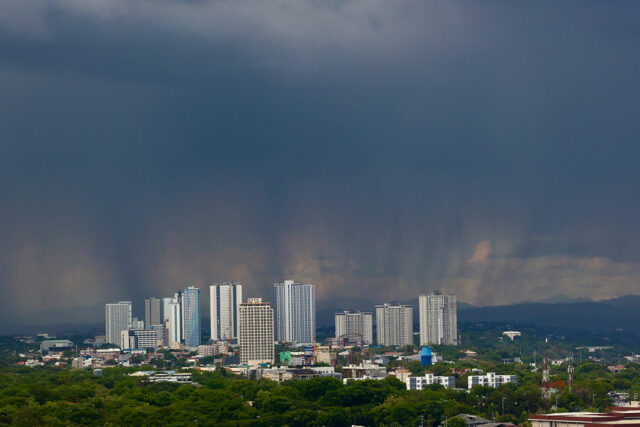
Clouds hover over buildings in Quezon City, April 28, 2025. — PHILIPPINE STAR/MIGUEL DE GUZMAN

By Katherine K. Chan

THE BANGKO SENTRAL ng Pilipinas (BSP) could lower borrowing costs as early as October if the economy shows signs of losing momentum, BSP Governor Eli M. Remolona, Jr. said, suggesting that policymakers are not ruling out further easing even after cutting rates for three straight meetings.

“If we see [economic] output slowing down because of the lack of demand, then we would step in, easing policy rates [to] strengthen demand,” he said in an exclusive interview on Thought Leaders with Cathy Yang on One News on Thursday.

But the BSP chief said monetary policy would be ineffective in addressing supply-driven slowdowns. “If it’s a supply thing, there’s little we can do. So, it has to come from a demand side for us to act decisively,” he added.

Last month, the Philippine central bank lowered its benchmark interest rate by 25 basis points (bps) to 5%, marking its third consecutive cut. That brought total easing to 150 bps since August 2024.

Mr. Remolona has repeatedly described the policy setting as a “Goldilocks rate,” balancing inflation and growth.

“We’re in the Goldilocks zone, I would say,” he said. “So, if the forecast stays… we’re going to stay where we are in terms of the policy rate. There may be small adjustments — a pause or an ease — but more or less, we’re going to be at the same range.”

The governor said two quarter-point reductions in October and December are “possible but not likely.” While not ruling them out, he said the central bank is inclined to hold steady if forecasts for both inflation and growth remain intact.

Larger cuts are improbable. “A 50-bp cut is a big shot,” Mr. Remolona said, stressing that easing would likely continue in smaller, incremental steps. He added that only a sharper slowdown in economic activity and a rise in unemployment would prompt more aggressive action.

Philippine inflation averaged 1.7% in the first eight months, below the BSP’s 2-4% target, after quickening slightly to 1.5% in August.

This was the sixth straight month that consumer price growth undershot the target. The economy expanded by 5.5% in the second quarter from a year earlier, quicker than 5.4% in the previous quarter.

The BSP projects full-year growth to settle at the lower end of the government’s 5.5-6.5% goal, with inflation ending the year at 1.7%.

The Monetary Board has two remaining policy meetings this year, on Oct. 9 and Dec. 11. Mr. Remolona said the central bank typically makes decisions every two months as new data come in, but he did not rule out off-cycle action.

“Of course, if it’s really bad, we can move the policy rate even outside our usual schedule of policy meetings, but that’s highly unlikely,” he said.

Beyond the immediate growth-inflation trade-off, Mr. Remolona said policy adjustments also help banks operate more efficiently.

“For me, it’s no longer a monetary policy thing,” he said. “It’s more of a structural thing to help banks be more efficient in terms of lending, pricing their deposits.”

The central bank chief said inflation risks are generally low. The BSP expects price increases to average 3.3% next year and 3.4% in 2027, both within target.

“If it’s not so good data, then of course we’ll ease,” he said. “The risks of higher inflation which would make us tighten, the way we see it now, those risks are small. So, I think we’re comfortable for now.”

Infrastructure spending slumps in July amid flood control mess

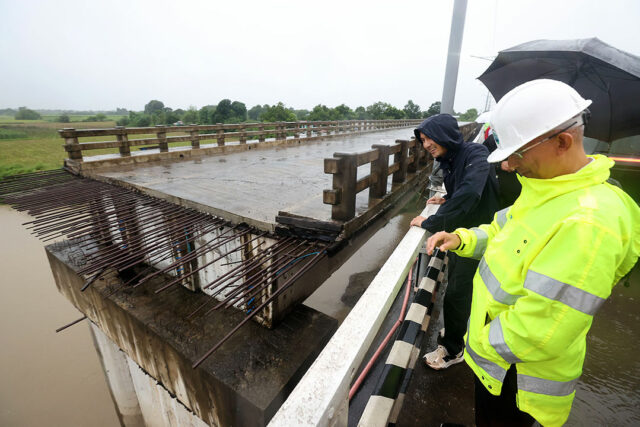
Government officials inspect the construction site of the anomalous flood control project in Barangay Candating, Arayat, Pampanga, Sept. 23. — PHILIPPINE STAR/MIGUEL DE GUZMAN

By Aubrey Rose A. Inosante, Reporter

STATE INFRASTRUCTURE spending declined by 25% in July, amid sluggish disbursements by the Department of Public Works and Highways (DPWH), the Budget department said.

At the same time, Budget Secretary Amenah F. Pangandaman said infrastructure disbursements may remain subdued in the coming months amid the ongoing probe into anomalous flood control projects.

In its latest disbursement report on Thursday, the Department of Budget and Management (DBM) said expenditures on infrastructure and other capital outlays fell by 25.3% to P93.3 billion in July from P124.9 billion in the same month last year.

Month on month, it dropped by 37.3% from P123.8 billion spent on infrastructure in June. 

This marked a reversal of the 6.5% annual increase seen in June after the election ban on public works disbursements was lifted in early May.

The DBM attributed the year-on-year decline in infrastructure spending to weak disbursements by the DPWH, which is currently embroiled in a controversy over anomalous flood control projects.

The Budget department noted the slow DPWH disbursements were due to project implementation schedules, including the timing and phasing of infrastructure activities, as well as delays in procurement, incomplete submission of progress billings and required documents by contractors.

Spending in July was also affected by contractors’ compliance with the new tax clearance requirement of the Bureau of Internal Revenue (BIR) for the release of final payments.

The BIR earlier said the failure of contractors to present their tax clearance will result in the suspension of contract settlements and the imposition of a tax line over the contract amount in favor of the government.

The updated clearance guarantees that every contractor has no outstanding tax liabilities.

“Disbursements for the Revised Armed Forces of the Philippines Modernization Program (RAFPMP) of the DND (Department of Defense) were also lower in July 2025 attributed to the timing of releases, as big-ticket items were scheduled in August,” the DBM said.

At the same time, the DBM said lower spending was partly offset by higher disbursements from the Department of Transportation, driven by local counterpart funding for foreign-assisted projects and the settlement of outstanding payables.

Rizal Commercial Banking Corp. Chief Economist Michael L. Ricafort said the government should exercise caution to prevent anomalies and corruption allegations.

“However, other infrastructure projects in good order will continue,” he said in a Viber message on Thursday.

For the January-to-July period, overall infrastructure and capital outlays disbursements slipped by 3.2% to P713.5 billion from P736.7 billion in the same period last year.

The decline was driven by combined factors, including the second-quarter election-related ban and timing of disbursements for the defense modernization program.

As of end-July, the DBM released P4.9 billion to the DPWH for nationwide classroom repairs, alongside P3.5 billion earmarked for the restoration of Gabaldon and other heritage school and the implementation of the Last Mile Schools Program.

‘TEMPORARY SLOWDOWN’
Meanwhile, Ms. Pangandaman said infrastructure spending this year was dented by the election ban, and now the ongoing investigation on flood control projects.

The Budget department warned of a temporary slowdown in infrastructure spending as the DPWH conducts tighter due diligence of projects.

“(This) following rigorous due diligence being undertaken by the DPWH to evaluate and validate status of completed projects, and employ measures to enforce stricter verification of progress billings and other payment claims,” the DBM said.

Earlier this month, the DPWH suspended the bidding of all locally funded projects for two weeks, to help the agency implement safeguards against so-called “ghost” projects.

“The DPWH has also since lifted the suspension of bidding and procurement activities for local projects to ensure continuity and timely implementation of the infrastructure program while implementing safeguards to prevent corruption and ensure compliance with existing laws, rules, and regulations,” the Budget department said.

“Infrastructure spending will hopefully normalize and catch up towards the latter part of the year.”

However, Ms. Pangandaman said it’s too early to tell if the infrastructure slowdown will dent economic growth.

“We’re working with the DBCC (Development Budget Coordination Committee) to crunch the numbers. We’ll know more after the next (DBCC) meeting,” she said.

Analysts said they expect spending to further cool until 2026 amid a widening probe on infrastructure projects.

“We may see even slower infra spending in the coming months amid scrutiny of the DPWH and the corruption scandal,” Reinielle Matt M. Erece, an economist at Oikonomia Advisory and Research, Inc., said in a Viber message.

Ateneo Center for Economic Research and Development Director Ser Percival K. Peña-Reyes said the flood control scandal is a “very hot issue” that’s likely to cool infrastructure spending through yearend.

Mr. Ricafort also said slower infrastructure spending could also dampen government spending, which contributes less than a fifth to the country’s economic output.

“Risk is slowdown in infrastructure spending and overall economic growth. But would help narrow the budget deficit and curb growth in overall NG (National Government) debt,” he said.

BSP’s P500,000 cash withdrawal limit ‘not foolproof’ — analysts

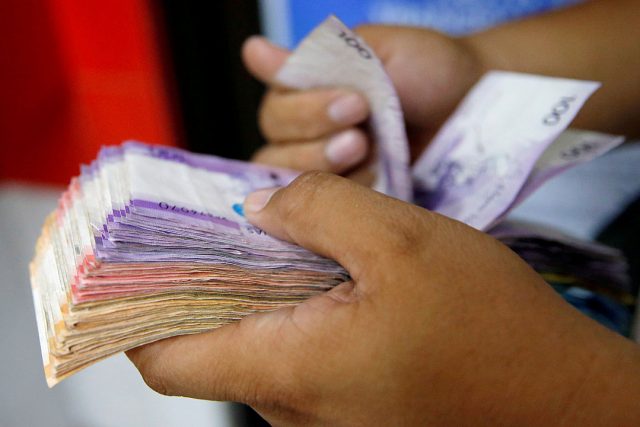
A MAN counts a wad of Philippine peso bills in Makati City, Metro Manila, Philippines, Sept. 19, 2018. — REUTERS/ELOISA LOPEZ

By Katherine K. Chan

THE BANGKO SENTRAL ng Pilipinas’ (BSP) new P500,000 cap on daily cash withdrawal may make money laundering more difficult but unlikely to completely deter it, analysts said.

At the same time, BSP Governor Eli M. Remolona, Jr. on Thursday defended the new policy amid complaints from the public about the smaller daily cash withdrawal limit.

“We want to make it more difficult for the contractors, for the guys involved in the flood control mess, to be able to take money out of the banks. We just realized that all these transactions are done in cash,” he said in an exclusive interview on Thought Leaders with Cathy Yang on One News on Thursday.

The BSP issued a circular which imposes a P500,000 daily limit on cash withdrawals amid an ongoing investigation into anomalous flood control projects involving government employees, contractors and other individuals.

Under the circular, a maximum of P500,000 or its equivalent in foreign currency may be withdrawn at once or via multiple transactions within one banking day.

However, clients may still withdraw cash beyond the limit if they provide evidence of a legitimate business purpose. Such transactions may be approved after the BSP-supervised financial institution (BSFI) conducts enhanced due diligence and files a suspicious transaction report.

Mr. Remolona acknowledged this would be “a bit of a hassle” but hoped that this would prompt a switch to digital transfers.

“We understand there are businesses that are cash-based, and I think the banks know this. The businessman can come to the bank and say, ‘I need cash, more than P500,000 and this is why I need the cash.’ The bank will understand that,” he said. “We want to go digital, so this may encourage that shift.”

Jonathan L. Ravelas, a senior adviser at Reyes Tacandong & Co., said money laundering will still be possible using alternative means such as cryptocurrency, shell firms, or trade-based laundering despite the BSP’s new regulations limiting cash withdrawals.

“Cash is the lifeblood of illicit finance, and this limit forces large transactions into traceable, digital channels. But let’s be clear: it’s not foolproof,” he said in a Viber message. “Criminals are adaptive. They find ways. They’ll shift to crypto, shell firms, or trade-based laundering.”

John Paolo R. Rivera, a senior research fellow at the Philippine Institute for Development Studies, said in a Viber message that the BSP circular is a sound anti-money laundering measure that promotes transparency and “reduces risks tied to large cash transactions.”

“It nudges high-value dealings toward traceable channels like fund transfers and digital platforms,” he said.

However, Mr. Rivera said the policy’s effectiveness will depend on strict enforcement, citing potential loopholes such as “smurfing” and use of informal platforms. 

“Loopholes such as ‘smurfing’ (structuring under-threshold withdrawals) and shifts to informal or offshore methods must be monitored,” Mr. Rivera added. “Banks should strengthen transaction monitoring and customer profiling, while regulators must remain vigilant.”

Smurfing refers to a money laundering technique where large illicit cash transactions are broken into multiple, smaller amounts to avoid regulatory reporting.

Union Bank of the Philippines Chief Economist Ruben Carlo O. Asuncion said robust monitoring and digital surveillance would allow the withdrawal ceiling to be an effective anti-money laundering measure.

“The P500,000 daily cash withdrawal cap is a strong deterrent against bulk cash movements, but it’s most effective when paired with robust monitoring and digital traceability,” he said in a Viber message. “Criminal networks often adapt, so banks must strengthen analytics to detect unusual patterns beyond cash.”

Reinielle Matt M. Erece, an economist at Oikonomia Advisory & Research, Inc., said the regulation will only pose minimal impact on consumers and the economy in general.

“There will be little impact on households since the bulk of their transactions are done in smaller amounts than the limit,” Mr. Erece said in a Viber message. “Further, even high-value items such as vehicles often are amortized.” 

Meanwhile, Mr. Rivera said the withdrawal cap could streamline the financial industry’s shift to digital platforms and strengthen the country’s financial integrity.

“Economic sectors reliant on cash (e.g., retail, transport, construction) may experience short-term friction, but this could accelerate the shift to digital finance and improve financial integrity in the long term,” he said.

Mr. Ravelas also noted that the BSP’s new policy could help promote transparency and inclusion if it motivates clients to adopt digital payments.

“On the economic front, cash-reliant sectors like agriculture, retail, and transport may feel the pinch initially. But if this policy nudges them toward digital payments, it’s a win for transparency and inclusion,” he said.

However, Mr. Ravelas said the transition to digital payments must not exclude the unbanked population.

“The challenge is ensuring the unbanked aren’t left behind. We need digital infrastructure that’s accessible, affordable, and trusted. This isn’t just a regulatory tweak. It’s a push toward a more modern, resilient financial system,” he said.

‘UNLAWFUL’
Meanwhile, Russell Stanley Q. Geronimo, founder and managing lawyer of Geronimo Law, flagged the circular as unlawful as it violates a provision of the Foreign Currency Deposit Act of the Philippines.

“With due respect, BSP’s new P500,000 cash withdrawal limit policy violates Section 5 of Republic Act (RA) No. 6426, which guarantees the absolute and free withdrawability of foreign currency deposits,” Mr. Geronimo said in a commentary on Friday.

Section 5 of the law states that withdrawals or transfer of deposits overseas may not be restricted, except for limitations specified in the agreement between the depositor and the bank.

“Section 5’s guarantee of free withdrawal is regarded as absolute,” Mr. Geronimo said. “The phrase ‘no restriction’ encompasses any form of impediment, whether in the amount, timing, or manner of withdrawal, except if the depositor agreed to a limitation in the bank’s terms and conditions.” 

“The legislative purpose was to attract and retain foreign exchange in the Philippine banking system by assuring depositors that their funds are fully protected, freely withdrawable, transferable abroad without restriction, and immune from government interference such as disclosure, garnishment, or forfeiture,” he added.

Mr. Geronimo also cited Section 7 of RA 6426 which provides that if new BSP regulations diminish depositors’ rights, the rules that were in place when the deposit was made will apply.

“Under Philippine law, a statute prevails over an administrative issuance. Administrative rules and circulars cannot amend, alter, or contravene the provisions of the law they seek to implement,” he said.

“Notably, the BSP did not seek public comments or issue an exposure draft before promulgating the new circular.”

NG to borrow P437B locally in Q4 

REUTERS

By Aaron Michael C. Sy, Reporter

THE NATIONAL GOVERNMENT (NG) is looking to borrow P437 billion from the domestic market in the fourth quarter, the Bureau of the Treasury (BTr) said on Thursday.

In a notice on its website, the BTr said it seeks to borrow P262 billion through the issuance of Treasury bills (T-bills) and P175 billion through Treasury bonds (T-bonds) in the October-to-December period.

The borrowing plan for the fourth quarter is 36.6% lower than the P690-billion borrowing plan for the third quarter.   

It is also 31.45% lower than the P637.448 billion that the government actually raised in the July-to-September period.

“Our bond auctions will be biweekly but the tenor will be dual, similar to what we’ve been doing for the three- and 20-year bonds,” National Treasurer Sharon P. Almanza said in a Viber message.

Ms. Almanza said the breakdown of amounts per tenor for T-bills and T-bonds will be announced in the weekly notice of offering.

For October, the NG plans to borrow P180 billion domestically, consisting of P110 billion in T-bills and P70 billion in T-bonds.

The government will hold auctions for T-bills on Sept. 29, Oct. 6, Oct. 13, Oct. 20 and Oct. 27. It seeks to raise P22 billion from the sale of 91-day, 182-day and 364-day T-bills from each of these auctions in October, but no breakdown was given.

For the Sept. 29 auction, the BTr will raise P7.5 billion each from 89-day and 182-day papers, as well as P7 billion from 364-day T-bills.

For longer-dated offerings, the BTr will auction off P35 billion worth of three-year and 10-year bonds on Oct. 7, and P35 billion worth of seven-year and 25-year bonds on Oct. 21.

For November, the government is looking to borrow P158 billion from the domestic market, composed of P88 billion from T-bills and P70 billion from T-bonds.

The NG seeks to raise P22 billion from each of the four auctions scheduled on Nov. 3, 10, 17 and 24. It will offer 91-day, 182-day and 364-day T-bills at these auctions, but no specific breakdown was given.

The government will offer five-year and 10-year bonds worth P35 billion on Nov. 4, and seven-year and 20-year bonds worth P35 billion on Nov. 18.

In December, the NG will borrow P99 billion from the domestic market, composed of P64 billion from T-bills and P35 billion from T-bonds.

The government is looking to raise P22 billion from the offering of 91-day, 182-day and 364-day T-bills at the Dec. 1 and 8 auctions, and P20 billion at the Dec. 15 auction.

The government scheduled only one T-bond auction in December. It will sell three-year and 10-year bonds on Dec. 2, with the goal of raising P35 billion.

There are less auctions in December to take into account the holiday season.

A trader said demand is expected to be strong in the fourth quarter, while yields could ease further due to the lower supply of bonds relative to the previous quarter’s offering.

“This is a welcome development for investors as there will be choices in terms of tenors.

“Also, expect rates to trend lower since we only have bi-weekly bond auctions next quarter. There should be strong demand given the relatively lower supply,” the trader said.

The trader noted that the BTr will conduct dual bond offerings in the October-to-December period to address demand for short and long tenors, and since the government has almost completed its borrowing plan for the year due to the retail Treasury bond (RTB) offering.

However, the trader expressed concern that investor confidence could be dampened by the ongoing corruption scandal involving anomalous flood control projects.

“Not sure also if it will be something good for our image given that we want to be included in the JPMorgan bond index,” the trader said.

JPMorgan this month tagged Philippine peso-denominated government bonds as “Index Watch Positive,” which is the final review phase for inclusion in its Government Bond Index for Emerging Markets series.

Rizal Commercial Banking Corp. Chief Economist Michael L. Ricafort said in a Viber message that the lower borrowing program for the fourth quarter has been a consistent trend amid lower maturities and due to less working days during the holiday season.

However, he said the widening budget deficit and lower interest rates may increase the share of domestic borrowings in the government’s total borrowing mix.

Latest BTr data showed gross domestic debt stood at P1.34 trillion as of end-July.

This was composed of P881.84 billion in fixed-rate Treasury bonds, P300 billion in fixed-rate Treasury notes and P159.85 billion in Treasury   bills.

The government borrows from local and foreign sources to help fund its budget deficit, which is capped at P1.56 trillion or 5.5% of gross domestic product this year.

House resolution seeks expanded market access for subsidiaries via preferred shares

AYALALAND.COM.PH

By Alexandria Grace C. Magno

A LAWMAKER has filed a resolution in the House of Representatives urging the Securities and Exchange Commission (SEC) and the Philippine Stock Exchange (PSE) to review their regulatory framework to allow subsidiaries of listed companies to issue and list preferred shares in the stock market, while ensuring investor protection, transparency, and market integrity.

House Resolution No. 263, introduced by Albay Rep. Raymond Adrian E. Salceda on Sept. 9, is pending with the Committee on Trade and Industry.

The resolution noted that subsidiaries in sectors such as power generation, renewable energy, water utilities, telecommunications, and infrastructure require expanded financing options.

Allowing them to issue preferred shares would provide additional avenues for raising capital beyond traditional bank loans, it said.

China Bank Capital Corp. Managing Director Juan Paolo E. Colet said that in 2022, the PSE established rules allowing companies to conduct initial public offerings and list preferred shares, effectively making this capital-raising option available to subsidiaries of listed firms.

“However, the House Resolution should give the SEC and PSE an opportunity to revisit these rules to make it easier for such subsidiaries to access the market for preferred shares,” he said in a Viber message.

In 2022, the PSE introduced a rule that permits companies to list preferred shares for their initial public offering without listing common shares, which enabled subsidiaries of listed companies to raise capital exclusively through preferred shares. The rule required a minimum public offering size of P1 billion or 20% of the preferred shares’ market capitalization, along with at least 1,000 stockholders at the time of listing.

Mr. Colet highlighted potential reforms worth exploring. “First, lowering or removing the requirement to have at least 1,000 shareholders and a 20% public float, and second, liberalizing the rules on operating history and financial track record,” he said.

The resolution also calls for updated regulatory frameworks that would include safeguards such as consolidated group reporting and transparent disclosures to protect investors and maintain market integrity.

Meanwhile, SM Investments Corp. Economist Robert Dan J. Roces said the measure may open the door for more companies to tap the stock market efficiently.

“It could let subsidiaries raise long-term funding without weighing down the parent, while still under SEC oversight,” he said in a Viber message.

“The [House resolution] broadens investor choice, deepens the capital market, and supports growth sectors like infrastructure and energy,” he added.

For his part, Rizal Commercial Banking Corp. Chief Economist Michael L. Ricafort said: “This is one innovative way to further develop the capital markets with a customized regulatory approach that adapts to market realities and investor requirements, while also easing administrative requirements for subsidiaries of listed firms.”

Peso breaches P58 amid flood probe, Fed signals

PHILIPPINE STAR/ MIGUEL DE GUZMAN

By Aaron Michael C. Sy, Reporter

THE PHILIPPINE PESO slumped past the P58-a-dollar mark on Thursday as a widening corruption scandal over state flood control projects weighed on sentiment and hawkish signals from the US Federal Reserve supported the greenback.

It closed at P58.10 against the dollar, down 63.9 centavos from a day earlier, according to data from the Bankers Association of the Philippines posted on its website. That was its weakest level since Aug. 1, when it closed at P58.145.

The peso opened at P57.75 and traded from P57.73 to P58.17. Dollar turnover rose to $2.15 billion from $1.73 billion on Wednesday, reflecting heavier activity as the peso sold off.

“The dollar-peso closed higher on political unrest due to the congressional inquiry on the flood control scandal,” a Manila-based trader said by telephone.

Finance Secretary Ralph G. Recto estimated corruption in these projects might have cost the country as much as P118.5 billion in economic losses since 2023.

At a Senate Blue Ribbon Committee hearing on Thursday, former Public Works undersecretary implicated more Philippine lawmakers in the multibillion-peso kickback scheme.

The allegations added to investor unease after the Anti-Money Laundering Council froze more than 700 accounts and assets linked to anomalous infrastructure spending earlier this month.

The peso’s weakness also reflected external headwinds. “The peso continues to be dragged by hawkish Fed signals,” Michael Ricafort, chief economist at Rizal Commercial Banking Corp., said in a Viber message.

The dollar index was steady at 97.838, near a two-week high, according to Reuters. The greenback has held firm since the Fed trimmed rates last week as expected, with traders pricing in another 42 basis points of cuts across its final two meetings this year.

Still, officials including Fed Chairman Jerome H. Powell signaled future moves would depend heavily on incoming data.

Investors are awaiting the Fed’s preferred inflation gauge, the personal consumption expenditure price index due Friday, along with the final estimate for second-quarter US gross domestic product. A possible US government shutdown could also inject volatility.

The trader sees the peso moving from P58 to P58.30 on Friday, while Mr. Ricafort expects it to trade from P57.95 to P58.25.

Película/Pelikula returns to Makati

FACEBOOK.COM/INSTITUTOCERVANTESMANILA

SPANISH-LANGUAGE FILMS, documentaries, and shorts will be giving Filipinos a taste of cultural variety for this year’s Película/Pelikula Spanish Film Festival.

The film festival will be held from Oct. 10 to 16 at Ayala Triangle Gardens and Power Plant Mall in Makati City.

José Maria Fons Guardiola, the cultural head of Instituto Cervantes de Manila, said at the press conference that this edition marks the festival’s return to Makati after five years of holding it elsewhere. “The festival was born there and, to mark the return, we’ll have the outdoor screening,” he said.

Twenty-one films will be shown this year, from Spain and Latin America. The opener is El 47, a film by Marcel Barrena that follows a bus driver who takes bold action to protest the neglect of an immigrant neighborhood in 1970s Barcelona.

There are many films of note in the official selection. One is the coming-of-age drama Reinas by Klaudia Reynicke, a Swiss-Peruvian-Spanish co-production that was selected as the Swiss entry for the Best International Feature at this year’s Oscars.

Other dramas to watch out for are Soy Nevenka, directed by Icíar Bollaín, and Nosotros, directed by Helena Taberna, both from Spain; and Becho from Uruguay. The Argentine film Por tu bien, directed by Axel Monsú, is set in the north near the Brazilian border, while the film from Brazil, Até que a música pare, is set in the south near the border of Argentina.

At the Sept. 25 press conference in Intramuros, Manila, Francisco Javier López Tapia, the director of Instituto Cervantes de Manila which is organizing the film festival, said that it will celebrate how cinema is “a powerful expression that connects different cultures.”

“Last year, we welcomed 7,000 spectators. This year, we hope to go even further,” Mr. López said in a video message.

There are documentaries as well: Un hombre libre, about Spanish writer Agustín Gómez Arcos, and La guitarra flamenca de Yerai Cortés, about the flamenco guitar player Yerai Cortés. Spanish animated films make a return in Mariposas negras, directed by David Baute, and Robotia, directed by Diego Cagie and Diego Lucero.

On Oct. 12, preceding an afternoon screening of Robotia at Power Plant, children will have a chance to win several footballs and an official Real Madrid jersey signed by football legend Emilio Butragueño.

SPECIAL SECTIONS
PELíCULA’s section En corto: Short films from the Philippines, Latin America, and Spain will feature three Filipino shorts — Animal Lovers by Aedrian Araojo, Lip Sync Assassin by Jon Galvez, and Radikals by Arvin Belarmino.

“We try to be alert with what’s going on in the local film industry, who the young filmmakers are. That’s how we manage to platform these excellent short films each year,” Mr. Fons said.

The section Cine Maratón will present a whole day of films on Oct. 11 at the Ayala Triangle, as a celebration to mark the festival’s move back to Makati.

Its program will have five films, including the opening film El 47; Dalia y el libro rojo, directed by David Bisbano; Tasio, directed by Montxo Armendáriz; Solos en la noche, directed by Guillermo Rojas; and Reinas. It will run from 11:45 a.m. to 11 p.m.

That same day, Instituto Cervantes will host an activity for children, inviting participants to partake in arts and crafts and games.

After that, the rest of the festival will move to the Power Plant Mall Cinemas.

This year’s crop of films is also different from before, according to Mr. Fons.

“There are more dramas and films with political themes,” he said. “It was hard to find comedies. We found three, but in the past there were more. That also says a lot about the changing film culture.”

All the films will have English subtitles, and the screenings are free and open to the public. For a complete list of films and the screening schedule, visit the festival’s website (https://pelikula.org) or the Facebook or Instagram pages of Instituto Cervantes de Manila. — Brontë H. Lacsamana

Megaworld launches P2-B share buyback, earmarks P2.21B from REIT for townships

ILOILO BUSINESS PARK — MREIT.COM.PH

By Beatriz Marie D. Cruz, Reporter

PROPERTY DEVELOPER Megaworld Corp. has launched a P2-billion share buyback program while allocating P2.21 billion raised from its listed real estate investment trust unit Megaworld Real Estate Investment Trust, Inc. (MREIT) for township projects in Cebu, Palawan, and Bacolod.

The buyback program will run for 24 months starting Thursday, the company said in a regulatory filing.

“The board believes that current market prices do not reflect the true value of the company’s shares and seeks to enhance shareholder value through a share buyback program,” Megaworld said.

The program will be funded internally, with the purchased shares to be booked as treasury shares.

Share purchases will be made through the trading facilities of the Philippine Stock Exchange (PSE), it added.

As of end-August, the company had an authorized capital stock of P45.7 billion, consisting of 45.64 billion common shares with a par value of P1 apiece and six billion voting preferred shares with a par value of P0.01 each.

Of the authorized capital, 32.56 billion common shares and six billion preferred shares are issued and outstanding, with 1.19 billion treasury shares.

“The buyback is positive for shareholders as it will support the company’s stock price and increase earnings per share over time,” China Bank Capital Corp. Managing Director Juan Paolo E. Colet said in a Viber message.

“Megaworld’s financial resources and profitability can easily bankroll the buyback while keeping their capital expenditure plans on track,” he added.

In a separate disclosure, Megaworld said it will allocate the P2.21 billion raised from its recent sale of MREIT shares to fund projects in its Cebu, Palawan, and Bacolod townships.

“Megaworld intends to use net proceeds received from the sale to fund ongoing and future investments in real estate properties in three townships located in Cebu, Bacolod, and Palawan or the development of malls, offices, and other developments within each township, which Megaworld may undertake on its own or through other subsidiaries,” it said.

“While the company is not contemplating acquiring land at this time, there is nothing preventing it from doing so in the future in accordance with the requirements of the law, if the timing and opportunity is right,” it added.

Megaworld is set to disburse P845 million for the Paragua Coastown project in Palawan, which is 42% completed and expected to be finished by 2028.

It is also allocating P830 million for The Mactan Newtown in Cebu, which has a 73% completion rate and is scheduled for completion in 2028.

The remaining P537.92 million has been earmarked for upcoming malls, offices, and land developments in Bacolod, the company said.

Megaworld said it will submit quarterly progress reports and a final reinvestment plan report to the PSE, certified by its chief financial officer, treasurer, and external auditor.

In the second quarter, Megaworld’s attributable net income rose by 35% to P5.6 billion from P4.15 billion a year earlier, driven by growth in its leasing, residential, and hospitality segments.

Its first-half attributable net profit climbed by 25% to P10.7 billion from P8.55 billion last year.

At the local bourse on Thursday, Megaworld shares fell by 0.98% or two centavos to close at P2.02 apiece, while MREIT shares slipped by 0.88% or 12 centavos to P13.48 each.

BSP says no bank runs as AMLC freezes 700 assets linked to flood scam

BW FILE PHOTO

By Katherine K. Chan

THE BANGKO SENTRAL NG PILIPINAS (BSP) said there has been no sign of bank runs despite the freezing of more than 700 accounts and assets linked to the multibillion-peso fraud in government flood control projects.

“I can say this with confidence: No bank runs,” BSP Governor Eli M. Remolona, Jr. told Money Talks with Cathy Yang on One News on Thursday.

The scandal, which officials have described as unprecedented in scale, has prompted investigations into the Department of Public Works and Highways (DPWH) and its contractors.   

“This flood control scandal was as much of a shock to us as it was to you, but we’re working hard to fix things,” Mr. Remolona said. “We knew there was corruption all along, but not [at] this scale.”

The Anti-Money Laundering Council (AMLC) has frozen hundreds of assets, bank accounts and insurance policies tied to contractors and DPWH officials implicated in the scheme. The BSP has begun probing the frozen accounts under its authority granted by the Anti-Financial Accounts Scamming Act.

Mr. Remolona said early findings showed that most of the questionable transactions were funneled through government-owned banks. “That makes sense because it’s government money,” he said.

The central bank plans to adopt artificial intelligence (AI) tools to sift through suspicious transaction reports filed by banks.

Lenders must report cash or noncash transactions above P500,000. “As far as we know, the banks have been following the rules,” the BSP chief said. “They have reported those transactions.”

He added that AI could help the BSP “connect the dots” between reports and speed up the process of identifying possible money laundering.

The BSP has been providing data to the Independent Commission for Infrastructure (ICI), which is leading the state probe into ghost projects and diverted funds.

“We’re cooperating with the ICI. I’m not sure who was first (to give data), but we were always ready to provide it. We weren’t waiting to be asked,” he added.

The scandal comes as regulators work to avoid renewed scrutiny from the Financial Action Task Force (FATF), which monitors dirty-money risks. The Philippines was removed from the FATF’s “gray list” last year, but online gambling operations and the flood control probe have raised concerns.

“Unlike before, we’re now being more proactive, doing things before the FATF tells us,” Remolona said. “In the past the FATF would tell us what to do with a list of action items and then we have to fulfill it. Now, we’re doing things before they tell us.”

Last week, the BSP imposed a P500,000 daily limit on cash withdrawals, part of a broader effort to curb large-scale laundering activities.