Home Blog Page 5329

Debt service bill declines 24% in November

BW FILE PHOTO

The National Government’s (NG) debt service bill fell 24.4% year-on-year in November following a large principal payment to foreign creditors.

According to preliminary data from the Bureau of the Treasury (BTr) the government paid P61.389 billion to service its debt against P81.239 billion ia year earlier.

Month-on-month, debt payments rose 54.2% from P39.817 billion in October.

Principal payments to foreign creditors surged 404.9% during the month to P35.089 billion. The BTr settled P208 million with domestic lenders, down 99.5% from a year earlier.

In November, 57.5% of the debt service bill went to amortization, while the rest went to interest payments.

Interest payments fell 16.4% year-on-year to P26.092 billion in November.

Interest paid on domestic debt fell 32.5% to P18.584 billion while foreign debt more than doubled or rose by 104.3% to P7.508 billion from P3.675 billion.

Domestic debt consisted of P10.202 billion in fixed-rate Treasury bonds, P7.618 billion in retail Treasury bonds, and P743 million in Treasury bills.

In the first 11 months, the debt service bill declined 12.3% to P991.052 billion, with amortization taking up 53.7% of the total.

Principal payments during the 11-month period totaled P531.799 billion, falling 27.3% from a year earlier. These included P409.041 billion in domestic debt and P122.758 billion in foreign debt payments.

Interest payments rose 14.2% to P459.253 billion a year earlier. This consisted of P347.201 billion worth of payments to domestic creditors and P112.052 billion to foreign creditors.

This year, the government plans to borrow from external and domestic sources to fund a budget deficit capped at 6.1% of gross domestic product (GDP).

At the end of November, the National Government’s outstanding debt rose to record P13.644 trillion.

The debt-to-GDP ratio was 63.7% at the end of September, the highest debt-to-GDP ratio in 17 years.

It is also remains above the 60% threshold considered manageable by sovereign debt lenders.

For 2023, the government is aiming to bring down the debt-to-GDP ratio to 60-62%. – Luisa Maria Jacinta C. Jocson

How can private boards be future-fit?

In today’s rapidly-evolving and disrupted business environment, private enterprises need to be resilient and responsive to fast-changing business needs. Boards and management alike should widen their agenda, and continually embrace transformation to keep their organizations aligned with the times.

The most recent geopolitical, societal and environmental events force companies to rethink their priorities and revisit their current business agenda. Suffice to say, strategies which worked pre-2020 may no longer be effective. That is why private boards must reframe how the future looks like for their organizations.

EY has identified six key actions to test the future fitness of boards and their ability to lead the business.

1. Gather new perspectives by asking the right questions from stakeholders

This helps create a robust dialogue around risk, opportunities, and any impacts on long-term purpose, which enables more informed decision-making. Initiating these discussions with management invites the exploration of alternatives that may not have been previously considered. Inputs from external resources such as business advisors or consultants can be beneficial as it provides new perspectives or provides alternatives to the current problems companies face.

Conversations with stakeholders can give boards a better view of current or potential problems to provide organizations with much-needed wisdom. The better the questions are, the better the answers to be found.

2. Revitalize board dynamics

Diversity and ongoing self-reflection, along with openness to varied inputs, reinvention and adaptation, builds a stronger, more effective board. A reasonable exchange of ideas can provide different frames of reference that are essential to problem-solving. An active board also provokes difficult but necessary questions.

As an example, the Securities and Exchange Commission advocated increasing female representation in the boardroom and that boards should be as diverse as possible, gender-wise. In a study by Harvard Business Review, companies with more than two women on the board outperform others with less in their sector. Clearly, increased diversity in the boardroom has direct benefits for organizations.

3. Increase focus on the long term

While current circumstances have many boards centered on short-term survival, flexible and longer-term strategies based on emerging technologies, trends, new intelligence and industry developments, as well as a clear commitment to putting people first, should also be clearly articulated. Companies are no longer just measured on how well they performed for a year – they are assessed on how well they prepare for the future.

Information about sustainable practices, including environmental, social, and governance (ESG) programs, are a staple in investor briefings for large companies. In the not-so-distant future, corporate communications will include sustainability practices and measures alongside financial metrics.

With the growing significance of sustainability reporting, assurance of non-financial measures is equally important. Private companies may initially look up to their publicly listed counterparts, which are required to report about their sustainability programs (currently under a “comply or explain” basis). Private boards can include ESG matters as a staple boardroom discussion as well.

Future-fit boards are focused on identifying megatrends and guiding management to face new challenges and innovate to seize the upside of disruption. Future-fitness is also about creating an environment for management which provides flexibility to develop better, more innovative business models, new collaborations, and new ways of working, drawing on talent, and incubating new ideas.

4. Adapt communication, protect reputation

To maintain stakeholder trust, private boards need to align purpose with action. Communication must be timely and the division of roles for external communication clearly understood. Private boards can set the tone for the whole organization to follow. The policies and guidelines they adapt and approve for the organization should trickle down through formal and informal communication channels to the staff so that frontliners are equipped with the right information to make the right call.

In the EY Global Integrity Report 2020, only 58% of junior employees, compared to 70% of board members, agree that employees in their organization can report wrongdoing at work without fear of negative consequences for themselves. Management must build the trust of their workforce through the clear communication of values and transparent compliance with the rules, as well as provide secure ways in which employees can voice their concerns.

5. Align and monitor culture

In his book Start with Why, Simon Sinek said that “Cultures are groups of people who come together around a common set of values and beliefs. When we share values and beliefs with others, we form trust.” It is important that boards have a clear vision of the corporate culture, align it with long-term strategies, and monitor said culture using new metrics to view issues from every angle.

Purpose is like a journey, the board and management are pilots and stewards, and the passengers are the employees and other stakeholders. The pilot, the crew and the passengers need to have a common understanding of where their destination is and more importantly, trust that everyone will play their roles in order to arrive safely.

6. Enhance risk and compliance oversight

Taking a pragmatic approach enables boards to gather external insights, deploy monitoring mechanisms, and think more broadly about emerging risks and how to address them.

One of the shifts required is to develop new competencies for finance, risk, technology and compliance. Private boards can organize committees similar to what public companies do to enhance oversight functions of their boards. Private boards may wish to rethink their usual agenda to tackle enterprise-wide risks.

FUTURE-PROOFING PRIVATE COMPANIES
Private companies can become future-proof by reimagining the way things are done and private boards are instrumental to setting that tone. A clear purpose acts as a compass in the journey of an organization to reshape and reinvent itself, setting a clear and inspiring direction that future-fit boards can navigate.

Furthermore, with the right information and the proper tools, private boards can lead the transformations of their companies to the next level and beyond.

This article is for general information only and is not a substitute for professional advice where the facts and circumstances warrant. The views and opinion expressed above are those of the author and do not necessarily represent the views of SGV & Co.


Kristopher S. Catalan is an Assurance Partner and the EY Private Leader of SGV & Co.

Amit resumes quest for the elusive world 9-ball crown

RUBILEN AMIT — PSC/POC

PHILIPPINE pool queen Rubilen Amit resumes her pursuit for the one hardware that has eluded her for more than a decade now as she plunges into action in the Kamui Women’s World 9-Ball Championship set Jan. 19 to 22 in Atlantic City.

The 41-year-old Ms. Amit left the country less than a week ago alongside countrywoman and fellow Southeast Asian Games gold medalist Chezka Centeno to continue her quest for that elusive world 9-ball crown.

Mmess. Amit and Centeno will be two of the 64 of the world’s cream of the crop of the sport vying for the top purse worth $30,000, or a whopping P1.6 million, and the glory as the mightiest in the world.

One of the stars participating in the event that is making a much-awaited return after a four-year absence is Brit Kelly Fisher, who trounced Austrian Jasmin Ouschan in ruling the last staging in Sanya, China in 2019.

Interestingly, Ms. Amit made it as far as the semifinals in that same edition only to succumb to a steadier Ms. Ouschan, 9-2.

The closest Ms. Amit got in claiming her breakthrough world 9-ball title was 16 years ago in Taipei where she wound up as runner up to eventual winner Pan Xiaoting of China.

The tournament will implement a double-elimination format of race-to-7, winner breaks matches down to the final-16 where a knockout, race-to-9 system will be implemented. Both Mmess. Amit and Centeno have an equal shot at glory having ranked fifth and eighth in the world, respectively.

But it will be more significant for Ms. Amit as that world 9-ball silverware will complete her massive collection of triumphs that included two world 10-ball crowns, 10 SEA Games gold, a world 10-ball team title last year when she joined forces with Carlo Biado and Johann Chua in Klagenfurt, Austria. — Joey Villar

SF 49ers rout Seahawks in 2nd half, cruise 41-23

BROCK Purdy threw for three touchdowns and ran for another in his first playoff start as the host San Francisco (SF) 49ers advanced with a 41-23 victory against the Seattle Seahawks on Saturday afternoon in Santa Clara, Calif.

The 49ers (14-4 overall), the NFC’s No. 2 seed, won their 11th consecutive game, overcoming a halftime deficit and outscoring the visitors 25-6 in the second half.

Mr. Purdy, a rookie who was the last overall pick in this year’s NFL draft, completed 18 of 30 passes for 332 yards.

“We chased him all over the place and he looked like Fran Tarkenton out there,” Seattle coach Pete Carroll said of Mr. Purdy.

Christian McCaffrey rushed 15 times for 119 yards and made a touchdown reception, and Deebo Samuel had six catches for 133 yards and a TD.

Seattle’s Geno Smith was 25-of-35 passing for 253 yards with two touchdowns, both to DK Metcalf, and one interception. Kenneth Walker III rushed 15 times for 63 yards and a score, and Metcalf had 10 catches for 136 yards and the two scores.

Trailing 17-16, the 49ers took the second-half kickoff and went 75 yards in 13 plays, with Mr. Purdy scoring on a 1-yard plunge.

The Seahawks (9-9) moved deep into San Francisco territory before taking their first two penalties of the game, leaving them with third-and-14 from the 19. Mr. Smith was sacked by Charles Omenihu for a 7-yard loss, with the ball squirting loose and recovered by Nick Bosa at the 30.

The 49ers drove down the field and Mr. Purdy escaped the rush before throwing a 7-yard TD pass to running back Elijah Mitchell. A two-point conversion pass to George Kittle gave San Francisco a 31-17 lead with 14:02 remaining.

Mr. Purdy threw a 74-yard scoring strike to Samuel, and Robbie Gould kicked a 31-yard field goal to make it 41-17.

Mr. Smith threw a 3-yard TD pass to Mr. Metcalf with 1:48 left to complete the scoring.

The Seahawks rallied from a 10-point deficit to take a 17-16 halftime lead on Jason Myers’ 56-yard field goal on the final play.

“Down 10-0 on the road with the fans going nuts, we did a great job to bounce right back,” Mr. Carroll said. “We were in it right to the end of the third quarter.”

The 49ers scored on their first two possessions — Mr. Gould’s 34-yard field goal and a 3-yard TD pass to Mr. McCaffrey — for a 10-0 lead.

“We came out and had some momentum and Seattle did a good job tracking back,” Mr. Purdy said of trailing at the half. “It’s playoff football; everyone is going to play their best from here on out. When our offense and defense are doing their thing, we’re hard to beat.”

Walker’s 7-yard TD run got the Seahawks on the scoreboard and, following Gould’s 33-yard field goal, they took the lead on a 50-yard scoring strike from Mr. Smith to Mr. Metcalf down the left sideline.

Mr. Gould’s 46-yarder gave San Francisco a 16-14 lead before Myers’ last-second kick. — Reuters

Rhenz Abando rules Slam Dunk Contest in Korean Basketball League All-Star Weekend

RHENZ Abando displayed a clean two-handed 360 and an electrifying baseline alley-oop dunk off a pass from compatriot RJ Abarrientos before capping the first round with a top-board reverse slam for 50 points. — ANYANG KGC

FILIPINO high-flyer Rhenz Abando took the Korean Basketball League (KBL) All-Star Weekend by storm, soaring his way to the championship of the Slam Dunk Contest yesterday at the KT Sonicboom Arena in Suwon.

The Anyang KGC import made heads turn in going perfect in two rounds with 100 points to best the homegrown stars of the KBL only in his first season.

Mr. Abando displayed a clean two-handed 360 and an electrifying baseline alley-oop dunk off a pass from compatriot RJ Abarrientos before capping the first round with a top-board reverse slam for 50 points.

There was no stopping the former NCAA Rookie-MVP from there on as he scored another 50 points in the second phase with a two-handed reverse windmill dunk and a one-handed windmill version.

The former Letran standout bagged two million Korean won or more than P88,000 as the best dunker in the KBL’s midseason spectacle.

Mr. Abando, 24, bested a bevy of local stars led by home bet Ha Yun-gi (90 points) of Suwon KT SonicBoom, Choi Jin-soo (89) of Ulsan Hyundai Mobis Phoebus and Park Jin-cheol (87) of and Goyang Carrot Jumpers.

Mr. Abarrientos, the Pinoy reinforcement of Ulsan, meanwhile fell short in the Three-Point Shootout with only 13 points to bow out of contention in the preliminaries.

Heo Ung of the Jeonju KCC Egis won the shootout with 19 points over Ulsan’s Kim Gook-chan with 13 in final round.

Mr. Abarrientos also settled for only three points as Team Heo Ung bowed to Team Lee Dae-sung, 122-117, in the All-Star Game proper.

The former FEU stalwart was the lone Filipino import that made it into the All-Star Game after placing 24th in the voting process. — John Bryan Ulanday

Gabe Vincent, Bam Adebayo propel Heat past Bucks

GABE Vincent scored 27 points as the Miami Heat posted a 111-95 victory over the visiting Milwaukee Bucks on Saturday afternoon.

Bam Adebayo led the charge down low, finishing with his 21st double-double of the season by collecting 20 points and 13 rebounds. Victor Oladipo scored 20 points and Jimmy Butler added 16.

Both teams were short-handed once again, as Giannis Antetokounmpo, Khris Middleton, Tyler Herro, Kyle Lowry and Duncan Robinson were all unable to play. Grayson Allen was able to return for Milwaukee after missing Thursday’s game between the two teams.

Milwaukee boasted six players that scored in double figures, including all five starters. Bobby Portis led the team with 15 points while Jrue Holiday had 12 points and 10 assists.

Mr. Vincent did most of his damage in the first half, going 8-for-10 from the field — including 5-for-7 from beyond the arc. He finished with 21 points before the halftime break.

Mr. Vincent scored a career-high 28 points in Miami’s win over Milwaukee on Thursday night. On Saturday, he became the first undrafted player to have at least 25 points and five steals in a game since Jeremy Lin accomplished the feat in 2016.

The Heat led by as many as 15 points in the second quarter, but the Bucks were able to cut the deficit to one in the third. Miami was able to pull ahead just under halfway through the final period, going on a 13-0 run to take a commanding 97-79 lead with 7:13 to play.

Milwaukee’s offensive approach without its superstar has been to launch 3-pointers. After attempting a season-high 57 shots from beyond the arc on Thursday, the Bucks went 19-for-48 from 3-point range Saturday.

Miami now leads the four-game season series against Milwaukee 2-0. The teams will face off twice in the month of February, with the Bucks hosting both matchups. — Reuters

Holger Rune ready to rock the boat at Australian Open

HOLGER Rune heads into the Australian Open as the last man to beat favorite Novak Djokovic. — REUTERS

MELBOURNE — Holger Rune heads into the Australian Open as the last man to beat favorite Novak Djokovic and the Danish teenager is ready to take the fight to the established order at the year’s first Grand Slam, which starts on Monday.

The 19-year-old won three titles in 2022 including his first ATP Masters 1000 crown in Paris in November, where he beat 21-times major champion Mr. Djokovic in the final after getting past four other top-10 players along the way.

“It was a crazy match,” Mr. Rune, who has surged up the world rankings to 10th spot, told reporters.

“Before it, I was super nervous. It was my biggest final and to play against Novak, who is so experienced, was super tough but I took the challenge and I gave it all I had.

“Winning gave me a huge confidence boost. Winning against him and in a final was even bigger, so it was a great tournament and probably one of the best matches of my career.”

Ninth seed Mr. Rune is well aware of the added expectations placed on him now but says he is looking forward to the challenge of loosening the old guard’s grip on the Grand Slams.

“I’ve honestly been dealing with it all my life,” Mr. Rune said. “Playing juniors, I was number one at the Under-14, 16 and 18 (levels) so I’m used to playing as the one who has to win.

“It’s obviously different now, playing the big guys on the big stage but I’m excited about it because all my life I’ve been dreaming to be at this moment where I am now and even go further, so my job isn’t finished.

“I still have a lot I want to achieve and I’m super excited to go for it.”

Mr. Rune begins his campaign against Serb Filip Krajinovic and has a potential third-round clash with Australian Nick Kyrgios, who is known to whip up the home crowd and heap pressure on his opponents. “I’ll take the fight, for sure. I’m not afraid,” Mr. Rune said. “I’m just going to go out there and play my tennis but now it’s just the first match I have to focus on.

“But it’s nice, it’s good for the sport that we have a guy like Nick who can cheer the crowd like he does and I like to do that as well, so I don’t mind him doing that.

“It’s fun, it’s better to play in a full stadium that’s loud than in front of nobody, so I see it as a positive.” — Reuters

Solly March double helps Brighton & Hove Albion to 3-0 victory over sorry Liverpool

BRIGHTON, England — Brighton & Hove Albion winger Solly March netted twice early in the second half and set up another goal in a 3-0 home win over a sluggish Liverpool on Saturday that lifts them above the Reds to seventh in the Premier League standings.

The victory was Brighton’s first over Liverpool in the top flight and they deserved to take all three points once Mr. March helped them convert their dominance in possession into goals.

With halftime approaching March thought he had won a penalty as he rounded Alisson Becker and appeared to be brought down by the goalkeeper’s hand, but a VAR review found that he had been in an offside position and the decision was overturned.

Undeterred, Mr. March gave his side the lead in the 47th minute as teenaged striker Evan Ferguson pressured the Liverpool defense into a mistake and Brighton won the ball high up the pitch.

Japanese winger Kaoru Mitoma broke into the box and slid an angled ball into the path of the onrushing Mr. March, leaving him the simple task of steering it into the net.

The 28-year-old added a brilliant second six minutes later, latching on to Mr. Ferguson’s pass and digging the ball out from under his feet to fire it home inside the far post.

Dutch forward Cody Gakpo, making his first start since joining Liverpool from PSV Eindhoven in December, was anonymous for much of the game as the visitors struggled to keep possession and create any decent chances.

Overrun in midfield and shaky in defence, Liverpool managed two shots on target over the 90 minutes and had to wait until second-half stoppage time before winning their first corner in another underwhelming showing from Jürgen Klopp’s side.

March rounded off an excellent performance by teeing up substitute Danny Welbeck with a glancing header from a throw-in, and Welbeck lifted the ball over a defender before slotting it into the net for his first league goal of the season.

The win means Brighton have 30 points from 18 games, two ahead of Liverpool who have struggled with form and injuries, with Reds boss Jürgen Klopp blaming a lack of organization for the result.

“The same players played outstanding football matches, but if things aren’t properly organized then it can look like that,” he told the BBC, adding that he was getting more and more concerned about their recent form.

“How can you not be after a game like this? I cannot stand here and say it didn’t happen. Of course, we have to be very concerned about it,” he said. — Reuters

Joel Embiid sinks game-winner with seconds left, 76ers edge Jazz, 118-117

JOEL Embiid hit a game-winning shot with five seconds left and James Harden fired in 18 of his 31 points in the fourth quarter to lead the Philadelphia 76ers to a 118-117 win over the Utah Jazz on Saturday in Salt Lake City.

Mr. Embiid finished with 30 points and seven rebounds, Tyrese Maxey scored 21 points and Shake Milton contributed 17 as the 76ers began a five-game Western Conference road trip on the right note.

Jordan Clarkson led the short-handed Jazz with 38 points, nine rebounds and five assists. He momentarily put Utah ahead with a go-ahead bucket with 13 seconds left after the Jazz rallied out of a 20-point, first-half deficit.

Talen Horton-Tucker scored 20 points off the bench for Utah, which played without four regulars, including leading scorer Lauri Markkanen, who was sidelined with a left hip contusion.

Rookie Walker Kessler totaled 15 points and 12 rebounds and Mike Conley added 14 points and eight assists for the Jazz, who had won two in a row.

The Sixers led the majority of the way after storming to a 20-point lead in the first quarter.

Trailing by 16, Utah pulled within five with 3:18 left in the first half thanks to an 11-0 run that included back-to-back dunks by Kessler and consecutive buckets from Clarkson.

Philadelphia went into the locker room at the half up 66-56 after Mr. Embiid banked in a 3-pointer with 1.6 seconds remaining.

Mr. Embiid gave the 76ers a 10-point lead in the third quarter with a three-point play. Utah responded with a 9-0 run to cut the lead to one.

Utah scored the final five points of the third quarter and then pulled even at 90-90 in the fourth on a Clarkson basket.

The 76ers regained an eight-point lead with an 11-3 run, including three 3-pointers by Harden in a minute-and-a-half stretch.

Mr. Clarkson kept the Jazz in it with 17 points in the fourth quarter. After Mr. Embiid split a pair of free throws, Mr. Kessler tipped in a Clarkson miss to give the Jazz their first lead of the game, 115-114, with 33.9 seconds remaining. — Reuters

Lakers woes

The Lakers had a golden opportunity to win their match the other day, and they flubbed it. Up by three with 11.1 ticks remaining in regulation, all they had to do was defend against the three-point shot to seal the outcome. And the clincher is that they could have done it any which way. Coming off a timeout, they could have aimed to double-team Mavericks top dog Luka Doncic and forced him to give up the ball. They could have tapped Russell Westbrook, who had success against him throughout the set-to, to defend him anew. Or they could have employed a sound strategy by fouling in the penalty, potentially giving up just two points from the charity stripe. They did none of those things, and the result was a loss arguably of their own making.

In the aftermath of the double-overtime setback at home, Lakers head coach Darvin Ham owned up to the mistake. Why he had Dennis Schroder (standing a mere six feet) guard Doncic (some seven inches taller) in single coverage, only he knows. What happened next was certainly predictable. Doncic took all of five seconds to dribble to the right spot and take a stepback trey that found nothing but net. It looked like a practice shot, really, with the All-Star once again living up to billing. And even as Troy Brown Jr. appeared to have been mugged while taking a shot from beyond the arc in the next play, their fate was already sealed.

Significantly, the National Basketball Association’s Last Two Minute Report cleared the referees of any wrongdoing in supposedly failing to whistle the Mavericks’ Tim Hardaway Jr. for a foul; “any ‘high-five’ contact,” the review noted, “is considered incidental.” It likewise bears pointing out that the men in gray made seven errant calls in the last two minutes of the fourth quarter and two extra periods, including one that should have put the Lakers’ LeBron James on the line with the score tied and 2.9 seconds left in the first overtime. Still, the stats don’t lie; the purple and gold had 10 more free throws and were called for eight less fouls.

The bottom line is what it is, and can be fairly contended as consistent with pre-contest predictions. Then again, there can be no going around the wasted chance. Perhaps the scores would not have been close had James not played atrociously; he made just nine of 28 field-goal attempts, a certified downer at any time, and especially in a humdinger. Meanwhile, Doncic proved to be as advertised: a big-time player hitting a big-time shot while in the midst of a 35-14-13 triple-double. It’s why the Lakers are two spots out of last place in the West, and why their definition of success is making the play-in tournament for a likely one-and-done appearance.


Anthony L. Cuaycong has been writing Courtside since BusinessWorld introduced a Sports section in 1994. He is a consultant on strategic planning, operations and human resources management, corporate communications, and business development.

The 50-year ‘disease’ in Philippine agriculture – Can President BBM put an end to it?

PHILIPPINE STAR/MICAHEL VARCAS

We are all wondering why our agriculture sector has failed us, why we have become more food insecure as years passed. Red onions recently have been more expensive than beef or chicken. According to a news report, the former costs about P550 per kilo, while the latter about P485 a kilo.

High food prices may just be a fluke, as the farming sector goes through the ravages of extreme weather, losing productivity in the process. But this unfavorable situation has been with us through the years. Agriculture growth has gradually tanked in the past half a century, so much so that its record has become an insignificant statistic in the country’s gross domestic product accounting.

Way back in the 1960s and 1970s, the Philippines was grouped with the major food exporters of the world, not just because of our coconut oil, but also because we were relatively successful in fruit exports. With India, we led the green revolution in the 1970s. IRRI, the premier rice research institution of the world, is in Los Baños. But through the years, we have become net food importers, and high food prices appear to be a new normal.

Even without the WTO (World Trade Organization) farm trade liberalization, the Philippines would have to increasingly rely on foreign food supplies. Population growth and food requirements have remained high, but food productivity has plummeted. The government has invested more money into the farming sector to make it more productive and competitive, but somehow those investments did not bear the good fruit that we expected to secure our food requirements.

We made the wrong turn in 1972, when Ferdinand Marcos, Sr., through Presidential Decree No. 27, ordered the purchase of farm lands in excess of seven hectares to be distributed to individual tenants. Before that, earlier leaders had their own brands of land reform. Diosdado Macapagal in 1963 made share tenancy illegal and institutionalized the leasehold system. In 1955, Ramon Magsaysay gave tenants security of tenure. Manuel Roxas ordered a 70-30% sharing arrangement in favor of tenants.

Compulsory acquisition of farm lands to be distributed to tenants had been ordered even before Marcos Sr., but the retention limits were just too high to disturb most of the haciendas of the country then. Magsaysay and Macapagal set their retention limits of farm lands at 200 hectares and 75 hectares, respectively.

Marcos Sr.’s seven-hectare farm land ownership ceiling successfully broke down the large haciendas in Central Luzon, but not in other parts of the country where landed elite and his political allies were numerous. His program distributed only 20% of rice and corn land, and by 1988 only 6% of all agricultural households had received certificates of land transfers.

The government of Corazon Aquino in 1988 passed the Comprehensive Agrarian Reform Law. Under it, the retention limit was further reduced to 5 hectares. Her government’s more important mistake was that it set an unrealistic goal of redistributing all farm lands, not just rice and corn as in Marcos Sr.’s, which compelled the government to implement the program in phases. That has deprived the farm sector of opportunities for scale economies and private sector investments due to the uncertainty engendered by the program.

It is 50 years now since Marcos Sr. broke down our farm lands to economically inefficient sizes, an idea made worse by Corazon Aquino. Other leaders before him appeared to merely paid lip service to farm land redistribution.

Social injustice in agriculture is recognized to be a serious problem in our society, so much so that our leaders since we became independent after the second world war had tried to solve this problem. Even before that, during the first Philippine Republic, Emilio Aguinaldo intended to seize friar lands to correct the injustice done to Filipino farmers by the Spanish encomienderos. His government did not last long enough to realize that plan.

In the Commonwealth period, Manuel Quezon planned to purchase and lease haciendas to be sold or leased to the tenants. Like Aquinaldo’s, that plan remained unimplemented. After the second world war, the push to break down large haciendas to be given to tenants remained a priority, although before Marcos Sr., one may say his predecessors merely showed off at they were doing something to correct the social injustice.

It was during Marcos Sr.’s administration, followed by Corazon Aquino’s, that fragmentation of farm lands got institutionalized. Reluctant as he was, Macapagal stopped at replacing the share tenancy with the leasehold system, and did not go into farm land redistribution. In his address just before he signed his land reform program into law, he said “The failure of past attempts at land reform was always a failure of determination: they tried to alleviate the pains, the evils, the injustices of the share-tenancy system, rather than resolutely attacking the system itself. The result is that while some of the edges of the problem have been treated with some success, the disease remains as formidable and as threatening as ever.”

Those words have underscored our common quest of correcting the social injustice. But somehow in their respective efforts of finding a solution to this problem, they created another and more serious one — they robbed the agriculture sector of its innate capability to produce. With unrealistic retention limits, private sector investors are not rushing in to make the sector more productive. The farm business has lost its value, so much so that farm lands are rapidly getting converted into non-agricultural uses. Children of farmers do not want to be in the farming business, pushing up the average age of our farmers.

In the literature, share tenancy is just one of many ways that agriculture can be organized. Like Macapagal, we have mistakenly called it a “disease” in the farming sector. It is a rural institution, and, as economists describe it, share tenancy can be a viable contract in light of the constraints of farming. Another view in support of farm land fragmentation is the idea that smaller farms are more productive. That statistical inverse relationship between productivity and farm sizes had been shown to be farcical.

There are other ways of organizing agriculture. We don’t have to return to share tenancy, especially now that we already fragmented the lands. The social injustice that our leaders have worked to correct cannot be righted with just a mere land redistribution. In the various versions of land reform in our country, the farmer beneficiaries were promised government support to make them productive and increase their family incomes. Our farmer beneficiaries have remained poor.

It is about time that private sector investors go into farming. One such model is to organize farmer beneficiaries to contract with private investors and form agricultural venture agreements (AVAs). What is important is we come up with a business model that allows the sector to capture scale economies, to realize an even application of technology, and facilitate access to product and credit markets.

The way to move forward from where we are now is simply to remove the retention limit in the current agrarian reform law. In the House of Representatives, a proposed law on debt condonation in favor of farmer beneficiaries still retains a retention limit, but increases it to 25 hectares. That is a good start. However, the Senate can introduce a better version of this bill by lifting altogether the retention limit.

I have two reasons why I prefer a more liberal version of correcting the “disease” in agriculture. I remember hearing from officials at the Department of Agriculture that a businessman was looking for 2,000 hectares that he could use to start a farming business. Investments like that could not materialize legally if the law has a limit on ownership.

My other reason is that organizing AVAs can be costly. If private investors have to negotiate with farmer beneficiaries to invest in agriculture, the law can facilitate that by lifting any retention limit. I recall former Agrarian Reform Secretary Gil delos Reyes saying that AVAs are difficult to form. If there remains a retention limit of 25 hectares in the proposed law, the provision could push private investors, who find a larger farm size as optimal, out from agriculture.

It is 50 years now since the “disease of fragmentation” was institutionalized by Marcos Sr. Can Marcos Jr. correct this problem?


Ramon L. Clarete is a professor at the University of the Philippines School of Economics.

10 years since the signing of the sin tax law

On Dec. 6, 2022, the Department of Health (DoH), the Philippine Statistics Authority (PSA), and the World Health Organization (WHO) published the results of the 2021 Global Adult Tobacco Survey (GATS).

The GATS, conducted every six years, is the global standard for monitoring the use of tobacco, the substance that remains the leading cause of preventable death around the world. The GATS is a nationally representative survey involving men and women aged 15 and older; in the Philippines’ 2021 GATS, the DoH and PSA selected 20,671 households and 18,708 individuals, with a response rate of around 97%.

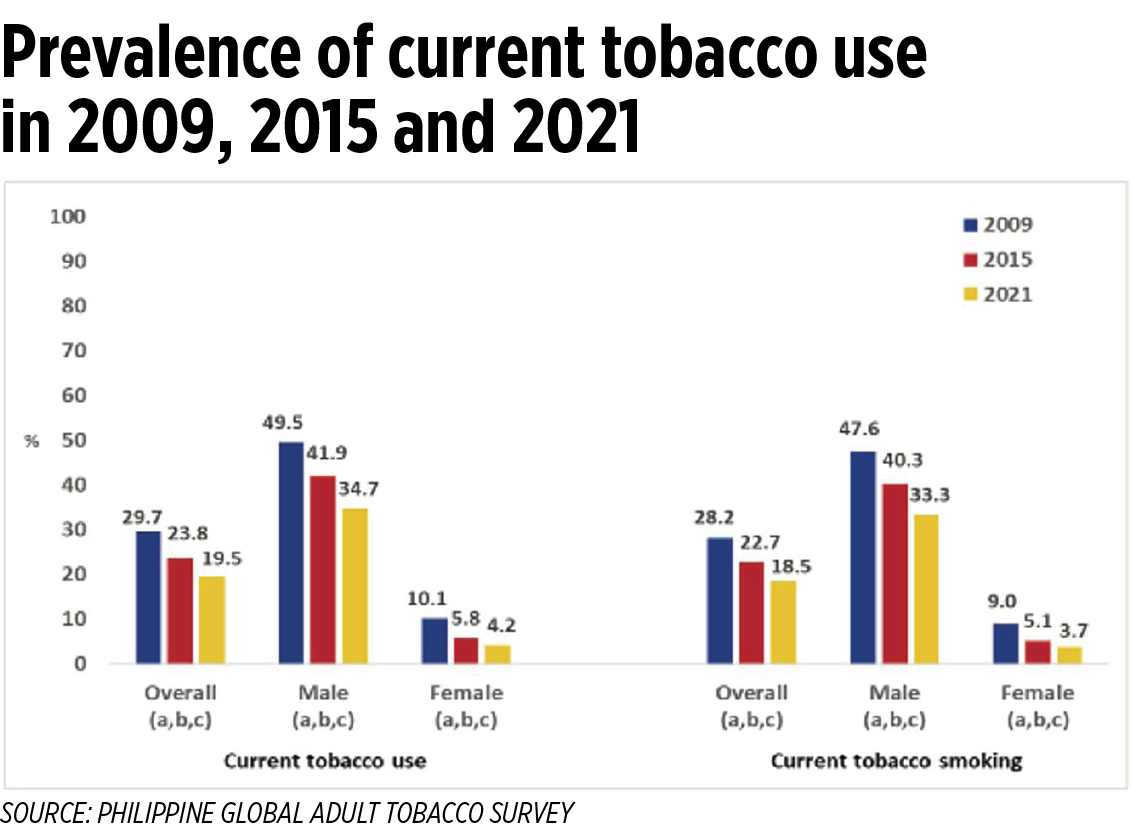
The results showed an astounding drop in smoking prevalence. The number of current tobacco users dropped from 29.7% of the population, or 17.3 million Filipinos in 2009, to 23.8% or 16.6 million Filipinos in 2015, and finally to 19.5% or 15.1 million Filipinos in 2021. In the last six years, 2.2 million Filipinos’ lives have been saved from the harmful health hazards brought about by smoking.

What explains this reduction in smoking prevalence? In the past decade, despite the deep pockets and vast network of what is dubbed the “strongest tobacco lobby in Asia,” the Philippine government has successfully adopted game-changing tobacco control policies and initiatives, which positioned the Philippines as a forerunner on the global tobacco control stage.

The most decisive factor that contributed to the reduction of smoking prevalence is the series of sin tax reform laws adopted between 2012 and 2020. The increasing tax rates during the last 10 years have made tobacco products less affordable. The WHO has described increasing tobacco tax and prices as “the least used, but most effective, tobacco control measures to help countries address development.”

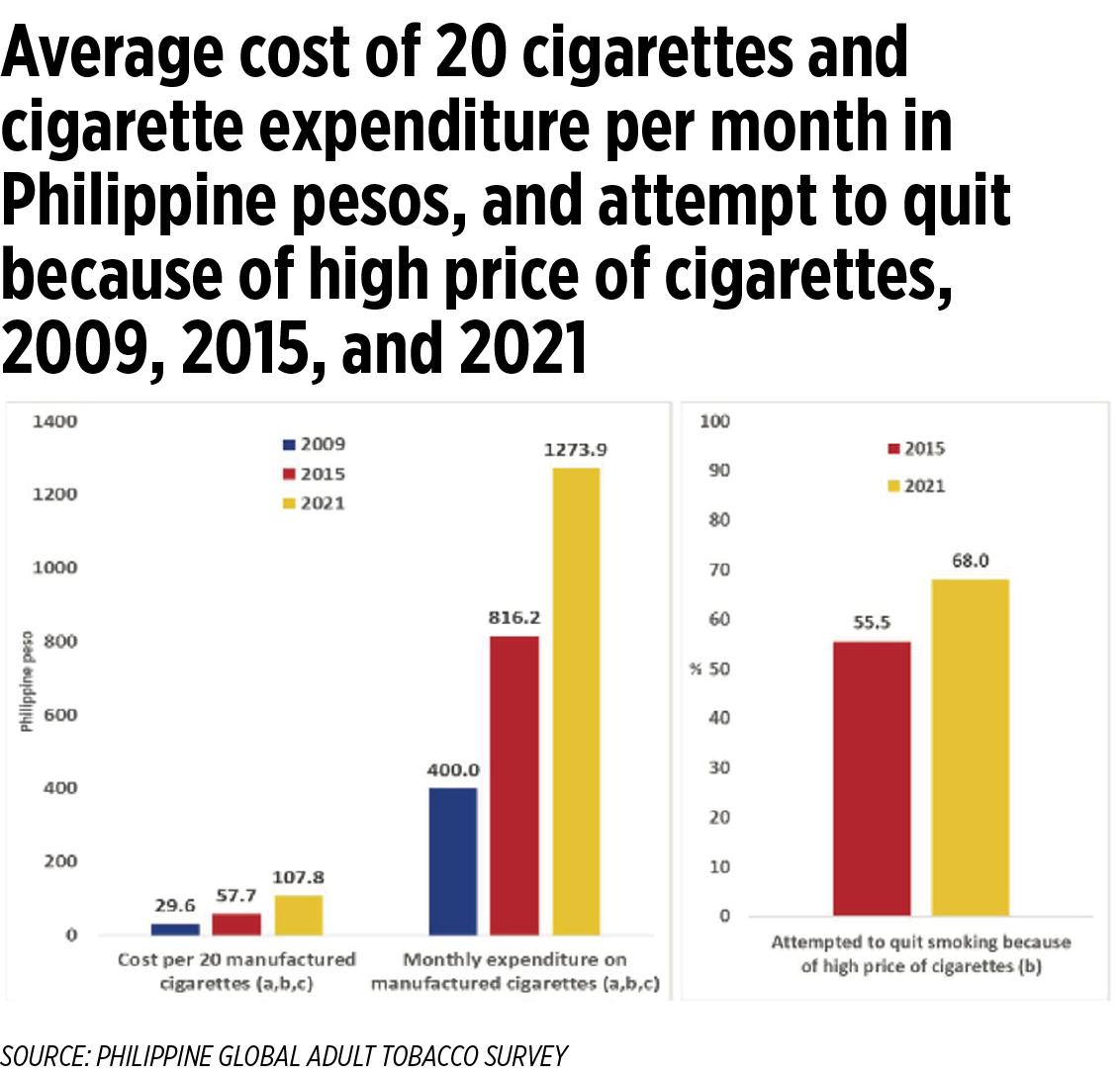
The Philippine GATS 2021 showed that higher prices (which were brought about by higher taxes) led smokers to quitting: the percentage of current smokers who attempted to quit in the past 12 months because of high cigarette prices rose to 68% in 2021 from 55.5% in 2015. Thanks to the sin tax reforms, the average monthly expenditure for cigarettes among cigarette smokers (in pesos) almost doubled, from P678.4 in 2015, to P1,273.90 in 2021. The average cost of a pack of 20 manufactured cigarettes increased from P57.70 in 2015 to P107.80 in 2021.

According to the Southeast Asian Tobacco Control Alliance (SEATCA)’s 2021 Tobacco Tax Index1, the Philippines has the second-highest tax burden as a percentage of retail price (71.32%) in the ASEAN region, next to Thailand (78.60%).

The release of the 2021 GATS happens to coincide with the 10th anniversary of the ceremonial signing of the Sin Tax Reform Law (Republic Act 10351) of 2012. This transformative law reformed the old tobacco tax regime. The old tobacco tax regime led to inefficiency and gaming, and Philippine cigarette prices were among the lowest in Asia.

Prior to Republic Act (RA) 10351, the excise tax rates on cigarettes were fixed at old rates based on 1996 prices for legacy brands, stifling competition. RA 10351 shifted the complicated, multi-tiered system to a unitary tax for all brands of tobacco products, regardless of net retail price, to simplify tax administration and to discourage price-sensitive smokers from switching to a cheaper brand. It also imposed a significant increase on excise tax rates for tobacco products, earmarked incremental revenues for health programs including universal health care, and earmarked revenues to support the livelihood of tobacco farmers.

The Sin Tax Reform Law was not just a one-off; its success paved the way for another wave of successful tobacco tax policies passed in 2017, 2019, and 2020. Since 2012, sin taxes have raised funds for our health budget and facilitated the enrollment of indigent Filipinos in our National Health Insurance Program. On average, about half of the total Department of Health budget in the past years was sourced from the incremental excise tax revenues on sin products. Earmarked revenues from sin taxes made up 54% of the 2020 budget for DoH-Office of the Secretary/PhilHealth.

While the sin tax law has succeeded in hitting its revenue and health objectives, as long as Filipinos are smoking, the fight for higher prices of tobacco products continues. In accordance with RA11346, excise tax rates have reached P60 this year. In 2024, however, the only increase will be the automatic 5% adjustment to inflation. Given the current high inflation (5.8% in 2022), the rates must be hiked further to prevent the value of the tax rate being eroded.

Further, we face a large fiscal deficit, as the increase in spending and borrowing during the pandemic have narrowed our fiscal space. A downgrade in our credit rating could happen unless we find sustainable and substantial sources of government revenue.

Our health system also hangs in the balance, as we have yet to implement Universal Health Care across the country, with a funding gap of at least P163 billion, according to the DoH’s Medium Term Expenditure Program (MTEP).

Policies like excise taxes could possibly curb the rising trend in the use of e-cigarettes and heated tobacco products (HTPs) among the youth. GATS 2021 showed that the highest e-cigarette use is among those in the 15- to 24-year-old age bracket.

Our call is for the Executive to adopt sin taxes as a legislative priority, as it is incumbent on them to protect the health of our people, especially young Filipinos, from harmful products such as tobacco. We laud Representative Joey Salceda for filing House Bill 5532, which raises taxes on e-cigarettes and HTPs and introduces new taxes on vaping devices. We call on our leaders in Congress to support this measure.

The proof of the effectiveness of sin taxes is here for us to witness. The data for smoking prevalence, revenues, and health budget among other things, show that sin taxes are efficient and cost-effective, deter smoking, save lives, and relieve our health system of the burden of tobacco-related diseases.

Thus, we have every reason to celebrate the 10 years of the Sin Tax Law. We thank all the stakeholders, and we specially mention the Department of Finance and the Department of Health, and the Representatives and Senators who sponsored the different RAs to make the successive increases in sin taxes serve society’s health and economy.


Pia Rodrigo leads the health policy team of Action for Economic Reforms.