
How PSEi member stocks performed — February 10, 2023
Here’s a quick glance at how PSEi stocks fared on Friday, February 10, 2023.
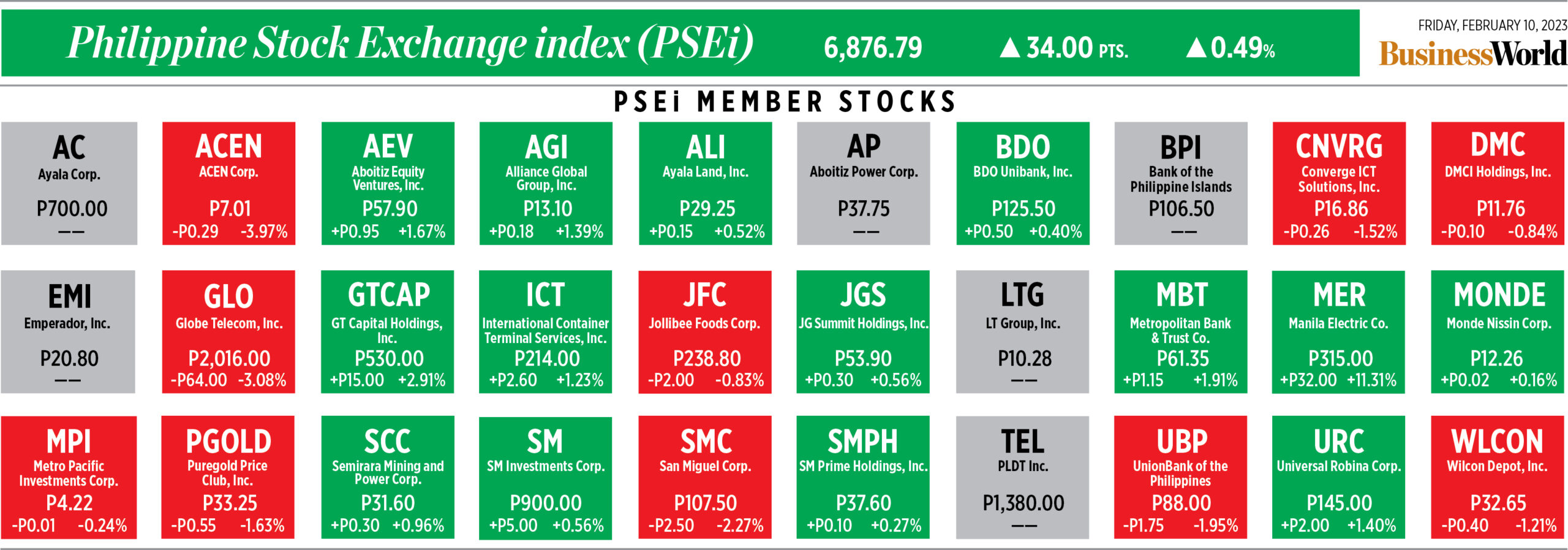

Here’s a quick glance at how PSEi stocks fared on Friday, February 10, 2023.

THE PESO may weaken against the dollar this week as the market expects a big rate hike from the Bangko Sentral ng Pilipinas (BSP) after headline inflation surged in January.
The local unit closed at P54.42 per dollar on Friday, strengthening by three centavos from its P54.45 finish on Thursday, data from the Bankers Association of the Philippines’ website showed.
Week on week, however, the peso dropped by 74 centavos from its P53.68 finish on Feb. 3.
The peso opened Friday’s session at P54.65 per dollar. Its weakest showing was at P54.70, while its intraday best was at P54.40 against the greenback.
Dollars exchanged went down to $1.248 billion on Friday from $1.375 billion on Thursday.
The peso strengthened on Friday “after a gauge of the US dollar versus major global currencies again corrected slightly lower from near one-month highs recently,” Rizal Commercial Banking Corp. Chief Economist Michael L. Ricafort said in a Viber message.
The dollar index was up 0.4% at 103.55 on Friday as investors await the US consumer price index (CPI) report to be released on Feb. 14.
For this week, Mr. Ricafort said peso-dollar trading could be driven by sentiment ahead of the BSP’s policy meeting on Feb. 16, Thursday.
He said he expects a 25-basis-point (bp) increase in borrowing costs at the meeting to match the US Federal Reserve’s move.
Meanwhile, UnionBank of the Philippines, Inc. Chief Economist Ruben Carlo O. Asuncion said in a report that the “disappointing” January inflation report has fueled bets that the BSP will hike rates by as much as 50 bps on Thursday.
“A BSP more hawkish than the (US Federal Reserve) in their first policy meetings this year, could spill over into a firmer peso later in the week,” he said.
“The peso will also benefit from flows attracted by the latest retail Treasury bond (RTB) issuance whose settlement starts on Feb. 22,” Mr. Asuncion added.
Headline inflation accelerated to a new 14-year high of 8.7% in January as food prices continued to surge, causing renewed rate hike worries.
This was faster than the 8.1% print in December 2022 and 3% in the same month last year. It also marked the 10th consecutive month that inflation was above the BSP’s 2-4% target for the year.
The BSP’s policy-setting Monetary Board last year raised interest rates by 350 bps, bringing its key rate to a 14-year high of 5.5%.
Meanwhile, the government last week raised an initial P162.18 billion from the rate-setting auction for its offer of 5.5-year RTBs.
Tenders hit P196.109 billion, or more than six times the P30 billion on the auction block. The RTBs were awarded at a coupon rate of 6.125%.
Mr. Ricafort expects the peso to trade between P54.20 and P54.70 per dollar this week, while Mr. Asuncion sees the local unit moving from P54.10 to P55. — A.M.C. Sy

PHILIPPINE STOCKS may move sideways this week on cautious trading as investors await the Bangko Sentral ng Pilipinas’ (BSP) policy decision on Thursday and the release of more firms’ financial reports.
The benchmark Philippine Stock Exchange index (PSEi) went up by 34 points or 0.49% to close at 6,876.79 on Friday, while the broader all shares index added 9.67 points or 0.26% to end at 3,653.17
Week on week, however, the PSEi went down by 150.59 points or 2.14% from 7,027.38 on Feb. 3.
“Bears took the reins amid the higher-than-expected inflation print for the month of January,” online brokerage 2TradeAsia.com said in a market note.
Headline inflation accelerated to a new 14-year high of 8.7% in January, faster than the 8.1% print in December 2022 and 3% in the same month last year.
This was also higher than the 7.5% to 8.3% forecast range given by the central bank for the month, and marked the 10th consecutive month that inflation was above the BSP’s 2-4% target for the year.
For this week, Philstocks Financial, Inc. Senior Research Analyst Japhet Louis O. Tantiangco expects investors to trade cautiously ahead of the central bank’s policy meeting on Feb. 16.
“The possibility of a 50-basis-point (bp) rate hike is expected to be priced in, following the Philippines’ strong January inflation data. This in turn could weigh on the local bourse,” Mr. Tantiangco said.
The central bank could raise benchmark rates by 50 bps at its meeting on Thursday to rein in elevated inflation, analysts said.
A BusinessWorld poll last week showed 17 out of 18 analysts see the Monetary Board hiking borrowing costs at its first meeting of the year. Nine see a 50-bp hike, while eight expect a 25-bp increase.
BSP Governor Felipe M. Medalla earlier said the central bank could hike borrowing costs by 25 or 50 bps at their policy meeting on Feb. 16 as they need to anchor inflation expectations.
“Investors may also look towards our upcoming OFW (overseas Filipino workers) remittances data for clues on the local economy,” Mr. Tantiangco added.
Remittances data are expected to be released by the central bank on Feb. 15, Wednesday.
“Over a few weeks of grappling with macro drivers, particularly following inflation and interest rate movements, markets are looking to find direction from earnings reports for fourth quarter,” 2TradeAsia.com said.
Listed companies are expected to continue releasing their 2022 financial reports in the coming weeks.
Mr. Tantiangco placed the PSEi’s support at 6,800 and immediate resistance at its 20-day exponential moving average, while 2TradeAsia.com put support at 6,700 and resistance at 7,000. — Justine Irish D. Tabile
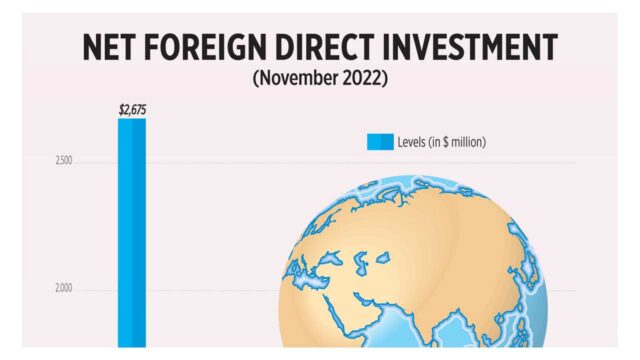
FOREIGN DIRECT investments (FDI) in the Philippines plummeted 43.6% in November to $793 million and 13.4% to $8.43 billion in the 11-month period, suggesting a weaker global economic outlook. Read the full story.

MONEY “mules” generated 732,392 suspicious-transaction reports (STRs) in 2021, up 1,277.09%, the Anti-Money Laundering Council (AMLC) reported.
The AMLC said the STRs spiked with the accelerated adoption of digital banking and electronic wallets.
Suspected money “mule” offenses in 2021 were up 50.50% from a year earlier.
“The sharp increase in the number of submitted STRs in 2021 can be attributed to the emergence and accelerated adoption of digital banking and electronic wallets, which did not only provide alternative payment methods but also made financial transactions easier and safer in the midst and in the wake of the COVID-19 (coronavirus disease 2019) pandemic,” the AMLC said.
“This is consistent with the reported volume of PESONet and InstaPay transactions, which posted 164% and 223% growth, respectively, in the first half of 2021,” it added.
PESONet and InstaPay are automated clearing houses launched in December 2015 under the central bank’s National Retail Payment System.
PESONet caters to high-value transactions and may be considered an electronic alternative to the paper-based check system.
On the other hand, InstaPay is a real-time, low-value electronic fund transfer facility for transactions up to P50,000 and is most useful for remittances and e-commerce.
“The annual values of STRs related to money mules likewise spiked in 2021, reaching P505.99 billion or 99.18% of the total value of the captured STRs,” the AMLC said.
It added that the sudden increase in the value of STRs in 2021 was due to an attempted bank account opening with an initial deposit of $10 billion.
According to the report, most of the STRs were triggered by suspicious circumstances defined by Republic Act (RA) 9160, accounting for 99.77% of the total volume of STRs.
About 45.89% of the STRs were deemed suspicious because there was no underlying legal or trade obligation, purpose, or economic justification.
Suspected money mules utilize three main modes of withdrawing funds: electronic cash cards, automated teller machines, and over the counter transactions.
“Using the available addresses of the reporting branches as proxy for the location of the cash-out facilities used by suspected money mules, it was observed that 54.91% of the withdrawal transactions were performed in Metro Manila. This was followed by Cavite (38.08%), Negros Occidental (2.80%), Laguna (2.10%), Pampanga (1.64%), and Tarlac (0.47%),” according to the report.
“Within Metro Manila, the withdrawal transactions by suspected money mules were done in Makati City (76.60% of total transactions in Metro Manila), Parañaque City (17.45%), City of Manila (2.98%), Quezon City (2.55%), and Pasay City (0.43%).”
“Given the seemingly rampancy of money mules in the country, the report highlights the need to raise awareness among the covered persons so that they may prevent money mules from taking advantage of the existing financial infrastructure,” the AMLC said.
“Likewise, the study finds value in educating the general public about the suspicious activities and notable typologies of money mules, so they may protect themselves from being victimized. Thus, the dissemination of this report to law enforcement agencies, supervising authorities, other government agencies, covered persons with Public-Private Partnership Agreement with the AMLC, other financial intelligence units, and the general public is recommended.”
According to the AMLC, a money mule is someone who, either intentionally or unintentionally, uses his or her bank account to transfer money on behalf of someone else, usually a cybercriminal.
Cybercriminals use these bank accounts for crimes such as money laundering or for transferring stolen money, which are prohibited under Republic Act 9160 or the Anti-Money Laundering Act of 2001. — Keisha B. Ta-asan

THE Independent Electricity Market Operator of the Philippines (IEMOP) said the project linking the power grids of the Visayas and Mindanao is expected to be completed by March.
“During the ceremonial launch of WESM (Wholesale Electricity Spot Market) Mindanao, it was announced that MVIP (Mindanao-Visayas Interconnection Project) will be commissioned by the end of March,” Isidro E. Cacho, Jr., IEMOP’s head of Corporate Strategy and Communications, said in a briefing.
The P52-billion MVIP will connect the Mindanao and Visayas power grids, to ensure the sharing of energy across the network and create a market for surplus power.
Robinson P. Descanzo, IEMOP’s chief operating officer, said that according to the National Grid Corp. of the Philippines the start of testing for the MVIP will begin in March.
“Gradually, while the unit testing is being conducted, the cable will be energized. It will start with a certain megawatt (MW) amount for import and export of power through that interconnection until it reaches the maximum capacity of the cable which is 240-MW,” Mr. Descanzo said.
Mr. Descanzo said that by the second quarter the import and export of power through interconnection may hit 80 MW to 100 MW.
“These are just estimates but again the build-up of export and import of power from Mindanao to the Visayas and vice versa will be gradual,” he said.
In January, the Department of Energy announced the start of the commercial operations of WESM Mindanao, which is expected to help lower the power costs in the region.
Meanwhile, IEMOP said that electricity spot market prices may continue to increase for the rest of February due to an expected lower supply margin.
“For the rest of February, covering the remaining days of the Malampaya shutdown, we are projecting that we will have an average market price of P7.55 per kWh, with the lower overall supply margin equivalent to 3,882 megawatts as compared to January’s 4,979 MW,” Christian Karla A. Rica, IEMOP knowledge management specialist, said in a virtual briefing last week.
The Malampaya gas field is currently shut down for maintenance until Feb. 18.
Malampaya-supplied plants account for up to 27% of the Luzon power grid’s electricity requirements. During its shutdown, the five power plants with a combined capacity of 3,453 MW will need to run on alternative fuel.
As of Feb. 8, electricity spot market prices rose P1.67 to P7.43 per kilowatt-hour (kWh) from their January levels.
Ms. Rica said that in early February, supply levels declined to 13,601 MW from 14,232 MW while demand continued to increase to 9,785 MW from 9,253 MW. — Ashley Erika O. Jose

THE sugar industry has called on the government to admit all interested parties, including sugar producers, industrial users, and accredited traders to the proposed program to import sugar.
In a letter to the Sugar Regulatory Administration (SRA) on Feb. 6, Confederation of Sugar Producers Association, Inc. (Confed) President Aurelio Gerardo J. Valderrama, Jr. asked the government to operate the import program in an “open, transparent, and equitable manner.”
“We also urged SRA to adopt import guidelines which are transparent and allow the participation not only of industrial users but also of sugar producers and other interested accredited sugar traders,” Mr. Valderrama told BusinessWorld in an e-mail on Friday.
According to Mr. Valderrama, the SRA has yet to respond.
Sugar federations and associations initially sent letters last month with a similar position and proposed a 50:50 split between industrial users and sugar producers.
Confed reiterated its recommendation to cut the amount of proposed imports to 350,000 metric tons (MT) from 450,000 MT, of which 300,000 MT will consist of refined sugar and 50,000 MT raw sugar.
These should arrive no earlier than July in order not to distort mill gate prices, the sugar group said.
“In our Jan. 27 letter, we leave it to SRA’s prudent judgment, based on actual market requirements, what volume of the 350,000 MT will be refined sugar and what volume will be raw sugar,” he said.
Confed further recommends that all applications be submitted and opened after five days upon the effectivity of the appropriate Sugar Order, to ensure transparency.
National Federation of Sugarcane Planters and Panay Federation of Sugarcane Farmers also sent a joint letter to the SRA with similar recommendations.
“Producers should be granted import rights, so that we can also benefit from the program and somehow make up for the high cost of production in the past years,” according to the letter.
Citing an SRA report and the pre-final crop estimate as of Dec. 11, 2022, Mr. Valderrama said that the remaining sugarcane to be harvested after Jan. 22 is around 9.42 million MT, with an estimated yield of 846,168 MT.
According to the SRA, the reserved stocks of imported sugar will begin to be released as required by the market.
“We are waiting for SRA’s final production figures so that we can also check for ourselves what the actual shortage is,” he said.
“The actual shortage should serve as the sole basis for determining the volume of the imports (initially classified as “C” or reserve sugar) which should be converted into “B” sugar and released to the domestic market,” he added. — Sheldeen Joy Talavera
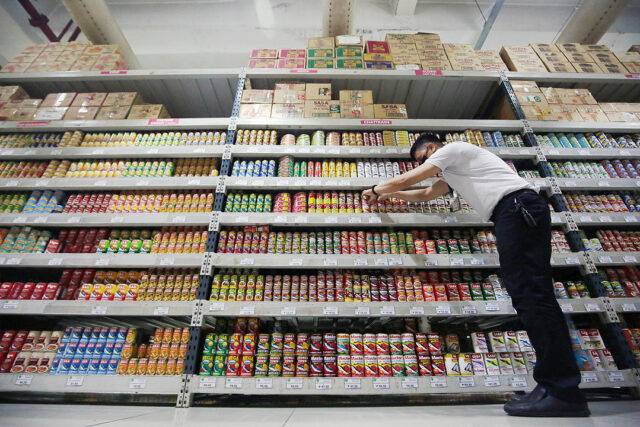
THE American Chamber of Commerce of the Philippines (AmCham) said it is counting on the Department of Trade and Industry (DTI) to more regularly publish its updated suggested retail price (SRP) bulletins, following the latest edition issued on Feb. 8.
“We have a good working relationship with them (the DTI), so I am certain they will be more regular in issuing the SRP. Maybe not on the exact frequency but certainly more regular,” AmCham Executive Director Ebb Hinchliffe told BusinessWorld via Viber.
In January, AmCham urged the DTI to publish SRP bulletins for basic necessities and prime commodities (BNPCs) on a regular basis, saying that it would help the business chamber’s member companies plan their operations and finances.
“This will ultimately help businesses stay afloat and continue to provide jobs and quality products,” the group said.
Mr. Hinchliffe said that the DTI’s new SRP bulletin will likely have an impact on inflation.
“I am glad to see the DTI releasing a new bulletin. With (the) January 8.7% inflation rate, most of the (price) increases (in SRP bulletin) can be justified. However, it may fuel inflation even further,” Mr. Hinchliffe said.
“Employees will expect high wages to offset the higher cost but higher wages without increases in production are inflationary. (It’s a) vicious cycle,” he added.
The Philippine Statistics Authority reported on Feb. 7 that headline inflation rose to 8.7% in January against year-earlier level of 3%, on the back of higher prices of rent, electricity, water, vegetables, milk, eggs, fruit, and nuts.
On Feb. 8, the DTI’s new SRP bulletin authorized price hikes of between 45 centavos and P7 for 76 stock keeping units (SKUs), while holding steady the recommended prices for 141 SKUs. The last SRP bulletin was issued in August.
The SKUs allowed to raise prices increases include canned sardines in tomato sauce, processed milk, coffee 3-in-1 original, noodles, bread, detergent soap, canned meat, candles, and condiments.
According to Trade Undersecretary Ruth B. Castelo, price increases in the new SRP bulletin were justified by external factors such as the high cost of raw materials, packaging materials, logistics, and transportation.
“The DTI assures the public that price adjustments were carefully studied and kept to a minimum to ensure that affordable goods are still available in the market. Further, we also regularly monitor the price movements of raw materials of these BNPCs, and continuously monitor retailers to ensure that the prices of BNPCs are reasonable,” Ms. Castelo said. — Revin Mikhael D. Ochave

By Beatriz Marie D. Cruz
MICRO, small, and medium enterprises (MSMEs) can survive within an “ecosystem” making them part of a broader supply chain as larger companies take in more foreign direct investment (FDI), economists said.
“The big fish can thrive with the small fish in a healthy ecosystem where they can exist symbiotically,” Ser Percival K. Peña-Reyes, director of the Ateneo Center for Economic Research and Development, said in a Viber message.
Mr. Peña-Reyes was referring to Marikina Rep. Stella Luz A. Quimbo’s contention that more FDI could point to a market opportunity for MSMEs.
“That is the aspiration… MSMEs will eventually find a particular market niche, in which they can become competitive in an ecosystem that will be created by your foreign firms,” Ms. Quimbo told legislators, academics, and the private sector during a public consultation to amend the Constitution in Cagayan De Oro City on Friday.
Ms. Quimbo said, for instance, that makers of household goods could supply multinational home furnishing retailers.
“If you are, for example, a basket maker in Bicol, now that IKEA is here, you can actually supply baskets to IKEA,” she added.
Rogelio Alicor L. Panao, an associate professor of political science at the University of the Philippines, said that amending the Constitution is not a prerequisite to ensure MSMEs can be part of the supply chain.
“It is not about a flawed charter,” he said via Messenger. “Issues with our present Constitution are miniscule compared to the lack of a national economic vision.”
Marinduque Rep. Lord Allan Jay Q. Velasco and Parañaque Rep. Gus S. Tambunting both filed a Resolution of Both Houses to include the phrase “unless otherwise provided by law” in several economic provisions of the Constitution, with the intent of creating a “suitable business environment to secure foreign investment and foster economic cooperation among contracting nations,” according to Mr. Tambunting’s resolution.
Mr. Panao said that lawmakers should craft separate policies ensuring that MSMEs are self-sufficient; otherwise, they will be overshadowed by foreign businesses.
“Without mechanisms that will ensure the growth and survival of MSMEs with the onslaught of foreign investment, it would be difficult for us to take advantage of foreign investment spillovers,” Mr. Panao said.
“Small firms will need access to inputs, technology, credit, and markets in order to survive and thrive,” Mr. Peña-Reyes added.
According to Mr. Panao, legislators need to be more creative in drafting policy to support MSMEs. These could include direct financial assistance, microinsurance, and “developing a supportive regulatory environment” through faster government transactions like paying taxes and obtaining business licenses.
Mr. Panao also called for the strengthening of domestic demand by enhancing productivity. He cited the central bank’s business expectations survey report for the fourth quarter of 2022, which found a “less optimistic” business outlook due to concerns about demand and sales, high inflation and interest rates, and a weak peso.
“This implies the need to improve product offerings and local productivity… we cannot even bring our farmers’ produce to market and lack a mechanism to check unscrupulous middlemen,” he said.
Mr. Panao added that more support is needed to improve entrepreneurial skills and social protections, especially for informal economy workers.
Some 99.58% of Philippines’ business establishments are MSMEs, in industries like wholesale and retail trade, motor vehicle repair, accommodation and food services, and manufacturing, according to a 2021 report by the Department of Trade and Industry.

SEVEN FARMER-beneficiaries from Region I received a combined P46,400 worth of insurance payouts through their LANDBANK (Land Bank of the Philippines) prepaid cards.
LANDBANK said in a statement on Sunday that the disbursements represent payouts from the Philippine Crop Insurance Corp. (PCIC), following calamities that affected farmers’ crops.
The bank added that it employed digital solutions in disbursing the claims.
“Through our partnership with PCIC, we aim to enhance the delivery of insurance claims and make our banking services more accessible to farmers. This forms part of LANDBANK’s digital thrust of promoting financial inclusion to make banking more convenient for every Filipino,” LANDBANK President and Chief Executive Officer Cecilia C. Borromeo said.
LANDBANK Senior Vice-President Ma. Belma T. Turla and PCIC Acting Senior Vice-President Segundo H. Guerrero, Jr. led the fund distribution activity with PCIC Regional Manager Raul A. Servito and LANDBANK Urdaneta, Pangasinan Branch Head Marlene M. Mendoza at the LANDBANK Pangasinan Corporate Center.
The PCIC on Jan. 27 asked LANDBANK to produce 52,236 prepaid cards for its farmer-beneficiaries, 34,847 of which have since been released to the PCIC, according to the statement.
LANDBANK said the PCIC will oversee card distribution, allowing farmers to receive their payouts in succeeding disbursements.
The bank added that it is also ramping up card production for 17,389 more farmer-beneficiaries endorsed by the PCIC.
LANDBANK said that it aims to provide prepaid cards and facilitate the crediting of insurance proceeds to around 1.8 million PCIC beneficiaries, in line with a Memorandum of Agreement signed in April.
Farmers can withdraw cash from 2,997 LANDBANK ATMs.
LANDBANK added that the prepaid cards can also be used to make cashless purchases via point-of-sale terminals in participating stores and transact with the bank’s 1,056 agent banking partners nationwide. — Aaron Michael C. Sy
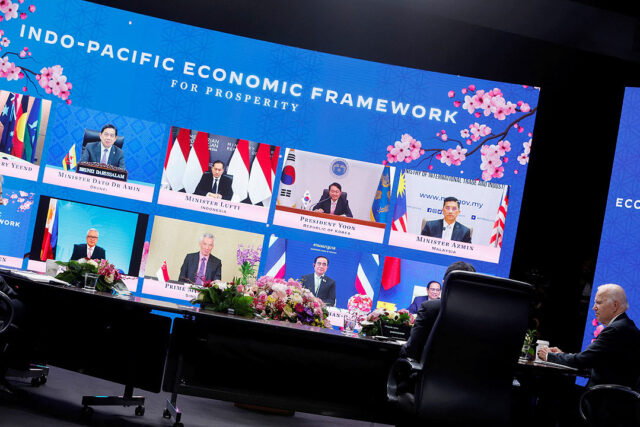
THE Indo-Pacific Economic Framework for Prosperity (IPEF) is expected to boost US investments in the Philippine semiconductor and electronics industries, according to the Semiconductor and Electronics Industries in the Philippines Foundation, Inc. (SEIPI).
“The IPEF will allow for the expansion and diversification of US foreign direct investment (FDI) in the Association of Southeast Asian Nations (ASEAN) region. We need a lot of that especially in the semiconductor and electronics space,” SEIPI President Danilo C. Lachica said in a forum organized by the American Chamber of Commerce of the Philippines in Makati City on Feb. 9.
He added that the IPEF will help build resilient supply chains through the creation of an intergovernmental crisis response mechanism, improve labor standards, and promote climate resiliency and the use of renewable energy.
The IPEF, launched by US President Joseph R. Biden, Jr. in May, aims to increase the economic engagement of the US in the Indo-Pacific region.
Parties to the IPEF include Australia, Brunei, Fiji, India, Indonesia, Japan, South Korea, Malaysia, New Zealand, the Philippines, Singapore, Thailand, the US, and Vietnam.
According to Mr. Lachica, called for a review of the incentives system as defined by Republic Act No. 11534 or the Corporate Recovery and Tax Incentives for Enterprises (CREATE) Act.
“This CREATE incentives rationalization is a big threat to the industry after the transition period. Without new products, you’re going to be stuck with legacy parts and after the nine years and when these parts become obsolete, guess what’s going to happen to the industry and the current employment we’re generating? It’s not going to be the same,” Mr. Lachica said.
“Hopefully, this new administration will review the incentives rationalization and correct this problem,” he added.
Supply Chain Management Association of the Philippines Executive Director Corazon Curay said the IPEF gives the Philippines wider access to global markets and ensures a resilient supply chain.
“The IPEF… also allows us to pursue goals of fully digitalized businesses, environmentally sustainable value chains, and resilient logistics networks expanding with our trading partners in Asia-Pacific and around the world,” Ms. Curay said.
“This provides Philippine enterprises with a running start as they pursue expansion plans, allowing them to provide more value to their customers, partners, shareholders and stakeholders and the wider economy,” she added.
SEIPI listed the top three destinations of Philippine electronics exports among IPEF member countries in 2022 as the US with $6.52 billion, Singapore $4.19 billion, and Japan $3.63 billion.
The top three products exported by the Philippines to IPEF member countries in 2022 were semiconductor components and devices at $14.08 billion, electronic data processing products $3.63 billion, and telecommunications products $780.37 million.
SEIPI has set a target of 9% growth for electronics exports this year, against the 10% growth target in 2022.
The Philippine Statistics Authority estimates that electronic product exports rose 7.2% to $45.58 billion in 2022. — Revin Mikhael D. Ochave

(Second of two parts)
The circular economy concept has been given more and more attention through the years and has now materialized in the Philippines through the Extended Producer Responsibility (EPR) Act of 2022 and its Implementing Rules and Regulations (IRR). In fact, the Philippines is one of the few countries around the globe with active regulations or national programs on the circular economy, counting itself among Scotland, Canada, South Africa, China, Japan, Singapore, and the European Union.
Because of the huge potential of the Act to accelerate the transition of the Philippines to a more circular economy, all companies, not just obliged enterprises, can play a critical role in this ambition.
In the first part of this article, we discussed six recovery programs, six reduction strategies and additional steps that obliged enterprises can undertake as part of their EPR programs. In this second part, we discuss EPR registration, EPR implementation, and keeping confidence through third-party assurance.
FROM EPR REGISTRATION TO EPR IMPLEMENTATION
The EPR registration with the National Ecology Center due on Feb. 13 is just the prelude to a long-term transformation process for plastic waste management. Mobilizing large enterprises in an action-oriented approach would lead to greater positive impact, which can also influence the micro, small and medium enterprises (MSMEs). MSMEs may voluntarily comply with the law by introducing small-scale EPR programs, but the real challenge lies in implementation.
Since both reduction and recovery methods are required to fully comply with the law, investment in technology, innovation, facilities and product development are needed. Partnerships with local governments and the informal waste sector are also highly encouraged to ensure the engagement of key stakeholders in EPR programs. Because the EPR requirements set forth in the law may be demanding for some, authorizing a Producer Responsibility Organization (PRO) can serve as a viable additional platform for EPR program implementation.
Obliged enterprises are required to have a system in place to account for their plastic footprint and engage an independent third-party auditor to certify the veracity of their reported plastic footprint, recovery and EPR program compliance using uniform standards established under the law. In this case, it would be advantageous to set up an internal auditing system as early as now to avoid delays and setbacks in the future. This will also allow obliged enterprises to thoroughly review the strategies and schemes that best suit their company.
KEEPING CONFIDENCE THROUGH THIRD-PARTY ASSURANCE
The initial waste footprint to be submitted in time for the EPR registration can be self-declared by the obliged enterprises. However, after the first-year implementation of their EPR programs, obliged enterprises would need to report their compliance and recovery targets achievement, assured by third-party audit.
While the submission of an EPR Law Compliance Audit Report (ECAR) is required for the government to monitor and evaluate the compliance of the obliged enterprises with their respective EPR programs, having third-party assurance provides transparency and confidence to businesses and their stakeholders that their efforts are contributing to a greater purpose.
The first ECAR submission is still in July 2024 covering the EPR programs implemented in 2023, and the following should be covered in the report:
• Footprint declaration for the volume of the obliged enterprise’s plastic packaging brought into the market during the period covered;
• Recovery or plastic packaging waste diversion based on third-party audited diversion or credits;
• Determination of the equivalent plastic packaging waste footprint reduction resulting from other EPR programs;
• Confirmation of confidential information declared by the obliged enterprise.
ADVANCING CIRCULARITY IN BUSINESSES
Embedding circular economy strategies in a company’s overall strategy and shifting to a circular model from a linear model can benefit the entire company and positively impact its operations, growth, and legal compliance. A circular economy is a type of economic structure that aims to reduce waste and unending resource usage. It represents a fundamental change in how stakeholders manage the use of goods and resources at their core. The goal is to maintain resources and their value in the loop rather than the present take-make-waste cycle, and to reimagine future business models suitable to creating a more sustainable society.
In advancing circularity, companies can reassess their product designs and material options, and target to reduce waste generation in their whole operations cycle. Businesses that utilize durable, renewable, and recyclable materials can lessen its reliance on scarce and expensive resources as well as reduce their susceptibility to supply chain disruptions. Companies can also employ more sustainable procurement.
Essentially, deciding to go with the more sustainable choice in applicable aspects of operations can make a huge impact and take the company a step closer to circularity. Additionally, shifting to a circular economy creates new jobs and revenue sources within the process of looping materials back into the system, including sorting, collecting, refurbishing, and remanufacturing, which is uncommon in the linear economy and opens businesses to new ways to drive growth.
BEYOND COMPLIANCE: TAKING STEPS TOWARDS A CIRCULAR ECONOMY
Taking into consideration the target timeline in the EPR, companies should now be ready for their plans and strategies on the implementation of their EPR programs for 2023. The first submission of the ECAR will cover the 2023 EPR programs. Obliged enterprises or PROs are required to establish and implement accounting, data recording, and auditing systems for their respective EPR Programs.
The implementation of effective EPR programs goes beyond compliance — it also benefits companies through cost and tax reduction, energy savings, and favorable investor and consumer perception of their brands.
The EPR Act of 2022 is an opportunity for businesses to contribute to tackling the growing volume of plastic waste in the country, preventing the loss of valuable resources and reducing environmental degradation. Since the IRR has been published, businesses must now step up and act to monitor and evaluate their plastic waste generation. By beginning to build partnerships and strategies for EPR program implementation, they can take a significant step towards a circular economy.
This article is for general information only and is not a substitute for professional advice where the facts and circumstances warrant. The views and opinions expressed above are those of the authors and do not necessarily represent the views of SGV & Co.
Benjamin N. Villacorte is a partner and Erica Nicole D. Gomez is a senior associate from the Climate Change and Sustainability Services team of SGV & Co.
