Home Blog Page 5301

National Developers Convention 2022 to address solutions for the housing industry in support of Marcos admin’s key economic agenda

DHSUD Secretary Acuzar and NEDA Chief Balisacan lead the roster of speakers

The Subdivision and Housing Developers Association, Inc. (SHDA), in partnership with the Department of Human Settlements and Urban Development (DHSUD), will bring together developers, policymakers, suppliers, and other housing industry stakeholders to discuss macro trends, current issues and solutions in the industry at the National Developers Convention 2022 on Oct. 5 to 6 to be held at the Grand Hyatt Manila, Bonifacio Global City, Taguig City.

With the theme “Change-proofing the Industry: Building Homes for Filipinos, Today and Tomorrow,” the National Developers Convention 2022 aims to tackle the new administration’s priorities for the housing industry as well as the importance of digitalization to resolve the emerging challenges brought by the pandemic and global economic crisis.

“We proudly organize the biggest event for the housing industry, which brings together housing developers, policymakers, and other housing stakeholders. The event will provide an avenue for them to meet and discuss future partnerships that can help us build more affordable housing for Filipinos through policy reforms and dialogues,” SHDA President May Rodriguez said.

President Ferdinand Marcos, Jr.’s administration has made the country’s rising housing backlog a priority, and is creating plans involving private developers and financial institutions in a more participative and inclusive approach for faster housing production.

Other top government officials who will grace the two-day event include Housing Secretary Jose Rizalino Acuzar and Socioeconomic Planning Secretary Arsenio M. Balisacan, who will deliver a keynote message and facilitate the Philippine macroeconomic briefing, respectively.

“The housing sector in the country needs aggressive efforts. Therefore, we have to involve every stakeholder that can take part in this advocacy of the new administration — that is to provide shelter to millions of Filipinos,” Secretary Acuzar stressed.

Senate Committee on Urban Planning, Housing and Resettlement Chairman Sen. Joseph Victor Ejercito and House Committee on Housing and Urban Development Chairman Rep. Jose Francisco B. Benitez will also attend to discuss the legislative initiatives on housing and urban development.

Change-proofing the housing industry

The convention is expected to gather around 300 housing sector stakeholders, who will hear from speaker experts on how they can respond together to the disruptive changes in the housing sector.

On the first day of the event, speakers will spotlight on the most talked-about topics, including urban planning and development initiatives, legislative initiatives on housing and urban development, sustainable financing for housing, and success stories of the private sector in housing and urban development programs.

Some notable speakers on the first day are Chairman and Co-Founder of 8990 Holding, Inc. Mariano Martinez, Pag-IBIG CEO Acmad Rizaldi Moti, President and CEO of BDO Unibank Nestor Tan, Chairman of I-Remit, Inc. Bansan Choa, President of Damosa Land Ricardo Lagdameo, President and CEO of Century Properties Group Jose Marco Antonio, and PRO-Friends Co-Founder Guillermo Choa.

The second day of the convention will highlight regional development and local government units’ processes, innovation for housing through technology, incentives and smart subdivisions, public utilities in housing development, and public housing and subsidies.

Bacolod City Mayor and Chairman of League of Cities of the Philippines Alfredo-Benitez, President and CEO of Meralco Ray Espinosa, Vice-President of PrimeWater Infrastructure Corp. Romeo Sabater, General Manager of National Housing Authority Joeben Tai, and President and CEO of PhilGuarantee Alberto Pascual are some of the speakers on the last day.

Last year’s National Developers Convention was held virtually from Oct. 28 to Nov. 5 and recorded 7,000 participants. With the theme “Beyond the Pandemic: The Future of Housing — Redesigning the Housing Industry through Innovation and Green Initiatives,” the 7-day event yielded the concept of the Smart Subdivision, which is now a new category in the Board of Investment’s Special Investment Priorities Plan.


Spotlight is BusinessWorld’s sponsored section that allows advertisers to amplify their brand and connect with BusinessWorld’s audience by enabling them to publish their stories directly on the BusinessWorld Web site. For more information, send an email to online@bworldonline.com.

Join us on Viber to get more updates from BusinessWorld: https://bit.ly/3hv6bLA.

IMF criticizes UK policy, Bank of England to make big response

CHRISTOPHER BILL/UNSPLASH

LONDON — The International Monetary Fund (IMF) openly criticized Britain’s new economic strategy on Tuesday, following another slide in bond markets that forced the Bank of England (BoE) to promise a “significant” response to stabilize the economy.

Pressure piled on new finance minister Kwasi Kwarteng to reassess his policy, which unleashed turmoil in financial markets, as leading economists, investors and executives said that rock-bottom investor confidence would recover only if the plan was scrapped.

New British Prime Minister Liz Truss of the Conservative Party came into office on Sept. 6 saying she wanted to snap the economy out of years of stagnant growth with deep tax cuts and deregulation.

Mr. Kwarteng’s plan, designed to support households and businesses with energy bills while doubling the long-run rate of economic growth. It requires an additional 72 billion pounds ($77.17 billion) in government debt issuance in this fiscal year alone, shocking investors, sending the costs of such borrowing even higher.

The IMF said the proposals, which sent the pound to touch an all-time low of $1.0327 on Monday, would likely increase inequality and it questioned the wisdom of such policies.

“Given elevated inflation pressures in many countries, including the UK, we do not recommend large and untargeted fiscal packages at this juncture, as it is important that fiscal policy does not work at cross purposes to monetary policy,” an IMF spokesperson said.

“We are closely monitoring recent economic developments in the UK and are engaged with the authorities,” the spokesperson said.

The IMF holds symbolic importance in British politics: its bailout of Britain in 1976 following a balance-of-payments crisis had long been regarded as a low point of modern British economic history.

BUDGET

The Fund said a budget due from Mr. Kwarteng on Nov. 23 would provide an “early opportunity for the UK government to consider ways to provide support that is more targeted and reevaluate the tax measures, especially those that benefit high-income earners.”

Earlier in the day, BoE Chief Economist Huw Pill said the central bank was likely to deliver a “significant” rate increase when it meets next in November, adding that financial market upheaval would have a big impact on the economy and would be factored into its next forecasts.

British government bonds have sold off at a ferocious pace since the fiscal plans sparked a crisis of confidence in Ms. Truss’s handling of the economy.

“It is hard not to draw the conclusion that this will require a significant monetary policy response,” Mr. Pill told the CEPR Barclays Monetary Policy Forum.

With analysts still speculating about Britain’s future financial direction, and markets volatile, a growing number of mortgage providers, unable to price loans, suspended sales.

REVERSE COURSE?

US economist Larry Summers, a former US Treasury Secretary, said rocketing interest rates on long-dated British debt were a sign that credibility had been lost.

Shai Weiss, head of airline Virgin Atlantic, urged the government to stabilize economic affairs and accept that a move to fund huge tax cuts with vast government borrowing had left Britain in a weaker position.

“All of us in this room should be humble enough to say that if I said something that is not working, maybe I should reverse course, that is not a bad thing to do,” he said at a press conference to announce an alliance with SkyTeam.

Two years before a general election is due, the opposition Labour Party has a 17-point lead over the Conservatives, a level not seen in more than two decades, according to a YouGov opinion poll for The Times newspaper.

The Bank of England and Treasury had released statements on Monday afternoon in the hope of reassuring investors, with the central bank saying it would not hesitate to raise interest rates if needed.

That immediately knocked the pound further, however, as some investors had bet on an emergency rate hike. It recovered slightly on Tuesday and was up 0.4% on the day at $1.0726 at around 2006 GMT.

Mr. Kwarteng met leading bankers, insurers and asset managers on Tuesday and said he was “confident” that his economic strategy would work when combined with supply side reforms.

But many remain unconvinced.

“(There) is still no clear sign that the source of the problem — the government’s fiscal strategy — is being reversed or reconsidered,” J.P. Morgan economist Allan Monks said.

“This will need to happen before November in order to avoid a much worse outcome for the economy.” ($1 = 0.9330 pounds) — Reuters

Angkas: PHL poised to leap forward in tech and startup space in 2022

From L to R: Angkas Chief Marketing Officer Brian Go, IMMAP DigiCon Co-Chair Denise Haak, IMMAP DigiCon Ways & Means Head Janelle Barretto, and IMMAP DigiCon Co-Chair Trish Elamparo-Esteban

IMMAP DigiCon’s co-presenter, Angkas, draws the road map for the tech-enabled industries and players in the coming years

Despite the global pandemic, the Philippines is poised to be one of five ASEAN countries to become tech powerhouses in the next fifteen years, according to the Center for Economics Business Research (CEBR).

Angkas CEO George Royeca

Angkas CEO George Royeca believes the country is ready for a big leap forward in the tech and startup sectors. These industries and their continuous growth in recent years will be the primary focus of this year’s IMMAP DigiCon Valley 2022, which will be co-presented by Angkas, the leading motorcycle taxi and delivery platform.

“While the pandemic has been the worst global crisis of the millennium, it undeniably opened new avenues for rapid growth in the country, particularly in the tech sector. Overnight, e-commerce, online payments, e-wallets, telemedicine, online gig employment, digital banks as well as delivery and logistics services experienced exponential growth which then had to be supported by faster internet speeds,” points out Mr. Royeca.

“The pandemic and the restricted mobility it necessitated primed the market in terms of tech literacy and a willingness to adopt tech-based solutions. There are products and services the market is ready for now that would not have been viable pre-pandemic, and that might have otherwise taken another 5-10 years for the country to be ready for,” adds Mr. Royeca. “We have had, and continue to have an ideal and unprecedented climate for both developing and funding tech startups. The kind of businesses that offer innovative products and services we couldn’t have even imagined pre-pandemic,” he concludes.

The road less trafficked

Angkas was itself an innovation, far more unconventional than it seems on the surface. Motorcycle taxis were already in wide use for public transport all over the region at the time of Angkas’ inception in 2015. Despite the crippling traffic in Metro Manila and its staggering economic cost, motorcycle taxis were not a solution being considered by anyone at the time, because motorcycles had an appalling safety record.

The Metro Manila Accident Recording and Analysis System (MMARAS) Traffic Accident report for 2015 indicated that motorcycle accidents comprised 39.6% of all vehicular accidents and 33.6% of all fatal accidents in Metro Manila. In each case they were by far the single largest contributors. Filipino motorcycle riders were regarded as too undisciplined for such a service to be reasonably safe.

Angkas’ innovation was in actually believing that with training, motivation and support, Filipinos could be the backbone of a safe and professionalized app-enabled motorcycle taxi service. “We shoulder the training of all rider applicants, then we carefully select only the top 30%. We also hold regular company events that serve as refreshers, and venues for more training in soft skills, and even things like anti-sexual harassment education,” explains Mr. Royeca. “The result is that after literally millions of rides booked, our safety record is 99.997%,” he concludes.

Sense of purpose, grit resilience

“I think the number one thing that potential startups should begin with is seeing the bigger picture: are you solving a real problem?” asks Mr. Royeca. “Any business venture is always going to have a money-making aspect, but in this day and age, it is businesses that have an innate sense of purpose and that offer real solutions to real problems that are embraced by the public,” Mr. Royeca points out.

Mr. Royeca had specific advice to would-be startups on failure: “Don’t be afraid of failure or adversity, these build grit. As long as you are imbued with a sense of purpose, you will overcome failure and adversity and come out stronger, and with more grit.”

In Angkas short history, they were ordered to cease operations twice, their rider pool was capped, and just when they seemed in the clear, the pandemic hit. Showing true resilience, it was then that Angkas launched a courier and buying assistant service, allowing more people to do errands and business safely from home. Angkas also formed a partnership with the Red Cross to assist with the delivery, and administration of COVID-19 test kits. When it became reasonably safe to do so, Angkas also offered free rides to medical frontliners.

Co-creation Breeds Innovation

Community building begins when everyone contributes for the welfare of everyone, and that is exactly what resonated with Angkas to sign up and be a co-presenter for this year’s IMMAP DigiCon Valley 2022, one of the most anticipated digital conferences in the industry which gathers professionals from marketing, advertising, and digital sectors to hear and learn from world-renowned and celebrated local keynote speakers.

Internet and Mobile Marketing Association of the Philippines (IMMAP) is an organization that works toward educating and providing the necessary digital tools for advertising and integrated marketing professionals to make better communication decisions. One such effort is the yearly DigiCon.

Mr. Royeca explains, “When you have a business that serves many, it is impossible to innovate without co-creation. Angkas would not have been possible without the coming together of technology innovations, government regulators, customers, and of course our rider partners, to create a “winnovation,” an innovation in which everyone has a stake, and in which everybody wins.”

After two years of purely virtual connections, this year’s IMMAP DigiCon Valley 2022 will finally bring back face-to-face networking through the DigiCon After-Hours, which will be held during the evenings across the city, promising to provide cocktails and entertainment, and allow delegates to physically reconnect with other industry players.

“I think what Angkas is excited about is this live interaction; a lot of the best collaborations and partnerships happen because of these more spontaneous, in-person things, and human interaction is what makes all the creativity and innovation grow more,” muses Mr. Royeca.

As co-presentor for this year’s IMMAP DigiCon Valley 2022, Angkas hopes that this can be a great model to induce new SMEs in the tech and startup sector, while also introducing a community mindset that can hopefully solve daily problems for Filipinos.

DigiCon Valley 2022 is happening on Oct. 10-14 from 9 a.m. to 1 p.m. PST using ViVYD platform, with all new tracks that tackle the different stages of innovation: Launchpad, Hypergrowth, Breakthrough, and Enterprise.

This year’s prestigious keynote speakers include one of the most influential women in the world and Huffington Post founder, Arianna Huffington; Rappler Founder and the first Filipino Nobel Peace Prize laureate, Maria Ressa; internationally acclaimed marketing expert and academic, Mark Ritson; co-founder of Character ventures and Design Sprint inventor, Jake Knapp; and Global CMO of Dole Sunshine Company, Rupen Desai.

Buy tickets now and learn more about IMMAP DigiCon Valley 2022 at www.digicon.com.ph and follow their social pages on Facebook, Twitter, and Instagram.

IMMAP DigiCon Valley 2022 is co-presented by Angkas, and would like to thank Platinum Sponsors: Manulife Philippines, Share Treats, and TikTok; Gold Sponsors: Investing in Women, an initiative of the Australian Government, Grab Ads, Kroma Entertainment, McDonald’s Philippines and Meta Philippines; and Silver Sponsors: Digital Turbine, Hepmil Philippines, and Metrobank.

A special thanks to IMMAP’s event partners: Creators and Influencers of the Philippines (CICP), Endeavor, and Kickstart Ventures.

This event is also brought to you by our media partners: Manila Broadcasting Company (MBC), Rappler, ABS-CBN, CNN Philippines, Manila Bulletin, One Mega Group, Inc., Podcast Network Asia, theAsianparent, BusinessWorld, Inquirer.Net, Kroma Entertainment, and The Philippine STAR.

Be an IMMAP Member today! To know more about IMMAP, please visit: www.immap.com.ph or contact us at connect@immap.com.ph, SMS/Viber: 0917-631-0206 / 0918-577-2357.


Spotlight is BusinessWorld’s sponsored section that allows advertisers to amplify their brand and connect with BusinessWorld’s audience by enabling them to publish their stories directly on the BusinessWorld Web site. For more information, send an email to online@bworldonline.com.

Join us on Viber to get more updates from BusinessWorld: https://bit.ly/3hv6bLA.

 

Europe investigates ‘attacks’ on Russian gas pipelines to Europe

Image via Danish Defence/forsvaret.dk

STOCKHOLM/COPENHAGEN — Europe was investigating on Tuesday what Germany, Denmark, and Sweden said were attacks which had caused major leaks into the Baltic Sea from two Russian gas pipelines at the center of an energy standoff.

But it remained far from clear who might be behind the leaks that were first reported on Monday or any foul play, if proven, on the Nord Stream pipelines that Russia and European partners spent billions of dollars building.

German Economy Minister Robert Habeck told business leaders the leaks were due to targeted attacks on the infrastructure and Berlin now knew for sure “that they were not caused by natural occurrences or events or material fatigue.”

Sweden’s and Denmark’s prime ministers said the leaks were clearly caused by deliberate actions, with information suggesting likely sabotage, while Poland’s premier blamed sabotage, without citing evidence.

Russia, which slashed gas deliveries to Europe after the West imposed sanctions over Moscow’s invasion of Ukraine, also said sabotage was a possibility and that the leaks undermined the continent’s energy security.

A senior Ukrainian official called the incident a Russian attack to destabilize Europe, without giving proof.

“We see clearly that it’s an act of sabotage, related to the next step of escalation of the situation in Ukraine,” Polish Prime Minister Mateusz Morawiecki said at the opening of a new pipeline between Norway and Poland.

Sweden’s Prime Minister Magdalena Andersson told a news conference that two blasts had been detected in relation to the leaks and though this did not represent an attack on Sweden, her government was in close contact with partners such as NATO (North Atlantic Treaty Organization) and neighbors such as Denmark and Germany concerning the developments.

Seismologists in Denmark and Sweden said they had registered two powerful blasts on Monday in the vicinity of the leaks.

“The signals do not resemble signals from earthquakes. They do resemble the signals typically recorded from blasts,” the Geological Survey of Denmark and Greenland (GEUS) said.

And seismologists at Sweden’s Uppsala University, which cooperates with GEUS, said the second, bigger explosion “corresponded to more than 100 kilos (kg) of dynamite,” adding the blasts were in the water not under the seabed.

The Nord Stream pipelines have been flashpoints in an escalating energy war between capitals in Europe and Moscow that has damaged major Western economies, sent gas prices soaring and sparked a hunt for alternative supplies.

“Germany is a country that knows how to defend itself. And Europe is a continent that can protect its energy infrastructure,” Germany’s Mr. Habeck said, adding the energy supply of Europe’s largest economy was not affected.

Denmark’s armed forces said the largest gas leak had caused a surface disturbance of well over 1 km (0.6 mile) in diameter.

‘RISK OF EXPLOSIONS’

The leaks were very large and it could take perhaps a week for gas to stop draining out of the Nord Stream 2 pipeline, the head of Denmark’s Energy Agency Kristoffer Bottzauw said.

Ships could lose buoyancy if they entered the area.

“The sea surface is full of methane, which means there is an increased risk of explosions in the area,” Mr. Bottzauw said.

The Swedish Maritime Administration (SMA) said two leaks on Nord Stream 1, one in the Swedish economic zone and another in the Danish zone, were northeast of Denmark’s Bornholm.

“We are keeping extra watch to make sure no ship comes too close to the site,” an SMA spokesperson said.

Kremlin spokesperson Dmitry Peskov called it “very concerning news. Indeed, we are talking about some damage of an unclear nature to the pipeline in Denmark’s economic zone.” He said it affected the continent’s energy security.

Neither pipeline was pumping gas to Europe at the time the leaks were found, but the incidents will scupper any remaining expectations that Europe could receive fuel via Nord Stream 1 before winter.

Operator Nord Stream said the damage was “unprecedented.”

Gazprom, the Kremlin-controlled company with a monopoly on Russian gas exports by pipeline, declined comment.

“There are some indications that it is deliberate damage,” said a European security source, adding it was still too early to draw conclusions. “You have to ask: Who would profit?”

Norway, meanwhile, said it will strengthen security at its oil and gas installations in the wake of leaks and reports of drone activities in the North Sea, Energy Minister Terje Aasland said in a statement.

Authorities in Denmark asked that the level of preparedness in its power and gas sector be raised, a step that would require heightened safety for power installations and facilities.

CUTTING SUPPLIES

Russia reduced gas supplies to Europe via Nord Stream 1 before suspending flows altogether in August, blaming Western sanctions for causing technical difficulties. European politicians say that was a pretext to stop supplying gas.

The new Nord Stream 2 pipeline had yet to enter commercial operations. The plan to use it to supply gas was scrapped by Germany days before Russia sent troops into Ukraine, in what Moscow calls a “special military operation,” in February.

“The multiple undersea leaks mean neither pipeline will likely deliver any gas to the EU over the coming winter, irrespective of political developments in the Ukraine war,” Eurasia Group wrote in a note.

European gas prices rose on the news, with the benchmark October Dutch price climbing almost 10% on Tuesday. Prices are still below this year’s peaks but remain more than 200% higher than in early September 2021. — Reuters

US seeks allies as split emerges over global plastics pollution treaty

PHILIPPINE STAR/ MICHAEL VARCAS

WASHINGTON D.C. — The United States is seeking to form a coalition of countries to drive negotiations on a global plastic pollution treaty, weeks after a similar group involving several other Group of Seven (G7) nations was launched, according to a document seen by Reuters.

The move underlines its desire to keep the treaty’s focus on the efforts of individual countries in a model similar to the 2015 Paris climate accord, rather than provide new universal rules favoured by other major nations, according to six government and civil society sources involved in the talks.

United Nations members agreed in February to create the world’s first treaty to tackle the scourge of plastic waste which extends from ocean trenches to mountain tops, with the aim of finalising it by the end of 2024.

In August, 20 countries, including Britain, Canada, France, Germany, and several developing nations at the sharp end of the environmental crisis, formed a “High Ambition Coalition To End Plastic Pollution” advocating for the treaty to include global standards, bans and restrictions on plastic.

Now, the United States is seeking to form its own group with a different approach, and has invited several countries to join including Australia and Japan, the sources said.

A concept note for its coalition seen by Reuters says “the development of national action plans” should be “the primary mechanism” for countries to contribute to the treaty, an approach environmentalists say will not be robust enough to curb the runaway problem.

The US-led coalition aims to launch at or before the first round of treaty negotiations scheduled to take place in Uruguay from Nov. 28 to Dec. 2, the draft document says.

The State Department did not directly answer questions about the proposed coalition.

In an emailed statement, Monica Medina, the US official leading its treaty negotiations, said the country was committed to ending plastic pollution by 2040.

“The best way is through a Paris-like agreement that helps countries take ambitious action and holds them accountable, lets them be innovative on finding solutions, and leads to action now and not later,” she said.

The United States was a key architect of the country-driven approach of the Paris agreement, a landmark international deal to limit global warming to at least 2 degrees Celsius. But that deal has faced criticism for having no enforcement mechanism as countries have missed deadlines to ratchet up their climate actions.

Japan’s vice minister for global environmental affairs, Hiroshi Ono, said he knew of a proposed coalition on plastic involving the United States but declined further comment. Australia’s environment department said in a statement it was aware of different coalitions forming, without elaborating.

‘LIGHT TOUCH’

Environmentalists say measures taken by individual countries must be complemented by more top-down measures like coordinated curbs on virgin plastic production and universal design standards to increase the recyclability of plastics.

Plastic production is forecast to double over the next 20 years while the amount of plastic flowing into the ocean will triple. That will cause widespread environmental damage, destroying sensitive ecosystems and putting some species at risk of extinction, according to a World Wildlife Fund study.

“We don’t need a treaty for countries to decide themselves what their national actions should be. We need a treaty that can actually add on top of that,” said Eirik Lindebjerg, global plastics policy manager at WWF, calling such an approach a “light touch.”

However, Mr. Ono, the Japanese environment official, said that the treaty cannot take a “one-size-fits-all approach” as countries have different “national circumstances” and “priorities” towards upstream measures, like plastic production, or downstream measures, like waste collection.

Calls for tougher global measures such as those focused on plastic production have also met resistance from the powerful oil and petrochemical firms that make plastic. Industry groups have been lobbying governments, including the US, to reject any deal that would limit plastic manufacturing, Reuters reported in February.

John Hocevar, a campaign manager for Greenpeace, and two other sources who requested anonymity told Reuters that US officials had privately said they are wary of agreeing to any global rules that would likely be rejected by its divided Congress.

That is why the United States is keen to pursue a Paris-like deal, the sources said, which did not have to be ratified by Congress because it largely relies on voluntary commitments based on national laws.

“If we are working from the position of we are only going to negotiate what we can get done at home, we’ve lost before we’ve even started,” said Jane Patton, a US-based campaign manager for plastics and petrochemicals at the Centre for International Environmental Law. — Reuters

WB upgrades PHL growth outlook

Buildings are seen along EDSA in Quezon City, July 3, 2022. — PHILIPPINE STAR/ MIGUEL DE GUZMAN

By Diego Gabriel C. Robles 

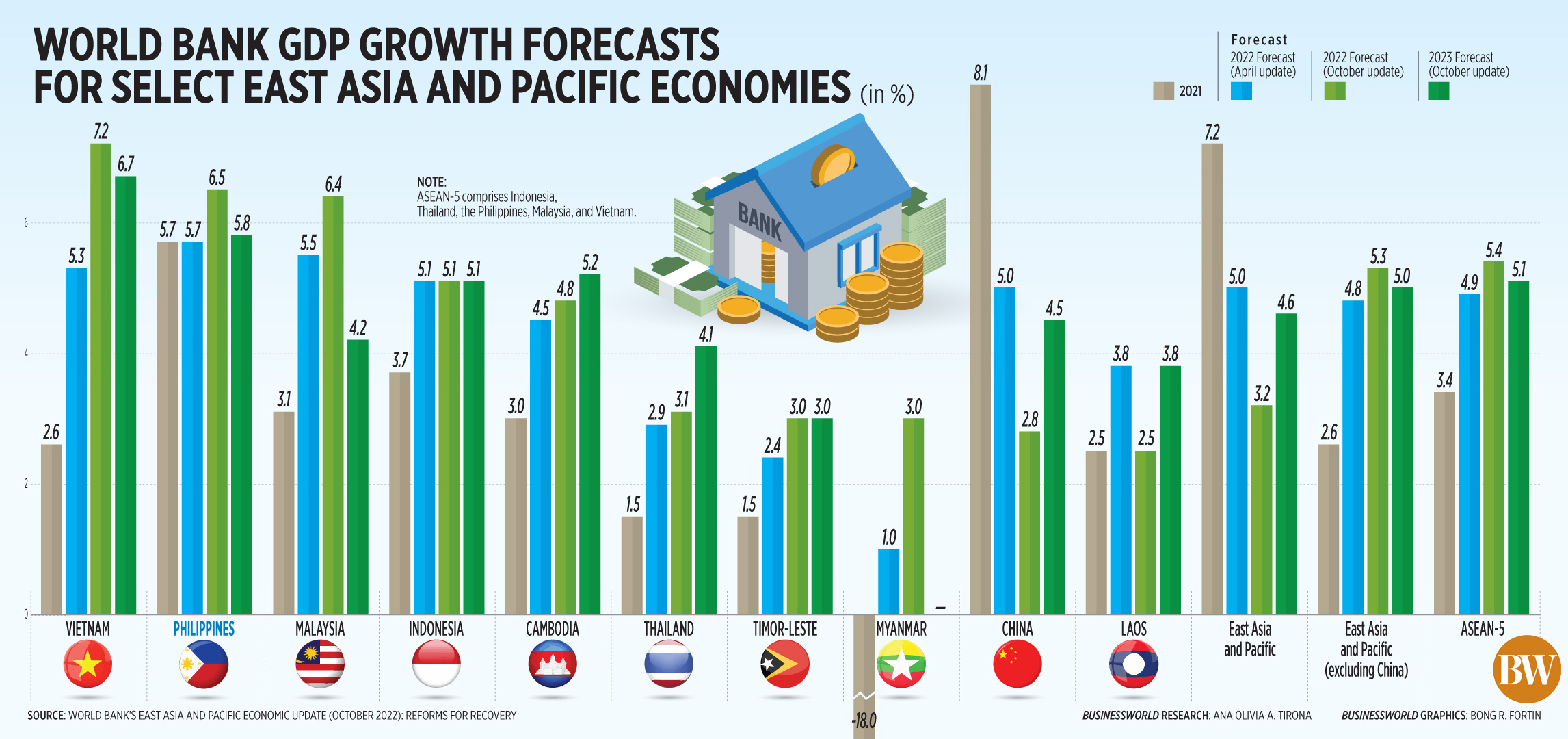
THE WORLD BANK (WB) upgraded its growth forecast for the Philippines for this year and 2023, citing an “accommodative” fiscal policy conducive to recovering domestic demand despite a hawkish central bank and a pessimistic global economic outlook.

In its East Asia and the Pacific Economic Update report for October released on Tuesday, the Washington-based lender raised the Philippines’ gross domestic product (GDP) outlook to 6.5%, from the 5.7% given in April. This is at the lower end of the government’s 6.5-7.5% goal this year.

The World Bank projects the economy to grow by 5.8% in 2023, from 5.6% previously, but still below the government’s 6.5-8% assumption for next year.

World Bank GDP growth forecasts for select East Asia and Pacific economies

Still, the Philippines’ growth projections for 2022 and 2023 were higher than the average for the ASEAN-5 (Association of Southeast Asian Nations-5) at 5.4% and 5.1% respectively. It was also above the East Asia and Pacific average of 3.2% and 4.6% for this year and next year.

The growth projections for the Philippines are second highest in the region, only lagging behind Vietnam’s 7.2% for 2022 and 6.7% in 2023.

Aaditya Mattoo, chief economist for the East Asia Pacific Region of the World Bank, attributed the Philippines’ growth outlook upgrade to the rebound of private consumption as the economy reopened after the coronavirus disease 2019 (COVID-19) pandemic-related lockdowns.

“It is also evident to us that the Philippines is one of the countries which saw reasonably good export performance. But even more than that, [it’s] the revival of both public and private investment, and some of that boost might have come related to the electoral activities in the region,” Mr. Mattoo said during a webinar on Tuesday, also citing the revival of its tourism sector.

“While some aspects of Philippine monetary policy may have been tight, its fiscal policy seems to us at least to be a little bit more accommodative,” he added.

The Bangko Sentral ng Pilipinas (BSP) has hiked its rates by 225 basis points since May.

Also, the World Bank report noted that output in Cambodia, the Philippines, and Thailand is already expected to surpass pre-pandemic levels this year.

However, it noted that while sectors like information and communication technology, finance, and agriculture have been resilient, the output of transportation, accommodation and catering sectors remains well below pre-pandemic levels in the Philippines, Malaysia and Thailand.

“In the Philippines’ case, there is also an interesting contrast,” Mr. Mattoo said. “That when it comes to agricultural policies, the Philippines has implemented significant liberalization and relied more on transfers in general than price subsidies. [But] when it comes to energy and fuel, [it is] less so.”

For next year, growth is expected to moderate as pent-up demand is expected to eventually fade amid continued elevated inflation, while public spending is anticipated to slow down in view of the limited fiscal space.

SLOWDOWN
The slowdown in global economic activity was also flagged as a downside risk to growth in the Philippines and the rest of the East Asia Pacific region.

“A slowing growth of one percentage point in the rest of the world and China could mean growth in the region slowing down by more than one percentage point,” Mr. Mattoo said.

The World Bank lowered its growth outlook for the East Asia and Pacific region, which includes China, to 3.2%, down from its 5% forecast in April. Last year, the region expanded by 7.2%.

The Chinese economy is already expected to slow to 2.8%, down from its previous forecast of 5% because of the Zero-COVID policy. China expanded by 8.1% in 2021.

“Even though tourism is reviving, supporting growth in countries like Thailand, the Philippines and many Pacific Islands, the global economic slowdown is dampening demand for the region’s exports,” the World Bank said.

The World Bank also noted that inflation in the Philippines, which has averaged 4.9% in the eight months to August, is still above the central bank’s target of 2-4%.

“Food prices have increased considerably in Indonesia, Malaysia, the Philippines and Thailand during the last few months and appear to be the major contributor of higher inflation,” it said, while also noting the rise in energy prices in the Philippines, as well as in Thailand and Vietnam.

Mr. Mattoo said that the resulting increase in interest rates from various central banks, particularly the US Federal Reserve, resulted in capital outflows and has depreciated currencies in the region.

In the year to date ending Sept. 27, the peso has weakened by 15.66% or P7.99 from its P51-a-dollar close last year.

“The combination of higher interest rates and depreciating currencies means that the burden of debt is increasing,” he said.

The Philippines’ debt-to-gross domestic product (GDP) ratio stood at 62.1% as of end-June, above the 60% threshold prescribed by multilateral lenders.

“On average, primary deficits have contributed to increasing public debt-to-GDP ratio by 1.1 percentage points. The historical patterns observed in most East Asia Pacific countries suggest that relying on fiscal consolidation as a policy option to deal with high debt to GDP would be challenging,” the World Bank said, noting how previous fiscal consolidations contributed to lower debt-to-GDP ratios in the Philippines, among other countries.

According to the World Bank, the Philippines’ fiscal balance posted a deficit of 6.5% as a ratio of GDP in the first half, which is lower compared with 7.8% in the same period last year. This was due to higher tax collections and a windfall from oil excise taxes.

Before the pandemic, the negative primary deficit in the Philippines helped reduce the debt-to-GDP by 1.9 percentage points, the World Bank added.

While dollar-denominated debt is just 10% of all debt in the Philippines, most of it is shouldered by the private sector, which is another risk in itself.

“Firms in Indonesia, the Philippines, and Vietnam have a greater share of maturing debt in the form of syndicated loans than in bonds, and at least 60% of the debt coming due is denominated in foreign currency, making the firms particularly vulnerable to exchange rate depreciations,” the World Bank said.

Still, Mr. Mattoo said that foreign direct investments can still be a source of growth for the region, as it has been before.

“The kind of reforms we have seen in Indonesia and are seeing in the Philippines are definitely going to see a lot of investment creation,” he said.

“There are new areas, like the utilities and the various infrastructure services, in the Philippines and in Indonesia; especially the green transition throughout the region. I think those are going to draw in a lot of new investment.”

Vehicle sales recovery at risk if taxes reimposed on pickup trucks — Fitch Solutions

Vehicles are stuck in traffic along EDSA, Cubao in Quezon City, Aug. 18. — PHILIPPINE STAR/ MIGUEL DE GUZMAN

THE PHILIPPINE auto industry’s sales recovery will likely be derailed if a measure reimposing excise taxes on pickup trucks is signed into law, according to Fitch Solutions Country Risk and Industry Research.

In a commentary dated Sept. 26, Fitch Solutions said it expects total vehicle sales to post double-digit growth this year, after a strong performance in the first nine months but the outlook for 2023 has dimmed.

“Prospects for the continued strong recovery in vehicle sales in 2023 have diminished following the possible reintroduction of excise taxes on pickup trucks, mainly due to the subsegment’s popularity in the country,” Fitch Solutions said.

Pickups are classified under the commercial vehicle (CV) segment. 

Vehicle sales rose by 25% to 212,872 units in the January to August period, data from the Chamber of Automotive Manufacturers of the Philippines, Inc. (CAMPI) and the Truck Manufacturers Association (TMA) showed.

This was mainly driven by a 39% increase in CV sales to 160,790, which helped offset a 4.3% decline in passenger car sales to 52,082 units.

“Indeed, CV sales rose by 39% over the same period as consumers brought forward their purchases in anticipation of a possible reintroduction of an excise tax exemption granted by the Filipino government to assist small and medium businesses under the Tax Reform for Acceleration and Inclusion (TRAIN) law first introduced by the Duterte administration in 2017,” Fitch Solutions said.

In August, the House Ways and Means Committee approved the fourth package of the Comprehensive Tax Reform Program which included the elimination of the excise tax exemption for pickup trucks.

According to the Finance department, the removal of the excise tax exemption is expected to generate P52.6 billion worth of additional revenues from 2022 to 2026.

“While the decision to reimpose the excise tax is yet to be made final, we believe that demand for pickup trucks will rise as the deadline to the excise tax exemption nears resulting in sales dropping thereafter,” Fitch Solutions said.

Sought for comment, Albay Rep. and House Ways and Means Committee Chair Jose Ma. Clemente S. Salceda said in a Viber message that pickup truck sales will be affected, but noted that the tax exemption gave it an “undue advantage” over sedans that are manufactured locally.

“Some 98% of all pickup trucks are imported, whereas some sedans are manufactured or assembled here, including the Toyota Vios. From a domestic value-added perspective, the tax measure will be good for the domestic car manufacturing sector, because it will shift some of the demand away from almost fully imported pickups,” Mr. Salceda said.

“The proposal might hit the Indonesian or the Thai car industries since that’s where we import our pickup trucks from, but the Philippine auto industry will be all right. Demand from the pickup truck sector will simply shift to other segments, such as sedans. The domestically assembled ones create jobs here,” he added.

CAMPI President Rommel R. Gutierrez previously said that the measure would affect the industry’s recovery, since it would raise prices of pickup trucks.

“We are concerned about the addition of the taxes. As we know, the demand for vehicles is price sensitive. This will definitely impact prices,” Mr. Gutierrez previously said.

OUTLOOK
Meanwhile, Fitch Solutions said it kept the vehicle sales outlook unchanged while the measure is still pending in Congress.

It expects vehicle sales to jump by 19.7% to 321,400 units this year, with passenger car sales growth at 17% and CV sales growth at 21%. For 2023, it sees vehicle sales growth slowing to 9.1%.

Fitch Solutions forecasts Philippine vehicle sales to return to the 2017 peak level by 2025.

“In the medium term (2022-2026), we expect demand for CVs to be driven by the government’s efforts to fill the country’s infrastructure deficit through an aggressive policy to promote economic development,” it said.

The Marcos administration has promised to focus on infrastructure development in order to drive economic growth.

Fitch Solutions said heavy trucks and light commercial vehicles will likely perform better since they are used for construction activities.

“In addition, due to pickup trucks’ continuous appeal on the domestic market, demand for light commercial vehicles (LCVs) will continue to be high. However, prospects of the reintroduction of excise taxes by the Marcos administration could derail the fast growth the sub-segment has witnessed since the onset of much relaxed movement restrictions,” it added.

Fitch Solutions also pointed out that the Public Utility Vehicle Modernization Program did not receive any allocations under the proposed Department of Transportation budget for 2023, “calling into question the political will to support public transport operators as they shift towards lower emissions vehicles.”

Meanwhile, Fitch Solutions sees an improved outlook for passenger vehicle sales in the coming year, as consumer confidence rises and restrictions on movement are eased.

“Positive changes to the limits on movement will boost economic activity, which will encourage consumers to resume buying expensive goods like new (passenger vehicles),” it said. — Revin Mikhael D. Ochave

Another BSP off-cycle rate hike likely, economist says

REUTERS

THE BANGKO SENTRAL ng Pilipinas (BSP) may deliver a second off-cycle rate hike in early November when the US Federal Reserve is expected to raise rates by another 75 basis points (bps), an economist from the Bank of the Philippine Islands (BPI) said.

At the same time, ANZ Research sees the BSP raising its benchmark rate to 5.25% by mid-June next year as it seeks to cool inflation.

In a statement, BPI Lead Economist Emilio S. Neri, Jr. said he hopes the BSP will not repeat the low-rate hike last June when “we were caught between two meetings of the FOMC (Federal Open Market Committee) with a much lower policy rate (adjustment).”

The Philippine central bank last week raised its benchmark policy rate by 50 bps to 4.25%. Rates on the overnight deposit and lending facilities also rose by 50 bps to 3.75% and 4.75%.

The Monetary Board has raised rates by 225 bps so far since May, including a 75-bp off-cycle hike in July.

Mr. Neri said the Fed is expected to continue its aggressive monetary tightening into 2023.   

“[We are] not catching up with the higher, faster, longer signal of the FOMC. Several foreign banks have already mentioned in reports that we are seen as dovish,” he added.

Mr. Neri said a P60-per-dollar exchange rate is “just around the corner.”

The peso closed at P58.99 a dollar on Tuesday, dropping 49 centavos from its P58.50 finish on Friday, based on Bankers Association of the Philippines data. It has weakened by 15.66% or P7.99 from its P51-a-dollar close last year.

Mr. Neri added that a “mild policy rate hike” by the BSP at its Nov. 17 policy meeting might use up the country’s gross international reserves (GIR).

“The only thing that is preventing a 40%, 42% depreciation of the peso now, like in 1997, is probably that we have a GIR at seven months, which we have to be careful not to use up,” he said.

Latest data from the central bank showed dollar reserves stood at $98.98 billion as of end-August, slipping by 0.85% from the $99.83 billion as of end-July. It was also 8.3% lower from the $107.96-billion level a year ago, and marked the sixth consecutive month of decline.

The BSP expects to end the year with $105 billion in dollar reserves and $106 billion in 2023.

HIGHER RATES BY 2023
In its latest Asia Economic Outlook, ANZ Research expects the BSP to raise its key policy rates by 50 bps to end the year at 4.75% and another 50 bps to 5.25% by mid-2023. This is higher than the initial forecasts of 3.5% in 2022 and 4% in 2023.     

“To some degree, these revisions reflect spillover from our hawkish Fed view. The stickiness of US inflation suggests the global inflation pulse is stronger. Some central banks will also be concerned about the inflationary implications of currency weakness against the dollar,” ANZ Research said.   

The FOMC has hiked its federal fund rate by 300 bps since March to a target of 3-3.25%. ANZ Research sees a full percentage point increase by yearend.

“We expect the dollar to continue to appreciate until the first half of 2023. The strong dollar is helping the Fed in its inflation challenge, but complicating policy elsewhere,” it added.    

ANZ Research also expects the consumer price index (CPI) in the Philippines to quicken to 5.6% this year, matching the central bank’s revised 5.6% average inflation forecast, and easing to 4.2% in 2023 and to 3% in 2024.

“Inflation is close to peaking in most economies owing to stabilizing food and energy prices, which carry large weights in the region’s CPI baskets,” ANZ said.   

“At the same time, it is unlikely that inflation will quickly slip back into official target ranges. We think that a correction of this magnitude is feasible only in the second half of 2023 in most economies.”

Inflation quickened to 6.3% in August from a year earlier, exceeding the central bank’s 2-4% target for a fifth straight month. It averaged 4.9% in the first eight months.

ANZ Research also sees the economy expanding by 6.5% this year, matching the lower end of the government’s 6.5-7.5% target. — Keisha B. Ta-asan

ADB allots $14B for program to ease food crisis in Asia

Vendors arrange their goods at a public market in Manila. — PHILIPPINE STAR/ RUSSEL A. PALMA

THE ASIAN Development Bank (ADB) is planning to allocate at least $14 billion for a program aimed at easing a food crisis in the Asia-Pacific region.

“The future of food and nutrition security in Asia and the Pacific depends on the region’s ability to address [the] current food price crisis, as well as the long-term challenges of climate change,” said ADB President Masatsugu Asakawa at a press briefing on Tuesday.   

“Floods, droughts, heat, disease, and other factors affected by climate change will have an impact on food production. Disruptions to livelihoods will drive even more food scarcity, compounded by climate-induced migration,” he added.    

Assistance under the program will start this year and run until 2025.

The amount of $14 billion will be drawn from the multilateral lender’s sovereign and private sector operations.

Broken down, $3.3 billion in commitments is expected to be mobilized this year, of which $1 billion is from repurposed funds for countercyclical support and $1.5 billion from projects on agriculture, natural resources, and rural development. 

The rest, or $800 million, is expected to reach the private sector, particularly as support to trade and supply chain finance; financing to agribusiness and to farmers; and lending to financial institutions that will support food and agriculture small and medium enterprises. 

The ADB said that it also seeks to leverage from the private sector an additional $5 billion as co-financing for food security initiatives.

“This is a timely and urgently needed response to a crisis that is leaving too many poor families in Asia hungry and in deeper poverty… Our support will be targeted, integrated, and impactful to help vulnerable people, particularly vulnerable women, in the near term, while bolstering food systems to reduce the impact of emerging and future food security risks,” Mr. Asakawa said in a separate statement.

Russia’s invasion of Ukraine disrupted supply of food, fertilizer and fuel, causing a food crisis in many countries still recovering from the pandemic.

ADB Country Director Kelly Bird told BusinessWorld that it is currently in talks with the Philippine government, not just for the assistance program from 2023 to 2025, but also in relation to a Country Partnership Strategy from 2024 to 2029.

“This will be aligned with the administration’s eight-point agenda which prioritizes food security,” Mr. Bird said, mentioning how it will focus on improving agricultural competitiveness and raising rural incomes.

“We are preparing with the Philippines a policy-based loan to improve agriculture productivity. The second subprogram is planned for approval at the end of this year,” he added, while also citing future planned partnerships on flood management, irrigation, and agribusiness. 

For next year until 2025, the ADB has programmed $10.7 billion, which is built on strategies “to build stronger, more sustainable, and equitable food systems.”

“We are scaling up our climate mitigation and climate adaptation investments across the entire food and agriculture value chain,” Mr. Asakawa said, noting how it is inclusive of support to smallholder farmers and women in strengthening agricultural communities.

Mr. Asakawa also said that the ADB will promote digital transformation initiatives and nature-based solutions.

The former “will improve the efficiency of agricultural production and value chains, including fisheries and livestock,” while the latter will “develop innovative financial instruments to attract capital that will build environment-friendly food systems, and to promote more balanced diets.”

In the Global Food Security Index Q2 2022 released by consultancy agency Deep Knowledge Analytics last month, the Philippines placed 146th out of 171 countries and last in East and Southeast Asia. Its food security index score of 5.05 out of 10 reflected the need for improvement in food accessibility, crisis level, and food system and economy resilience. — Diego Gabriel C. Robles

Iconoclasts to icons: Two National Artists, one stage

MONICA GANA and Katrene San Miguel in Carmina Burana (2018) by Alice Reyes — PHOTO BY JOJO MAMANGUN

By Sam L. Marcelo, Multimedia Editor

Ballet
Pulso Pilipinas II: Alay nina Alice at Agnes
Sept. 30, 8 p.m.
Oct. 1, 3 p.m. and 8 p.m.
Oct. 2, 3 p.m.
Tanghalang Nicanor Abelardo (CCP Main Theater)
Cultural Center of the Philippines

A PRODUCTION that celebrates the work of two living National Artists for Dance — Alice G. Reyes and Agnes D. Locsin — will attempt to encapsulate more than 50 years of Philippine dance and make a stand about its future.

Pulso Pilipinas II: Alay nina Alice at Agnes will see the Alice Reyes Dance Philippines (ARDP) performing alongside underprivileged youth from different regions in a program composed of Ms. Reyes’ Carmina Burana, a feat of athleticism and stamina that matches the musicality and monumentality of German composer Carl Orff’s cantata; and Ms. Locsin’s Igorot, Moriones, and Elias at Salome, a trio of works that show off the range of the pioneering neo-ethnic choreographer known for her angularity, percussive power, and groundedness.

Accreted time and accolades have turned these dances into masterpieces but they were revolutionary — controversial, even — when they were first staged and their choreographers, iconoclasts instead of the icons they are now.

“People like to put things in boxes,” said Ms. Reyes at an open rehearsal in the Cultural Center of the Philippines this July. “Should you step out of these boxes and do something else, people … don’t know how to deal with it.”

‘A HAPPY SOLUTION’
Carmina Burana, like the rest of Ms. Reyes’s oeuvre, incorporates different dance vocabularies: where ballet has pointe shoes, modern dance has bare flexed feet; where ballet desires to escape gravity, modern dance is enamored of it.

The ability to do both is the hallmark of a dancer who has been trained by Ms. Reyes and her protégés. Celebrated today, the combination of techniques was questioned then. “People thought I was doing something really stupid because I was doing modern and classical ballet. They thought it was odd,” she said. “And now you won’t find a ballet or dance company that doesn’t do that — even in Russia.”

The last is a veiled reference to the rift between Ms. Reyes and Ballet Philippines (BP), the company she founded in 1969. (See “Copyright fight: Ballet Philippines risks losing ‘treasure trove’ of dance”)

At a masterclass on copyright organized by BP this August, Lorna P. Kapunan, the company’s legal adviser, advised diplomacy: “The more important thing here is the viewing public. Let’s not deprive the public of good creations. …  The public benefits from the parties not quarreling whether it’s Ballet Philippines, Alice Reyes, or CCP. The constitution says that intellectual property must have a social function. To me, the social function of art is to bring happiness and not discord to people. Perhaps Ballet Philippines, CCP, and Alice Reyes should sit down and come up with a happy solution.”

BASTARDIZATION, VINDICATION
Meanwhile, Ms. Locsin, who once dressed women in G-strings as they portrayed gender-bending roles (a necessity since she lacked male dancers), was accused of bastardizing and appropriating indigenous dances when her neo-ethnic pieces premiered. Igorot is inspired by dance rituals of the Mountain Province; Moriones, by the Moriones Festival of Marinduque.

“I never explained myself. The best answer to criticism is silence,” said Ms. Locsin in a Zoom call with BusinessWorld. Naysayers have dwindled over the decades, or have become smart enough to remain silent themselves.

When pressed, Ms. Locsin has always said that she never wanted to supplant tradition. “This is my tribute to Philippine culture,” she said of her research-based choreography.

Vindication by way of being conferred the highest state honor for individuals who have done much for their artistic field is far from her mind. “Right now, this National Artist thing hasn’t sunk in,” she said, adding that she is concentrating on helping Ms. Reyes’ fledgling company.

“I want ARDP to continue and further Alice Reyes’ legacy,” she said. “Why make a new vision when her vision is there and it is good? There is room for all kinds of dances, room for growth.”

EPHEMERAL, OF THE MOMENT
Alay nina Alice at Agnes is a rare jewel, given how few and far between National Artists are among those who toil in dance. Ms. Locsin, recognized this year, is only the 6th; Ms. Reyes, recognized in 2014, was the 5th.

The dearth of honorees — as compared to, say, those in the visual arts — might be explained by the nature of dance itself and the limits of video technology when Ms. Reyes, 79, and Ms. Locsin, 64, began their careers.

“If you never saw me dance, you never saw me dance. If you didn’t see Agnes Locsin’s Encantada 10 years ago, then you’ve never seen it,” said Ms. Reyes. “It [dance] is so ephemeral, so of the moment, and so not visible after the moment.”

The momentousness of Alay nina Alice at Agnes as a moment in Philippine dance is not lost on the members of ARDP.

“We’re starting something new and we want to make an impression on the audience: this is who we are, we’re different from them, this is what we’re focused on,” said ARDP ballet soloist Monica A. Gana. Unnamed but out in the open in her reply is how ARDP compares to BP (“them”).

Added Ronelson P. Yadao, ARDP artistic director: “There is pressure and I can feel it. But Alice Reyes believes in the group and in me: that gives me confidence.”

The dancers have always been the priority of Ms. Reyes, who formed ARDP out of like-minded individuals who were displaced from various dance companies over the pandemic — and it is for them that she continues despite less-than-ideal circumstances: Zoom as the de facto means of communication, the lack of an office and studio, questions about copyright, and competing ideologies.

When Ms. Reyes staged her first modern dance concert at the CCP in 1969, she had the run of the place. “It was a different world. The CCP was ours. And now, there are different resident companies all wanting space, all with their own plans and programs,” she said. “You’re not going to get everyone to understand. There will always be those who prefer opera to BTS. There will always be those who prefer Swan Lake to Encantada or Amada.”

AEV says units exit Sri Lanka, files P12-B bonds

ABOITIZ Equity Ventures, Inc. (AEV) said on Tuesday that its subsidiaries had agreed to sell their 100% equity interest in Gold Coin Feed Mills (Lanka) Ltd., a manufacturer and distributor of animal feed products in Sri Lanka.

The listed holding firm disclosed to the stock exchange that its units Gold Coin Management Holdings Pte. Ltd. and Glen Arbor Holdings Pte. Ltd. entered into a share sale and purchase agreement with New Anthoney’s Farms (PVT) Ltd.

“Following the signing of the agreement and subject to completion of conditions precedent, the transaction is expected to be completed by the year-end of 2022,” AEV said.

“The exit from Sri Lanka is aligned with the Aboitiz Group’s direction to grow its animal feeds business in other parts of the SouthEast Asia and China markets,” the firm added.

New Anthoney’s Farms said on its website that it is one of the leading frozen chicken manufacturing and poultry farming companies in Sri Lanka.

Glen Arbor and Gold Coin Management are AEV’s Singapore-based subsidiaries whose shares are held through Pilmico International Pte. Ltd.

In a separate disclosure, AEV said that it had filed an application with the Securities and Exchange Commission to issue fixed-rate retail bonds with an aggregate principal amount of up to P12 billion, including oversubscription.

The application consists of the issuance of the final tranche of its P30-billion shelf registration program in 2019 amounting to P7.45 billion and the first tranche of the new P30-billion shelf-registered debt amounting to up to P4.55 billion.

AEV said proceeds from the bonds will partially fund the company’s equity contribution to its subsidiary Aboitiz Infracapital, Inc. and for the repayment of the parent company’s outstanding bonds.

“[Aboitiz Infracapital] will use such amount to acquire interest in GMR-Megawide Cebu Airport Corp.,” the firm said.

The bonds are expected to be offered to the public in the fourth quarter, subject to market conditions, and are intended to be listed with the Philippine Dealing and Exchange Corp.

AEV said the P12-billion bonds received a credit rating of PRS Aaa with a stable outlook from the Philippine Rating Services Corp. (PhilRatings), which also maintained the issue credit rating of PRS Aaa with a stable outlook for the firm’s total outstanding bonds.

Bonds with a PRS Aaa rating are of the highest quality with minimal credit risk, indicating the obligor’s capacity to meet its financial commitment “is extremely strong.” A stable outlook means that the rating is likely to be maintained or to stay unchanged in the next 12 months.

On Tuesday, Aboitiz Equity shares lost P2.40 or 4.18% to P55.05 apiece. — Justine Irish D. Tabile

How to show off crypto art? On flat-screen TVs

ANG HULING HAPUNAN by AJ Dimarucot

SINCE crypto art exists online, how to show it off onsite? On flat-screen TVs.

Twelve artists’ individual works and a collaborative piece will be highlighted at Galeria Paloma crypto art exhibit, “1/1” (read: One of One), which will be held both online and onsite.

The exhibit will be up from Sept. 30 to Oct. 4 at Power Plant Mall in Makati. It can also be visited online now on the NFT art platform Foundation (https://foundation.app/@galeriapaloma).

The physical exhibition will display the works of crypto art on Samsung The Frame TV screens.

“This partnership enables us to bring to the fore how The Frame TV can display digital artwork the way they are meant to be seen and appreciated,” Mahir Al-Rubah, Audiovisual Product Marketing Head of Samsung Electronics Philippines Corp., said in a statement.

Mounted in conjunction with Crypto Art Week Asia, “1/1” is the gallery’s second in a series of exhibits of crypto art which are digital artworks minted on a blockchain.

“This series of exhibitions is focused on highlighting crypto art as a genre of fine art,” Galeria Paloma director Kimi Rocha-Delgado said at a press conference at the Power Plant Mall’s The Grid on Sept. 19.
“Digital art has been around since the advent of the computer. But in the past years, it has enjoyed a renaissance due to blockchain infrastructure that now makes it possible for artists and collectors to have a solution for issues it has before” like proof of ownership, authenticity, and royalties Ms. Delgado added.

The exhibition features 12 crypto artists from the Philippines and Singapore.

One of the artists is Luis Buenaventura, who will showcase an animated work that commemorates the recent merge of the Ethereum blockchain. The blockchain holds sentimental value in Mr. Buenaventura’s crypto career — he was one of the artists whose work was included in the first NFT art collection ever minted on the Ethereum blockchain, Curio Cards (2017), which is the first lot in the history of Christie’s auction house that sold in Ether for $1.2 million.

Graphic designer, crypto artist, art director, and illustrator AJ Dimarucot employs artificial intelligence (AI) in his work Ang Huling Hapunan, a tribute to reproductions of The Last Supper. Mr. Dimarucot transforms the image into an electric, expressionist artwork that morphs into a scene of families gathering at a fast-food restaurant.

Win Magsino’s collection, Ghosts of Luggard Road, is made up of photos of trees walking home from Victoria Harbor. Mr. Magsino has won top awards at various international photography competitions. He is also a 2021 NCCA Ani ng Dangal honoree.

Cris Magsino’s Symphony of Stars is an animated image of the night sky, gracefully moving over the turquoise crater lake of the Kawa Ijen volcano. The photograph was awarded the Jury Top 5 selection and Honorable Mention at the 2020 International Photography Awards and Bronze at the 2020 Moscow International Foto Awards.

Painter and co-founder of CryptoartPh Jopet Arias joins the roster with original works on canvas in his signature style — traditional mediums intersected by digital technology.

The award-winning performing and visual artist Raymond Lauchengco will also be displaying his landscape photography. Painter and sculptor Carlos will be exhibiting his paintings which were animated by motion designer Isaiah Cacnio, who will also be presenting his own original work.

Holy Blood, a self-taught graphic designer and artist, as well as collage artist Sheila Ledesma will also be exhibiting their crypto work. Ten-year-old NFT artist Sevi Agregado also joins the exhibit with works on canvas tokenized on the blockchain.

Singaporean visual artist Wyn-Lyn Tan, who has been working on landscapes since she launched her collection on the blockchain last year, is also in “1/1”.

To commemorate the exhibition, a limited edition collaborative NFT titled The Twelve will be produced by the featured artists, to be distributed among the artists and supporters of the crypto art community.

Alongside the crypto art exhibit, Galeria Paloma will also be launching Galeria Paloma Perspectives, an educational initiative that will host talks, panel discussions, and lectures about art and its integrations of Web3 in its practices.

The exhibit runs from Sept. 30 to Oct. at the 2nd Floor Activity Area at the Power Plant Mall in Makati City and can be viewed online on www.galeriapaloma.com and https://foundation.app/@galeriapaloma. For more information, visit www.galeriapaloma.com. — Michelle Anne P. Soliman