Home Blog Page 5284

Philippine poultry firm Bounty considers $500 million IPO in Manila

https://bavi.com.ph/

Bounty Agro Ventures Inc., a Philippine poultry firm, is exploring an initial public offering in Manila that could raise $400 million to $500 million, according to people with knowledge of the matter.

The company is having discussions with potential advisers on the planned listing, said the people, who asked not to be identified as the information is private. A first-time share sale could take place as early as the end of this year, the people said.

Deliberations are at an early stage and Bounty could still opt not to proceed with the offering, said the people. A representative for Bounty didn’t immediately respond to requests for comment.

Should Bounty go ahead with the IPO, it would give a boost to the Philippines’ IPO market, which hosted only $389 million worth of first-time share sales last year, a fraction of the $2.5 billion raised in 2021, according to data compiled by Bloomberg.

Bounty Agro Ventures traces its roots to 1986 as an egg producer, according to its “sister company” Bounty Fresh Foods Inc.’s website. Bounty Agro Ventures was founded in 1997 and has grown into the largest rotisserie chicken company in the Philippines, its website shows.

It has almost 2,000 retail outlets selling roasted chickens and chicken burgers through brands such as Chooks-to-Go, Uling Roasters and HeiHei. The company sells 100,000 roasted chickens every day. It also distributes dressed chicken products in supermarkets, hotels and others under the Bounty Fresh Chicken brand. — Bloomberg

Philippines’ Marcos visits Japan seeking closer security ties

President Ferdinand R. Marcos, Jr. answers questions from the media after his first Cabinet meeting at the Heroes Hall of the Malacañan Palace, July 5. — PHILIPPINE STAR/KRIZ JOHN ROSALES

TOKYO/MANILA – Philippine President Ferdinand Marcos Jr arrives in Japan on Wednesday for a visit that is expected to pave the way for closer security ties with Tokyo, as Manila increasingly sides with the United States in its regional tussle with China.

Marcos and Prime Minister Fumio Kishida are expected to deepen cooperation in disaster relief, a possible precursor to establishing a broader legal framework that would allow Japanese forces to deploy to the Philippines more easily.

“As the United States deepens its relationship with the Philippines, it’s important for regional security that Japan join in,” a Japanese defense ministry source with knowledge of internal discussions on national security told Reuters. He asked not to be identified because he is not authorised to talk to the media.

Marcos’s first visit to Japan since taking office in July comes after he signed an agreement last week granting the United States greater access to its military bases. It also follows a trip to Beijing last month where he told his Chinese counterpart, Xi Jinping, that the Philippines would pursue an independent foreign policy.

At a press briefing last week, Neil Imperial, the Philippines Assistant Secretary for Asian and Pacific Affairs, said Marcos wanted to “facilitate closer defence, security, political, economic and people-to-people ties” while in Japan.

That sentiment is shared in Tokyo, which has been deepening security ties with nations that view China with concern.

A year ago, Japan and Australia signed a visiting forces agreement, allowing them to deploy forces on each other’s soil, with Tokyo concluding a similar accord with Britain last month. Those deals provide a framework for how Marcos and Kishida could also forge deeper military ties to counter their common adversary, say experts.

“The Philippines is a critical security partner for Japan,” said Narushige Michishita, a professor at the National Graduate Institute for Policy Studies (GRIPS) in Tokyo. “Any conflict in the Taiwan Strait would make the Philippine Sea strategically important,” he added.

Taiwan, which lies between Japan and the Philippines, has become a focal point of intensifying Chinese military activity that Tokyo and Washington worry could escalate into war as Beijing tries to capture what it views as a rogue province.

A Japanese military presence in the Philippines could also help Marcos counter Chinese influence in the South China Sea, much of which Beijing claims, including territory that Manila considers its own.

Beijing has said its intentions in the region are peaceful.

Marcos has vowed not lose an inch of territory in the strategic waterway, through which $3 trillion in ship-borne trade passes annually.

By gaining access to bases in the Philippines, Japan would extend the range of its defence forces, including surveillance aircraft that could patrol the South China Sea, according to Ken Jinbo, a professor at Keio University in Japan, who also served as a government security advisor.

“One thing people are watching out for during President Marcos’ visit, is whether Japan will agree to provide infrastructure assistance now that the United States has access to the nine bases there,” he said. — Reuters

So you’re looking for the sweetest valentine? SM Supermalls’ gotchu!

Whether you’re single but not going solo, in a committed relationship, or just happy and in love with the fam, SM Supermalls will give you the sweetest Valentine’s Day ever!

SM Supermalls has got a slew of activities coming up for you from February 1 to 14. So if you are looking for ways to celebrate the sweetest valentine, look no further because SM Supermalls’ gotchu!

Keep the love burning with the sweetest dining deals

They say food is the way to a man’s heart. So why not treat your SO to a sumptuous dining experience? With hundreds of restaurants to choose from, SM got lotsa lovin’ vibe to share and the sweetest dining deals to offer. Plus, there are very cute dining spots and IG-worthy outdoor hubs to dine into. But if you want a more romantic ambiance, there are also alfresco spots available for you!

Self-love is the best kind of love

Experience the euphoria of self-love at your favorite SM mall when you gift yourself with a few pampering items. From skin care packages and discounts on fashion items to solo dining promos, SM will definitely shower you with tons of sweet self-love deals to enjoy a love-filled month.

Sweets for your sweet at the Sweet A-fair

What’s Valentine’s Day without a  Sweet A-fair? If you’re looking for the sweetest Valentine’s gifts, there’s no need to scour far and wide just to get them. Check out SM Supermalls’ pop-up bazaar and get your hands on sweet items like chocolates, cakes, and other treats to spoil your loved ones.

Dance to sweet beats and retro nights

This season of love, give your fangirl/fanboy self a sweet reward at the mini-concert held every weekend from February 1 to 14. Your favorite DJs and Tiktok artists will play beats from the 1980s to the 2000s so be there and catch their one-of-a-kind performances.

Make room for Sweet Vibes only!

Everyone deserves a special someone who can take good IG photos. But if you don’t have one, it’s A-ok. You can grab your friends and capture the love at the Sweet Beats Stage or at the V-day installations that will surely make this year’s heart’s day extra memorable for you.

Kiss and Treat at the furry kissing booth

Let your furry friends sashay away in Valentine’s Day-inspired costumes at the activity center and get a chance to win amazing prizes.

Or, if you don’t have pets to flex, you can still experience sweet puppy love. Check out SM Supermalls’ cutest and sweetest Kissing Booth featuring trained dogs. And the best part is, it’s absolutely free!

Nothing says “sweet valentine’s day” like shopping, dining, and getting entertained at SM Supermalls. So come and celebrate the sweetest Valentine’s at your favorite SM mall!

For more sweet V-day ideas, visit www.smsupermalls.com or follow @smsupermalls on social media.


Spotlight is BusinessWorld’s sponsored section that allows advertisers to amplify their brand and connect with BusinessWorld’s audience by enabling them to publish their stories directly on the BusinessWorld Web site. For more information, send an email to online@bworldonline.com.

Join us on Viber at https://bit.ly/3hv6bLA to get more updates and subscribe to BusinessWorld’s titles and get exclusive content through www.bworld-x.com.

India, Philippines commence bilateral development cooperation; agreement for implementation of Indian grant-funded projects in the Philippines signed

Hon. Benjamin C. Abalos, Jr., Department of the Interior and Local Government secretary; and H.E. Shambhu S. Kumaran, Ambassador of India to the Philippines

An agreement between the Government of India and the Government of Philippines regarding Indian grant assistance for implementation of Quick Impact Projects (QIP) was signed recently.

The agreement was signed by H.E. Shambhu S. Kumaran, Ambassador of India to the Philippines and Hon. Benjamin C. Abalos, Jr. Secretary, Department of the Interior and Local Government (DILG) of the Philippines. The signing ceremony held at Cape Crame, Quezon City was witnessed by the senior officials from the Departments of Foreign Affairs (DFA) and Finance (DoF) and the National Economic and Development Authority (NEDA) and Embassy of India.

Speaking on the occasion, Ambassador Kumaran described the agreement as a milestone in the bilateral relationship, as it will mark the beginning of new phase in the people-centric partnership between two democracies in the Indo-Pacific region. This agreement will provide a legal framework for bringing India’s rich and varied development experience to the Philippines, Ambassador Kumaran added. He underlined that the choice of QIPs would be based on the priorities of the Philippines Government and noted in this context that Philippine President Ferdinand R. Marcos, Jr. had identified several focus areas such as agriculture, health, education etc. Ambassador Kumaran stated that in all these sectors, India’s recent successes in digital technology driven developmental experience could be introduced to the Philippines through the QIPs.

On behalf of the Government of the Philippines, Secretary Abalos thanked the Government of India for the grant funding offered through QIPs, and noted such developmental support was the first of its kind for the DILG. Secretary Abalos expressed confidence that the QIPs would support development efforts of local government units (LGUs) across the Philippines, and reinforce ongoing related efforts of the department. He hoped that implementation of the QIPs would lead to many success stories in the Philippines leading to meaningful changes in the lives of people.

The agreement provides an enabling framework for facilitating Indian grant assistance to implement small projects for socio-economic development in the Philippines, which would include, but not be limited to, creation or improvement of both social infrastructure (such as education, health, sanitation, community development, etc.) and physical infrastructure (such as roads, local community centers etc). Each project, with an indicative value of about US$ 50,000, would be focussed in implementation and quick in creating beneficial impact on the local communities in different provinces/cities across the Philippines. The agreement will come into force after completion of requisite internal formalities by both the sides.

A Joint Project Selection Committee comprising of representatives from both governments will be set up, which would undertake call for project proposals; setting up of criteria; appraisal of project proposals; provision of grant; and monitoring of project implementation.

The signing of this agreement is a testimony of the growing people-to-people ties and the commitment of both governments to work towards a stronger developmental partnership between India and the Philippines.


Spotlight is BusinessWorld’s sponsored section that allows advertisers to amplify their brand and connect with BusinessWorld’s audience by enabling them to publish their stories directly on the BusinessWorld Web site. For more information, send an email to online@bworldonline.com.

Join us on Viber at https://bit.ly/3hv6bLA to get more updates and subscribe to BusinessWorld’s titles and get exclusive content through www.bworld-x.com.

Inflation soars to fresh 14-year high

INFLATION accelerated to a fresh 14-year high in January as food prices surged. — PHILIPPINE STAR/MIGUEL DE GUZMAN

By Keisha B. Ta-asan, Reporter

HEADLINE INFLATION accelerated to a fresh 14-year high in January as food prices continued to surge, fueling bets of further interest rate hikes to anchor expectations.

The consumer price index jumped 8.7% in January, the Philippine Statistics Authority (PSA) said on Tuesday, well above the 7.6% median estimate in a BusinessWorld poll conducted last week and the 7.5% to 8.3% forecast range given by the Bangko Sentral ng Pilipinas (BSP).

This was also higher than the 8.1% in December, which the BSP earlier said would be the peak, and 3% a year ago.

inflation rates in the Philippines

January’s headline inflation was the fastest in over 14 years or since the 9.1% uptick recorded in November 2008. It also marked the 10th consecutive month inflation was above the BSP’s 2-4% target range. 

Month on month, inflation climbed to 1.7% from 0.3% in December. Stripping out seasonality factors, month-on-month inflation rose by 1% in January.

Core inflation, which excludes volatile prices of food and fuel, jumped to 7.4% in January from 6.9% in December and 1.8% in the same month in 2022. This is the fastest core inflation print in more than two decades or since 8.2% in December 2000.

At a press briefing, National Statistician Claire Dennis S. Mapa attributed the sizzling January inflation to the 11.2% annual increase in food inflation, which was the fastest since the 11.3% in March 2009.

Food inflation quickened from 10.6% a month ago and 1.6% in January 2022, mainly due to 37.8% increase in vegetable prices from 32.4% in December.

Supply issues drove up prices of key agricultural products such as onions. Mr. Mapa noted onions accounted for only 0.34% of the food basket, but its inflation hit 132% in January. This pushed onions’ contribution to food inflation to 12.7% during the month.

Mr. Mapa said inflation was also driven by faster increases in housing, water, electricity, gas and other fuels (8.5% from 7% in December) and restaurants and accommodation services (7.6% from 7%).

He noted housing rentals rose in January after being relatively stable during the pandemic, as landlords adjusted rates to reflect the economy’s reopening. This brought the annual inflation of housing rental to 5%, along with electricity (22%) and water rates (6.6%).    

Higher rents would likely affect overall inflation for the whole year since landlords usually set rental rates for at least one year, Mr. Mapa added.

BROAD-BASED
ING Bank N.V. Manila Senior Economist Nicholas Antonio T. Mapa said headline inflation blew past expectations as price pressures were “clearly broad-based and not limited to select commodities.”

“Poor agriculture output and elevated energy prices drove much of the supply-side price pressure but inflation was also driven by surging domestic demand. Robust economic growth resulted in accelerating inflation for items related to recreation (4.2%), restaurants and accommodation (7.6%) and personal care (5%),” he said.   

Out of 13 commodity groups, nine reported faster inflation in January, including alcoholic beverages (10.9% from 10.7% in December), furnishings and household equipment (5.2% from 4.8%), clothing and footwear (4.4% from 3.9%), and health (3.3% from 3.1%).

How much did each commodity group contribute to January 2023 inflation?

Meanwhile, a slower rate of price increase was seen in transport (11.2% from 11.7% in December), while the annual inflation rate for education services (3.6%), information and communication (0.7%), and financial services (0%) were unchanged.

Inflation for the bottom 30% income households, which started using the 2018-based prices, quickened to 9.7% in January. This was faster than the 9.4% print in December and 4% last year.

In the National Capital Region (NCR), inflation also climbed to 8.6% in January from 7.6% in December and 1.3% a year ago.

Outside of NCR, consumer prices went up 8.7% from 8.2% in December and 3.5% a year prior.

“The January 2023 inflation data points to the need for sustained efforts to combat price pressures, particularly non-monetary government measures to mitigate the impact of persistent supply-side constraints,” the BSP said in a statement.

In a statement on Tuesday, President Ferdinand R. Marcos, Jr. said it was unfortunate that inflation continued to rise, noting that the measures to address high inflation “have not yet gone through the system.”

Finance Secretary Benjamin E. Diokno said the government will intensify efforts to bring full-year inflation within the 2.5-4.5% forecast for 2023.   

“With peso stabilizing, oil prices falling and relatively mild La Niña (less unpredictable weather in first half of the year), I expect the deceleration of prices to start in the first quarter 2023,” Mr. Diokno said.

However, PSA’s Mr. Mapa said headline inflation may further accelerate in the coming months if food prices rise.

“We saw it in the past that if inflation for food items goes up further, there is a higher probability headline inflation will increase. Especially for inflation of the bottom 30% because the weight of their food basket is larger,” Mr. Mapa said in a mix of English and Tagalog.   

HSBC Economist for ASEAN Aris Dacanay said inflation in the Philippines has yet to reach its peak, as January marked the 11th straight month of higher inflation.

“And momentum is still relentless, with month-on-month inflation at 1%… It seems second-round effects are still reverberating in the economy, supported by still-high demand,” Mr. Dacanay said.

ING’S Mr. Mapa said the confluence of supply and demand side pressures will likely keep inflation elevated in the next few months, “with inflation only grinding lower throughout 2023.”    

BIGGER RATE HIKE
“The BSP remains focused on restoring inflation to the government target and stands ready to adjust its monetary policy settings as necessary to anchor inflation expectations and safeguard the inflation target over the policy horizon,” the central bank said.

With the faster-than-expected inflation in January, economists said the BSP is now likely to raise interest rates by as much as 50 basis points (bps) at its Feb. 16 meeting.

“We believe Governor Medalla will whip out a 50-bp rate increase in an attempt to get ahead of surging inflation,” ING’s Mr. Mapa said.

While Mr. Medalla previously signaled the possibility of a pause in the first quarter, Mr. Mapa said the latest inflation print “likely means BSP will need to stay hawkish in the near term.”

“Our baseline forecast is a 25-bp hike next week. But the risk of a higher hike, such as a 50-bp hike, increases given the stronger-than-expected inflation reading,” Mr. Dacanay said.

The Monetary Board increased the benchmark key rate by 350 bps to a 14-year high of 5.5% in 2022.

“Additional rate hikes will help in easing price pressures coming from revenge spending. The economy has enough strength to absorb the impact of higher interest rates,” Bank of the Philippine Islands (BPI) Senior Economist Emilio S. Neri, Jr. said.

ING’s Mr. Mapa said the BSP will likely need to continue raising rates “until we see inflation head back towards the target in a convincing manner.”

The BSP sees inflation averaging 4.5% this year before easing to 2.8% in 2024.

Gov’t raises P162B from latest retail Treasury bond  offering

REUTERS

THE PHILIPPINE government on Tuesday raised an initial P162.180 billion in an auction of retail Treasury bonds (RTBs), the second under the Marcos administration.

In a statement, the Bureau of the Treasury (BTr) said the RTBs were met with strong demand.

Tenders at the rate-setting auction hit P196.109 billion, or more than six times the P30 billion on offer at the BTr’s first retail bond offer this year.

The five-and-a-half-year RTBs fetched a coupon rate of 6.125%, 37.5 basis points (bps) higher than the 5.75% set for the previous RTB offering in August.

The papers were awarded at rates ranging from 5.375% to 6.24%, bringing the average to 6.022%.

The RTBs’ coupon rate is also 28.56 bps higher than the five-year debt papers quoted at 5.8394% in the secondary market, based on the PHP Bloomberg Valuation (BVAL) Reference Rates published on the Philippine Dealing System’s website.

National Treasurer Rosalia V. de Leon said in a Viber message to reporters that the auction had a “good outcome with rates lower than [the rates posted on] BVAL.”

“This (coupon rate) is well-within the expected range and overall good for those looking for an alternative investment outlet,” a trader said in a Viber message.

“It is higher than the going BVAL rate because of the expected higher volume of issuance or supply compared to the usual bond offerings,” the trader added.

The rate issued was higher than that of the secondary market due to the faster-than-expected inflation print for January, Rizal Commercial Banking Corp. Chief Economist Michael L. Ricafort said in a Viber message.

Inflation soared to a fresh 14-year high of 8.7% in January, from 8.1% in December and 3% a year ago. This was the fastest print since the 9.1% logged in November 2008.

“The latest CPI also helped the rate to nudge higher,” the trader added.

Mr. Ricafort noted that the large bids could lead to another jumbo, if not, record RTB issuance.

The RTBs target small investors who want low-risk, higher-yielding savings instruments backed by the National Government.

Investors can avail of RTBs with a minimum initial investment of P5,000 until Feb. 17, unless earlier terminated by the Treasury.

Holders of fixed-rate Treasury notes maturing on March 8, April 21, and May 29 this year can swap their holdings for the RTBs, the Treasury said. The minimum exchange offer is P5,000.

The offer period for the peso-denominated debt is from Feb 7 to 17, while settlement is on Feb. 22.

The RTBs’ maturity date is on Aug. 22, 2028.

Authorized selling agents for the RTBs are Asia United Bank, BDO Unibank, Inc., BDO Capital & Investment Corp., BPI Capital Corp., China Banking Corp., Citibank N.A., Development Bank of the Philippines, East West Banking Corp., First Metro Investment Corp., ING Bank N.V., Land Bank of the Philippines, Maybank Philippines, Inc., Metropolitan Bank & Trust Co., Philippine Bank of Communications, Philippine National Bank, Rizal Commercial Banking Corp., Robinsons Bank Corp., Standard Chartered Bank, The Hongkong and Shanghai Banking Corp., Ltd. and UnionBank of the Philippines. — Aaron Michael C. Sy

Banks’ NPL ratio in 2022 hits fresh two-year low

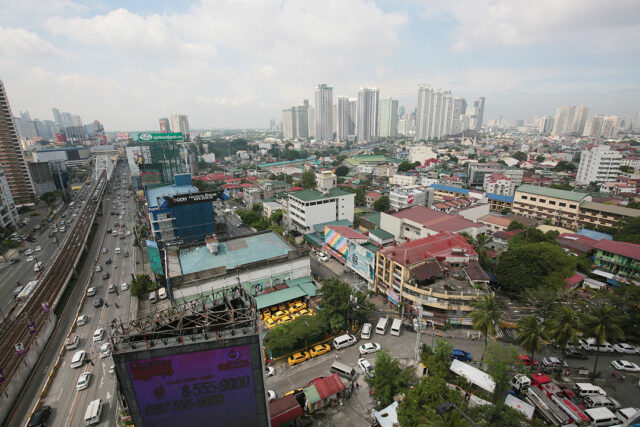
The view of the Makati skyline seen from EDSA, Sept. 24, 2020. — PHILIPPINE STAR/ MICHAEL VARCAS

PHILIPPINE BANKS ended 2022 with their nonperforming loan (NPL) ratio at its lowest in 28 months as the economy’s reopening helped increased the capacity of Filipinos to repay their loans.

The banking industry’s NPL ratio fell to 3.17% as of end-December from 3.35% as of end-November, based on preliminary data released by the Bangko Sentral ng Pilipinas (BSP) on Tuesday. This is also lower than the NPL ratio of 3.97% at the end of 2021.

The latest bad loan ratio is the lowest in 28 months or since the 2.84% in August 2020. This is also better than BSP’s 8.2% projection for end-2022.

“This is still due to the further reopening of the economy towards greater normalcy that improved the ability of borrowers to pay with more jobs/employment/livelihood, sales, net income,” Rizal Commercial Banking Corp. Chief Economist Michael L Ricafort said in a Viber message.

Outstanding loans issued by universal and commercial banks increased by 13.4% year on year to P10.9 trillion in December, slower than the revised 13.9% growth in November, preliminary data from the BSP showed.

Credit for production activities jumped by 12.1% to P9.56 trillion, easing from the revised 12.6% growth in November.

Banks extended more loans for real estate activities (13.1%); manufacturing (14.9%); electricity, gas, steam and air-conditioning supply (14.4%); motor vehicles (12.7%); and information and communication (21.6%).

In the same month, domestic liquidity rose by 6.4% year on year to P16.3 trillion in December.

Mr. Ricafort noted the NPL ratio further eased in December as loan demand grew amid better economic and business prospects.

Central bank data showed bad loans declined by 11.7% to P399.538 billion as of end-December from P452.453 billion a year earlier. It was also 2.1% lower from the P408.097 billion in the previous month.

The loan portfolio of Philippine banks expanded by 10.7% to P12.61 trillion as of end-2022 from P11.39 trillion as of end-2021 and by 3.4% from the P12.20 trillion a month prior.

Past due loans held by Philippine banks declined 9.4% year on year to P478.791 billion as of end-December from P528.276 billion. This brought its share to total credit to 3.80% from 4.64% a year earlier.

Meanwhile, restructured loans eased by 7.4% to P330.107 billion from P356.657 billion the previous year. These borrowings made up 2.62% of banks’ portfolio from 3.13% previously.

The industry’s loan loss reserves reached P426.857 billion, growing by 7.6% year on year from P396.823 billion. This is equivalent to 3.38% of banks’ loans, as compared with the 3.48% a year earlier.

The NPL coverage ratio at the end of 2022 stood at 106.84%, up from the 87.7% in 2021.

“Lower NPL is due to increased capacity of people to pay during the holidays — a season where consumers are quite liquid,” Asian Institute of Management economist John Paolo R. Rivera said in a Viber message. — Keisha B. Ta-asan

BIR confident of surpassing revenue target this year

The Bureau of Internal Revenue (BIR) held its National Tax Campaign kick-off event in Pasay City, Feb. 7. — PHILIPPINE STAR/KRIZ JOHN ROSALES

THE BUREAU of Internal Revenue (BIR) is confident it will not just meet its revenue collection target, but exceed it this year.

“With all our efforts and support we are getting, definitely we’re here to work doubly hard to attain the target,” BIR Commissioner Romeo D. Lumagui, Jr. said at the “BIR National Tax Campaign Kick-off” in Pasay City on Tuesday.

Finance Secretary Benjamin E. Diokno said the agency will “definitely” meet its P2.6-trillion collection target for this year.

The BIR collects about 70% of government revenues.

According to Mr. Lumagui, the agency collected a total of P2.34 trillion in 2022.

“We exceeded our revenue targets for 2022. Meanwhile, the emerging tax effort or the taxes as a percentage of GDP for full-year 2022 now stands at 14.6% and we are on track to achieving our goal of raising it to 17.1% by 2028,” Mr. Diokno added.

He said revenue collections this year will be driven by economic growth. “The stronger the economy, the higher the revenues.”

Mr. Lumagui said the BIR will focus on making tax payments more convenient as it accelerates its digital transformation programs.

“We are all focusing on providing good taxpayer service so the processes won’t be too difficult. Our expectation is once we are able to provide convenience, then taxpayers will voluntarily comply,” he said.

Mr. Lumagui said the BIR also has initiatives in place to mitigate the impact of a widely anticipated global recession.

“Definitely it has an effect, but we are addressing it. We have a lot of plans and programs to address those situations. We are confident we will be able to do what is necessary to attain our collection target,” he added.

The BIR chief said the government needs to ramp up spending on infrastructure development, as the economy recovers from the pandemic.

“The modernization and expansion of infrastructure will create high quality jobs, improve overall productivity and encourage businesses and improve taxes for all communities,” he added.

The government plans to spend 5-6% of gross domestic product (GDP) on infrastructure.

Mr. Diokno also said the government is pushing for priority legislative measures such as the imposition of value-added tax (VAT) on digital transactions and the excise tax on single-use plastic.

“In the long term, this will enable more revenues to fund priority programs and boost inclusive sustainable growth of the economy. On top of policy reforms, digital transformation programs and other reforms have widened the tax base and simplified the process of tax collections,” he added. — Luisa Maria Jacinta C. Jocson

Marcos backs luxury tax, urges Filipinos to pay correct taxes

President Ferdinand R. Marcos, Jr. speaks during the kickoff of the National Tax Campaign at the Philippine International Convention Center in Pasay City, Feb. 7. Also in photo are Finance Secretary Benjamin E. Diokno and Speaker Ferdinand Martin G. Romualdez. — PHILIPPINE STAR/KRIZ JOHN ROSALES

PRESIDENT Ferdinand R. Marcos, Jr. has backed a legislative proposal seeking to increase the tax rate on luxury goods.

At the same time, the Philippine leader praised the Bureau of Internal Revenue’s (BIR) intensified campaign against tax evasion as the country needs more funds for its economic recovery programs.

“I think right now the tax on luxury goods only covers very specific items and luxury goods,” Mr. Marcos told reporters on the sidelines of the BIR’s national tax campaign event in Pasay City.

He noted demand for luxury items such as high-end bags, jewelry, cars, private jets, among others, does not easily change “whatever the situation is.”

House Committee on Ways and Means Chair Jose Maria Clemente S. Salceda has filed a bill increasing the taxes on non-essential goods or luxury items to 25% from 20% previously — a move that could generate about P15 billion in additional revenues for the government.

“I think it’s reasonable that we will tax the consumption side of those consuming luxury items,” Mr. Marcos said.

Mr. Salceda last month said his proposal was in response to calls from international organizations for the imposition of a wealth tax in the Philippines.

Oxfam International and its Philippine affiliate have said the inequality experienced in the Philippines is “starker” with the nine richest Filipinos having more wealth than the bottom half or 55 million of the population.

The government’s fiscal consolidation plan includes measures that would generate fresh revenues to pay for the national debt that reached P13.42 trillion at the end of 2022.

In his speech at the BIR event, Mr. Marcos urged Filipinos to pay the correct amount of taxes on time “to support the country’s economic recovery and expansion so critical in this time.”

Mr. Marcos also cited the tax bureau’s accomplishments last year, including an “intensified” anti-tax evasion campaign, which he said resulted in the filing of 15 cases with the Department of Justice amounting to P5.1 billion in tax liability. — Kyle Aristophere T. Atienza

Metro Pacific unit taking 35% stake in Axelum for P5 billion

By Justine Irish D. Tabile, Reporter

THE agriculture arm of Metro Pacific Investments Corp. (MPIC) is buying a 34.76% stake in coconut products maker Axelum Resources Corp. for P5.32 billion as the investment company boosts its presence in agribusiness.

“The north star of our agriculture business is helping our country achieve food security,” said Manuel V. Pangilinan, MPIC chairman, president and chief executive officer, in a regulatory filing on Tuesday.

“This investment into Axelum will mean more income opportunities for coconut farmers, as well as a broader landscape for Philippine agriculture,” he added.

MPIC subsidiary Metro Pacific Agro Ventures, Inc. (MPAV) will be acquiring 1.19 billion common shares and 200 million redeemable preferred shares in the listed manufacturer of a full line of coconut products.

The move comes after its venture into the dairy business with the acquisition of a 51% stake in Magsaysay-led dairy company, Carmen’s Best Group in June 2022.

The Axelum common shares are being sold by Theol Holdings, Inc., Domus Este Holdings, Inc., Tufnell Park Holdings, Inc., Luxdomino Holdings Corp., Luceatlux Holdings Corp., Greenridge East Holdings, Inc., Axelum Resources Corp. Retirement Plan, CP Compass Singapore Pte. Ltd., and various individual sellers.

The common shares are priced at P4.05 apiece or a total amount of around P4.82 billion, while the redeemable shares are priced at P2.50 each for a total consideration of P500 million.

MPAV is paying a total of P5.32 billion in cash, which the company said is internally funded. Axelum and MPAV said the P500 million will be coming in as “new money” for the manufacturer, which distributes its products in the Philippines and abroad.

In a press briefing on Tuesday, Axelum President and Chief Operating Officer Henry J. Raperoga said: “The proceeds will be used for the improvement of facilities as well as for our expansion program.”

Among the expansion projects is a new coconut water line feeding machine, which will increase Axelum’s capacity to 4 million liters a month from 3 million liters previously.

“We placed an order for the expansion of our coconut water line. We will be putting up another 500-milliliter feeding machine,” Mr. Raperoga said.

Ryan Jerome T. Chua, MPIC vice-president for business development, said the company has not issued any intent in writing to acquire a majority stake in the company.

“We are a minority shareholder primarily because we think that Mr. Chan will continue to be the best operator of this business going forward,” Mr. Chua said, referring to Axelum’s chairman, Romeo I. Chan.

“They know this business far better than us, so our intent here is to develop our businesses together,” he added.

The deal is subject to customary closing conditions as well as regulatory approvals, but MPIC is targeting to complete the transaction before the end of the first quarter this year.

“We have the Philippine Competition Commission’s and various regulatory approvals, so it will be subject to that. Depending on what happens, our best guess is we can finish this before the end of March,” Mr. Chua said.

Axelum is present in more than 30 export markets, with an extensive coconut portfolio under its homegrown brand labels: Fiesta, Fiesta Tropicale, Red V and Romantika. It is also the top supplier of a global coconut water drink brand, Vita Coco.

MPIC is an infrastructure investment company with holdings in Manila Electric Co., Maynilad Water Services, Inc., MetroPac Water Investments Corp., Metro Pacific Tollways Corp., Metro Pacific Hospital Holdings Inc., and Light Rail Manila Corp., among others.

On Tuesday, MPIC shares rose by 12 centavos or 2.98% to close at P4.15 apiece, while Axelum shares dropped by 18 centavos or 5.14% to P3.32 each.

MPIC is one of three key Philippine units of First Pacific, the others being Philex Mining Corp. and PLDT Inc. Hastings Holdings, Inc., a unit of PLDT Beneficial Trust Fund subsidiary MediaQuest Holdings, Inc., has a majority stake in BusinessWorld through the Philippine Star Group, which it controls.

Globe net earnings hit P3B in fourth quarter

GLOBE Telecom, Inc. reported a core net income of P3.16 billion in the fourth quarter of 2022, bringing its full-year bottom line to P19.17 billion, amid greater public mobility and the resumption of face-to-face activities.

In a press release on Tuesday, the Ayala-led company said its October-December core income declined by 37% quarter on quarter. It previously reported its fourth-quarter 2021 income at P2.95 billion.

In the three months that ended December 2022, the company reached P40 billion in service revenues from P37.96 billion in the same period in 2021.

“The revenue improvement came mostly from prepaid with greater public mobility and the resumption of face-to-face classes and work,” the company said.

In the fourth quarter of 2022, Globe booked P26.93 billion in revenues from its mobile business, up from P26.54 billion in 2021.

“Despite 2022 being a challenging year marked by inflationary pressures, high interest rates and weakened consumer confidence, Globe once again showed resilience,” Globe President And Chief And Executive Officer Ernest L. Cu said.

“We are happy that the Globe Group closed the year with strong topline and EBITDA (earnings before interest, taxes, depreciation and amortization) growth,” he added.

For full-year 2022, Globe’s core net income was 9.8% lower at P19.17 billion from P21.25 billion in 2021.

This was despite a 3.8% rise in its topline to P157.98 billion in 2022 from P152.26 billion a year earlier, driven by its mobile and corporate data business.

“The significant increase in data revenues, which accounts for 81% of total service revenues mainly fueled this year’s performance, given the accelerated digital adoption among Filipinos,” said Globe.

Corporate data revenues are largely from the company’s information and communication technology (ICT) business which includes business applications, cloud, and data center services.

The company’s full-year EBITDA was also higher at P79.09 billion, up by 5.6% from P74.92 billion in the previous year.

Meanwhile, Globe said its capital expenditure rose by almost 9% in 2022 to P101.4 billion. This is the company’s “highest investment ever” in its mobile and fixed network.

The company said that 86% of this capital was used for data requirements “to ensure more relevant digital solutions and best-in-class connectivity” to its customers.

At the stock exchange, shares in the company declined by 1.67% or P36 to close at P2,114 each on Tuesday. — Justine Irish D. Tabile

Cebu Landmasters reservation sales up 14% to P19B

AN architect’s perspective of an aerial shot of Casa Mira Towers Palawan.

CEBU Landmasters, Inc. (CLI) posted a 13.6% increase in higher reservation sales last year to P18.8 billion, with mid-market residential projects driving sales, the Visayas-Mindanao property developer said on Tuesday.

In a disclosure to the stock market, the company said sales in its mid-market residential projects surged by 95% to P8.83 billion, accounting for 47% of the total reservation sales last year.

“Our numbers tell us that CLI made the most of the post-pandemic growth surge and we are very grateful. The new residential units that we launched were immediately absorbed by the market as shown by our record high sales velocity,” said Chief Operating Officer Jose Franco B. Soberano.

Up to 73% of the booked “record-high” reservation sales came from newly launched development. The rest came from demand for ongoing projects.

Mr. Soberano said that several of the new projects of the company were sold out in a matter of days.

CLI’s Calle 104 in Cebu City was fully taken up in three days, while its East Village project in Davao Global Township was sold out in four days. Casa Mira Towers Palawan was sold out in less than a week.

In 2022, the company launched around 5,000 units in its 16 projects worth P28.4 billion, 74% of which were sold by the end of the year.

Its ongoing projects booked an overall take-up rate of 91%, while 97% of its completed projects have been fully taken up.

The company said it is planning to launch 17 more residential projects as part of its plan of expanding to more areas in the Visayas and Mindanao region.

“We foresee an even more productive 2023 as we bring our residential brands to more and new areas in the VisMin region. We are also further expanding our portfolio by opening more hotels, launching more mixed-use and townships, and by introducing new product lines,” Mr. Soberano said.

Since the company’s initial public offering year in 2017, cumulative reservation sales have reached almost P80 billion, CLI said.

On Tuesday, shares in the company rose 1.93% to finish at P2.64 apiece. — Justine Irish D. Tabile