Home Blog Page 5246

Fantasy series focuses on Philippine heroine

AFTER its success with historical series Maria Clara at Ibarra, GMA Network again turns to the country’s past — again with a twist of fantasy — with Mga Lihim ni Urduja which premieres on Feb. 27, replacing the earlier time-travel tale based on Joe Rizal’s famous novel, Noli Me Tangere and El Filibusterismo.

The drama, set in a pre-colonial world, showcases a modern adventure.

It is loosely based on the legendary warrior princess — or hara – Urduja. She is mentioned in the travel accounts of Ibn Battuta in the 1400s, where he was impressed by her military exploits. She is believed to have been from the province of Pangasinan.

The stars of the show Encantadia — Kylie Padilla, Gabbi Garcia, and Sanya Lopez — reunite in the new series. as Gem, Crystal, and Hara Urduja, respectively.

Gem, a modern-day police officer, and Crystal, a jewelry designer, recover priceless jewelry known to be the magical amulets of Hara Urduja. To defeat a nemesis that they never imagined to be so closely linked to both of them, Gem and Crystal must deal with personality problems as well as the astonishing realization that they may be long-lost half-sisters and gifted descendants of Urduja.

“I’m surprised that I was included in the cast,” Ms. Lopez said in a press conference on Feb. 15 at Le Reve Pool and Events venue in Quezon City. She added that she is happy that she reunited with the her fellow cast members from Encantadia.

Si Urduja ibang klase siya at magandang role siya para sa akin, kaya ko siya tinanggap (Urduja is a unique role and for me it is beautiful, that’s why I accepted the role).”

“It’s my first time to play a policewoman, so it’s a very different place in the craft,” said Ms. Padilla, who has previously done action scenes in fantasy shows.

Also in the cast are Arra San Agustin, Michelle Dee, Vin Abrenica, Kristoffer Martin, Pancho Magno, Jeric Gonzales, Rochelle Pangilinan, and Zoren Legaspi.

Co-director Jorron Lee Monroy, without stating any figures, said that the series is also a big-budget project which utilizes filmmaking technology that will include graphics as if living in a virtual world.

The series tackles the theme of women empowerment and the narrative of how women held positions of power during the precolonial period.

“Sometimes, we are wrong about how we think of ourselves and how we belittle our strengths,” concept creator and head writer Jojo Tawasil Nones said of the show’s message.

Matagal na tayong pinapaniwalang hanggang biktima lang ang ating pwedeng gampanan. Pero tayo ang lahi ng mandirigma na palaban at matatapang (For a long time, we were made to believe that we could only play victims. But we are a race of warriors who fight and are brave),” he said.

“Whatever you are into, you should be proud of it. We are happy to be creating something for the Filipino audience and hopefully something for the international audience that we can be proud of,” associate director Ralf Malabunga said.

Also in the show’s creative team are director Aloy Adlawan, senior creative consultant Agnes Gagelonia-Uligan, content development consultant Ricky Lee, senior writer John Roque, writers Renei Dimla and Patrick Ilagan, and contributing writer Jai Shane Cañete.

Mga Lihim ni Urduja premieres on Feb. 27. It airs weeknights at 8 p.m. and at 9:40 p.m. on GTV. — Michelle Anne P. Soliman
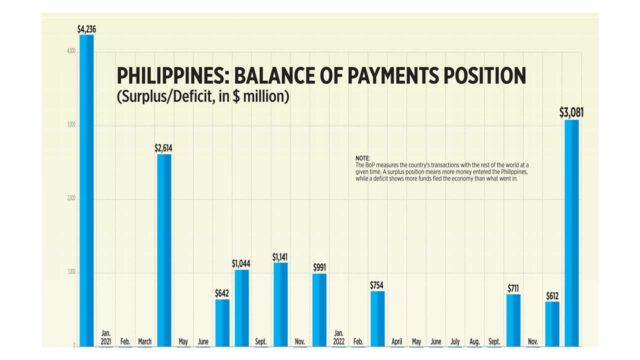
Philippines: Balance of payments position

THE PHILIPPINES’ balance of payments (BoP) position swung to a surplus in January from a deficit a year ago, reflecting the proceeds of the government’s global bond issuance, the Bangko Sentral ng Pilipinas (BSP) said on Monday. Read the full story.

Philippines: Balance of payments position

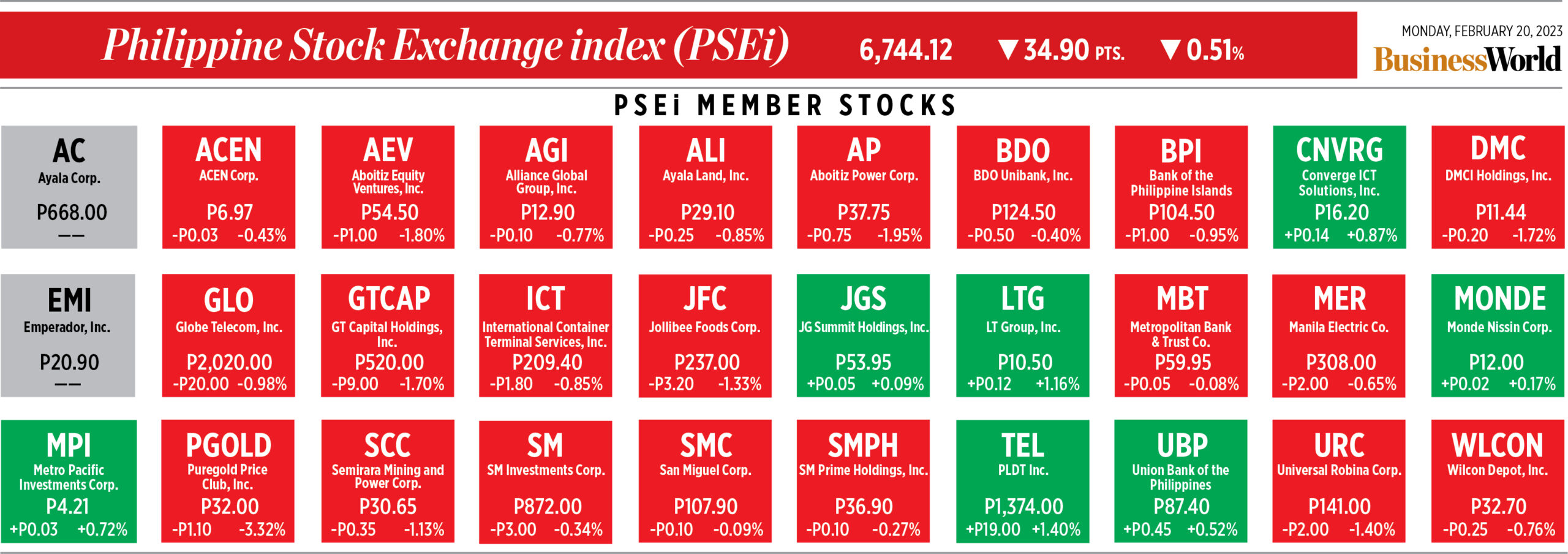
How PSEi member stocks performed — February 20, 2023

Here’s a quick glance at how PSEi stocks fared on Monday, February 20, 2023.


Peso rises on bets of more BSP hikes

BW FILE PHOTO

THE PESO strengthened against the dollar on Monday after the Bangko Sentral ng Pilipinas (BSP) signaled more rate hikes to come as it seeks to stem elevated inflation.

The local currency closed at P54.95 versus the greenback on Monday, appreciating by 29 centavos from Friday’s P55.24 finish, data from the Bankers Association of the Philippines showed.

The peso opened Monday’s trading session weaker at P55.31 per dollar. Its intraday best was its closing level of P54.95, while its worst showing was at P55.32 against the greenback.

Dollars traded went down to $717.4 million on Monday from $878.3 million on Friday.

“The peso appreciated following the impact of last week’s BSP monetary policy decision, wherein BSP Governor Medalla signaled at more local rate hikes this year,” a trader said in an e-mail.

Rizal Commercial Banking Corp. Chief Economist Michael L. Ricafort also said in a Viber message that the central bank’s policy decision and signals of another rate increase next month supported the peso against the dollar.

The BSP on Thursday hiked benchmark interest rates by 50 basis points (bps) for a second straight meeting, bringing its policy rate to 6%, amid higher prices and rising inflation expectations.

BSP Governor Felipe M. Medalla said after the meeting that they could not rule out a third or fourth rate increase this year, and could deliver a 25-bp or 50-bp hike at their next review on March 23.

Mr. Ricafort added that the peso appreciated after global crude oil prices eased over the weekend.

Oil futures fell sharply on Friday amid signs of ample supply along with concerns of more US Federal Reserve hikes, which could weigh on demand.

US crude settled down 2.74% at $76.34 per barrel and Brent finished at $83.00, down 2.51%.

However, on Monday, Brent edged up 58 cents to $83.58 a barrel, while US crude rose 45 cents to $76.79.

For Tuesday, the trader said the peso could weaken anew against the dollar on expectations of improved US manufacturing data.

The trader and Mr. Ricafort expect the peso to trade between P54.85 and P55.10 per dollar on Tuesday. — A.M.C. Sy

PSEi declines amid hawkish hints from Fed, BSP

STOCKS dropped on Monday as investors were cautious ahead of the release of minutes of the US Federal Reserve’s latest meeting and after the Bangko Sentral ng Pilipinas (BSP) hinted at more rate hikes moving forward.

The benchmark Philippine Stock Exchange index (PSEi) went down by 34.90 points or 0.51% to close at 6,744.12 on Monday, while the broader all shares index lost 13.94 points or 0.38% to end at 3,607.75.

“Philippine shares slipped ahead of the upcoming Fed meeting as US inflation weighed on investor sentiment. Market participants are overall still wary on Fed’s rate adjustments to tame inflation,” Regina Capital Development Corp. Head of Sales Luis A. Limlingan said in a Viber message.

“The PSEi ended lower for the third time as market continued to price in more rate concerns, with expectations for the Fed rate hike now moving to a 50 bps (basis points) next month from 25 bps,” AP Securities, Inc. Equity Research Analyst Carlos Angelo O. Temporal said in a Viber message.

Minutes of the Fed’s Jan. 31 to Feb. 1 meeting will be released on Wednesday. At that review, the US central bank raised its target interest rate by 25 bps to a range between 4.5% and 4.75%.

Some Fed officials have said they would support a bigger rate hike at their March 21-22 meeting following the release of data showing sticky US inflation.

The US consumer price index increased 0.5% last month after gaining 0.1% in December. In the 12 months through January, the  consumer price index increased 6.4%.

“The local bourse lost 34.90 points as investors remained cautious amid the hawkish stance of the Bangko Sentral ng Pilipinas and Fed,” Philstocks Financial, Inc. Research Analyst Claire T. Alviar said in a Viber message.

BSP Governor Felipe M. Medalla said after their policy meeting last week, where they raised borrowing costs by 50 bps, that a third or maybe fourth rate hike is likely this year.

He also said they could consider a 25-bp or 50-bp increase at their March 23 meeting.

All sectoral indices closed lower on Monday. Mining and oil declined by 136.33 points or 1.21% to 11,090.98; industrials dropped by 66.42 points or 0.67% to 9,726.54; property shed 14.44 points or 0.48% to end at 2,944.60; holding firms went down by 28.04 points or 0.43% to 6,457.34; financials lost 7.05 points or 0.38% to close at 1,811.75; and services inched down by 2.56 points or 0.15% to 1,700.57.

Value turnover declined to P3.3 billion on Monday with 483.44 million shares changing hands from the P5.68 billion with 851.14 million issues traded on Friday.

Decliners outnumbered advancers, 115 versus 72, while 47 names closed unchanged.

Net foreign selling declined to P43.79 million on Monday from P121.29 million on Friday.

AP Securities’ Mr. Temporal placed the PSEi’s support at 6,650 and resistance at 6,900, while Mercantile Securities’ Mr. See put support at 6,550 to 6,762 and resistance at 7,000 to 7,150. — Ashley Erika O. Jose

Domestic tourism seen fully recovered this year

PIXABAY

THE Department of Tourism (DoT) said it expects domestic tourism to make a full recovery this year with international tourism following in 2024 after travel disruptions caused by the pandemic.

“Even as the pandemic set back our gains, the momentum for recovery and growth is already here. We see domestic tourism recovering to 2019 levels this year, and international tourism next year,” Tourism Secretary Ma. Esperanza Christina G. Frasco said during a meeting of the Tourism Coordinating Council (TCC) Monday.

“The possibilities for Philippine tourism are endless. With your continued support we will accomplish our goals for a tourism industry that is a major economic pillar,” she added.

In 2022, the Philippines recorded 2.65 million international visitor arrivals. The DoT is targeting 4.8 million international visitors this year, still some distance from the 8.26 million international arrivals in 2019.

The Philippine Statistics Authority estimates that domestic trips totaled 37.28 million in 2021, still off their pre-pandemic level of 122.12 million in 2019. The data for 2022 are not yet available.

The TCC is the coordinating body for national tourism development efforts under Republic Act No. 9593 or the Tourism Act.

Ms. Frasco said the National Tourism Development Plan (NTDP) will help the country become a “tourism powerhouse.” 

The DoT is hoping to launch the NTDP by March of this year.

“The NTDP is framed by the strategic values of Philippine identity, sustainability, resilience, and global competitiveness. Our programs should reflect these values if we are to truly seize the opportunities for long-term growth for our industry,” Ms. Frasco said. — Revin Mikhael D. Ochave

Malampaya completes maintenance shutdown; gas deliveries resume

PRIME ENERGY Resources Development B.V. (Prime Energy), the operator of the Malampaya gas field, has resumed the supply of gas to power plant customers following the completion of maintenance, the Department of Energy (DoE) said.

In a statement, the DoE said Malampaya was shut down as scheduled between Feb. 4 and 18. It underwent maintenance without incident.

“The DoE welcomes the successful completion of the maintenance works on the Malampaya platform, pipelines and entire system,” the DoE said.

“The works were completed with zero incidents recorded. This was achieved through diligent planning and execution by the operator, Prime Energy, in coordination with the DoE,” the DoE said.

Energy Secretary Raphael P.M. Lotilla said that he expects to further upgrade the technical capabilities of Philippine energy suppliers.

Malampaya gas powers 27% of Luzon’s power requirements. During the shutdown, power plants supplied by Malampaya ran on liquid fuel.

First Gen Corp. said only its 420-megawatt (MW) San Gabriel plant went offline during the Malampaya shutdown.

Its other power plants, the 1,000-megawatt Santa Rita, 500-MW San Lorenzo and 97-MW Avion ran on liquid fuel during the two-week shutdown.

Upon the switchover to gas, ”San Gabriel went online at 7 a.m. today. Santa Rita 1 of four units is now on Malampaya gas. San Lorenzo and Avion have been on Malampaya Gas since past midnight,” First Gen said.

The other units of Santa Rita are still on liquid fuel as Malampaya ramps up its supply.

Prime Infrastructure Capital, Inc., through its subsidiary Prime Energy, is a member of the Malampaya consortium, which is exploiting Service Contract 38.

Prime Energy holds a 45% stake in the Malampaya project. The other members of the consortium, UC38 LLC and PNOC Exploration Corp., own a 45% and 10% interest, respectively. — Ashley Erika O. Jose

NTC uncertain about meeting deadline for shutting down analog TV

PHILIPPINE STAR/ MIGUEL DE GUZMAN

THE National Telecommunications Commission (NTC) said it is not certain it can meet its deadline for shutting down analog television because of the slower-than-expected digital TV rollout.

“We are still looking at this year, but this is still tentative,” NTC Commissioner Ella Blanca Lopez told reporters Monday.

The commission had originally intended to phase out analog television broadcasting in 2023, but Ms. Lopez said many households are still not digital-ready.

Mahirap naman na i-shutdown mo tapos hindi pa digital ready lahat (It will be too disruptive if we shut it down when not everyone is digital-ready),” Ms. Lopez said.

According to the commissioner, digital penetration nationwide has not yet hit 50% with most digital-ready households located in Metro Manila.

Mataas-taas na ang penetration sa Metro Manila, pero sa ibang region hindi pa. Malabo pa po yung sa provinces (The digital penetration in Metro Manila is high, but not in the regions. The provinces are not yet ready),” Ms. Lopez said.

Ms. Lopez said various networks have been rolling out digitalization initiatives to the regions in the footsteps of ABS-CBN.

Nagro-rollout na rin ang ibang networks (The other networks are also rolling out), so I think we will get there,” Ms. Lopez said. — Justine Irish D. Tabile

Preliminary estimate for ‘strategic goods’ exports at $4.5 billion in 2022, little changed — Trade dep’t

REUTERS

PHILIPPINE exports of “strategic goods” — military goods, as well as those with dual civilian and military applications — amounted to $4.5 billion in 2022, little changed from a year earlier, the Department of Trade and Industry (DTI) said in a preliminary estimate.

Trade Secretary Alfredo E. Pascual said Monday however that strategic goods trade is expected to grow going forward as the risk assessment process and the permitting system become more efficient.

“The potential trade in strategic goods is expected to increase as businesses become more confident about expanding their activities, considering the risk assessment criteria we apply to all export applications. For instance, (we guarantee that) US-headquartered companies’ Philippine counterparts (do not do business with) sanctioned individuals and entities,” Mr. Pascual said during the launch of the DTI’s Strategic Trade Management Office (STMO) e-licensing platform in Makati City.

Strategic goods include software and technology that could be used for military purposes, including the manufacture of weapons of mass destruction.

Exports of these products are governed under Republic Act No. 10697, or the Strategic Trade Management Act.

“The STMO has yet to verify the specific amount for last year, 2022, but it is estimated to be around the same $4.5 billion figure. The STMO is still validating the annual reports and reconciling the data with the Bureau of Customs,” Mr. Pascual said.

According to Mr. Pascual, information systems accounted for 98% of the Philippines’ strategic goods exports in 2021, while semiconductors and integrated circuits accounted for the remaining 2%.

“Our biggest trading partner is the United States with a 60% share. Next is Japan at 21%, Singapore 5%, South Korea 4%, and China 3%,” Mr. Pascual said.

Meanwhile, the DTI also launched on Monday the Philippine STMO e-licensing platform as part of the Cooperative Threat Reduction Agreement (CTRA) with the US.

The online platform will serve as the one-stop shop for all export control-related services.

“The e-licensing platform is also accessible 24/7 to all stakeholders. Safeguards have been placed to make transactions more efficient, transparent, and secure. Ultimately, this IT infrastructure project will facilitate the issuance of certificates to our industry stakeholders applying for the cross-border transfer of strategic goods,” Mr. Pascual said.

“The DTI expects this infrastructure to help increase industry awareness and compliance with the Strategic Trade Management Act law. This will significantly increase and improve the Philippines’ implementation of our international obligations, thus demonstrating our commitment to peace and security,” he added. — Revin Mikhael D. Ochave

Electric vehicle rollout strategy to incentivize ‘green’ transport routes

EREN GOLDMAN-UNSPLASH

THE Department of Transportation (DoTr) said its strategy for promoting electric vehicles (EVs) will focus on creating “green” transport routes whose operators will be granted incentives for deploying EVs.

“We will release a department order that will further enhance and promote EVs so we see their proliferation in the next couple of years. We will provide incentives and leeway for EVs to (operate on transport) routes,” Transportation Undersecretary Mark Steven C. Pastor said during a Stratbase ADR Institute briefing.

Mr. Pastor said the government is working on low-carbon urban transport systems to increase demand for EVs and make the 5% fleet quota mandatory for transport operators.

“There is also a proposed incentive for EVs to ensure the readiness of green routes, charging stations, and other support programs,” he added.

In January, President Ferdinand R. Marcos, Jr. approved the reduction of tariffs to zero for EVs.

Mr. Pastor also estimated there is a potential market for public utility vehicles at $6 billion, with road projects at $1.2 billion.

“We see transforming the public transport system as a whole as the precursor of the success of all other sectors,” he added.

However, he said the transport sector faces challenges like poor road quality, congestion, the high proportion of private to public vehicles, limited investment in transport infrastructure and road safety issues.

The Philippines loses P3.5 billion daily due to traffic, according to estimates by Japan’s development cooperation agency. The losses are expected to triple by 2030 if congestion is not addressed in Metro Manila.

Bureaucratic processes are also viewed as a hurdle to infrastructure projects.

“The risks that the government encounter include the delay in implementation due to various internal processes and requirements in the Philippines. There’s also a strong need to tailor-fit the solutions to adapt to the Philippine market,” Mr. Pastor said.

Mr. Pastor said the government plans to remove the red tape “so those who want to participate have the leeway to implement.”

“One of the main complaints of private sector is the number of permits being required by proponents in these projects,” Terry L. Ridon, a lawyer and convenor of think tank Infrawatch PH, added.

Makati Business Club Executive Director Francisco Alcuaz, Jr. said there is much overlap in the responsibilities of local and National Government (NG) agencies, resulting in delayed projects.

“We need to build capacity in the NG and LGUs (local government units). Streamline the requirements,” he added.

He said the process of fare regulation must be depoliticized to allow transport operators to realize returns on their projects.

Aboitiz InfraCapital, Inc. President and Chief Executive Officer Cosette V. Canilao recommended the greater adoption of information and communications technology (ICT) infrastructure.

“Our government operations can become more transparent with better ICT infrastructure now we are moving towards the digital economy,” she said.

Ms. Canilao said that the government should create an enabling environment for the private sector to invest in, citing incentives, frameworks, and a clear pipeline to help the sector prepare for bids.

Mr. Ridon said that the public should be involved in the decision-making process for key infrastructure projects.

“Ideas should be subject to testing and scrutiny to communities. Never second guess or underestimate public sentiment,” he said.

“In every forum or consultation, the public should be there and be invited by the government so they can articulate their ideas. There is a real public impact if we fail in implementing good projects. Every step of the way, the public should be involved,” he added.

The government should also prioritize using railways and buses over roads, Mr. Alcuaz said.

“We are overweight on roads, we would like to be overweight in transport — that’s railways and buses,” he said.

Mr. Alcuaz also called for the privatization of the EDSA busway system and for it to be turned into a full service contracting system.

“It’s time to seriously consider putting it in place in a privatized (mode). The EDSA busway is a hybrid between rails and buses. They reflect a more affordable way to put a rail system in place, that’s a very beneficial endeavor for the government to pursue,” he said.

”Most bus systems in the developed world are real service contracting systems. That’s something they can and should roll out and more and more bus routes around the country to ensure that we have timely and adequate service and reduce congestion when buses pile up,” he added. — Luisa Maria Jacinta C. Jocson

House panel approves flexible ODA funding, tourist VAT refund bills

REUTERS

A HOUSE BILL proposing a “blended financing” framework that hopes to unlock private-sector participation in development projects was approved the committee level on Monday.

The House ways and means committee approved an unnumbered substitute bill proposing to broaden the funding base for development projects to leverage the limited amounts of Official Development Assistance (ODA) available.

The panel also approved a bill seeking to allow value-added tax refunds for foreign tourists to encourage more visitor spending.

“Our neighbors and peers now benefit from blended financing in ODA (official development projects),” committee chairman Jose Ma. Clemente S. Salceda told the panel, noting that India and China are top recipients of blended financing. He added that European partners prefer this kind of framework to allow their private sector to contribute fundwing and expertise to participate in development projects.

If signed into law, the bill will allow an ODA grant component of only 15%, with the current 25% no longer deemed appropriate for the country’s stage of development, according to Mr. Salceda. The Finance department will be required to sign off on the rate, terms and grant component for ODA classified as ‘concessional.’

The measure also allows “the donor government, bilateral or multilateral agency, or international or multilateral lending institution (to) mobilize financing from private or commercial institutions in funding the loan or grant.”

The loan must be covered by a bilateral and multilateral agreement.

LGUs cwan also access ODA, but will still be subject to LGU borrowing guideliness.

The committee also approved a substitute bill proposing a value-added tax refund mechanism for non-resident tourists on goods that cost at least P3,000 and are exported from the Philippines within 60 days from purchase.

Nueva Ecija Rep. Mikaela Angela B. Suansing, who chaired the technical working group, said the amended threshold is similar to minimum transaction amounts of Thailand and Indonesia.

The Secretary of Finance may adjust the threshold amount based on changes in the administration cost for the refund; consumer price index; as well as changes in other market conditions.

It clarified that a tourist refers to a non-resident individual owning a foreign passport not engaged in trade and business in the Philippines.

John Paolo R. Rivera, associate director of the Asian Institute of Management, said that VAT refunds are common in countries with developed economies and self-sufficient tourism industries.

“VAT refunds will somehow encourage foreign tourists to come but remember that foreign tourists comprise approximately 20% of tourism receipts,” Mr. Rivera said in a Viber message. He also raised concerns on whether the government can make up for foregone revenues.

President Ferdinand R. Marcos Jr. last month expressed his support for a VAT refund scheme for foreign tourists by 2024.

The Tourism department said that 2.02 million international tourists visited the Philippines last year, generating approximately $3.68 billion in revenue. — Beatriz Marie D. Cruz

Farmers warn RCEP will damage other industries

PHILIPPINE STAR/MICHAEL VARCAS

The Regional Comprehensive Economic Partnership (RCEP) trade deal is expected to affect industries other than agriculture, farmers warned, with the resulting wave of imports expected to wipe out manufacturing.

“Whatever industry we have will be lost to RCEP. Imports will further displace our local output since RCEP will eliminate tariffs on 93% of our industrial tariff lines,” Kilusang Magbubukid ng Pilipinas (KMP) National Chairman Danilo Ramos said in a statement.

Mr. Ramos urged the government to instead prioritize the strengthening of domestic farming and fisheries production.

RCEP is a free trade deal involving the Association of Southeast Asian Nations (ASEAN), China, Japan, South Korea, New Zealand, and Australia.

Last week, 16 senators signed the committee report on the bill signifying the chamber’s concurrence to joining RCEP.

According to Jayson H. Cainglet, executive director of Samahang Industriya ng Agrikultura w(SINAG), Thailand and Vietnam prepared their agricultral industry to compete before joining RCEP.

Para huwag kang maiwan, ihanda mo yong sektor mo (To avoid being left behind, prepare your industries) Just look at these countries, hindi muna daanin sa pagpirma, unahan yan sa paghahanda ng sektor mo to compete globally (these countries did not sign the agreement to get their industries ready for global competition, they got their industries ready before signing) ,” he said in a briefing.

The Foundation for Economic Freedom (FEF) said it supports the agreement which it believes “will facilitate the expansion of regional trade and investment.”

“The agriculture sector’s uncompetitiveness today lies more on the protectionist and heavy-handed approach of the government in regulating agriculture over the years,” the group said in a statement Monday.

“Turning the situation around requires reintroduction of free market principles, starting with freeing up the land market allow greater consolidation and achievement of scaled economies in our agricultural production systems,” it added.

Earlier this month, Senate President and RCEP Sponsor Juan Miguel F. Zubiri said his target for ratifying the agreement is before Congress goes on its Easter break. — Sheldeen Joy Talavera

ADVERTISEMENT
ADVERTISEMENT