Home Blog Page 5224

Rescuers near Cessna crash site with hope of finding survivors 

MAYOR CIG BALDO JR

THE SEARCH and rescue team deployed to Mt. Mayon following a Cessna aircraft crash Saturday were already 300 meters away from the wreckage site as of Wednesday afternoon, according to authorities, traversing on foot with hopeof finding the four people on board.  

Our priority is still search and rescue as we hope for possible results later today,Cedric D. Daep, chief of the Albay Provincial Safety, Emergency, and Management Office, said during a live-streamed press briefing Wednesday morning. 

The responders include six firefighters and 11 members of the Philippine Army, according to the Civil Aviation Authority of the Philippines (CAAP).   

Camalig Mayor Carlos “Caloy” Irwin G. Baldo, Jr., the rescue operation’s ground commander, said during the briefing that they are also putting a high priority on protecting the team.  

He said they are executing flexibleplans to avoid the risk of further casualties.  

Investigators from the CAAP Aircraft Accident Investigation and Inquiry Board confirmed on Tuesday that the wreckage captured on camera by the team surveying the area was that of the missing Cessna aircraft.  

Once the wreckage site has been reached and the passengers are identified, they will be airlifted to an undisclosed area for further medical assessment,CAAP said.   

CAAP said the Cessna aircraft, owned by the Energy Development Corp., that went missing in Camalig, Albay early Saturday was carrying a pilot, a crew, and two Australian passengers.

Study TikTok audience to succeed on the platform, experts advise media 

REUTERS

For media outfits looking to build a lasting presence on TikTok, it is important to study the nuances of the platform’s community, according to experts. 

This means understanding the types of content that resonate with TikTok users, Kristoffer Eduard M. Rada, public policy head at TikTok Philippines, said during a digital literacy forum on Wednesday.  

“I encourage everyone who wants to enter into this space of educating certain audiences to also understand what these audiences are receptive to, because as you see on TikTok, there’s a certain way of doing it that’s very, very unique to the [platform],” he said.     

“It’s a very different community on TikTok,” Mr. Rada added. “Look into that and leverage that knowledge to produce good content.”

Understanding how the different social media platforms work – especially in the context of digital literacy – is crucial, according to Rachel E. Khan, journalism professor and associate dean at the University of the Philippines-Diliman’s College of Mass Communication.

“Part of digital literacy is for people to understand how a platform works, so they don’t get fooled by it when there are bad actors who want to use it in a negative way,” she said.

The Philippines has 43.3 million active TikTok users aged 18 and above.

Be quick, quippy, and quotable to be successful on TikTok, said Lyqa Maravilla, a registered psychometrician, podcast host, and educreator with 1.1 million followers on the platform.

News anchors are there as a mouthpiece, she also said. “But now people are asking, ‘Who are you to inform me?’”

“If they don’t get to know the person behind the account, they just don’t latch on that quickly, or they don’t stay for too long.”  

Ms. Maravilla also talked about the importance of community. “Once you have that community, they’ll be the ones to actively share your content, participate… and [even] defend you when people are going after you,” she said.  

Trust should be built around that community, said Malou C. Mangahas, the executive director of the Philippine Center for Investigative Journalism.  

Social media offers the opportunity to do something good, unique, and authentic, she said.

“Trust should be built on the sense that we want to do good for this country. I think everyone wants to tell a story, tell it right, and tell it well.” — Patricia B. Mirasol

Lady Chiefs rout Red Spikers in four sets for its 2nd win in a row

ARELLANO University (AU) recovered from a second-set meltdown as it bested San Beda College, 25-11, 25-27, 25-7, 25-12. — NCAA/GMA-SYNERGY

Games Friday
(San Andres Complex)
9 a.m. — SSC-R vs LPU (M/W)
2 p.m. — Mapua vs Letran (W/M)

ARELLANO University (AU) recovered from a second-set meltdown as it bested San Beda College, 25-11, 25-27, 25-7, 25-12, yesterday to join University of Perpetual Help at the helm in the women’s division of the NCAA Season 98 Volleyball at the San Andres Complex.

After dominating the opening set, the Lady Chiefs lost concentration in the second set that allowed the Red Spikers to steal it and knot the match at one set apiece.

Good thing AU recovered its wits and blew away San Beda in the last two sets to claim its second win in a row.

San Beda sputtered to 0-2.

And the merry Obet Javier-mentored women from Legarda did it with a balanced attack spearheaded by Laika Tudlasan, who uncorked a match-best 15 points that included six booming aces.

Also taking turns were Pauline de Guzman, Marianne Padillion, Dodie Risa Joy Patindaan and Donnalyn Mae Paralejas, who scattered 14, 13, 11 and nine hits, respectively.

Arellano University also did it with its almost impenetrable net defense as it scored on 15 kill blocks including five by Ms. De Guzman and four by Ms. Batindaan while capitalizing on its serves in scoring a whopping 19 aces.

Earlier in the men’s section, AU edged San Beda, 25-23, 26-24, 22-25, 23-25, 16-14, to likewise nail its second straight win. — Joey Villar

PLDT shoots for another big win as it clashes with Petro Gazz Angels

PLAYING smooth as silk, the PLDT High Speed Hitters blitzed the Chery Tiggo Crossovers, 25-13, 25-22, 27-25. — PVL

Games Thursday
(Filoil EcoOil Center)
4 p.m. — Choco Mucho vs Army Black Mamba
6:30 p.m. — Petro Gazz vs PLDT

FRESH from its merciless demolition of Chery Tiggo, PLDT shoots for another big win and a share of the lead as it clashes with Petro Gazz today (Feb. 23) in the Premier Volleyball League All-Filipino Conference at the Filoil EcoOil Center.

Playing smooth as silk, the PLDT High Speed Hitters blitzed the Chery Tiggo Crossovers, 25-13, 25-22, 27-25, to nail their second straight win in three starts and catch the Petro Gazz Angels at No. 4.

The winner in their 6:30 p.m. showdown will leapfrog straight to the top alongside Chery Tiggo, Creamline and F2 Logistics on identical 3-1 slates.

And PLDT is hoping it could sustain the same spectacular form it showed the other night.

Mr. Ricafort is looking forward to playing Petro Gazz, the team he steered to last year’s Reinforced Conference title before he moved to PLDT.

In that duel, he will face his successor, former Choco Mucho Flying Titans mentor Oliver Almadro.

PLDT is expected to rely more on its new recruits, Mary Anne Mendrez and Michelle Morente, who fired 14 and 10 points, respectively, in that massive victory over Chery Tiggo.

“I’m thankful I was given a chance to return but I feel to be more consistent and play with less errors,” said Ms. Morente, who last suited for Army Black Mamba a year ago.

In the other game, Choco Mucho Flying Titans(1-2) and Army Black Mamba Lady Troopers (0-3) face off at 4 p.m. and breath life to their semifinal hopes. — Joey Villar

UAAP women’s volleyball kicks off at MOA Arena

Reigning champion team National University Lady Bulldogs — THE UAAP

National University vs Adamson University in opener

REIGNING champion National University (NU) is still the barometer but all teams agreed in declaring the climb to the top as a wide-open race this time in the highly-anticipated UAAP Season 85 women’s volleyball tournament firing off on Saturday at the Mall of Asia Arena.

All eight coaches were in unison to declare everyone as the “team to beat” given the long offseason preparations this time around compared to Season 84 when teams had to adjust under the new normal and little to no warm-up events due to the pandemic.

“You must prepare for all the team,” said Shaq Delos Santos of University of the Philippines, one of the returning UAAP mentors along with Adamson’s Jerry Yee and Far Eastern U’s Tina Salak.

“We respect every team so we should be ready and well-prepared against everybody,” added NU mentor Karl Dimaculangan as the Lady Bulldogs shoot for back-to-back crowns.

Just right after the compressed Season 84 last June, the entire Philippine volleyball landscape sprung back to action with a bevy of local tournaments led by the inaugural Shakey’s Super League (SSL) Pre-season Conference.

NU, with an intact core that completed a 16-0 campaign in Season 84 for its first title in 65 years, went on to sweep De La Salle University as well — making the Lady Bulldogs an even stronger force to deal with according to Ateneo de Manila University mentor Oliver Almadro.

“NU is the champion team while De La Salle University, Adamson University and University of Santo Tomas have intact line-ups. We have to watch out for them,” he said as the Ateneo Blue Eagles also ruled the V-League Collegiate Conference late last year as part of their UAAP build-up.

NU’s sweep last season prompted a stepladder Final Four featuring runner-up De La Salle with semifinalists Santo Tomas and Ateneo. Adamson barely missed the cut at No. 5 after a knockout loss to Ateneo.

Meanwhile, Commissioner Michael Verano said a challenge system will be implemented starting in the second round of the eliminations. The UAAP will also shift back to pre-pandemic routines, including allowing handshakes and changing courts, and the opening of the patron area to the audience.

Adamson and NU take centerstage in the opener this Saturday against University of the East and Ateneo, at 12 p.m. and 2 p.m., respectively. Their men’s counterparts also see action at 10 a.m. and 4 p.m. — John Bryan Ulanday

FIFA Women’s World Cup trophy tour at Glorietta on March 1

THE FIFA Women’s World Cup trophy — ANK KUMAR

THE PHILIPPINES will host the FIFA Women’s World Cup Trophy Tour on March 1-2 ahead of the Filipinas’ dream stint in the prestigious football showpiece.

The trophy to be contested in the July 20 to Aug. 20 Women’s World Cup (WWC) in New Zealand and Australia will be up for public viewing on March 1 at the Glorietta Activity Center from 3 p.m. to 6 p.m. to highlight the Manila stop.

Aside from giving Filipinos a good look at the coveted trophy and photo opportunity, fans can partake in mini games like freestyle football, penalty shootouts and skills and header challenges during the tour.

“We are delighted to welcome the FIFA Women’s World Cup trophy in Manila as the excitement continues to build up for the Filipinas’ debut in the most prestigious women’s football tournament in the world,” said Philippine Football Federation (PFF) President Nonong Araneta.

PFF General Secretary Edwin Gastanes hopes that this activity will inspire Filipino fans and players alike, especially the youth.

“It is a unique moment for everyone to see the trophy, which is only seen during the official draw and final match of the Women’s World Cup,” he said.

The Filipinas are deep in preparation for their WWC. Yesterday, they wrapped up their campaign in the tough Pinatar Cup in Spain, where they took a 5-0 beating from powerhouse Iceland. This came after bowing to Wales, 1-0, and Scotland, 2-1, in their initial assignments. — Olmin Leyba

Real Madrid come from two down to earn stunning 5-2 victory at Liverpool

REAL MADRID’S Vinicius Junior celebrates scoring their second goal. — REUTERS/PHIL NOBLE

LIVERPOOL, England — Holders Real Madrid produced a stunning comeback from two goals down to earn a devastating 5-2 victory at a shell-shocked Liverpool in the first leg of their Champions League last-16 tie on Tuesday.

Two goals each from Vinicius Jr. and Karim Benzema turned what had looked like being an unpleasant evening for Real into a stylish romp that left Juergen Klopp’s side flat on the canvas and facing a monumental task to reach the quarterfinals.

It was Liverpool’s heaviest home defeat in Champions League history, eclipsing a 3-0 loss to the same opponents in 2014.

In a re-run of last year’s final, the first half was played at a ferocious pace, with the hosts racing into a fourth-minute lead through a superb Darwin Nunez flick — the quickest goal Liverpool have ever scored at Anfield in the Champions League.

The stadium erupted 10 minutes later when an horrendous miscontrol from Real goalkeeper Thibaut Courtois let Mohamed Salah in for the second, with the Egyptian now Liverpool’s all time top goalscorer in European competition.

Yet just as they did on several occasions en route to their 14th European Cup crown last season, Real quickly turned things around, with Mr. Vinicius scoring one sublime strike and one fluke goal after another goalkeeping mistake to level the match by halftime.

A bullet Eder Militao header completed the turnaround for Real early in the second half, sapping all the life out of Anfield in the process.

The hosts’ misery was not done there, however, as Mr. Benzema’s double ensured Liverpool shipped five goals at home for only the third time this century in all competitions.

“It’s an important night for us, we showed personality and scored the goals we needed. We want this Champions League title,” Mr. Benzema told Movistar Plus.

“We struggled in the beginning, they started well, better than us, it was a big game. But we managed to turn things around. We are in a good position but football is tricky and we have to close the deal at home.”

Mr. Klopp said in the run-up to the match that he had been unable to rewatch last season’s final, which Real won 1-0, until this weekend, insisting doing so was torture, reliving how Liverpool had their chances to claim victory in the Paris showpiece.

Fourteen minutes in at Anfield and some form of redemption seemed to be on the cards for the Liverpool manager.

First, Mr. Nunez darted onto Mr. Salah’s pinpoint pass and flicked the ball through his legs into the net, before the Egyptian’s record-breaking goal, from a mistake by Mr. Courtois, who was man of the match in the Paris final, made it two.

A player of Mr. Vinicius’ ability only needs one chance and a superb slotted finish from the edge of the penalty area started the comeback, before Mr. Alisson fired the ball at the Brazilian, with the rebound bouncing into the unguarded net.

The second half was a lesson in how to kill a game, and potentially the tie, from Real, who did not give Liverpool an inch and took their chances clinically.

Mr. Militao’s superb header from Luka Modric’s corner was unstoppable, but there was more than an element of fortune about the fourth as Joe Gomez deflected Mr. Benzema’s effort over the stranded Mr. Alisson.

Mr. Benzema’s second was expertly put away on the counter, as the Real striker coolly took his time to find the net and finish the hosts off. The Frenchman has scored six goals against Liverpool in the Champions League, more than any other player.

“It’s hard to sum it up straight after the game,” Liverpool captain Jordan Henderson told BT Sport.

“Mixed feelings. Frustration with the result. For large parts of the first half we performed well and were unlucky to be level at halftime. We made too many mistakes. Real Madrid punished us every time tonight.” — Reuters

CSC, PSC revisit plans on gov’t eligibility grant to nat’l athletes

THE CIVIL Service Commission (CSC) and the Philippine Sports Commission (PSC) have agreed to revisit plans on the possible granting of government service eligibility to national athletes who won medals in various international games.

“As the CSC welcomes the chairmanship of PSC Chairman Richard Bachmann, we also want to reiterate our support to our national athletes who achieved podium finishes for the country,” said CSC Commissioner Aileen Lizada in her courtesy visit at Rizal Memorial Sports Complex last Tuesday.

Ms. Lizada added that “the current examinations for eligibility would not totally capture the skill set of our national athletes. That is why we are pushing for this special grant so that they may still be in government service after their careers and help them ensure their future.”

“We thank the CSC for this initiative in supporting the PSC’s vision of changing the lives of our national athletes for the better, whether at their current or post-sports careers,” said PSC Chairman Richard Bachmann.

The sports agency chief believes that it is good to have athletes in corporate and government institutions because of their undivided dedication and commitment to serve.

In February 2020, the CSC initially proposed this plan to the PSC, noting that the crafting of terms of this future agreement shall be derived from the existing policies of the Republic Act No. 6847 — the Philippine Sports Commission Act, and Republic Act No. 2260, also known as Civil Service Act of 1959.

Under the Civil Service Act, Sub-Professional Eligibility qualifies applicants for first level positions such as clerical, trade, and custodial service positions which require less than four years of college education.

On the other hand, Professional Eligibility, qualifies one for first and second level positions such as professional, technical, and scientific positions that require four years of college education.

PHL Facebook users uninterested in monthly subscription service — informal poll

PHILSTAR FILE PHOTO

Following Meta Platforms, Inc.’s announcement on Sunday that it would test a $14.99 monthly subscription service that allows users to verify their Facebook and Instagram accounts using a government ID, many Filipinos appear unenthusiastic about the feature and are unwilling to pay for it.

An informal poll set up by BusinessWorld on its Twitter page on Monday has received 59 responses as of Wednesday, indicating that 95% are unwilling to pay for Meta Verified, the subscription service which will be available for direct purchase on Instagram or Facebook in Australia and New Zealand starting later this week.

Though gradual launches in other countries are set to follow, there is yet to be news of a launch in the Philippines.

The subscription bundle for Instagram and Facebook includes a blue badge on verified accounts and extra protection against impersonation. It will be priced starting at $11.99 per month on the web or $14.99 a month on Apple’s iOS system and Android. 

“I don’t understand why we have to pay for them to verify and protect our accounts. Shouldn’t it be possible for all users anyway without them profiting from it?” said Analyn B. Nance, a Facebook user who answered the poll, via Messenger. 

Meta Chief Executive Officer Mark Zuckerberg touted Meta Verified as one of their upcoming products that aims to “empower creators to be way more productive and creative” as well as add revenue to support the technology for Meta’s large user base. 

Last month, Twitter announced that Twitter Blue will be priced at $11 per month for iOS and Android subscribers. It added this week that only Twitter Blue subscribers will be able to use two-factor authentication (2FA) text messages after March 20. 

“We have seen phone-number based 2FA be used – and abused – by bad actors. Starting today, we will no longer allow accounts to enroll in the text message method of 2FA unless they are Twitter Blue subscribers,” the company said on Friday. 

To authenticate their Twitter log-ins at no cost, non-subscribers will have to use an authentication mobile app and a security key. — Brontë H. Lacsamana

DoST-backed program explores medicinal potential of local plants 

The Department of Science and Technology (DoST) said it is supporting a program that explores local plants’ medical potential for diabetes, cancer, and inflammation.  

Led by Irene M. Villaseñor of the University of the Philippines Diliman, the health products formulation program aims to develop standardized and stable dosage forms of selected plant extracts, the department said in a statement. 

Once the formulation is completed, the project team will scale up and produce enough dosage forms with the goal of testing their safety and efficacy through pre-clinical and clinical stages.    

“Herbal medicine plays a large role in the community and is well-accepted in the rural areas,” said Executive Director Jaime C. Montoya of the DoST-Philippine Council for Health Research and Development. 

“Validating the use of these traditional medicinal plants through research is a step closer into bridging the gap between evidence-based research and our fellow Filipino people,” he added. 

The program has studied seventeen undisclosed plant extracts. It has also made inert formulations for eight spray-dried extracts (SDEs), or ethanolic plant extracts which are dried using a spray drying process. The SDEs are tested for their physical, phytochemical, and microbial properties, and subjected to stability testing. Those deemed stable SDEs are then used for dosage formulation and undergo standardization.  

The second phase of the program, which began in Sept. 2021, is expected to be completed in Sept. this year. It has a total funding of P65,784,206.56 from the from the DoST. 

It is under the Tuklas Lunas Program, DoST’s drug discovery and development initiative. Tuklas Lunas aims to produce medicines derived from Philippine biodiversity by leveraging on local expertise.  

The Philippine terrestrial and marine habitats contain some of the richest biodiversity of flora and fauna. About two-thirds (65%) of its over 10,000 plant species are endemic (or limited to a particular locality), according to the World Wildlife Fund, an international conservation organization.  Patricia B. Mirasol

Fighting Inflation: Non-monetary Measures

PHILIPPINE STAR/ WALTER BOLLOZOS

IN A FEB. 20 news article in BusinessWorld, Finance Secretary Benjamin Diokno was quoted as saying, “The monetary authorities have done their part; the Executive department, including LGUs, have to do more, be more aggressive and focused. In the fight against inflation, monetary policy is not the only game in town.”

We agree that there is basis for the statement of our finance secretary. The 14-year record January inflation rate of 8.7% is due to food (10.7%) and to transport (10.9%). Such a high inflation rate is not demand driven, meaning there was no sudden increase in demand for food or gasoline. The inflation is supply driven, meaning the supply of food (Department of Agriculture) and oil (OPEC+) has been restricted and so prices have risen.

The way to fight this type of inflation is not by raising the interest rate which seeks to lower demand, but to increase the supply or, even better, to buy or obtain the supply at a much lower price. Thus, if we follow the example of India and buy Russian oil at a discount, we could lower our price of gasoline by 30%. By the way, we are now allowed to import Russian oil so long as the price is at $60 per barrel or lower.

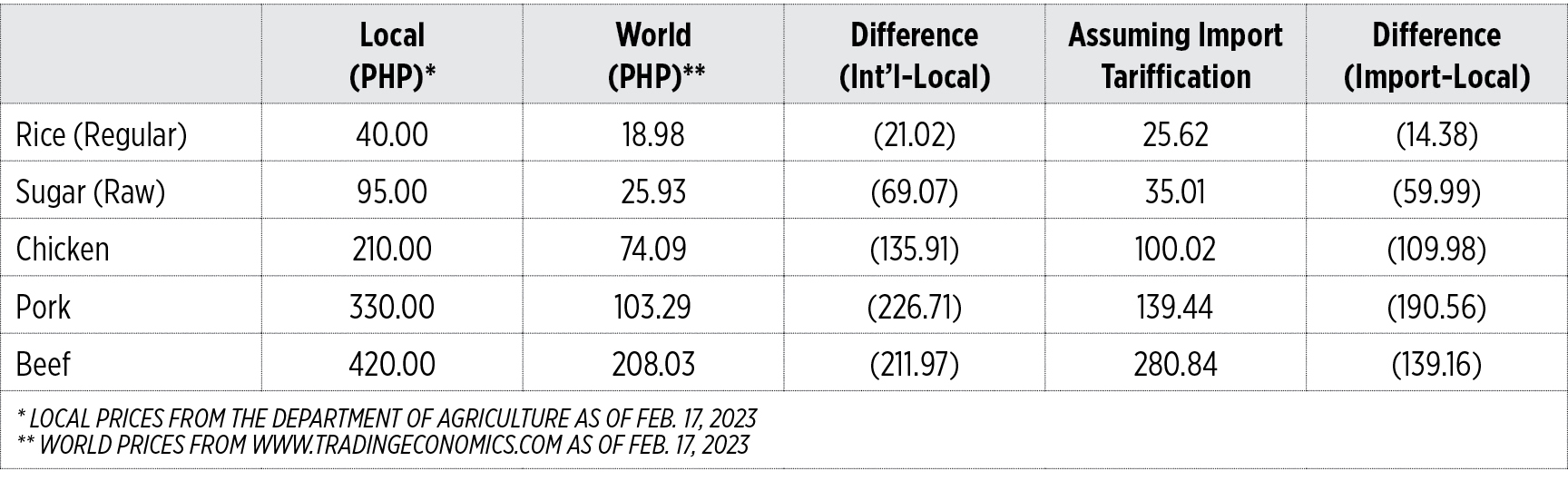
With respect to food, we could, as suggested by the finance secretary, import the food that is priced lower in the world market. For example, the local price of sugar is P95 compared to the world price of P25.93.

Presented in the table below are the local and world prices of selected food commodities with assumed tariff rate of 35%.

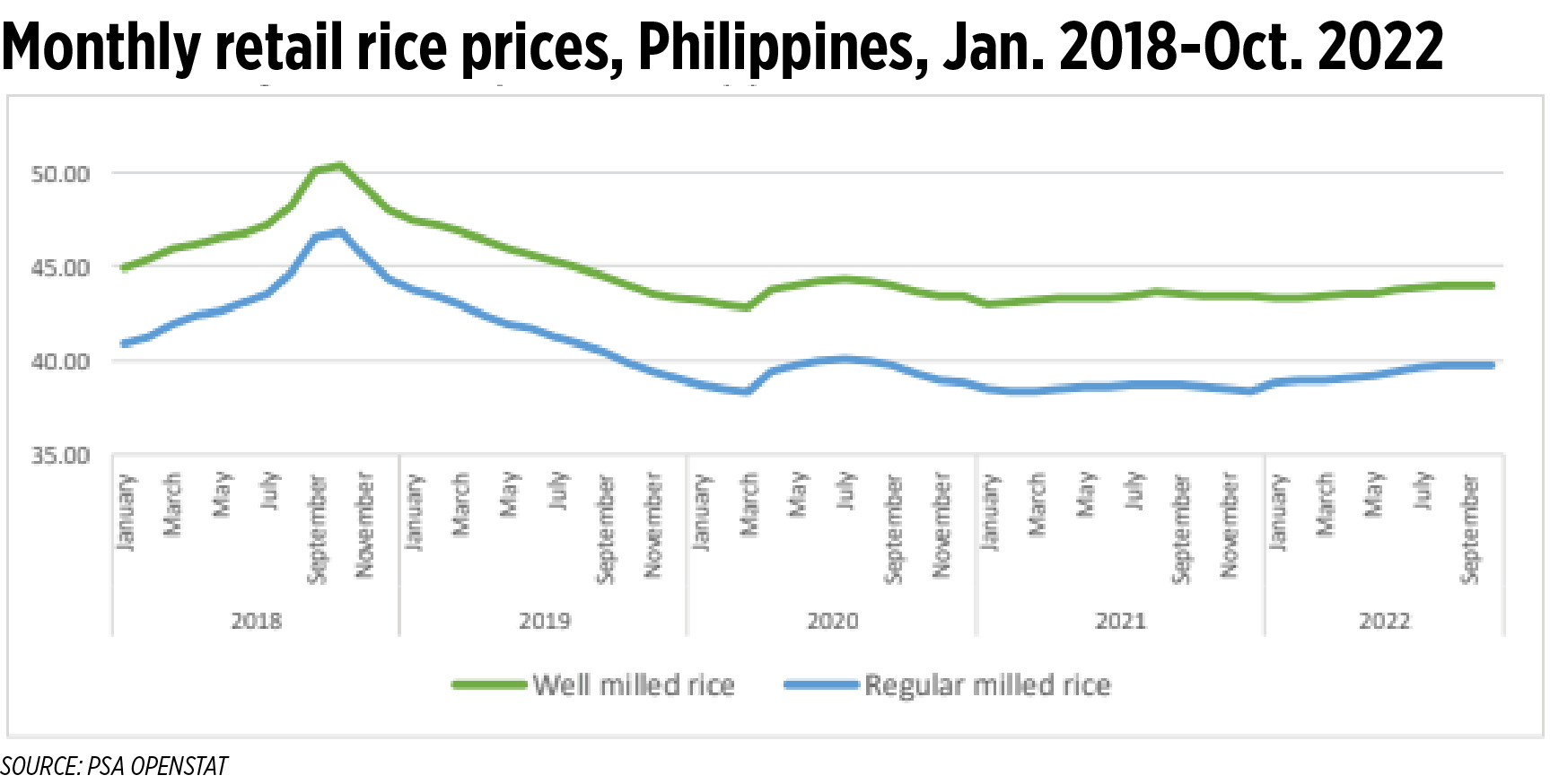
Moreover, we have already used this approach in fighting inflation. In 2018, during the Duterte Administration, due to the miscalculation of National Food Authority (NFA), the price of rice rose from P40 to as high as P50. Faced with his declining popularity, the Duterte Administration passed the Rice Tariffication Law.

This enabled the private sector to import rice by paying a 35% excise tax. The result of this law is that the price of rice is still stable at P40 while the rice farmers have received at least P10,000 each in direct cash subsidy as well as other benefits from the excise tax. (“Rice farmers receive P8.2 billion from DBP and LandBank since 2019,” BusinessWorld, June 13, 2022)

Our monetary authorities have issued a call for help from our non-monetary government agencies. Hopefully they will answer the call.


Dr. Victor S. Limlingan, who has PhD in Business from Harvard University, is a former professor at the Asian Institute of Management.

Moving people and cargo

PHILIPPINE STAR/ MICHAEL VARCAS

On the railway front, it seems things are about to get worse before they get better. The government wants to deliver better railway service by 2028. But to do so, it needs to shut down the Philippine National Railways (PNR) starting this year. According to transport officials, the shutdown will allow for cheaper, faster line modernization in next five years.

Obviously, an empty house is easier to renovate than an occupied one. Residents are best moved out temporarily, to allow for faster — and thus possibly cheaper — work. On the other hand, to completely shut down the one and only heavy gauge railway operating north to south through Metro Manila — and for five years at that — will have its adverse consequences.

In building the Metro Manila Skyway, contractors found “creative” ways to go about the work without necessarily having to shut down existing tollways. The same applied to airports and seaports and light rail lines that were upgraded. In short, land, sea, and air travel were all upgraded without having to completely shut down service for five years. Can’t the government do the same for the PNR?

The Skyway was an elevated tollway built over an existing tollway, partly over the Pasig River, and partly over existing Metro Manila roads. None of the at-grade tollways or roads were completely shut down for a prolonged period to get the work done. In the case of PNR’s modernization, a new elevated track will be built also over the existing at-grade track in some parts of Metro Manila. Elevated stations will also be built.

In the interest of safety and expediency, since power and water lines located along the tracks will also have to moved, the government is opting to shut down PNR while construction is ongoing. And since the project will make use of the existing PNR “alignment” or tracks line, new land acquisition will be minimized. Even utilities relocation can be minimized.

Transportation Undersecretary Cesar Chavez told a House hearing that PNR would have to suspend all rail services between Malabon City and Calamba for about five years to hasten by eight months the construction of the P873.62-billion North-South Commuter Railway (NSCR). The shutdown will allow the government to quickly lay down new elevated tracks, save on land acquisition, and expedite relocation of water and power lines, and thus generate over P15 billion in savings.

The NSCR project, to be financed by Japan, includes new tracks from Pampanga to Laguna, the construction of railway viaducts and elevated train stations at Blumentritt, España, Sta. Mesa, and Paco in Manila; and new train stations from Manila to Taguig, Parañaque, and Muntinlupa onwards. The project aims to connect by 2028 the Clark International Airport in Pampanga to Malolos in Bulacan, then to Tutuban in Manila, then all the way down to Calamba in Laguna.

A tunnel will also be built to connect the North-South train line with the Metro Manila Subway. This will be under a separate contract that includes a 4.7-km underground rail and 1.7-km at-grade rail to connect the train’s FTI station to the subway’s Senate station. There will also be a subway line from the Senate to Lawton, which will then again connect the subway to the train going north.

By shutting down the PNR for five years, the government will gain eight months lead time and P15 billion in savings, Mr. Chavez said. The plan is seen as cost-effective. Anyway, PNR ridership has dwindled from a high of 50,000 daily pre-pandemic to about 20,000 to 25,000 now. Also, for the Alabang-Calamba line, the daily ridership is only about 2,000. More affected by the shutdown would be passengers to and from Tutuban, Manila and Makati, he added.

Thus, alternative modes of transportation will be offered, Mr. Chavez added. The Land Transportation Franchising and Regulatory Board (LTFRB) is expected to provide for more land transport options over routes to be affected by the temporary closure. Special franchises may be issued to select buses to service the affected routes and make stops near PNR stations.

The shutdown plan is most likely backed by study, especially with Japan financing the railway project. The concern, however, is that to-be-displaced train passengers will soon find themselves back on Metro Manila roads as PUV commuters. And this also means additional buses being dispatched on roads smaller and narrower than EDSA that run parallel to the train line.

For sure, this alternative mode will further congest Metro Manila roads and create even more traffic gridlocks. In short, for Metro Manila residents, whether motorists or users of public utility vehicles, things are bound to get worse within the year. All in the hope that public transport — after five years — will improve as we open a new commuter train line and a subway system.

There is no doubt that PNR, which previously ran to northern and southern Luzon in the 1950s to the ’70s, should be fully rehabilitated to become once more an effective and efficient transport for people and cargo in and out, and within, Metro Manila. That is, if the modernization plan is pursued in earnest.

As I wrote in a previous column, in many industrialized countries, prioritizing investments in mass transit infrastructure proved crucial to ensuring economic success. The Philippines can have only so many airports and seaports. Travel in the interior, and to and from and within cities, will be best served by a combination of efficient rail systems and rapid bus systems.

Traffic and congestion, particularly in densely populated urban areas, cannot be addressed by expanding the road network or by electronic road pricing systems. Mass transit is the more efficient solution. The rehabilitation, further expansion, and modernization of the PNR is the better option, in my opinion.

But rehabilitating heavy gauge rail at ground level is fairly easier to work on than those underground or overhead. Little to no digging is required, and all stations are above ground as well, requiring only new platforms and waiting sheds plus a few other creature comforts. However, at-grade rail can be affected by flooding, unlike elevated railways.

In the end, the PNR is opting for an elevated railway, at least in some parts. And this will make the rehabilitation work more difficult, thus necessitating a shut down for five years. But my greater concern with this option is that it limits the PNR’s ability to haul cargo to and from Manila’s port area to destinations in North and South Luzon.

The importance of the PNR, to me, includes its trains’ ability to haul bulk and containerized cargo. This is crucial to a growing economy like ours. Freight rail can help take more cargo trucks off roads during peak hours. Fewer cargo trucks also lighten the “load” of roads, making their maintenance easier. Cargo trains can also run for 24 hours and do not encounter traffic or port congestion. Heavy gauge at-grade rail can take even double-stack containers — one shipping container on top of another on a rail car.

However, it is not likely for an elevated train line — as what is planned for the PNR now — to take heavy bulk and containerized cargo. Double-stack will not be an option. As such, perhaps the government can consider dividing the line into commuter and freight, with freight service perhaps going to the private sector to modernize and operate. This may mean building two rail networks running on top of one another — passengers on top, and cargo at the bottom.

If the government will opt for modernizing the railway only for passenger travel, then this may be short-sighted. It will miss the golden opportunity to build things better, and to help further improve trade and commerce and quickly grow the economy by efficiently moving not only people but cargo as well. It is time to get cargo off our roads and onto the tracks.


Marvin Tort is a former managing editor of BusinessWorld, and a former chairman of the Philippine Press Council

matort@yahoo.com