Home Blog Page 5164

Nvidia, AMD grapple with latest US curbs on China’s Inspur Group

TRUSTPAIR.COM

NVIDIA CORP., Advanced Micro Devices Inc. (AMD) and other tech firms are scrambling to assess whether they must halt sales to units of China’s Inspur Group Ltd. after its addition to a US export blacklist last week.

The United States last week added Inspur to its trade blacklist for allegedly acquiring US-origin items in support of the China’s military modernization efforts. The listing means that companies cannot sell Inspur items like semiconductors, which are made with US tools, unless they apply for and get licenses, which are likely to be denied.

A US Department of Commerce spokesperson told Reuters on Tuesday that it “is reviewing Inspur Group Co. Ltd.’s Entity List entry and will update it as appropriate,” referring to the official name of the export blacklist.

Executives from AMD and Nvidia were questioned about dealings with Inspur Group Co. Ltd. at an investor conference on Monday. AMD said it was seeking clarification on the rules.

While not a household name, Inspur’s Chinese-listed subsidiary had nearly $10 billion in sales in 2021 and Inspur Group is the world’s third-largest supplier of the servers used in data centers that power cloud computing, according to market research firm IDC figures for the third quarter of 2022, the most recent available.

But chip industry insiders and their advisers said firms are trying to assess whether they must halt supplying Inspur’s subsidiaries, including Inspur Electronics Information Industry Co., which is not automatically subject to the restrictions.

US regulators could view unlicensed shipments to that subsidiary as a violation of last week’s listing if there is a risk of the goods going from the unlisted subsidiary to the listed parent.

Inspur Electronics Information Industry Co. has the same corporate address as the blacklisted parent company. The company on Monday proposed changing its address in a filing. The proposal, which shareholders will vote on later this month, did not specify a new address.

“Shipments to related entities constitute a ‘red flag’ due to the risk of diversion,” the Commerce department spokesperson said in a statement.

Inspur did not return a request for comment. Last week, an official from the Chinese Embassy in Washington told Reuters that China was “firmly opposed” to the placement of Inspur and 27 other companies on the trade blacklist.

A Chinese Foreign Ministry spokesperson last week also said the US was “once again cracking down on Chinese companies under false pretexts through unfair means.”

Dan Fisher-Owens, an export law attorney at Berliner Corcoran & Rowe who works with chip firms, said many of his clients have paused shipments to Inspur’s subsidiaries to assess the situation.

At an investor conference in San Francisco on Monday, Nvidia Chief Financial Officer Colette Kress said the company will “follow export controls very closely” but did not comment on whether Nvidia has stopped shipping to Inspur subsidiaries.

“We will probably be working with other partners,” Ms. Kress said. An Nvidia spokesperson declined to comment beyond her remarks.

An AMD spokesperson did not return a request for additional comment on AMD Chief Technology Officer Mark Papermaster’s remarks made at the same conference.

Inspur’s listing is even more restrictive than many other companies on the US Department of Commerce’s “entity list,” and may be comparable to the curbs placed on China’s blacklisted telecommunications company, Huawei Technologies, one person familiar with the matter said.

As with Huawei, the listing restricts the shipment of products to Inspur even if they are made in a foreign country but with US technology. Those products also cannot go to Inspur’s subsidiaries if the blacklisted corporate parent is considered a party to the transaction, under a broad definition of the term, the person said. — Reuters


Food Review: The scent of truffles

By Joseph L. Garcia, Reporter

WE never thought we’d see truffle-roasted chicken from a fast-casual brand, but here we are.

Last month, Kenny Rogers Roasters launched its Truffle Roasted Chicken, loaded with the promise of luxury from the strong-smelling and very expensive fungus. Delivery and transportation platform Grab partnered with the chain so the chicken could be brought to the home in splendor. According to a statement, if one orders an item from the Kenny Rogers Roasters’ Truffle Collection, the Grab rider will be dressed in gold, with a golden motorcycle.

When Kenny Rogers Roasters’ gave BusinessWorld a tasting earlier this month, sadly, we weren’t at home to witness the spectacle. The chicken, marinated in truffle extracts and drizzled with truffle oil, arrived in gold foil to drive the point home. It had the scent of truffle, yes; but it faded away quickly and the truffle taste had become a mere suggestion. The original taste from Kenny Rogers was very evident though, and it brought satisfaction still.

We would, however, recommend the Truffle Mac & Cheese (solo: P180; platter: P539). Perhaps the truffle oil clung better to cheese, because even if we served it cold and the pasta had gone mushy from staying in an insulated bag for a few hours, this had a richer truffle flavor and scent than the chicken itself.

The Truffle Roasted Chicken is available as combination meals. There’s the Truffle Roast Solo B plate (P300), with a quarter roast chicken, a choice of two side dishes, rice, and muffin; and the Truffle Roast Group Meal (P1,065) which includes a whole roast, four side dishes, four cups of rice, four muffins, and a 1.5 liter bottle of soda.

Frankly, we’d rather have the Chimichurri chicken back, which had been available on a limited-time promo. That recipe could stand up to those from more expensive restaurants, and at least according to a release earlier this year, that promotion helped farmers.

In January, Kenny Rogers Roasters initiated the Farmvocacy campaign where every purchase of its best-selling Chimichurri Solo Plate offers support to local farmers. A portion of sales from every Chimichurri Solo Plate purchased via dine-in, takeout, and delivery, was donated to select local farmer groups. These non-government organizations (NGOs) included Tabang sa Dunong in Bicol, Vizcaya Fresh from Nueva Vizcaya, and Mapalad Ka from Mindoro. “The proceeds will be used in operational and processing section or infrastructure in the farms to ensure sustainability, better yields and land cultivation,” said a statement.

Kenny Rogers Roasters’ menu offerings are available for dine-in, takeout, or delivery through www.kennyrogersdelivery.com.ph, 8-555-9000, or via Grab Food and Food Panda.

AboitizPower expects to maintain growth in 2023

ABOITIZ Power Corp. said on Wednesday that the company is optimistic about maintaining this year its previous year’s growth to support the country’s transition to cleaner energy.

“As we move into 2023, we must maintain and build on this momentum. This year, we are ready to ride the waves of transformation as we leverage digitalization and innovation to improve our operations further,” AboitizPower President and Chief Executive Officer Emmanuel V. Rubio said in a media release.

In 2022, the energy company of the Aboitiz group reported a core net income of P26.5 billion, 27.4% higher than the P20.8 billion posted a year earlier due to fresh contributions from its coal-fired plants.

Including one-off gains, the energy company registered a net income of P27.5 billion in 2022, higher by 32.2% than the P20.8 billion recorded a year earlier.

Mr. Rubio said that the energy company will reinvest its gains to drive the company’s growth and to balance its renewable and thermal energy portfolio by 2030.

AboitizPower is targeting to spend about P190 billion to expand its clean energy capacity to 4,600 megawatts (MW).

To date, AboitizPower has 1,000 MW or 1 gigawatt of clean energy projects in the pipeline.

“In today’s digital age, we are driven to maximize new technologies to enhance our services and business performance to ultimately provide enjoyable and exceptional customer experiences,” Mr. Rubio said.

AboitizPower said it plans to explore emerging technologies such as distributed energy resources, mobile energy storage, and microgrids.

At the stock exchange on Wednesday, shares in the company closed unchanged at P38 apiece. — Ashley Erika O. Jose

Natural disasters, climate issues to affect PHL banks

CLIMATE RISKS are expected to have long-lasting negative effects on the banking sector, especially in disaster-prone countries like the Philippines, the World Bank said.

“There is increasing global recognition that climate change, natural disasters and environmental issues can lead to risks for the financial sector,” the multilateral lender said in a policy research working paper.

It said severe natural disaster episodes can increase a banking system’s nonperforming loan (NPL) ratio by 0.37 percentage point one year after a disaster episode.

After two and three years involving multiple disasters, the increase will be at 0.56 to 0.6 percentage point, respectively.

“The relationship between severe climate and environmental related disasters and the level of systemwide NPL ratios is observed across multiple World Bank regions, including in East Asia and Pacific,” it added.

The World Bank said the Philippines is one of the most disaster-prone countries in the world as at least 60% of the country’s total land area and close to 74% of its population are exposed to multiple natural hazards, including typhoons, floods, storm surges, tsunamis, and landslides.

Typhoon damage led to a significant increase in NPL in the Philippines between 2011 and 2018, it said.

“We find that a one percentage point increase in the typhoon damage ratio, defined as the amount of damage divided by regional gross domestic product (GDP), could lead to an increase in the NPL ratio as large as 2.3%, an estimate larger in magnitude than these found for the cross-country sample,” it said.

“Following a typhoon, the combined effect of bank lending contraction and an increase in defaulting loans leads to an overall increase of the NPL ratio. This evidence suggests that typhoons have a destabilizing effect on the Philippine banking system,” it added.

The World Bank said disaster episodes can also affect banks’ margins, capital, credit to the private sector, and liquidity.

“We also find tentative evidence that severe climate and environmental related natural disaster episodes may be associated with several other key banking sector variables, such as net interest margin, capital adequacy, credit to the private sector and liquidity-to-deposit ratio,” it added.

Credit risk could also rise as disaster events affect borrowers’ ability to repay and service debt, the World Bank said.

“The loss of collateral or, in general, destruction of physical assets diminishes borrowers’ wealth, affecting banks’ ability to fully recover the value of a loan in case of bankruptcy. On the other hand, government intervention, the availability of insurance, financial support by banks or alternative funding sources can keep borrowers afloat, financing the recovery in the aftermath of a natural disaster,” it added.

“An important first step would be to collect information to track such risks, including filling any data gaps that may hinder a full understanding of such risks. Once information is in place, policy makers could consider a more detailed assessment of these risks, and specifically the various risk channels that may be at work,” it said.

It added that the banking sector should conduct stress tests to assess the impact of climate risks on lenders’ operations. — L.M.J.C. Jocson

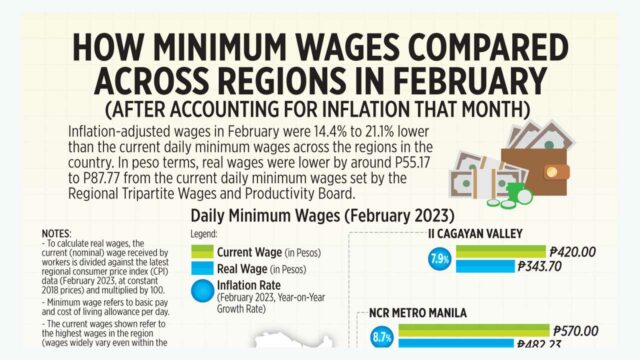
How minimum wages compared across regions in February

Inflation-adjusted wages in February were 14.4% to 21.1% lower than the current daily minimum wages across the regions in the country. In peso terms, real wages were lower by around P55.17 to P87.77 from the current daily minimum wages set by the Regional Tripartite Wages and Productivity Board.

How minimum wages compared across regions in February

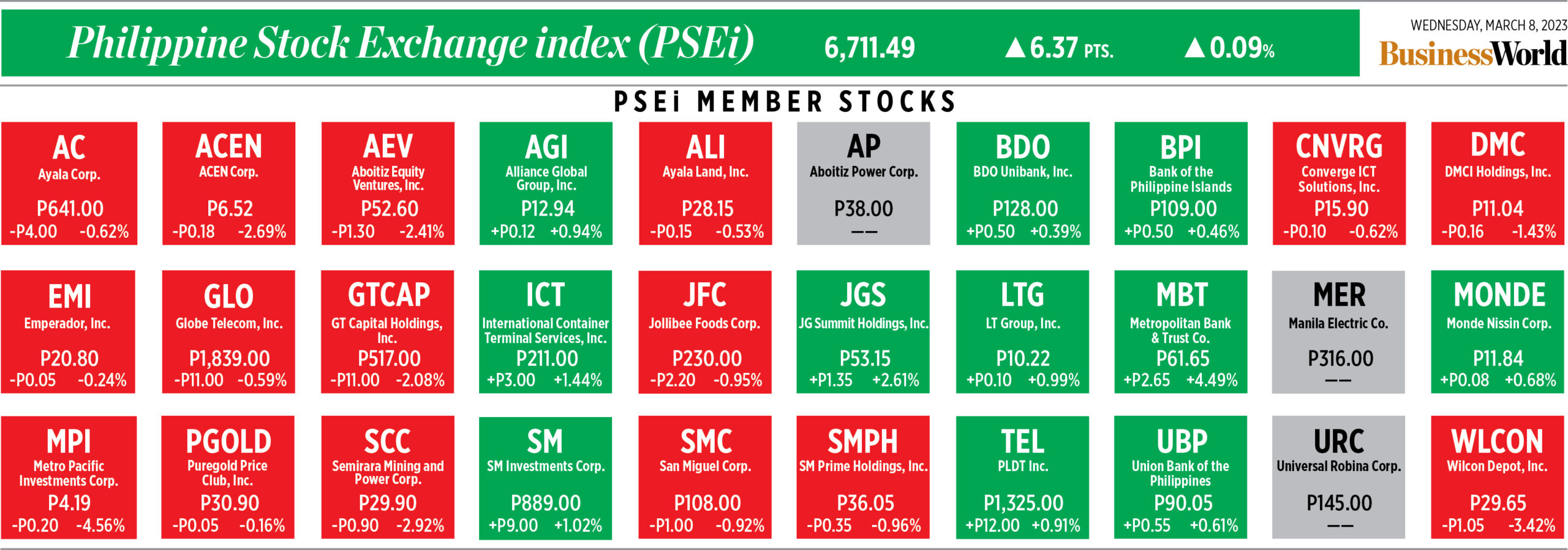
How PSEi member stocks performed — March 8, 2023

Here’s a quick glance at how PSEi stocks fared on Wednesday, March 8, 2023.


They wined, dined, and fled — but law finally catches up with Spain wine thieves

KELSEY KNIGHT/UNSPLASH

MADRID — A former Mexican beauty queen and her partner enjoyed a 14-course dinner at Atrio’s Michelin-starred restaurant and hotel in western Spain followed by a guided tour of its wine cellar.

But when they left the hotel before dawn the next morning, they had spirited away 45 bottles of some of the finest wines available to humanity, worth a total of about $1.7 million.

The law eventually caught up with them, however.

A court in the city of Careres said on Monday the woman had been sentenced to four years in prison and her Romanian-Dutch accomplice to four-and-a-half years after it found them guilty of aggravated robbery.

They were also ordered to pay damages to insurers worth over 750,000 euros ($799,000), the court said in a statement. It gave their names only as Tatiana and Estanislao.

According to the court, the 29-year-old Mexican checked in to the hotel in October 2021 using a fake Swiss passport and carrying only a backpack. A hotel employee who lifted the bag noticed it weighed very little.

The woman, who according to El Pais newspaper had competed in a beauty pageant in her homeland, was later joined by her 47-year-old male accomplice.

They had a 14-course dinner at the hotel’s restaurant and were then taken on tour of the wine cellar.

Shortly after 2 a.m., she ordered a salad to her room, distracting the sole night staff member and allowing her accomplice to swipe an electronic key from reception.

After he failed to gain access to the cellar as he had taken the wrong key, the woman tried another diversion by asking for a dessert.

The man managed to retrieve a master key and sneak into the cellar, where he stuffed 45 bottles — including a unique 19th-century vintage worth 350,000 euros — into the backpack and two bags with towels to prevent the glass from clinking.

The couple left the hotel before dawn and quickly fled Spain, but after a nine-month hunt across Europe, they were detained by border guards while crossing from Montenegro into Croatia. — Reuters

Peso drops on hawkish remarks from US Federal Reserve chair

THE PESO weakened against the dollar on Wednesday due to hawkish remarks from US Federal Reserve Chair Jerome H. Powell.

The local currency closed at P55.32 versus the greenback on Wednesday, down by 32 centavos from Tuesday’s P55 finish, data from the Bankers Association of the Philippines’ website showed.

The peso opened Wednesday’s trading session at P55.30 per dollar. It traded weaker the entire session, with its intraday best was at P55.24 and its worst showing at P55.48 against the greenback.

Dollars traded went up to $1.022 billion on Wednesday from the $896.8 million recorded on Tuesday.

The peso dropped due to a stronger dollar after hawkish signals from the Fed chief, Rizal Commercial Banking Corp. Chief Economist Michael L. Ricafort said in a Viber message.

“The peso weakened along with regional currencies. The dollar was strong across given Powell’s hawkish comments,” a trader likewise said in a Viber message.

The dollar index rose to as high as 105.65, up 1.3% on the day and the highest since Dec. 6, Reuters reported.

The dollar hit a three-month high after Mr. Powell said to lawmakers that the US central bank is likely to raise rates more than previously expected and warned that the process of getting inflation back to 2% has “a long way to go.”

“The latest economic data have come in stronger than expected, which suggests that the ultimate level of interest rates is likely to be higher than previously anticipated,” the US central bank chief said in his semi-annual testimony before the Senate Banking Committee.

“If the totality of the data were to indicate that faster tightening is warranted, we would be prepared to increase the pace of rate hikes,” Mr. Powell said.

The Fed hiked its target interest rate by 25 bps at its Jan. 31 to Feb. 1 meeting to a range between 4.5% and 4.75%.

Since March 2022, the US central bank has raised rates by a total of 450 bps. Its next policy meeting is on March 21-22.

For Thursday, the trader expects the peso to trade between P55 and P55.50 per dollar, while Mr. Ricafort gave a forecast range of P55.25 to P55.45. — A.M.C. Sy with Reuters

PSEi up on last-minute buying, positive sentiment

THE MAIN INDEX closed in the green on Wednesday on last-minute buying and improved market sentiment as inflation eased slightly in February.

The benchmark Philippine Stock Exchange index (PSEi) increased by 6.37 points or 0.09% to close at 6,711.49 on Wednesday, while the broader all shares index declined by 4.55 points or 0.12% to end at 3,585.66.

“The local bourse dodged a downturn on last-minute buying as investors weigh further the surprising cooling of Philippine inflation in February, which improved the odds of a 25-bp (basis point) BSP (Bangko Sentral ng Pilipinas) rate hike, against growing concerns over the Federal Reserve’s monetary policy,” AP Securities, Inc. Equity Research Analyst Carlos Angelo O. Temporal said in a Viber message.

“Philippine equities managed to climb, still riding on the momentum of better-than-expected inflation print for February,” Regina Capital Development Corp. Head of Sales Luis A. Limlingan said in a Viber message.

Headline inflation slowed to 8.6% in February from the 14-year high of 8.7% in January, which could lead to a smaller 25-bp hike from the BSP in its March 23 review.

“The PSEi managed to eke out gains in today’s session despite spending most of the day in the negative territory, given the surge of market-on-close buying,” China Bank Securities Corp. Research Director Rastine Mackie D. Mercado said in an e-mail on Wednesday.

Mr. Mercado said local stocks barely moved due to negative sentiment in the market following hawkish remarks from US Federal Reserve chief Jerome H. Powell.

Mr. Powell told US lawmakers on Tuesday that the Fed will likely need to raise interest rates more than expected in response to recent strong data and is prepared to move in larger steps if the “totality” of incoming information suggests tougher measures are needed to control inflation, Reuters reported.

The Fed hiked its target interest rate by 25 bps at its Jan. 31 to Feb. 1 meeting to a range between 4.5% and 4.75%.

Its next policy meeting is on March 21-22.

Back home, sectoral indices were split on Wednesday. Mining and oil declined by 318.62 points or 2.85% to 10,831.60; property went down by 27.71 points or 0.95% to 2,867.55; and industrials dropped by 27.10 points or 0.27% to 9,697.79.

Financials went up by 19.03 points or 1.02% to 1,867.80; services climbed by 3.07 points or 0.18% to 1,647.96; and holding firms rose by 4.04 points or 0.06% to 6,411.19.

Value turnover declined to P5.46 billion on Wednesday with 870.39 million shares changing hands from the P5.5 billion with 1.82 billion issues traded on Tuesday.

Decliners outnumbered advancers, 120 versus 72, while 46 names closed unchanged.

Net foreign buying declined to P12.27 million on Wednesday from P127.75 million on Tuesday.

China Bank Securities’ Mr. Mercado placed the PSEi’s support at 6,640 and resistance at 6,740, while AP Securities’ Mr. Temporal put support at 6,500 and resistance at 6,800. — A.E.O. Jose

Bottom 30% inflation rate in the Philippines

PHILIPPINE INFLATION eased for the first time in six months in February as transport and food prices rose at a slower pace, the statistics agency said. Read the full story.

Bottom 30% inflation rate in the Philippines

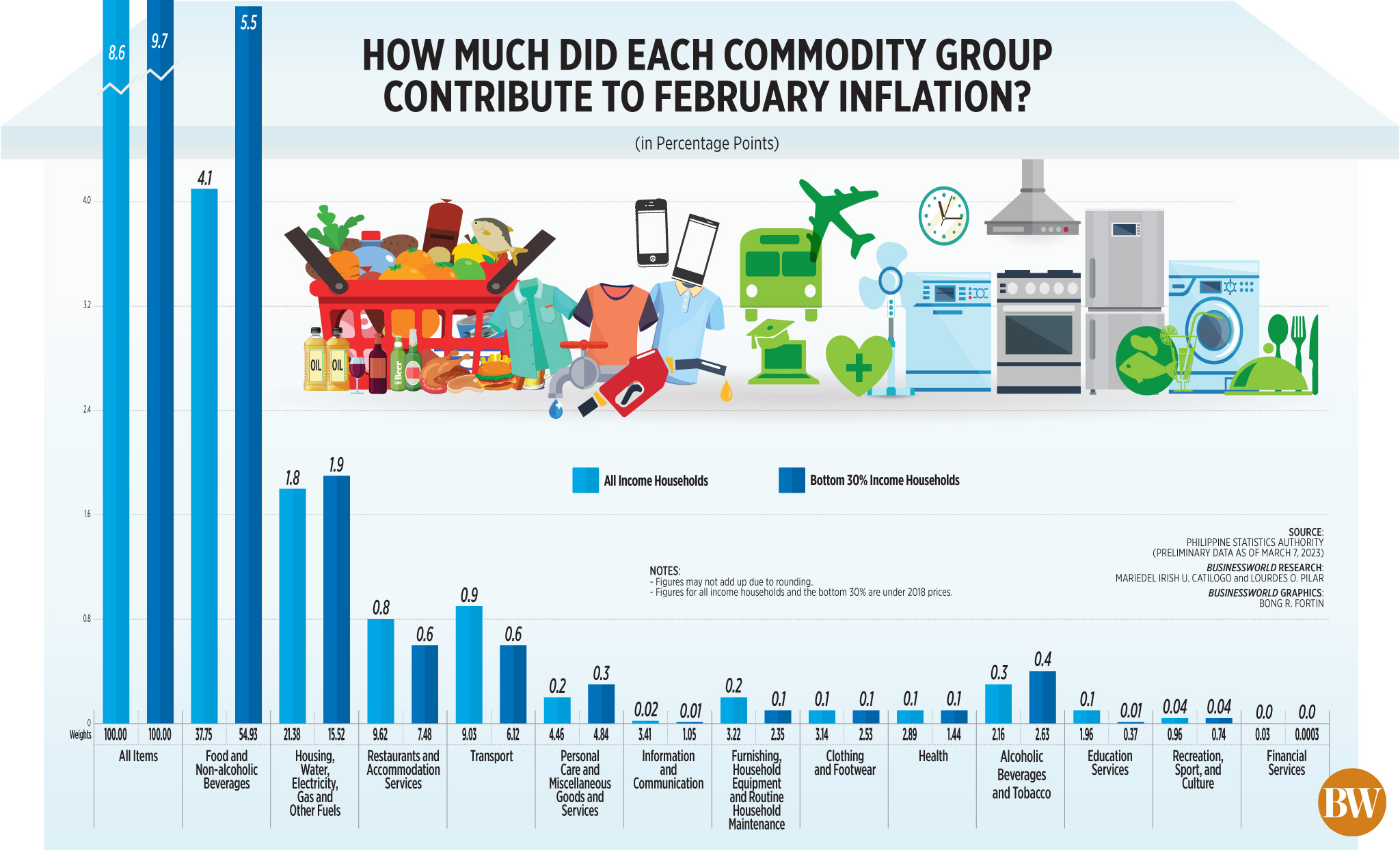
How much did each commodity group contribute to February inflation?

PHILIPPINE INFLATION eased for the first time in six months in February as transport and food prices rose at a slower pace, the statistics agency said. Read the full story.

How much did each commodity group contribute to February inflation?

Philippines told to stand up to increasing Chinese aggression

PHILIPPINE COAST GUARD FILE PHOTO

SECURITY experts on Wednesday urged the government of President Ferdinand R. Marcos, Jr. to stand up against escalating Chinese aggression in the South China Sea and engage in united response with allies.

“The best way to address Chinese gray zone activities in the West Philippine Sea is to expose it,” Philippine Coast Guard spokesman Jay T. Tarriela told a forum, referring to areas of the sea within the country’s exclusive economic zone.

He said the Philippine Coast Guard has been trying to remove the shades of gray as far as Chinese maritime activities are concerned by showing these to be either black or white.

“The Philippine Coast Guard’s persistent presence in patrolling the contested waters while at the same time documenting China’s activities allowed the international community to criticize their actions that violate international law and the international rules-based order,” said Mr. Tarriela, who advises the Coast Guard commandant on maritime security.

Chinese operations in the South China Sea have become “more and more clearly hostile and aggressive,” Jay L. Batongbacal, head of the University of the Philippines Institute for Maritime Affairs and Law of the Sea, told the forum organized by Strabase ADR Institute.

More than 40 Chinese boats were still roaming near Thitu Island, the Philippine Coast Guard said on Tuesday, weeks after it accused its Chinese counterpart of endangering the crew of a resupply ship at Second Thomas Shoal in an incident that has stoked long-running diplomatic tensions over China’s expansive claims in the waterway.

A People’s Liberation Army Navy vessel, a China Coast Guard ship and at least 42 suspected Chinese maritime militia boats were still roaming about 4.5 to 8 nautical miles from Philippine-occupied Thitu Island, which it calls Pag-asa, it said.

In his speech, Mr. Batongbacal urged the government to prepare responses to threats and activities undertaken by China against Filipinos at sea.

“We should not be afraid to consider proportional and reasonable responses,” he said. “We should not shy away every time they make threatening moves and then we retreat for fear of provocation.”

“There should be no gray area anymore. We need to begin erasing the gray zone. We need to begin acting and standing up for our lawful maritime rights,” Mr. Batongbacal said.

“This is the only way we can move that forward. Otherwise, we might as well retreat and give up everything.”

He said the government should consider working with allies and engage in a collective deterrence against Chinese aggression.

“We should not be doing everything on our own only,” he said. “We should also consider talking closely with and coordinating with allies and friends so we can engage in collective deterrence.”

“We should demonstrate to China that its gray zone activities and various other shenanigans will no longer be effective because there will be a united and collective response from all fronts wherever they may be,” he added.

‘EXPOSURE IS KEY’
Raymond Powell, Gordian Knot Center for National Security Innovation fellow urged the Marcos government to engage the public, get the help of independent analysts, storytellers and the media and use commercially available maritime data to deter so-called Chinese gray zone activities.

“Exposure is key to deterring and building resilience against them,” he told the forum. “Governments control the best gray zone information, but face barriers to release it.”

The solution is to “light up the maritime gray zone” by giving access to commercially available maritime data to credible independent analysts and media, Mr. Powell said.

Embedding media reporters in coast guard vessels to help monitor, document and disseminate all gray zone activities in the South China Sea could also work, he added.

Mr. Tarriela said the impact of publicizing Chinese activities in the waterway could be measured by the reaction of the international community.

“We can see it from how the United States, Japan and Australia express their support and willingness to develop the capability of the Philippine Coast Guard and also the Armed Forces of the Philippines,” he told reporters on the sidelines of the forum.

“Through the publication of unedited real photos and videos of the Philippine Coast Guard, we can once again reshape public opinion to weigh things objectively based on facts and not just propaganda,” he added.

Stratbase President Victor Andres C. Manhit said the Marcos government should work with like-minded states through joint patrols and maritime domain awareness.

“The Philippines and other Indo-Pacific states must engage in strategies that will ultimately change China’s behavior to be symbiotic with the internationally established rules-based order,” he said. “China’s activities within Philippine territory, driven by its expansionist ambitions and militarization, cannot be allowed.”

These activities include swarming their fishing and militia vessels in Philippine territory, blocking resupply missions, tailing scientific vessels and pointing military-grade lasers,” Mr. Manhit said. “We cannot let this aggression continue.”

The expected response to an emerging threat is to try to balance it, said Renato C. de Castro, an international studies professor at De La Salle University.

“To limit China’s ability to conduct grey zone operations against the Philippines requires Manila, Washington, Canberra and Tokyo to convey strong signals of commitment for mutual assistance through security agreements, troop deployments, arms transfers and multinational exercises, thereby reducing the Philippines’ sense of insecurity,” he told the forum.

He also said a surveillance system must be developed to monitor Chinese gray operations. “This requires the development of a region-wide surveillance network that can detect, identify and monitor Chinese vessels that are positioned for grey zone operations in the West Philippine Sea. — Alyssa Nicole O. Tan

ADVERTISEMENT
ADVERTISEMENT