Home Blog Page 504

‘China is not uninvestable’: Global funds return to China’s markets

An investor looks at an electronic board showing stock information at a brokerage house. — REUTERS

Global money managers are venturing back into China after years of aversion, piqued by a world-beating stock rally and the country’s advances in high-tech industries.

Goldman Sachs Group Inc. said global hedge funds were last month the most active in onshore equities in recent years — a stark contrast to 2021, when some clients had deemed the market “uninvestable.” Pacific Investment Management Co. said investors have pivoted away from worrying about risks to missing out. Official data show foreign inflows rising across asset classes, a coordinated advance that’s only happened in three of the past 10 years.

Taken together, these are signs of a turnaround for a market that had fallen out of favor with global investors amid prolonged regulatory crackdowns and a spiraling property crisis.
This year’s $2.7 trillion equity rally onshore has proven too compelling to ignore, and global funds’ still-underweight positioning suggests ample room to build exposure.

“Global investors have been growing notably more interested in Chinese assets,” said Joseph Zhang, a portfolio manager for Fidelity International, who has been increasing holdings in the market. “This year is different in the sense that the revaluation of Chinese assets is no longer a policy-fueled frenzy but driven by better fundamentals. Investor confidence will likely grow stronger.”

It’s a far cry from the harrowing years following the 2021 peak, when some money managers said China is just not worth the risk. The narrative has now changed to one of confidence, spurred by its artificial intelligence prowess and economic resilience in the face of US restrictions. Stronger inflows could buttress the yuan and aid President Xi Jinping’s ambition to elevate the currency’s role in global finance.

Timing has also worked in China’s favor. President Donald Trump’s confrontational trade policies, the Federal Reserve’s rate-cut cycle and a ballooning US budget deficit have encouraged investors to seek alternatives to dollar assets, prompting a fresh look at the vast Chinese market.

As risk appetite continues to improve and the dollar weakens, markets with compelling valuation and low global fund positioning — such as China — stand to benefit, said Chang Hwan Sung, a multi-asset portfolio manager with Invesco’s investment solutions team. Sung’s fund has been increasing allocation in Chinese equities, he said.

In the first half of this year, foreigners boosted their holdings of onshore stocks, bonds, loans and deposits — a simultaneous increase for the first time since 2021. Net inflows through June have already surpassed the 2024 annual tally by about 60%, according to the latest data from the People’s Bank of China.

The momentum has likely carried on. “Foreign investors overall purchased onshore stocks and bonds on a net basis” in August, Li Bin, deputy head for the State Administration of Foreign Exchange, said in a briefing earlier this month.

TECH’S ASCENT
Underpinning the shift in perception is the technology sector’s advance, as heavyweights including Alibaba Group Holding Ltd. roll-out their own AI models and chipmakers like Cambricon Technologies Corp. notch breakthroughs.

“Global investors will increase their allocations to Chinese assets in the coming years,” said Yerlan Syzdykov, global head of emerging markets at Amundi UK Ltd. Among the drivers will be a sense of “FOMO” from China’s strong performance and attractively-priced opportunities in areas like clean-tech and AI, he said.

Among US-listed exchange-traded products that focus on emerging markets, those tracking Hong Kong and China stocks and bonds saw the largest inflow in the week ended Sept. 19, according to data compiled by Bloomberg.

Morgan Stanley said inflows from foreign long-only funds reached $1 billion as of end-August, a reversal from the $17 billion in outflows last year. Global funds are still 1.3 percentage points underweight China despite some improvement, according to the note released earlier this month, while Asia ex-Japan managers have turned overweight.

Strategist Laura Wang said over 90% of clients she met during a US marketing trip expressed “explicit willingness” to increase China exposure, the highest level of interest since the early 2021 peak.

And while China has discontinued the release of northbound data — a key route for global funds to buy Chinese stocks through Hong Kong — Goldman Sachs strategist Kinger Lau said available data show “foreign investors’ participation in China equity, A-shares in particular, has risen to cycle highs.” He said gross flows by global hedge funds in August was the largest in recent years.

The CSI 300 Index, a benchmark for onshore shares, has climbed 16% this quarter to reach more than a three-year high. The tech-focused ChiNext Index has rallied nearly 50% during the period in one of the best performances globally. Despite the advances, the two gauges are still below their 2021 highs.

To some, however, the scars of China’s prolonged market downturn run so deep that returning is a nonstarter. A wave of regulatory crackdowns that began in 2021 — spanning sectors from tech to tutoring — sent equities into a tailspin and fueled the “uninvestable” narrative.

Authorities are also keen to tame market exuberance, suggesting runaway rallies may face scrutiny. Geopolitical tensions mean America’s biggest public and pension funds will continue avoiding China for political reasons. Florida last year joined a number of US states in requesting its pension funds to divest Chinese holdings.

SPILLOVER TO BONDS
Nonetheless, growing interest in other asset classes point to a common theme: Beijing is committed to supporting the economy, and the US trade war will only embolden the country’s industrial strength.

Chinese tech companies have sold a record amount of yuan-denominated debt in Hong Kong this year. The “big growth” in dim sum bond markets has been supported by a broadening investor base across continents, according to Eugene Ng, head of debt capital markets for greater China at HSBC Holdings Plc.

In Tencent Holdings Ltd.’s bond sale earlier this month, those from the Middle East invested across the curve while high-quality funds from Europe also joined, Ng said.
Alibaba’s convertible bond sale was multiple times subscribed, with bidders including long-only investors and hedge funds.

While the revival in risk sentiment has weighed on government bonds, expectations of PBOC easing and China’s low inflation are starting to lure back buyers. The conversation with clients has shifted from “how to de-risk” to “what are the opportunities” in China, said Stephen Chang, managing director and Asia portfolio manager at Pimco. Chang, who co-manages a $572 million fund that beat 98% of peers this year, said he may buy more Chinese government bonds after purchasing some recently.

Foreigners trimmed their holdings of Chinese government bonds in August but the scale of the selloff eased to just one fifth of July’s, official data showed.

“The real interest rate of yuan bonds is still relatively high, which provides a very good channel for global investors,” Zou Lan, the PBOC’s deputy governor, said at a forum in Hong Kong last week.

All of this has been supportive for the yuan, which rose to 7.1 against the dollar this month — the strongest since November.

“China is not uninvestable,” said Thomas Fang, head of China global markets at UBS AG. “The vast gap between China’s global economic footprint and the low single-digit allocation from global investors represent a significant long-term opportunity.” — Bloomberg


Top 5 crypto wallets in the Philippines: Secure and convenient options for every Pinoy

(This article is a paid content published on Spotlight, BusinessWorld’s sponsored section, and therefore does not reflect BusinessWorld’s views on the matter. BusinessWorld does not endorse any cryptocurrency and does not have any legal liability on any decisions derived from reading cryptocurrency-related advertisements published on its platforms. Readers are advised to thoroughly research and understand potential risks before availing cryptocurrency products or services.)

The Philippines has become one of the fastest-growing crypto markets in Southeast Asia. From OFW remittances and play-to-earn gaming, to using digital assets for online shopping and payments, Filipinos are finding more reasons to adopt cryptocurrency in their daily lives.

At the heart of this growth is the crypto wallet — the essential tool that keeps digital assets safe while giving access to trading, investing, and Web3 services. With more than 70% of Filipinos accessing the internet through mobile devices, the best wallets today are designed to be mobile-friendly, secure, and easy to use.

Here are the top 5 crypto wallets in the Philippines right now:

Bitget Wallet

Bitget Wallet has quickly risen in popularity among Filipinos because it combines security, convenience, and everyday usability. It supports thousands of tokens across multiple blockchains and connects users to DeFi, NFTs, and dApps with just a few taps.

For Filipinos, Bitget Wallet is especially practical:
– It’s mobile-first, making it easy to manage crypto on the go.
– It integrates with QRPH for Web3 payments, bridging crypto with local transactions.
– It offers staking and trading features for those looking to grow their holdings.

Binance Wallet

A strong choice for active traders, Binance Wallet offers quick access to spot and futures markets. Many Filipinos use it to trade popular coins like Bitcoin, Ethereum, and BNB. While powerful, it can feel overwhelming for first-time users who only want simple storage.

MetaMask

For Filipinos diving into NFTs and play-to-earn games, MetaMask is often the go-to. It works with Ethereum and other EVM-compatible chains, making it a favorite in the Web3 space. The tradeoff is that gas fees and network setup can be confusing for beginners.

Trust Wallet

Trust Wallet is known for being simple and mobile-friendly, which appeals to the Philippines’ mobile-first population. It supports multiple blockchains and is great for users who want a straightforward wallet without too much complexity.

Coins.ph Wallet

As one of the earliest crypto platforms in the Philippines, Coins.ph remains popular for its peso integration. Users can cash in through local banks, e-wallets, and convenience stores, and even pay bills directly. It’s ideal for Filipinos who want an easy bridge between crypto and everyday transactions, though it operates more as a centralized service.

Final Thoughts

Crypto wallets are no longer just for storing assets — they are becoming part of the way Filipinos earn, spend, and send money. From OFWs remitting through stablecoins, to gamers cashing out tokens, to young investors growing their portfolios, wallets are the gateway to the digital economy.


Spotlight is BusinessWorld’s sponsored section that allows advertisers to amplify their brand and connect with BusinessWorld’s audience by publishing their stories on the BusinessWorld Web site. For more information, send an email to online@bworldonline.com.

Join us on Viber at https://bit.ly/3hv6bLA to get more updates and subscribe to BusinessWorld’s titles and get exclusive content through www.bworld-x.com.

DA eyes rice import ban extension until year-end

PHILIPPINE STAR/KRIZ JOHN ROSALES

The Department of Agriculture (DA) is considering extending the ban on rice imports until the end of the year as farmgate prices of unmilled rice continue to fall.

“I met with the President last week and we decided to extend the import ban by a minimum of 30 days,” Agriculture Secretary Francisco P. Tiu-Laurel, Jr. told reporters in mixed English and Filipino at the House of Representatives on Monday. “It is possible that it will be extended until the end of the year.”

He said the extension seeks to prop-up plunging farmgate prices of unmilled rice, which had dropped to P8 to P10 per kilo.

Philippine President Ferdinand R. Marcos, Jr., in August announced a 60-day suspension of rice imports starting Sept. 1 to protect Filipino farmers.

Mr. Tiu Laurel said the President would also issue an executive order for the emergency procurement of palay from local producers, as well as the emergency procurement of warehouses to store the rice stocks.

The Philippines is the biggest importer of rice in the world, according to the US Department of Agriculture. It is projected to import about 4.9 million metric tons this year. — Adrian H. Halili

Cagayan Valley’s captivation colors dazzle at Festival Mall Alabang

Padday na Lima paints the metro with Cagayan Valley’s hues of heritage, opening the trade fair with a vibrant showcase at the Festival Mall Alabang, last Friday Sept. 19. Brimming with culture and tradition, Padday na Lima, the Ybanag vernacular for “made by hands,” is the prime venue for showcasing the region’s best of the best.

Welcoming the guests was DTI Region 2 Regional Director Ma. Sofia G. Narag, CESO V, who invited guests to witness the dazzling spirit of Cagayan Valley, embodied in its colors, flavors, and artistry. DTI Regional Operations Group Assistant Secretary Grace Baluyan, together with LGU officials and private partners, lauded the fair as a powerful testament to the region’s vibrant heritage and the resilience of its MSMEs.

Guests were treated to a splash of colors through the Hibla’t Habing Rehiyon Dos fashion show, alongside an impressive display of the region’s best offerings in the provincial pavilions. Each product tells a story of tradition, ingenuity, and the hardworking communities behind their creations.

Alongside the launch of the 19th Padday na Lima Regional Trade Fair was the unveiling of the fair’s website PaddayNaLima.ph, a digital platform designed to expand the visibility and market reach of Region 2’s MSMEs beyond that of the physical fair.

Come and experience this extraordinary festival of colors firsthand. Padday na Lima runs from Sept. 19-25, 2025 at the Upper Ground, Carousel Court and East Hall, Festival Mall Alabang, Muntinlupa City. Support local, shop local!


Spotlight is BusinessWorld’s sponsored section that allows advertisers to amplify their brand and connect with BusinessWorld’s audience by publishing their stories on the BusinessWorld Web site. For more information, send an email to online@bworldonline.com.

Join us on Viber at https://bit.ly/3hv6bLA to get more updates and subscribe to BusinessWorld’s titles and get exclusive content through www.bworld-x.com.

South Korea begins visa-free entry for Chinese tourist groups

STREET VENDORS wait for customers at Myeongdong shopping district in Seoul, South Korea, Jan. 9, 2023. — REUTERS

SEOUL/BEIJING – South Korea began offering visa-free entry for Chinese tourist groups on Monday, a measure it hopes will boost the economy and help improve ties with its Asian neighbour.

As part of the pilot programme due to run through until next June, groups of three or more tourists from mainland China will be able to stay without a visa for 15 days.

The action comes ahead of China’s National Day holidays from October 1-8, as well as a run of South Korean holidays around the same time.

South Korean companies are seeking to benefit from the increased demand. Shilla Duty Free has organised a Chinese cruise tour and food delivery app Baedal Minjok is introducing payment options in Alipay and WeChat Pay.

The programme, announced in March, follows China’s decision last November to offer visa exemptions to South Koreans for up to 30 days.

The last time South Korea offered mainland Chinese similar visa-free entry was from December 2017 to March 2018, coinciding with the Pyeongchang Winter Olympics.

The new administration of South Korean President Lee Jae Myung is hoping to further improve ties with China during an expected visit by President Xi Jinping in late October to an Asia-Pacific summit in South Korea. — Reuters

Britain may toughen rules for migrants seeking permanent residency

IAN TAYLOR-UNSPLASH

LIVERPOOL, England – Britain will consider tightening the rules over how migrants can settle permanently in the country by making applicants prove their value to society, interior minister Shabana Mahmood will say on Monday.

The plan is the latest government effort to dent the rising popularity of the populist Reform UK party, which has led the debate on tackling immigration and forced Prime Minister Keir Starmer’s Labour Party to toughen its policies.

Most migrants can currently apply for “indefinite leave to remain” after five years of living in Britain, a status that gives them the right to live permanently in the country.

In her first speech to Labour Party conference as interior minister, Mahmood will say the government is considering making changes so people will only qualify for this status if they pay social security contributions, have a clean criminal record and do not claim benefits.

The government is considering only allowing people to qualify if they can speak English to a high standard and have a record of volunteering in their communities, Mahmood will say, according to extracts of her speech released by Labour.

A consultation on the proposals will be launched later this year, she will say.

Nigel Farage’s anti-immigration Reform UK, which is leading in opinion polls, said last week it was considering scrapping “indefinite leave to remain”, and replacing it with a five-year renewable work visa.

Starmer accused Reform on Sunday of planning a “racist policy” of mass deportations that would “tear this country apart”.

Immigration has long been one of the most important issues for voters in Britain.

Controlling the number of arrivals was a key factor in the 2016 vote to leave the European Union, yet net arrivals hit record levels after Britain left the bloc. — Reuters

Davao Doctors Hospital (Clinica Hilario), Inc.’s share ‘Buyback Program’ approved by Board of Directors


Spotlight is BusinessWorld’s sponsored section that allows advertisers to amplify their brand and connect with BusinessWorld’s audience by publishing their stories on the BusinessWorld Web site. For more information, send an email to online@bworldonline.com.

Join us on Viber at https://bit.ly/3hv6bLA to get more updates and subscribe to BusinessWorld’s titles and get exclusive content through www.bworld-x.com.

Once China’s richest man, Wang Jianlin now faces curbs on luxury spending – reports

FREEPIK

SHENZHEN, China – Wang Jianlin, chairman of Chinese conglomerate Dalian Wanda Group, and once China’s richest man, has been restricted from high-value consumption by a court in Gansu province, according to information provider Qichacha and reports in local media.

The restriction, which prohibits high-end spending on luxury goods, services or hotels, relates to a case filed against Dalian Wanda and several affiliates in July and an enforcement amount of 186 million yuan ($26.08 million), according to the state-owned Beijing Daily.

In June state-run The Paper reported that cash-strapped Wanda would sell 48 of its giant shopping malls, known as Wanda Plaza, to a consortium of investors. — Reuters

Gross borrowings hit P508.5B in Aug.

BW FILE PHOTO

THE NATIONAL Government’s (NG) gross borrowings nearly tripled in August amid sharp rise in domestic and foreign borrowings, the Bureau of the Treasury (BTr) said.

The latest data from the Treasury showed that total gross borrowings jumped by 192% to P508.53 billion in August from P174.03 billion in the same month a year ago.

Month on month, gross borrowings surged by 206% from P166.11 billion in July.

Domestic borrowings, which made up 97.97% of the total, rose by 198% to P498.21 billion in August from P167.05 billion in the same month last year.

This was composed of P425.61 billion in retail Treasury bonds (RTB), P60 billion in fixed-rate Treasury bonds (T-bonds), and P12.6 billion in Treasury bills (T-bills).

External borrowings, which mainly consisted of project loans, climbed by 47.57% to P10.31 billion in August from P6.99 billion in the previous year.

Rizal Commercial Banking Corp. Chief Economist Michael L. Ricafort said elevated gross borrowings in August were likely driven by the latest RTB issuance as the government needed additional funds to plug the budget deficit.

The government raised P507.16 billion from the issuance of RTBs in August, exceeding the P30-billion target.

“The large increase in borrowings can be attributed to the large issuance of domestic debt securities by the government which successfully met the demand for these securities amid investors seeking safe returns,” Reinielle Matt M. Erece, an economist at Oikonomia Advisory and Research, Inc., said in a Viber message. 

END-AUGUST BORROWING
Meanwhile, NG’s gross borrowings stood at P2.27 trillion in the January-to-August period, up 17.22% from P1.93 trillion a year ago.

The total borrowings accounted for 87.16% of the revised P2.6-trillion financing program for 2025.

Domestic debt accounted for the bulk or 81.19% of total gross borrowings in the first eight months.

Gross domestic debt increased by 11.46% to P1.84 trillion as of end-August from P1.65 trillion in the same period last year. This made up 87.12% of the P2.11-trillion program this year.

Broken down, domestic debt was composed of P941.84 billion in fixed-rate Treasury bonds, P425.61 billion in RTBs, P300 fixed-rate Treasury notes, and P172.45 in T-bills.

As of end-August, gross external debt rose by 50.89% to P426.23 billion from P282.46 billion a year ago. The total foreign borrowings in the January-to-August period accounted for 87.31% of the P488.17-billion program this year.

Broken down, foreign debt was made up of P191.97 billion in global bonds, P171.31 billion in program loans and P62.96 billion in project loans.

External borrowings in the end-August period were also padded by the global bond issuance that raised $3.3 billion or P192 billion in late January but settled in February.

Mr. Ricafort said the government would likely exceed its borrowing program with the ballooning budget deficit.

“There is a chance if the budget deficit widened for the rest of 2025 and needed to be funded by additional NG borrowings,” he said.

Separate data from the BTr showed that the fiscal gap swelled by 56.38% to P84.8 billion in August, which brought the eight-month deficit to P869.2 billion.

“The government’s recalibration of debt to increase the share of domestic debt over foreign debt sources is reflective in the composition of new borrowings this August. We may see the same trend in the coming months,” Mr. Erece said.

The government favors domestic sources of debt as it aims to reduce foreign currency risk.

The BTr earlier said it is looking to borrow P437 billion from the domestic market in the fourth quarter, comprised of P262 billion in T-bills and P175 billion in T-bonds.

For 2026, the financing program is set at P2.68 trillion, of which P2.05 trillion will be from local lenders and P627.1 billion from foreign sources.

HIGHER DEBT
Meanwhile, the share of Philippines government debt to gross domestic product (GDP) edged up to 57.8% in the second quarter of 2025 from 56.7% a year earlier, according to the Institute of International Finance quarterly debt monitor.

Household debt as a share of GDP slid to 11.3% in the second quarter this year from 12.1% in the same period a year ago.

The domestic financial sector’s debt-to-GDP ratio eased to 7.2% in the second quarter from 7.6% in the same quarter in 2024.

On the other hand, nonfinancial corporates’ debt-to-GDP ratio also eased to 25.7% in the second quarter this year from 26.8% a year ago. — A.R.A.Inosante

Gov’t eyes bidding for LRT-2, MRT-3 contracts in early 2026

Commuters board the Light Rail Transit (LRT-2) train at a station in Quezon City, March 5, 2023. — PHILIPPINE STAR/MIGUEL DE GUZMAN

By Ashley Erika O. Jose, Reporter

THE Department of Transportation (DoTr) aims to start the bidding process for the operations and maintenance (O&M) of Light Rail Transit Line 2 (LRT-2) and Metro Rail Transit Line 3 (MRT-3) within the first half of 2026.

“The bidding of LRT-2 (O&M contract) will definitely be by the first half of next year. We will be submitting it to DEPDev (Department of Economy, Planning, and Development) simultaneously with the bidding of MRT-3,” Transportation Undersecretary for Railways Timothy John R. Batan told reporters on the sidelines of Arangkada Investments Forum 2025 last week.

The government is adopting a dual track for the privatization of the MRT-3, he said, noting the DoTr will not turn away any unsolicited proposals while it is soliciting bids.

The government is targeting to implement the solicited bidding process for the MRT-3 project by early next year, Mr. Batan said.   

“We are on dual track for MRT-3. We are pursuing a solicited together with the ADB (Asian Development Bank). But we are also open to unsolicited proposals,” he said.

The Transportation department has also hinted at receiving an unsolicited proposal for the operations and maintenance of MRT-3, though Mr. Batan declined to name the proponent, referring only to the group as one of the “usual suspects.”

“We actually think that a proposal, an unsolicited proposal will be submitted very soon. So, once that is submitted, we will definitely look at that seriously,” he said.

Mr. Batan said a proponent has expressed interest, but a formal proposal has yet to be submitted.

The Public-Private Partnership (PPP) Center has said that the Transportation department rejected Metro Pacific Investments Corp.’s (MPIC) unsolicited proposal for the MRT-3 project in December 2024.

BusinessWorld sought comment from MPIC on whether it would revive its submission for the MRT-3 project but had yet to receive a response by the deadline.

Earlier this year, MPIC Chairman Manuel V. Pangilinan said the company is unlikely to resubmit its unsolicited proposal for the MRT-3 project.

Rene S. Santiago, former president of the Transportation Science Society of the Philippines called the DoTr’s move as indecisive, adding that the government should not have rejected the MPIC-Sumitomo proposal.

“In the first place, they should not have rejected the MPIC-Sumitomo unsolicited proposal last December. By this time, a Swiss Challenge would have been received, compared and awarded,” Mr. Santiago said in a Viber message.

Aside from the group, San Miguel Corp.  has also previously submitted an unsolicited proposal for the MRT-3 project.

Mr. Batan likened the DoTr’s dual track for MRT-3 project to that of Ninoy Aquino International Airport (NAIA) rehabilitation and operations project where the government accepted unsolicited proposals before ultimately taking the solicited route.

“You have to remember when we did NAIA, we also had non-solicited and solicited. We do an evaluation. So, until we receive it (unsolicited proposal), we do not know what it looks like,” he said.

For Nigel Paul C. Villarete, senior adviser on PPP at the technical advisory group Libra Konsult, Inc., unsolicited proposals are usually only accommodated when agencies do not have a definite intention of proceeding with a solicited route. 

“Shifting from one mode to another is uneconomical and may result in confusion. It would be in the government’s best interest to finalize the mode of procurement first, and proceed from that,” Mr. Villarete said in a Viber message.

A solicited mode is likely more advantageous to the government as it explicitly specifies the terms and coverage of the concession agreement, Mr. Villarete said,

“Solicited bids will always be superior to unsolicited ones, in terms of covenants because the government prepared it in accordance with what it wants,” Mr. Villarete said.

“In other words, don’t do a dual track. If there’s  an unsolicited proposal, work on that. But if there is none, proceed with the solicited mode,” he said.

The DoTr had initially aimed to initiate the bidding process for the operations and maintenance of the MRT-3 before the expiration of its build-lease-transfer (BLT) agreement with the Sobrepeña-led Metro Rail Transit Corp. (MRTC) in July 2025.

Under the BLT concession, the DoTr holds the franchise and manages operations and fare collection, while MRTC builds and maintains the system in exchange for regular payments from the government. Following the contract’s expiration, the ownership and operations of MRT-3 have been transferred to the government. 

Further, Mr. Batan said the government is also planning to start the bidding process for the operations and maintenance of LRT-2 by the first half of 2026.

The DoTr is working with the International Finance Corp. for the planned privatization of LRT-2, which is currently operated and managed by Light Rail Transit Authority.

The plan to privatize LRT-2 via public-private partnership aims to increase its ridership and extend its rail line.

Artificial intelligence gives Philippine entrepreneurs a competitive edge

Words reading “Artificial intelligence AI” of miniature robot and toy hand are pictured in this illustration taken on Dec. 14, 2023. — REUTERS/DADO RUVIC/ILLUSTRATION

By Beatriz Marie D. Cruz, Reporter

AMARI NEIL B. DIMAFELIZ, 18, first turned to artificial intelligence (AI) in 2023 when his small 3D-printing business started growing faster than he could manage.

Running a youth-led enterprise with limited manpower, he struggled to find employees willing to work for someone still in college. “My age has been an obstacle to hiring people, so I turned to AI because it’s not selective in who it’s performing for,” he said by telephone.

Instead of hiring extra staff, Mr. Dimafeliz invested in a P100,000 printer with AI features that automatically checks the quality of his customized products, which include keychains, figurines, thesis prototypes, coasters, ballpens and pencil cases.

“On the operational side, our printers use artificial intelligence for precautionary measures when there are failures in printing,” he said.

AI also helps market his products. He uses it to generate captions and images for his small business’ social media pages, a task that once ate up hours of his time. For a full-time mechanical engineering student at Mapua University, AI has become a crucial tool for balancing academics with entrepreneurship.

Stories like Mr. Dimafeliz’s illustrate how AI could reshape the way micro, small and medium enterprises (MSME) operate.

MSMEs account for about 99% of all businesses in the Philippines, yet adoption of advanced digital tools remains low. As of 2021, only 14.9% of firms had integrated AI, according to the government think tank Philippine Institute for Development Studies (PIDS).

AI has the potential to transform these businesses, said Ian Jester M. De Vera, head of the research division at the University of the Philippines Institute for Small-Scale Industries (UP ISSI). “Some of the tasks of MSMEs are just repetitive, so if they’re going to leverage AI, they will do away with these tasks,” he told BusinessWorld by telephone.

AI can also help smaller firms scale operations and compete with larger corporations, said John Paolo R. Rivera, a PIDS senior research fellow. “By using AI, MSMEs can better compete with larger firms and participate in digital trade,” he said in a Viber message.

Among its practical benefits: AI can forecast demand, analyze customer behavior, and reduce overstock or shortages. It can personalize marketing strategies and improve logistics efficiency.

Beyond operations, AI can handle invoicing, payroll and appointment scheduling, reducing costs and human error. Virtual assistants and chatbots can also take over routine customer service inquiries, saving time for owners and staff.

AI may even help protect businesses from rising cyberthreats. MSMEs are often prime targets for ransomware and phishing attacks, noted Bambi Escalante, country manager at Fortinet Philippines.

STEEP CHALLENGES
“Most small and medium businesses don’t have dedicated IT security teams, making it difficult to keep up with evolving threats,” she told BusinessWorld in an e-mailed reply to questions. “This is where AI becomes a game-changer — it automates routine security tasks and helps businesses stay ahead of cyber risks without needing extensive resources.”

A joint study by Google and Access Partnership estimates that if widely adopted, AI-powered products and solutions could unlock as much as P2.8 trillion in economic benefits for Philippine businesses.

Despite its promise, AI adoption among MSMEs faces steep challenges.

For one, resources remain tight. “Let’s face it, MSMEs have limited resources, and some of them are even cash-strapped,” Mr. De Vera said. “If AI would just add to their costs, maybe they would think twice about adopting it.”

Generational gaps also play a role. Many first-generation business founders remain hesitant to use AI themselves. “When I talk about AI, of course they’re amazed, but they instead want their children to learn how to use it, because they don’t know how to use it,” said Reynaldo C. Lugtu, Jr., president and chief executive officer (CEO) at consulting firm Hungry Workhorse.

Digital infrastructure is another major hurdle. Reliable internet access is still uneven across the country. “The foremost barrier is infrastructure, because it’s still a problem, especially in a developing country like the Philippines, to have a reliable internet connection,” Mr. De Vera said.

The Philippines ranked 56th out of 77 countries in Huawei Technologies’ 2024 Global Digitalization Index, classifying it as a “starter” in digital transformation.

MSMEs also often lack the data needed to fuel AI systems. “AI requires large datasets to function effectively, but many MSMEs struggle with limited or unstructured data,” Mr. Rivera said. This data gap also affects their access to credit, marketing insights and long-term planning.

To address these challenges, organizations are working to strengthen MSMEs’ digital skills. The UP ISSI offers training and mentorship programs, guiding entrepreneurs on responsible AI use, strategy development and data-driven decision making. It has also rolled out a business course covering AI systems, analysis tools and ethical frameworks.

Private firms are innovating as well. Peddlr, a smart point-of-sale (POS) app for small businesses, plans to integrate AI into its analytics and reporting features.

“It is on our product roadmap to incorporate this technology with our POS app, starting with the reports and analytics module,” Peddlr founder and CEO Nel Laygo said in an e-mailed reply to questions.

Mr. Laygo added that MSMEs should begin embedding AI proficiency into their workforce development. “They should start incorporating AI proficiency into internal training to upskill staff and include this as a requirement when hiring new talent, alongside proficiency in Microsoft Word, PowerPoint and Excel,” he said.

Experts say both the government and private sector need to step in by subsidizing AI tools, improving internet infrastructure, and promoting digital literacy. “Both sectors can also invest in digital literacy and training, so this will upskill MSME employees through courses and workshops that will improve their competence in using AI,” Mr. De Vera said.

While MSMEs worldwide are beginning to integrate AI into their operations, many owners remain cautious about overreliance.

Mr. Dimafeliz, whose 3D-printing business continues to grow alongside his studies, sees AI as a helpful partner but not a substitute for creativity.

“AI is not perfect,” he said. “We still have to apply our personal touch to ensure originality. We still need the intervention of human beings.”

BusinessWorld @ 38: Strengthening the legacy of print media and beyond

By Bjorn Biel M. Beltran, Special Features and Content Assistant Editor

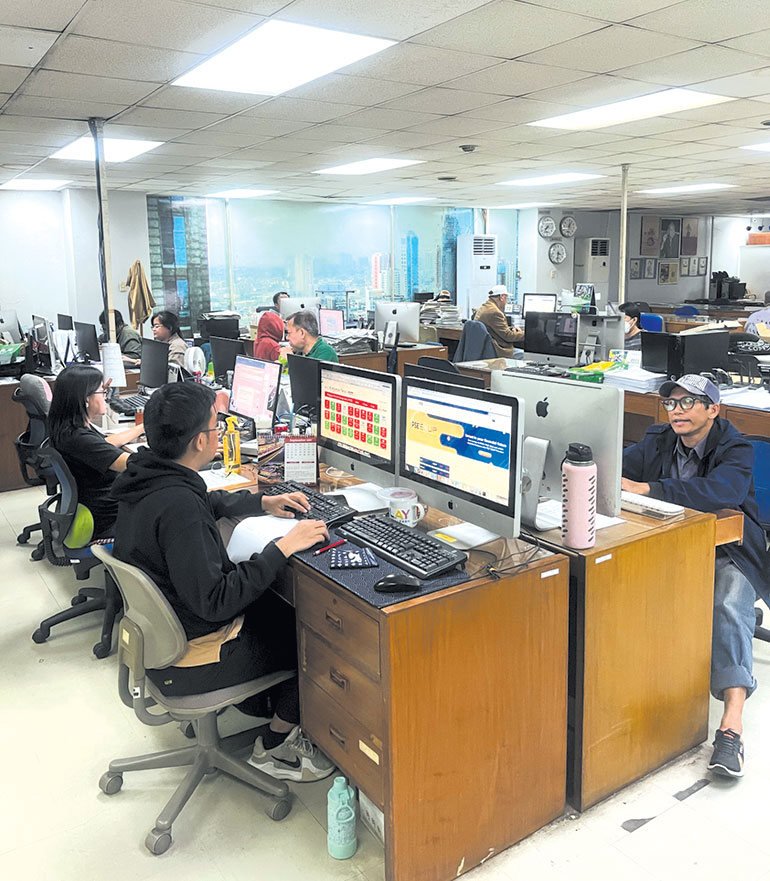
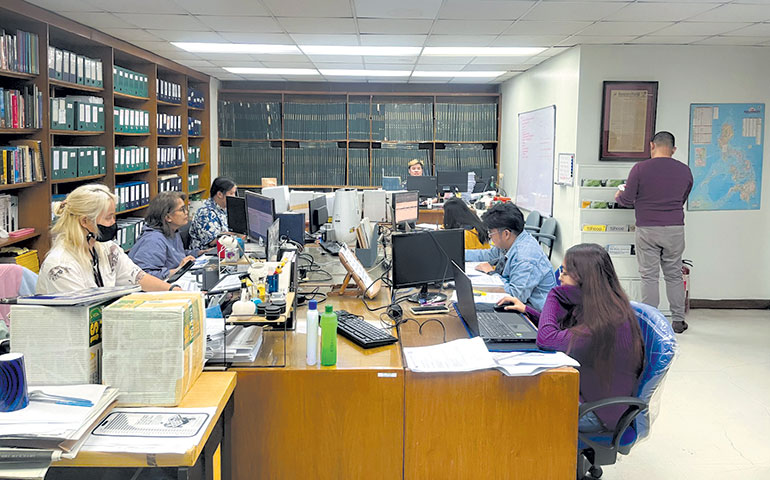
For decades now, legacy media companies around the world have been confronting a flurry of challenges from declining print revenues, shifting audience behaviors, and disruptive technologies. Survival in this industry, let alone growth, is something of an anomaly.

And yet, against this backdrop, BusinessWorld has not only withstood the pressures reshaping the media landscape, it has emerged bigger and better than it ever was during the heyday of print.

As President and Chief Executive Officer Miguel G. Belmonte noted, “It may sound unusual, but BusinessWorld is actually doing better post-pandemic than during the heyday of newspapers.”

BusinessWorld President and CEO Miguel G. Belmonte

“What is good is that in terms of net profit, we are actually showing better bottom lines now than during the pre-pandemic years. Clearly, in terms of success as a corporation, BusinessWorld is possibly even top three now among the print companies. I believe we’re doing a good job.”

Mr. Belmonte explained that the publication’s continued relevance has been the result of deliberate strategy based on a sharpened understanding of the business community it serves. On its 38th year, BusinessWorld still puts significance on the value of print newspapers, but the brand itself has gone beyond that as a multi-platform provider of business information, insight, and analysis — a platform still trusted by decision-makers, yet one steadily adapting to reach the next generation of readers.

“I think that we’re still pretty much using the same strategy as before a few years prior to the pandemic. We’ve diversified our mix with other revenue streams such as digital and events, but our print has held its own,” he said.

In fact, to speak on BusinessWorld’s print readership, Mr. Belmonte noted that the company “continues to have a considerable readership and even more so have maintained influence on society.”

“Fact is, decision-makers of today are still reading BusinessWorld,” he said. “We acknowledge that print is under great pressure, so we really have to do our best to come up with the best product we can come up with. The challenge for us is to be better than our competitors, and again, I believe that we are doing very well in the race and that we’re doing better than all our competitors.”

BusinessWorld Executive Vice-President Lucien C. Dy Tioco

Lucien C. Dy Tioco, executive vice-president of BusinessWorld, explained that as today’s media landscape becomes more muddied with the proliferation of disinformation, toxicity, and closed-minded biases, print media retains its value as a beacon of integrity.

“If you assess where this is headed, there comes a point where you start to value things that have been lost along the way. Newspapers bring a needed relevance in the mix because of its presentation of news, unbiased reporting and journalistic integrity,” he said.

Vice-President for Sales and Marketing Jay R. Sarmiento further noted that while digital media offers immediacy, interactivity, and widespread accessibility, print media maintains certain advantages such as a physical, lasting experience that digital isn’t able to fully replicate.

BusinessWorld Vice-President for Sales and Marketing Jay R. Sarmiento

Ms. Sarmiento said print can provide “credible and trustworthy content especially for in-depth journalism, academic content, or official documentation and serves as a crucial source of information where internet access remains limited.”

Navigating ever-changing landscapes

Still, acknowledging the enduring value of print is not the same as resisting change. BusinessWorld’s leadership has their eyes open to the demographic and behavioral shifts shaping the future of media consumption.

While its print edition remains a trusted source for policy makers and executives, the next generation of decision-makers who are digital natives shaped by algorithmic feeds and mobile-first platforms require a different approach.

BusinessWorld Editor-in-Chief Cathy Rose A. Garcia

Cathy Rose A. Garcia, editor-in-chief of BusinessWorld, pointed out that according to Reuters’ latest Digital News Report, video has overtaken print and radio as the preferred medium for news in the Philippines, as more people now prefer to watch than listen or read the news.

“This shift compels us to rethink the traditional model for print media. In recent months, BusinessWorld has been introducing more video reports,” she said. “Our online team has come out with more video reports about small businesses as well as legacy businesses. We have also increased our presence in YouTube, Instagram, Facebook and TikTok, as a way to boost our multimedia offerings.”

Mr. Dy Tioco shared his insights: “Digital transformation is a continuum, as newer technologies enhance the things we do and consume. It is therefore expected that this progression has a perpetual effect on the media landscape as technology always changes behavior.”

“With rapid digitalization and evolving audience behaviors, BusinessWorld is also reshaping its vision to leverage these changes and solidify its position as the leading source of credible business news and analysis, not just in print, but across all platforms. This involves adapting its business model, content strategy, and technological infrastructure to remain relevant and sustainable for the future,” Ms. Sarmiento also explained.

According to Ms. Garcia, the goal then is for BusinessWorld to become a multi-platform media brand.

“We have to focus on meeting the audiences where they are. BusinessWorld has to embrace digital formats while leveraging our legacy of credibility,” she said.

Rethinking in an AI-driven future

Emerging technology like generative artificial intelligence (Gen AI) pushes the future of media further into ambiguity. The rapid proliferation of deepfakes and fake news, alongside growing public distrust in journalism, presents yet another challenge that publications like BusinessWorld must confront.

Photo by Marlon B. Merced

In this environment, relevance demands so much more than credibility. To find purchase in the minds of the new generation, a publication must be accessible, agile, and have a voice that can cut through the noise. For BusinessWorld, that has meant rethinking not just how news is delivered, but who it is ultimately for.

“I believe journalism should still be reported and written by humans. AI tools can be used in aid of journalism, like summarization and transcription. However, we have to make sure there is always human oversight and review when it comes to using AI in the newsroom,” Ms. Garcia noted.

“There’s no doubt that Gen AI is disrupting the media landscape. AI is a tool that has the potential to boost productivity of journalists. But I do not think AI will replace journalists.”

At the same time, she pointed out that Gen AI has made it easier to spread misinformation and disinformation over the internet, highlighting the role of integrity and transparency in journalism more than ever to maintain the audience’s trust in the media.

“Generative AI is groundbreaking because it can drastically improve systems and processes on the way we do things in a more efficient and scalable manner. We are right now at the cusp of another major digital transformation because the augmentation of AI into business and media is going to change our behavior and actions. It is therefore important for us to recognize these inevitable changes and how will we manage them,” Mr. Dy Tioco said.

Photo by Marlon B. Merced

Ms. Sarmiento added that the advent of AI brings with it both exciting opportunities and significant challenges for the industry as a whole. For its positives, she sees AI enabling more personalized content delivery, faster news generation, and innovative storytelling formats. It can also enhance productivity and help media organizations analyze large datasets to better understand audiences.

However, these advancements also raise concerns about misinformation, deepfake misuse, bias in algorithms, and the potential for job displacement. “Overall, AI serves as a powerful tool that, if managed responsibly, can greatly enrich media experiences and democratize information access,” she said.

“It’s very hard to predict exactly what the future holds, but we have an idea of where we’re headed given where we’ve come from and what we’re experiencing today,” Mr. Belmonte said.

“But for the short term, and maybe up to midterm, I think BusinessWorld has the right strategy moving forward. Given what we’ve achieved thus far and the plans we have in line, BusinessWorld will continue to be a force to reckon with.”

Photo by Adrian Paul B. Conoza

At 38, that strategy of being the ever-reliable provider of trusted business and industry news in the Philippines remains tried and true. Towards the nationwide effort of recalibrating the Philippines’ path forward, BusinessWorld’s part has become indispensable.

Even as its platforms evolve, BusinessWorld’s commitment remains the same: to solid and reliable economic journalism that helps the Philippine business community nav­igate what comes next. Whether in print, on-screen, or through new formats shaped by AI and data, that mission endures.