Home Blog Page 5039

China simulates striking Taiwan on 2nd day of drills
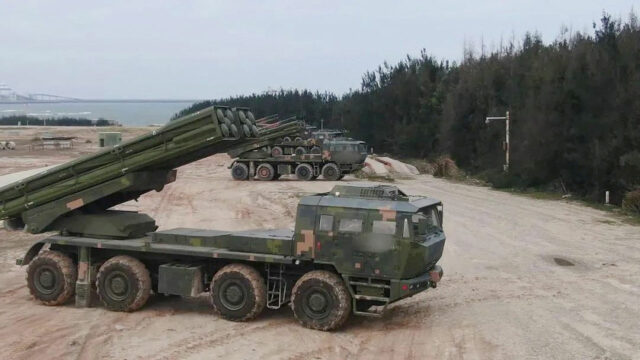
MILITARY VEHICLES of the Ground Force under the Eastern Theatre Command of China’s People’s Liberation Army (PLA) take part in a combat readiness patrol and ‘Joint Sword’ exercises around Taiwan, at an undisclosed location in China in this handout image released on April 8, 2023. — EASTERN THEATRE COMMAND/HANDOUT VIA REUTERS

TAIPEI — military simulated precision strikes against Taiwan in a second day of drills around the island on Sunday, with the island’s defense ministry reporting multiple air force sorties and that it was monitoring China’s missile forces.

China, which claims democratically governed Taiwan as its own territory, began three days of military exercises around the island on Saturday, the day after Taiwan President Tsai Ing-wen returned from a brief visit to the United States.

Chinese state television reported that the combat readiness patrols and drills around Taiwan were continuing.

“Under the unified command of the theater joint operations command center, multiple types of units carried out simulated joint precision strikes on key targets on Taiwan island and the surrounding sea areas, and continue to maintain an offensive posture around the island,” it said.

A Taiwan security source told Reuters that on Saturday the Chinese drills around the Bashi Channel, which separates Taiwan from the Philippines, included simulated attacks on aircraft carrier groups as well as anti-submarine drills.

Taiwan’s defense ministry said that as of Sunday midday (0400 GMT) they had spotted 58 Chinese aircraft, including Su-30 fighters and H-6 bombers, as well as nine ships, around Taiwan.

The ministry said they were paying particular attention to the People’s Liberation Army’s (PLA) Rocket Force which is in charge of China’s land-based missile system.

“Regarding the movements of the Chinese communists’ Rocket Force, the nation’s military also has a close grasp through the joint intelligence, surveillance and reconnaissance system, and air defense forces remain on high alert,” the ministry said.

It reiterated that Taiwan’s forces will “not escalate conflicts nor cause disputes” and would respond “appropriately” to China’s drills.

‘COMFORTABLE, CONFIDENT’ US MONITORS DRILLS
Life in Taiwan has continued as normal, with no sign of panic or disruption from the Chinese drills.

Last August, following a visit to Taipei by Nancy Pelosi, then the speaker of the US House of Representatives, China staged war games around Taiwan, including firing missiles into waters close to the island. It has not announced similar drills this time.

While in Los Angeles last week, on what was officially billed a transit on her way back from Central America, Ms. Tsai met the current speaker of the House, Kevin McCarthy, despite Beijing’s warnings against it.

The de facto US embassy in Taiwan said on Sunday the United States was monitoring China’s drills around Taiwan closely and is “comfortable and confident” it has sufficient resources and capabilities regionally to ensure peace and stability.

US channels of communication with China remain open and the United States had consistently urged restraint and no change to the status quo, said a spokesperson for the American Institute in Taiwan, which serves as an embassy in the absence of formal diplomatic ties.

Washington severed diplomatic relations with Taipei in favor of Beijing in 1979 but is bound by law to provide the island with the means to defend itself.

China, which has never renounced the use of force to bring the island under its control, says Taiwan is the most important and sensitive issue in its relations with the United States, and the topic is a frequent source of tensions.

Beijing considers Ms. Tsai a separatist and has rebuffed her repeated calls for talks. Ms. Tsai says only Taiwan’s people can decide their future.

CHINESE FIGHTERS, WARSHIPS
China has over the past three years or so stepped up its military pressure against Taiwan, flying regular missions around Taiwan, though not in its territorial air space or over the island itself.

Taiwan’s defense ministry said earlier on Sunday that in the previous 24 hours it had spotted 71 Chinese air force aircraft and nine navy vessels around Taiwan.

The ministry published a map showing around half of those aircraft, including Su-30s and J-11s, crossed the median line of the Taiwan Strait, which has for years served as an unofficial barrier between the two sides.

Chinese state media said the aircraft were armed with live weapons. Taiwanese air force jets also typically carry live weapons when they scramble to see off Chinese incursions.

Late on Saturday, Taiwan’s Ocean Affairs Council, which runs the Coast Guard, put out footage on its YouTube channel showing one of its ships shadowing a Chinese warship, though did not give an exact location.

“You are seriously harming regional peace, stability and security. Please immediately turn around and leave. If you continue to proceed, we will take expulsion measures,” a Coast Guard officer says by radio to the Chinese ship.

Other footage showed a Taiwanese warship, the Di Hua, accompanying the Coast Guard ship in what the Coast Guard officer calls a “standoff” with the Chinese warship.

Still, civilian flights around Taiwan, including to Kinmen and Matsu, two groups of Taiwan-controlled islands right next to the Chinese coast, have continued as normal.

In August, civilian air traffic was disrupted after China announced effective no-fly zones in several blocks close to Taiwan where it was firing missiles. — Reuters
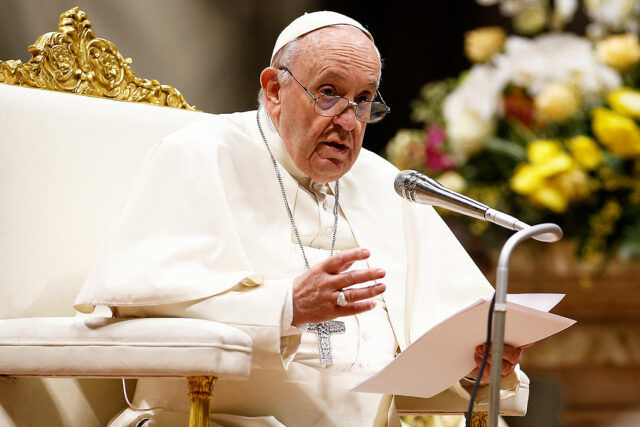
At Easter vigil, Pope Francis encourages hope amid the ‘icy winds of war,’ injustices

REUTERS

VATICAN CITY — Pope Francis led the world’s Roman Catholics into Easter at a Saturday night vigil Mass in St. Peter’s Basilica, decrying the “icy winds of war” and other injustices.

The 86-year-old Pope Francis skipped an outdoor event on Friday night because of unseasonably cold temperatures in Rome. His doctors ordered prudence after he was hospitalized last week for bronchitis.

Francis appeared to be well during the Easter Vigil service, during which he baptized eight adult converts to Catholicism.

After starting the service in the rear of the church with the traditional lighting of a large paschal candle, he was taken in a wheelchair to the front to preside at the Mass.

Easter is the most important day in the Christian liturgical calendar because it commemorates the day the Bible says Jesus rose from the dead.

In his homily, read before about 8,000 people in Christendom’s largest church, Pope Francis spoke of the bitterness, dismay and disillusionment many feel today.

“We may feel helpless and discouraged before the power of evil, the conflicts that tear relationships apart, the attitudes of calculation and indifference that seem to prevail in society, the cancer of corruption, the spread of injustice, the icy winds of war,” he said.

Pope Francis has called for an end to all wars, and since Russia invaded Ukraine in February, 2022, he has repeatedly referred to Ukraine and its people as being “martyred”.

Reading his homily in a strong and confident voice, Francis said that even when people felt the wellspring of hope had dried up, it was important not to be frozen in a sense of defeat but to seek an “interior resurrection” with God’s help.

Francis concludes Holy Week celebrations on Sunday by presiding at an Easter day Mass in St. Peter’s Square and then delivering his twice-annual Urbi et Orbi (to the city and the world) blessing and message from the central external balcony of St. Peter’s Basilica. — Reuters

UK PM Sunak to meet Biden in Northern Ireland

THE TITANIC BUILDING and Harland and Wolff cranes are seen in Belfast, Northern Ireland, April 29, 2022. — REUTERS

LONDON — British Prime Minister Rishi Sunak will meet Joseph R. Biden in Northern Ireland next week when the US president flies in to take part in events to mark the 25th anniversary of the Good Friday peace accord.

Having helped broker the 1998 deal, the United States remains an influential voice in Northern Ireland’s politics and has sought to protect the peace from the strains caused by Britain’s exit from the European Union (EU).

Mr. Sunak will greet Mr. Biden on Tuesday evening when Air Force One lands for what will be a closely watched visit to both sides of the Irish border at a time of heightened political uncertainty in Northern Ireland.

Mr. Sunak hosts a gala dinner on Wednesday to commemorate the anniversary, his office said in a statement setting out some details of his itinerary.

Mr. Biden, who often speaks proudly of his Irish roots, will also spend time in the Irish Republic, where he will visit Dublin and his two ancestral homes.

The Good Friday Agreement — signed on April 10, 1998 — largely ended three decades of sectarian bloodshed that had convulsed Northern Ireland since the late 1960s.

However, the anniversary has been overshadowed by a year-long boycott by Northern Ireland’s largest pro-British unionist party of the power-sharing devolved government central to the peace deal. The Democratic Unionist Party is angry about post-Brexit trade rules that treated the province differently to the rest of the United Kingdom (UK).

In March, Britain’s MI5 intelligence agency increased the threat level in Northern Ireland from domestic terrorism to “severe” — meaning an attack is highly likely — though the move was not thought to be linked to the anniversary.

Mr. Biden clashed with the British government at times during Brexit talks, but has spoken in support of a recently agreed UK-EU deal to address some of the tensions caused by the original Brexit agreement.

Although that deal has so far failed to restore the devolved government in Northern Ireland, Mr. Sunak will seek to bolster his support for the province by announcing a summit later in the year to stimulate international investment. — Reuters

Israel hits Syria after rockets fired towards Golan Heights

Image by Larry Koester/Flickr/CC BY 2.0

JERUSALEM — Israeli jets hit Syrian military targets on Sunday in response to rockets launched towards Israeli controlled territory overnight, Israel’s military said, as violence flared again following cross-border exchanges of fire during the week.

State media in Syria reported explosions in the vicinity of the capital Damascus as Israel said its forces continued to hit Syrian territory after six rockets were fired overnight towards the Golan Heights.

Israel said artillery and drone strikes hit the rocket launchers and were followed by airstrikes against a Syrian army compound, military radar systems and artillery posts.

The Israeli military “sees the State of Syria responsible for all activities occurring within its territory and will not allow any attempts to violate Israeli sovereignty,” the Israeli Defense Forces said in a statement.

The Syrian defense ministry said its air defenses had responded to the Israeli attacks and intercepted some Israeli missiles. It said no casualties had been reported with only material damage caused by the strikes.

Sirens had sounded earlier near towns in the Golan Heights as rockets were launched from Syrian territory, but no damage or casualties were reported. Israel seized the Golan Heights in the 1967 Middle East war and annexed the 1,200-square-km (460-square-mile) territory in 1981, a move not recognized by most of the international community.

Only three of the rockets crossed into Israeli-controlled territory, with two falling on open ground and a third intercepted by air defense systems, the military said.

Lebanon-Based Al Mayadeen TV said the rocket salvoes were claimed by Al-Quds Brigades, the armed wing of the Iranian-backed Palestinian Islamic Jihad movement.

On Thursday, more than 30 rockets were fired towards Israel from southern Lebanon, drawing cross-border counterstrikes from Israel on sites linked to the Islamist movement Hamas in Lebanon and Gaza.

The cross-border exchanges came amid sharply increased tensions between Israel and Palestinian groups following Israeli police raids in recent days on Al-Aqsa mosque in Jerusalem, which caused outrage across the Arab world.

Israel said the operations were intended to dislodge groups of what police called extremists that had barricaded themselves into the mosque armed with firecrackers and stones.

But the raids, during the Muslim holy month of Ramadan, drew a furious reaction and concern even among Israel’s US allies, with mobile phone footage from inside the mosque showing police beating worshippers.

The site in Jerusalem’s Old City, holy to both Muslims and Jews, who know it as Temple Mount, has been a longstanding flashpoint, notably over the issue of Jewish visitors defying a ban on non-Muslim prayer in the mosque compound.

Clashes there in 2021 helped set off a 10-day war between Israel and Hamas. The recent exchanges of cross-border fire have awakened memories of that conflict.

Despite fears of further violence around the mosque on Saturday, there were no reports of serious disturbances overnight.

In a separate incident, a Palestinian man was shot dead by Israeli forces during a confrontation in the occupied West Bank, Israel’s military and the Palestinian health ministry said. — Reuters

IMF’s Georgieva sees global growth below 3% in 2023, robust recovery ‘elusive’

INTERNATIONAL MONETARY FUND (IMF) Managing Director Kristalina Georgieva attends the China Development Forum 2023, in Beijing, China, March 26, 2023. — REUTERS

WASHINGTON — The International Monetary Fund (IMF) expects global economic growth to dip below 3% in 2023 and to remain at around 3% for the next five years, Managing Director Kristalina Georgieva said on Thursday, flagging increased downside risks.

That is the global lender’s lowest medium-term growth forecast since 1990, and well below the average growth of 3.8% seen in the past two decades.

Ms. Georgieva said strong monetary and fiscal policy actions to respond to the COVID-19 pandemic and Russia’s invasion of Ukraine had prevented a much worse outcome in recent years, but growth prospects remained weak given persistently high inflation. Bank failures in Switzerland and the United States had exposed financial vulnerabilities that increased the downside risks for the global economy, she added.

“Despite surprisingly resilient labor markets and strong consumer demand, despite the uplift in China, we expect the world economy to grow less than 3% this year,” she said in a speech ahead of next week’s spring meetings of the IMF and World Bank. “Growth remains historically weak now and in the medium-term.”

“With rising geopolitical tensions, with inflation still running high, a robust recovery remains elusive, and that harms the prospects of everyone, especially for the most vulnerable people and the most vulnerable countries,” she said at an event hosted by Meridian House and Politico.

Global growth dropped by almost half to 3.4% in 2022 following the shock of Russia’s war in Ukraine from the 6.1% rebound seen in 2021.

Ms. Georgieva said India and China would account for half of global growth in 2023, but about 90% of advanced economies would see a decline in their growth rate this year.

Low-income countries, saddled by higher borrowing costs and weakening demand for their exports, would see per-capita income growth staying below that of emerging economies, she said.

The IMF chief called on central banks to stay the course in the fight against inflation as long as financial pressures remained limited, but to address financial stability risks when they emerge through appropriate provision of liquidity.

Recent bank failures in Switzerland and the United States had exposed risk management failures at specific banks and supervisory lapses, she said.

“The key is to carefully monitor risks in banks and non-bank financial institutions, as well as weaknesses in sectors such as commercial real estate,” she added. “Now is not the time for complacency.”

“Clearly downside risks have increased. We now see some of the risks in the financial sector more exposed,” she said, adding that she had “full confidence” that central banks and other relevant institutions were very vigilant of the dangers.

While policymakers had responded swiftly to recent stress in the sector, concerns remained about potential “hidden” vulnerabilities at banks and non-banks, she said.

To boost the prospects for growth and productivity, Ms. Georgieva called for major step changes, including an estimated $1 trillion a year in spending on renewable energy, and moves to avoid the fragmentation of the global economy, which could shave as much as 7% off global gross domestic product.

Technological decoupling could see some countries suffer losses of up to 12% of GDP, she said. — Reuters

PHL 24th-largest exporter of digitally-delivered services 

THE Philippines was the 24th-largest exporter of digitally-delivered services in 2022 , with a tally of $27.66 billion, up 11%, the World Trade Organization (WTO) said.   

In its Global Trade Outlook and Statistics report released Wednesday, the WTO said Philippine exports accounted for 0.7% of the global total for digitally delivered services.   

According to the WTO, exports of digitally delivered services include business, professional, and technical services, computer services, financial services, intellectual property services, insurance services, telecommunication services, audio-visual and other personal, cultural, and recreational services, and information services. 

The US was the top exporter of digitally delivered services at $632.16 billion, followed by the UK with $350.31 billion, Ireland $290.47 billion, Germany $227.24 billion, and India $227.23 billion. 

The WTO added that the Philippines is 24th in terms of merchandise imports at $144.50 billion, if intra-EU trade is excluded. The 2022 total is up 16% and is equivalent to a 0.7% global share.  

The Philippine Statistics Authority (PSA) said in January that the trade balance, or the difference between exports and imports, expanded to a deficit of $58.32 billion in 2022, up from a deficit of $42.23 billion in 2021.

In a separate statement, the WTO said the volume of world merchandise trade is projected to grow 1.7% in 2023, slowing from the 2.7% growth in 2022 due to the ongoing Ukraine-Russia war and high inflation.   

The new forecast for the year is higher than the 1% estimate made by the WTO in October 2022. The WTO made the change following the expected boost in international trade with the relaxation of the coronavirus disease 2019 (COVID-19) pandemic controls in China.   

“Trade continues to be a force for resilience in the global economy, but it will remain under pressure from external factors in 2023. This makes it even more important for governments to avoid trade fragmentation and refrain from introducing obstacles to trade,” WTO Director-General Ngozi Okonjo-Iweala said.

“Investing in multilateral cooperation on trade, as WTO members did at our Twelfth Ministerial Conference last June, would bolster economic growth and people’s living standards over the long term,” she added.   

For 2024, the WTO is expecting trade growth to hit 3.2%. Some of the factors that might affect the 2024 projection include geopolitical tensions, food supply shocks, and the possibility of unforeseen fallout from monetary tightening.  

“The lingering effects of COVID-19 and the rising geopolitical tensions were the main factors impacting trade and output in 2022 and this is likely to be the case in 2023 as well,” WTO Chief Economist Ralph Ossa said.   

“Interest rate hikes in advanced economies have also revealed weaknesses in banking systems that could lead to wider financial instability if left unchecked. Governments and regulators need to be alert to these and other financial risks in the coming months,” he added.  - Revin Mikhael D. Ochave 

DBM calls on agencies to prioritize infrastructure, human capital, food security in budget proposals 

THE DEPARTMENT of Budget and Management (DBM) said the 2024 budget will highlight infrastructure, human capital development, and food security, and urged agencies to prepare their budget proposals accordingly. 

“Priority will be given to shovel-ready infrastructure projects, investments in human capital development, and sustainable agriculture and food security, among others, which will steer the economy back on a high growth path,” the DBM said in its National Budget Memorandum. 

“The National Government shall continue to foster economic and social transformation to address the economic scarring due to the pandemic and to mitigate the effects of high inflation on basic commodities,” it added. 

For infrastructure, the DBM said implementing agencies should prioritize the completion of ongoing infrastructure programs, activities and projects (PAPs). 

“New infrastructure PAPs shall be limited to shovel-ready proposals aligned with the investment priorities (of the government),” the DBM said. 

“In addition, priority will be afforded to infrastructure PAPs that have undergone program convergence efforts and inter-agency collaboration,” it added. 

It said specific investment priorities under infrastructure include transportation and logistics networks, water supply and sanitation, and energy security.  

The DBM said it will also favor proposals to develop human capital, particularly investment in health, education, social protection, and labor and employment. 

“Given that the pandemic had posed threats to the gains in the education and health system, the NG will provide continuous support in prioritizing reforms and investments in health and nutrition, education, and income-earning ability to bring back the country on the right track in accelerating human capital development,” it said. 

The DBM said that priority will be given to food security programs that “strengthen local supply chains by enhancing agriculture productivity and expanding the access of farmers and fisherfolk to markets.” 

“In response to the global food crisis due to, among others, supply chain disruptions, climate risks, and higher energy and fertilizer prices, the government shall ensure that food is available, affordable, and accessible for consumers,” it added. 

It said that the government will address high production costs by improving access to land distribution and climate-proof irrigation, as well as minimizing the impact of high energy and fertilizer prices. 

The DBM also cited other priorities such as enterprise development, research and development and innovation, digital transformation of the government, climate action and disaster resilience, and the transition to full devolution. 

The proposed 2024 national budget has been set at P5.8 trillion, up 10%. – Luisa Maria Jacinta C. Jocson 

JFC buys majority stake in brand’s HK franchisee

JOLLIBEE Foods Corp. (JFC) is acquiring the majority stake in the fast-food brand’s master franchisee in Hong Kong to hasten its growth in what it considers an important market, the company said on Wednesday.

In a regulatory filing, the listed food service company said its Singapore-based unit Golden Plate Pte. Ltd. will purchase 60% of Meko Holdings Ltd. for $16.08 million from the franchisee’s shareholders, who will continue to own the remaining 40%.

“Hong Kong is an important market for Jollibee and an important part of JFC China’s strategy to elevate the Jollibee brand in a general population or mainstream market,” JFC said. 

“Hong Kong is renowned for its relationship with a vast variety of food and attracts both a strong base of local consumers and tourists,” it added. 

Once completed, the transaction will give JFC the controlling stake in the once 100% franchised market.

A share purchase agreement and shareholders’ agreement were signed by the transacting parties on April 5, “subject to fulfillment of agreed closing conditions.”

Golden Plate is a wholly owned subsidiary of Jollibee Worldwide Pte. Ltd., which is 100%-owned by JFC.

JFC said the group, as of end-February, operated 6,506 stores worldwide — 3,281 in the Philippines and 3,225 overseas. 

Outside the Philippines, it has 501 stores in China, 385 in North America, and 333 in Europe, the Middle East and other parts of Asia. It also counts 640 stores, mainly in Vietnam, under its SuperFoods group, plus 1,079 The Coffee Bean & Tea Leaf (CBTL) stores apart from 287 stores under the Milksha brand.

JFC said its largest brands by store outlets worldwide are Jollibee with 1,594, CBTL with 1,079, Chowking with 613, Mang Inasal with 571 and Highlands Coffee with 610.

Shares in Jollibee closed lower on Wednesday by 1.33% or P3.00 to end at P223.00 apiece. — Adrian H. Halili

Rice prices expected to rise by up to P5 on reduced imports 

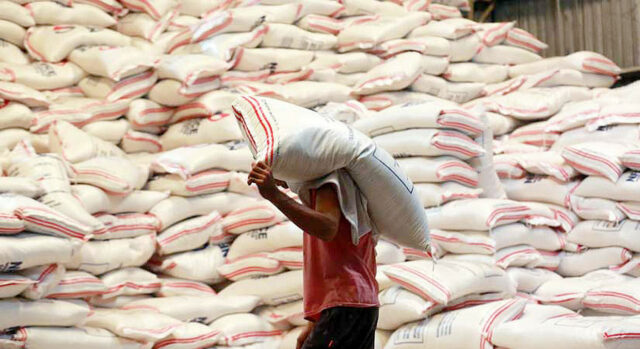
THE RETAIL price of rice is expected to rise by up to P5 this year due to lower import volume, according to a Department of Agriculture (DA) official. 

“For now, we are seeing a maximum (increase) of P5 per kilo. But (thanks to government action) maybe it won’t go that high,” DA Deputy Spokesperson Rex C. Estoperez said in a briefing Tuesday. 

As of March 30, the Bureau of Plant Industry (BPI) estimated that the volume of imported rice landed in the country fell 16.20% year-on-year to 360,196.175 metric tons (MT). 

Under Republic Act No. 111203 or the Rice Tariffication Law, private parties may import rice without restriction, though incoming shipments of Southeast Asian grain must pay a 35% tariff. 

Mr. Estoperez said the DA is seeking to unravel why rice inventories fell despite substantial imports last year. 

The Philippine Statistics Authority (PSA) said the national rice inventory as of Jan. 1 declined 5.1% year-on-year to 1.77 million MT. 

“Nagtataka rin kami (We have been wondering why) because we had imports of 3.8 million metric tons last year. What happened to those stocks?on.” 

He said prices could be kept in check if imports of rice are fast-tracked. 

Samahang Industriya ng Agrikultura (SINAG) Executive Director Jayson H. Cainglet that the projected increase reflects higher global rice prices.  

“Precisely because of the reliance on imports, especially in the last three years, hindi natugunan yung pagtulong sa rice farmers (aid to rice farmers was not addressed), in terms of reducing their cost of producing palay (unmilled rice),” he said in a Viber message. 

According to Mr. Cainglet, the average farmgate price of palay is currently between P19 and P20 per kilogram. 

“Time and again, we have said that imports will not ‘tame high prices,’ across commodities. It is also happening in pork, chicken, sugar, fish products, and onions,” he said. 

Mr. Cainglet reiterated that the agriculture department must instead help farmers boost productivity. 

“Unless producers are encouraged to farm or raise animals; retail prices will never go down, and stocks will continue to dwindle,” he said. 

As of Tuesday, domestically-produced regular milled rice is being sold in Metro Manila at between P34 and P40 per kilo, according to DA price monitoring reports. Imported regular-milled rice prics were sellng for between P37 and P44 per kilo. 

RICE BUFFER STOCK
Rice import liberalization program has relegated the National Food Authority (NFA) to maintaining an emergency rice buffer stock, sourced from domestic farmers. 

“For now, I don’t have the figure (for rice buffer socks) pero mababa siya (but it’s low). Maybe in the next few days we will know if there’s a recommendation that the National Food Authority should import (to add to the) buffer stock,” he told reporters in response to a query about the NFA’s holdings. 

“NFA is not allowed to import under the Rice Tariffication Law, but if the buffer stock went down, (we need to find out because) we are talking about buffer stock,” he added. 

The law also allows the NFA to regularly replenish the inventory and sell to avert spoilage if it does not distribute rice in the absence of calamites.

Mr. Estoperez said that the current procurement price of rice has increased to P22 – P23 per kilo from P19 per kilo, with increaed procurement meaning increased subsidy.

“Mukhang mahirap bawiin ‘yan pag tinaas mo na (It’s hard to bring down the subsidized price if it is raised), so we’d rather suggest that the procurement price serves as an incentive because prices fluctuate every season.” – Sheldeen Joy Talavera 

Metro Pacific eyes new expressway project in Indonesia

Metro Pacific Tollways Corp. (MPTC) is targeting a new expressway project in Jakarta, Indonesia that is awaiting regulatory approval, its top official said.

“We cannot announce it yet. But there’s a new project that we have submitted a proposal of to the government, through our Indonesian company, and it’s being negotiated. Hopefully, it will be finalized soon,” MPTC President and Chief Executive Officer Rodrigo E. Franco told reporters recently. 

The elevated expressway project will be via Indonesia’s public-private partnership scheme and will be under MPTC’s Indonesian unit. 

“I cannot disclose [how much the project cost will be] but it’s a big project,” Mr. Franco said. 

Mr. Franco said that he expects the more than 20-kilometer road project to be awarded within the year, as it has been being discussed for “some time already.”

“We expect this project to be finalized this year assuming that the government will approve it because it is not yet formally approved,” he added.

Mr. Franco said that MPTC’s tollway network in Indonesia is the largest among its portfolio, as it caters to 1.4 million daily motorists.

“In Indonesia, in our tolling network — because there is a different tolling system in Indonesia, it’s a network — approximately, we have 1.4 million traffic every day and here in the Philippines we have around 600,000,” Mr. Franco said.

For 2023, Mr. Franco said MPTC is expecting significant improvements as traffic recovers and with the opening of its new roads.

“We expect more significant improvements from 2022 as traffic further grows and as we open new roads — NLEX Connector, Subsection 4 in CALAX (Cavite–Laguna Expressway), and the second section of NLEX Connector — we have new roads, and that will add to the traffic,” he said. 

“Year on year, we are kind of looking at around 20% growth. I wouldn’t know the exact numbers right now, but definitely double-digit growth,” he said about the expected growth of traffic and revenues.

In 2022, the tollway group’s revenues reached more than P22.9 billion.

“I think last year, the toll revenue was over P20 billion, so I think yes around 20% growth for this year,” he added. 

MPTC is the tollways unit of Metro Pacific Investments Corp., one of three key Philippine units of Hong Kong-based First Pacific Co. Ltd., the others being Philex Mining Corp. and PLDT Inc.

Hastings Holdings, Inc., a unit of PLDT Beneficial Trust Fund subsidiary MediaQuest Holdings, Inc., has a majority stake in BusinessWorld through the Philippine Star Group, which it controls. — Justine Irish DP. Tabile

Balai set to acquire P111-M Quezon City property

Balai Ni Fruitas Inc.’s board of directors approved the acquisition of land, building and improvements on a P111.3-million property in Quezon City, the company said on Wednesday.

In a disclosure to the stock market, the company said the 484-square-meter (sq.m.) property will be used as a warehouse and commissary to expand its distribution channels, with part of the funding coming from the proceeds of its initial public offering (IPO).

“[Balai Ni Fruitas] continues to expand its distribution channels through setting up new Balai Pandesal stores, product placements in other Fruitas Holdings, Inc. community stores, and third-party partnerships,” the company said.

The transacting parties executed a deed of absolute sale of assets for a total consideration of P111.3 million, which the company said will be paid through a bank loan of P28.4 million, cash payment from IPO proceeds, which are allocated for commissary setup, and internal cash.

“The consideration shall be funded by approximately 25% debt and 75% cash,” the company said.

The property, which will be acquired from Lush Properties, Inc., is a 484 sq.m. land with a 288 sq.m. building and improvements. It is located in N. Domingo St., Quezon City.

Balai tapped Tan-Gatue Appraisal Associates, Inc. as the third-party property appraiser, it will assess the fair market value of the location and set the price at 90% of the appraised value.

On Wednesday, shares in Balai fell by 4.84% or 3 centavos to close at P0.59 apiece. — Adrian H. Halili

ERC, NEDA discuss ‘affordability index’ for power

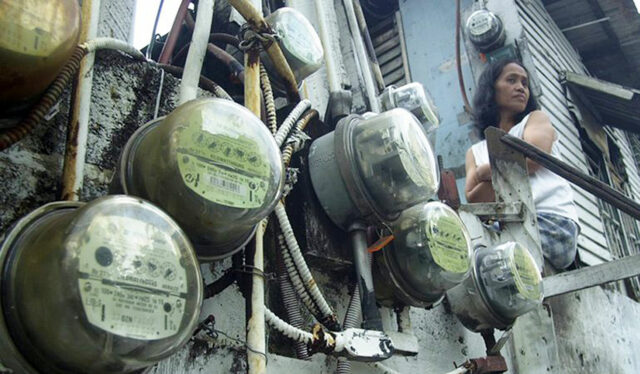
THE ENERGY Regulatory Commission (ERC) said Wednesday that it held discussions with the government’s economic planning agency on establishing an electricity affordability index to better implement subsidized power rates for poor consumers. 

In a statement, the ERC said it met with the National Economic and Development Authority (NEDA) to discuss the index as part of the regulator’s activities in response to Republic Act No. 11552, An Act Extending and Enhancing the Implementation of the Lifeline Rate. 

The lifeline rate is a socialized pricing mechanism for marginalized end-users. It was first authorized by RA 9136, or the Electric Power Industry Reform Act of 2001 (EPIRA). RA 11552 amends Section 73 of EPIRA.  

“Considering the current state of our electricity rates, particularly generation rates, we look forward to the immediate realization of the objectives of Republic Act No. 11552 and achieve a more equitable implementation of the lifeline subsidy, particularly to those living below the poverty threshold,” ERC Chairperson and Chief Executive Officer Monalisa C. Dimalanta said in the statement. 

The ERC said index is intended to provide government agencies a “clear view” of a consumer’s ability to pay electricity bills, and will reflect the nuances of every region in terms of retail electricity prices. 

“The Electricity Affordability Index is envisioned to support the adoption of government policies and programs that are sensitive to the geographic and economic peculiarities of electricity consumers,” the ERC said. 

The ERC added that it has signed a data-sharing agreement with private distribution utilities to improve lifeline rate implementation 

The ERC said the data-sharing deal will be accompanied by  privacy safeguards to protect those eligible for lifeline rates, which are intended for marginalized power consumers. – Ashley Erika O. Jose