Home Blog Page 5024

AirAsia seeks international flights moved to Terminal 1

BW FILE PHOTO

LOW-COST carrier AirAsia Philippines is requesting the reassignment of its international flights to Terminal 1 to ensure on-time performance and lessen costs.

Ang Terminal 3 po namin mananatili roon ang aming international flights sa kasalukuyan. (Our international flights will stay at Terminal 3),” AirAsia Communication and Public Affairs Head Steve F. Dailisan said during a media briefing on Thursday.

He said the airline is asking the Manila International Airport Authority (MIAA) to let it move international flights to Terminal 1.

Under the schedule and terminal assignment rationalization program of the MIAA, the domestic flights of the carrier will be moved to Terminal 2, while its international flights will remain at Terminal 3.

At present, the airline’s international flights are in Terminal 3, while its domestic flights are in Terminal 4.

Mr. Dailisan said that if the plan pushes through, they are expecting the reassignment to incur more costs and dampen on-time performance.

Magiging malaking hamon naman po ito doon sa aming aircraft movement lalo na for international (This is going to be a challenge for our aircraft movement especially for international flights),” he said.

AirAsia’s international and domestic flights share the same air fleet, with the Airbus 320s used for both locations, according to Mr. Dailisan.

“So ‘yung rotation ng eroplano maaari pong magkaroon ng dagdag na oras sa kasalukuyan (Because of this, the airfleet rotation would take more time), he added.

The airline said it is preparing a time and motion study to be presented to the MIAA in a meeting next week.

The study aims to present the efficiency of moving AirAsia’s international flights to Terminal 1 once all its domestic flights are moved to Terminal 2.

Di hamak po kasi na mas malapit po ang Terminal 1 sa Terminal 2, so mas madali po ‘yung passenger movement, mas madali rin ang movement ng cargo (Terminal 1 is much closer to Terminal 2. So that will result to easier passenger movement and cargo movement),” Mr. Dailisan said.

He added that if AirAsia’s international flights remain at Terminal 3, this would affect the airline’s on-time performance and create more costs.

“We are also studying the costs. For one, we will pay more for passenger buses since Terminal 3 is far from Terminal 2,” Mr. Dailisan said in a mix of English and Filipino.

Iisa naman po ang layunin namin (We only have one goal): passenger comfort and improved customer experience,” he added.

Earlier this week, AirAsia posted an outstanding on-time performance of 99%, which it attributed to the commitment and dedication of its employees. — Justine Irish D. Tabile

Eight-step problem-solving guide

Four out of my five workers don’t meet my daily deadline for submitting production reports, which are compiled manually. The fourth can do the job without any complaint. I wish my small company can afford software to make daily reporting easier. In the meantime, what’s the cure? — Banana Boat.

You should examine all angles of the problem in order not to fall into the trap of what psychologists call “confirmation bias.” Many of us have our own biases and prejudices. We tend to apply certain solutions in solving similar problems because they were effective before.

In your case, it’s easy to conclude that when four out of five workers are having difficulty meeting your production deadline, maybe the problem lies in the system. Or maybe the report form is difficult to accomplish or there is too much data that needing to be tracked.

Maybe the logic behind the requirement to track the data in a daily report is faulty.

The biggest problem of all is when the four workers continue to agonize about their respective challenges. Now, look at it this way. If one worker can meet your daily deadline, then why can’t the majority do it? That’s another angle that you should consider.

Maybe the one exception has some tricks or techniques that help him complete his task. Speak in confidence with your model worker and explain the issue. But first, congratulate him on a good job.

Inform him that you need his input in solving the problem. But be very careful in giving too much credit to Peter as it could antagonize his co-workers.

FISHBONE DIAGRAM
I teach critical thinking and problem-solving skills. One of the diagnostic tools I use is the Fishbone Diagram, also known as the Ishikawa Diagram or Cause-and-Effect. It’s a practical way for discovering the root cause or causes of a problem. Try it. If you or your team doesn’t know how to use this tool, check the internet.

To ensure a comprehensive analysis, establish a six-point test that includes manpower, machinery, material, method, measurement and milieu to cover either employee morale and mother nature. The usual template typically  excludes either measurement and milieu. For now, let’s consider all factors for a comprehensive analysis.

The more causes workers can identify, the better.

Theoretically, it’s best to use this tool in a group set-up to ensure a consensual decision-making process. This time, however, I’m advising you to request that all five workers work individually on their Fishbone Diagram, with each one listing their top causes, arranged in order of importance. They must not share their work with other workers until their analysis is complete.

As soon as everyone has completed their work, arrange a group meeting to reconcile their inputs. You should act as the facilitator. Your job is to define the one factor cited by all. If two workers cite an identical number one root cause, then that should suffice.

Focus on addressing that root cause with the help of the five workers.

EIGHT STEPS
What approach should you take in addressing the root cause behind late production reports? I’m a follower of the Toyota Production System, based on the ideas of Taiichi Ohno and Shigeo Shingo, who in turn learned from W. Edwards Deming.

From their teachings, I developed a system called the Thinking Production System that incorporates the work of Peter Drucker, the father of modern management. I needed to tweak Toyota’s system to meet the demands of people and organizations outside of the automobile industry.

It’s an eight-step process that you can use for solving this particular issue. Regardless of whether the problem is complex or simple, it’s better to have a systematic approach so you don’t miss anything.

Here are the eight steps:

One, define the problem. If it is not addressed, how much money will you lose every day? If unquantifiable, what are its adverse effects on organizational objectives?

Two, know your goal. Define clearly the target condition using the SMART (specific, measurable, attainable, relevant, time-bound) template.

Three, analyze the root cause. Choose the root cause that was most frequently cited by your team.

Four, validate the root cause. Ask Five Whys. Ask as many ‘whys’ as possible until your team has exhausted all possibilities.

Five, generate low-cost, common-sense solutions. Your team must solve this problem using the company’s existing resources.

Six, seek consensus. This is often a formality because the eight-step problem-solving guide requires the active participation of everyone on the team.

Seven, implement the solution. Write a new policy. Standardize the policy. Educate all team members and continue to solicit their feedback.

Last, monitor the system. Find out how to improve the system. Review the solution and adjust accordingly as soon as you discover something.


Bring Rey Elbo’s “Kaizen Problem-Solving Workshop” to your management team. Socialized pricing scheme and result-based consulting is available. E-mail elbonomics@gmail.com or via https://reyelbo.com

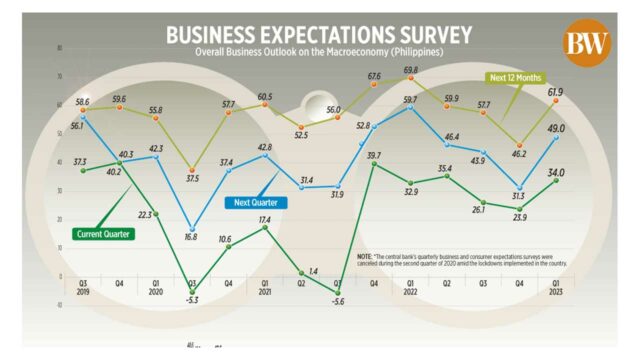
Business expectations survey

BUSINESSES NOW have a more optimistic economic outlook this year, amid a return to pre-pandemic normalcy and increased consumer demand, a survey by the Bangko Sentral ng Pilipinas (BSP) showed. Read the full story.

Business expectations survey

US actor Jeremy Renner says he broke over 30 bones in snowplow accident

Jeremy Renner in a scene from Hawkeye.

LOS ANGELES —  Hawkeye actor Jeremy Renner said he broke more than 30 bones and sustained a collapsed lung and pierced liver in a January snowplow accident, disclosing for the first time the full extent of his injuries. The actor, 52, spoke in an interview with ABC News anchor Diane Sawyer, and clips were released on Wednesday. The interview will air April 6. In his accident, Mr. Renner was plowing snow at his Nevada home when the machine began to roll away while the actor was not in the driver seat. The snowplow ran him over as he tried to get back into it.

“I was awake through every moment,” Mr. Renner told Sawyer as he recalled the physical pain he felt.

Mr. Renner has starred in multiple Marvel projects as well as in two Mission: Impossible films and Arrival, American Hustle, and 28 Weeks Later.

He was nominated for an Academy Award for best actor for his work in 2008 film The Hurt Locker and for best supporting actor for his work in 2010 movie The Town. Mr. Renner is slated to make his in-person return to Hollywood during a red-carpet event and discussion of his docuseries Rennervations, on April 11. — Reuters

Crucial considerations for boards in 2023

CERTAIN topics that were top of mind for Asia-Pacific boards in 2022 are still considered crucial in 2023, according to the EY Asia-Pacific Board Priorities 2023 report. In particular, the climate crisis, cybersecurity, and geostrategy are now widely acknowledged as fundamental elements of an ongoing strategic business agenda.

THE CLIMATE CRISIS
Organizations have already recognized and embraced the potential for growth in transitioning to clean energy. The economic prospects associated with the ASEAN green economy alone are estimated to be worth over $1 trillion. With the certainty of these disclosures increasing and regulators soon likely to enforce reporting, capital allocation is now more dependent on climate and environmental, social, and governance (ESG) performance. As a starting point, boards should consider actively increasing their climate competency, specifically on the significant effects of climate change on their particular enterprises.

While some industries, such as the automobile, energy, and manufacturing sectors, are more advanced than others in integrating climate action into their core business strategies, all boards should consider climate risk a permanent item on their agendas. In order to increase value for shareholders, boards can promote sustainability indicators for management performance and regulate how to further integrate climate action into strategy.

Boards will have to consider whether they will strengthen the role of a Chief Sustainability Officer (CSO) to make ESG a cornerstone of the corporate strategy, and develop the company’s timetables and transition strategy to succeed in a net-zero world. These objectives must also be included in CEO compensation and incentive plans. Boards will need to ask themselves how to redesign corporate strategy to move toward a regenerative economy while still creating value for both people and businesses.

Boards should also consider what type of governance is in place to reflect the significance of the ESG agenda and the CSO’s role, whether ESG oversight has been delegated to a particular committee or distributed across several committees.

CYBERSECURITY
Artificial intelligence has continued to progress and become more sophisticated over the past year along with cutting-edge cybersecurity capabilities, all thanks to the adoption of Internet of Things (IoT). In parallel, an increase in cyber risks has led to data privacy concerns and heightened new regulations. Despite these advancements, non-executive-level directors rarely have a high level of confidence in the board’s capacity to comprehend the most serious cyber threats to the firm or its level of cybersecurity investment.

It is then essential that directors keep highlighting how crucial it is to manage cybersecurity as an enterprise risk. To set that tone, the board should bring up cyber threats in communications from management figures in addition to the chief information officer (CIO) or chief information security officer (CISO), underscoring the message that cybersecurity is an enterprise-wide concern. To guarantee cyber resiliency, boards must constantly collaborate with management to examine the size and talent profile of the cybersecurity team. Boards must also evaluate the method by which cybersecurity is integrated from the outset through a “trust by design” attitude when creating new technology, products, and business and supplier arrangements with their management teams.

Boards will also need to consider how they supervise cybersecurity, and whether these governance frameworks are regularly evaluated for efficacy. The CEO must also consider how frequently to assess the size and talent profile of the cybersecurity team to guarantee cyber resiliency, and how the company can strategically invest in building cybersecurity into its data systems and procedures.

GEOSTRATEGY
According to recent analysis, the connections between China and other important economies are anticipated to gradually weaken. This might eventually lead to a reorientation of supply chains, divergent development, and varied investment prospects. Various regional and economic effects are produced by the ongoing conflict in Ukraine, while the economic ties between the US, China, and Europe are constantly shifting.

Boards need to have a very clear understanding of how problems could arise with respect to these processes. Advanced scenario analysis should be used by boards to ensure they fully understand the implications and opportunities associated with any geopolitical shifts. They should be ready to position their organizations to remain stable during the anticipated turbulent times ahead, giving them a strategic advantage.

Boards should also continue to advise management to proactively evaluate how geopolitical developments may affect their growth, supply chain, strategic partnership choices, and stakeholder expectations, particularly as it increasingly relates to a “deglobalizing” agenda.

Boards will have to determine if they hold management responsible for routine advanced scenario planning analysis in order to be ready for unpredictable events in geopolitics. They must consider how significant changes may be incorporated into the overall strategic planning process of the company, and how the board is kept abreast of material risks and opportunities.

They should consider, as well, which circumstances, if any, would result in a talent shortage, and what impact this would have on capital access. They will also have to determine how to restructure their growth and investment strategy when considering joint ventures with domestic markets and allied nations.

REMAINING RESILIENT FOR LONG-TERM GROWTH
Asia-Pacific economies generally remain resilient, with investors expressing renewed confidence in long-term opportunities. With global economic disruption continuing past the pandemic, Asia-Pacific boardrooms should keep certain crucial elements top of mind to maintain investor interest and ensure long-term growth.

This article is for general information only and is not a substitute for professional advice where the facts and circumstances warrant. The views and opinion expressed above are those of the author and do not necessarily represent the views of SGV & Co. and FINEX.


Wilson P. Tan is the chairman and country managing partner of SGV & Co. and the president of FINEX.

Manila’s colorful jeepneys make way for carbon-free minibuses

THEY vanished from Philippine roads in the thick of one of the world’s strictest pandemic lockdowns. Now, Manila’s colorful jeepneys may disappear for good as the government seeks to cut planet-warming emissions.

The Southeast Asian nation is pursuing a plan to replace highly polluting jeepney models with modern minibuses that run on cleaner fuels or electricity. But the program is facing pushback from drivers who need more financial support to make the shift, putting at risk the country’s goal of cutting greenhouse gas emissions by 75% by the end of the decade from 2020 levels.

Only 4% of the Philippines’ 158,000 jeepneys have been replaced with a more climate-friendly alternative since the government’s program began in 2017, according to official data. President Ferdinand Marcos Jr., who took office in 2022, has given drivers until the end of the year to form or join cooperatives to help them fund the transition or risk losing their permits to operate.

The mandate is a major worry for drivers like Roger del Monte, who returned to Manila’s roads last year after the pandemic halted his main source of income for almost two years. Jeepney drivers like him typically earn about 650 pesos ($12) a day, putting the cost of a modern jeepney — which can go for as much as 2.8 million pesos — far out of reach.

“We won’t be able to shoulder the cost,” the 46-year-old said as he waited for passengers to board the rickety jeepney he’s driven for seven years so he could send his two children to school. “We’ll be deep in debt.”

Called the “king of the road” because of their bulky frames, flashy designs and notoriously aggressive drivers, jeepneys are the cheapest mode of transport for many of the Philippines’ 110 million people. The 20-seater vehicles, often decorated with graffiti-inspired spray paint, evolved from the army jeeps used during World War II and run on diesel, one of the dirtiest fuels available. A study from De La Salle University in Manila said replacing old models in the capital may reduce carbon monoxide and dangerous particulate matter emissions by 90%.

The problem for the Marcos administration is finding the money to back up its green plans. State resources remain scarce as the economy recovers from a Covid-induced slowdown. The government currently offers a subsidy of 160,000 pesos per jeepney, and didn’t set aside funding specifically for the jeepney modernization program in this year’s budget. Last year, it allocated 1.8 billion pesos for subsidies and social safety programs for drivers — a fraction of the 64.2 billion pesos that the land transport agency estimates is needed to raise the subsidy per jeepney to 360,000 pesos.

“This is torture for drivers,” said Modesto Floranda, who heads Piston, one of the transport groups that organized a strike against the jeepney modernization policy this month. Some 900,000 drivers may lose their jobs if the government removes old jeepneys from roads, he warned. “The government left us on our own to carry out this program.”

The government’s end goal is to transition drivers to zero-emission electric vehicles, but the Philippines still lacks sufficient charging infrastructure. It’s more common right now for those able to make the shift to buy minibuses with “Euro-4 compliant” diesel engines, which have catalytic converters that are more efficient at filtering out pollutants such as sulfur and carbon monoxide.

Those who have taken the plunge tout the benefits to their health and income. Elisio Estoque, who plies a regular route between the capital and nearby Rizal province, said he earns more after switching to a white Euro 4-compliant minibus due to its bigger capacity. The vehicle belongs to a cooperative, which pays Estoque a fixed 750-peso daily wage and takes the rest of his earnings.

“I get to ride an air-conditioned vehicle in this heat,” said 44-year-old Estoque, “and I am not exposed to smoke outside.”

Helen Viloria, who manages a cooperative in the capital, said her group had to take out loans from a state bank to fund its fleet of 52 jeepneys. The government should give them more subsidies as well, she said. “Drivers will not be able to do this alone.”

The Marcos administration should also consider pilot-testing the program with local governments that are more prepared, said Reycel Hyacenth Bendaña from Move As One Coalition, a civil society group pushing for safer transport.

Mr. Marcos has said his government will review the program until December, and make sure that transport workers won’t carry additional burden. “We have to make sure that no one loses livelihood because he or she can’t afford a vehicle,” he said.

While the government has good intentions, putting the cost on drivers and operators from the poor and lower-middle classes is “not acceptable,” said Antonio La Viña, associate director for climate policy at research group Manila Observatory. He suggested that officials try to get financing from developed countries to advance the program. “We can’t transition well to a green economy if we don’t do it in a just manner.” — Bloomberg

Freediver sues Netflix claiming film depicted him as a murderer

A CUBAN-American freediver who set 21 world records sued Netflix, Inc. for defamation, claiming the media giant wrongly depicted him as a murderer in the 2022 film No Limits.

The film is presented as a fictional work, inspired by real events, but Francisco Ferreras Rodriguez claims it’s very similar to what happened in his life, with the exception that the film’s lead character, Pascal Gautier, deliberately killed his wife, a fellow freediver. A picture and the name of Mr. Ferraras’s wife, Audrey, who drowned in a record attempt dive, appear at the end of the film.

“Many viewers reasonably concluded that Mr. Ferreras behaved in real life in the same way that the Gautier character behaves in the film,” Mr. Ferreras’ lawyer Alexander Rufus-Isaacs wrote in the complaint, filed Wednesday in Los Angeles federal court. “There was a storm of online abuse directed at him by viewers who believed that he had murdered Audrey.”

Netflix’s docudramas have landed the company in court on numerous occasions now. The company settled a defamation suit by a Georgian chess master who claimed a reference to her in an episode of Queen’s Gambit was sexist and belittling. That suit was also brought by Rufus-Isaacs and is still pending.

Earlier this month, a judge threw out a lawsuit brought by a retired police officer who claimed he was defamed by Netflix’s series Making a Murderer, Variety Magazine reported.

Netflix declined to comment on the Ferreras lawsuit.

No Limits was released Sept. 9 by Netflix and held the No. 1 spot in Netflix’s weekly list of top 10 non-English films for the first two weeks, according to the complaint.

Ferreras said in a phone interview from Cuba that the producers didn’t contact him before the film was released and he only found out about it from friends and posts on Facebook, where he said he was called “all sorts of ugly things.”

“It caught me by surprise,” he said. “Why did they do something like that to us?”

HOLDING BREATH
Freediving involves being lowered to a predetermined depth under water, and with no exterior air supply returning to surface by hanging onto a sled with an inflatable lift bag. The diver has to hold his or her breath for two to three minutes while experiencing the pressure from the weight of the water.

Audrey, a French citizen, died as a result of her last dive, when the sled returned to the surface too slowly, leaving her underwater for more than 8-1/2 minutes, according to the complaint. The death was ruled accidental by authorities in the Dominican Republic, according to the complaint.

In the film, it’s suggested Mr. Gautier tampered with the equipment to kill his wife.

Mr. Ferreras’ last logged record dive was in 2000 when he reached a depth of 162 meters (531 feet), according to the complaint. In 2003, he reached 171 meters, matching the depth of his wife’s last dive.

Ferreras is seeking unspecified monetary damages from Netflix, as well as Nolita Cinema, which produced the film, and David M. Rosenthal, the writer and director.

A representative for Rosenthal didn’t immediately respond to an emailed request for comment. —  Bloomberg

How PSEi member stocks performed — March 30, 2023

Here’s a quick glance at how PSEi stocks fared on Thursday, March 30, 2023.


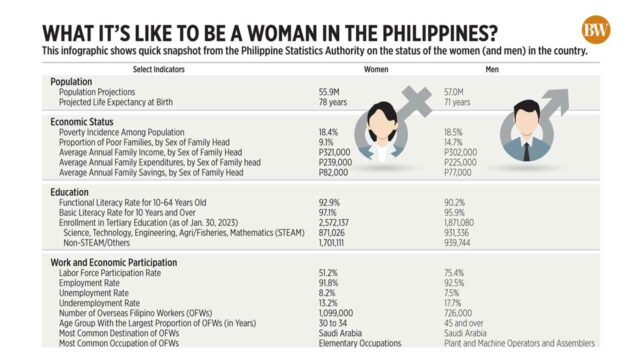
What it’s like to be a woman in the Philippines?

This infographic shows quick snapshot from the Philippine Statistics Authority on the status of the women (and men) in the country.

What it’s like to be a woman in the Philippines?

Peso inches higher vs dollar as bank concerns ease

STOCK PHOTO | Image by iiijaoyingiii from Pixabay

THE PESO edged higher against the dollar on Thursday on easing worries over the global banking sector and amid the smaller month-on-month increase in the National Government’s debt. 

The local unit closed at P54.415 per dollar on Thursday, gaining 3.5 centavos from its P54.45 finish on Wednesday, based on Bankers Association of the Philippines data.

The peso opened Thursday’s session at P54.39 per dollar, which was also its intraday best. Its weakest showing was at P54.495 against the greenback.

Dollars exchanged inched down to $1.009 billion on Thursday from $1.112 billion on Wednesday.

“The peso appreciated amid improving optimism on the global banking sector after the recent US Congress hearing on Silicon Valley Bank’s (SVB) fall,” a trader said in an e-mail.

Officials from the US Federal Reserve and other regulators told US lawmakers on Wednesday that the scope for blame for SVB’s failure stretches across bank executives. 

Michael Barr, Fed Vice Chair for Supervision criticized SVB for going months without a chief risk officer and for how it modeled interest rate risk, Reuters reported. 

The peso strengthened following the release of data showing a smaller month-on-month increase in the government’s outstanding debt, Rizal Commercial Banking Corp. Chief Economist Michael L. Ricafort said in a Viber message.

The National Government’s total debt hit a fresh record-high of P13.75 trillion at the end of February amid the increase in domestic borrowings, the Bureau of the Treasury (BTr) said on Thursday.

Preliminary data from the BTr showed outstanding debt inched up by 0.4% or P54.26 billion from the P13.698 trillion as of end-January “primarily due to the net issuance of domestic securities.”

For Friday, the trader said the peso could strengthen further ahead the release of data showing potentially lower US personal consumption expenditures (PCE) inflation.

Mr. Ricafort said the PCE data could give a clue on the US Federal Reserve’s next policy move.

The trader sees the peso moving between P54.25 and P54.50 on Friday, while Mr. Ricafort gave a slightly wider forecast range of P54.30 to P54.50 per dollar. — K.B. Ta-asan with Reuters

PHL stocks rise on easing banking sector fears

PHILIPPINE STAR/KRIZ JOHN ROSALES

PHILIPPINE STOCKS rose further on Thursday in thin trade amid easing banking fears and positive data.

The Philippine Stock Exchange index (PSEi) rose by 13.78 points or 0.2% to close at 6,644.75 on Thursday, while the broader all shares index went up by 9.07 points or 0.25% to end at 3,538.73.

“Despite trading in sideways, the local bourse managed to gain 13.78 points or 0.2%, closing at 6,644.75, thanks to the continued easing of banking fears. Furthermore, the release of strong economic data domestically helped to ease investors’ concerns and contributed to the market’s positive momentum,” Philstocks Financial, Inc. Research Analyst Claire T. Alviar said.

“BSP (Bangko Sentral ng Pilipinas) Governor Felipe M. Medalla has reassured investors that the local banks remain robust and that the recent monetary tightening measures do not pose any significant risks to the overall financial stability of the Philippines. Additionally, the market was boosted by the news of higher approved investments by the PEZA (Philippine Economic Zone Authority) in the first quarter of 2023 and the strong performance of domestic travel,” Ms. Alviar added.

The PEZA on Wednesday said it approved P12.54 billion worth of investments in January to March from P8.14 billion in the same period last year.

China Bank Securities Corp. Research Director Rastine Mackie D. Mercado said in an e-mail that trading volume remained tepid, “which could indicate continuing investor disinterest.”

Value turnover decreased to P4.03 billion on Thursday with 573.95 million shares changing hands from the P13.01 billion with 2.29 billion issues on Wednesday.

“We also remain wary of possible weakness in the coming days as we expect investors to trim market exposures ahead of the March inflation report (due out next week) and next week’s long weekend,” Mr. Mercado said.

“The market managed to close higher in today’s session as likely driven by: (1) positive sentiment spillover from offshore markets, (2) and improving business optimism according to the BSP’s Business Expectations Survey,” he added.

The majority of sectoral indices closed higher on Thursday, except for property, which went down by 23.54 points or 0.84% to 2,773.63.

Meanwhile, services gained 13.29 points or 0.8% to end at 1,662.60; industrials increased by 63.74 points or 0.67% to 9,556.22; financials rose by 11.50 points or 0.63% to 1,811.82; mining and oil climbed by 50.75 points or 0.46% to 11,021.22; and holding firms went up by 10.06 points or 0.15% to 6,459.79.

Advancers outnumbered decliners, 98 versus 72, while 53 names closed unchanged.

Net foreign buying went down to P557.39 thousand on Thursday from the P2.70 billion seen on Wednesday.

China Bank Securities’ Mr. Mercado put the PSEi’s support at 6,400-6,420 and main resistance at 6,650. — AHH

Danish fund awarded first 100%-foreign RE contracts

REUTERS

By Sheldeen Joy Talavera

DENMARK’s Copenhagen Infrastructure New Markets Fund (CINMF) on Thursday signed agreements to develop three offshore wind sites, becoming the first company to obtain concessions after the renewable energy (RE) industry was opened up to full foreign ownership.

The sites, each covered by a Service Contract, are in Camarines Norte and Camarines Sur, with capacity projected at 1,000 megawatts (MW); Northern Samar (650 MW); and Pangasinan and La Union (350 MW).

Przermek Lupa, associate partner in Copenhagen Infrastructure Partners (CIP), which manages the fund, said the investment involved is $5 billion, with each service contract running for 25 years.

“As the first fully foreign entity to the renewable energy sector in the Philippines, we want to grow with the country. We want to be a catalyst for deploying large volumes of capital in sustainable projects,” Mr. Lupa said at the signing ceremony.

The projects are targeted to be completed within the tenure of President Ferdinand R. Marcos, Jr.

“If we can look at achieving COD (commercial operations date) by 2028, (it) means starting construction a couple of years earlier. That is the goal,” he said.

He said that the company will seek to conduct its dealings with the Department of Energy as a “one-stop shop,” and indicated the need to collaborate with the National Grid Corp. of the Philippines and other stakeholders.

“CIP believes that bold moves, scale, and speed (are critical in mitigating) the impacts of climate change. Of course, we know how the Philippines is particularly vulnerable to the effects of climate change,” he said.

Energy Secretary Raphael P.M. Lotilla said the projects will help accelerate the Philippines’ shift to indigenous and renewable sources of energy.

“These agreements represent an additional strategic investment and a firm commitment to strengthen the renewable energy sector, particularly the development of offshore wind,” he said. 

“They provide a significant contribution towards a low carbon future as well as encourage the development of the local supply chain,” he added.

Danish Ambassador to the Philippines Franz-Michael Melbin said foreign investors “are more comfortable taking 100% control of projects.”

He said that the Philippines’ target capacity of 40 gigawatts will depend on the availability of sites investors are interested in.

Mr. Melbin added that red tape has been a challenge for foreign investors. “Cut the red tape and we can cut the red ribbons,” he said, referring to the ribbon-cutting ceremonies at the launch of projects.

“The government can do a lot more for foreign investment by cutting red tape,” he said.

Niels Holst, a CIP partner and head of the CINMF, was quoted as saying in a statement that the removal of foreign ownership restrictions on renewable energy projects was a “positive signal” for entry of investments.

“We believe the Philippines holds great potential for low-cost power delivery from high-quality renewable energy projects that would deliver local employment and skills,” he said.