
How PSEi member stocks performed — March 22, 2023

Here’s a quick glance at how PSEi stocks fared on Wednesday, March 22, 2023.
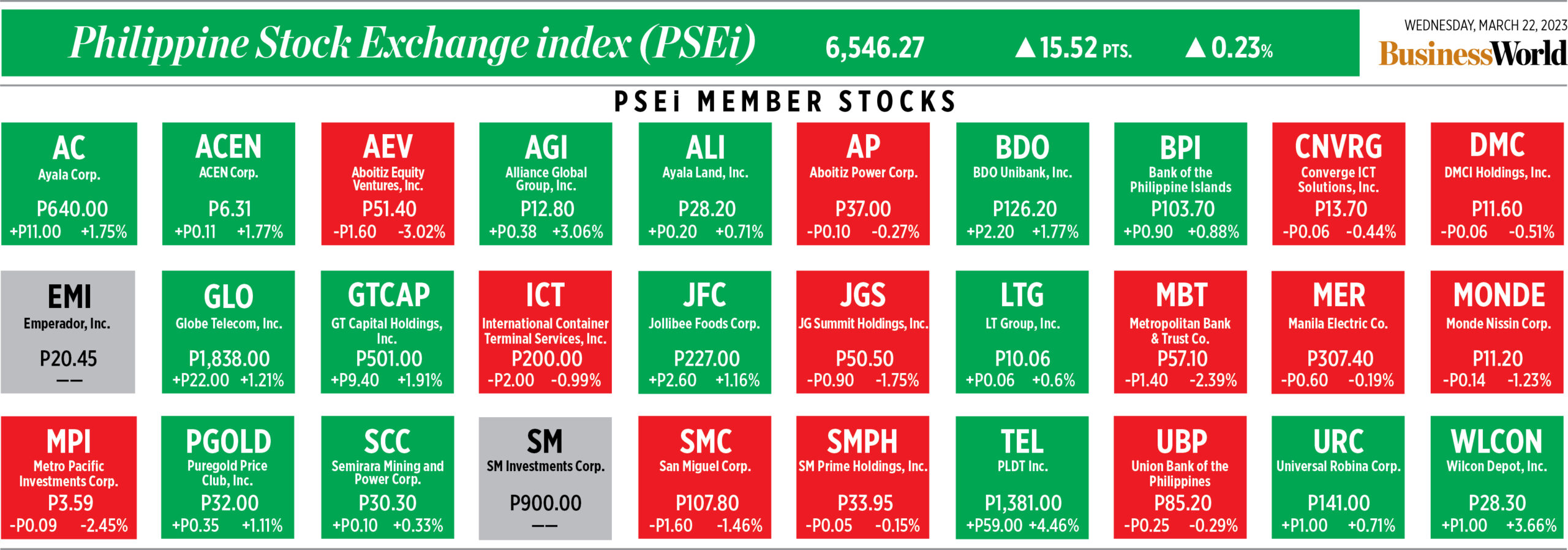

Here’s a quick glance at how PSEi stocks fared on Wednesday, March 22, 2023.
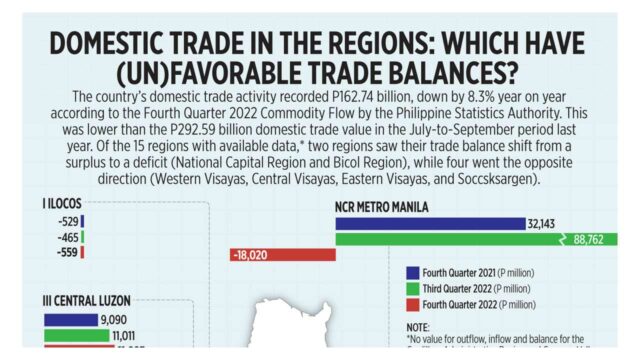
THE domestic trade in goods fell 8.3% year on year by value in the fourth quarter, the Philippine Statistics Authority (PSA) reported on Monday. Read the full story.


STOCKS climbed on Wednesday as investors stayed on the sidelines ahead of the policy decisions of the US Federal Reserve and the Bangko Sentral ng Pilipinas (BSP).
The benchmark Philippine Stock Exchange index (PSEi) went up by 15.52 points or 0.23% to close at 6,546.27 on Wednesday, while the broader all shares index rose by 6.47 points or 0.18% to end at 3,499.97.
“This Wednesday, the local bourse extended its rally… ahead of the respective decision of the Federal Reserve and Bangko Sentral ng Pilipinas on interest rates. Positive sentiment from Wall Street overnight helped to lift the bourse as well,” Philstocks Financial, Inc. Research Analyst Claire T. Alviar said in a Viber message.
“Aside from the interest rate decision, investors also want to know the outlook of the mentioned central banks on the economy, especially amid the banking crisis and the still-elevated inflation rate. Given this, many investors were on the sidelines,” Ms. Alviar added.
Value turnover went down to P4.23 billion on Wednesday with 413.61 million shares changing hands from the P4.78 billion with 545.92 million issues traded on Tuesday.
“Shares… staged a cautious bounce as hopes of a global banking crisis would be averted, while investors remain uncertain over the outlook for US interest rates as the Federal Reserve holds a high stakes meeting on policy,” Globalinks Securities and Stocks, Inc. Head of Sales Trading Toby Allan C. Arce said in a Viber message.
“The still-brittle mood was evident amid fears of financial risk and a flight from bank stocks, which puts the Fed in a tough position as it decides whether to raise interest rates… On the local front, the central bank may consider a smaller 25-basis-point (bp) rate hike or even pause monetary policy tightening at its meeting on Thursday amid heightened global uncertainties,” Mr. Arce said.
The Fed will hold its second policy meeting for the year on March 21-22, while the BSP’s review will be held on March 23.
The US central bank hiked its target interest rate by 25 bps at its Jan. 31 to Feb. 1 meeting to a range between 4.5% and 4.75%. Since March 2022, the Fed has raised rates by a total of 450 bps.
Meanwhile, the BSP last month raised benchmark interest rates by 50 bps for a second straight meeting, bringing its policy rate to 6%. It has hiked borrowing costs by 400 bps since May 2022 as it seeks to bring down elevated inflation.
The majority of sectoral indices closed higher on Wednesday, except for holding firms, which went down by 15.42 points or 0.24% to 6,353.03; and mining and oil, which dropped by 6.14 points or 0.05% to 10,661.01.
Meanwhile, services climbed by 16.99 points or 1.06% to 1,608.98; financials rose by 9.24 points or 0.51% to 1,797.03; industrials increased by 37.56 points or 0.39% to 9,454.73; and property added 7.92 points or 0.28% to close at 2,771.25.
Advancers outnumbered decliners, 98 to 77, while 49 names closed unchanged.
Net foreign selling went down to P9.87 million on Wednesday from P33.74 million on Tuesday. — A.H. Halili

THE PESO weakened against the dollar on Wednesday, with the greenback steadying amid easing worries over the banking sector and ahead of the US Federal Reserve’s policy decision.
The local currency closed at P54.50 versus the dollar on Wednesday, dropping by six centavos from Tuesday’s P54.44 finish, data from the Bankers Association of the Philippines’ website showed.
The peso opened Wednesday’s session stronger at P54.30 per dollar. Its intraday best was at P54.28, while its worst showing was at P54.75 versus the greenback.
Dollars traded climbed to $1.4 billion on Wednesday from the $1.077 billion recorded on Tuesday.
“The peso weakened amid improving market optimism after the US Treasury temporarily considered to expand FDIC (Federal Deposit Insurance Corp.) coverage on all US bank accounts,” a trader said in an e-mail.
US Treasury department staff are studying whether federal regulators have enough emergency authority to insure deposits above the current $250,000 cap on accounts without the consent of Congress, Reuters reported.
One legal framework being looked at for expanding FDIC insurance would use the Treasury department’s authority to take emergency action and lean on the Exchange Stabilization Fund.
The dollar was pinned near five-week lows on Wednesday ahead of the conclusion of the US Federal Reserve’s policy meeting, with investors awaiting clarity on the path the central bank is likely to take in the wake of global banking turmoil.
The US dollar index, which measures the currency against six peers, was at 103.19, just above the five-week low of 102.99 touched overnight.
Investor sentiment remained fragile, with worries over the outlook for the banking sector starting to ease after sharp volatility in the market in the past few weeks following high-profile US banking failures earlier in the month and the rescue of lender Credit Suisse Group AG at the weekend.
The peso fell ahead of the conclusion of the Fed’s policy meeting, with markets expecting a 25-basis-point (bp) rate hike that could be matched by the Bangko Sentral ng Pilipinas (BSP) in its review on Thursday, Rizal Commercial Banking Corp. Chief Economist Michael L. Ricafort said in a Viber message.
The Fed was set to announce its policy decision overnight. The US central bank hiked its target interest rate by 25 bps at its Jan. 31 to Feb. 1 meeting to a range between 4.5% and 4.75%.
Since March 2022, the Fed has raised rates by a total of 450 bps.
For its part, the BSP hiked borrowing costs by 50 bps for a second straight meeting last month, bringing its key rate to 6%.
The Philippine central bank has hiked rates by a total of 400 bps since May 2022.
For Thursday, the trader said the peso could appreciate against the dollar ahead of the BSP’s decision.
The trader and Mr. Ricafort expect the peso to move between P54.40 and P54.60 against the dollar on Thursday. — A.M.C. Sy with Reuters

PRESIDENT Ferdinand R. Marcos, Jr. called on Wednesday for a review of a 2021 executive order (EO) farming out National Government (NG) functions to local government units (LGUs), saying his government will not be bound by a timetable that proposes to complete the transfers by 2024.
“We have to re-examine Executive Order 138 of President (Rodrigo R.) Duterte. We are looking at it… to make it fair,” he told reporters on the sidelines of a Philippine Army event, noting that some poorer municipalities are not capable to taking over NG functions that require project planning and expertise.
Citing a Tuesday meeting with local officials as well as Cabinet secretaries, Mr. Marcos said the participants decided against a one-size-fits-all approach to the devolution program.
He said poorer municipalities would be at a disadvantage because of their low absorptive capacity for taking on NG functions.
LGUs are classified as highly-urbanized cities and provinces on the high end of the revenue-generating scale, and 5th and 6th class municipalities on the low end.
The President said that for the moment, functions that “require planning on a national scale” should be left to the NG.
He said the administration is also looking to pass a law seeking to revamp the LGU classification system.
Last year, the House Committee on Local Government, then chaired by former Valenzuela Rep. and now Social Welfare Secretary Rexlon T. Gatchalian, approved a bill governing the income classifications of provinces, cities and municipalities.
At the time, Mr. Gatchalian proposed that reclassification takes place every two years to “accurately capture the economic activities in the LGUs.”
Mr. Marcos on Tuesday ordered government agencies to study EO 138 for possible amendment, and to determine what NG functions should be devolved to LGUs in a manner that complies with a 2018 Supreme Court ruling.
The Mandanas ruling had awarded LGUs a larger share of NG revenue. In response, the Duterte administration sought to shed NG functions commensurate with the LGUs’ newfound spending power.
The EO had given LGUs until 2024 to fully assume some NG functions.
The mechanism in the Mandanas ruling for expanding LGU revenue was the Supreme Court’s interpretation of the Local Government Code (Republic Act 7160), which had originally granted LGUs a 40% share of NG “internal revenue” in an annual payment then known as the “Internal Revenue Allotment (IRA).”
Over the years, the NG had interpreted this clause to mean 40% of Bureau of Internal Revenue (BIR) collections, and paid out the IRA accordingly, based on BIR collections from three years prior.
The Supreme Court declared this interpretation unconstitutional, ordered that annual payment to LGUs be based on 40% of all national taxes, changed the name of the IRA to the National Tax Allocation, and amended the Local Government Code accordingly.
Mr. Marcos also described EO No. 138, which grants more responsibility and autonomy to LGUs, as no substitute for the Charter change measures being considered by Congress.
“The Charter change efforts are directed at the economic provisions of the Constitution, as far as I understand. And so that’s what that is about,” he said.
“And the reason given by the proponents in the House and those in the Senate is that they need to be changed because the conditions have changed,” he added. “And for us to take full advantage of the new economy, we have to amend the Constitution. So that’s not the same thing.” — Kyle Aristophere T. Atienza
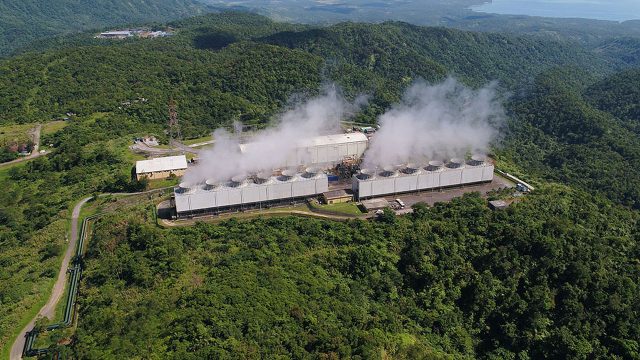
THE Department of Energy (DoE) said it has selected 19 sites to be offered this year for the fourth round of the open and competitive selection process (OCSP-4).
Energy Undersecretary Rowena Cristina L. Guevara said at an energy forum that some of these sites will be suitable for geothermal, hydropower, and wind projects.
“We will host a public consultation on OCSP-4, publish the Department Circular in May, undertake the bidding process from June to August and have the contracts awarded in September,” Ms. Guevara said during the Philippine Electric Power Industry Forum 2023.
For geothermal, the DoE has identified three sites with potential capacity of about 160 megawatts (MW).
The first site, with potential output of 100 MW, straddles the municipalities of Buguias, Benguet and Tinoc, Ifugao. A second site with potential output of 40 MW is in Mabini, Batangas. The third site with potential output of 20 MW straddles Pililla and Jala-Jala, Rizal, and Pangil and Pakil, Laguna.
For hydropower, the DoE has identified 13 predetermined areas at 86.25 MW. It identified three sites for wind but it did not disclose the target potential capacity.
The proposed hydropower sites are in Tinoc, Ifugao (5 MW); Alilem, Ilocos Sur (16.2 MW); San Remigio, Antique (4.2 MW); Libacao, Aklan (15 MW); Badian, Cebu (0.5 MW); two sites in Malaybalay, Bukidnon (4.5 and 5.65 MW); Dingalan, Aurora (1.0 MW); Surigao del Sur (16.3 MW); Digos City, Davao del Sur (4.0 MW); Manabo, Abra (7 MW); Naujan, Oriental, Mindoro (3.3 MW); and Calamba, Misamis Occidental (3.6 MW).
The proposed wind sites are in San Jose City, Nueva Ecija; Pantabangan, Nueva, Ecija; and Bagac, Bataan.
Separately, Ms. Guevara said that to date, the Department of Energy has awarded a total of 57 offshore wind energy service contracts with potential capacity of 42.22 gigawatts.
The DoE is projecting 11,160 MW worth of renewable energy available in the next few years through its green energy auction program. — Ashley Erika O. Jose

By Brontë H. Lacsamana, Reporter
RESORTS and marine parks along the Verde Island Passage, an area of rich biodiversity between Luzon and Mindoro, could see the long-term damage from the oil spill to their southeast, marine experts said.
The oil spill, caused by the loss of the tanker Princess Empress in February off Naujan, Oriental Mindoro, has reached Verde Island, which is to the northwest of the tanker’s underwater resting place.
The 1.4-million hectare strait between Batangas and Mindoro has been placed under continuous watch by the Philippine Coast Guard (PCG), according to Mary dela Cruz, manager of the Surface Interval Resort in San Agapito, which in the southeast of Verde Island.
“So far we’re not affected by the oil spill but the PCG has been roaming the area every day,” she told BusinessWorld. “If the waves aren’t big, people can still swim.”
The three barangays being monitored in Verde Island are San Antonio, San Agustin, and San Agapito, after traces of the spill were found there early Monday, according to PCG spokesperson Armand Balilo. The cleanup effort removed 230 liters of oil-contaminated material on the beaches of the three barangays that day.
The oil spill response team put up booms in those waters, with the spill reported to be receding as of late Monday, according to aerial surveillance reports.
On Tuesday, the authorities located the tanker using a remotely operated vehicle from Japan. It captured underwater images at nearly 400 meters’ depth off Balingawan Point, Naujan.
The vessel was reported to be carrying 800,000 liters of industrial oil to Iloilo.
“We’ve had 10 major oil spills since early 2000s but still, as you can see, there’s not enough infrastructure. We should have a national oil spill response but even LGUs are left in the dark on how to deal with oil spills,” Oceana Philippines senior campaign manager Daniel Ocampo told One News PH on Tuesday.
He cited the need to shield the area’s marine protected areas from the effects of the spill.
He added that the four-month cleanup period estimated by the President may not be enough to stem the long-term effects of the spill on livelihoods, displaced communities, and marine life.
The University of the Philippines Marine Science Institute (MSI) warned in a forum on Sunday that the Verde Island Passage, Puerto Galera, and coastal towns in Batangas may be affected by the spill depending on the direction of the winds.
“The Amihan winds, which confined most of the oil to the coasts of Naujan and (the neighboring town of) Pola in previous weeks, are now more variable, allowing the oil to spread northwards,” according to an advisory issued by the MSI.
If the oil seeping from the hull of the vessel is not contained before Amihan season ends, the MSI said, more critical biodiversity areas along the passage may be affected.
The Amihan is a northeast wind that runs until May or June. It gives way to the Habagat or southwest monsoon.

PHILIPPINE TRADE with the rest of Asia is expected to triple by 2030 to $393 billion, logistics company UPS Philippines said.
Citing the results of a company study, UPS said expanded Philippine trade with 11 other Asian countries that it services will be driven by efforts to develop more domestic manufacturing.
“There are also significant opportunities for Filipino businesses in areas such as digitalization, building supply chain resilience and multilateral cooperation in international trade,” UPS said.
UPS said that retail, industrial manufacturing and automotive (IM&A), tech, and healthcare accounted for 75% of the Philippine’s intra-Asia trade in 2020, and is assuming the same segments will fuel growth until 2030.
In its study, UPS said that the IM&A segment will be the largest in value in 2030 as the country aims to be a global and a regional hub for automotive and electronics sectors.
It said tech could more than double in value by 2030, driven by significant demand for digitalization across Asia.
“Philippine-based businesses can plan for both headwinds and opportunities by diversifying supply chains into resilient trade routes and targeting high-value and high-growth trade routes, such as IM&A, healthcare, and retail trade with economies like Japan, as well in the high-tech segment with Hong Kong and Vietnam,” UPS said.
UPS said, however, that despite the positive outlook, barriers remain that could dampen trade growth within the 12 Asian countries.
“Filipino businesses surveyed indicated tariffs and other punitive measures as the top barrier, followed by shortages of labor and skills in the logistics industry, and lack of harmonization of standards,” UPS said.
It added that the Philippine logistics network needs to digitalize as it still relies on costly and time-consuming paper-based processes.
“While the COVID-19 (coronavirus disease 2019) pandemic has accelerated adoption of digital technologies within the Philippines, adoption of digital payments and digital supply chain tools have fallen behind,” it said. — Justine Irish D. Tabile

A LEGISLATOR representing power cooperatives asked the Energy Regulatory Commission (ERC) on Wednesday to review its value-added tax (VAT) policy governing system losses, disputing this item’s classification as a good or service subject to VAT.
At a House ways and means committee hearing, Association of Philippine Electric Cooperatives Party-list Representative Sergio C. Dagooc questioned the VAT on the two charges.
According to a breakdown of distribution charges presented by the ERC, the system loss charge rate is P0.4509.
System loss refers to the difference between the energy delivered to the distribution system and the energy delivered to end-users and other entities connected to the system.
“How will it fall under the definition of services and goods? Are losses considered goods and services? It (is) considered a loss, why is a VAT still imposed?” Mr. Dagooc said.
Leila O. Cilio, ERC chief energy regulation officer with the agency’s Investigation and Enforcement Division for Generation Companies, told the panel that system loss charges qualify for VAT because they form part of gross receipts.
Mr. Dagooc also questioned whether consumers should subsidize “lifeline rates” charged to marginalized power consumers.
Manila Electric Co. Vice-President and Head of Utility Economics Lawrence S. Fernandez told the committee that power users who consume 20 kilowatt-hours (kWh) or less receive a 100% discount on their electricity rates.
Under the Implementing Rules and Regulations of Republic Act No. 11552 or “An Act Extending and Enhancing the Implementation of the Lifeline Rate, Amending for the Purpose Section 73 of Republic Act No. 9136 (Electric Power Industry Reform Act of 2021),” poor Filipino families or those who consume less than 100 kWh qualify for such aid on their monthly electricity bill.
Ms. Cilio said “non-lifeliners,” or those who consume 101 kWh or more, subsidize the lifeline. VAT is also imposed on lifeline rates.
“I should be the government who will subsidize that,” Mr. Dagooc said. “(We are already) soliciting from consumers, but we still apply VAT on their subsidy.”
Energy Undersecretary Sharon S. Garin told the committee, “We want the electricity cost to be lower, but we do not want the revenue impact to cripple government services.” — Beatriz Marie D. Cruz

THE House of Representatives passed a resolution to renew a travel tax exemption for passengers departing from Mindanao and Palawan headed for any destination within the special economic group encompassing Brunei Darussalam and parts of Indonesia, Malaysia, and the Philippines.
Lawmakers late Tuesday adopted House Resolution No. 454, which seeks to extend by five years the tax exemption that is set to expire in May.
The government collects travel tax, ranging from P400 to P2,700, from Filipinos and resident aliens for foreign travel, except overseas workers, Filipino permanent residents overseas, and children below two years old.
The travel tax exemption will promote tourism and trade activity in Mindanao and Palawan, the parts of the Philippines which lie within the BIMP-EAGA sub-region, according to the resolution.
The exemption has also “produced economic benefits in terms of increased business activities, remarkable growth in tourism development, additional and sea services in the transportation sector, and heightened sociocultural ties among people in the growth area,” Association of Southeast Asian Nations (ASEAN) Growth Area special committee and Sultan Kudarat Rep. Princess Rihan M. Sakularan said in the resolution.
In 2018, former President Rodrigo R. Duterte issued Memorandum Order No. 23 granting the tax exemption.
BIMP-EAGA — or the Brunei Darussalam, Indonesia, Malaysia, Philippines-East ASEAN Growth Area — includes Brunei; the provinces of Kalimantan, Sulawesi, Maluku, and West Papua, Indonesia; the states of Sabah and Sarawak and the federal territory of Labuan, Malaysia; as well as Mindanao and Palawan. — Beatriz Marie D. Cruz
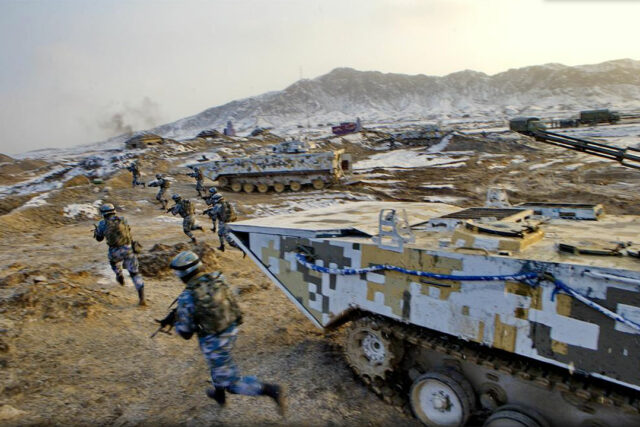
THE Philippine Chamber of Agriculture and Food, Inc. (PCAFI) on Wednesday urged the government to stockpile food in the event of supply chain disruptions if China ever makes good on its long-running threat to invade Taiwan.
PCAFI President Danilo V. Fausto said the resulting embargoes or blockades are likely to disrupt commercial shipping and in turn the delivery of agricultural goods.
“What we are expecting here is a commercial shipping blockade or possible trade embargo, he said, noting that the US may retaliate by intercepting shipping at the Strait of Malacca, through which much China’s trade passes,” Mr. Fausto said in a forum.
“We have to expect the worst and be self-sufficient,” he said.
Mr. Fausto called on the government to subsidize farm inputs while maintaining reserves of grain and other staples.
“At the moment, because this is immediate, we are recommending that those vacant warehouses at (National Food Authority) compounds all over the country, be utilized for buffer stocking,” he said.
Meanwhile, Alberto D. Lina, founding chairman of logistics company Air21 and former customs commissioner, said the gaps in the food supply chain include cold storage faculties, silos, driers, and mills.
Addressing these gaps will involve the creation of cooperatives to consolidate farmers’ purchasing power, marketing, and distribution capacity, he said.
Mr. Fausto said a Taiwan crisis is only “a matter of time.”
“The Philippines will have to be prepared. We have to prepare our people for possible shortages of food; therefore, we have to increase productivity and (build up) buffers for food security,” he added. — Sheldeen Joy Talavera
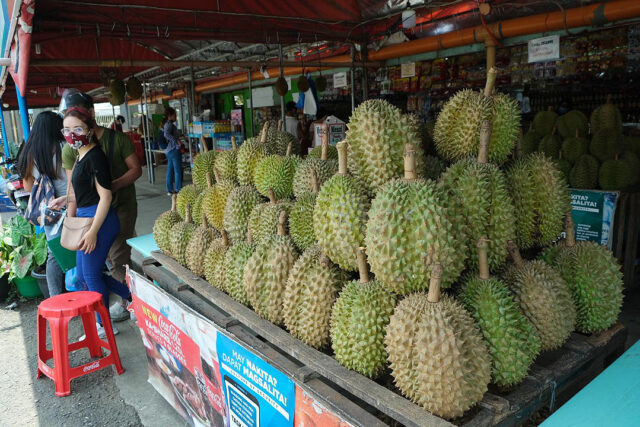
DURIAN has the potential to become a top-five food export for the Philippines, growers said, as the industry undertakes preparations to supply the China trade.
Emmanuel Belviz, president of the Durian Industry Association of Davao City, said that the group is working with the Department of Agriculture (DA) in laying the groundwork for the China export trade, including the preparation of documents and safety protocols.
“I think the Philippines has huge potential in the export market, especially with our Puyat and Duyaya varieties,” he said.
He added that durian could be “one of the country’s top export products in the next five years.”
The Philippines and China sealed an agreement for the export to the mainland of at least 54,000 metric tons of fresh durian, according to the DA.
Mr. Belviz said that the DA should provide more training for farmers to learn how to produce globally competitive durian fruit.
“We need to produce better durian fruit and (improve) food safety, as there are many certifications needed. I hope the association, together with the DA, can help farmers reach that market,” he said.
John Tan, chief executive officer of Eng Seng Food Products, said his company has a target to export 300-500 container vans of durian of the Puyat, Duyaya, and D101 varieties.
According to the DA, its regional field office in Davao is working on a five-year development plan aiming to strengthen technical support, provide inputs such as fertilizer, pesticide, and post-harvest facilities.
Federation of Free Farmers National Manager Raul Q. Montemayor said much needs to be done to improve the durian industry’s competitiveness.
“A lot of things have to be done from production to marketing. We also face competition from Thailand, Vietnam, maybe Indonesia and Malaysia, too. Can we compete? They are ahead of us,” he told BusinessWorld in a Viber message.
He said the Philippines needs to study the long-term prospects for the durian market and prepare for adverse conditions like a possible glut.
The current annual harvest volume of durian is about 75,000 tons, suggesting that the export target could take more than two-thirds of the crop out of the domestic market, he said.
According to Mr. Montemayor, the farmgate price of durian in Davao was P60 per kilo. It retails for about P90 per kilo.
He warned of scenarios like more expensive durian or the reservation of the best-quality durian for the China market.
The farmgate price is expected to fall to P20-P25 per kilo at the peak of the harvest season starting July. — Sheldeen Joy Talavera
